
Penny Dreadfuls, 1865 · page 110 of 204
Rose Mortimer; Or, The Ballet-Girl's Revenge — page 110: what you’re looking at
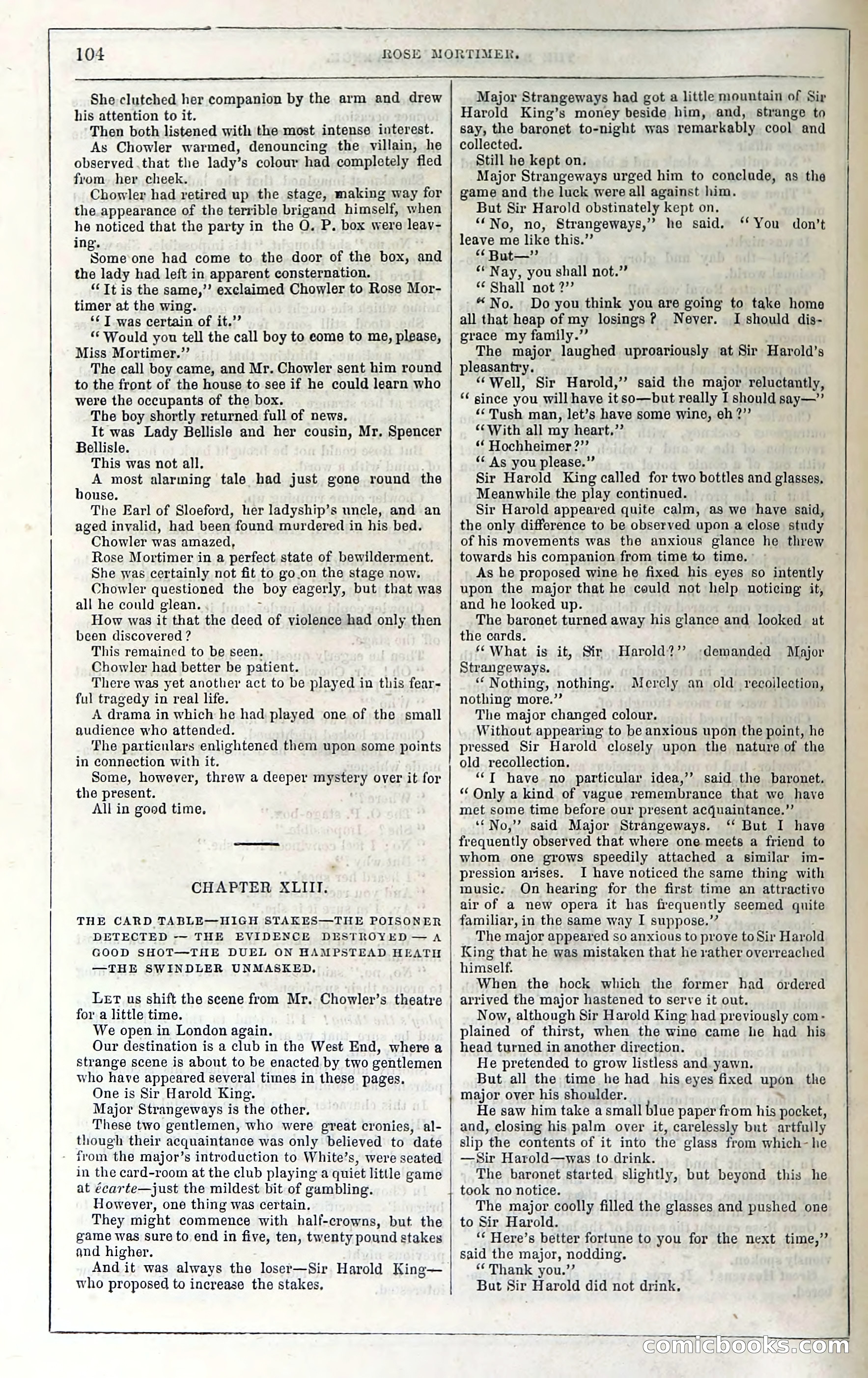
A restored page from Penny Dreadfuls, 1865. Page through the whole issue in the reader above.
📄 Transcribed text from this page (OCR, searchable)
Machine-transcribed from the original scan — historical spelling and the odd misread are preserved.
—- -— 104 She clutched her companion by the arm and drew his attention to it. Then both listened with the most intense interest. As Chowler warmed, denouncing the villain, he observed that the lady’s colour had completely fled from her cheek. Chowler had retired up the stage, making way for the appearance of the terrible brigand himself, when he noticed that the party in the O. P. box were leay- ing. Someone had come to the door of the box, and the lady had left in apparent consternation. “It is the same,”’ exclaimed Chowler to Rose Mor- timer at the wing. ‘¢ T was certain of it.” ‘‘ Would yon tell the call boy to eome to me, please, Miss Mortimer.”’ The call boy came, and Mr. Chowler sent him round to the front of the house to see if he could learn who were the occupants of the box. The boy shortly returned full of news, It was Lady Bellisle and her cousin, Mr. Spencer Bellisle. This was not all. A most alarming tale had just gone round the house. The Earl of Sloeford, her ladyship’s uncle, and an aged invalid, had been found murdered in his bed. Chowler was amazed, Rose Mortimer in a perfect state of bewilderment. She was certainly not fit to go.on the stage now, Chowler questioned the boy eagerly, but that was all he could glean. How was it that the deed of violence had only then been discovered ? This remained to be seen. Chowler had better be patient. There was yet another act to be played in this fear- ful tragedy in real life. A drama in which he had played one of the small audience who attended. The particulars enlightened them upon some points in connection with it. Some, however, threw a deeper TASERETY over it for the present. All in good time. CHAPTER XLIII. THE CARD TABLE—HIGH STAKES—THE POISONER DETECTED -—- THE EVIDENCE DESTROYED —aA GOOD SHOT—THE DUEL ON HAMPSTEAD HEATH —THE SWINDLER UNMASKED, LET us shift the scene from Mr. Chowler’s theatre for a little time. We open in London again. Our destination is a club in the West End, where a strange scene is about to be enacted by two gentlemen who have appeared several times in these pages. One is Sir Harold King. Major Strangeways is the other. These two gentlemen, who were great cronies, al- though their acquaintance was only believed to ‘date - from the major’s introduction to White’s, were seated in the card-room at the club playing a quiet litle game at écarte—just the mildest bit of gambling. However, one thing was certain. They might commence with half-crowns, but the game was sure to end in five, ten, twenty pound stakes and higher. And it was always the loser—Sir Harold King— who proposed to increase the stakes, ROSE MORTIMER, -_——_-— Major Strangeways had got a little mountain of Sir Harold King’s money beside him, and, strange to say, the baronet to-night was remarkably cool and collected. Still he kept on. Major Strangeways urged him to conclude, as the game and the luck were all against him. But Sir Harold obstinately kept on. ‘‘No, no, Strangeways,” he said. leave me like this.” ce But—2 ‘* Nay, you shall not.” ‘¢ Shall not ?” “No. Do you think you are going to take home all that heap of my losings ? Neyer. I should dis- grace my family.” The major laughed uproariously at Sir Harold’s pleasantry. ‘Well, Sir Harold,’’ said the major reluctantly, *‘ since you will have itso—but really I should say—”’ ‘Tush man, let’s have some wine, eh ?” ‘With all my heart,” “ Hochheimer ?”’ “* As you please.” Sir Harold King called for two bottles and glasses, Meanwhile the play continued. Sir Harold appeared quite calm, as we haye said, the only difference to be observed upon a close study of his movements was the anxious glance he threw towards his companion from time to time. - As he proposed wine he fixed his eyes so intently upon the major that he could not help noticing it, and he looked up. The baronet turned away his glance and looked ut the cards. ‘What is it, Sir Harold?” Strangeways. ‘“‘ Nothing, nothing. nothing more.” The major changed colour, Without appearing to be anxious upon the point, he pressed Sir Harold closely upon the nature of the old recollection. “‘T have no particular idea,’”’ said the baronet. * Only a kind of vague remembrance that we have met some time before our present acquaintance.”’ ‘‘No,”’ said Major Strangeways. ‘ But I have frequently observed that where one meets a friend to whom one grows speedily attached a similar im- pression arises. I have noticed the same thing with music. On hearing for the first time an attractivo air of a new opera it has frequently seemed quite familiar, in the same way I suppose. m! The major appeared so anxious to prove to Sir Har old King that he was mistaken that he rather overreached himself, When the hock which the former had ordered arrived the major hastened to serve it out. Now, although Sir Harold King had previously com - plained of thirst, when the wine came he had his head turned in another direction. He pretended to grow listless and yawn. But all the time he had his eyes fixed npn the major over his shoulder. He saw him take a small blue paper from his pocket, and, closing his palm over it, carelessly but artfully slip ‘the contents of it into the glass from which-he —Sir Harold—was to drink. The baronet started. slightly, but beyond this he took no notice. The major coolly filled the glasses and pushed one to Sir Harold. “* Here’s better fortune to you for the next time,” said the major, nodding. ‘Thank you.’ But Sir Harold did not drink. “You don’t ‘demanded Major Mercly an old recollection, 4 OOKS CONMUC (CO)