
Penny Dreadfuls, 1865 · page 69 of 204
Rose Mortimer; Or, The Ballet-Girl's Revenge — page 69: what you’re looking at
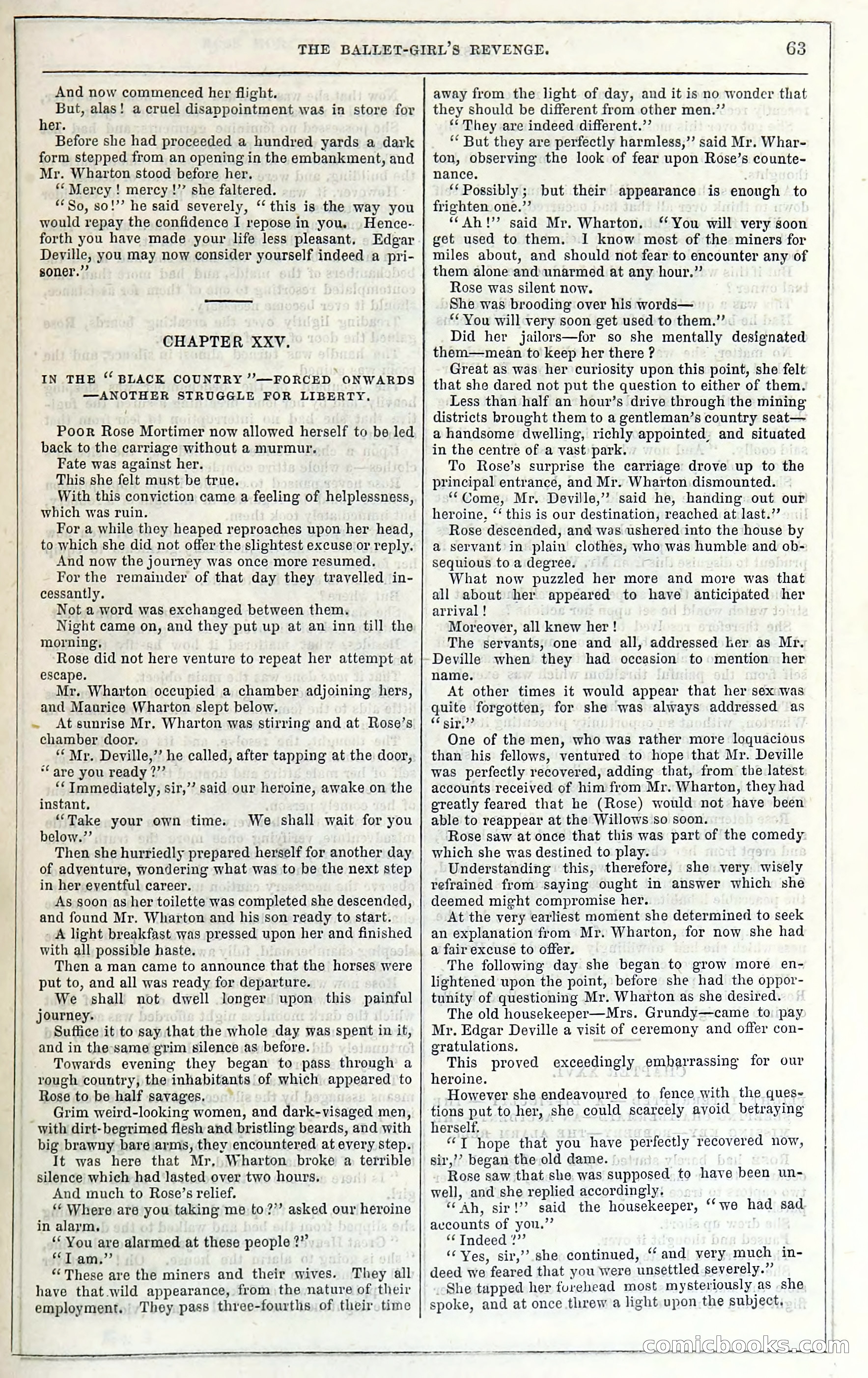
A restored page from Penny Dreadfuls, 1865. Page through the whole issue in the reader above.
📄 Transcribed text from this page (OCR, searchable)
Machine-transcribed from the original scan — historical spelling and the odd misread are preserved.
rn nnn enennnneEnnnnEEEnEEEEEEER THE BALLET-GIRL’S REVENGE. 63 And now commenced her flight. But, alas! a cruel disappointment was in store for her. Before she had proceeded a hundred yards a dark form stepped from an opening in the embankment, and Mr. Wharton stood before her. *“ Mercy ! mercy !”’ she faltered. “So, so!’’ he said severely, “this is the way you would repay the confidence I repose in you. Hence-- forth you have made your life less pleasant, Edgar Deville, you may now consider yourself indeed a pri- soner.”’ CHAPTER XXV. IN THE “ BLACK COUNTRY ’—FORCED ONWARDS —ANOTHER STRUGGLE FOR LIBERTY. Poor Rose Mortimer now allowed herself to be led back to the carriage without a murmur. Fate was against her. This she felt must be true. With this conviction came a feeling of helplessness, which was ruin. For a while they heaped reproaches upon her head, to which she did not offer the slightest excuse or reply. And now the journey was once more resumed. For the remainder of that day they travelled in- cessantly. Not a word was exchanged between them. Night came on, and they put up at an inn till the morning, Rose did not here venture to repeat her attempt at escape. Mr. Wharton occupied a chamber adjoining hers, and Maurice Wharton slept below. . Atsunrise Mr, Wharton was stirring and at Rose’s chamber door. ‘Mr. Deville,’’ he called, after tapping at the door, “are you ready 2” ‘‘ Immediately, sir,’”’ said our heroine, awake on the instant. “Take your own time. below.”’ Then she hurriedly prepared herself for another day of adventure, wondering what was to be the next step in her eyentful career. As soon as her toilette was completed she descended, and found Mr. Wharton and his son ready to start. _ A light breakfast was pressed upon her and finished with all possible haste. Then a man came to announce that the horses were put to, and all was ready for departure. We shall not dwell longer upon this painful journey. Suffice it to say that the whole day was spent in it, and in the same grim silence as before. Towards evening they began to pass through a rough country, the inhabitants of which appeared to Rose to be half savages. Grim weird-looking women, and dark-visaged men, with dirt-begrimed flesh and bristling beards, and with big brawny bare arms, they encountered at every step. It was here that Mr, Wharton broke a terrible silence which had lasted over two hours, And much to Rose’s relief. *‘ Where are you taking me to?” asked our heroine in alarm, ‘“‘ You are alarmed at these people 2” ce I am.” “These are the miners and their wives. They all have that wild appearance, from the nature of their employment. ‘They pass three-fourths of their time We shall wait for you — away from the light of day, and it is no wonder that they should be different from other men.’’ ‘*They are indeed different.’’ ** But they are perfectly harmless,’’ said Mr. Whar- ton, observing the look of fear upon Rose’s counte- nance. ‘*Possibly ; but their appearance is enough to frighten one.’’ “Ah!” said Mr. Wharton. ‘You will very soon get used to them. I know most of the miners for miles about, and should not fear to encounter any of them alone and unarmed at any hour.” Rose was silent now. She was brooding over his words— ** You will very soon get used to them.” Did her jailors—for so she mentally designated them—mean to keep her there ? Great as was her curiosity upon this point, she felt that she dared not put the question to either of them. Less than half an hour’s drive through the mining districts brought them to a gentleman’s country seat— a handsome dwelling, richly appointed. and situated in the centre of a vast park. To Rose’s surprise the carriage drove up to the principal entrance, and Mr. Wharton dismounted. ‘*Come, Mr. Deville,’? said he, handing: out our heroine, ‘‘ this is our destination, reached at last.’’ Rose descended, and was ushered into the house by a servant in plain clothes, who was humble and ob- sequious to a degree. What now puzzled her more and more was that all about her appeared to have anticipated her arrival ! Moreover, all knew her ! The servants, one and all, addressed her as Mr. Deville when they had occasion to mention her name. At other times it would appear that her sex was quite forgotten, for she was always addressed as cé sir.’? One of the men, who was rather more loquacious than his fellows, ventured to hope that Mr. Deville was perfectly recovered, adding that, from the latest accounts received of him from Mr. Wharton, they had ereatly feared that he (Rose) would not have been able to reappear at the Willows so soon. Rose saw at once that this was part of the comedy which she was destined to play. Understanding this, therefore, she very wisely refrained from saying ought in answer which she deemed might compromise her. At the very earliest moment she determined to seek an explanation from Mr. Wharton, for now she had a fair excuse to offer. The following day she began to grow more en- lightened upon the point, before she had the oppor- tunity of questioning Mr. Wharton as she desired. The old housekeeper—Mrs. Grundy—came to pay Mr. Edgar Deville a visit of ceremony and offer con- gratulations, This proved exceedingly embarrassing for our heroine. However she endeavoured to fence with the ques tions put to her, she could scarcely ayoid betraying herself. “T hope that you have perfectly recovered now, sir,’’? began the old dame. Rose saw that she was supposed to have been un- well, and she replied accordingly. ‘Ah, sir!’? said the housekeeper, “we had sad accounts of you.”’ ) ‘¢ Indeed?’ ; ‘Yes, sir,’’ she continued, “ and very much in- deed we feared that you were unsettled severely.” She tapped her furehead most mysteriously as she spoke, and at once threw a light upon the subject, Ccommcaoalk