
Penny Dreadfuls, 1865 · page 41 of 204
Rose Mortimer; Or, The Ballet-Girl's Revenge — page 41: what you’re looking at
A restored page from Penny Dreadfuls, 1865. Page through the whole issue in the reader above.
📄 Transcribed text from this page (OCR, searchable)
Machine-transcribed from the original scan — historical spelling and the odd misread are preserved.
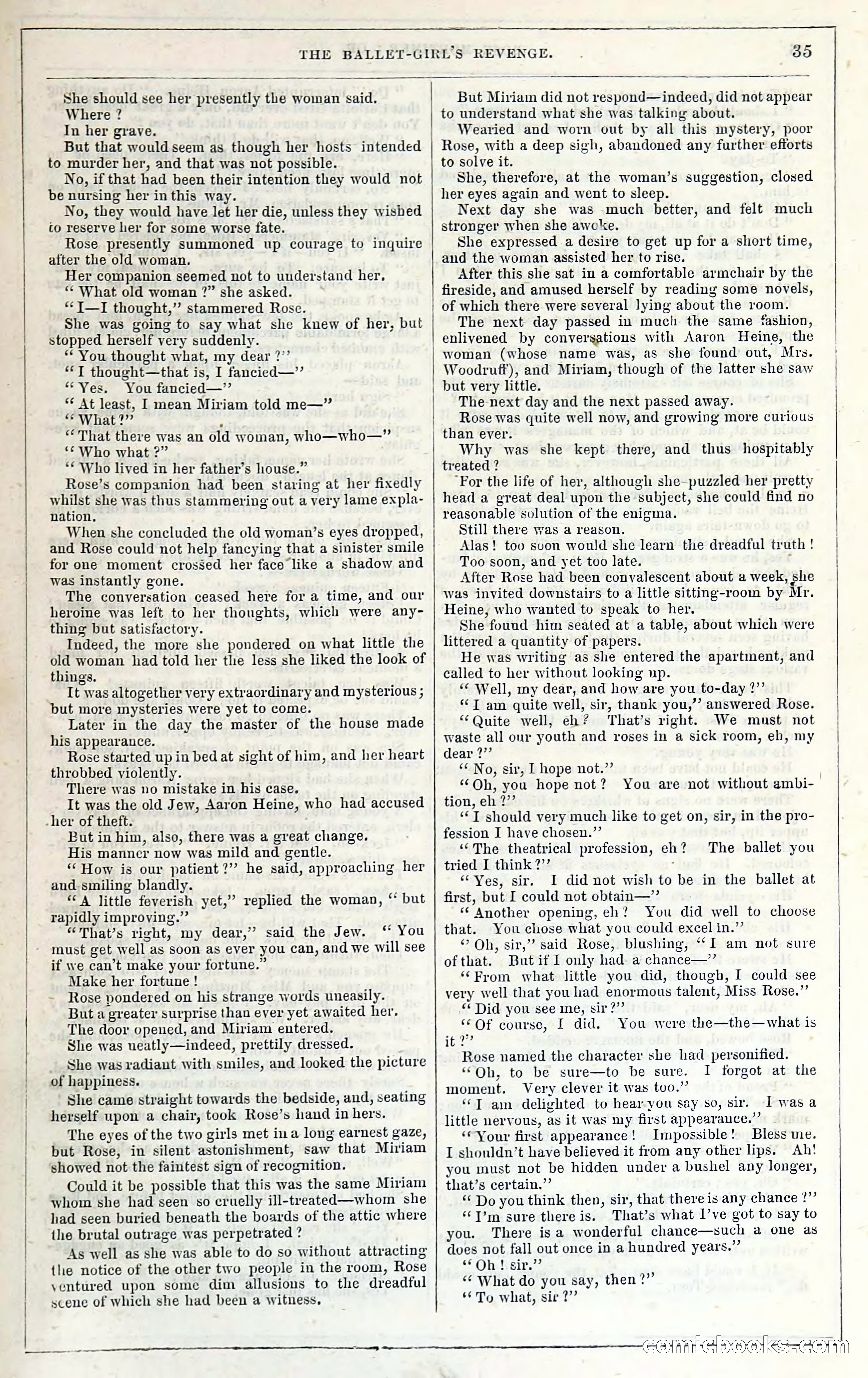
THE BALLET-GIRL'S REVENGE. She should see her presently the woman said. Where ? In her grave. But that would seem as though her hosts intended to murder her, and that was not possible. No, if that had been their intention they would not be nursing her inthis way. No, they would have let her die, unless they wished co reserve her for some worse fate. Rose presently summoned up courage to inquire after the old woman. Her companion seemed not to understand her, “* What old woman 2” she asked. *“I—I thought,” stammered Rose. She was going to say what she knew of her, but stopped herself very suddenly. ** You thought what, my dear ?”’ ““T thought—that is, I fancied—’’ “Yes. You fancied—’’ *¢ At least, I mean Miriam told me—” ““ What?” ; “That there was an old woman, who—who—”’ *¢ Who what ?” ** Who lived in her father’s house.” Rose’s companion had been staring at her fixedly whilst she was thus stammering out a very lame expla- nation. When she concluded the old woman’s eyes dropped, and Rose could not help fancying that a sinister smile for one moment crossed her face like a shadow and was instantly gone. The conversation ceased here for a time, and our heroine was left to her thoughts, which were any- thing but satisfactory. Indeed, the more she pondered on what little the old woman had told her the less she liked the look of things. It was altogether very extraordinary and mysterious ; but more mysteries were yet to come. Later in the day the master of the house made his appearance. Rose started up in bed at sight of him, and her heart throbbed violently. There was no mistake in his case. It was the old Jew, Aaron Heine, who had accused -her of theft. But in him, also, there was a great change. His manner now was mild and gentle. “How is our patient?” he said, approaching her aud smiling blandly. ‘A little feverish yet,’ replied the woman, ‘ but rapidly improving.” «“That’s right, my dear,” said the Jew. “ You must get well as soon as ever you can, and we will see if we can’t make your fortune.” Make her fortune! Rose pondered on his strange words uneasily. But a greater surprise than ever yet awaited her. The door opened, and Miriam entered. She was ueatly—indeed, prettily dressed. She was radiant with smiles, and looked the picture of happiness. She came straight towards the bedside, and, seating herself upon a chair, took Rose’s hand in hers. The eyes of the two girls met ina long earnest gaze, but Rose, in silent astonishment, saw that Miriam showed not the faintest sign of recognition. Could it be possible that this was the same Miriam whom she had seen so cruelly ill-treated—whom she had seen buried beneath the boards of the attic where the brutal outrage was perpetrated ? As well as she was able to do so without attracting {lie notice of the other two people in the room, Rose ventured upon some dim allusions to the dreadful scene of which she had been a witness, ee oe 30 But Miriam did not respond—indeed, did not appear to understand what she was talking about. Wearied and worn out by all this mystery, poor Rose, with a deep sigh, abandoned any further efforts to solve it. She, therefore, at the woman’s suggestion, closed her eyes again and went to sleep. Next day she was much better, and felt much stronger when she awoke. She expressed a desire to get up fora short time, aud the woman assisted her to rise. After this she sat in a comfortable armchair by the fireside, and amused herself by reading some novels, of which there were several lying about the room. The next day passed in much the same fashion, enlivened by conversations with Aaron Heine, the woman (whose name was, as she found out, Mrs. Woodruff), and Miriam, though of the latter she saw but very little. The next day and the next passed away. Rose was quite well now, and growing more curious than ever. Why was she kept there, and thus hospitably treated ? ‘For the life of her, although she-puzzled her pretty head a great deal upon the subject, she could find no reasonable solution of the enigma. Still there was a reason. Alas! too soon would she learn the dreadful truth ! Too soon, and yet too late. ; After Rose had been convalescent about a week, she was invited downstairs to a little sitting-room by Mr. Heine, who wanted to speak to her. She found him seated at a table, about which were littered a quantity of papers. He was writing as she entered the apartment, and called to her without looking up. ‘© Well, my dear, and how are you to-day ?”’ “T am quite well, sir, thank you,’’ answered Rose. “Quite well, eh? That’s right. We must not waste all our youth and roses in a sick room, eh, my dear ?”’ ‘ No, sir, I hope not.” ‘Oh, you hope not? tion, eh ?”’ ‘IT should very much like to get on, sir, in the pro- fession I have chosen.”’ ‘“The theatrical profession, eh? tried I think ?”’ “Yes, sir. I did not wish to be in the ballet at first, but I could not obtain—’’ ‘Another opening, eh? You did well to choose that. You chose what you could excel in.”’ © Oh, sir,” said Rose, blushing, ‘“‘I am not sure ofthat. But if I only had a chance—” ‘‘From what little you did, though, I could see very well that you had enormous talent, Miss Rose.” ** Did you see me, sir?” ‘Of course, I did. You were the—the—what is 162 Rose named the character she had personified. ‘“Oh, to be sure—to be sure. I forgot at the moment. Very clever it was too.” ‘‘T am delighted to hear you say so, sir. little nervous, as it was my first appearance.’ ‘© Your first appearance! Impossible! Bless me. I shouldn’t have believed it from any other lips. Ah! you must not be hidden under a bushel any longer, that’s certain.”’ ‘Do you think then, sir, that there is any chance ?”’ ‘‘T’m sure there is. That’s what l’ve got to say to you. There is a wonderful chance—such a one as does not fall out once in a hundred years.” “Oh ! sir.” ‘¢ What do you say, then?” ‘6 To what, sir ?”’ You are not without ambi- The ballet you I was a COAG DOO)