
Penny Dreadfuls, 1865 · page 53 of 204
Rose Mortimer; Or, The Ballet-Girl's Revenge — page 53: what you’re looking at
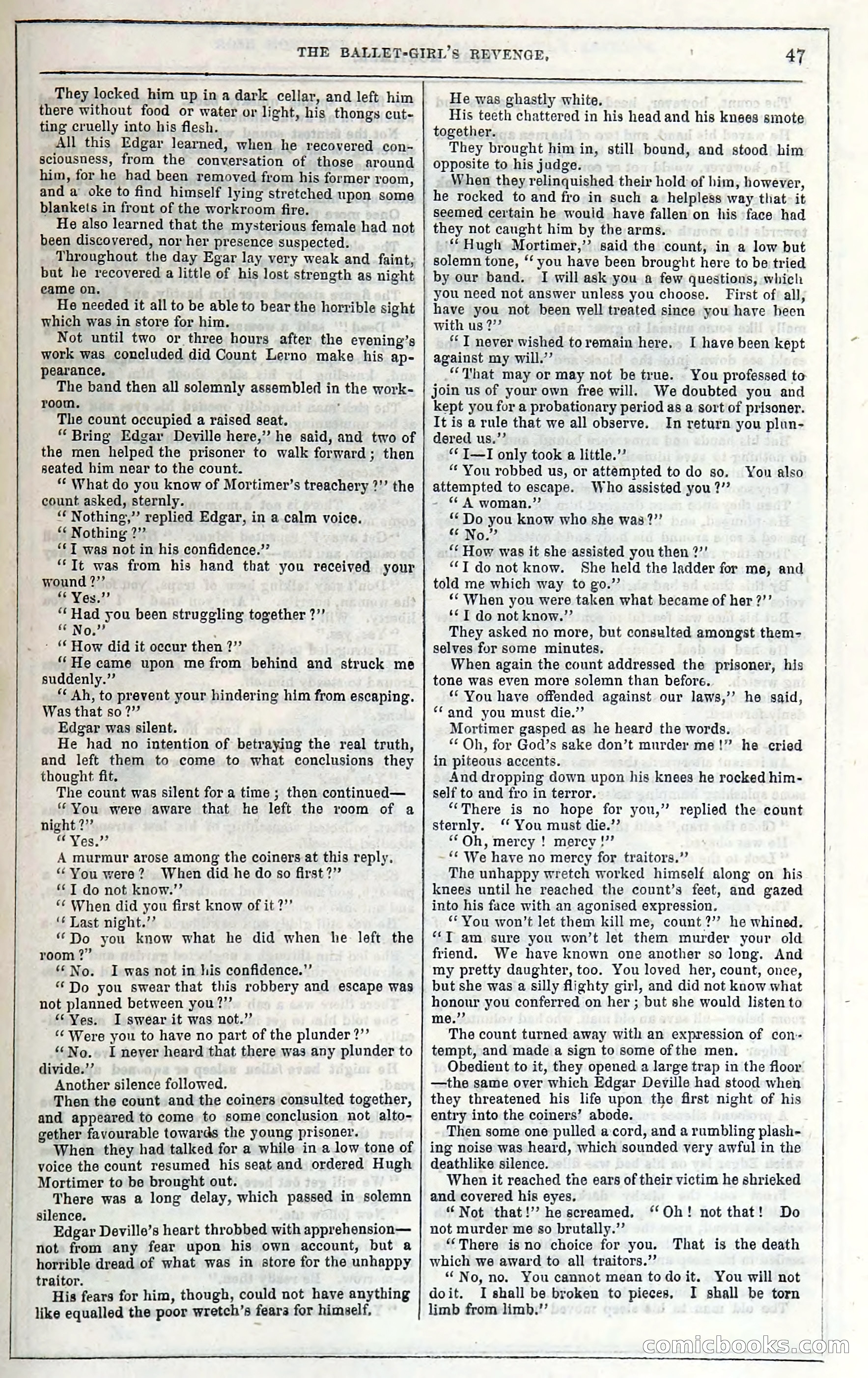
A restored page from Penny Dreadfuls, 1865. Page through the whole issue in the reader above.
📄 Transcribed text from this page (OCR, searchable)
Machine-transcribed from the original scan — historical spelling and the odd misread are preserved.
THE BALLET-GIRL’S REVENGE, 47 a a a They locked him up ina dark cellar, and left him there without food or water or light, his thongs cut- ting cruelly into his flesh. All this Edgar learned, when he recovered con- sciousness, from the conversation of those around him, for he had been removed from his former room, and a oke to find himself lying stretched upon some blankets in front of the workroom fire. He also learned that the mysterious female had not been discovered, nor her presence suspected. Throughout the day Egar lay very weak and faint, bat he recovered a little of his lost strength as night eame on. He needed it all to be able to bear the horrible sight which was in store for him. Not until two or three hours after the evening’s work was concluded did Count Lerno make his ap- pearance. The band then all solemnly assembled in the work- room. The count occupied a raised seat. “ Bring Edgar Deville here,” he said, and two of the men helped the prisoner to walk forward; then seated him near to the count. ** What do you know of Mortimer’s treachery ?”’ the count asked, sternly. “Nothing,” replied Edgar, in a calm voice. “‘ Nothing ?” “*T was not in his confidence.’’ “It was from his hand that you received your wound ?”’ ** Yes.” “Had you been struggling together ?”’ ce No.” - How did it occur then ?”’ ‘He came upon me from behind and struck me suddenly.” ‘ Ah, to prevent your hindering him from escaping. Was that so?” Edgar was silent. He had no intention of betraying the real truth, and left them to come to what conclusions they thought fit. The count was silent for a time ; then continued— ‘You were aware that he left the room of a night ?”’ © ¥Yes:?? A murmur arose among the coiners at this reply. “You were? When did he do so first?” *©T do not know.”’ *¢ When did you first know of it ?”’ ‘‘ Last night.’’ “Do you know what he did when he left the room ?” “No. I was not in his confidence.” “Do you swear that this robbery and escape was not planned between you ?”’ “Yes. I swear it was not.” ‘¢ Were you to have no part of the plunder ?”’ ‘‘No. I never heard that there was any plunder to divide.’’ Another silence followed. Then the count and the coiners consulted together, and appeared to come to some conclusion not alto- gether favourable towards the young prisoner. When they had talked for a while in a low tone of voice the count resumed his seat and ordered Hugh Mortimer to be brought out. There was a long delay, which passed in solemn silence. Edgar Deyille’s heart throbbed with apprehension— not from any fear upon his own account, but a horrible dread of what was in store for the unhappy traitor. His fears for him, though, could not have anything like equalled the poor wretch’s fears for himself. He was ghastly white, His teeth chattered in his head and his knees smote together. They brought him in, still bound, and stood him opposite to his judge. When they relinquished their hold of him, however, he rocked to and fro in such a helpless way tliat. it seemed certain he wouid have fallen on his face had they not caught him by the arms. “Hugh Mortimer,’’ said the count, in a low but solemn tone, “‘ you have been brought here to be tried by our band. I will ask you a few questions, which you need not answer unless you choose. First of all, have you not been well treated since you have been with us ?”’ ** I never wished to remain here. against my will.” “That may or may not be true. You professed to join us of your own free will. We doubted you and kept you for a probationary period as a sort of prisoner. It is a rule that we all observe. In return you plun- dered us.’’ ‘¢ [—I only took a little.’ “‘ You robbed us, or attempted to do so. attempted to escape. Who assisted you 2?” ** A woman.” “Do you know who she was?”’ if 4 No.” “How was it she assisted you then ?”’ “‘T donot know. She held the ladder for me, and told me which way to go.’ ** When you were taken what became of her ?’’ ‘*T do not know.”’ They asked no more, but consulted amongst them- selves for some minutes. When again the count addressed the prisoner, his tone was even more solemn than before. ‘‘ You have offended against our laws,’’ he said, ‘and you must die.” Mortimer gasped as he heard the words. ‘© Oh, for God’s sake don’t murder me!” he cried in piteous accents. And dropping down upon his knees he rocked him- self to and fro in terror. “‘There is no hope for you,” replied the count sternly. ‘‘ You must die.’’ ‘Oh, mercy ! mercy !” *¢ We have no mercy for traitors.” The unhappy wretch worked himself along on his knees until he reached the count’s feet, and gazed into his face with an agonised expression. ‘*You won’t let them kill me, count ?’”’ he whined. *‘T am sure you won’t let them murder your old friend. We have known one another so long. And my pretty daughter, too. You loved her, count, once, but she was a silly flighty girl, and did not know what honour you conferred on her ; but she would listen to me.” The count turned away with an expression of con- tempt, and made a sign to some of the men. Obedient to it, they opened a large trap in the floor —the same over which Edgar Deville had stood when they threatened his life upon the first night of his entry into the coiners’ abode. Then some one pulled a cord, and a rumbling plash- ing noise was heard, which sounded very awful in the deathlike silence. When it reached the ears of their victim he shrieked and covered his eyes. “Not that!’’ he screamed, not murder me so brutally.” “There is no choice for you. which we award to all traitors.”’ “No, no. You cannot mean todoit. You will not doit. I shall be broken to pieces, I shall be torn limb from limh.”’ I have been kept You also ‘Oh! not that! Do That is the death conmicloooks ©) nn