
Penny Dreadfuls, 1865 · page 116 of 204
Rose Mortimer; Or, The Ballet-Girl's Revenge — page 116: what you’re looking at
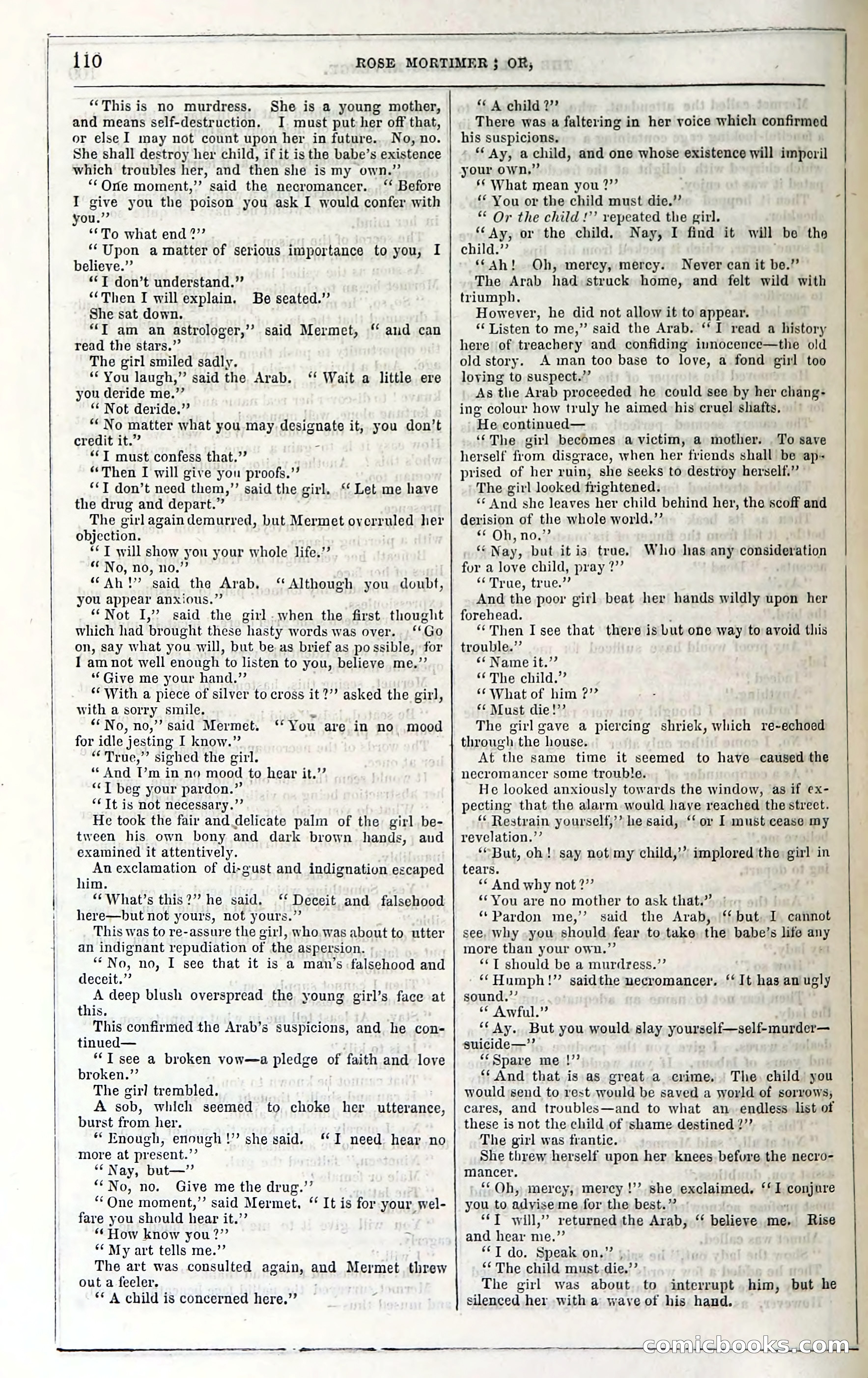
A restored page from Penny Dreadfuls, 1865. Page through the whole issue in the reader above.
📄 Transcribed text from this page (OCR, searchable)
Machine-transcribed from the original scan — historical spelling and the odd misread are preserved.
I 110 ROSE MORTIMER } OR; ‘This is no murdress. She is a young mother, and means self-destruction. I. must put her off that, or else I may not count upon her in future. No, no. She shall destroy her child, if it is the babe’s existence which troubles her, and then she is my own.” ‘‘Orfe moment,’’ said the necromancer. ‘‘ Before I give you the poison you ask I would confer with ou.”” ‘*To what end ?”’ ‘‘Upon amatter of serious importance to you, I believe.” **T don’t understand.” “Then I will explain. She sat down. *T am an astrologer,” said Mermet, “ and can read the stars.” The girl smiled sadly. *“ You laugh,” said the Arab. yon deride me.”’ “‘ Not deride.” “No matter what you may designate it, you don’t credit it.” “‘T must confess that.’ “Then I will give you proofs.” **T don’t need them,”’ said the girl. the drug and depart.” Be seated.”’ * Wait a little ere “‘ Let me have The girl again demurred, but Mermet overruled her objection. *¢T will show you your whole life.’ sor 0, DO; 0. 2 “Ah!” said the Arab, you appear anxious.” ‘Not I,” said the girl-when the first thought which had brought these hasty words was over. ‘‘Go on, say what you will, but be. as brief as possible, for I am not well enough to listen to you, believe me.’’ ‘Give me your hand.” ‘* With a piece of silver to cross it?”’ asked the girl, with a sorry smile. “* No, no,’ said Mermet, for idle jesting I know.” “True,” sighed the girl. “And I’m in no mood to hear it.’’ “‘T beg your pardon.” “It is not necessary.”’ He took the fair and delicate palm of the girl be- tween his own bony and dark brown hands, aud examined it attentively. An exclamation of di-gust and indignation escaped him. “‘What’s this?” he said, ‘‘ Deceit and falsehood here—but not yours, nof yours.”’ This was to re-assure the girl, who.was about to. utter an indignant repudiation of the aspersion. ‘* No, no, I see that it is a man’s falsehood and deceit.” A deep blush overspread the young girl’s face at this, This confirmed the Arab’s suspicions, and he con- tinued— *“T see a broken vow—a pledge of faith and love broken.”’ The girl trembled. A sob, which seemed to choke her necaees burst from her. “Enough, enough !” she said. more at present.”’ ‘* Nay, but—” “‘No, no. Give me the drug.’’ “One moment,’ said Mermet, “ It is for your wel- fare you should hear its2’ “How know you?” . ** My art tells me.”’ The art was consulted again, and Mermet threw out a feeler. ** A child is concerned here.” “Although you doubt, ‘You are in no mood “T need hear no a ee ee “A \ child? VA There was a faltering in her voice which confirmed his suspicions. ‘‘ Ay, achild, and one whose existence will imporil your own,” ‘* What mean you ?”’ ** You or the child must die.” ““ Or the child!’ repeated the girl. ‘Ay, or the child. Nay, I find it will be the child.”’ ‘Ah! Oh, merey, mercy. Never can it be.” The Arab had struck home, and felt wild with triumph, However, he did not allow it to appear. ‘‘ Listen to me,” said the Arab. ‘I read a history here of treachery and confiding innocence—the old old story. A man too base to love, a fond girl too loying to suspect.’’ As the Arab proceeded he could see by her chang- ing colour how truly he aimed his cruel sliafts, ‘He continued— ‘‘The girl becomes a victim, a mother. To save herself from disgrace, when her friends shall be ap- prised of her ruin, she seeks to destroy herself.” The girl looked frightened. ‘¢ And she leaves her child behind her, the scoff and derision of the whole world.”’ ‘ Oh, no,# ‘Nay, but itis true, for a love child, pray ?”’ ‘True, true.” And the poor girl beat her hands wildly upon her forehead. ‘Then I see that there is but one way to avoid this trouble.” ‘* Name it.”” “The child.” ‘‘ What of him ?” ** Must die!”’ The girl gave a piercing shriek, which re-echoed through the house. At the same time it seemed to have caused the necromancer some trouble. He looked anxiously towards the window, as if ex- pecting that the alarm would have reached the street. i Restrain yourself,’’ he said, ‘‘ or I must cease my revelation.’ ‘“But, oh! say not my child,’” implored the girl in tears. ** And why not ?”’ *‘You are no mother to ask that.” | ‘Pardon me,’’ said the Arab, ‘but I cannot see, Why you should, fear to take. the babe’s life sit) more than your own.’ **T should be a murdress.”’ ‘“‘Humph!” saidthe necromancer. ‘‘ It has an ugly sound,”’ ce Awful. bP) : ‘‘ Ay. But you would slay yourself—self-murder— suicide—”’ ‘‘Spare me !”’ ‘‘ And that is as great a crime, The. child you would send to rest would be saved a world of sorrows; cares, and troubles—and to what an endless list of these is not the child of shame destined ?”’ The girl was frantic. She threw herself upon her knees befvre the necro- mancer. ‘‘ Oh, mercy, mercy !’’? she exclaimed, ‘I conjnre you to advise me for the best.” “‘T will,” returned the Arab, and hear me.” *‘T do. Speak on,” ‘‘ The child must-die,’’ The girl was about to interrupt him, but he silenced her with a wave of his hand. Who has any consideration ‘¢ believe me, Rise AO TCIM OOKS; COM