
Penny Dreadfuls, 1865 · page 200 of 204
Rose Mortimer; Or, The Ballet-Girl's Revenge — page 200: what you’re looking at
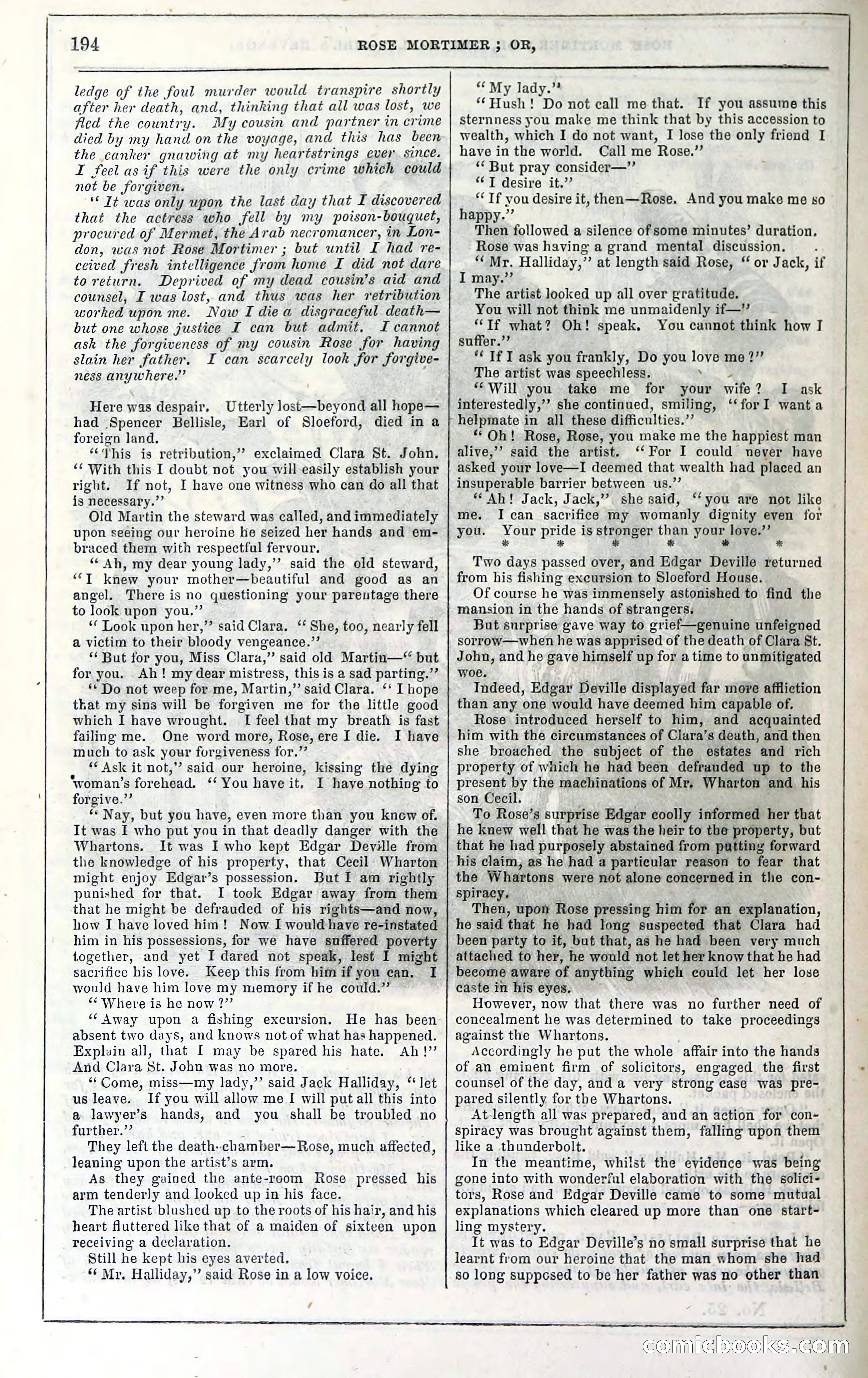
A restored page from Penny Dreadfuls, 1865. Page through the whole issue in the reader above.
📄 Transcribed text from this page (OCR, searchable)
Machine-transcribed from the original scan — historical spelling and the odd misread are preserved.
194 ROSE MORTIMER ; OR, et ledge of the foul murder would transpire shortly after her death, and, thinking that all was lost, we fled the country. My cousin and partner in crime died by my hand on the voyage, and this has been the canker gnawing at my heartstrings ever since. I feelasif this were the only crime which could not be forgiven. © Tt was only upon the last day that I discovered that the actress who fell by my poison-bouquet, procured of Mermet, the Arab necromancer, in Lon- don, was not Rose Mortimer ; but until I had re- ceived fresh intelligence from home I did not dare to return. Deprived of my dead cousin’s aid and counsel, I was lost, and thus was her retribution worked upon me. Now I diea disgraceful death— but one whose justice I can but admit. JI cannot ask the forgiveness of my cousin Rose for having slain her father. I can scarcely look for forgive- ness anywhere.” Here was despair, Utterly lost—beyond all hope— had Spencer Bellisle, Earl of Sloeford, died in a foreign land. *‘This is retribution,’ exclaimed Clara St. John. ‘¢ With this I doubt not you will easily establish your right. If not, I have one witness who can do all that is necessary.”’ Old Martin the steward was called, and immediately upon seeing our heroine he seized her hands and em- braced them with respectful fervour. “‘ Ah, my dear young lady,’’ said the old steward, “I knew your mother—beautiful and good as an angel. There is no questioning your parentage there to look upon you.” ‘‘ Look upon her,”’ said Clara. ‘* She, too, nearly fell a victim to their bloody vengeance.’’ ‘* But tor you, Miss Clara,” said old Martin— but for you. Ah! my dear mistress, this is a sad parting.” ** Do not weep for me, Martin,’ said Clara. ‘‘ I hope that my sins will be forgiven me for the little good which I have wrought. I feel that my breath is fast failing me. One word more, Rose, ere I die. I have much to ask your forgiveness for.’” ‘* Ask it not,’? said our heroine, kissing the dying ‘woman’s forehead. ‘You haye it. I haye nothing to forgive.” ‘* Nay, but you have, even more than you knew of. It was I who put you in that deadly danger with the Whartons. It was I who kept Edgar Deville from the knowledge of his property, that Cecil Wharton might enjoy Edgar’s possession. But I am rightly punished for that. I took Edgar away from them that he might be defrauded of his rights—and now, how I have loved him! Now I would have re-instated him in his possessions, for we have suffered poverty together, and yet I dared not speak, lest I might sacrifice his love. Keep this from him if you ean. I would have him love my memory if he could.” ‘Where is he now ?2”’ ‘‘ Away upon a fishing excursion. He has been absent two days, and knows not of what has happened. Expluin all, that [ may be spared his hate. Ah!” And Clara St. John was no more. ** Come, miss—my lady,’ said Jack Halliday, “ let us leave. If you will allow me I will put all this into a lawyer’s hands, and you shall be troubled no further.’’ : They left the death-chamber—Rose, much affected, leaning upon the artist’s arm. As they gained the ante-room Rose pressed his arm tenderly and looked up in his face. The artist blushed up to the roots of his hair, and his heart fluttered like that of a maiden of sixteen upon receiving a declaration. Still he kept his eyes averted. ** Mr, Halliday,” said Rose in a low voice. / “My lady.” ‘Hush! Do not call me that. If you assume this sternness you make me think that by this accession to wealth, which I do not want, I lose the only friend I have in the world. Call me Rose.” ** But pray consider—”’ “*T desire it.’ ‘“ Tf vou desire it, then—Rose. And you make me so happy.” Then followed a silence of some minutes’ duration, Rose was having a grand mental discussion. *““ Mr. Halliday,” at length said Rose, ‘ or Jack, if I may.”’ The artist looked up all over gratitude. You will not think me unmaidenly if—” “Tf what? Oh! speak. You cannot think how I suffer.’’ *€ If I ask you frankly, Do you love me?” The artist was speechless, ee *‘Will you take me for your wife? I ask interestedly,’’ she continued, smiling, ‘‘forI wanta helpmate in all these difficulties.”’ ** Oh! Rose, Rose, you make me the happiest man alive,’’ said the artist. ‘‘ For I could never have asked your love—I deemed that wealth had placed an insuperable barrier between us.” “Ah! Jack, Jack,” she said, ‘‘you are not like me. I can sacrifice my womanly dignity even for you. Your pride is stronger than your love.’’ # 2k % # ® * Two days passed over, and Edgar Deville returned from his fishing excursion to Sloeford House. Of course he was immensely astonished to find the mansion in the hands of strangers, But surprise gave way to grief—genuine unfeigned sorrow—when he was apprised of the death of Clara St. John, and he gave himself up for a time to unmitigated woe. Indeed, Edgar Deville displayed far move affliction than any one would have deemed him capable of, Rose introduced herself to him, and acquainted him with the circumstances of Clura’s death, and then she broached the subject of the estates and rich property of which he had been defrauded up to the present by the machinations of Mr, Wharton and his son Cecil. To Rose’s surprise Edgar coolly informed her that he knew well that he was the heir to the property, but that he had purposely abstained from patting forward his claim, as he had a particular reason to fear that the Whartons were not alone concerned in the con- spiracy, ; c Then, upon Rose pressing him for an explanation, he said that he had long suspected that Clara had been party to it, but that, as he had been very much attached to her, he would not let her know that he had beeome aware of anything which could let her lose caste in his eyes. However, now that there was no further need of concealment he was determined to take proceedings against the Whartons. Accordingly he put the whole affair into the hands of an eminent firm of solicitors, engaged the first counsel of the day, and a very strong case was pre- pared silently for the Whartons. Atlength all was prepared, and an action for con- Spiracy was brought against them, falling upon them like a thunderbolt. In the meantime, whilst the evidence was being gone into with wonderful elaboration with the solici- tors, Rose and Edgar Deville came to some mutual explanations which cleared up more than one start- ling mystery. It was to Edgar Deville’s no small surprise that he learnt from our heroine that the man whom she had so long supposed to be her father was no other than Gomichdoo