
Penny Dreadfuls, 1865 · page 98 of 204
Rose Mortimer; Or, The Ballet-Girl's Revenge — page 98: what you’re looking at
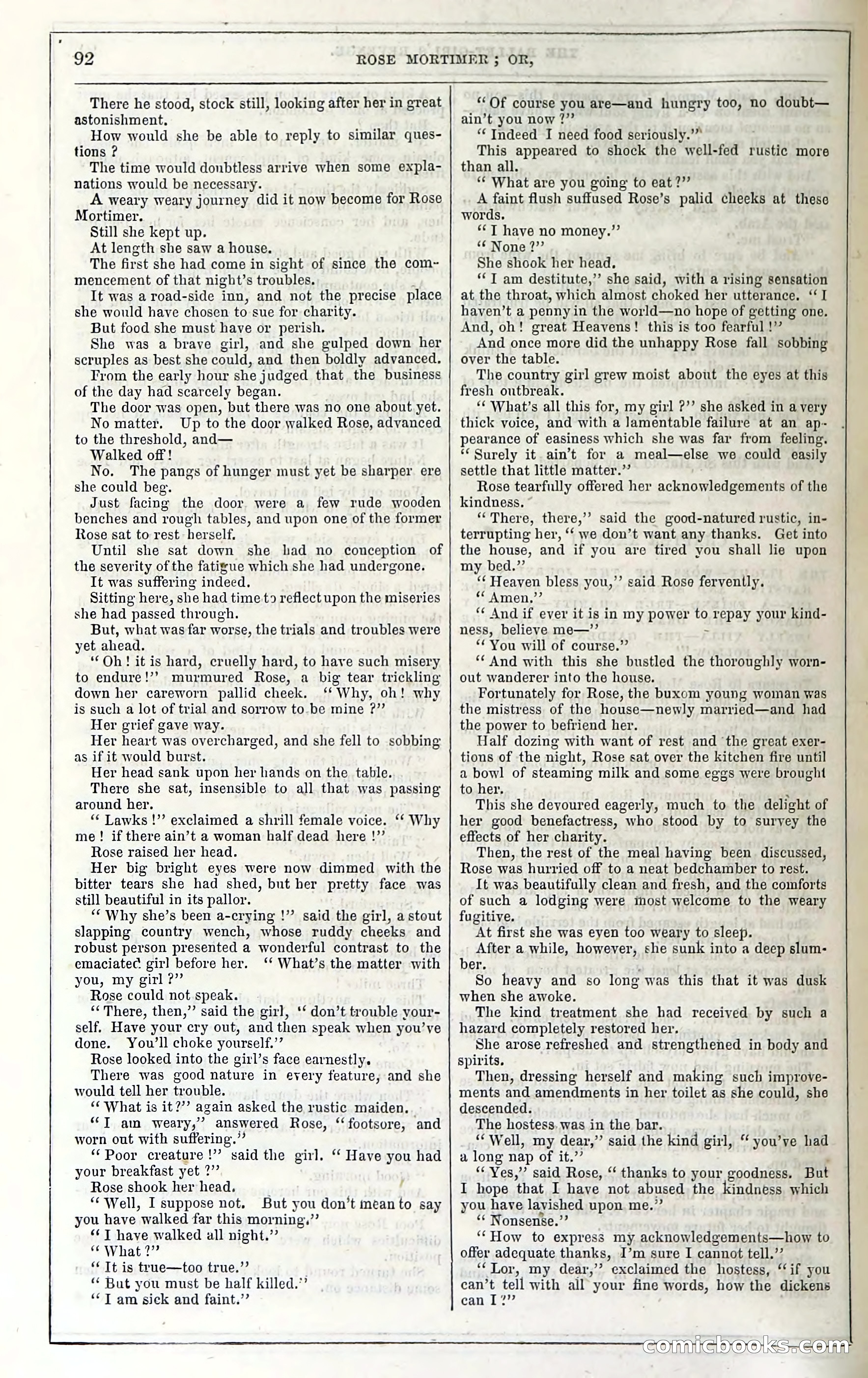
A restored page from Penny Dreadfuls, 1865. Page through the whole issue in the reader above.
📄 Transcribed text from this page (OCR, searchable)
Machine-transcribed from the original scan — historical spelling and the odd misread are preserved.
ROSE MORTIMER ; OR, There he stood, stock still, looking after her in great astonishment. How would she be able to reply to similar ques- tions ? The time would donbtless arrive when some expla- nations would be necessary. A weary weary journey did it now become for Rose Mortimer. Still she kept up. At length she saw a house. The first she had come in sight of since the com~ mencement of that night’s troubles. It was a road-side inn, and not the precise place she would have chosen to sue for charity. But food she must have or perish. She was a brave girl, and she gulped down her scruples as best she could, and then boldly advanced. From the early hour she judged that the business of the day had scarcely began. The door was open, but there was no one about yet. No matter. Up to the door walked Rose, advanced to the threshold, and— Walked off! No. The pangs of hunger must yet be sharper ere she could beg. Just facing the door were a few rude wooden benches and rough tables, and upon one of the former Rose sat to rest herself. Until she sat down she had no conception of the severity of the fatigue which she had undergone. It was suffering indeed. Sitting here, she had time to reflect upon the miseries she had passed through. But, what was far worse, the trials and troubles were yet ahead. ‘Oh! it is hard, cruelly hard, to have such misery to endure!’’ murmured Rose, a big tear trickling down her careworn pallid cheek. ‘‘ Why, oh! why is such a lot of trial and sorrow to.be mine ?”’ Her grief gave way. Her heart was overcharged, and she fell to sobbing as if it would burst. Her head sank upon her hands on the table. There she sat, insensible to all that was passing around her. “* Lawks !”’ exclaimed a shrill female voice. ‘‘ Why me! if there ain’t a woman half dead here !”’ Rose raised her head. Her big bright eyes were now dimmed with the bitter tears she had shed, but her pretty face was still beautiful in its pallor. ‘Why she’s been a-crying !” said the girl, a stout slapping country wench, whose ruddy cheeks and robust person presented a wonderful contrast to the emaciatec girl before her. ‘‘ What’s the matter with you, my girl ?” Rose could not speak. ‘‘There, then,” said the girl, ‘* don’t trouble your- self. Have your cry out, and then speak when you’vye done. You’ll choke yourself.’’ Rose looked into the girl’s face earnestly. There was good nature in every feature, and she would tell her trouble. ‘* What is it?’’ again asked the rustic maiden. “T am weary,” answered Rose, ‘‘footsore, and worn out with suffering.” “Poor creature !”’ said the girl. “‘ Have you had your breakfast yet ?” Rose shook her head. ! ‘Well, I suppose not. But you don’t mean to say you have walked far this morning,”’ ‘¢T have walked all night.” What? ‘‘ Tt is true—too true.”’ “ But you must be half killed.’ “*T am sick and faint.’’ “Of course you are—and hungry too, no doubt— ain’t you now ?” “‘ Indeed I need food seriously.’” This appeared to shock the well-fed rustic more than all. ** What are you going to eat?” A faint flush suffused Rose’s palid cheeks at these words. **T have no money.” ‘¢ None ?” ‘ She shook her head. “T am destitute,’’ she said, with a rising sensation at the throat, which almost choked her utterance. “I haven’t a penny in the world—no hope of getting one. And, oh! great Heavens! this is too fearful !” And once more did the unhappy Rose fall sobbing over the table. The country girl grew moist about the eyes at this fresh outbreak. ‘¢ What’s all this for, my girl ?’’ she asked in a very thick voice, and with a lamentable failure at an ap- pearance of easiness which she was far from feeling. ‘Surely it ain’t for a meal—else we could easily settle that little matter.” Rose tearfully offered her acknowledgements of the kindness. © “There, there,’ said the good-natured rustic, in- terrupting her, ‘‘ we don’t want any thanks. Get into the house, and if you are tired you shall lie upon my bed.” ‘ Heaven bless you,”’ said Rose fervently. a3 Amen.,’’ ‘“¢ And if ever it is in my power to repay your kind- ness, believe me—’’ = ** You will of course.” ‘‘ And with this she bustled the thoroughly worn- out wanderer into the house. Fortunately for Rose, the buxom young woman was the mistress of the house—newly married—and had the power to befriend her. Half dozing with want of rest and ‘the great exer- tions of the night, Rose sat over the kitchen fire until a bowl of steaming milk and some eggs were brought to her, This she devoured eagerly, much to the delight of her good benefactress, who stood by to suryey the effects of her charity. Then, the rest of the meal having been discussed, Rose was hurried off to a neat bedchamber to rest. It was beautifully clean and fresh, and the comforts of such a lodging were inost welcome to the weary fugitive. At first she was eyen too weary to sleep. After a while, however, she sunk into a deep slum- ber. So heavy and so long was this that it was dusk when she awoke. The kind treatment she had received by such a hazard completely restored her, She arose refreshed and strengthened in body and spirits. Then, dressing herself and making such improve- ments and amendments in her toilet as she could, she descended. The hostess, was in the bar. ‘Well, my dear,” said the kind girl, “ you’ye had a long nap of it.”’ , ** Yes,” said Rose, ‘‘ thanks to your goodness. But I hope that I have not abused the kindness which you have lavished upon me.” ‘‘ Nonsense.” ‘‘How to express my acknowledgements—how to offer adequate thanks, I’m sure I cannot tell.’’ ‘‘ Lor, my dear,’’ exclaimed the hostess, ‘if you can’t tell with all your fine words, how the dickens can [?” OMmiGhboo So GOUAAE