
Penny Dreadfuls, 1865 · page 93 of 204
Rose Mortimer; Or, The Ballet-Girl's Revenge — page 93: what you’re looking at
A restored page from Penny Dreadfuls, 1865. Page through the whole issue in the reader above.
📄 Transcribed text from this page (OCR, searchable)
Machine-transcribed from the original scan — historical spelling and the odd misread are preserved.
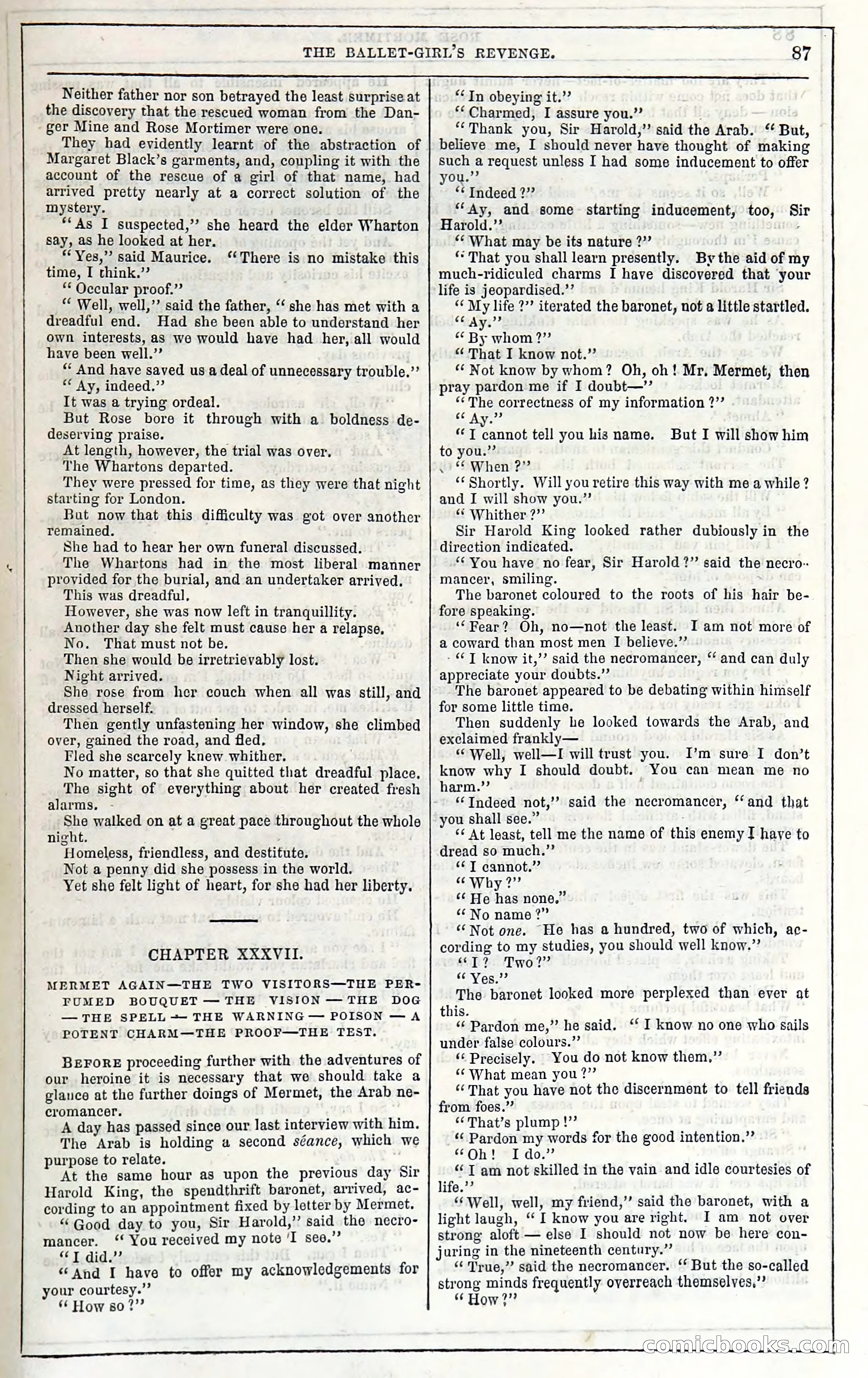
THE BALLET-GIRI’S REVENGE. 87 nnn creer erence een SSS SSS Neither father nor son betrayed the least surprise at the discovery that the rescued woman from the Dan- ger Mine and Rose Mortimer were one. They had evidently learnt of the abstraction of Margaret Black’s garments, and, coupling it with the account of the rescue of a girl of that name, had arrived pretty nearly at a correct solution of the mystery. ; **As I suspected,” she heard the elder Wharton say, as he looked at her. **Yes,”’ said Maurice. time, I think.’ *“* Occular proof.” ““ Well, well,’”’ said the father, ‘‘ she has met with a dreadful end. Had she been able to understand her own interests, as we would have had her, all would have been well.”’ “ And have saved us a deal of unnecessary trouble.’’ ““ Ay, indeed.” It was a trying ordeal. But Rose bore it through with a boldness de- deserving praise. At length, however, the trial was over. The Whartons departed. They were pressed for time, as they were that night starting for London. But now that this difficulty was got over another remained. She had to hear her own funeral discussed. The Whartons had in the most liberal manner provided for the burial, and an undertaker arrived. This was dreadful, However, she was now left in tranquillity. Another day she felt must cause her a relapse, No. That must not be. Then she would be irretrievably lost. Night arrived. She rose from her couch when all was still, and dressed herself. Then gently unfastening her window, she climbed over, gained the road, and fled. Fled she scarcely knew whither. No matter, so that she quitted that dreadful place, The sight of everything about her created fresh alarms, She walked on at a great pace throughout the whole night. Homeless, friendless, and destitute. Not a penny did she possess in the world, Yet she felt light of heart, for she had her liberty. “There is no mistake this CHAPTER XXXVII. MERMET AGAIN—THE TWO VISITORS—THE PER- FUMED BOUQUET —THE VISION-—THE DOG — THE SPELL ~~ THE WARNING — POISON —A POTENT CHARM—THE PROOF—THE TEST. BEFORE proceeding further with the adventures of our heroine it is necessary that we should take a glauce at the further doings of Mermet, the Arab ne- cromancer. oe” A day has passed since our last interview with him. The Arab is holding a second séance, which we purpose to relate. At the same hour as upon the previous day Sir Harold King, the spendthrift baronet, arrived, ac- cording to an appointment fixed by letter by Mermet, “ Good day to you, Sir Harold,’’ said the necro- mancer. ‘‘ You received my note 'I see.” © hdidzi “And I have to offer my acknowledgements for your courtesy.’ * How so?” “In obeying it.’? ‘Charmed, I assure you.”? ‘‘Thank you, Sir Harold,” said the Arab. ‘ But, believe me, I should never have thought of making such a request unless I had some inducement to offer you.’ “* Indeed ??? ‘Ay, and some starting inducement, too, Sir Harold.”’ “¢ What may be its nature ?”’ ** That you shall learn presently. By the aid of my much-ridiculed charms I have discovered that your life is jeopardised.’’ ‘* My life ?”’ iterated the baronet, not a little startled. 4 Ay.’’ “* By whom 2” “ That I know not.”’ ‘Not know by whom? Oh, oh! Mr, Mermet, then pray pardon me if I doubt—”’ “‘The correctness of my information ?”’ c¢ 3 ‘‘T cannot tell you his name. to you.” .) © When ?” ‘¢ Shortly. Will you retire this way with me a while ? and I will show you.” “¢ Whither ?” Sir Harold King looked rather dubiously in the direction indicated. ‘You have no fear, Sir Harold?” said the necro: mancer, smiling. The baronet coloured to the roots of his hair be- fore speaking. ‘‘Fear? Oh, no—not the least. I am not more of a coward than most men I believe.” -“T know it,’’ said the necromancer, ‘‘ and can duly appreciate your doubts.” The baronet appeared to be debating within himself for some little time. Then suddenly he looked towards the Arab, and exclaimed frankly— “Well, well—I will trust you. I’m sure I don’t know why I should doubt. You can mean me no harm.’’ ‘Indeed not,’’? said the necromancer, ‘‘and that you shall see.” ‘¢ At least, tell me the name of this enemy J haye to dread so much.”’ *€T cannot.” oWhy ?”’ ‘¢ He has none.” ‘“ No name 2” ‘‘ Not one. He has a hundred, two of which, ac- cording to my studies, you should well know.” “T? Two?” ‘6 Yes.” The baronet looked more perplexed than ever at this. ‘¢ Pardon me,” he said. ‘“‘ I know no one who sails under false colours.”’ ‘© Precisely. You do not know them,” ‘¢ What mean you 2” ‘¢That you have not the discernment to tell friends from foes.” ‘‘That’s plump !” ‘© Pardon my words for the good intention.” ’'Oh ! = 1 do:?’ “ T am not skilled in the vain and idle courtesies of life.’’ ‘‘ Well, well, my friend,’”’ said the baronet, with a light laugh, “ I know you are right. I am not over strong aloft — else I should not now be here con- juring in the nineteenth century.” ‘¢ True,” said the necromancer. ‘‘ But the so-called strong minds frequently overreach themselves,” “Gow But I will show him SOMMGCIOOKSECON)