
Penny Dreadfuls, 1865 · page 50 of 204
Rose Mortimer; Or, The Ballet-Girl's Revenge — page 50: what you’re looking at
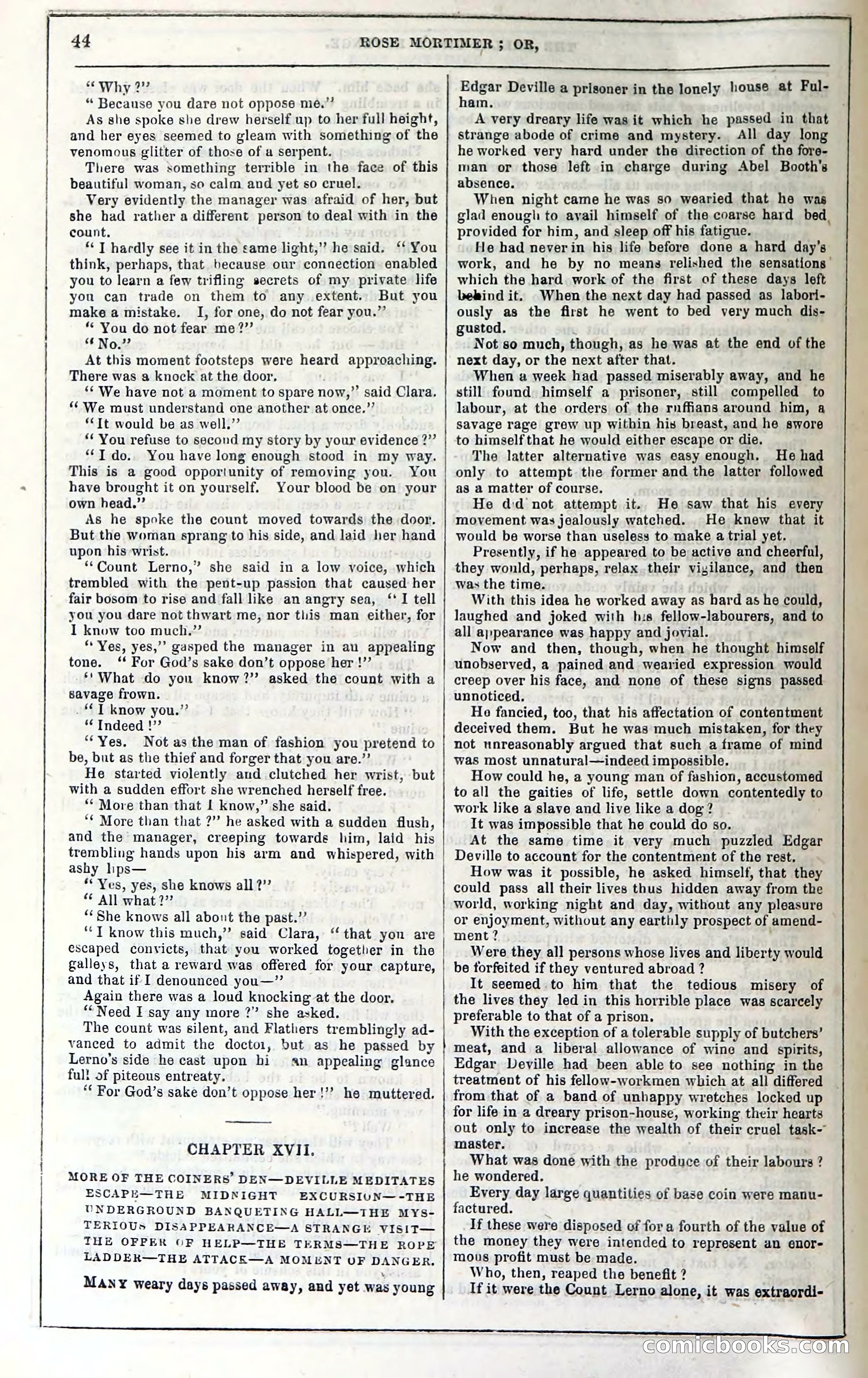
A restored page from Penny Dreadfuls, 1865. Page through the whole issue in the reader above.
📄 Transcribed text from this page (OCR, searchable)
Machine-transcribed from the original scan — historical spelling and the odd misread are preserved.
44 ROSE MORTIMER ; OR, SL — aaa * Because you dare not oppose meé,” As she spoke she drew herself up to her full height, and her eyes seemed to gleam with something of the venomous glitter of those of a serpent. There was something terrible in the face of this beautiful woman, so calm and yet so cruel. Very evidently the manager was afraid of her, but she had rather a different person to deal with in the count, “T hardly see it in the same light,’’ he said. ‘‘ You think, perhaps, that because our connection enabled you to learn a few trifling secrets of my private life you can trade on them to any extent. But you make a mistake. I, for one, do not fear you.” “You do not fear me?”’ “ No.’? At this moment footsteps were heard approaching. There was a knock at the door, ‘¢ We have not a moment to spare now,”’ said Clara. ‘‘ We must understand one another at once.”’ Tt would be as well.” ‘* You refuse to second my story by your evidence ?” ‘Ido. You have long enough stood in my way. This is a good opportunity of removing you. You have brought it on yourself. Your blood be on your own head.”’ As he spoke the count moved towards the door. But the woman sprang to his side, and laid her hand upon his wrist. ‘Count Lerno,”’ she said in a low yoice, which trembled with the pent-up passion that caused her fair bosom to rise and fall like an angry sea, ‘I tell you you dare not thwart me, nor this man either, for I know too much.’”’ * Yes, yes,’’ gasped the manager in au appealing tone. ‘‘ For God’s sake don’t oppose her !”’ ‘‘What do you know?” asked the count with a savage frown. . 1 know you.” ‘“ Indeed !” ‘Yes. Not as the man of fashion you pretend to be, but as the thief and forger that you are.’’ He started violently and clutched her wrist, but with a sudden effort she wrenched herself free. ** More than that I know,” she said. ‘€ More than that ?”” he asked with a sudden flush, and the manager, creeping towards him, laid his trembling hands upon his arm and whispered, with ashy lips— ‘* Yes, yes, she knows all?” “* All what?” “She knows all about the past.” ‘““T know this much,” said Clara, ‘‘ that yon are escaped convicts, that you worked togetler in the galleys, that a reward was offered for your capture, and that if I denounced you—”’ Again there was a loud knocking at the door, “Need I say any more ?” she asked. The count was silent, and Flathers tremblingly ad- vanced to admit the doctoi, but as he passed by Lerno’s side he cast upon bi an appealing glance ful! of piteous entreaty. “* For God’s sake don’t oppose her !’? he muttered. CHAPTER XVII. MORE OF THE COINERS’ DEN—DEVILLE MEDITATES ESCAPE—THE MIDNIGHT EXCURSIUN—-THE UNDERGROUND BANQUETING HALL—THE MYS- TERIOUs DISAPPEARANCE—A STRANGE VISiTt— THE OFPER ©F HELP—THE TERMS—THE ROPE LADDER—THE ATTACE—A MOMENT UF DANGER. MANY weary days passed away, and yet was young ae Deville a prisoner in the lonely house at Ful- am. A very dreary life was it which he passed in that strange abode of crime and mystery. All day long he worked very hard under the direction of the fore- man or those left in charge during Abel Booth’'s absence. When night came he was so wearied that he was glad enough to avail himself of the coarse hard bed, provided for him, and sleep off his fatigue. He had never in his life before done a hard day’s work, and he by no means relished the sensations which the hard work of the first of these days left bebind it. When the next day had passed as labori- ously as the first he went to bed very much dis- gusted. Not so much, though, as he was at the end of the next day, or the next after that. When a week had passed miserably away, and he still found himself a prisoner, still compelled to labour, at the orders of the rnffians around him, a savage rage grew up within his breast, and he swore to himself that he would either escape or die. The latter alternative was easy enough, He had only to attempt the former and the latter followed as a matter of course. He did not attempt it. He saw that his every movement was jealously watched. He knew that it would be worse than useless to make a trial yet. Presently, if he appeared to be active and cheerful, they wonld, perhaps, relax their vigilance, and then was the time. With this idea he worked away as hard as he could, laughed and joked with his fellow-labourers, and to all appearance was happy and jovial. Now and then, though, when he thought himself unobserved, a pained and wearied expression would creep over his face, and none of these signs passed unnoticed. He fancied, too, that his affectation of contentment deceived them. But he was much mistaken, for they not unreasonably argued that such a frame of mind was most unnatural—indeed impossible. How could he, a young man of fashion, accustomed to all the gaities of life, settle down contentedly to work like a slave and live like a dog ? | It was impossible that he could do so. At the same time it very much puzzled Edgar Deville to account for the contentment of the rest, How was it possible, he asked himself, that they could pass all their lives thus hidden away from the world, working night and day, without any pleasure or enjoyment, without any earthly prospect of amend- ment? Were they all persons whose lives and liberty would be torfeited if they ventured abroad ? It seemed to him that the tedious misery of the lives they led in this horrible place was scarcely preferable to that of a prison. With the exception of a tolerable supply of butchers’ meat, and a liberal allowance of wine and spirits, Edgar Deyille had been able to see nothing in the treatment of his fellow-workmen which at all differed from that of a band of unhappy wretches locked up for life in a dreary prison-house, working their hearts out only to increase the wealth of their cruel task- master. - What was done with the produce of their labours ? he wondered. Every day large quantities of base coin were manu- factured. If these were disposed of for a fourth of the value of the money they were intended to represent an enor- mous profit must be made. Who, then, reaped the benefit ? If it were the Count Lerno alone, it was extraordi- GOmiGcsoOokSrco