
Penny Dreadfuls, 1865 · page 34 of 204
Rose Mortimer; Or, The Ballet-Girl's Revenge — page 34: what you’re looking at
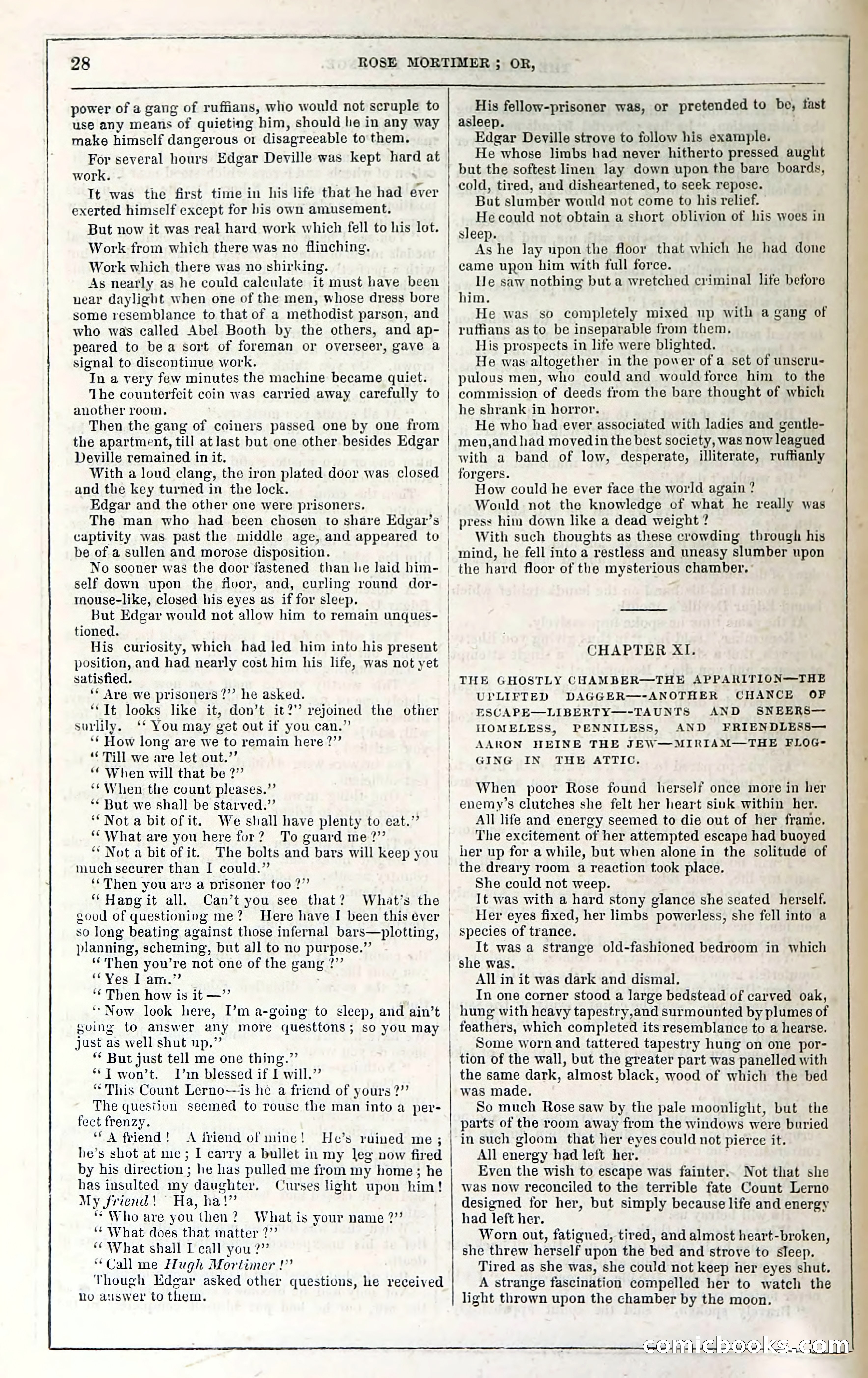
A restored page from Penny Dreadfuls, 1865. Page through the whole issue in the reader above.
📄 Transcribed text from this page (OCR, searchable)
Machine-transcribed from the original scan — historical spelling and the odd misread are preserved.
ROSE MORTIMER ; OR, OO Le power of a gang of rufiians, who would not scruple to use any means of quieting him, should he in any way make himself dangerous o1 disagreeable to them. For several hours Edgar Deville was kept hard at work. . It was the first time in his life that he had ever exerted himself except for bis own amusement, But now it was real hard work which fell to his lot. Work from which there was no flinching. Work which there was no shirking. As nearly as he could calculate it must have been near daylight when one of the men, whose dress bore some resemblance to that of a methodist parson, and who was called Abel Booth by the others, and ap- peared to be a sort of foreman or overseer, gave a signal to discontinue work. In a very few minutes the machine became quiet. The counterfeit coin was carried away carefully to another room. Then the gang of coiners passed one by one from the apartment, till atlast but one other besides Edgar Deville remained in it. With a loud clang, the iron plated door was closed and the key turned in the lock. Edgar and the other one were prisoners. The man who had been chosen to share Edgar’s captivity was past the middle age, and appeared to be of a sullen and morose disposition. No sooner was the door fastened than lie laid him- self down upon the floor, and, curling round dor- mouse-like, closed his eyes as if for sleep. But Edgar would not allow him to remain unques- tioned. His curiosity, which had led him into his present on position, and had nearly cost him his life, was not yet © | THE GHOSTLY CHAMBER—THE APPARITION—THE satisfied. ‘* Are we prisoners ?”’ he asked. ‘‘Tt looks like it, don’t it?’ rejoined the other | surlily. ‘* You may get out if you can.” ‘* How long are we to remain here ?”’ ‘“‘ Till we are let out.’’ ** When will that be ?” ‘When the count pleases.”’ ‘** But we shall be starved.” ‘** Not a bit of it. We shall have plenty to eat.” ‘¢ What are you here for? To guard me ?”’ ‘* Not a bit of it. The bolts and bars will keep you much securer than I could.” ‘‘Then you are a prisoner foo 2” “ Hang it all. Can’t you see that? What’s the good of questioning me? Here have I been this ever so long beating against those infernal bars—plotting, planning, scheming, but all to no purpose.” “Then you’re not one of the gang ?”’ “Yes I am.” ‘* Then how is it —”’ ‘‘Now look here, I’m a-going to sleep, and ain’t guing to answer any more questtons ; so you may just as well shut up.” ** But just tell me one thing.”’ ‘‘T won’t. I’m blessed if I will.” “This Count Lerno—is he a friend of yours ?”’ The question seemed to rouse the man into a per- fect frenzy. “A friend! A friend of mine! He’s ruined me ; he’s shot at me; I carry a bullet in my leg now fired by his direction ; he has pulled me from my home; he has insulted my daughter. Curses light upon him! My friend! Ha, ha!” ‘* Who are you then? What is your name 2?” “‘ What does that matter 2?” ‘¢ What shall I call you ?” “Call me Hugh Mortimer !” Though Edgar asked other questions, he received no auswer to them. His fellow-prisoner was, or pretended to be, fast asleep. Edgar Deville strove to follow his example. He whose limbs had never hitherto pressed aught but the softest linen lay down upon the bare boards, cold, tired, and disheartened, to seek repose. But slumber would not come to his relief. He could not obtain a short oblivion of his woes in sleep. As he Jay upon the floor that which he had done came upon him with full force. He saw nothing but a wretched criminal life before him. He was so completely mixed up with a gang of ruffians as to be inseparable from them. His prospects in life were blighted. He was altogether in the power of a set of unscru- pulous men, who could and wouldforce him to the commission of deeds from the bare thought of which he shrank in horror. He who had ever associated with ladies and gentle- men,and had movedin the best society, was now leagued with a band of low, desperate, illiterate, ruffianly forgers. How could he ever face the world again? Would not the knowledge of what he really was press him down like a dead weight ? With such thoughts as these crowding through his mind, he fell into a restless and uneasy slumber upon the hard floor of the mysterious chamber, ° CHAPTER XI. UPLIFTED DAGGER—-ANOTHER CHANCE OF ESCAPE—LIBERTY—-TAUNTS AND SNEERS— HOMELESS, PENNILESS, AND FRIENDLESS— AARON HEINE THE JEW—MIRIAM—THE FLOG- GING IN THE ATTIC. When poor Rose found herseJf once more in her enemy’s clutches she felt her heart siuk within her. All life and energy seemed to die out of her frame. The excitement of her attempted escape had buoyed her up for a while, but when alone in the solitude of _ the dreary room a reaction took place. She could not weep. It was with a hard stony glance she seated herself. Her eyes fixed, her limbs powerless, she fell into a species of trance. It was a strange old-fashioned bedroom in which she was. All in it was dark and dismal. In one corner stood a large bedstead of carved oak, hung with heavy tapestry,and surmounted by plumes of feathers, which completed its resemblance to a hearse. Some worn and tattered tapestry hung on one por- tion of the wall, but the greater part was panelled with the same dark, almost black, wood of which the bed was made. So much Rose saw by the pale moonlight, but the parts of the room away from the windows were buried in such gloom that her eyes could not pierce it. All energy had lett her. Even the wish to escape was fainter.. Not that she Was now reconciled to the terrible fate Count Lerno designed for her, but simply because life and energy had left her. Worn out, fatigued, tired, and almost heart-broken, she threw herself upon the bed and strove to sleep. Tired as she was, she could not keep ner eyes shut. A strange fascination compelled her to watch the light thrown upon the chamber by the moon.