
Penny Dreadfuls, 1865 · page 162 of 204
Rose Mortimer; Or, The Ballet-Girl's Revenge — page 162: what you’re looking at
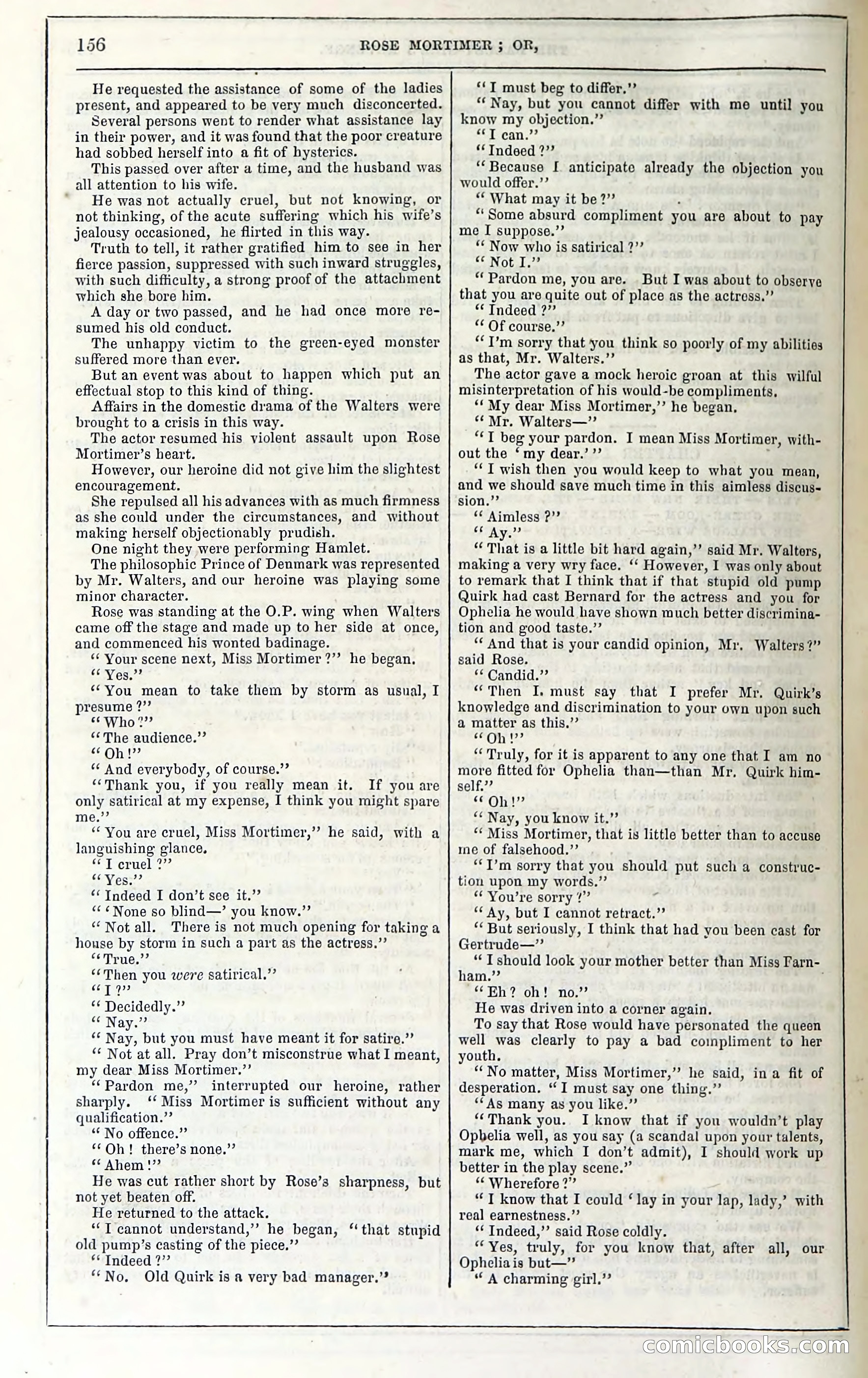
A restored page from Penny Dreadfuls, 1865. Page through the whole issue in the reader above.
📄 Transcribed text from this page (OCR, searchable)
Machine-transcribed from the original scan — historical spelling and the odd misread are preserved.
156 ROSE MORTIMER ; OR, LLL LL, He requested the assistance of some of the ladies present, and appeared to be very much disconcerted. Several persons went to render what assistance lay in their power, and it was found that the poor creature had sobbed herself into a fit of hysterics. This passed over after a time, and the husband was all attention to his wife. ’ He was not actually cruel, but not knowing, or not thinking, of the acute suffering which his wife’s jealousy occasioned, he flirted in this way. Truth to tell, it rather gratified him to see in her fierce passion, suppressed with such inward struggles, with such difficulty, a strong proof of the attachment which she bore him. A day or two passed, and he had once more re- sumed his old conduct. The unhappy victim to the green-eyed monster suffered more than ever. But an event was about to happen which put an effectual stop to this kind of thing. Affairs in the domestic drama of the Walters were brought to a crisis in this way. The actor resumed his violent assault upon Rose Mortimer’s heart. However, our heroine did not give him the slightest encouragement. She repulsed all his advances with as much firmness as she could under the circumstances, and without making herself objectionably prudish. One night they were performing Hamlet. The philosophic Prince of Denmark was represented by Mr. Walters, and our heroine was playing some minor character. Rose was standing at the O.P. wing when Walters came off the stage and made up to her side at once, and commenced his wonted badinage. *‘ Your scene next, Miss Mortimer ?”’ he began. Bs Ge) pie “*You mean to take them by storm as usual, I presume 2”? cE W10 8 “‘The audience.” ce Oh 19) ** And everybody, of course.’’ ‘Thank you, if you really mean it. If you are only satirical at my expense, I think you might spare me.”’ ‘* You are cruel, Miss Mortimer,’”’ he said, with a languishing glance, Teruel 77? 3 Yes:? “Indeed I don’t see it.’’ “¢¢None so blind—’ you know.’’ “Not all. There is not much opening for taking a house by storm in such a part as the actress.”’ ‘sTrue,?” “‘Then you were satirical.” ce I fades *¢ Decidedly.” “Nay.2 ‘* Nay, but you must have meant it for satire.’’ ‘* Not at all. Pray don’t misconstrue what I meant, my dear Miss Mortimer.’’ ‘‘Pardon me,” interrupted our heroine, rather sharply. ‘* Miss Mortimer is sufficient without any qualification.”’ ‘“* No offence.” “Oh! there’s none.” ‘SAhem'\"4 He was cut rather short by Rose’s sharpness, but not yet beaten off. He returned to the attack. ‘“‘T cannot understand,” he began, “that stupid old pump’s casting of the piece.”’ ** Indeed ?” ‘‘No. Old Quirk is a very bad manager.” ‘‘T must beg to differ,” “Nay, but you cannot differ with me until you know my objection.” ‘1. can.’? ‘* Indeed ?” ‘Because I anticipate already the objection you would offer.’’ “What may it be?” : “Some absurd compliment you are about to pay me I suppose.”’ ** Now who is satirical ?”’ RN Oban “Pardon me, you are. But I was about to observe that you are quite out of place as the actress.” “* Indeed ?” “¢ Of course.”’ “I’m sorry that ‘you think so poorly of my abilities as that, Mr. Walters.’’ The actor gave a mock heroic groan at this wilful misinterpretation of his would-be compliments, ‘‘ My dear Miss Mortimer,’’ he began, ‘Mr. Walters—”’ “‘T beg your pardon. I mean Miss Mortimer, with- out the ‘ my dear.’ ”’ : ‘“‘T wish then you would keep to what you mean, and we should save much time in this aimless discus- sion.” ‘¢ Aimless ?”? 6 Ay.” “ That is a little bit hard again,’’ said Mr. Walters, making a very wry face. ‘‘ However, I was only about to remark that I think that if that stupid old pump Quirk had cast Bernard for the actress and you for Ophelia he would have shown much better discrimina- tion and good taste.”’ ‘* And that is your candid opinion, Mr, Walters?” said Rose. ** Candid.” “Then I, must say that I prefer Mr. Quirk’s knowledge and discrimination to your own upon such a matter as this.’ On? ‘Truly, for it is apparent to any one that I am no aa fitted for Ophelia than—than Mr, Quirk him- self.’? ‘Ons? “* Nay, you know it.” “* Miss Mortimer, that is little better than to accuse me of falsehood.”’ **T’m sorry that you should put such a construc- tion upon my words.” *'You’re sorry ?” ‘ ** Ay, but I cannot retract.’ “But seriously, I think that had you been cast for Gertrude—”’ ‘“T should look your mother better than Miss Farn- 1am.”’ Eh? oh! no.” He was driven into a corner again. To say that Rose would have personated the queen well was clearly to pay a bad compliment to her youth. “No matter, Miss Mortimer,’”’ he said, ina fit of desperation. “I must say one thing.” ‘*AS many as you like.” “‘Thank you. I know that if you wouldn’t play Opbelia well, as you say (a scandal upon your talents, mark me, which I don’t admit), I should work up better in the play scene.” * Wherefore ?” “TI know that I could ‘lay in your lap, lady,’ with real earnestness.” ‘* Indeed,”’ said Rose coldly. “Yes, truly, for you know that, after all, our Opheliais but—” “A charming girl.” GOmMmiIchdoo <S