
Penny Dreadfuls, 1865 · page 165 of 204
Rose Mortimer; Or, The Ballet-Girl's Revenge — page 165: what you’re looking at
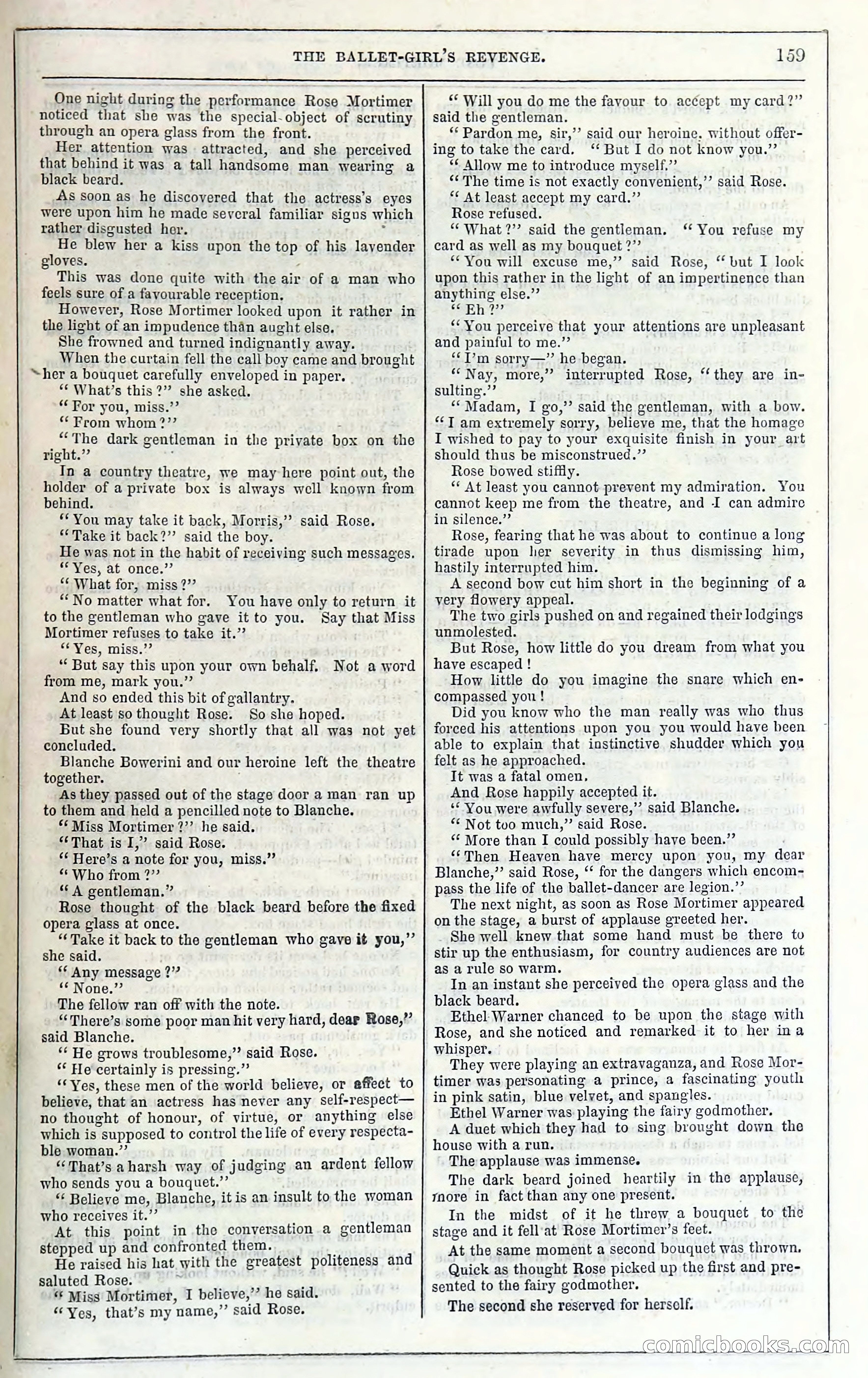
A restored page from Penny Dreadfuls, 1865. Page through the whole issue in the reader above.
📄 Transcribed text from this page (OCR, searchable)
Machine-transcribed from the original scan — historical spelling and the odd misread are preserved.
ee eT THE BALLET-GIRL’S REVENGE. 159 reer eeeeeererereserey. eee ass aassssssSssa sssssSsnsns—s One night during the performance Rose Mortimer noticed that she was the special-object of scrutiny through an opera glass from the front. Her attention was attracted, and she perceived that behind it was a tall handsome man wearing a black beard. As soon as he discovered that the actress’s eyes were upon him he made several familiar signs which rather disgusted her. ; He blew her a kiss upon the top of his layender gloves. ; This was done quite with the air of a man who feels sure of a favourable reception. However, Rose Mortimer looked upon it rather in the light of an impudence than aught else. She frowned and turned indignantly away. When the curtain fell the call boy came and brought “her a bouquet carefully enveloped in paper. “‘ What’s this ?” she asked. ‘For you, miss.”’ ** From whom ?”’ - “The dark gentleman in the priyate box on the right.” In a country theatre, we may here point out, the holder of a private box is always well known from behind. “You may take it back, Morris,” said Rose. “Take it back?”’ said the boy. He was not in the habit of receiving such messages. ‘Yes, at once.’’ ‘‘ What for, miss ?”’ **No matter what for. You have only to return it to the gentleman who gave it to you. Say that Miss Mortimer refuses to take it.” “Yes, miss.”’ “But say this upon your own behalf, Not a word from me, mark you.”’ And so ended this bit of gallantry. At least so thought Rose. So she hoped. But she found very shortly that all was not yet concluded. Blanche Bowerini and our heroine left the theatre together. é As they passed out of the stage door a man ran up to them and held a pencilled note to Blanche. ‘* Miss Mortimer ?’’ he said. “That is I,” said Rose. ** Here’s a note for you, miss.” ** Who from ?”’ “A gentleman.” Rose thought of the black beard before the fixed opera glass at once. “Take it back to the gentleman who gave it you,” she said. * Any message ?” ‘* None.”’ The fellow ran off with the note. “‘There’s some poor man hit very hard, dear Rose,” said Blanche. ** He grows troublesome,” said Rose. ** He certainly is pressing.” ‘‘ Yes, these men of the world believe, or effect to believe, that an actress has never any self-respect— no thought of honour, of virtue, or anything else which is supposed to control the life of every respecta- ble woman.”’ “‘That’s aharsh way of judging an ardent fellow who sends you a bouquet.” ‘‘ Believe me, Blanche, itis an insult to the woman who receives it.” At this point in the conversation a gentleman stepped up and confronted them. He raised his hat with the greatest politeness and saluted Rose. : ; “‘ Miss Mortimer, I believe,” he said. “Yes, that’s my name,” said Rose. oe EE Ee comico “Will you do me the favour to accept my card?” said the gentleman. ** Pardon me, sir,’’ said our heroine. without offer- ing to take the card. ‘‘ But I do not know you.”’ ** Allow me to introduce myself.” <¢ The time is not exactly convenient,’’ said Rose. ** At least accept my card.” Rose refused. “What ?”’ said the gentleman. card as well as my bouquet ?”’ “*You will excuse me,” said Rose, ‘‘ but I look upon this rather in the light of an impertinence than anything else.”’ a4 Eh M37 <‘You perceive that your attentions are unpleasant and painful to me.”’ ‘*1’m sorry—” he began. ‘“ Nay, more,” interrupted Rose, ‘‘ they are in- sulting.”’ ‘“ Madam, I go,”’ said the gentleman, with a bow. “‘T am extremely sorry, believe me, that the homage I wished to pay to your exquisite finish in your art should thus be misconstrued.” Rose bowed stiffly. * At least you cannot prevent my admiration. You cannot keep me from the theatre, and I can admire in silence.” Rose, fearing that he was about to continue a long tirade upon her severity in thus dismissing him, hastily interrupted him. A second bow cut him short in the beginning of a very flowery appeal. The two girls pushed on and regained their lodgings unmolested. But Rose, how little do you dream from what you have escaped ! How little do you imagine the snare which en- compassed you! Did you know who the man really was who thus forced his attentions upon you you would have been able to explain that instinctive shudder which you felt as he approached. It was a fatal omen, And Rose happily accepted it. ‘* You were awfully severe,’ said Blanche. *¢ Not tuo much,” said Rose. “* More than I could possibly have been.” ‘Then Heaven have mercy upon you, my dear Blanche,’’ said Rose, ‘‘ for the dangers which encom- pass the life of the ballet-dancer are legion.’’ The next night, as soon as Rose Mortimer appeared on the stage, a burst of applause greeted her. She well knew that some hand must be there to stir up the enthusiasm, for country audiences are not as a rule so warm. In an instant she perceived the opera glass and the black beard. Ethel: Warner chanced to be upon the stage with Rose, and she noticed and remarked it to her ina whisper. They were playing an extravaganza, and Rose Mor- timer was personating a prince, a fascinating youth in pink satin, blue velvet, and spangles. Ethel Warner was playing the fairy godmother. A duet which they had to sing brought down the house with a run. The applause was immense. The dark beard joined heartily in the applause, rnore in fact than any one present. . In the midst of it he threw a bouquet to the stage and it fell:at Rose Mortimer’s feet. At the same moment a second bouquet was thrown. Quick as thought Rose picked up the first and pre- sented to the fairy godmother. The second she reserved for herself. ‘You refuse my