
Penny Dreadfuls, 1865 · page 196 of 204
Rose Mortimer; Or, The Ballet-Girl's Revenge — page 196: what you’re looking at
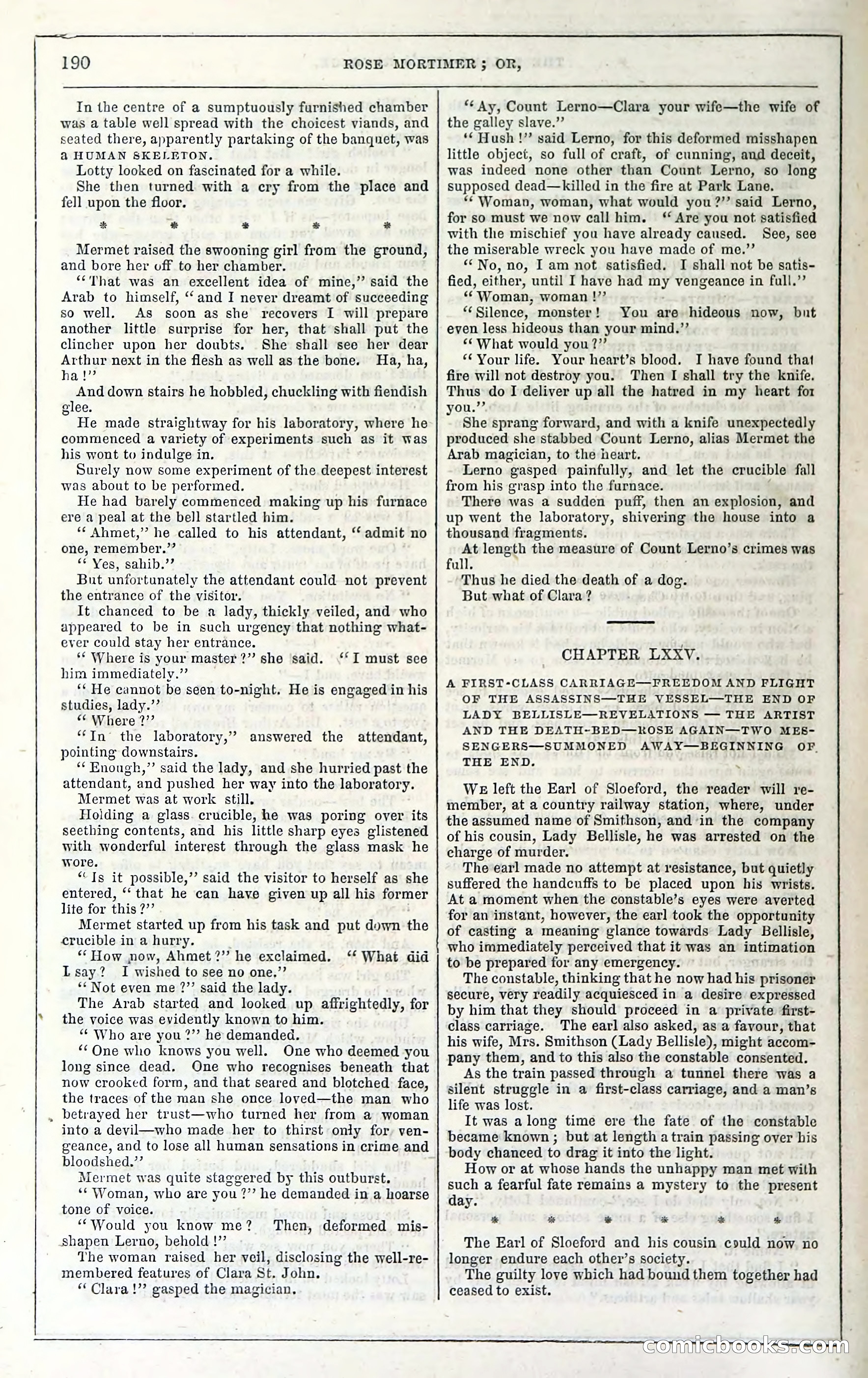
A restored page from Penny Dreadfuls, 1865. Page through the whole issue in the reader above.
📄 Transcribed text from this page (OCR, searchable)
Machine-transcribed from the original scan — historical spelling and the odd misread are preserved.
—_—_—_. -__e_e_e_e 190 In the centre of a sumptuously furnished chamber was a table well spread with the choicest viands, and seated there, apparently partaking of the banqnet, was a HUMAN SKELETON. Lotty looked on fascinated for a while. She then turned with a cry from the place and fell upon the floor. * a * * * Mermet raised the swooning girl from the ground, and bore her off to her chamber. ““That was an excellent idea of mine,’’ said the Arab to himself, ‘‘and I never dreamt of succeeding so well. As soon as she recovers I will prepare another little surprise for her, that shall put the clincher upon her doubts. She shall see her dear Arthur next in the flesh as well as the bone. Ha, ha, ha!” And down stairs he hobbled, chuckling with fiendish elee. He made straightway for his laboratory, where he commenced a variety of experiments such as it was his wont to indulge in. Surely now some experiment of the deepest interest was about to be performed. He had barely commenced making up his furnace ere a peal at the bell startled him. ‘* Ahmet,” he called to his attendant, “ admit no one, remember.” “* Yes, sahib.”’ But unfortunately the attendant could not prevent the entrance of the visitor. It chanced to be a lady, thickly veiled, and who appeared to be in such urgency that nothing what- ever could stay her entrance. ‘** Where is your master?” she said. him immediately.”’ ‘‘ He cannot be seen to-night. He is engaged in his studies, lady.’’ ““ Where ?”” ‘‘In’ the laboratory,” answered the attendant, pointing downstairs. ‘* Enough,” said the lady, and she hurried past the attendant, and pushed her way into the laboratory. Mermet was at work still. Holding a glass. crucible, he was poring over its seething contents, and his little sharp eyes glistened with wonderful interest through the glass mask he wore. ““Ts it possible,”’ said the visitor to herself as she entered, ‘‘ that he can have given up all his former lite for this ?’’ . Mermet started up from his task and put down the crucible in a hurry. ‘How now, Ahmet?” he exclaimed. Lsay? I wished to see no one,’’ ‘* Not even me 2”’ said the lady. The Arab started and looked up affrightedly, for the voice was evidently known to him. “‘ Who are you 2?”’ he demanded. “‘One who knows you well. One who deemed you long since dead. One who recognises beneath that now crooked form, and that seared and blotched face, the traces of the man she once loved—the man who , betrayed her trust—who turned her from a woman into a devil—who made her to thirst only for ven- geance, and to lose all human sensations in crime and bloodshed.’’ Mermet was quite staggered by this outburst. ‘* Woman, who are you ?”’ he demanded in a hoarse tone of voice. ‘““Would you know me? shapen Lerno, behold !” The woman raised her veil, disclosing the well-re- membered features of Clara St. John. ‘Clara !”? gasped the magician. ‘“T must see “What did Then, deformed mis- i ee a a San a > COMICHOOKS ROSE MORTIMER ; OR, “Ay, Count Lerno—Clara your wife—the wife of the galley slave.” ‘‘ Wush !”? said Lerno, for this deformed misshapen little object, so full of craft, of cunning, and deceit, was indeed none other than Count Lerno, so long supposed dead—killed in the fire at Park Lane. ** Woman, woman, what would you?” said Lerno, for so must we now call him. ‘ Are you not satisfied with the mischief you have already caused. See, see the miserable wreck you have made of me.’’ ‘No, no, Iam not satisfied. I shall not be satis- fied, either, until I have had my vengeance in full.’’ ‘Woman, woman !’ “Silence, monster! You are hideous now, but even less hideous than your mind.’’ ‘* What would you?’’ *¢ Your life. Your heart’s blood. I have found that fire will not destroy you. Then I shall try the knife. Thus do I deliver up all the hatred in my heart for you.”’ She sprang forward, and with a knife unexpectedly produced she stabbed Count Lerno, alias Mermet the Arab magician, to the heart. Lerno gasped painfully, and let the crucible fall from his grasp into the furnace. é There was a sudden puff, then an explosion, and up went the laboratory, shivering the house into a thousand fragments. At length the measure of Count Lerno’s crimes was full. | Thus he died the death of a dog. But what of Clara ? CHAPTER LXXV. A FIRST-CLASS CARRIAGE—FREEDOM AND FLIGHT OF THE ASSASSINS—THE VESSEL—THE END OF LADY BELLISLE—REVELATIONS — THE ARTIST AND THE DEATH-BED—RKOSE AGAIN—TWO MES- SENGERS—SUMMONED AWAY—BEGINNING OF THE END. * WE left the Earl of Sloeford, the reader will re- member, at a country railway station, where, under the assumed name of Smithson, and in the company of his cousin, Lady Bellisle, he was arrested on the charge of murder. The earl made no attempt at resistance, but quietly suffered the handcuffs to be placed upon his wrists. At a moment when the constable’s eyes were averted for an instant, however, the earl took the opportunity of casting a meaning glance towards Lady Bellisle, who immediately perceived that it was an intimation to be prepared for any emergency. The constable, thinking that he now had his prisoner secure, very readily acquiesced in a desire expressed by him that they should proceed in a private first- class carriage. The earl also asked, as a favour, that his wife, Mrs. Smithson (Lady Bellisle), might accom- pany them, and to this also the constable consented. As the train passed through a tunnel there was a silent struggle in a first-class carriage, and a man’s life was lost. It was along time ere the fate of the constable became known ; but at length a train passing over his body chanced to drag it into the light. How or at whose hands the unhappy man met with such a fearful fate remains a mystery to the present day. sa ae * * ae te The Earl of Sloeford and his cousin could now no longer endure each other’s society. The guilty love which had bound them together had ceased to exist.