
Penny Dreadfuls, 1865 · page 123 of 204
Rose Mortimer; Or, The Ballet-Girl's Revenge — page 123: what you’re looking at
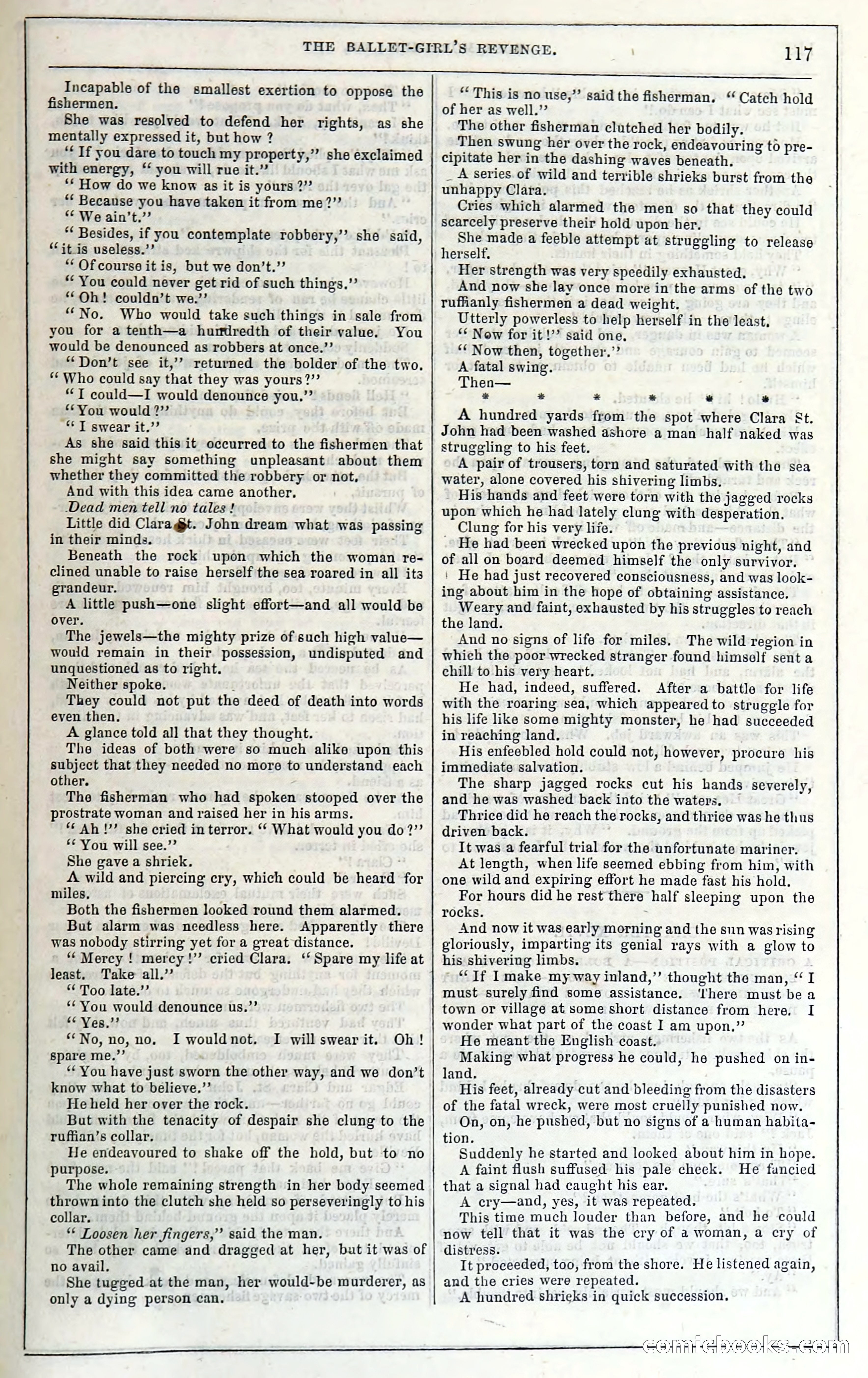
A restored page from Penny Dreadfuls, 1865. Page through the whole issue in the reader above.
📄 Transcribed text from this page (OCR, searchable)
Machine-transcribed from the original scan — historical spelling and the odd misread are preserved.
THE BALLET-GIRL’S REVENGE. 117 BN Incapable of the smallest exertion to oppose the fishermen. She was resolved to defend her rights, as she mentally expressed it, but how ? ‘ If you dare to touch my property,”’ she exclaime with energy, ‘‘ you will rue it.” “* How do we know as it is yours 2” “‘ Because you have taken it from me?” “ We ain’t.”’ “* Besides, if you contemplate robbery,’’ she said, “itis useless.” “‘ Ofcourse it is, but we don’t.” “You could never get rid of such things,” “Oh! couldn’t we.’ “No. Who would take such things in sale from you for a tenth—a hurmdredth of their value. You would be denounced as robbers at once.’’ “Don’t see it,’’? returned the bolder of the two. * Who could say that they was yours?”’ “T could—I would denounce you.”’ “You would ?” © T swear it.” As she said this it occurred to the fishermen that she might say something unpleasant about them whether they committed the robbery or not, And with this idea came another, Dead men tell no tales! Little did Claragt. John dream what was in their minds. Beneath the rock upon which the woman re- clined unable to raise herself the sea roared in all its grandeur. A little push—one slight effort—and all would be over. The jewels—the mighty prize of such high value— would remain in their possession, undisputed and unquestioned as to right. Neither spoke. They could not put the deed of death into words even then. A glance told all that they thought. The ideas of both were so much alike upon this subject that they needed no more to understand each other. The fisherman who had spoken stooped over the prostrate woman and raised her in his arms. “Ah !”” she cried in terror. “‘ What would you do?”’ *€ You will see.’’ She gave a shriek. A wild and piercing cry, which could be heard for miles, Both the fishermen looked round them alarmed. But alarm was needless here. Apparently there was nobody stirring yet for a great distance. “Mercy ! mercy!” cried Clara. ‘‘ Spare my life at least. Take all.’ “Too late.’”’ ** You would denounce us.’’ “ec Yes,’? *“No, no, no. I would not. spare me.”’ “You have just sworn the other way, and we don’t know what to believe.’’ He held her over the rock. But with the tenacity of despair she clung to the ruffian’s collar. He endeavoured to shake off the hold, but to no purpose. The whole remaining strength in her body seemed thrown into the clutch she held so perseveringly to his collar. ** Loosen her fingers,” said the man. The other came and dragged at her, but it was of no avail. She tugged at the man, her would-be murderer, as only a dying person can. passing I will swear it. Oh! I Ee HED OO! “ This is no use,’’ said the fisherman. “ Catch hold of her as well.” The other fisherman clutched her bodily. Then swung her over the rock, endeavouring to pre- cipitate her in the dashing waves beneath. _ A series.of wild and terrible shrieks burst from the unhappy Clara. Cries which alarmed the men so that they could searcely preserve their hold upon her. She made a feeble attempt at struggling to release herself. Her strength was very speedily exhausted. And now she lay once more in the arms of the two ruffianly fishermen a dead weight. Utterly powerless to help herself in the least, “* Now for it !”’ said one, ‘* Now then, together.”? A fatal swing. Then— * * * *~ wt &% A hundred yards from the spot where Clara &t. John had been washed ashore a man half naked was struggling to his feet. A pair of trousers, torn and saturated with the sea water, alone covered his shivering limbs. His hands and feet were torn with the jagged rocks upon which he had lately clung with desperation. _ Clung for his very life. He had been wrecked upon the previous night, and of all on board deemed himself the only survivor. ' He had just recovered consciousness, and was look- ing about him in the hope of obtaining assistance. Weary and faint, exhausted by his struggles to reach the land. And no signs of life for miles. The wild region in which the poor wrecked stranger found himself sent a chill to his very heart. He had, indeed, suffered. After a battle for life with the roaring sea, which appeared to struggle for his life like some mighty monster, he had succeeded in reaching land. His enfeebled hold could not, however, procure his immediate salvation. The sharp jagged rocks cut his hands severely, and he was washed back into the waters. Thrice did he reach the rocks, and thrice was he thus driven back. It was a fearful trial for the unfortunate mariner. At length, when life seemed ebbing from him, with one wild and expiring effort he made fast his hold. For hours did he rest there half sleeping upon the rocks. And now it was early morning and the sun was rising gloriously, imparting its genial rays with a glow to his shivering limbs. ' “Tf Imake my way inland,”’ thought the man, ‘I must surely find some assistance. ‘here must be a town or village at some short distance from here. I wonder what part of the coast I am upon.” He meant the English coast. Making what progress he could, he pushed on in- land. His feet, already cut and bleeding from the disasters of the fatal wreck, were most cruelly punished now. On, on, he pushed, but no signs of a human habita- tion. Suddenly he started and looked about him in hope. A faint flush suffused his pale cheek. He fancied that a signal had caught his ear. A ery—and, yes, it was repeated, This time much louder than before, and he could now tell that it was the cry of a woman, a cry of distress. It proceeded, too, from the shore. He listened again, and the cries were repeated. A hundred shrieks in quick succession.