
Penny Dreadfuls, 1865 · page 36 of 204
Rose Mortimer; Or, The Ballet-Girl's Revenge — page 36: what you’re looking at
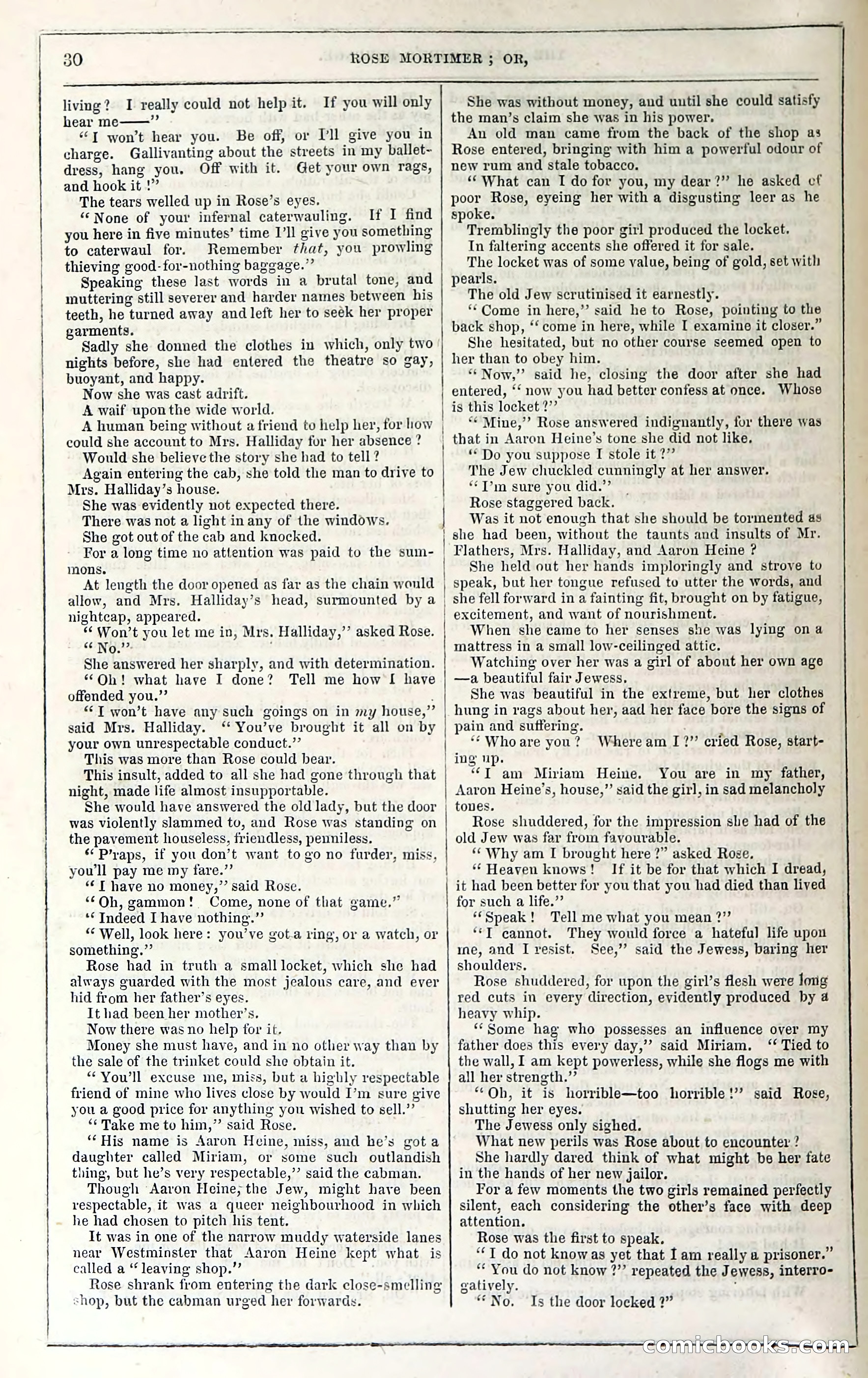
A restored page from Penny Dreadfuls, 1865. Page through the whole issue in the reader above.
📄 Transcribed text from this page (OCR, searchable)
Machine-transcribed from the original scan — historical spelling and the odd misread are preserved.
eee 2 ROSE MORTIMER ; OR, a I really could not help it. If you will only 3) living ? hear me—— ; ‘‘T won't hear you. Be off, or I'll give you in charge. Gallivanting about the streets in my ballet- dress, hang you. Off with it. Get your own rags, and hook it !” The tears welled up in Rose’s eyes. ‘‘None of your infernal caterwauling. If I find you here in five minutes’ time I’ll give you something to caterwaul for. Remember that, you prowling thieving good-for-nothing baggage.” Speaking these last words in a brutal tone, and muttering still severer and harder names between his teeth, he turned away and left her to seek her proper garments. Sadly she donned the clothes in which, only two nights before, she had entered the theatre so gay, buoyant, and happy. Now she was cast adrift. A waif upon the wide world. A human being without a friend to help her, for how could she account to Mrs. Halliday for her absence ? Would she believe the story she had to tell? Again entering the cab, she told the man to drive to Mrs. Halliday’s house. She was evidently not expected there. There was not a light in any of the windows. She got out of the cab and knocked. For a long time no attention was paid to the sum- mons. At length the door opened as far as the chain would allow, and Mrs. Halliday’s head, surmounted by a nightcap, appeared. “‘ Won’t you let me in, Mrs. Halliday,’’ asked Rose. “ee No.’”: ‘ She answered her sharply, and with determination. ‘““Oh! what have I done? Tell me how [ have offended you.”’ ““T won’t have any such goings on in my house,” said Mrs. Halliday. ‘‘ You’ve brought it all on by your own unrespectable conduct.”’ This was more than Rose could bear. This insult, added to all she had gone through that night, made life almost insupportable. She would have answered the old lady, but the door was violently slammed to, and Rose was standing on the pavement houseless, friendless, penniless. ‘*P’yaps, if you don’t want to go no furder, miss, youll pay me my fare.”’ ‘*T have no money,” said Rose. ‘Oh, gammon! Come, none of that game,” ‘© Indeed I have nothing.” “Well, look here: you’ve got.a ring’, or a watch, or something.” Rose had in truth a small locket, which she had always guarded with the most jealous care, and ever hid from her father’s eyes. It had been her mother’s. Now there wasno help for it. Money she must have, and in no other way than by the sale of the trinket could she obtain it. “You'll excuse me, miss, but a highly respectable friend of mine who lives close by would I’m sure give you a good price for anything you wished to sell.”’ ‘Take me to him,” said Rose. ‘‘His name is Aaron Heine, miss, and he’s gota daughter called Miriam, or some such outlandish thing, but he’s very respectable,’’ said the cabman. Though Aaron Heine, the Jew, might have been respectable, it was a queer neighbourhood in which he had chosen to pitch his tent. It was in one of the narrow muddy waterside lanes near Westminster that Aaron Heine kept what is called a “ leaving shop.” Rose shrank from entering the dark close-smelling shop, but the cabman urged her forwards. —_—_——— COA OOK She was without money, and uutil she could satisfy the man’s claim she was in his power. An old man came from the back of the shop as Rose entered, bringing with him a powerful odour of new rum and stale tobacco. ‘‘ What can I do for you, my dear?” he asked ef poor Rose, eyeing her with a disgusting leer as he spoke. Tremblingly the poor girl produced the locket. In faltering accents she offered it for sale. The locket was of some value, being of gold, set with pearls. The old Jew scrutinised it earnestly. ‘* Come in here,” said he to Rose, pointing to the back shop, ‘‘ come in here, while I examine it closer.” She hesitated, but no other course seemed open to her than to obey him. “‘ Now,’’ said he, closing the door after she had entered, ‘‘ now you had better confess at once. Whose is this locket ?”’ ** Mine,’ Rose answered indignantly, for there was that in Aaron Heine’s tone she did not like, “Do you suppose I stole it ?” The Jew chuckled cunningly at her answer. “I’m sure you did.” Rose staggered back. Was it not enouch that she should be tormented as she had been, without the taunts and insults of Mr. Flathers, Mrs. Halliday, and Aaron Heine ? She held out her hands imploringly and strove to speak, but her tongue refused to utter the words, and she fell forward in a fainting fit, brought on by fatigue, excitement, and want of nourishment. When she came to her senses she was lying on a mattress in a small low-ceilinged attic. Watching over her was a girl of abont her own age —a beautiful fair Jewess, She was beautiful in the extreme, but her clothes hung in rags about her, aad her face bore the signs of pain and suffering. ‘* Who are you? ing up. ‘‘T am Miriam Heine. You are in my father, Aaron Heine’s, house,” said the girl, in sad melancholy toues. Rose shuddered, for the impression she had of the old Jew was far from favourable. ‘‘ Why am I brought here ?” asked Rose. ‘‘ Heaven knows! If it be for that which I dread, it had been better for you that you had died than lived for such a life.”’ ‘‘Speak! Tell me what you mean ?” ‘‘T cannot. They would force a hateful life upon me, and I resist. See,’ said the Jewess, baring her shoulders. Rose shuddered, for upon the girl’s flesh were log red cuts in every direction, evidently produced by 4 heavy whip. **Some hag who possesses an influence over my father does this every day,’’? said Miriam. ‘* Tied to the wall, I am kept powerless, while she flogs me with all her strength.” *‘Oh, it is horrible—too horrible!’ said Rose, shutting her eyes. The Jewess only sighed. What new perils was Rose about to encounter ? She hardly dared think of what might be her fate in the hands of her new jailor. For a few moments the two girls remained perfectly silent, each considering the other’s face with deep attention. Rose was the first to speak. “‘T do not knowas yet that I am really a prisoner.” ‘* You do not know ?”’ repeated the Jewess, interro- eatively. INO; Where am I?” cried Rose, start- Is the door locked ?” . SACOM)