
Penny Dreadfuls, 1865 · page 193 of 204
Rose Mortimer; Or, The Ballet-Girl's Revenge — page 193: what you’re looking at
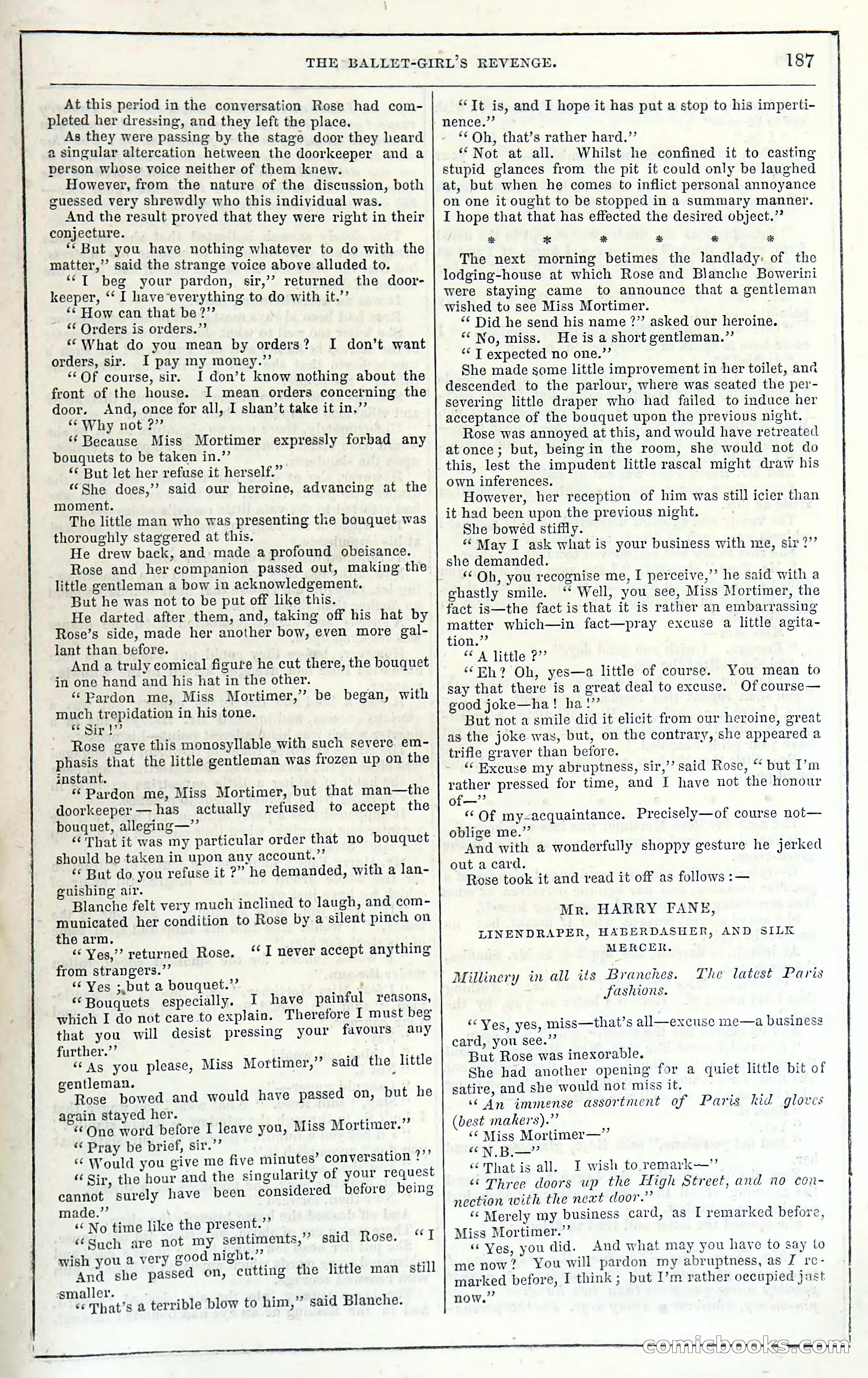
A restored page from Penny Dreadfuls, 1865. Page through the whole issue in the reader above.
📄 Transcribed text from this page (OCR, searchable)
Machine-transcribed from the original scan — historical spelling and the odd misread are preserved.
Coe er THE BALLET-GIRL’S REVENGE. 187 At this period in the conversation Rose had com- pleted her dressing, and they left the place. As they were passing by the stage door they heard a singular altercation hetween the doorkeeper and a person whose voice neither of them knew. However, from the nature of the discussion, both guessed very shrewdly who this individual was. And the result proved that they were right in their conjecture. ‘But you have nothing whatever to do with the matter,” said the strange voice above alluded to. ‘*T beg your pardon, sir,’’ returned the door- keeper, ‘‘ I have everything to do with it.’’ “¢ How can that be?” “¢ Orders is orders.”’ “What do you mean by orders? orders, sir. I pay my money.’’ ‘¢Of course, sir. I don’t know nothing about the front of the house. I mean orders concerning the door. And, once for all, I shan’t take it in,”’ “Why not ?” ‘‘ Because Miss Mortimer expressly forbad any bouquets to be taken in.”’ ‘‘ But let her refuse it herself.” “She does,’ said our heroine, advancing at the moment. The little man who was presenting the bouquet was thoroughly staggered at this. He drew back, and made a profound obeisance. Rose and her companion passed out, making the little gentleman a bow in acknowledgement. But he was not to be put off like this. He darted after them, and, taking off his hat by Rose’s side, made her another bow, even more gal- lant than before. And a truly comical figure he cut there, the bouquet in one hand and his hat in the other. ‘‘ Pardon me, Miss Mortimer,” be began, with much trepidation in his tone. ihe hi Rose gave this monosyllable with such severe em- phasis that the little gentleman was frozen up on the instant. ‘Pardon me, Miss Mortimer, but that man—the doorkeeper—has actually refused to accept the bouquet, alleging—”’ ‘That it was my particular order that no bouquet should be taken in upon any account.”’ ‘‘ But do you refuse it ?” he demanded, with a lan- guishing air. Blanche felt very much inclined to laugh, and com- municated her condition to Rose by a silent pinch on the arm. “ Yes,’’ returned Rose. from strangers.” ‘Yes ;.but a bouquet.”’ , “Bouquets especially. I have painful reasons, which I do not care to explain. Therefore I must beg that you will desist pressing your favours auy further.”’ , ‘© As you please, Miss Mortimer,”’ said the | little gentleman. Rose bowed and would have passed on, but he again stayed her. , ; ‘¢Ono word before I leave you, Miss Mortimer. “‘ Pray be brief, sir.”’ Fag: «Would you give me five minutes’ conversation ? ‘ Sir, the hour and the singularity of your request cannot surely have been considered before being made.”’ ‘‘ No time like the present.”’ ‘Such are not my sentiments,” said Rose. “I wi very good night.” take 3 diac on, cutting the little man still smaller. : arr That’s a terrible blow to him,” said Blanche. I don’t want ‘¢T never accept anything Om DOO “Tt is, and I hope it has put a stop to his imperti- nence.”’ ‘¢ Oh, that’s rather hard.” “Not at all. Whilst he confined it to casting stupid glances from the pit it could only be laughed at, but when he comes to inflict personal annoyance on one it ought to be stopped in a summary manner. I hope that that has effected the desired object.” % “ * * 7 a The next morning betimes the landlady: of the lodging-house at which Rose and Blanche Bowerini were staying came to announce that a gentleman wished to see Miss Mortimer. ‘¢ Did he send his name ?”’ asked our heroine. “No, miss. He is a short gentleman.” ““ T expected no one.”’ She made some little improvement in her toilet, ana descended to the parlour, where was seated the per- severing little draper who had failed to induce her acceptance of the bouquet upon the previous night. Rose was annoyed at this, and would have retreated atonce; but, being in the room, she would not do this, lest the impudent little rascal might draw his own inferences. However, her reception of him was still icier than it had been upon the previous night. She bowed stiffly. “ May I ask what is your business with me, sir?” she demanded. ‘‘ Oh, you recognise me, I perceive,”’ he said with a ghastly smile. ‘‘ Well, you see, Miss Mortimer, the fact is—the fact is that it is rather an embarrassing matter which—in fact—pray excuse a little agita- tion.’’ ‘ & little 2:7 “Eh? Oh, yes—a little of course. You mean to say that there is a great deal to excuse. Of course— good joke—ha! ha-’’ But not a smile did it elicit from our heroine, great as the joke was, but, on the contrary, she appeared a trifle graver than betore. ‘“‘ Excuse my abruptness, sir,’’ said Rose, “ but I’m rather pressed for time, and I have not the honour oy eee ‘¢Of my-acquaintance. Precisely—of course not— oblige me.”’ And with a wonderfully shoppy gesture he jerked out a card. Rose took it and read it off as follows :— Mr. HARRY FANE, LINENDRAPER, HABGERDASHUER, AND SILK MERCER. Millinery in all its Branches. The latest Paris Sashions. ‘Yes, yes, miss—that’s all—excuse me—a business card, you see.” But Rose was inexorable. She had another opening for a quiet little bit of satire, and she would not miss it, “ 4n immense assortment of Paris hid gloves (best makers).” ‘¢ Miss Mortimer—”’ ce NN. Be “Thatis all. I wish to remark—’”’ ‘“‘ Three doors up the High Street, and no con- nection with the next door.” ‘¢ Merely my business card, as I remarked before, Miss Mortimer.”’ “Yes, you did. And what may you have to say to me now? You will pardon my abruptness, as T re- marked before, I think; but I’m rather oecupied just now.” SCORE