
Penny Dreadfuls, 1865 · page 73 of 204
Rose Mortimer; Or, The Ballet-Girl's Revenge — page 73: what you’re looking at
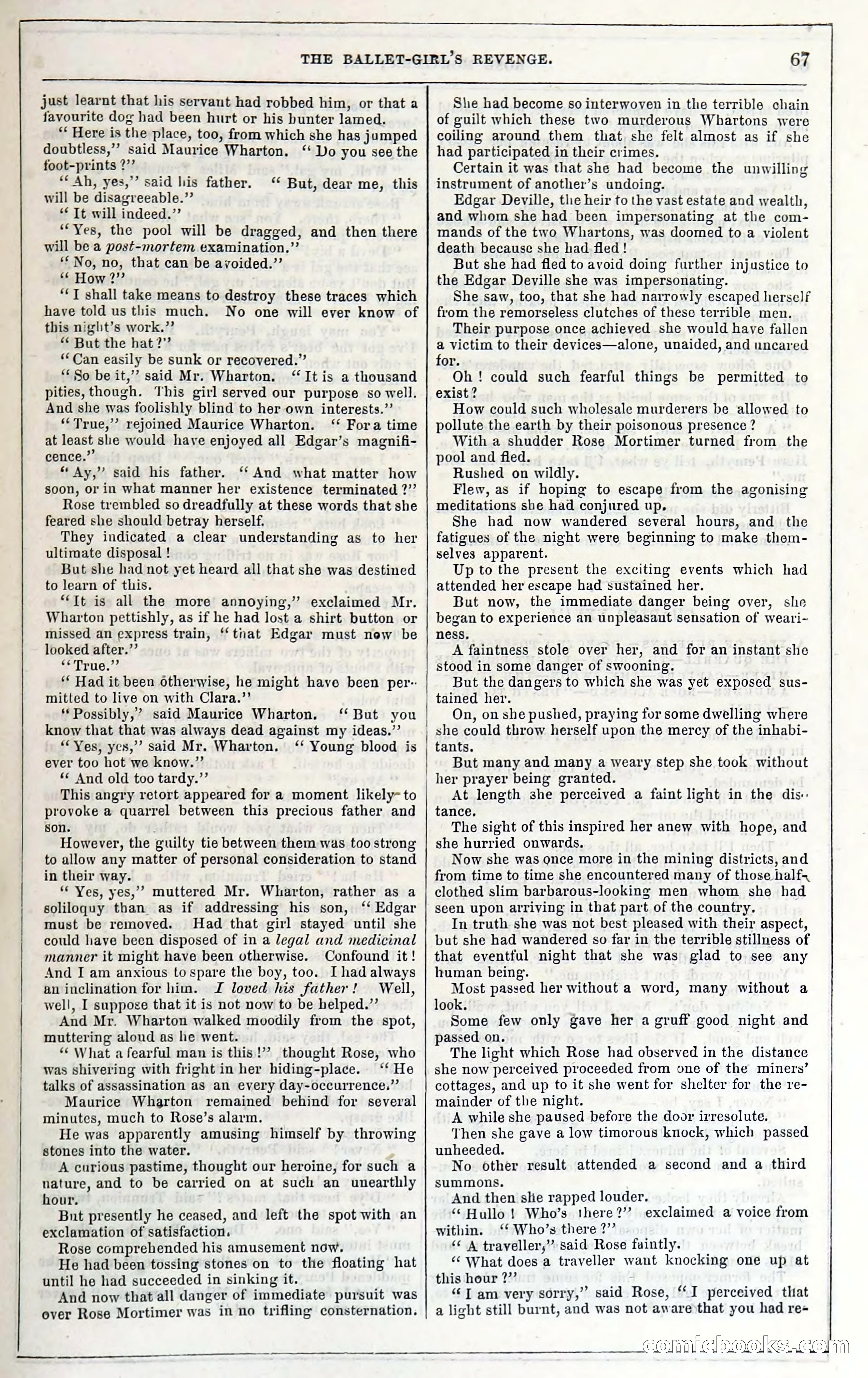
A restored page from Penny Dreadfuls, 1865. Page through the whole issue in the reader above.
📄 Transcribed text from this page (OCR, searchable)
Machine-transcribed from the original scan — historical spelling and the odd misread are preserved.
THE BALLET-GIRL’S REVENGE. 67 SS De SSS eee just learnt that his servant had robbed him, or that a favourite dog had been hurt or his bunter lamed. ** Here is the place, too, from which she has jumped doubtless,’ said Maurice Wharton. ‘‘ Do you see the foot-prints 2?’ “Ah, yes,’’ said lis father. will be disagreeable.”’ ** Tt will indeed.’’ “Yes, the pool will be dragged, and then there will be a post-mortem examination.” ‘* No, no, that can be avoided.”’ “e How 99? “‘T shall take means to destroy these traces which have told us this much. No one will ever know of this night’s work.’”’ * But the hat?” “Can easily be sunk or recovered.” ‘So be it,” said Mr. Wharton. “Itis a thousand pities, though. This girl served our purpose so well. And she was foolishly blind to her own interests.” ‘True,’ rejoined Maurice Wharton. ‘‘ Fora time at least she would have enjoyed all Edgar’s magnifi- cence.” “ Ay,” said his father. ‘‘ And what matter how soon, or in what manner her existence terminated ?”’ Rose trembled so dreadfully at these words that she feared she should betray herself. They indicated a clear understanding as to her ultimate disposal ! But she had not yet heard all that she was destined to learn of this. “Tt is all the more annoying,” exclaimed Mr. Wharton pettishly, as if he had lost a shirt button or missed an express train, ‘‘tnat Edgar must new be looked after.” ATG. 7 ‘* Had it been otherwise, he might have been per-. mitted to live on with Clara.”’ ‘Possibly,’ said Maurice Wharton. ‘‘ But you know that that was always dead against my ideas.” “Yes, yes,’ said Mr. Wharton. ‘‘ Young blood is ever too hot we know.”’ *« And old too tardy.”’ This angry retort appeared for a moment likely~to provoke a quarrel between this precious father and son. However, the guilty tie between them was too strong to allow any matter of personal consideration to stand in their way. “Yes, yes,’ muttered Mr. Wharton, rather as a soliloquy than as if addressing his son, ‘‘ Edgar must be removed. Had that girl stayed until she could liave been disposed of in a legal and medicinal manner it might have been otherwise. Confound it! And I am anxious to spare the boy, too. I had always an inclination for him. J loved his father! Well, well, I suppose that it is not now to be helped.” And Mr. Wharton walked moodily from the spot, muttering aloud as he went. *‘ What a fearful man is this!” thought Rose, who was shivering with fright in her hiding-place. ‘‘ He talks of assassination as an every day-occurrence.”’ Maurice Wharton remained behind for several minutes, much to Rose’s alarm. He was apparently amusing himself by throwing stones into the water. A curious pastime, thought our heroine, for such a nature, and to be carried on at such an unearthly hour. Bnt presently he ceased, and left the spot with an exclamation of satisfaction. Rose comprehended his amusement now, He had been tossing stones on to the floating hat until he had succeeded in sinking it. And now that all danger of immediate pursuit was over Rose Mortimer was in no trifling consternation. “* But, dear me, this She had become so interwoven in the terrible chain of guilt which these two murderous Whartons were coiling around them that she felt almost as if she had participated in their crimes. Certain it was that she had become the unwilling instrument of another’s undoing. Edgar Deville, tlie heir to the vast estate and wealth, and whom she had been impersonating at the com- mands of the two Whartons, was doomed to a violent death because she had fled! But she had fled to avoid doing further injustice to the Edgar Deville she was impersonating. She saw, too, that she had narrowly escaped herself from the remorseless clutches of these terrible men. Their purpose once achieved she would have fallen a victim to their devices—alone, unaided, and uncared for. Oh! could such fearful things be permitted to exist ? How could such wholesale murderers be allowed to pollute the earth by their poisonous presence ? With a shudder Rose Mortimer turned from the pool and fled. Rushed on wildly. Flew, as if hoping to escape from the agonising meditations she had conjured up. She had now wandered several hours, and the fatigues of the night were beginning to make them- selves apparent. Up to the present the exciting events which had attended her escape had sustained her. But now, the immediate danger being over, she began to experience an unpleasant sensation of weari- ness. A faintness stole over her, and for an instant she stood in some danger of swooning. But the dangers to which she was yet exposed sus- tained her. On, on she pushed, praying fur some dwelling where she could throw herself upon the mercy of the inhabi- tants. But many and many a weary step she took without her prayer being granted. At length she perceived a faint light in the dis: tance. The sight of this inspired her anew with hope, and she hurried onwards. Now she was once more in the mining districts, and from time to time she encountered many of those half clothed slim barbarous-looking men whom she had seen upon alriving in that part of the country. In truth she was not best pleased with their aspect, but she had wandered so far in the terrible stillness of that eventful night that she was glad to see any human being. Most passed her without a word, many without a look, Some few only gave her a gruff good night and passed on. The light which Rose had observed in the distance she now perceived proceeded from one of the miners’ cottages, and up to it she went for shelter for the re- mainder of the night. A while she paused before the door irresolute. Then she gave a low timorous knock, which passed unheeded. No other result attended a second and a third summons. And then slie rapped louder. “Hullo! Who’s there?” exclaimed a voice from within. ‘‘ Who’s there ?”’ ‘¢ A traveller,” said Rose faintly. ‘¢ What does a traveller want knocking one up at this hour ?” “‘T am very sorry,” said Rose, ‘‘I perceived that a light still burnt, and was not aware that you had re« SONMGIOOKSECON