
Penny Dreadfuls, 1865 · page 201 of 204
Rose Mortimer; Or, The Ballet-Girl's Revenge — page 201: what you’re looking at
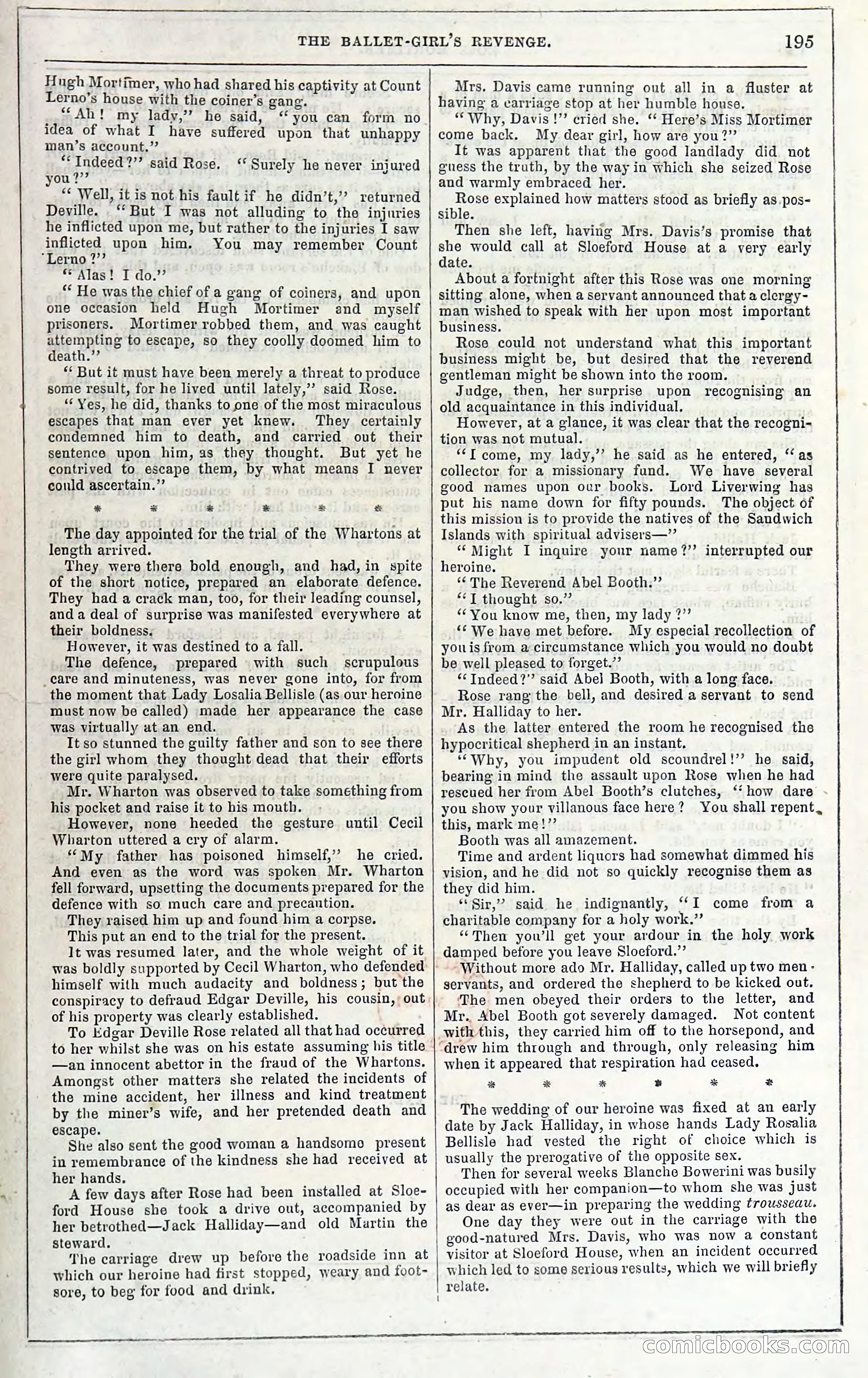
A restored page from Penny Dreadfuls, 1865. Page through the whole issue in the reader above.
📄 Transcribed text from this page (OCR, searchable)
Machine-transcribed from the original scan — historical spelling and the odd misread are preserved.
a ES Se, CE Ee a es ee THE BALLET-GIRL’S REVENGE. 195 Pn i a a Hugh Mortimer, who had shared his captivity at Count Lerno s house with the coiner’s gang. Ah! my lady,’”’ he said, “you can form no idea of what I have suffered upon that unhappy man’s account,” “Indeed ?”’ said Rose. ou ?’’ “< Well, it is not his fault if he didn’t,” returned Deville. ‘But I was not alluding to the injuries he inflicted upon me, but rather to the injuries I saw inflicted upon him, You may remember Count ‘Lerno ?”’ “Alas! I do.’ ** He was the chief of a gang of coiners, and upon one occasion held Hugh Mortimer and myself prisoners. Mortimer robbed them, and was caught attempting to escape, so they coolly doomed him to death.” * But it must have been merely a threat to produce some result, for he lived until lately,’’ said Rose. ““ Yes, he did, thanks to one of the most miraculous escapes that man ever yet knew. They certainly condemned him to death, and carried out their sentence upon him, as they thought. But yet he contrived to escape them, by what means I never could ascertain.”’ ** Surely he never iniured a * * * FS & The day appointed for the trial of the Whartons at length arrived. They were there bold enough, and had, in spite of the short notice, prepared an elaborate defence. They had a crack man, too, for their leading counsel, and a deal of surprise was manifested everywhere at their boldness. However, it was destined to a fall. The defence, prepared with such scrupulous _eare and minuteness, was never gone into, for from the moment that Lady Losalia Bellisle (as our heroine must now be called) made her appearance the case was virtually at an end. . It so stunned the guilty father and son to see there the girl whom they thought dead that their efforts were quite paralysed. Mr. Wharton was observed to take something from his pocket and raise it to his mouth. However, none heeded the gesture until Cecil Wharton uttered a cry of alarm. ‘My father has poisoned himself,’ he cried. And even as the word was spoken Mr. Wharton fell forward, upsetting the documents prepared for the defence with so much care and precaution. They raised him up and found him a corpse. This put an end to the trial for the present. lt was resumed later, and the whole weight of it was boldly supported by Cecil Wharton, who defended himself with much audacity and boldness; but the conspiracy to defraud Edgar Deville, his cousin, out of his property was clearly established. To Kdgar Deville Rose related all that had occurred to her whilst she was on his estate assuming his title —an innocent abettor in the fraud of the Whartons. Amongst other matters she related the incidents of the mine accident, her illness and kind treatment by the miner’s wife, and her pretended death and escape. She also sent the good woman a handsome present in remembrance of the kindness she had received at her hands. A few days after Rose had been installed at Sloe- ford House she took a drive out, accompanied by her betrothed—Jack Halliday—and old Martin the steward. The carriage drew up before the roadside inn at which our heroine had first stopped, weary and foot- sore, to beg for food and drink. - a Mrs, Davis came running out all in a fluster at having a carriage stop at her humble house. “Why, Davis!” cried she. ‘‘ Here’s Miss Mortimer come back. My dear girl, how are you?” It was apparent that the good landlady did not guess the truth, by the way in which she seized Rose and warmly embraced her. mie explained how matters stood as briefly as.pos- sible. Then she left, having Mrs. Davis’s promise that ah would call at Sloeford House at a very early ate. About a fortnight after this Rose was one morning sitting alone, when a servant announced that a clergy- man wished to speak with her upon most important business. Rose could not understand what this important business might be, but desired that the reverend gentleman might be shown into the room. Judge, then, her surprise upon recognising an old acquaintance in this individual. However, at a glance, it was clear that the recogni- tion was not mutual. **T come, my lady,’’ he said as he entered, ‘as collector for a missionary fund. We have several good names upon our books. Lord Liverwing has put his name down for fifty pounds. The object of this mission is to provide the natives of the Sandwich Islands with spiritual advisers—’’ “Might I inquire your name?’’ interrupted our heroine. ‘The Reverend Abel Booth.” ‘I thought so,” ‘You know me, then, my lady ?”’ ‘¢ We have met before. My especial recollection of youis from a circumstance which you would no doubt be well pleased to torget.’’ ‘<Indeed?”’ said Abel Booth, with a long face. Rose rang the bell, and desired a servant to send Mr. Halliday to her. As the latter entered the room he recognised the hypocritical shepherd in an instant, ‘Why, you impudent old scoundrel!’ he said, bearing in mind the assault upon Rose when he had rescued her from Abel Booth’s clutches, ‘* how dare you show your villanous face here? You shall repent, this, mark me!”’ Booth was all amazement. Time and ardent liquors had somewhat dimmed his vision, and he did not so quickly recognise them as they did him. ‘‘ Sir,” said he indignantly, “‘I come from a charitable company for a holy work.”’ ‘‘Then you'll get your ardour in the holy work damped before you leave Sloeford.”’ Without more ado Mr. Halliday, called up two men - servants, and ordered the shepherd to be kicked out. ‘The men obeyed their orders to the letter, and Mr., Abel Booth got severely damaged. Not content with this, they carried him off to the horsepond, and ‘drew him through and through, only releasing him when it appeared that respiration had ceased. 3 ik 2 ® * a The wedding of our heroine was fixed at an early date by Jack Halliday, in whose hands Lady Rosalia Bellisle had vested the right of choice which is usually the prerogative of the opposite sex. Then for several weeks Blanche Bewerini was busily occupied with her companion—to whom she was just as dear as ever—in preparing the wedding trousseau. One day they were out in the carriage with the good-natured Mrs. Davis, who was now a constant visitor at Sloeford House, when an incident occurred which led to some serious results, which we will briefly relate. CoOnmicloooks.c© een eal o —