
Penny Dreadfuls, 1865 · page 18 of 204
Rose Mortimer; Or, The Ballet-Girl's Revenge — page 18: what you’re looking at
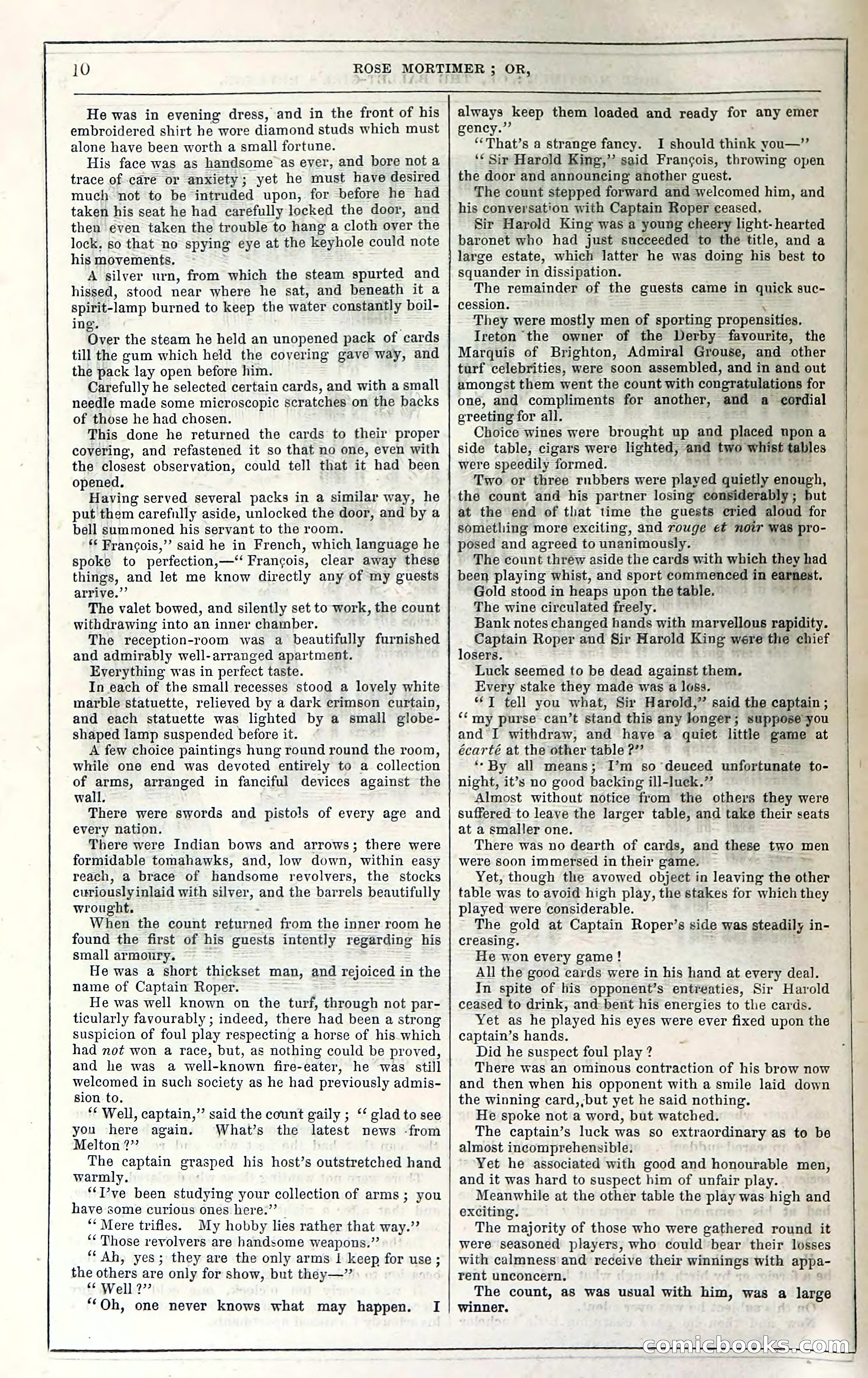
A restored page from Penny Dreadfuls, 1865. Page through the whole issue in the reader above.
📄 Transcribed text from this page (OCR, searchable)
Machine-transcribed from the original scan — historical spelling and the odd misread are preserved.
10 ROSE MORTIMER ; OR, He was in evening dress, and in the front of his embroidered shirt he wore diamond studs which must alone have been worth a small fortune. His face was as handsome as eyer, and bore not a trace of care or anxiety; yet he must have desired much not to be intruded upon, for before he had taken his seat he had carefully locked the door, and then even taken the trouble to hang a cloth over the lock. so that no spying eye at the keyhole could note his movements. A silver urn, from which the steam spurted and hissed, stood near where he sat, and beneath it a spirit-lamp burned to keep the water constantly boil- in ver the steam he held an unopened pack of cards till the gum which held the covering gave way, and the pack lay open before him. Carefully he selected certain cards, and with a small needle made some microscopic scratches on the backs of those he had chosen. This done he returned the cards to their proper covering, and refastened it so that no one, even with the closest observation, could tell that it had been opened. Having served several packs in a similar way, he put them carefully aside, unlocked the door, and by a bell summoned his servant to the room, ** Francois,’ said he in French, which language he spoke to perfection,—‘‘ Frangois, clear away these things, and let me know directly any of my guests arrive.” The valet bowed, and silently set to work, the count withdrawing into an inner chamber. The reception-room was a beautifully furnished and admirably well-arranged apartment. Everything was in perfect taste. In each of the small recesses stood a lovely white marble statuette, relieved by a dark erimson curtain, and each statuette was lighted by a small globe- shaped lamp suspended before it. A few choice paintings hung round round the room, while one end was devoted entirely to a collection of arms, arranged in fanciful devices against the wall. There were swords and pistols of every age and every nation. There were Indian bows and arrows; there were formidable tomahawks, and, low down, within easy reach, a brace of handsome revolvers, the stocks curiouslyinlaid with silver, and the barrels beautifully wrought. When the count returned from the inner room he found the first of his guests intently regarding his small armoury. He was a short thickset man, and rejoiced in the name of Captain Roper. He was well known on the turf, through not par- ticularly favourably ; indeed, there had been a strong suspicion of foul play respecting a horse of his which had not won a race, but, as nothing could be proved, and he was a well-known fire-eater, he was still welcomed in such society as he had previously admis- sion to. ** Well, captain,’”’ said the count gaily ; ‘ you here again. Melton ?”’ The captain grasped his host’s outstretched hand warmly. *‘P’ve been studying your collection of arms; you have some curious ones here.”’ ‘Mere trifles. My hobby lies rather that way.” ‘‘ Those revolvers are handsome weapons.” ‘‘ Ah, yes; they are the only arms | keep for use ; the others are only for show, but they—” ** Oh, one never knows what may happen. I | glad to see What’s the latest news -from always keep them loaded and ready for any emer gency.” ‘“‘That’s a strange fancy. I should think you—”’ ‘* Sir Harold King,” said Fran¢ois, throwing open the door and announcing another guest. The count stepped forward and svelcomed him, and his conversation with Captain Roper ceased, Sir Harold King was a ‘young cheery light-hearted baronet who had just succeeded to the title, and a large estate, which latter he was doing his best to squander in dissipation. The remainder of the guests came in quick suc- cession. They were mostly men of sporting propensities. Ireton the owner of the Derby favourite, the Marquis of Brighton, Admiral Grouse, and other turf celebrities, were soon assembled, and in and out amongst them went the count with congratulations for one, and compliments for another, and a cordial greeting for all. Choice wines were brought up and placed upon a side table, cigars were lighted, and two whist ees were speedily formed. Two or three rubbers were played quietly eno Ms the count and his partner losing considerably; t at the end of that time the guests cried aloud a something more exciting, and rouge et noir was pro- posed and agreed to unanimously. The count threw aside the cards with which they had been playing whist, and sport commenced in earnest. Gold stood in heaps upon the table, The wine circulated freely. Bank notes changed hands with marvellous rapidity. Captain Roper and Sir Harold King were the chief losers. Luck seemed to be dead against them. Every stake they made was a loss. — “TI tell you what, Sir Harold,” said the captain ; ‘‘ my purse can’t stand this any longer ; suppose you and I withdraw, and have a quiet little game at écarté at the other table [7 ‘By all means; I’m so deuced unfortunate to- night, it’s no good backing ill-luek.” Almost without notice from the others they were suffered to leave the larger table, and take their seats at a smaller one. There was no dearth of cards, and these two men were soon immersed in their game. | > Yet, though the avowed object in leaving the other table was to avoid high play, the stakes for which they played were considerable. The gold at Captain Roper’s side was steadily in- creasing. He won every game! All the good ecards were in his hand at every deal. In spite of his opponent’s entreaties, Sir Harold ceased to drink, and: bent his energies to the cards. Yet as he played his eyes were ever fixed upon the captain’s hands. Did he suspect foul play ? There was an ominous contraction of his brow now and then when his opponent with a smile laid down the winning card,,but yet he said nothing. He spoke not a word, but watched. The captain’s luck was so extraordinary as to be almost incomprehensible: Yet he associated with good and honourable men, and it was hard to suspect him of unfair play. Meanwhile at the other table the play was high and exciting. The majority of those who were gathered round it were seasoned players, who could bear their losses with calmness and receive their winnings with appa- rent unconcern. The count, as was usual with him, was a large winner. eC OL COO > coll