
Penny Dreadfuls, 1865 · page 149 of 204
Rose Mortimer; Or, The Ballet-Girl's Revenge — page 149: what you’re looking at
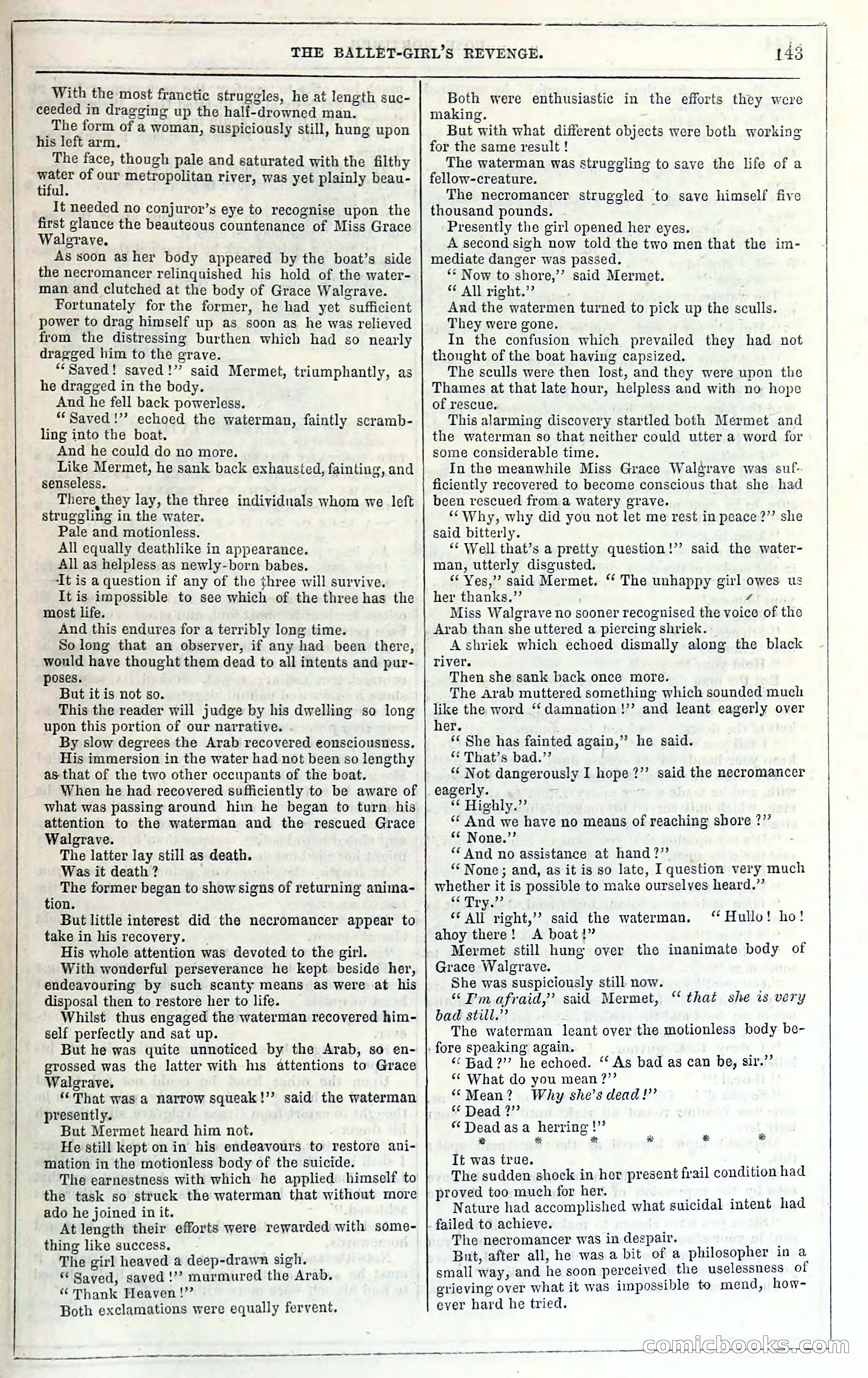
A restored page from Penny Dreadfuls, 1865. Page through the whole issue in the reader above.
📄 Transcribed text from this page (OCR, searchable)
Machine-transcribed from the original scan — historical spelling and the odd misread are preserved.
————— ——_ =. SS THE BALLET-GIRL’S REVENGE. a ee Se _*....__ With the most franctic struggles, he at length suc- ceeded in dragging up the half-drowned man. The form of a woman, suspiciously still, hung upon his left arm. The face, though pale and saturated with the filthy ti of our metropolitan river, was yet plainly beau- It needed no conjuror’s eye to recognise upon the first glance the beauteous countenance of Miss Grace Walgrave. As soon as her body appeared by the boat’s side the necromancer relinquished his hold of the water- man and clutched at the body of Grace Walgrave. Fortunately for the former, he had yet sufficient power to drag himself up as soon as he was relieved from the distressing burthen which had so nearly dragged him to the grave. “Saved! saved!” said Mermet, triumphantly, as he dragged in the body. And he fell back powerless. “Saved!” echoed the waterman, faintly scramb- ling into the boat. And he could do no more. Like Mermet, he sank back exhausted, fainting, and senseless. There they lay, the three individuals whom we left struggling in the water. Pale and motionless. All equally deathlike in appearance. All as helpless as newly-born babes. It is a question if any of the three will survive. It is impossible to see which of the three has the most life. And this endures for a terribly long time. So long that an observer, if any had been there, would have thought them dead to all intents and pur- poses. But it is not so. This the reader will judge by his dwelling so long upon this portion of our narrative. By slow degrees the Arab recovered eonsciousness. His immersion in the water had not been so lengthy as that of the two other occupants of the boat. When he had recovered sufficiently to be aware of what was passing around him he began to turn his attention to the waterman and the rescued Grace Walgrave. The latter lay still as death. Was it death ? | The former began to show signs of returning anima- tion. But little interest did the necromancer appear to take in his recovery. | His whole attention was devoted to the girl. With wonderful perseverance he kept beside her, endeavouring by such scanty means as were at his disposal then to restore her to life. Whilst thus engaged the waterman recovered him- self perfectly and sat up. But he was quite unnoticed by the Arab, so en- | grossed was the latter with his attentions to Grace Walgrave. ‘That was a narrow squeak!” said the waterman presently. But Mermet heard him not. He still kept on in his endeavours to restore ani- mation in the motionless body of the suicide. The earnestness with which he applied himself to the task so struck the waterman that without more ado he joined in it. At length their efforts were rewarded with some- thing like success, The girl heaved a deep-drawn sigh. * Saved, saved !”? murmured the Arab. ‘Thank Heaven !” Both exclamations were equally fervent. ee Oo Both were enthusiastic in the efforts they were making. But with what different objects were both working for the same result ! The waterman was struggling to save the life of a fellow-creature. The necromancer struggled to save himself five thousand pounds. Presently the girl opened her eyes, A second sigh now told the two men that the im- mediate danger was passed. ** Now to shore,’”’? said Mermet. cf All rieht.7? And the watermen turned to pick up the sculls. They were gone. In the confusion which prevailed they had not thought of the boat having capsized. The sculls were then lost, and they were upon the Thames at that late hour, helpless and with no hope of rescue. This alarming discovery startled both Mermet and the waterman so that neither could utter a word for some considerable time. In the meanwhile Miss Grace Walérave was suf-. ficiently recovered to become conscious that she had been rescued from a watery grave. *‘ Why, why did you not let me rest in peace?” she said bitterly. ‘¢ Well that’s a pretty question!’’ said the water- man, utterly disgusted. ‘* Yes,’ said Mermet. ‘* The unhappy girl owes us her thanks.”’ 4 Miss Walgrave no sooner recognised the voice of the Arab than she uttered a piercing shriek. A shriek which echoed dismally along the black river. Then she sank back once more. The Arab muttered something which sounded much like the word “‘ damnation !’’? and leant eagerly over her. *¢ She has fainted again,” he said. *‘ That’s bad.’’ *‘ Not dangerously I hope ?”’ said the necromancer eagerly. “¢ Hiehly.”’ ‘* And we have no means of reaching shore ?” ‘* None.’’ “And no assistance at hand ?’’ *‘ None; and, as it is so late, I question very much whether it is possible to make ourselves heard.” Try.” ‘F All right,’? said the waterman. ahoy there! <A boat!” Mermet still hung over the inanimate body of Grace Walgrave. She was suspiciously still now. ‘I’m afraid,’ said Mermet, ‘ that she ts very bad still.” : The waterman leant over the motionless body be- fore speaking again. ‘‘ Bad?” he echoed. “‘ As bad as can be, sir.” ‘* What do you mean ?”’ * Hullo! ho! ‘Mean? Why she’s dead!” ** Dead 2?” * Dead asa herring!” It was true. e The sudden shock in her present frail condition had proved too much for her. us Nature had accomplished what suicidal intent had failed to achieve. The necromancer was in despair. But, after all, he was a bit of a philosopher in a small way, and he soon perceived the uselessness of grieving over what it was impossible to mend, how- ever hard he tried. 148 secsietlliantheteemaiiidanicmaamiade ee = es Rene aE al a a ——————— —— —— — ————— —