
Penny Dreadfuls, 1865 · page 86 of 204
Rose Mortimer; Or, The Ballet-Girl's Revenge — page 86: what you’re looking at
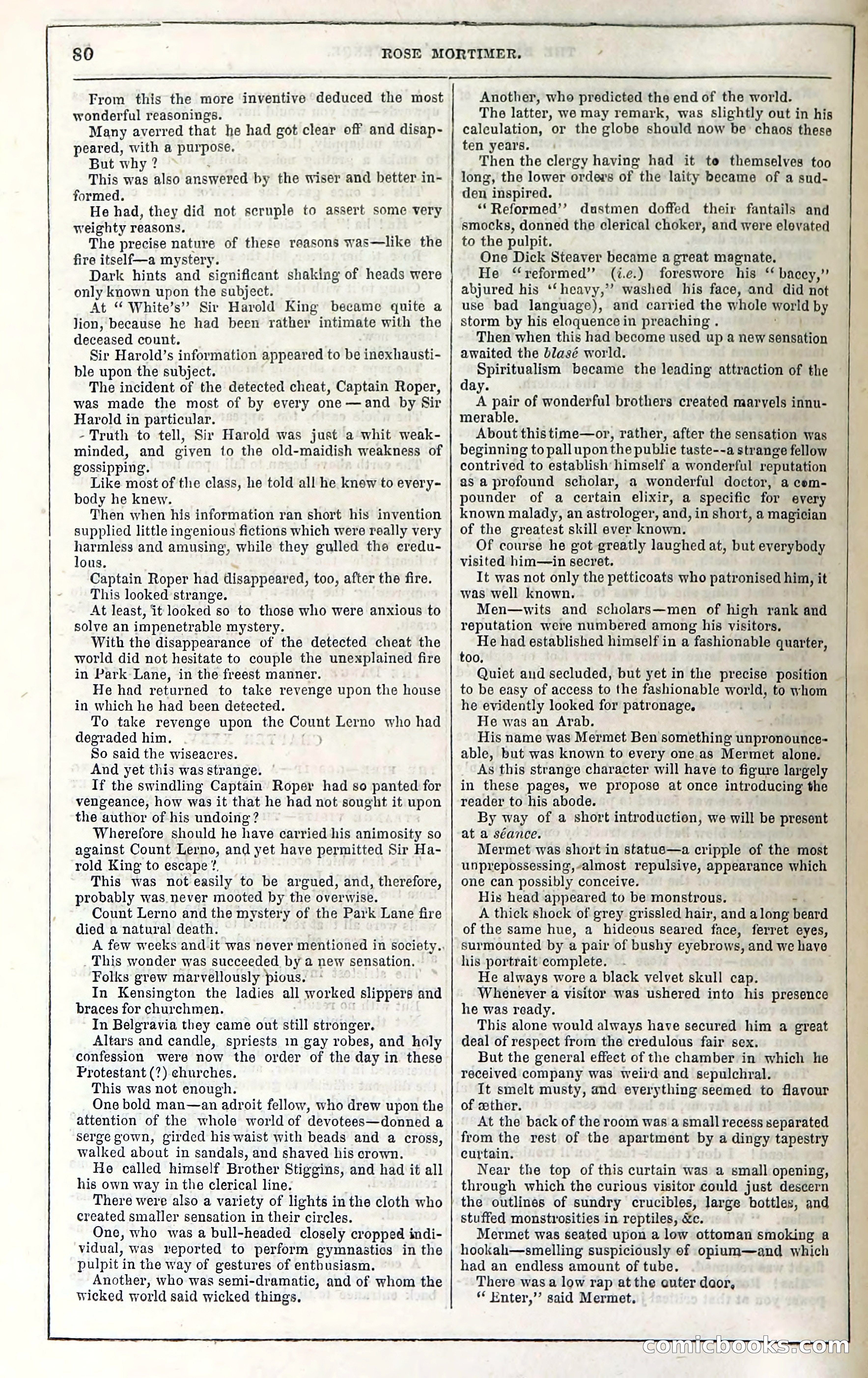
A restored page from Penny Dreadfuls, 1865. Page through the whole issue in the reader above.
📄 Transcribed text from this page (OCR, searchable)
Machine-transcribed from the original scan — historical spelling and the odd misread are preserved.
80 From this the more inventive deduced the most wonderful reasonings. Many averred that he had got clear off and disap- peared, with a purpose. But why ? This was also answered by the wiser and better in- formed. He had, they did not scruple to assert some very weighty reasons. The precise nature of these reasons was—like the fire itself—a mystery. Dark hints and significant shaking of heads were only known upon the subject. At “‘ White’s” Sir Harold King became quite a Jion, because he had been rather intimate with the deceased count. Sir Harold’s information appeared to be inexhausti- ble upon the subject. The incident of the detected cheat, Captain Roper, was made the most of by every one —and by Sir Harold in particular. - Truth to tell, Sir Harold was just a whit weak- minded, and given to the old-maidish weakness of gossipping. Like most of the class body he knew. Then when his information ran short his invention supplied little ingenious fictions which were really very harmless and amusing, while they gulled the credu- lous. Captain Roper had disappeared, too, after the fire. This looked strange. At least, it looked so to those who were anxious to solve an impenetrable mystery. With the disappearance of the detected cheat the world did not hesitate to couple the unexplained fire in Park Lane, in the freest manner. He had returned to take revenge upon the house in which he had been detected. To take revenge upon the eouNt Lerno who had degraded him. So said the wiseacres. And yet this was strange. If the swindling Captain Roper had so panted for vengeance, how was it that he had not sought it upon the author of his undoing? Wherefore should he have carried his animosity so against Count Lerno, and yet have permitted Sir Ha- rold King to escape ?, This was not easily to be argued, and, therefore, probably was never mooted by the overwise. Count Lerno and the mystery of the Park Lane fire died a natural death. , he told all he knew to every- A few weeks and it was never mentioned in Society.. _ This wonder was succeeded by a new sensation. Folks grew marvellously pious. In Kensington the ladies all worked slippers and braces for churchmen. In Belgravia they came out still stronger. Altars and candle, spriests 1n gay robes, and holy confession were now the order of the day in these Protestant (?) ehurches. This was not enough. One bold man—an adroit fellow, who drew upon the attention of the whole world of devotees—donned a serge gown, girded his waist with beads and a cross, walked about in sandals, and shaved his crown. He called himself Brother Stiggins, and had it all his own way in the clerical line. There were also a variety of lights in the cloth who created smaller sensation in their circles. One, who was a bull-headed closely cropped indi- vidual, was reported to perform gymnastics in the pulpit i in the way of gestures of enthusiasm. Another, who was semi-dramatic, and of whom the wicked world said wicked things. ROSE MORTIMER. , Another, who predicted the end of the world. The latter, we may remark, was slightly out in his calculation, or the globe should now be chaos these ten years. | Then the clergy having had it te themselves too long, the lower orders of the laity became of a sud- den inspired. “Reformed”? duastmen doffed their fantails and smocks, donned the clerical choker, and were elevated to the pulpit. One Dick Steaver became a great magnate. He “ reformed’ (i.e.) foreswore his ‘‘ bacey,” abjured his ‘‘heavy,’’ washed his face, and did not use bad language), and carried the whole world by storm by his eloquence in preaching . > ir] Then when this had become used up a new sensation awaited the blasé world. Spiritualism became the leading attraction of the day. A pair of wonderful brothers created marvels innu- merable. About this time—or, rather, after the sensation was beginning to pallupon the publie tuste--a strange fellow contrived to establish himself a wonderful reputation as a profound scholar, a wonderful doctor, a com- pounder of a certain elixir, a specific for every known malady, an astrologer, and, in short, a magician of the greatest skill ever known. Of course he got greatly laughed at, but everybody visited him—in secret. It was not only the petticoats who patronised him, it was well known. Men—wits and scholars—men of high rank and reputation were numbered among his visitors, He had established himself in a fashionable quarter, too, Quiet aud secluded, but yet in the precise position to be easy of access to the fashionable world, fo whom he evidently looked for patronage. He was an Arab. His name was Mermet Ben something unpronounce- able, but was known to every one as Mermet alone. As this strange character will have to figure largely in these pages, we propose at once introducing the reader to his abode. By way of a short introduction, we will be present at a séance. Mermet was short in statue—a cripple of the most unprepossessing,-almost repulsive, appearance which one can possibly conceive. His head appeared to be monstrous. A thick shock of grey grissled hair, and along beard of the same hue, a_ hideous seared face, ferret eyes, surmounted by a pair of bushy eyebrows, and we have his portrait complete. He always wore a black velvet skull cap. Whenever a visitor was ushered into his presence he was ready. This alone would always have secured him a great deal of respect from the credulous fair sex. But the general effeet of the chamber in which he received company was weird and sepulchral. It smelt musty, and everything seemed to flavour of zether. At the back of the room was a small recess separated from the rest of the apartment by a dingy tapestry curtain. Near the top of this curtain was a small opening, through which the curious visitor could just descern the outlines of sundry crucibles, large bottles, and stuffed monstrosities in reptiles, &c. Mermet was seated upon a low ottoman smoking a hookah—smelling suspiciously of opium—and which had an endless amount of tube. There was a low rap at the outer daor, ** Enter,’”’ said Mermet. \ Om