
Penny Dreadfuls, 1865 · page 13 of 204
Rose Mortimer; Or, The Ballet-Girl's Revenge — page 13: what you’re looking at
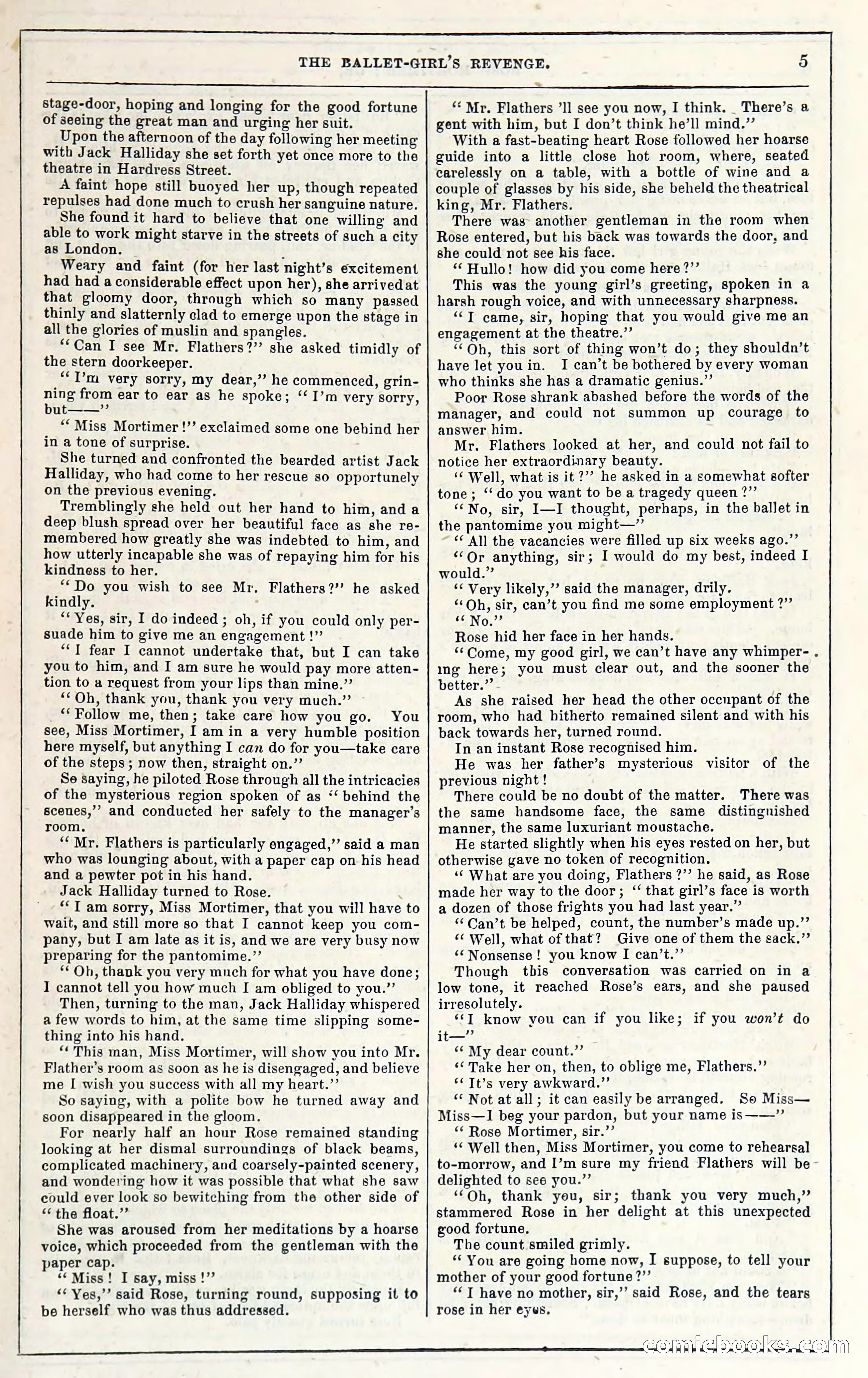
A restored page from Penny Dreadfuls, 1865. Page through the whole issue in the reader above.
📄 Transcribed text from this page (OCR, searchable)
Machine-transcribed from the original scan — historical spelling and the odd misread are preserved.
THE BALLET-GIRL’S REVENGE. 3) SE -eEE E S ———EE——————E——E————— ee stage-door, hoping and longing for the good fortune of seeing the great man and urging her suit. Upon the afternoon of the day following her meeting with Jack Halliday she set forth yet once more to the theatre in Hardress Street. A faint hope still buoyed her up, though repeated repulses had done much to crush her sanguine nature. She found it hard to believe that one willing and able to work might starve in the streets of such a city as London. : Weary and faint (for her last night’s excitement had had a considerable effect upon her), she arrivedat that gloomy door, through which so many passed thinly and slatternly clad to emerge upon the stage in all the glories of muslin and spangles. “‘Can I see Mr. Flathers?”’ she asked timidly of the stern doorkeeper. “I’m very sorry, my dear,’’ he commenced, grin- eu from ear to ear as he spoke; ‘‘ I’m very sorry, u tian eee ‘* Miss Mortimer !”’ exclaimed some one behind her in a tone of surprise. She turned and confronted the bearded artist Jack Halliday, who had come to her rescue so opportunely on the previous evening. > Tremblingly she held out her hand to him, and a deep blush spread over her beautiful face as she re- membered how greatly she was indebted to him, and how utterly incapable she was of repaying him for his kindness to her. ““Do you wish to see Mr. Flathers?”’ he asked kindly. “Yes, sir, I do indeed ; oh, if you could only per- suade him to give me an engagement !”” “‘I fear I cannot undertake that, but I can take you to him, and I am sure he would pay more atten- tion to a request from your lips than mine.” “Oh, thank you, thank you very much.” ‘* Follow me, then; take care how you go. You see, Miss Mortimer, I am in a very humble position here myself, but anything I can do for you—take care of the steps; now then, straight on.”’ Se saying, he piloted Rose through all the intricacies of the mysterious region spoken of as “‘ behind the scenes,’’ and conducted her safely to the manager’s room, ‘“ Mr. Flathers is particularly engaged,” said a man who was lounging about, with a paper cap on his head and a pewter pot in his hand. Jack Halliday turned to Rose. *‘T am sorry, Miss Mortimer, that you will have to wait, and still more so that I cannot keep you com- pany, but I am late as it is, and we are very busy now preparing for the pantomime.’’ ** Oh, thank you very much for what you have done; I cannot tell you how much I am obliged to you.”’ Then, turning to the man, Jack Halliday whispered a few words to him, at the same time slipping some- thing into his hand. ‘This man, Miss Mortimer, will show you into Mr. Flather’s room as soon as he is disengaged, and believe me I wish you success with all my heart.”’ So saying, with a polite bow he turned away and soon disappeared in the gloom. For nearly half an hour Rose remained standing looking at her dismal surroundings of black beams, complicated machinery, and coarsely-painted scenery, and wondering how it was possible that what she saw could ever look so bewitching from the other side of “‘ the float.” She was aroused from her meditations by a hoarse voice, which proceeded from the gentleman with the paper cap. ‘¢ Miss! I say, miss !” ‘¢ Yes,’’ said Rose, turning round, supposing it to be herself who was thus addressed. ‘* Mr. Flathers ’1] see you now, I think. There’s @ gent with him, but I don’t think he’ll mind.’’ With a fast-beating heart Rose followed her hoarse guide into a little close hot room, where, seated carelessly on a table, with a bottle of wine and a couple of glasses by his side, she beheld the theatrical king, Mr. Flathers. There was another gentleman in the room when Rose entered, but his back was towards the door, and she could not see his face. ‘‘ Hullo! how did you come here ?”’ This was the young girl’s greeting, spoken in a harsh rough voice, and with unnecessary sharpness. ‘T came, sir, hoping that you would give me an engagement at the theatre.”’ ““Oh, this sort of thing won’t do; they shouldn’t have let youin. I can’t be bothered by every woman who thinks she has a dramatic genius.”’ Poor Rose shrank abashed before the words of the manager, and could not summon up courage to answer him. Mr. Flathers looked at her, and could not fail to notice her extraordinary beauty. ‘© Well, what is it ?’’ he asked in a somewhat softer tone; ‘‘do you want to be a tragedy queen ?”’ ‘No, sir, I—I thought, perhaps, in the ballet in the pantomime you might—”’ << All the vacancies were filled up six weeks ago.”’ ‘Or anything, sir; I would do my best, indeed I would.” ‘< Very likely,’”’ said the manager, drily. “Oh, sir, can’t you find me some employment ?” “ce No.’” Rose hid her face in her hands. “‘Come, my good girl, we can’t have any whimper- ing here; you must clear out, and the sooner the better.”’ - As she raised her head the other occupant of the room, who had hitherto remained silent and with his back towards her, turned round. In an instant Rose recognised him. He was her father’s mysterious visitor of the previous night! There could be no doubt of the matter. There was the same handsome face, the same distinguished manner, the same luxuriant moustache. He started slightly when his eyes rested on her, but otherwise gave no token of recognition. ‘‘ What are you doing, Flathers ?”’ he said, as Rose made her way to the door; ‘‘ that girl’s face is worth a dozen of those frights you had last year.” ‘“Can’t be helped, count, the number’s made up.’’ “¢ Well, what of that? Give one of them the sack.” ‘““Nonsense! you know I can’t.”’ Though this conversation was carried on in a low tone, it reached Rose’s ears, and she paused irresolutely. ‘¢T know you can if you like; if you won’t do it—— “¢ My dear count.”’ ‘¢ Take her on, then, to oblige me, Flathers.”’ ‘¢Tt’s very awkward.”’ “‘ Not at all; it can easily be arranged. So Miss— Miss—I beg your pardon, but your name is——”’ “‘ Rose Mortimer, sir.’’ ‘¢ Well then, Miss Mortimer, you come to rehearsal to-morrow, and I’m sure my friend Flathers will be- delighted to see you.”’ ‘Oh, thank you, sir; thank you very much,” stammered Rose in her delight at this unexpected good fortune. The count smiled grimly. “You are going home now, I suppose, to tell your mother of your good fortune ?”’ ‘‘T have no mother, sir,’’ said Rose, and the tears rose in her eyes. Ia ANKE OLOLOY COV AM