
Penny Dreadfuls, 1865 · page 141 of 204
Rose Mortimer; Or, The Ballet-Girl's Revenge — page 141: what you’re looking at
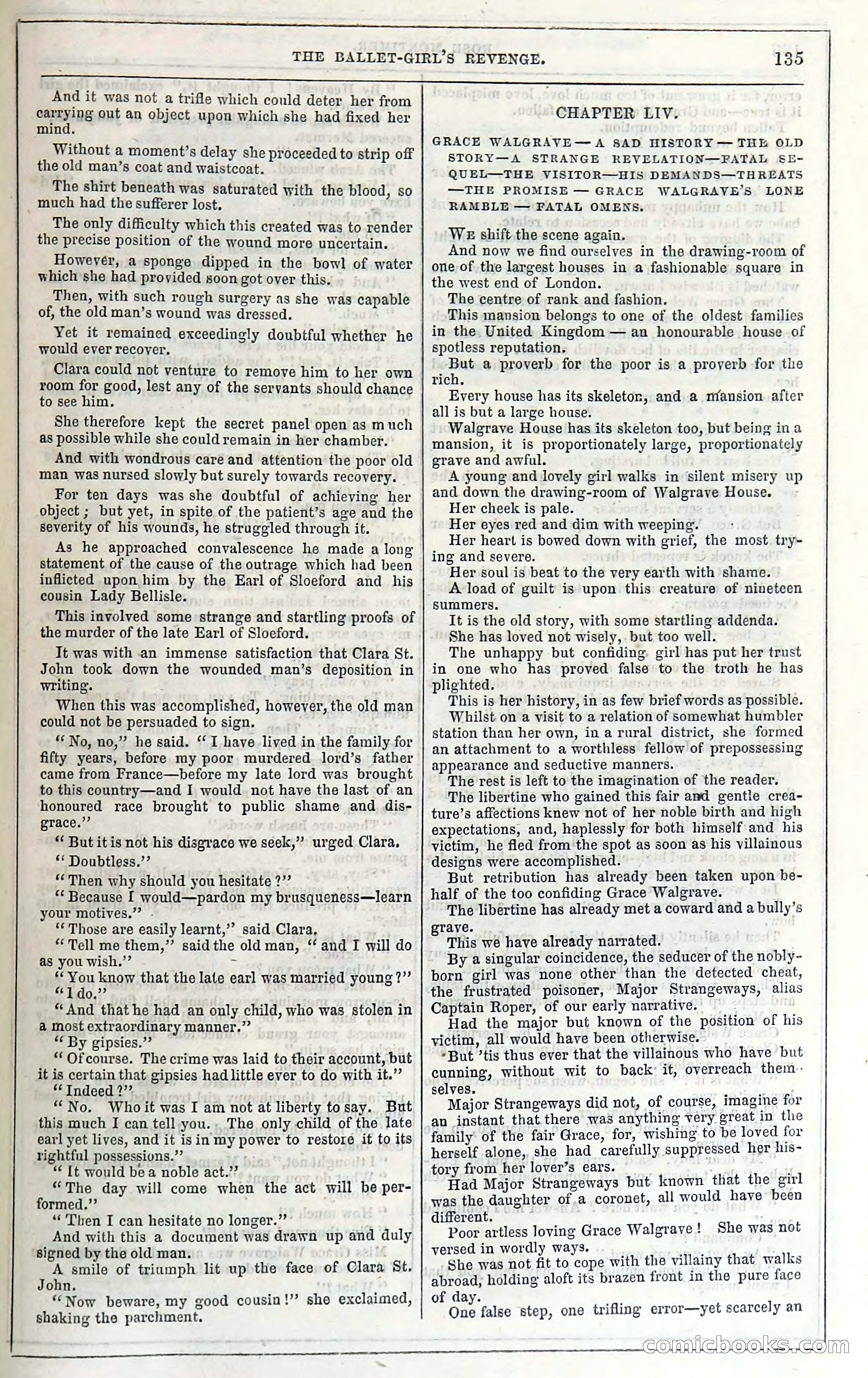
A restored page from Penny Dreadfuls, 1865. Page through the whole issue in the reader above.
📄 Transcribed text from this page (OCR, searchable)
Machine-transcribed from the original scan — historical spelling and the odd misread are preserved.
THE BALLET-GIRL’S REVENGE. A a a And it was not a trifle which could deter her from carrying out an object upon which she had fixed her mind. Without a moment’s delay she proceeded to strip off the old man’s coat and waistcoat. The shirt beneath was saturated with the blood > SO much had the sufferer lost. The only difficulty which this created was to render the precise position of the wound more uncertain. However, a sponge dipped in the bowl of water which she had provided soon got over this, Then, with such rough surgery as she was capable of, the old man’s wound was dressed. Yet it remained exceedingly doubtful whether he would ever recover, Clara could not venture to remove him to her own room for good, lest any of the seryants should chance to see him. She therefore kept the secret panel open as much as possible while she could remain in her chamber. And with wondrous care and attention the poor old man was nursed slowly but surely towards recovery. For ten days was she doubtful of achieving her object ; but yet, in spite of the patient’s age and the severity of his wounds, he struggled throuch it. As he approached convalescence he made a long statement of the cause of the outrage which had been inflicted upon him by the Earl of Sloeford and his cousin Lady Bellisle. This involved some strange and startling proofs of the murder of the late Earl of Sloeford. It was with an immense satisfaction that Clara St. John took down the wounded man’s deposition in writing. When this was accomplished, however, the old man could not be persuaded to sign. ‘No, no,” he said. ‘‘ I have lived in the family for fifty years, before my poor murdered lord’s father came from France—before my late lord was brought to this country—and I would not have the last of an honoured race brought to public shame and dis- grace.” ** But it is not his disgrace we seek,”’ urged Clara, ** Doubtless.”’ ‘Then why should you hesitate ?” *‘ Because [ would—pardon my brusqueness—learn your motives.” . *‘ Those are easily learnt,’’ said Clara. ** Tell me them,” said the old man, ‘ and I will do as you wish.”’ . on know that the late earl was married young ?”’ 6 do.” * And that he had an only child, who was stolen in a most extraordinary manner,” *¢ By gipsies.”’ | “Ofcourse. The crime was laid to their account, but it is certain that gipsies had little ever to do with it.” *‘ Indeed 2”” “No. Whoit was I am not at liberty tosay. But this much I can tell you.. The only child of the late earl yet lives, and it isin my power to restore it to its rightful possessions.” ‘It would bea noble act.” “The day will come when the act will be per- formed.” “‘ Then I can hesitate no longer.” And with this a document was drawn up and duly signed by the old man. A smile of triumph lit up the face of Clara St. John, “Now beware, my good cousin!” she exclaimed, shaking the parchment. CHAPTER LIV. GRACE WALGRAVE—A SAD HISTORY — THE OLD STORY—A STRANGE REVELATION—FATAL SE- QUEL—THE VISITOR—HIS DEMANDS—THREATS —THE PROMISE — GRACE WALGRAYE’S LONE RAMBLE — FATAL OMENS. WE shift the scene again. And now we find ourselves in the drawing-room of one of the largest houses in a fashionable square in the west end of London. The centre of rank and fashion. This mansion belongs to one of the oldest families in the United Kingdom — an honourable house of spotless reputation. But a proverb for the poor is a proverb for the rich. Every house has its skeleton, and a mansion after all is but a large house. Walgrave House has its skeleton too, but being ina mansion, it is proportionately large, proportionately grave and awful. A young and lovely girl walks in silent misery up and down the drawing-room of Walgrave House. Her cheek is pale. Her eyes red and dim with weeping. Her heart is bowed down with grief, the most try- ing and severe. Her soul is beat to the very earth with shame. A load of guilt is upon this creature of nineteen summers. It is the old story, with some startling addenda. She has loved not wisely, but too well. The unhappy but confiding, girl has put her trust in one who has proved false to the troth he has plighted. This is her history, in as few brief words as possible. Whilst on a visit to a relation of somewhat humbler station than her own, in arural district, she formed an attachment to a worthless fellow of prepossessing appearance and seductive manners. The rest is left to the imagination of the reader. The libertine who gained this fair and gentle crea- ture’s affections knew not of her noble birth and high expectations, and, haplessly for both himself and his victim, he fled from the spot as soon as his villainous designs were accomplished. But retribution has already been taken upon be- half of the too confiding Grace Walgrave. The libertine has already met a coward and a bully’s grave. This we have already narrated. By a singular coincidence, the seducer of the nobly- born girl was none other than the detected cheat, the frustrated poisoner, Major Strangeways, alias Captain Roper, of our early narrative. Had the major but known of the position of his victim, all would have been otherwise. *But ’tis thus ever that the villainous who have but cunning, without wit to back’ it, overreach them. selves. : 3 Major Strangeways did not, of course, imagine for an instant that there was anything very great in the family of the fair Grace, for, wishing to be loved for herself alone, she had carefully suppressed her his- tory from her lover’s ears. Had Major Strangeways but known that the girl was the daughter of.a coronet, all would have been different. Poor artless loving Grace Walgrave ! ‘sed in wordly ways. ve she was not fit teane with the villainy that walks abroad, holding aloft its brazen front in the pure face of day. a One false step, one trifling error—yet scarcely an 3 She was not