
Penny Dreadfuls, 1865 · page 122 of 204
Rose Mortimer; Or, The Ballet-Girl's Revenge — page 122: what you’re looking at
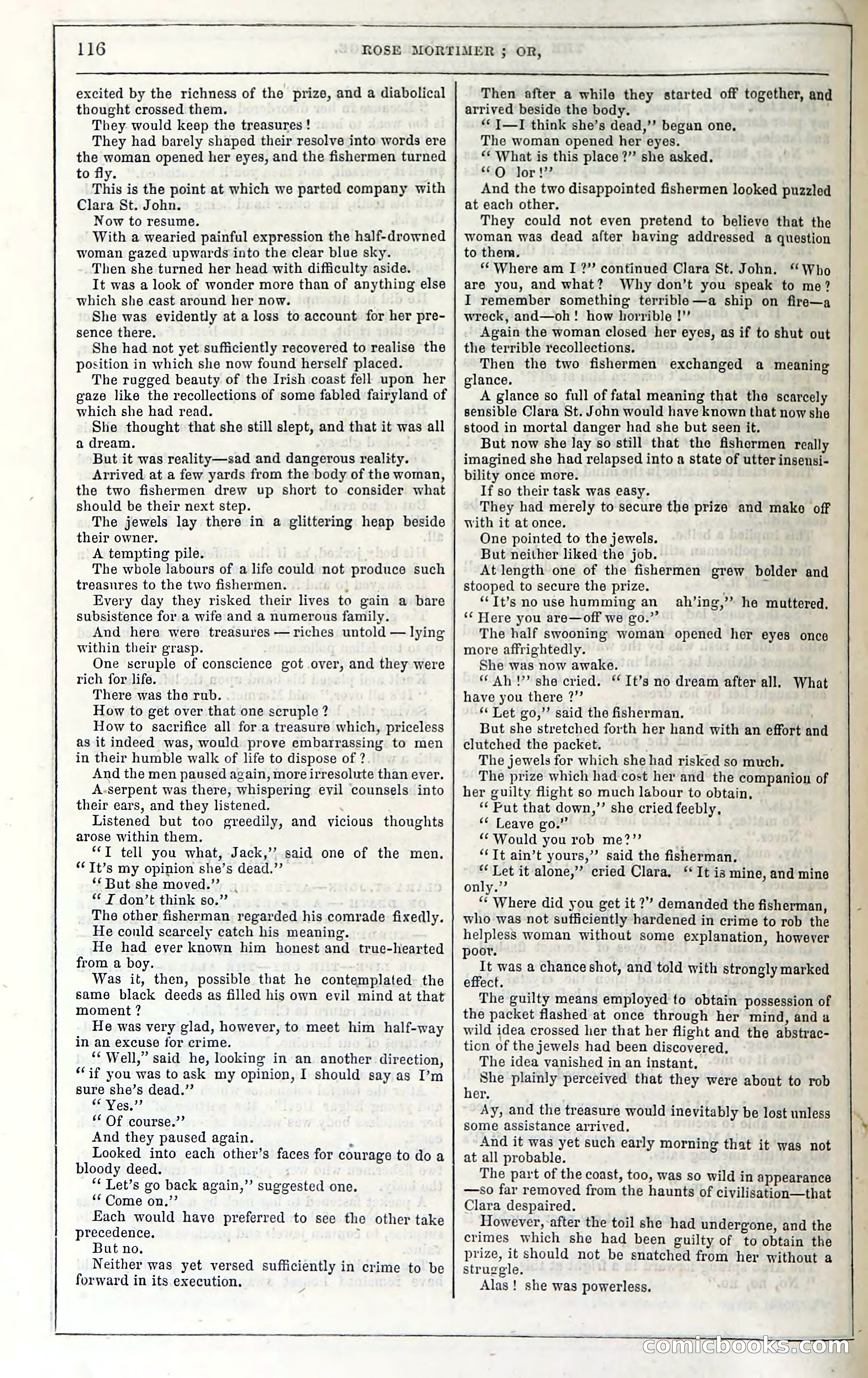
A restored page from Penny Dreadfuls, 1865. Page through the whole issue in the reader above.
📄 Transcribed text from this page (OCR, searchable)
Machine-transcribed from the original scan — historical spelling and the odd misread are preserved.
116 ROSE MORTIMER ; OR, excited by the richness of the prize, and a diabolical thought crossed them. They would keep the treasures ! They had barely shaped their resolve into words ere the woman opened her eyes, and the fishermen turned to fly. This is the point at which we parted company with Clara St. John. ; Now to resume. With a wearied painful expression the half-drowned woman gazed upwards into the clear blue sky. Then she turned her head with difficulty aside. It was a look of wonder more than of anything else which she cast around her now. She was evidently at a loss to account for her pre- sence there. She had not yet sufficiently recovered to realise the position in which she now found herself placed. The rugged beauty of the Irish coast fell upon her gaze like the recollections of some fabled fairyland of which she had read. She thought that she still slept, and that it was all a dream. But it was reality—sad and dangerous reality. Arrived at a few yards from the body of the woman, the two fishermen drew up short to consider what should be their next step. The jewels lay there in a glittering heap beside their owner. A tempting pile. The whole labours of a life could not produce such treasures to the two fishermen. j Every day they risked their lives to gain a bare subsistence for a wife and a numerous family. And here were treasures —riches untold — lying within their grasp. One scruple of conscience got over, and they were rich for life. There was the rub. How to get over that one scruple ? How to sacrifice all for a treasure which, priceless as it indeed was, would prove embarrassing to men in their humble walk of life to dispose of ? And the men paused again, more irresolite than ever. A-serpent was there, whispering evil counsels into their ears, and they listened. Listened but too greedily, and vicious thoughts arose within them. “IT tell you what, Jack,’’ said one of the men. ‘It’s my opinion she’s dead.”’ ‘* But she moved.”’ “* T don’t think so.” The other fisherman regarded his comrade fixedly. He could scarcely catch his meaning. He had ever known him honest and true-hearted from a boy. Was it, then, possible that he contemplated the same black deeds as filled his own evil mind at that moment ? He was very glad, however, to meet him half-way in an excuse for crime. ‘* Well,” said he, looking in an another direction, ‘if you was to ask my opinion, I should say as I’m sure she’s dead.” 79 Yes.’ ‘“ Of course.”’ And they paused again. . Looked into each other’s faces for courage to do a bloody deed. ‘* Let’s go back again,” suggested one. ‘Come on.”’ Each would have preferred to see the other take precedence. But no. Neither was yet versed sufficiently in crime to be forward in its execution. Then after a while they started off together, and arrived beside the body. ; . ‘‘T—I think she’s dead,’’ began one. The woman opened her eyes. ** What is this place?” she asked. ‘2Q'“or And the two disappointed fishermen looked puzzled at each other. They could not even pretend to believe that the woman was dead after having addressed a question to them. ‘Where am I ?”’ continued Clara St. John. ‘Who are you, and what? Why don’t you speak to me? I remember something terrible—a ship on fire—a wreck, and—oh! how horrible !” Again the woman closed her eyes, as if to shut out the terrible recollections. Then the two fishermen exchanged a meaning glance. A glance so full of fatal meaning that the scarcely sensible Clara St. John would have known that now she stood in mortal danger had she but seen it. But now she lay so still that the fishermen really imagined she had relapsed into a state of utter insensi- bility once more. If so their task was easy. They had merely to secure the prize and make off with it at once. One pointed to the jewels. But neither liked the job. At length one of the fishermen grew bolder and stooped to secure the prize. “It’s no use humming an ‘¢ Here you are—off we go.”’ The half swooning woman opened her eyes once more affrightedly. She was now awake. * Ah!” she cried. “ It’s no dream after all. What have you there ?” ** Let go,’’ said the fisherman. But she stretched forth her hand with an effort and clutched the packet. The jewels for which she had risked so much. The prize which had cost her and the companion of her guilty flight so much labour to obtain, ** Put that down,”’ she cried feebly, ‘* Leave go.” ‘Would you rob me?”’ ; “‘Tt ain’t yours,”’ said the fisherman, “Let it alone,” cried Clara, “ It is mine, and mine only.” ‘ Where did you get it ?” demanded the fisherman, who was not sufficiently hardened in crime to rob the helpless woman without some explanation, however poor. ont was a chance shot, and told with strongly marked effect. The guilty means employed to obtain possession of the packet flashed at once through her mind, and a wild idea crossed her that her flight and the abstrac- tion of the jewels had been discovered, The idea vanished in an instant. She plainly perceived that they were about to rob er. Ay, and the treasure would inevitably be lost unless some assistance arrived. And it was yet such early morning that it was not at all probable. The part of the coast, too, was so wild in appearance —so far removed from the haunts of civilisation—that Clara despaired. However, after the toil she had undergone, and the crimes which she had been guilty of to obtain the prize, it should not be snatched from her without a struggle. Alas! she was powerless. ah’ing,” he muttered, (COMICLOOOKES com