
Penny Dreadfuls, 1865 · page 181 of 204
Rose Mortimer; Or, The Ballet-Girl's Revenge — page 181: what you’re looking at
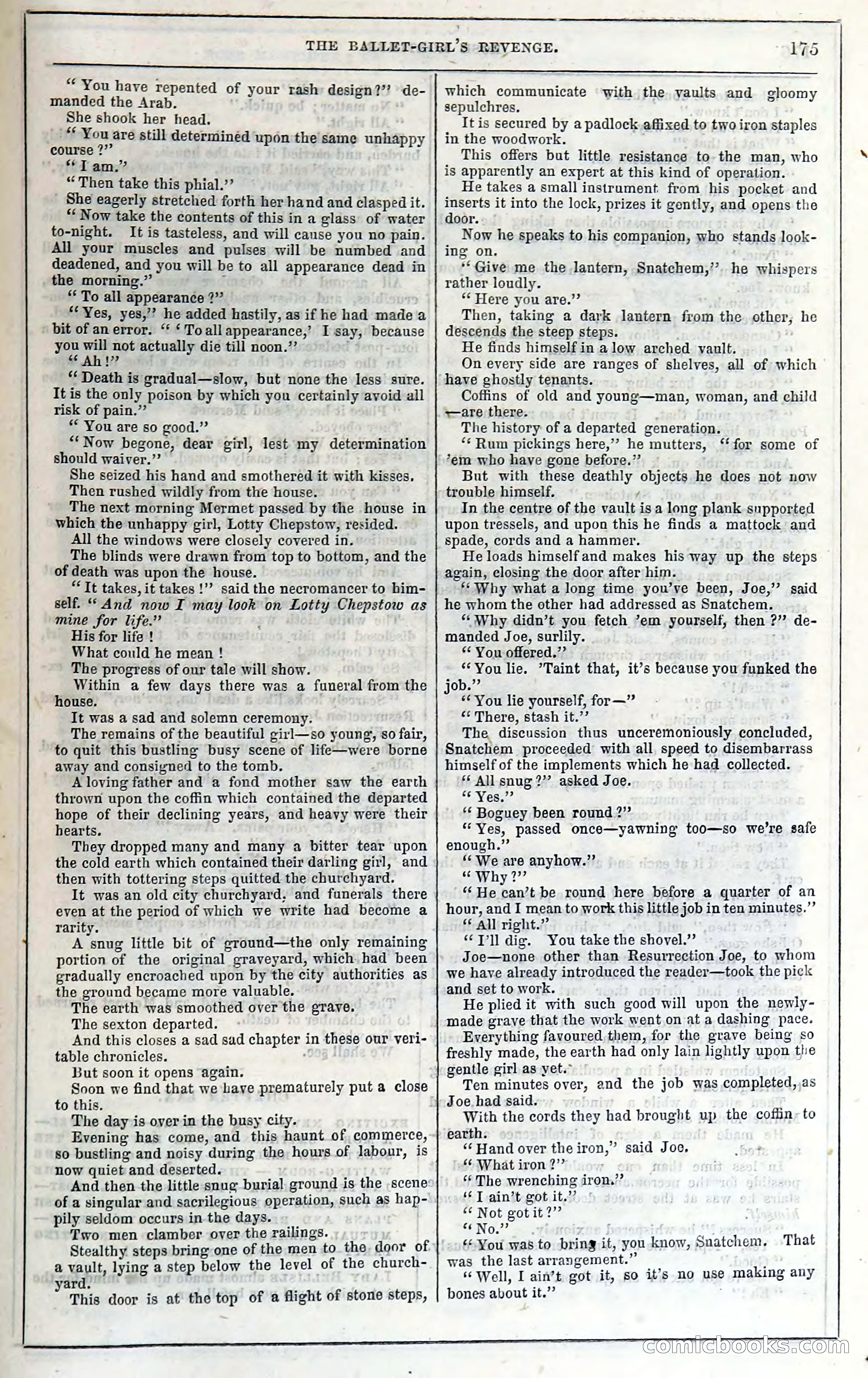
A restored page from Penny Dreadfuls, 1865. Page through the whole issue in the reader above.
📄 Transcribed text from this page (OCR, searchable)
Machine-transcribed from the original scan — historical spelling and the odd misread are preserved.
THE BALLET-GIRL’S REVENGE. 175 ee ene OER “You have repented of your rash: design?”? de- manded the Arab. a ro ° She shook her head. _ * You are still determined are upon the same unhappy ffLam/? “Then take this phial.”’ _ She eagerly stretched forth her hand and clasped it. “‘ Now take the contents of this in a glass of water to-night. It is tasteless, and will cause you no pain. All your muscles and pulses will be numbed and deadened, and you will be to all appearance dead in _the morning.” 4 “‘ To all appearance ?” ** Yes, yes,’”? he added hastily, as if he had made a - bit of an error. “ ‘ Toallappearance,’ I say, because you will not actually die till noon.’’ “se Ah $7? ; ** Death is gradual—slow, but none the less sure. It is the only poison by which you certainly avoid all risk of pain.” ** You are so good.” “Now begone, dear girl, lest my determination should waiver.” | She seized his hand and smothered it with kisses. Then rushed wildly from the house. The next morning Mermet passed by the house in which the unhappy girl, Lotty Chepstow, resided. All the windows were closely covered in. The blinds were drawn from top to bottom, and the of death was upon the house. “Tt takes, it takes !’’ said the necromancer to him- self. ““ And now I may look on Lotty Chepstow as mine for life.” His for life ! What could he mean ! The progress of our tale will show. Within a few days there was a funeral from the house. It was a sad and solemn ceremony. _ The remains of the beautiful girl—so young, so fair, to quit this bustling busy scene of life—were borne away and consigned to the tomb. A loving father and a fond mother saw the earth thrown upon the coffin which contained the departed hope of their declining years, and heayy were their hearts. They dropped many and many a bitter tear upon the cold earth which contained their darling girl, and then with tottering steps quitted the churchyard. It was an old city churchyard, and funerals there even at the period of which we write had become a rarity. A snug little bit of ground—the only remaining portion of the original graveyard, which had been gradually encroached upon by the city authorities as the ground became more valuable. The earth was smoothed over the grave. The sexton departed. And this closes a sad sad chapter in these our veri- table chronicles. But soon it opens again. Soon we find that we haye prematurely put a close to this. The day is over in the busy city. Evening has come, and this haunt of commerce, so bustling and noisy during the hours of labour, is now quiet and deserted. And then the little snug burial. ground is the scene: of a singular and sacrilegious operation, such as hap- pily seldom occurs in the days. Two men clamber over the railings. Stealthy steps bring one of the men to the door of a vault, lying a step below the level of the church- ard. if This door is at the top of a flight of stone steps, which communicate with the yaults and sepulchres. It is secured by a padlock.affixed to two iron staples in the woodwork. This offers but little resistance to-the man, who is apparently an expert at this kind of operation. He takes a small instrument from his pocket and ee it into the lock, prizes it gently, and opens the oor. _ Now he speaks to his companion, who stands look- ing on. ‘Give me the lantern, Snatchem,’?. he whispers rather loudly. ** Here you are.” Then, taking a dark lantern from the other, he descends the steep steps. He finds himself in alow arched vault. On every side are ranges of shelves, all of which have ghostly tenants. Coffins of old and young—man, woman, and child ~—are there. : The history of a departed generation. “‘ Rum pickings here,” he mutters, ‘‘ for some of ?em who have gone before.’ But with these deathly objects he does not now trouble himself. / In the centre of the vault isa long plank supported upon tressels, and upon this he finds a mattock and spade, cords and a hammer. He loads himself and makes his way up the steps again, elosing the door after him. ‘* Why what a long time you’ve been, Joe,’ said he whom the other had addressed as Snatchem. ** Why didn’t you fetch ’em yourself, then ?”? de- manded Joe, surlily. ** You offered.” ‘You lie. ’Taint that, it’s because you funked the gloomy job.” ‘You lie yourself, for —” ‘¢ There, stash it.’’ The discussion thus unceremoniously concluded, Snatchem proceeded with all speed to disembarrass himself of the implements which he had collected. ** All snug?” asked Joe. SV ES=o *€ Boguey been round 2” “Yes, passed once—yawning too—so we’re safe enough.”’ ‘“ We are anyhow.” ‘6 Why 2” ‘‘ He can’t be round here before a quarter of an hour, and I mean to work this little job in ten minutes.”’ € All right.” *T’ll dig. You take the shovel.” Joe—none other than Resurrection Joe, to whom we have already introduced the reader—took the pick and set to work. He plied it with such good will upon the newly- made grave that the work went on at a dashing pace. Everything favoured them, for the grave being so freshly made, the earth had only lain lightly upon the gentle girl as yet.” Ten minutes over, and the job was completed,,as Joe had said. With the cords they had brought up the cofiin-to earth. ‘¢ Hand over theiron,” said Joe, «¢ What iron ?” ‘¢ The wrenching iron.” ‘© T ain’t got it.” ‘¢ Not got it?” cs No.” ‘ “You was to bring it, you know, Snatchem, That was the last arrangement.” ‘Well, I ain’t got it, so it’s no use making any bones about it.”