
A complete issue · 112 pages · 1911
Life — December 7, 1911
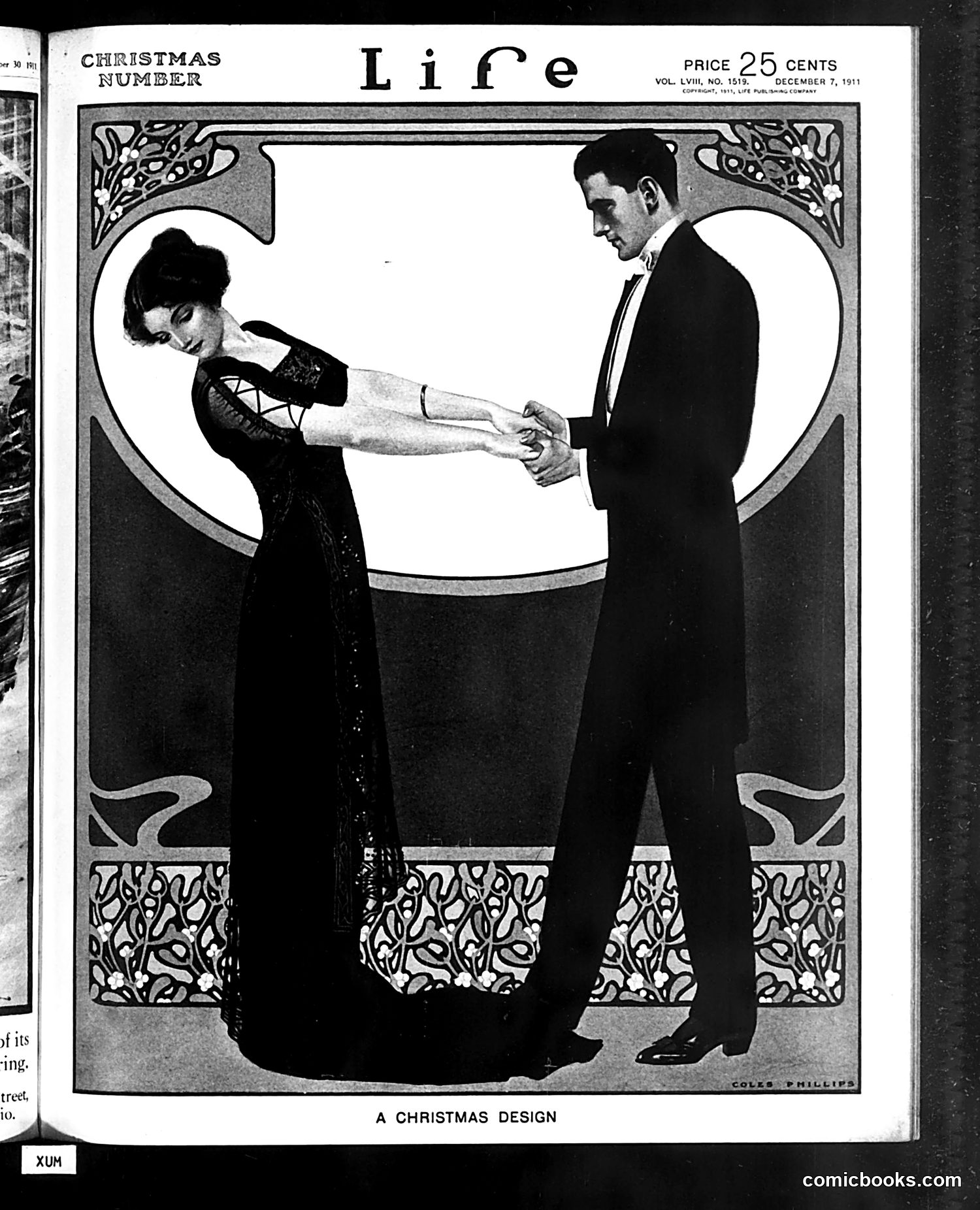
This cover illustration depicts a formal exchange between a well-dressed man and woman in elegant evening wear, set within decorative Art Nouveau-style borders. The woman extends her arm while the man reaches toward her hand in what appears to be a genteel greeting or dance position. The title "A Christmas Design" suggests this is seasonal artwork rather than political satire. The image exemplifies early 20th-century aesthetics—formal etiquette, refined fashion, and decorative stylization typical of Life magazine's sophisticated humor and social commentary. Without additional context or identifying captions, the specific figures cannot be determined, though the scene represents idealized holiday social interaction among the upper classes.
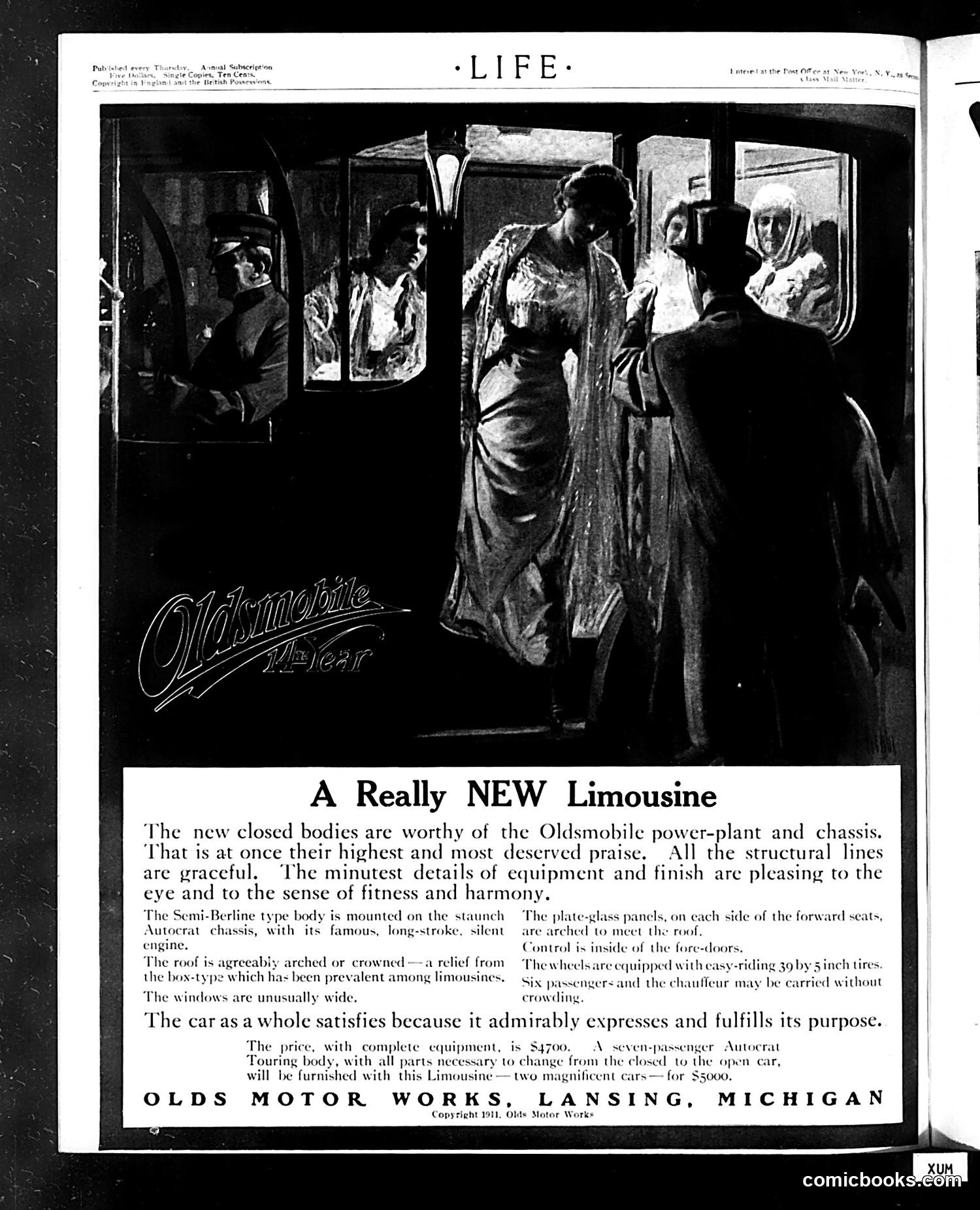
This page is **primarily advertising, not political satire**. It's a full-page advertisement for the Oldsmobile Limousine, placed in Life magazine around 1911 (based on the copyright notice visible). The image shows a Semi-Berliner closed automobile with passengers in formal dress, illustrating the vehicle's elegant interior design. The ad emphasizes the limousine's luxurious features: graceful structural lines, arched roof, plate-glass windows, and comfortable seating for six passengers plus chauffeur. The pricing ($4700) and comparison to a seven-passenger Autocrat model indicate this targeted wealthy buyers. There is **no political cartoon or satire present**—this is straightforward luxury automobile marketing from the early automotive era, emphasizing comfort and status.
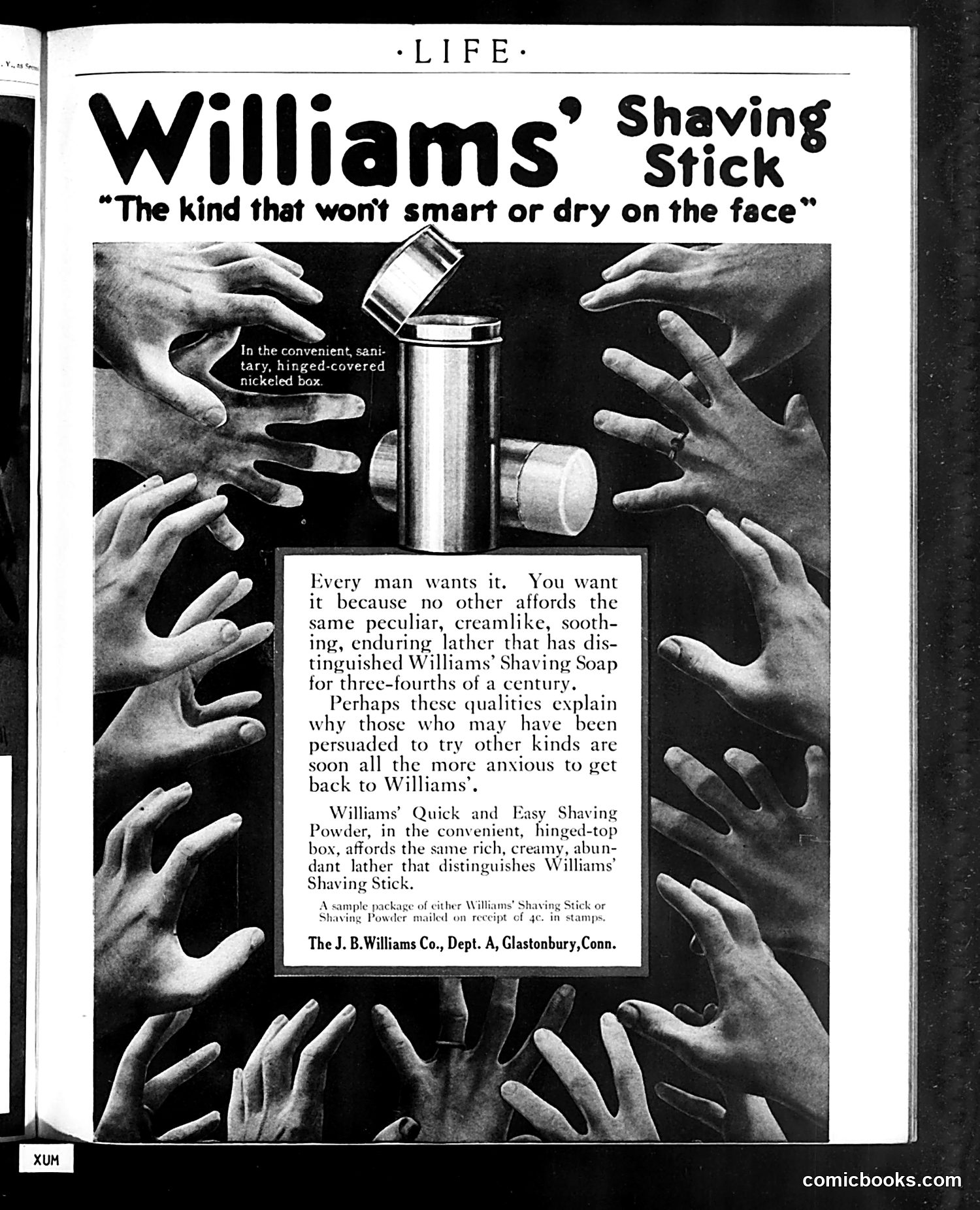
This is a **straightforward product advertisement**, not satire or political commentary. The J.B. Williams Company promotes their shaving stick as superior because it "won't smart or dry on the face." The visual strategy uses multiple hands surrounding the product to suggest widespread consumer demand and endorsement. The text emphasizes the product's three-quarter-century reputation and compares it favorably to their shaving powder alternative, both claiming to produce a "rich, creamy, abundant lather." The advertisement aims to appeal to male vanity and practicality—positioning Williams' as the established, trusted choice that loyal customers return to repeatedly. No political or satirical content is present; this is purely commercial promotion typical of *Life* magazine's era.
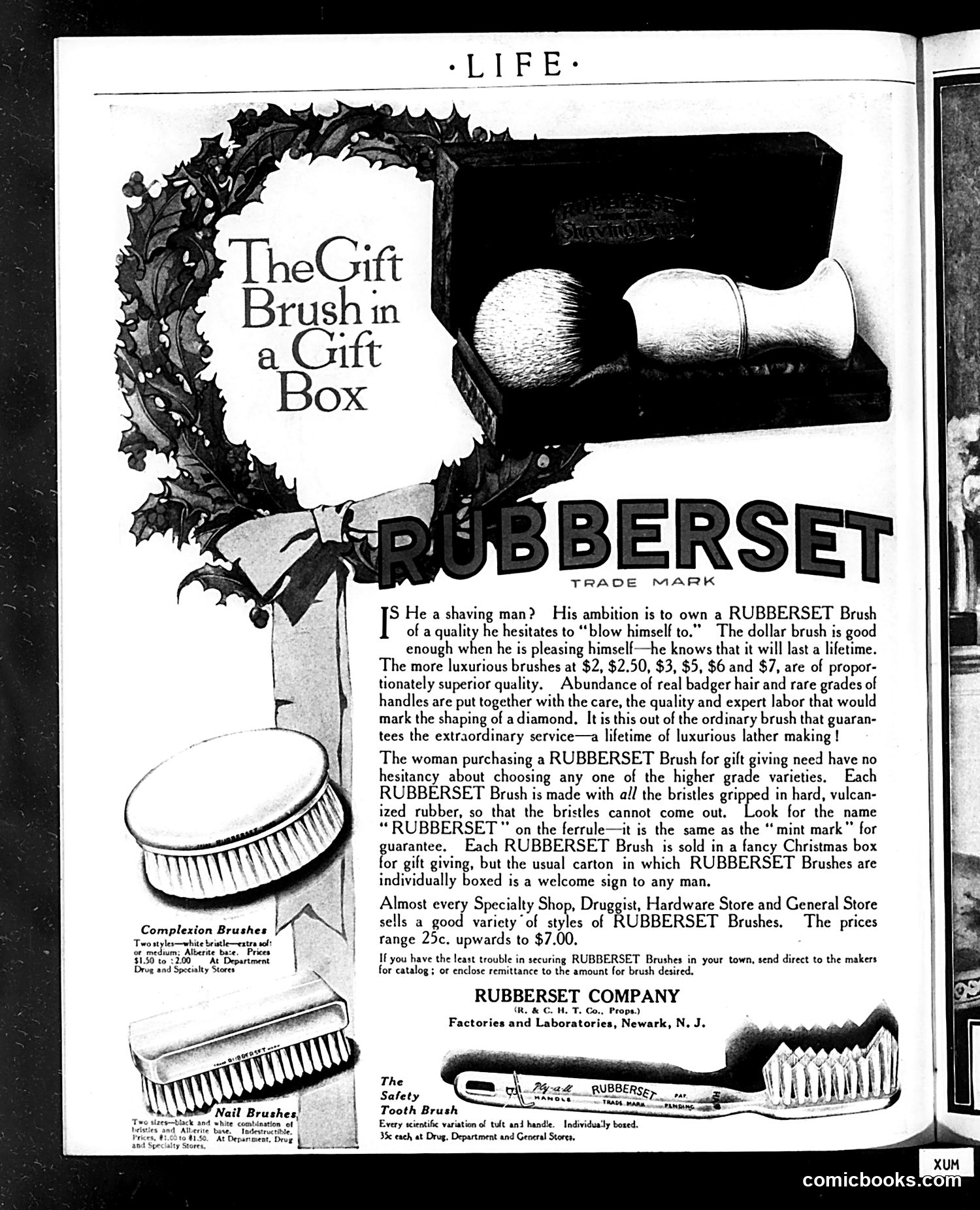
This page is **primarily advertising**, not satire or political commentary. It's a LIFE magazine advertisement for Rubberset Brushes, a personal grooming product line from the early 20th century. The ad targets two audiences: men (shaving brushes) and women (complexion and nail brushes). It uses aspirational messaging—suggesting that owning a quality Rubberset brush signals ambition and good taste. The decorative holly-wreathed frame and "Gift Box" presentation indicate this ran during the Christmas shopping season. The copy emphasizes luxury ("badger hair," "vulcanized rubber," lifetime durability) to justify premium pricing ($2-$7). This is straightforward product marketing rather than political or social satire.
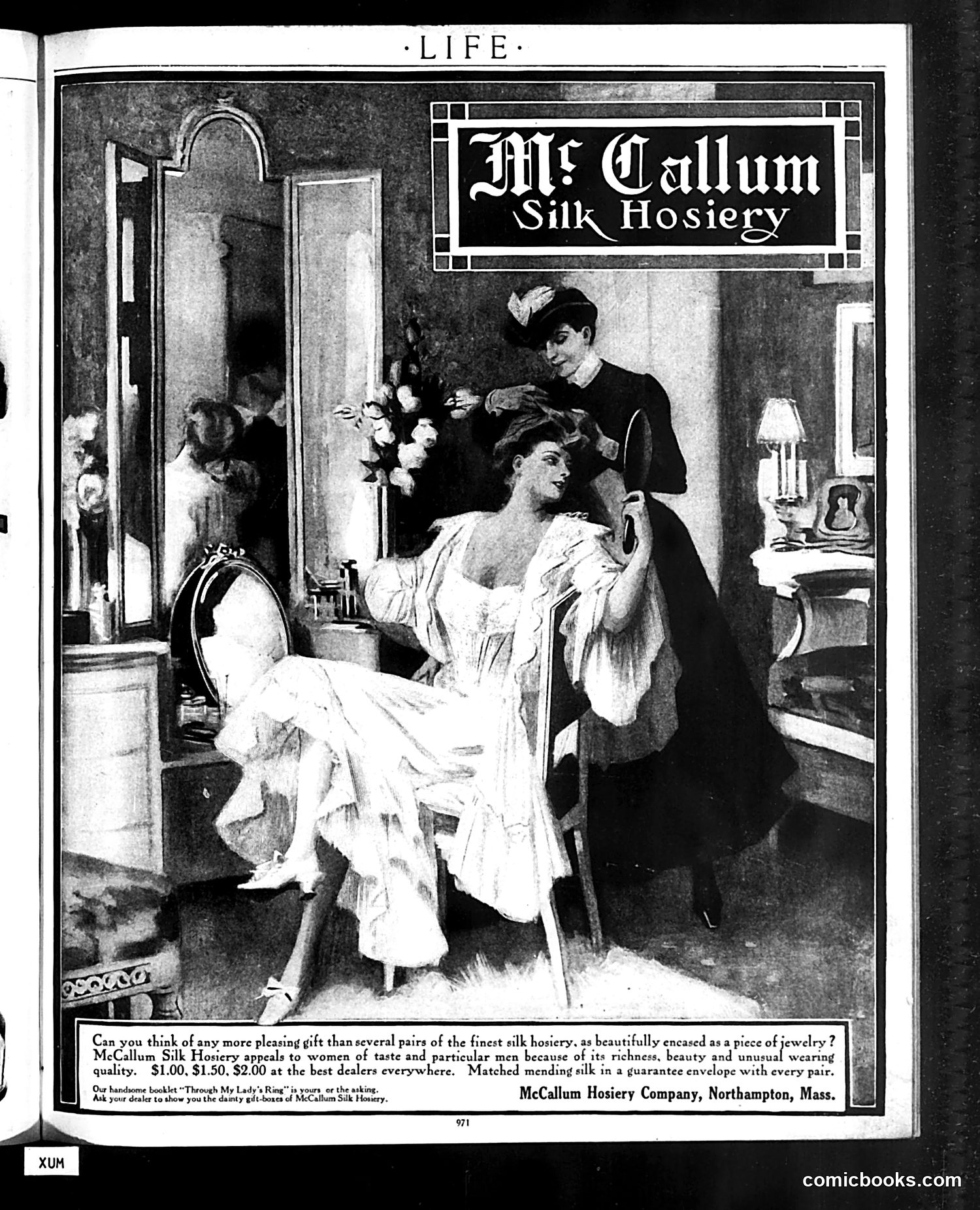
This page is **primarily an advertisement**, not satire or political commentary. It's a full-page ad for McCullum Silk Hosiery from the McCullum Hosiery Company in Northampton, Massachusetts. The image shows a woman in an elegant white negligee admiring her silk-stockinged legs while seated, with an attendant behind her. The ad copy emphasizes that silk hosiery makes an ideal luxury gift, comparable to jewelry. It highlights quality, durability ("matched mending silk"), and price points ($1.00, $1.50, $2.00). This represents early 20th-century marketing targeting women of means, positioning stockings as both practical wear and status symbols. The luxurious setting and aesthetic reflect the product's premium positioning in that era.
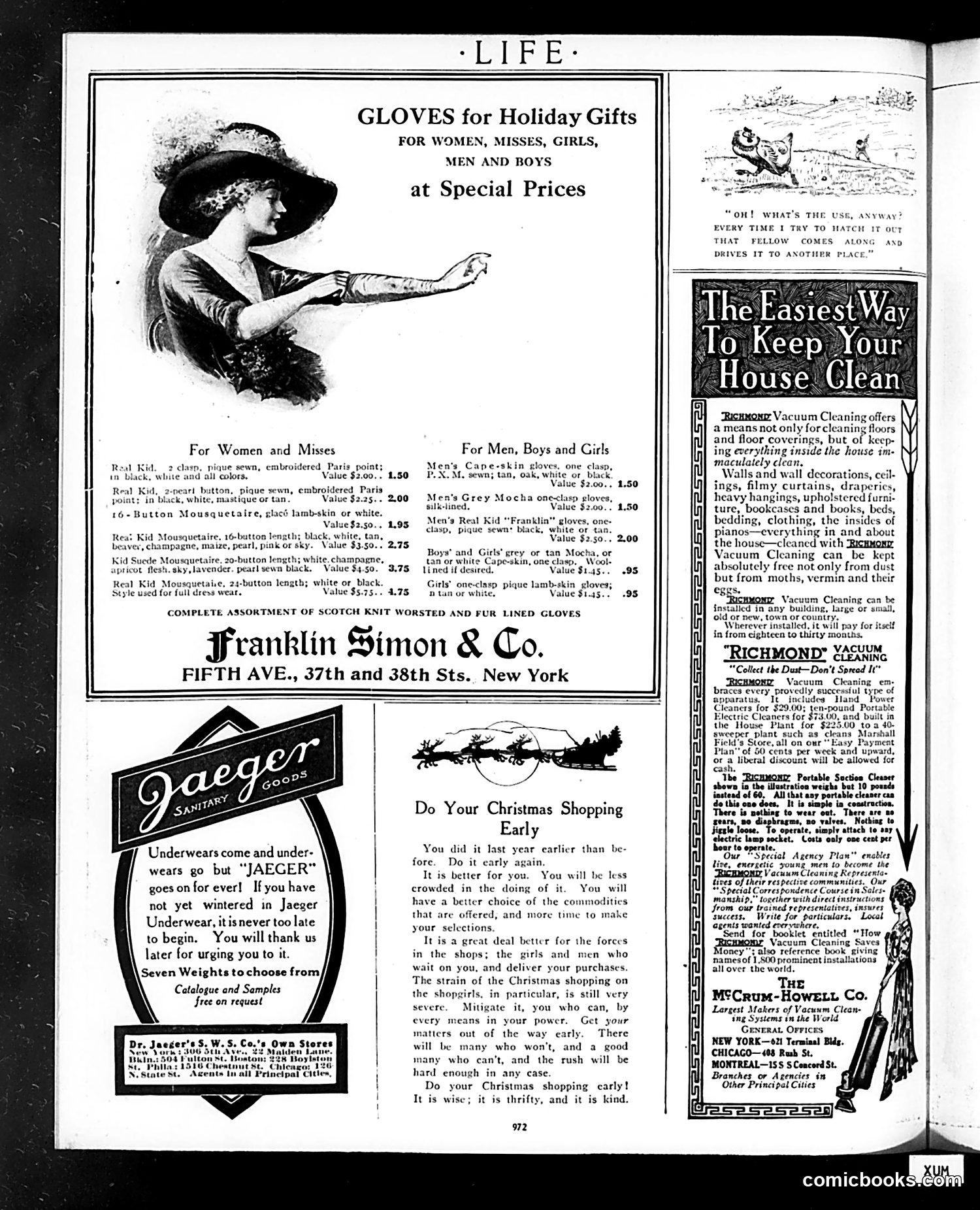
This page is primarily **advertising**, not political satire. It contains three distinct advertisements: 1. **Franklin Simon & Co. glove advertisement** (top left): Features an illustration of a fashionable woman modeling gloves for holiday gifts, with pricing for women's and men's styles. 2. **Jaeger Sanitary Goods advertisement** (bottom left): Promotes underwear, emphasizing that Jaeger brand won't winterize or deteriorate over time. 3. **Richmond Vacuum Cleaning advertisement** (right side): Markets vacuum cleaning services for homes, with detailed text about dust removal and available equipment options. The center contains editorial content titled "Do Your Christmas Shopping Early"—practical holiday advice, not satire. This appears to be a standard **commercial magazine page** from the early 20th century focused entirely on consumer goods and services.
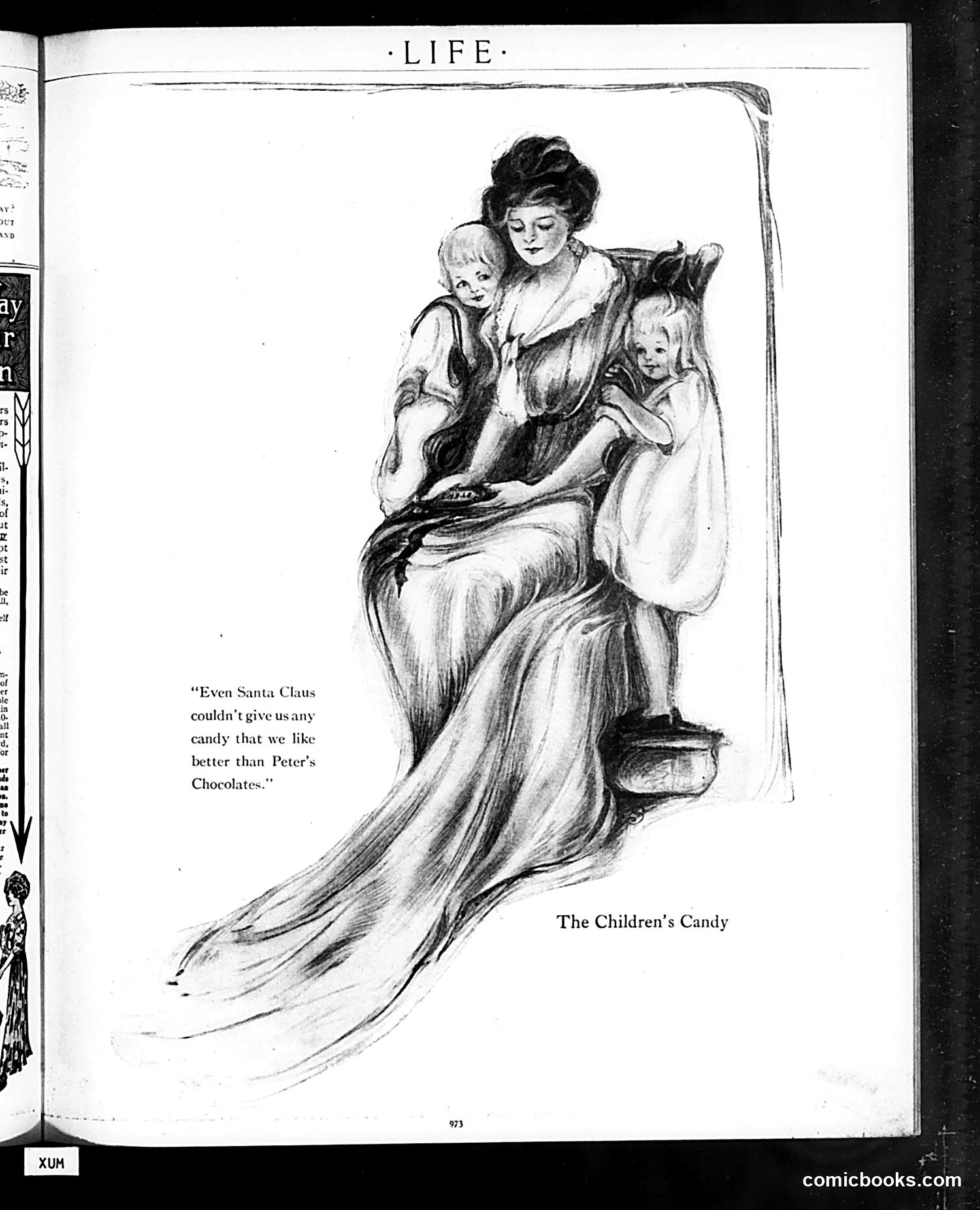
This is a **Peter's Chocolates advertisement** from *Life* magazine, disguised as editorial content. The illustration shows a woman with two children, with a testimonial quote praising Peter's Chocolates as superior even to gifts from Santa Claus. The satire is subtle: the ad uses sentimental imagery (motherhood, childhood innocence) to market luxury candy. By claiming Peter's Chocolates surpass Santa's gifts, it appeals to parents' desires to provide their children with premium treats—essentially converting parental love into a consumer transaction. The joke targets both advertising's manipulation of family sentiment and the early 20th-century consumer culture's infiltration of childhood wonder. It's simultaneously sincere and ironic commentary on commercialism.
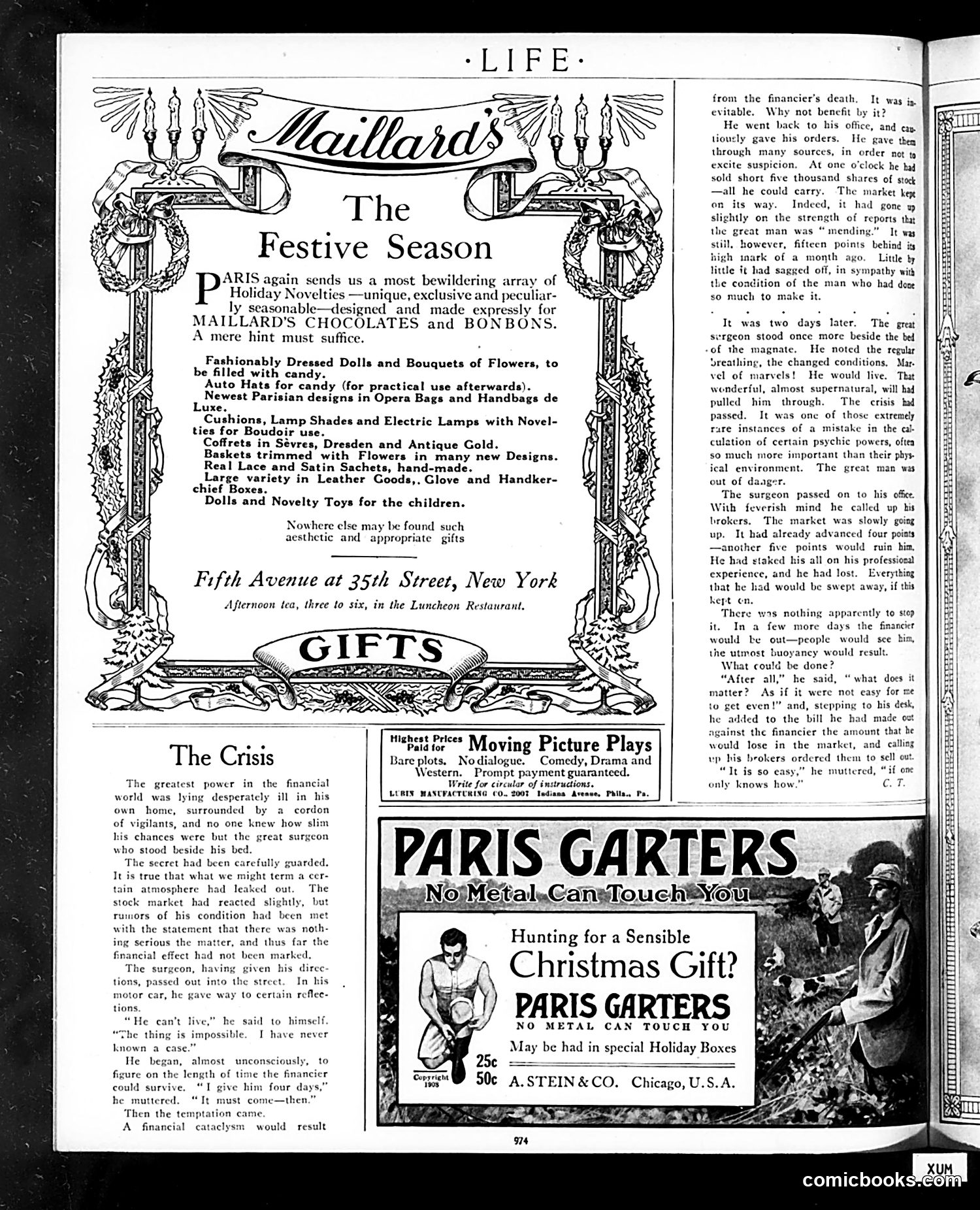
This page is primarily **advertising and promotional content**, not editorial satire. The main feature is a Maillard's Chocolates advertisement for holiday gifts, listing luxury items like dolls, flowers, lamps, and leather goods available at their Fifth Avenue store. Below that is "The Crisis," a short story about financial distress during what appears to be a stock market crisis (though the specific event isn't named). The narrative describes a financier contemplating suicide before a surgeon friend provides perspective. At the bottom are two additional advertisements: one for moving picture plays and another for Paris Garters (elastic garters for men's socks), marketed as a practical Christmas gift at 25-50 cents. The page reflects early 20th-century consumer culture and period anxieties about financial instability.
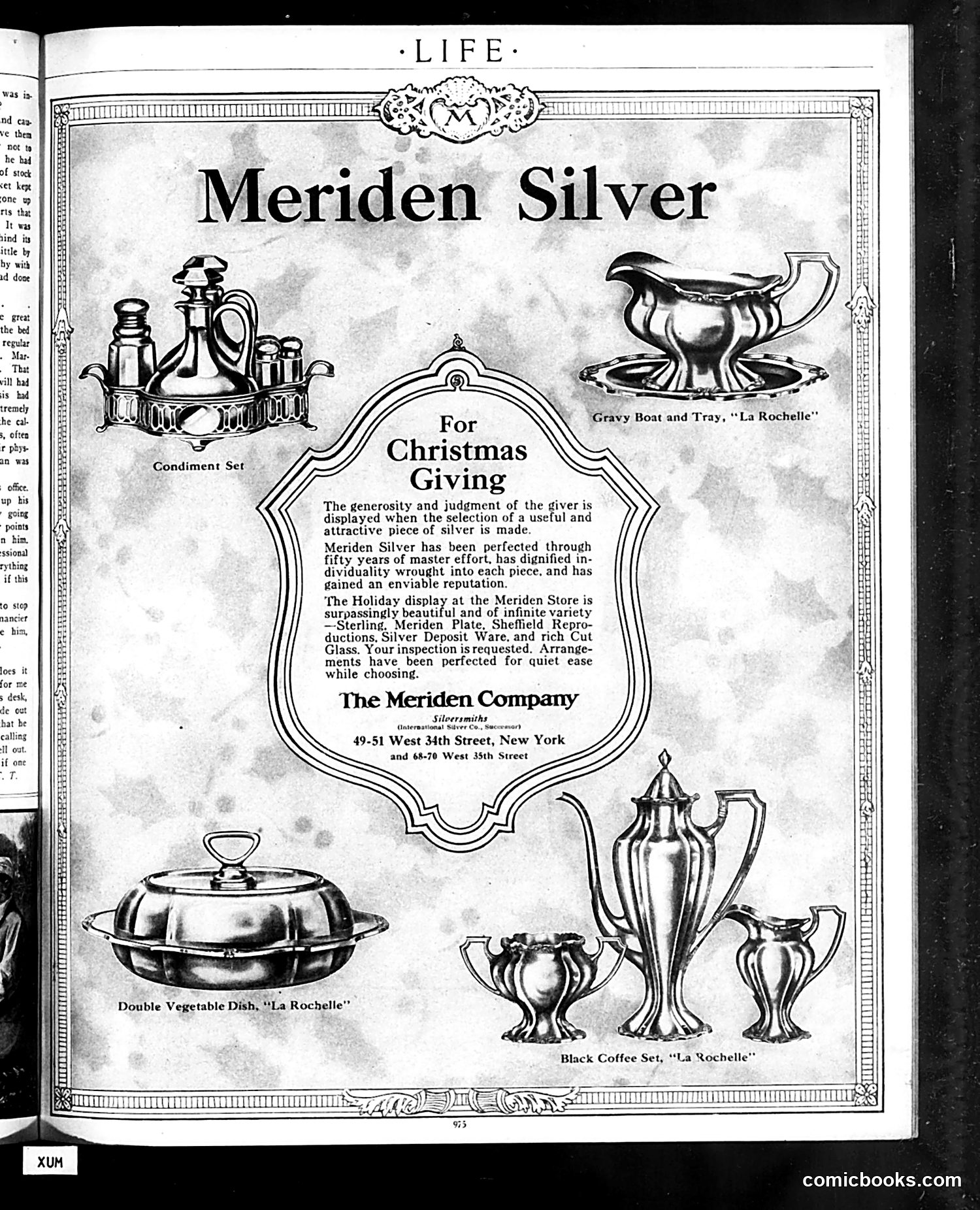
This is an **advertisement, not a cartoon or satirical content**. It's a full-page holiday advertisement for the Meriden Company, a silverware manufacturer, appearing in *Life* magazine around the early 20th century. The ad promotes "Meriden Silver" for Christmas giving, emphasizing the company's 50-year reputation for quality. It displays various silver products: a condiment set, gravy boat, vegetable dish, and coffee service—all labeled with pattern names like "La Rochelle." The text appeals to gift-givers' desire to demonstrate "generosity and judgment" through purchasing fine silverware. The Meriden Company locations in New York are listed at the bottom. This represents typical luxury goods advertising of the era, targeting affluent holiday shoppers.
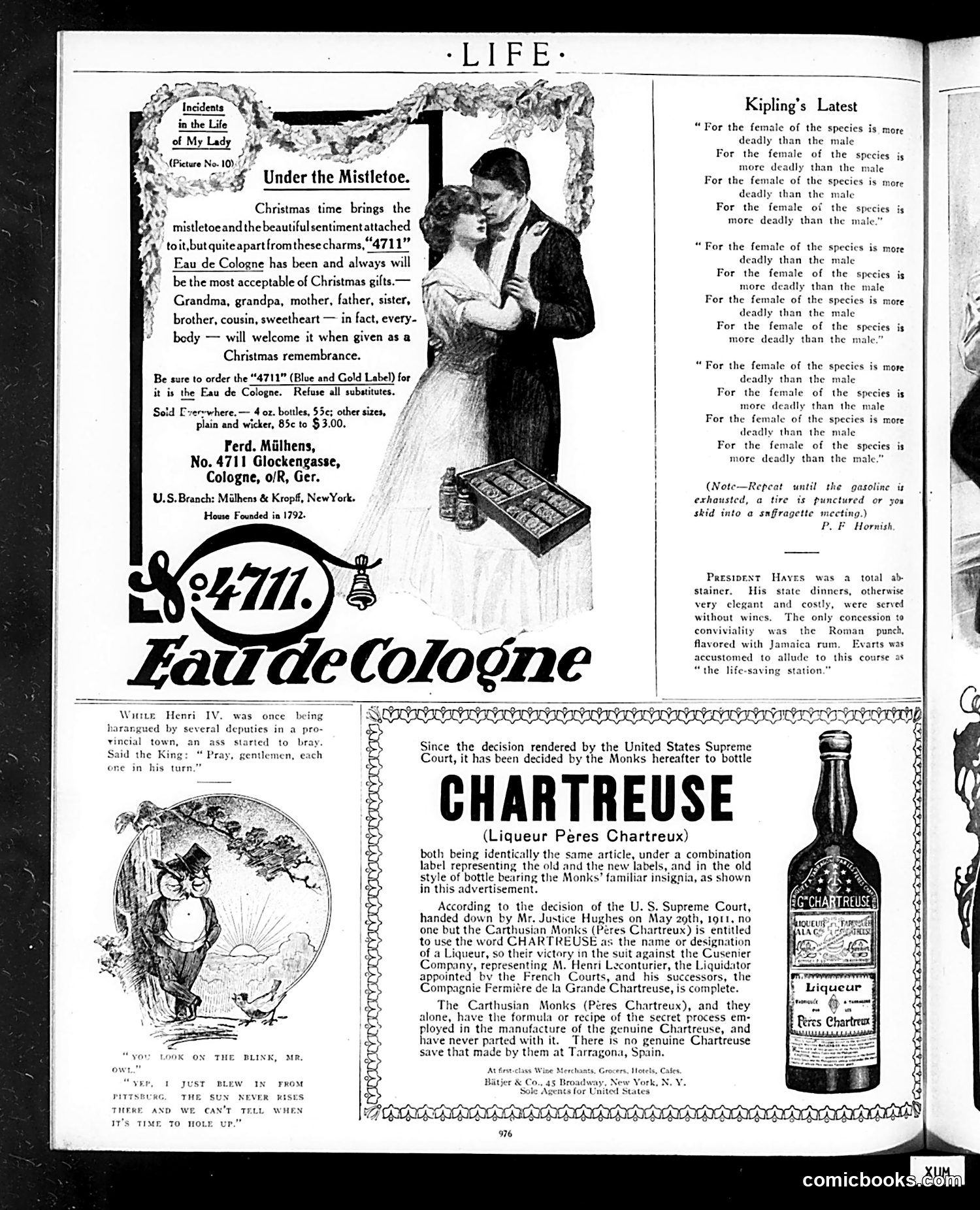
This page is primarily **advertising content** with some editorial material. The main features are: 1. **"Under the Mistletoe"** - An ad for Eau de Cologne #4711, showing a couple about to kiss. It's a Christmas gift advertisement exploiting romantic sentiment. 2. **Kipling's Latest** - A satirical poem repeating the line "For the female of the species is more deadly than the male," referencing Rudyard Kipling's 1911 poem about female aggression/danger. The repetition emphasizes the joke about women's lethality. 3. **Chartreuse liqueur ad** - Announcing a Supreme Court decision allowing monks to use the "Chartreuse" name for their liqueur after a trademark dispute with a Cusenier company. 4. **Historical anecdote** - A brief story about Henri IV and deputies, with a small illustration labeled "You Look on the Brink, Mr. Owl." The page mixes commercial advertising with light satirical commentary typical of *Life* magazine's format.
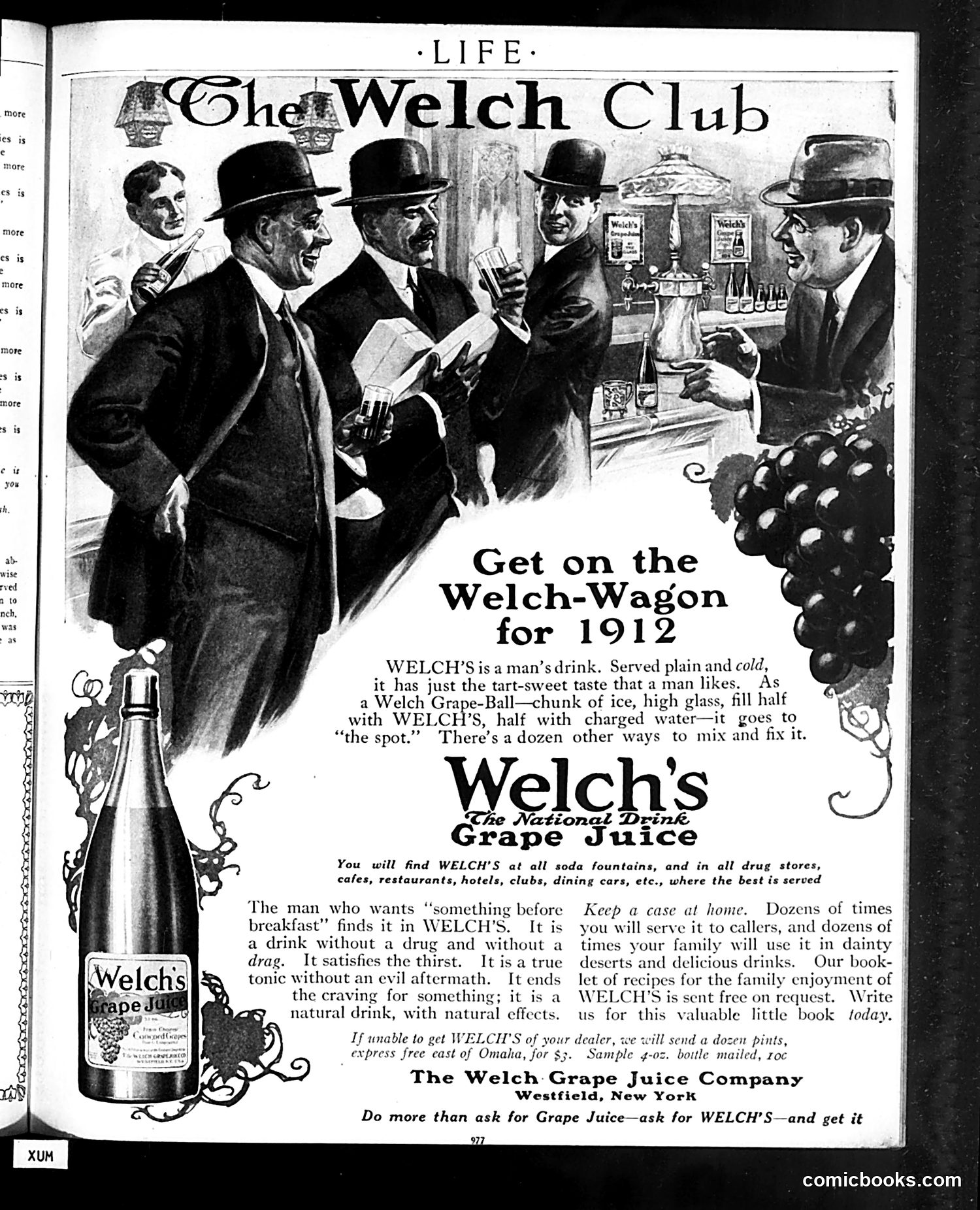
This is a **Welch's Grape Juice advertisement**, not political satire. The page depicts "The Welch Club"—a social gathering of well-dressed men at what appears to be a bar or establishment, with the tagline "Get on the Welch-Wagon for 1912." The humor relies on a play on words: "Welch-Wagon" mimics the temperance movement's famous "Water Wagon" (abstaining from alcohol). The ad markets Welch's as "a man's drink"—an alternative beverage for social occasions that doesn't require alcohol. The advertisement emphasizes Welch's as wholesome ("natural drink, with natural effects"), suitable for home use, and available everywhere. It represents early 20th-century marketing attempting to position grape juice as sophisticated and manly, targeting men specifically.
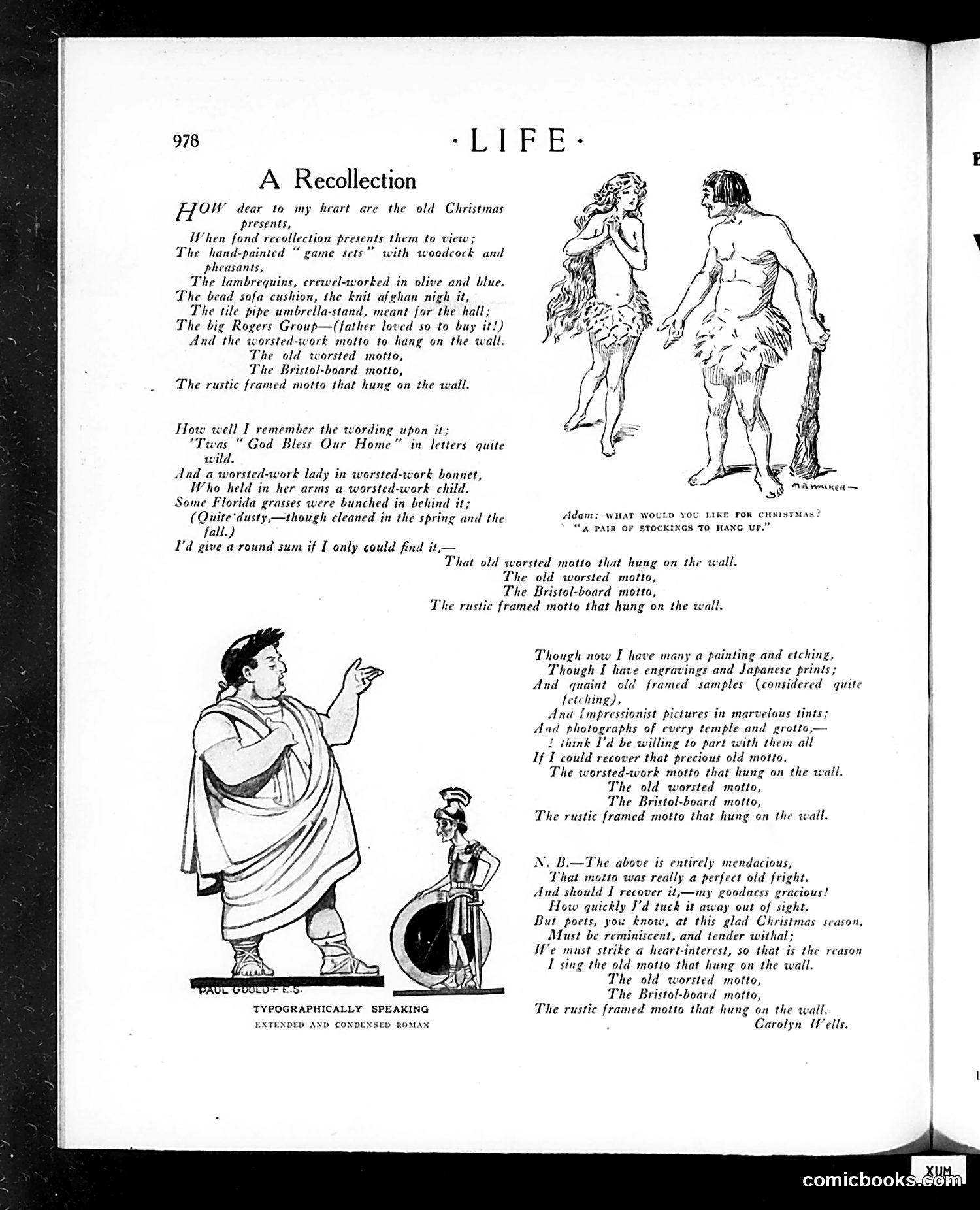
This page presents a nostalgic poem about cherished Christmas gifts from childhood, accompanied by illustrative sketches. The verses recall specific items: hand-painted game sets, lambregains (decorative fabric), a tin whistle, a Rogers Group statue, and notably "the worsted-work motto that hung on the wall"—a needle-work decorative piece. The bottom cartoon by Paul Goclfrey labeled "Typographically Speaking" appears to show extended and condensed roman typefaces personified as figures, likely a visual pun about printing terminology for modern readers unfamiliar with typography. The overall page is sentimental rather than satirical, celebrating Victorian-era domestic nostalgia and childhood memories.
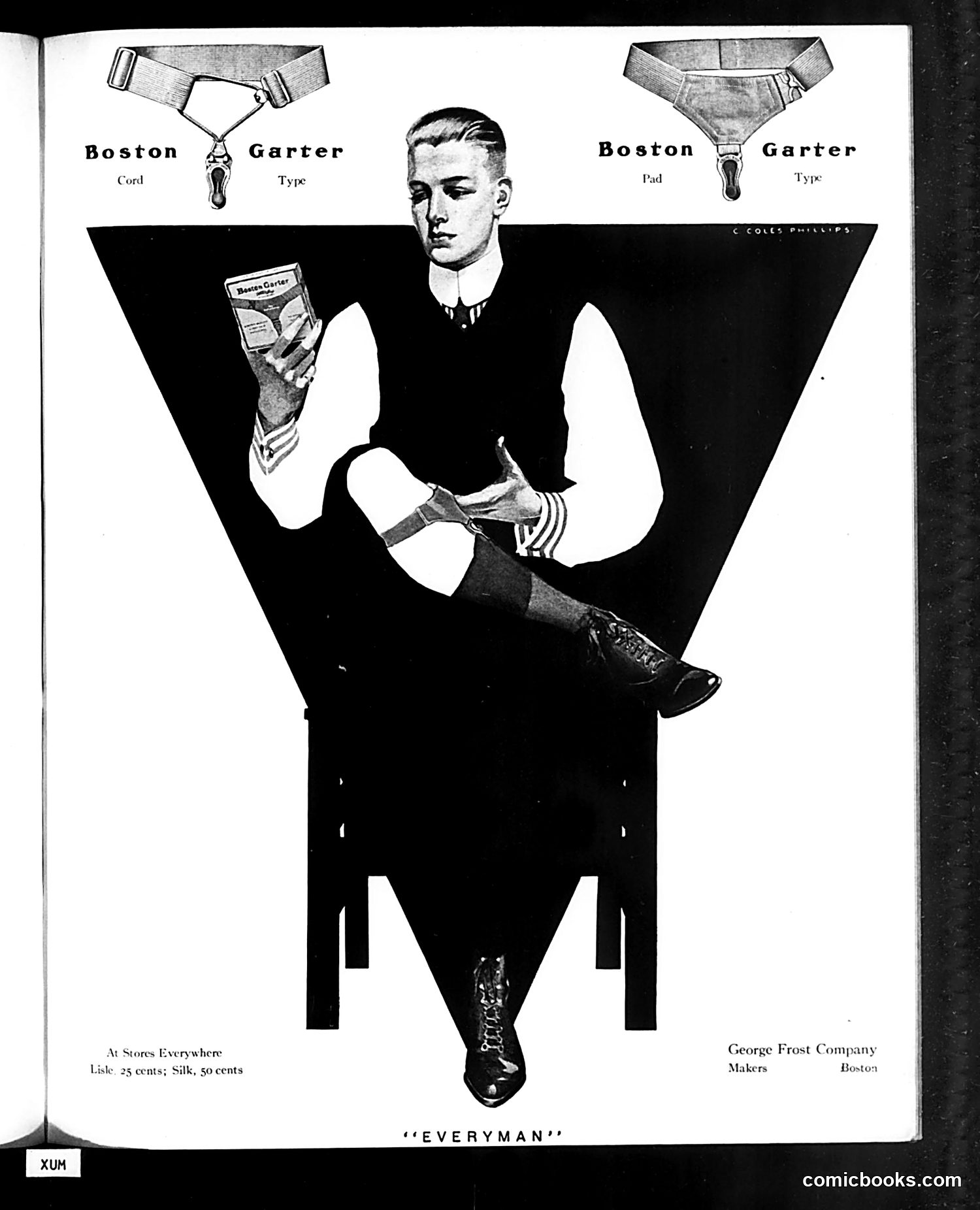
This is a product advertisement for **Boston Garter** brand garters, made by the George Frost Company of Boston. The page shows two garter styles—a "Cord Type" and "Pad Type"—displayed at the top. The central illustration depicts a well-dressed man seated in a chair, deliberately displaying his garter-clad leg. The word **"EVERYMAN"** below suggests this product is marketed as essential everyday wear for all men. The satire lies in the exaggerated, almost theatrical pose—the model appears to be proudly showcasing his garter as if it were a fashion statement or status symbol. This gentle mockery targets masculine vanity while simultaneously advertising garters as a practical, fashionable necessity for the modern gentleman. Pricing information indicates availability at stores for 25 cents (lisle) and 50 cents (silk).
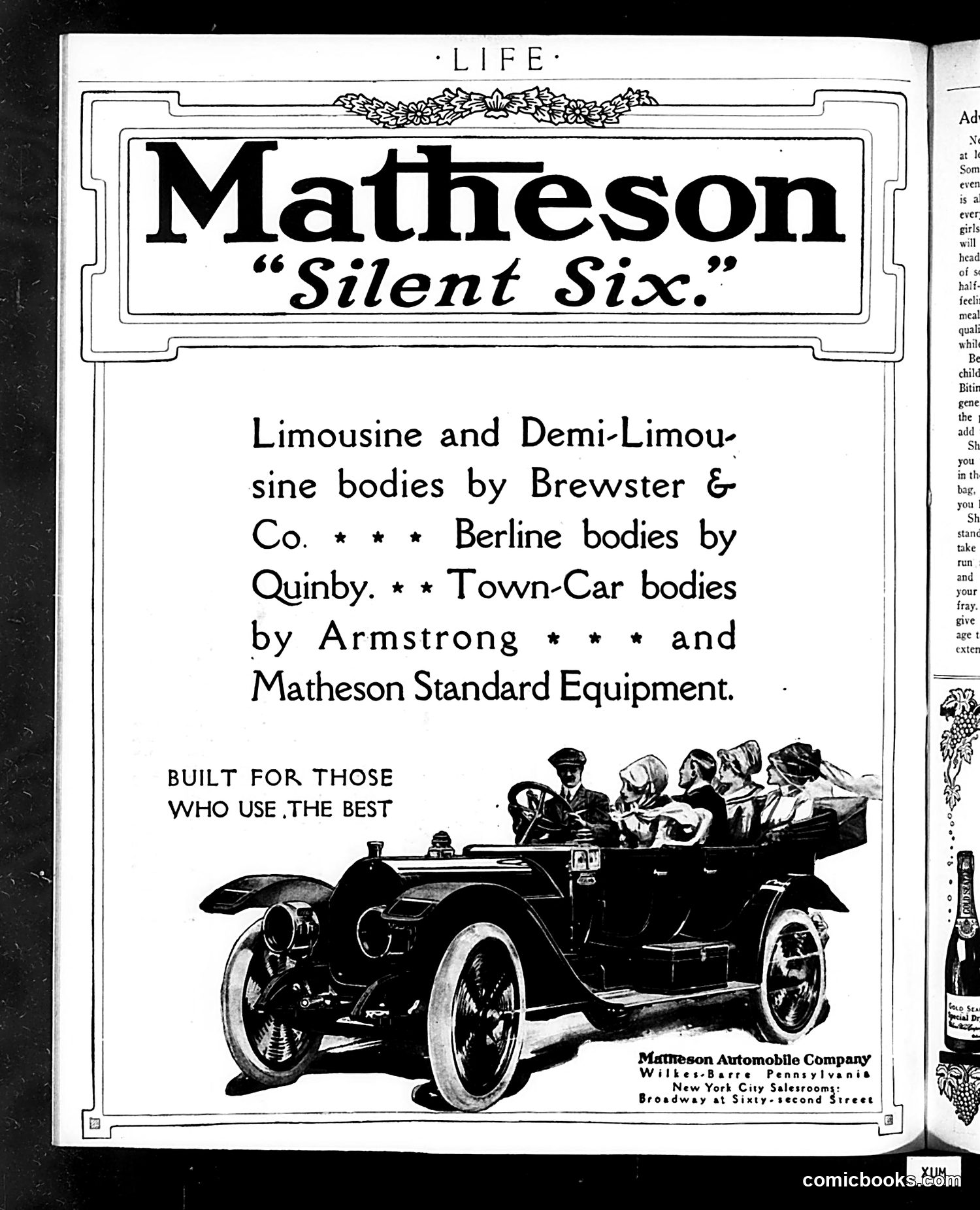
This is a **full-page advertisement**, not a political cartoon. It promotes the Matheson automobile, nicknamed the "Silent Six"—likely referring to a six-cylinder engine known for quiet operation, a luxury feature of the era. The ad lists various body styles available (Limousine, Demi-Limousine, Berline, Town-Car) made by different coachbuilders. The illustration shows a well-dressed group of passengers enjoying a leisurely drive, emphasizing comfort and refinement. The tagline "Built for Those Who Use the Best" targets wealthy consumers. The company's location is given as Wilkes-Barre, Pennsylvania, with showrooms in New York City (Broadway at Sixty-second Street). This is purely commercial advertising, not satire.
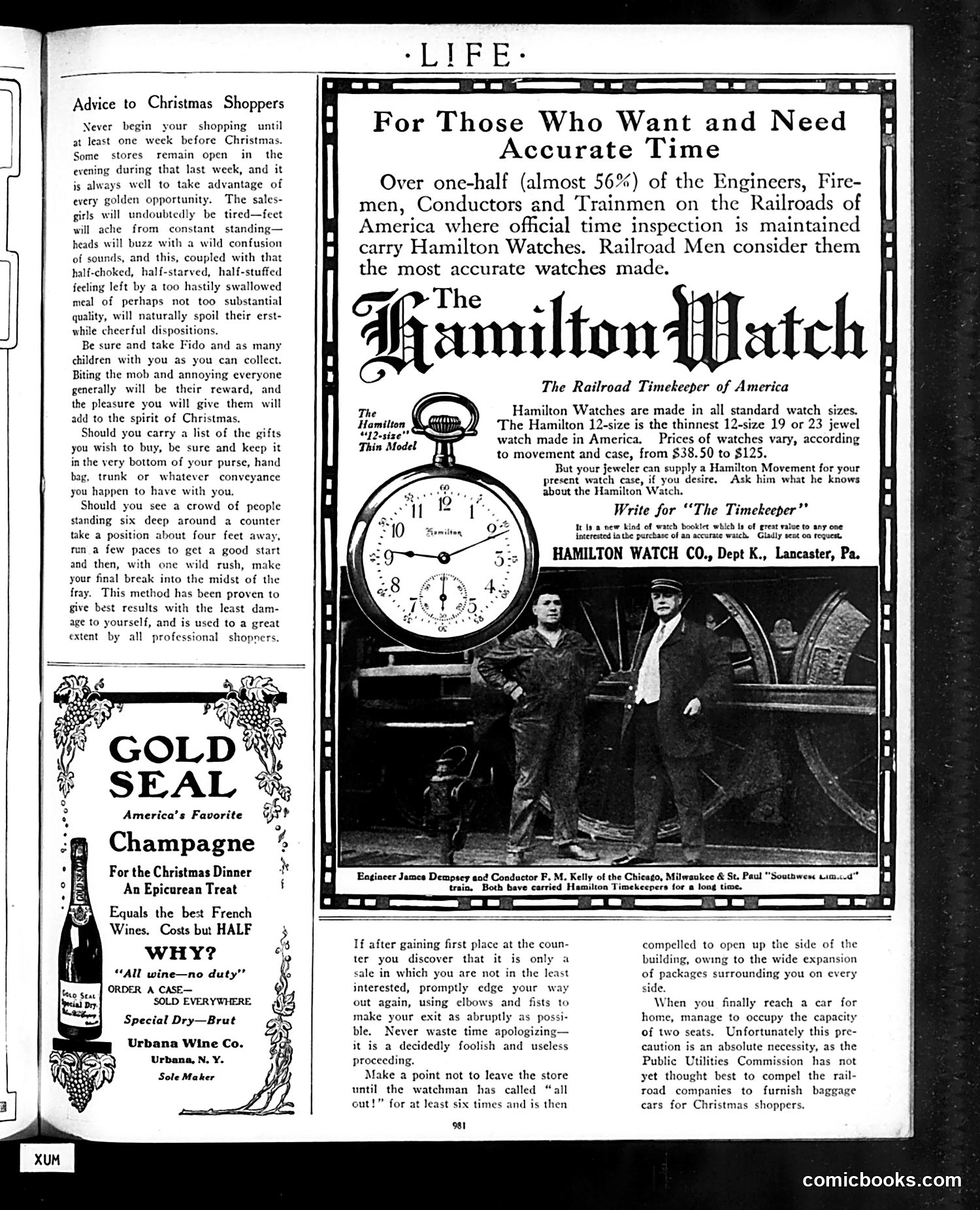
This page combines **satirical advice** with vintage **advertisements**. The left column offers tongue-in-cheek Christmas shopping tips that mock both retail chaos and shopper behavior—advising readers to bring children to "annoy everyone," rush crowds with "one wild rush," and occupy two train seats going home. The satire targets the madness of holiday shopping and inconsiderate consumer behavior. The right side features a **Hamilton Watch advertisement** leveraging railroad credibility (56% of railroad workers allegedly carry them) to market precision timepieces. A photograph shows two named railroad employees endorsing the product—a common early 20th-century advertising tactic using professional endorsements. The lower left advertises **Gold Seal Champagne**, emphasizing affordability ("costs but HALF" of French wines) due to no import duties. The page's humor lies in juxtaposing sincere product pitches against deliberately absurd shopping etiquette—the contrast itself being the joke about consumer excess and holiday pandemonium.
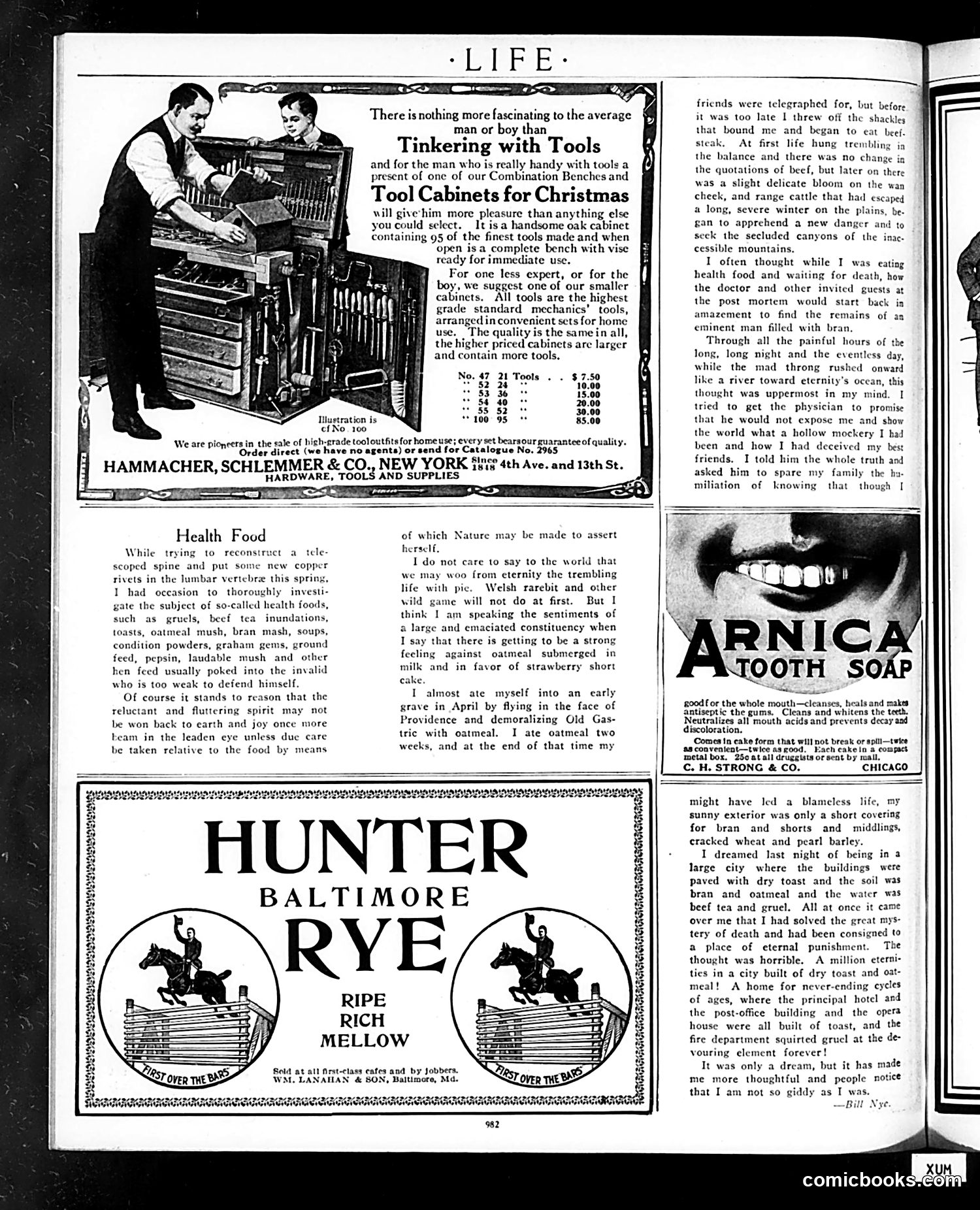
This page is primarily **advertisements and light humor essays**, not political satire. The main content includes: 1. **Hammacher Schlemmer Tool Cabinet ad** (top): A Christmas gift advertisement for tool sets, featuring two men examining a wooden cabinet of mechanics' tools. The copy emphasizes quality and convenience for "the average man or boy" interested in tinkering—reflecting early 20th-century DIY culture and gift-giving conventions. 2. **"Health Food" essay** (center): A humorous first-person account mocking the era's obsession with health foods and dietary remedies. The author satirizes eating bland "health foods" (oatmeal, bran mash, beef tea) while ill, then recovers by eating beefsteak instead. The joke targets the period's pseudoscientific health crazes and the irony that forbidden "rich" foods actually restored vitality. 3. **Arnica Tooth Soap and Hunter Rye advertisements** (right): Standard product promotions. The page reflects 1920s consumer culture and contemporary skepticism toward fad diets—relatively timeless humor about wellness trends.
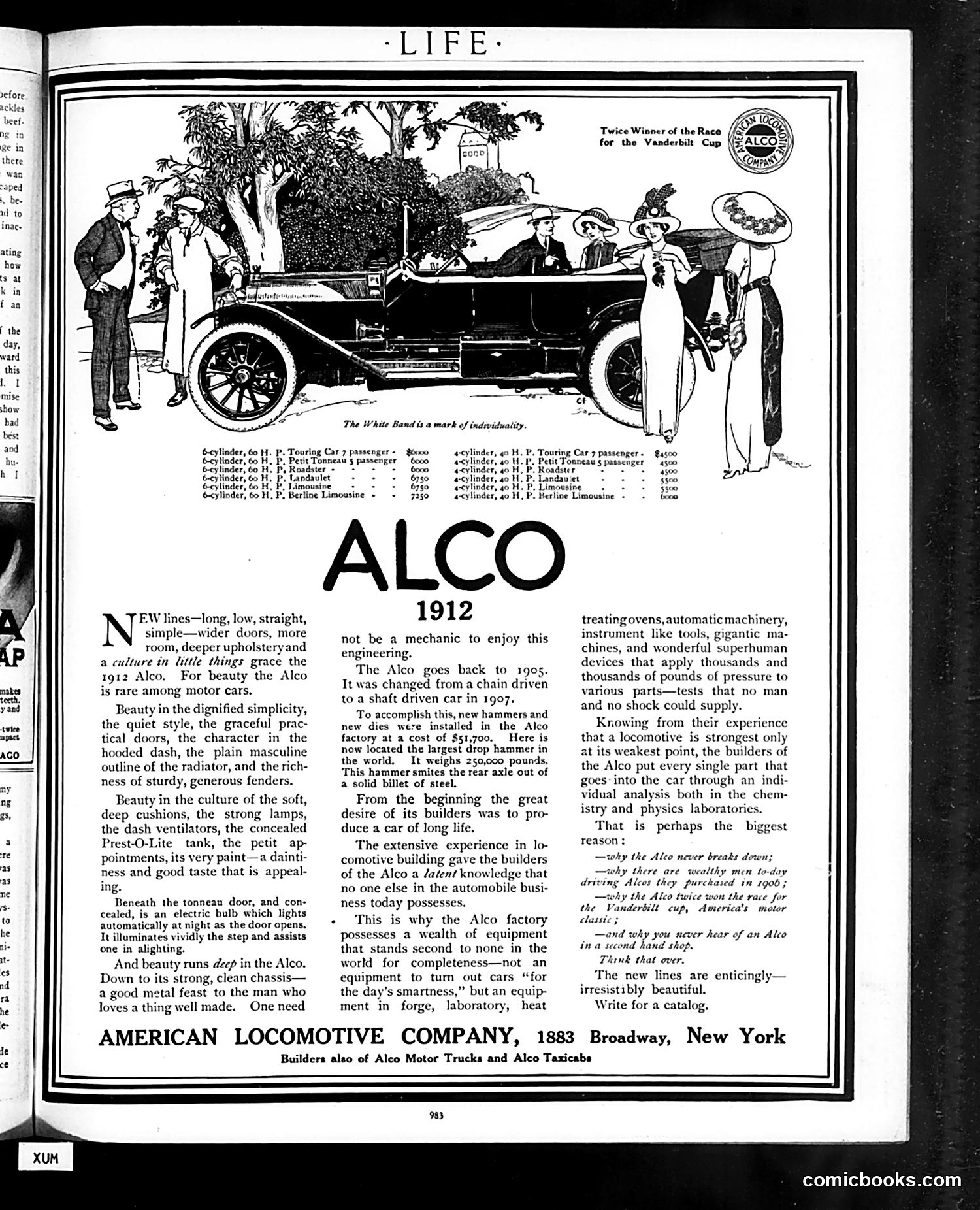
This is primarily a **car advertisement**, not satire. The "Life" magazine page promotes the Alco automobile, manufactured by American Locomotive Company. The illustration shows a well-dressed couple admiring an Alco touring car, establishing it as a luxury vehicle. The ad emphasizes engineering heritage: Alco's experience building locomotives (dating to 1895) supposedly ensures quality automobiles. It highlights specific innovations—the 1907 shift to shaft-drive, a 250,000-pound drop hammer for manufacturing, and rigorous testing protocols. The tagline "The White Band is a mark of individuality" references the car's distinctive visual feature. The ad claims the Alco won the Vanderbilt Cup (a prestigious early auto race) twice, and boasts that wealthy owners from 1906 still drive theirs, contrasting with cars appearing in "second-hand shops." This reflects early automotive-era marketing: positioning cars as durable, engineered products for affluent consumers. The "culture in little things" messaging emphasizes refinement and craftsmanship as selling points to wealthy buyers.
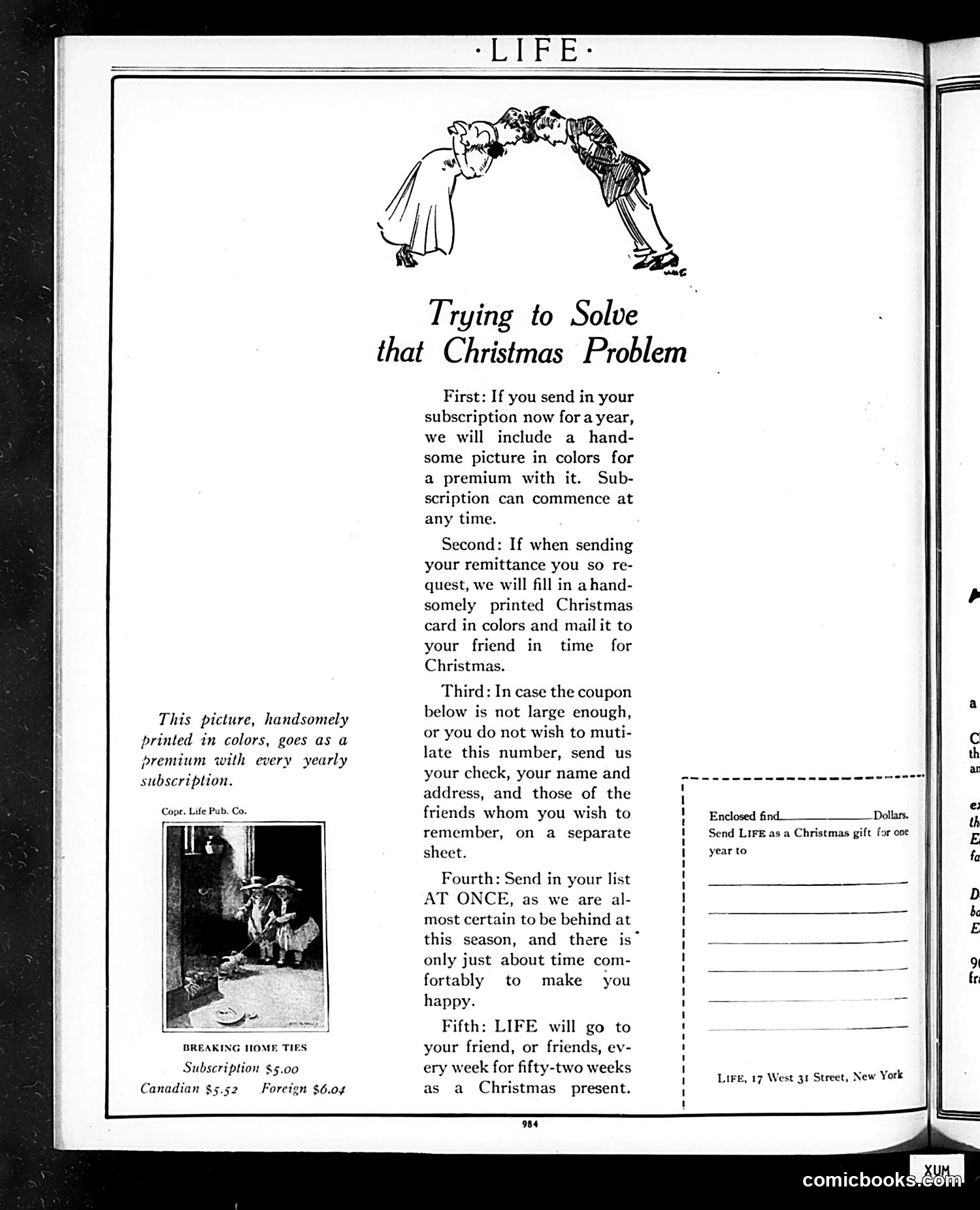
This page is primarily a **subscription advertisement** rather than political satire. It promotes Life magazine as a Christmas gift solution, offering five incentives to subscribers: The small illustration titled "Breaking Home Ties" (showing what appears to be a sentimental domestic scene) serves as a sample of the "handsome picture in colors" included with yearly subscriptions—a premium gift. The advertisement addresses the "Christmas Problem" of gift-giving by proposing that a year-long subscription to Life solves the dilemma. It emphasizes urgency ("send in your list AT ONCE"), offering to personalize Christmas cards and deliver the magazine weekly to friends for fifty-two weeks. Subscription costs are listed as $5.00 (US), $5.52 (Canadian), and $6.04 (Foreign). This reflects early 20th-century magazine marketing strategies—positioning subscriptions as thoughtful, year-round gifts rather than one-time purchases.
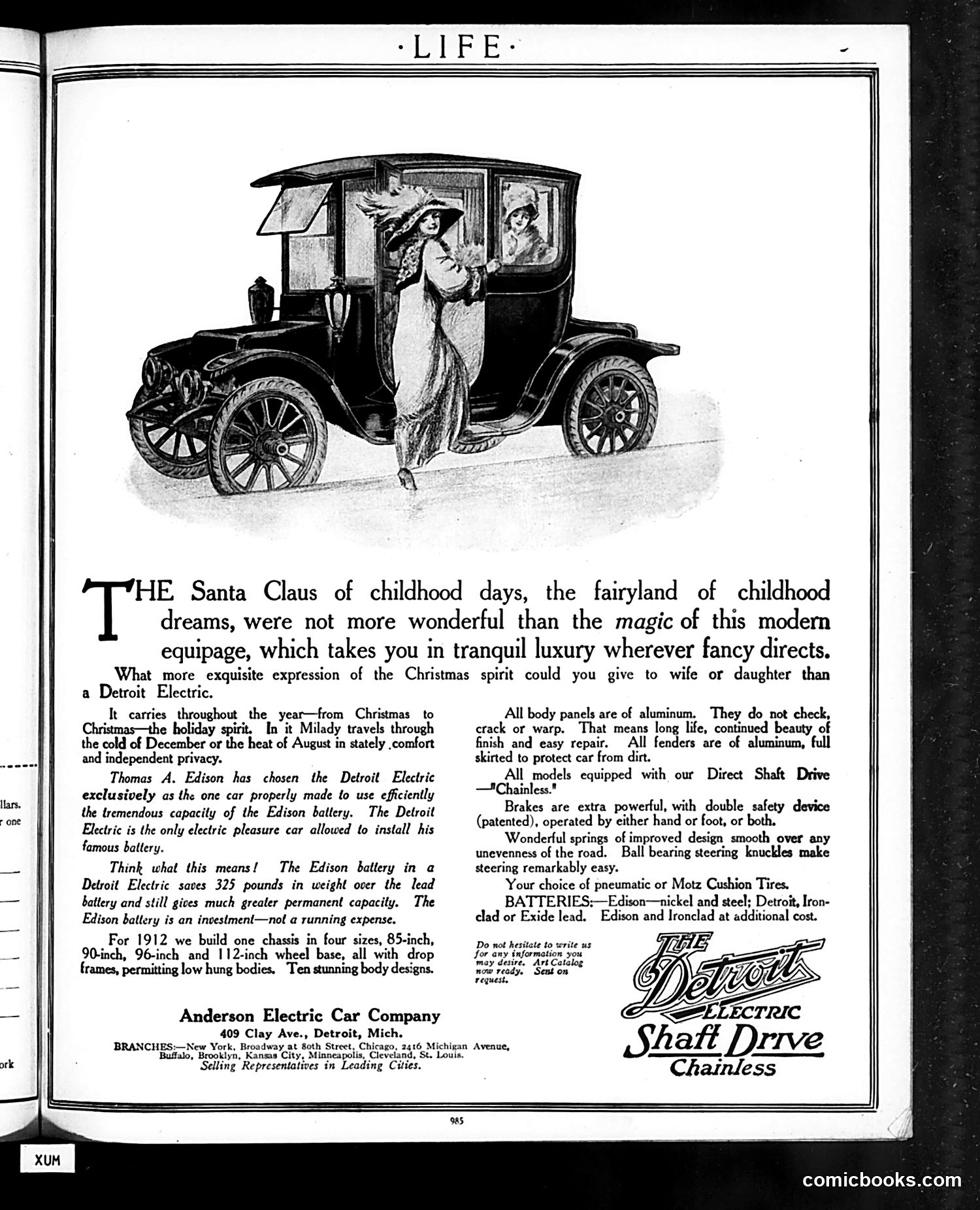
This is **not a cartoon or satire**—it's a full-page automobile advertisement for the Detroit Electric car, published in *Life* magazine. The ad positions the electric car as a luxury Christmas gift for women ("wife or daughter"), comparing it to childhood magic. The imagery shows an elegantly dressed woman boarding the vehicle, emphasizing comfort and refinement over speed or power. The key selling point is Thomas Edison's endorsement: Edison personally chose the Detroit Electric and allowed it exclusive use of his superior nickel-steel battery, which allegedly outperforms lead batteries while weighing 325 pounds less. The ad emphasizes features appealing to early 20th-century affluent consumers: aluminum body panels, chainless drive, dual braking systems, and smooth pneumatic tires. The Anderson Electric Car Company positioned electric vehicles as sophisticated, safe, and reliable—the opposite of gasoline cars' association with noise, danger, and mechanical difficulty. This reflects the pre-Model T era when electric vehicles competed seriously with gas engines, particularly among wealthy urbanites and women drivers.
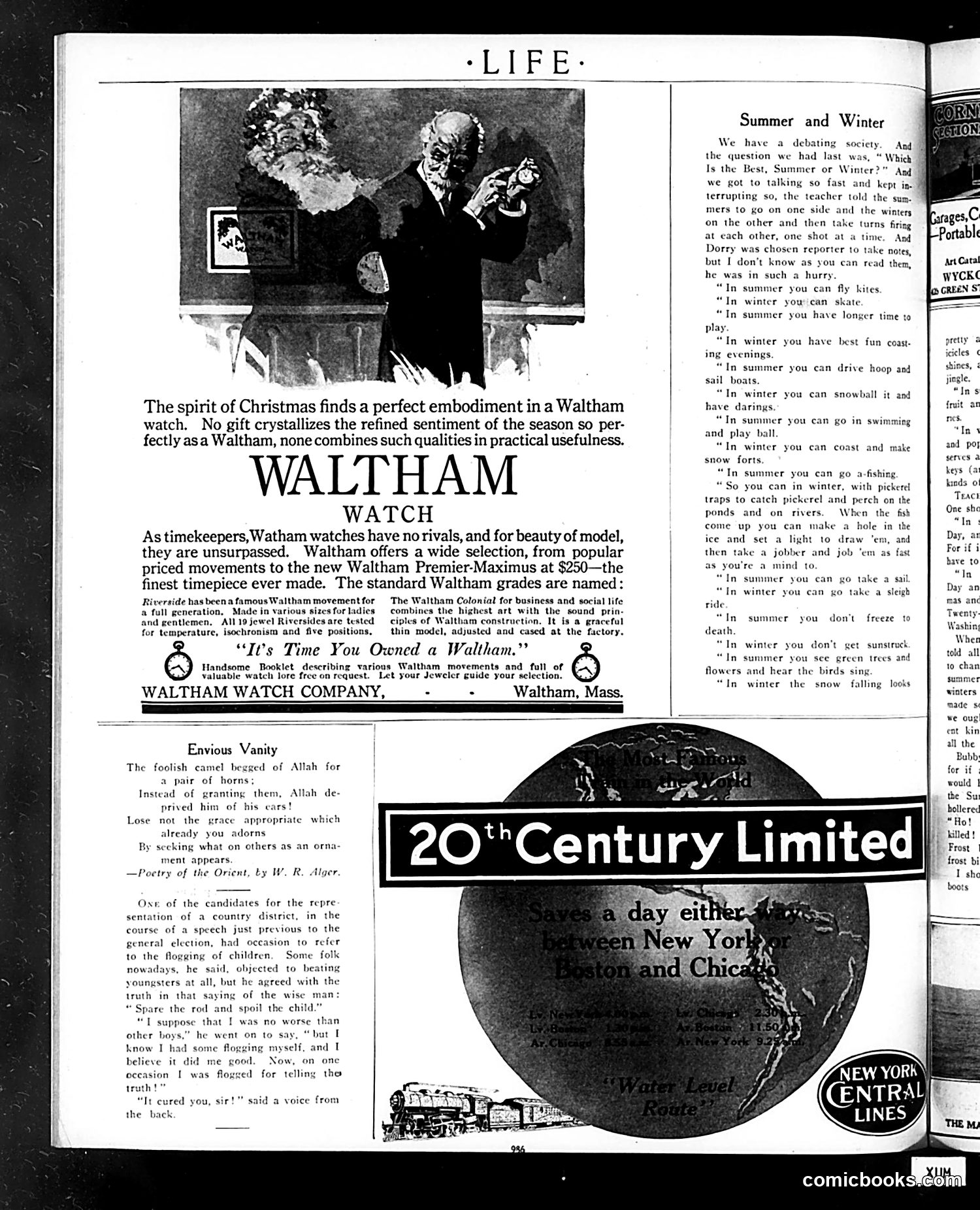
This page contains **primarily advertisements** (Waltham watches, 20th Century Limited train service) alongside literary content rather than political cartoons. The main satirical content is a humorous piece titled **"Summer and Winter"**—a school debate where students list contrasting activities. The joke relies on children's earnest, overlapping arguments (you can fly kites in summer; you can use pickerel traps in winter) that circle back to similar conclusions. It's gentle domestic satire about youthful debate logic. Below that is **"Envious Vanity,"** a cautionary poem about a camel who asked Allah for horns but lost his ears instead—a moral fable warning against coveting others' attributes. The final anecdote satirizes corporal punishment: a politician defends flogging children, claiming it helped him. When someone asks "It cured you, sir?"—the implication being he still needed "curing" (suggesting the beating didn't work)—it's gentle mockery of the speaker's logic. These are light, non-political humor pieces typical of Life's social satire.
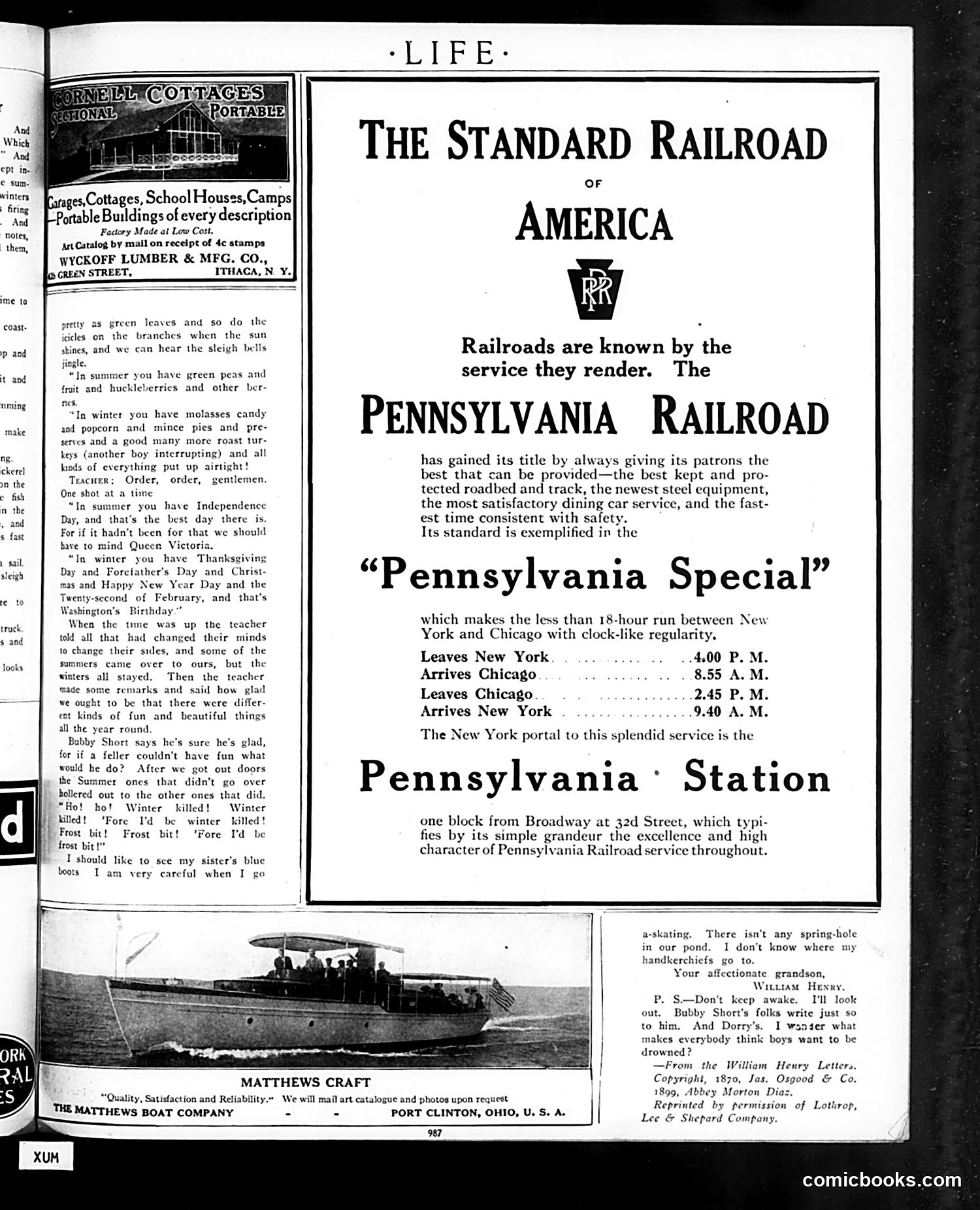
This page is **primarily advertising**, not satire or editorial cartooning. The main content promotes the Pennsylvania Railroad's "Pennsylvania Special" express train service between New York and Chicago, emphasizing its speed (under 18 hours), modern equipment, dining cars, and safety standards. The left column contains a **didactic dialogue** (not a cartoon) where a teacher asks students about seasonal activities—summer holidays like Independence Day and winter holidays like Thanksgiving and Washington's Birthday. The point appears educational rather than satirical: to highlight American holidays and regional pleasures. Below is an image of the **Matthews Craft boat**, another advertisement emphasizing "Quality, Satisfaction and Reliability." At bottom right is an excerpt from "*The William Henry Letters*" (a children's correspondence), showing a boy's innocent observations about winter activities and safety concerns. **No political satire is evident.** This is a commercial page showcasing American transportation and goods circa 1899.
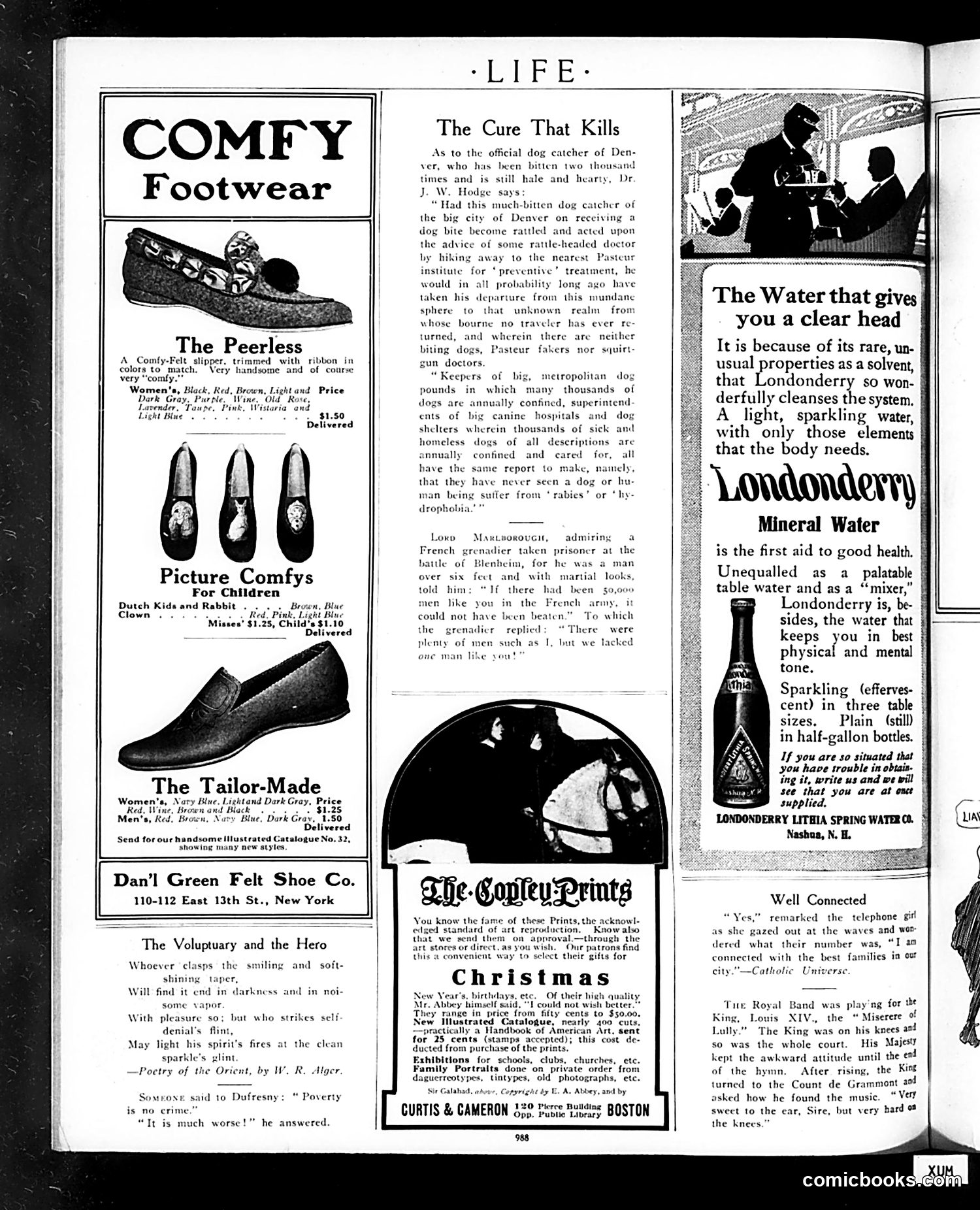
This page is primarily **advertising**, not political satire. It contains multiple product ads (footwear, mineral water, art prints) interspersed with short humorous anecdotes and poetry. The substantive content includes: **"The Cure That Kills"** — A brief article praising Denver's dog catcher who survived 2,000 dog bites without seeking Pasteur treatment (rabies vaccination), contrasting him favorably against those who panic after bites. This reflects early 20th-century skepticism toward medical intervention. **Small jokes** scattered throughout, including one about a telephone operator and "well-connected families" (a pun on phone connections). **Historical anecdotes**: a story about Lord Marlborough and a French grenadier at the Battle of Blenheim. The page reflects *Life* magazine's typical format of mixing satirical commentary with advertisements and light humor, though nothing here constitutes sharp political satire. The dog-catcher story's anti-alarmism is the closest to editorial commentary.
This is primarily an **advertising page** from *Life* magazine, not a political cartoon. It contains four distinct advertisements: 1. **Gray & Davis Lighting Dynamo System** - promotes electric lighting for automobiles, contrasting modern electric lights with "old-fashioned gas lamps." This reflects the early automotive era when electric lighting was a cutting-edge feature. 2. **Brooks Brothers Clothing** - a luxury menswear advertisement offering Christmas gift suggestions including formal wear, accessories, and luggage. 3. **Martell's Brandy** - emphasizes the brand's prestige by noting it supplies "the House of Lords," leveraging royal patronage for legitimacy (spanning from "George I to George V"). 4. **Pinehurst, North Carolina** - a winter resort advertisement marketing golf, hunting, and leisure activities for wealthy vacationers, emphasizing its exclusivity and modern amenities. The page reflects early 20th-century consumer culture targeting affluent readers, with no apparent satirical content or political commentary.
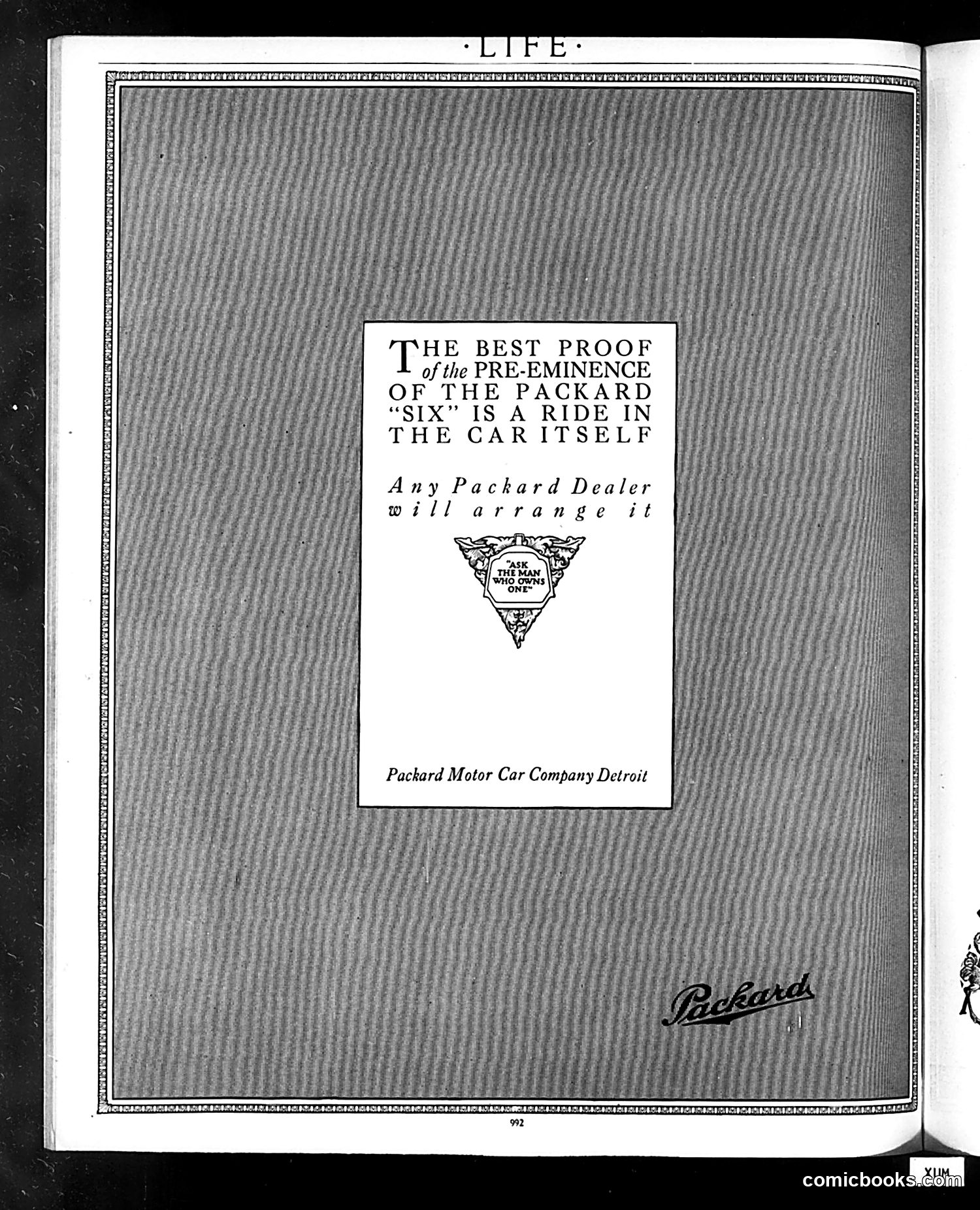
This is a **full-page advertisement** for the Packard Motor Car Company of Detroit, not editorial cartoon content. The page features a decorative border and centered advertisement promoting the Packard "Six" automobile. The ad's claim is straightforward: the best proof of the Packard Six's quality is "a ride in the car itself." It encourages prospective buyers that any Packard dealer will arrange a test drive. The ornamental triangle emblem contains the Packard logo. This represents typical early 20th-century automotive advertising strategy—emphasizing direct experience with the product as superior to any written claims. There is no political or social satire present; this is straightforward commercial messaging in a magazine that mixed editorial content with advertisements.
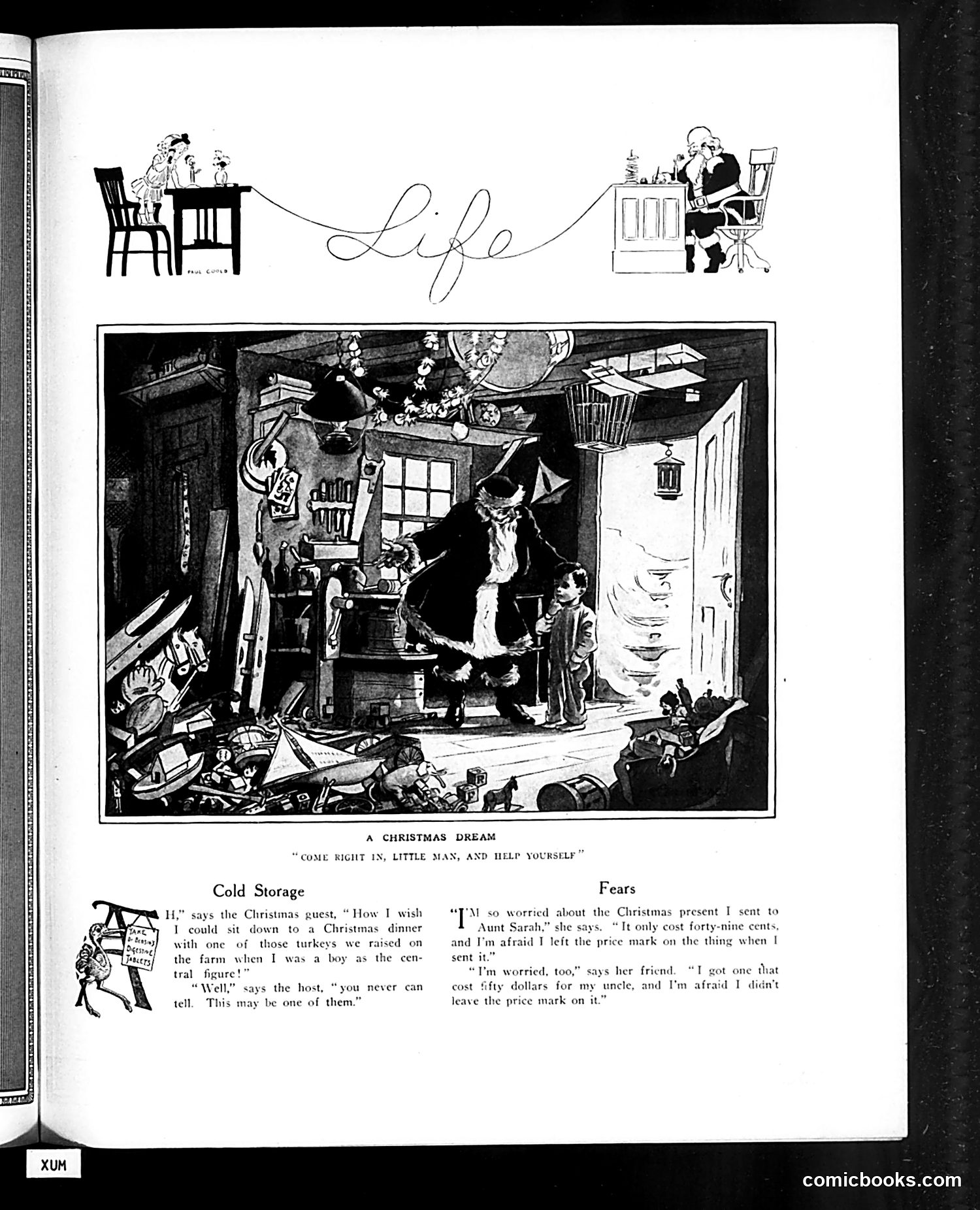
This page presents satirical commentary on Christmas anxieties through two segments: **"A Christmas Dream"** (central illustration): Shows Santa Claus visiting a modest home, captioned "Come right in, little man, and help yourself." The imagery contrasts a child's fantasy of abundance with the reality of limited means. **"Cold Storage" and "Fears"** (text sections below): Two brief anecdotes mock middle-class Christmas worries. One guest recalls modest farm dinners; another worries about a 49-cent gift to an aunt and an uncle's expensive gift without price tags removed—exposing anxiety about appearing poor or ungrateful. The satire targets class consciousness and materialism infiltrating Christmas celebration, suggesting Americans obsessed over gift costs and social appearance rather than holiday spirit.
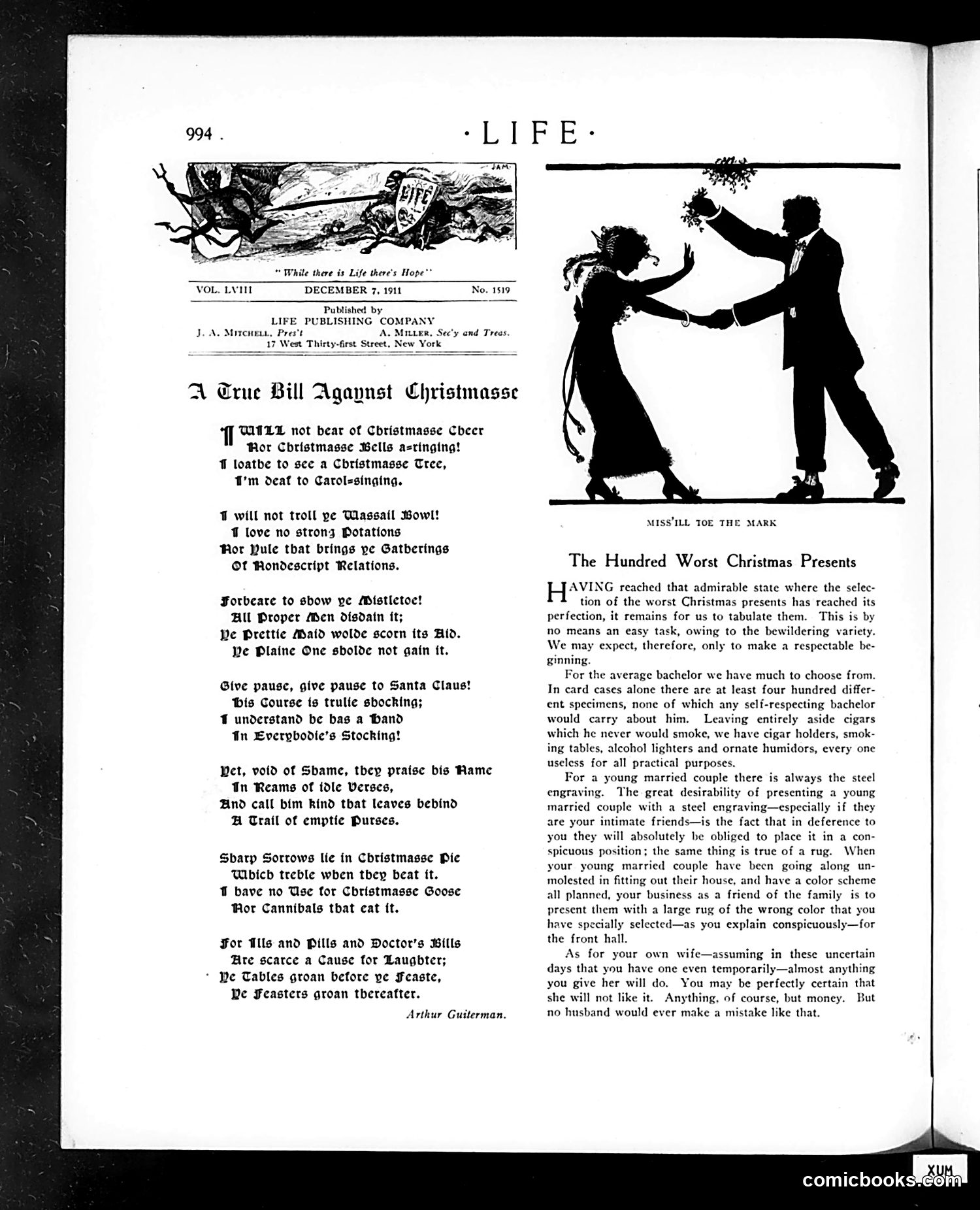
This page combines satirical poetry and humor about Christmas gift-giving. **The Poem** ("A True Bill Against Christmasse") by Arthur Guiterman is a mock-archaic complaint about Christmas excess—rejecting festive cheer, holiday gatherings, expensive feasts, and the financial burden ("trail of empty Purses"). It's written in deliberately old-fashioned spelling to humorously heighten the curmudgeonly tone. **The Silhouette Cartoon** ("Miss'll Toe the Mark") shows a woman and man in what appears to be a dance or playful struggle, likely illustrating romantic holiday interactions or courtship—a lighter counterpoint to the poem's grumpiness. **The Article** ("The Hundred Worst Christmas Presents") sarcastically catalogs terrible gift ideas: useless card cases and cigar accessories for bachelors; deliberately ugly steel engravings and wrong-colored rugs for newlyweds designed to clutter their homes; and for wives—anything except money. The humor relies on recognizing these as genuinely thoughtless, obligatory gifts people actually gave.
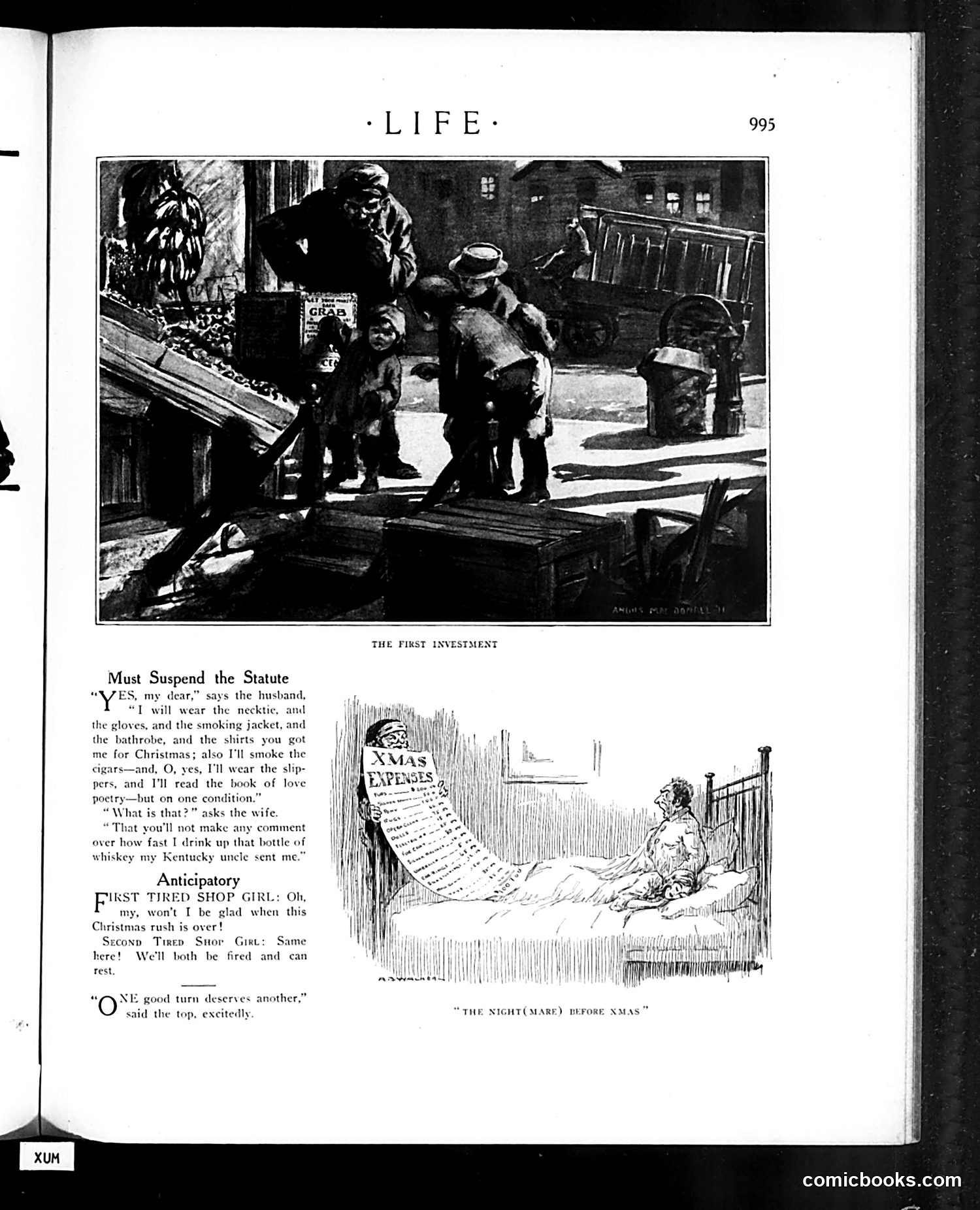
This page contains three separate jokes satirizing Christmas-era behaviors and social norms: **"Must Suspend the Statute"**: A husband agrees to wear gifts and read love poetry his wife gave him—but only if she won't comment on his heavy drinking of whiskey from his uncle. The joke mocks both marital compromises and men's casual alcoholism during this period. **"Anticipatory"**: Two exhausted shop girls discuss being fired after the Christmas rush ends. The second girl's response—that they'll "both be fired and can rest"—is darkly humorous, treating job loss as a relief rather than catastrophe. This reflects Depression-era anxieties about retail work. **"The Night(Mare) Before Xmas"**: The sketch (right) plays on Clement Clarke Moore's famous poem, showing someone anxiously awaiting Christmas expenses listed on a scroll labeled "XMAS EXPENSES." The pun in the title suggests Christmas brings nightmares rather than joy—satirizing the financial stress the holiday creates for ordinary families. All three pieces mock the gap between Christmas's idealized image and harsh economic realities.
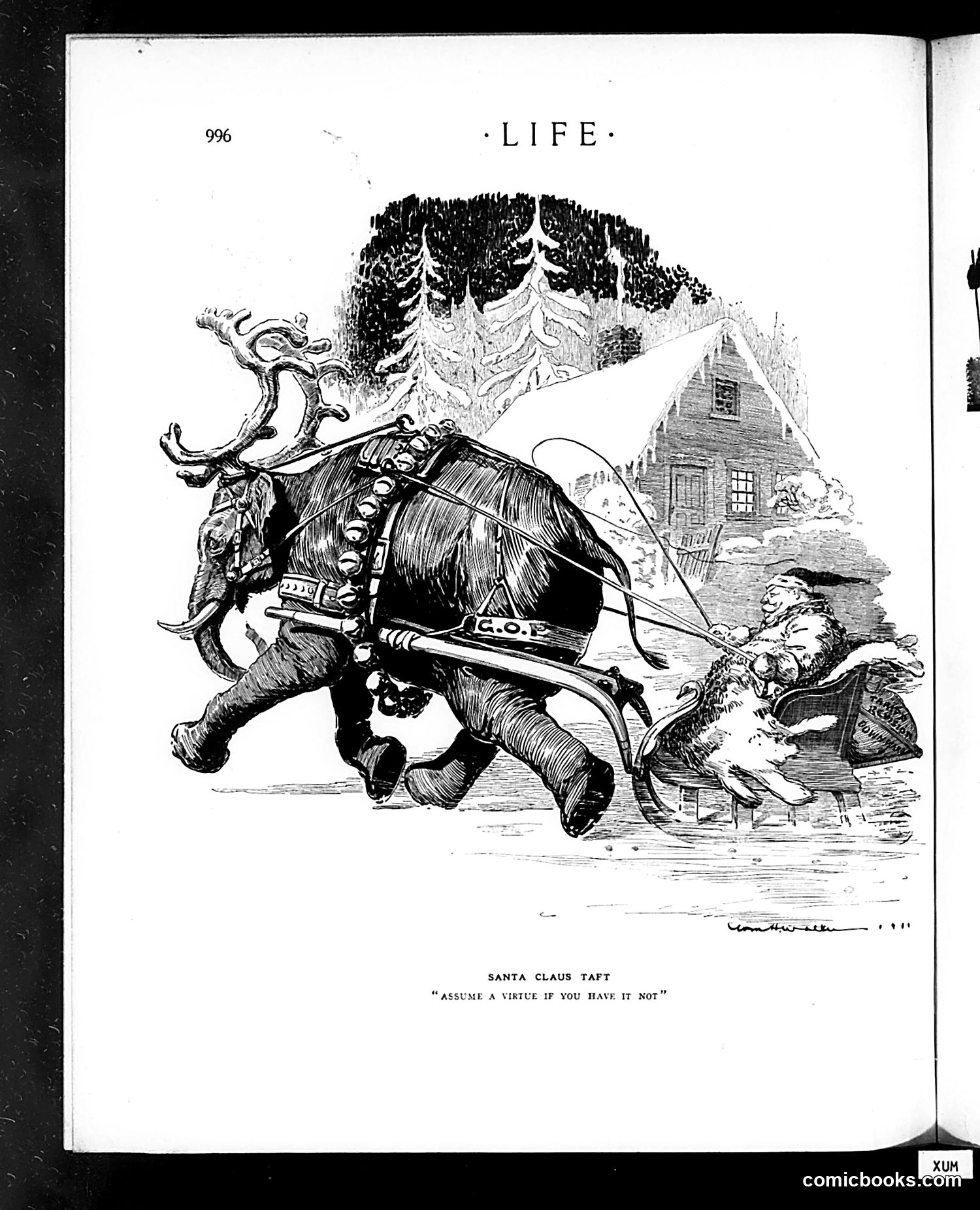
This political cartoon depicts President William Howard Taft as Santa Claus, driving a heavily-laden sleigh pulled by an elephant (the Republican Party symbol). The subtitle quotes Shakespeare's *Hamlet*, suggesting Taft is *pretending* to be virtuous or generous. The satire likely critiques Taft's policies or public image—perhaps mocking him as a false benefactor or suggesting his administration was hypocritical in its charitable or progressive claims. The overloaded sleigh and strained elephant suggest the burden or strain of his policies. The winter cabin scene in the background completes the Christmas imagery. Without the publication date visible, the specific grievance remains unclear, though this appears to target Taft's presidency (1909-1913) during a period of significant political controversy.
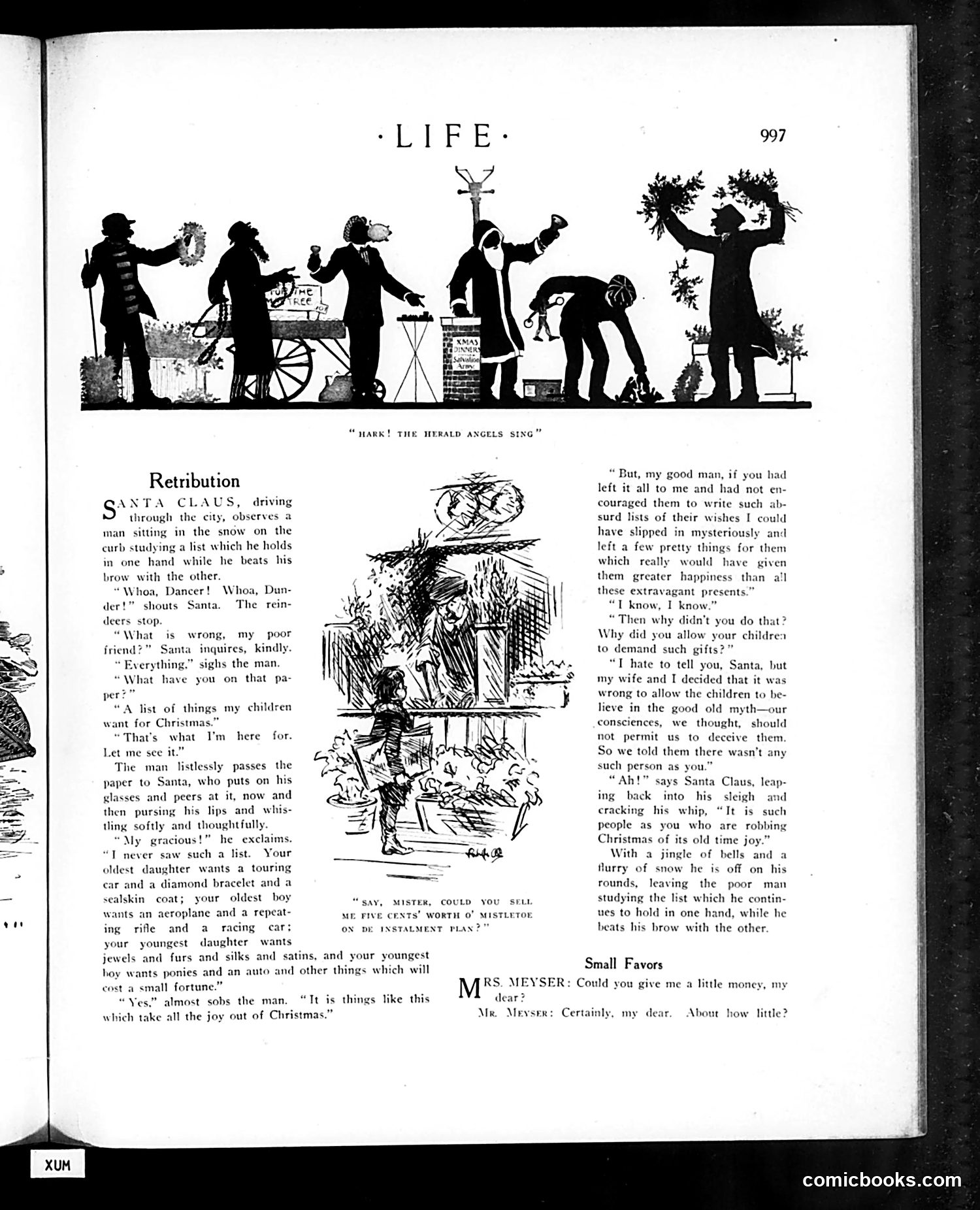
This story satirizes modern parenting and consumerism circa early 20th century. A poor man sits despairing over his children's extravagant Christmas wish list (touring cars, diamond bracelets, aeroplanes, racing cars). Santa Claus encounters him and criticizes the situation—not because the gifts are expensive, but because the father has *stopped telling children Santa exists*, believing it's dishonest. Santa argues this "rational parenting" backfires: children who don't believe in Santa lose the *magic* of modest surprises and instead demand material luxuries from parents directly. By destroying the Santa myth for conscience's sake, the father has inadvertently created greedy, materialistic children. The satire targets progressive early-1900s parenting philosophy that rejected "deception" in favor of brutal honesty—suggesting such moral superiority actually harms childhood wonder and family joy. The point: sometimes useful myths are worth preserving.
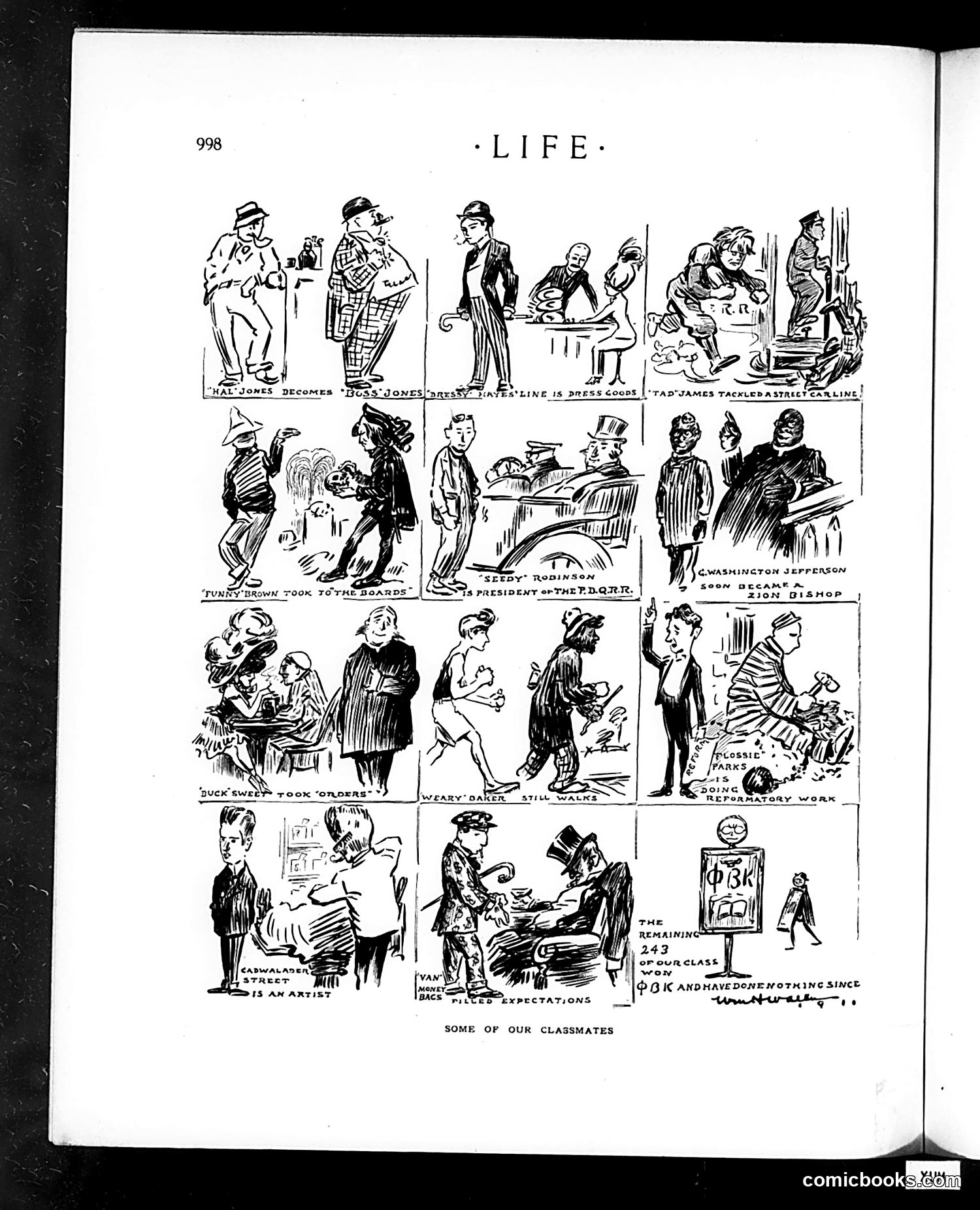
This page presents a series of comic vignettes mocking various social types and professions of the era. Each panel captions a figure with a punny or ironic caption suggesting what they've become. Visible examples include: - "Hal Jones Becomes Guss Jones" (a play on names) - "Fad James Tackles a Street Car Line" (suggesting someone pursuing business ventures) - "Funny Brown Took to the Boards" (theatrical career) - "Gerry Robinson" as "President of the P.D.Q.R.R." (mock railroad presidency) - References to professions like street artists and sign bishops The humor relies on wordplay, career trajectories, and social commentary about what becomes of former classmates—likely from a school or university yearbook context. The satirical point appears to be deflating pretensions and mocking various professions through exaggerated caricatures and puns typical of early 20th-century American humor magazines.
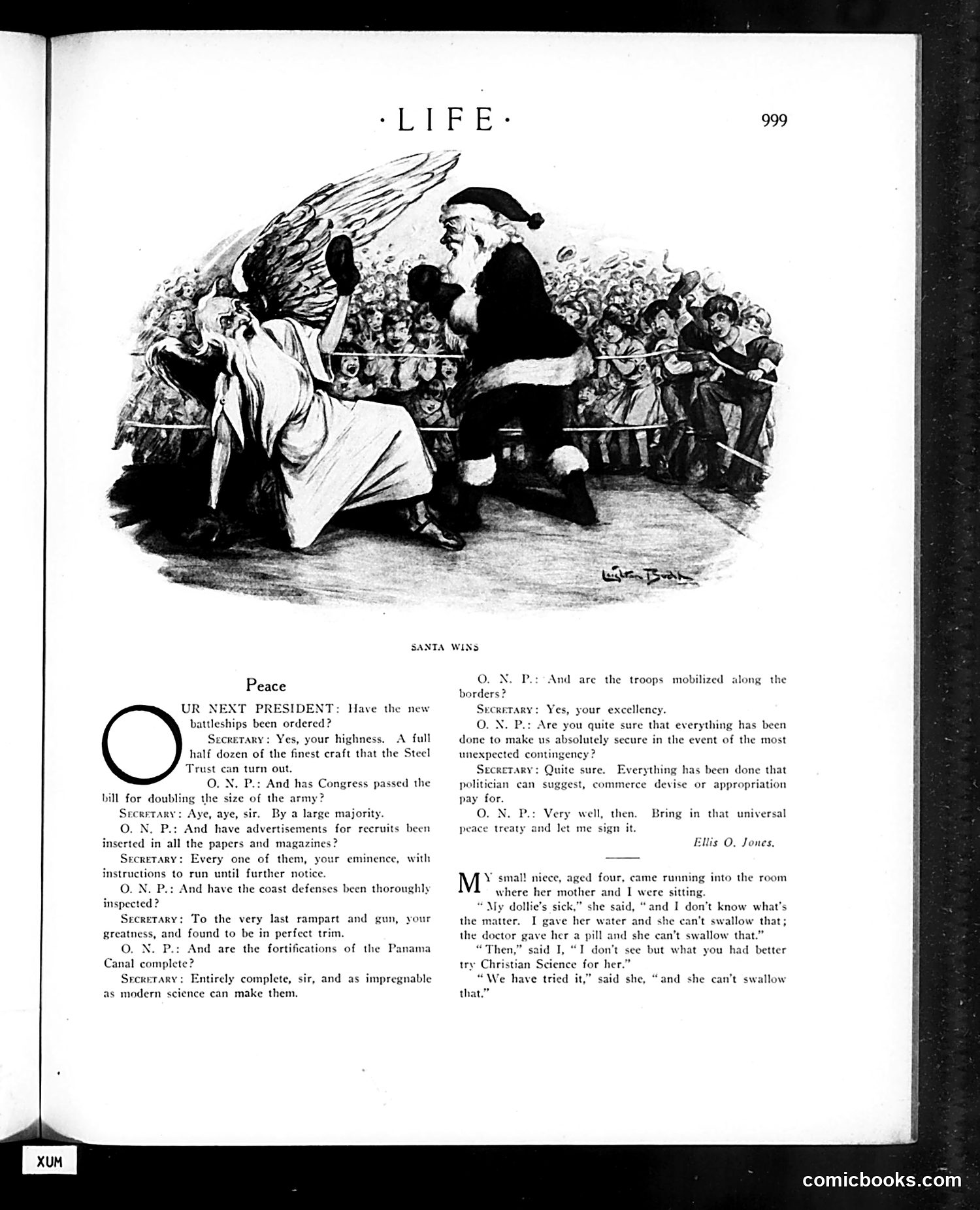
This satirical cartoon critiques early 20th-century American militarism and the contradiction between peace rhetoric and military buildup. The illustration shows Santa Claus (representing peace) confronting a military figure labeled "O.N.P." (likely "Our Next President"), surrounded by cheering crowds. The dialogue reveals the satire: despite claiming to pursue peace, the administration has ordered battleships, doubled the army, mobilized troops, fortified borders, and completed the Panama Canal—all presented as necessary "security" measures. The joke is that genuine peace is impossible when politicians pursue simultaneous contradictions: they sign peace treaties while frantically militarizing. The Secretary's final line crystallizes this: everything has been done that "politician can suggest, commerce devise or appropriation pay for"—exposing military spending as driven by politics and corporate profit rather than genuine security needs. The secondary humor piece about Christian Science reinforces the theme of ineffective solutions being applied stubbornly.
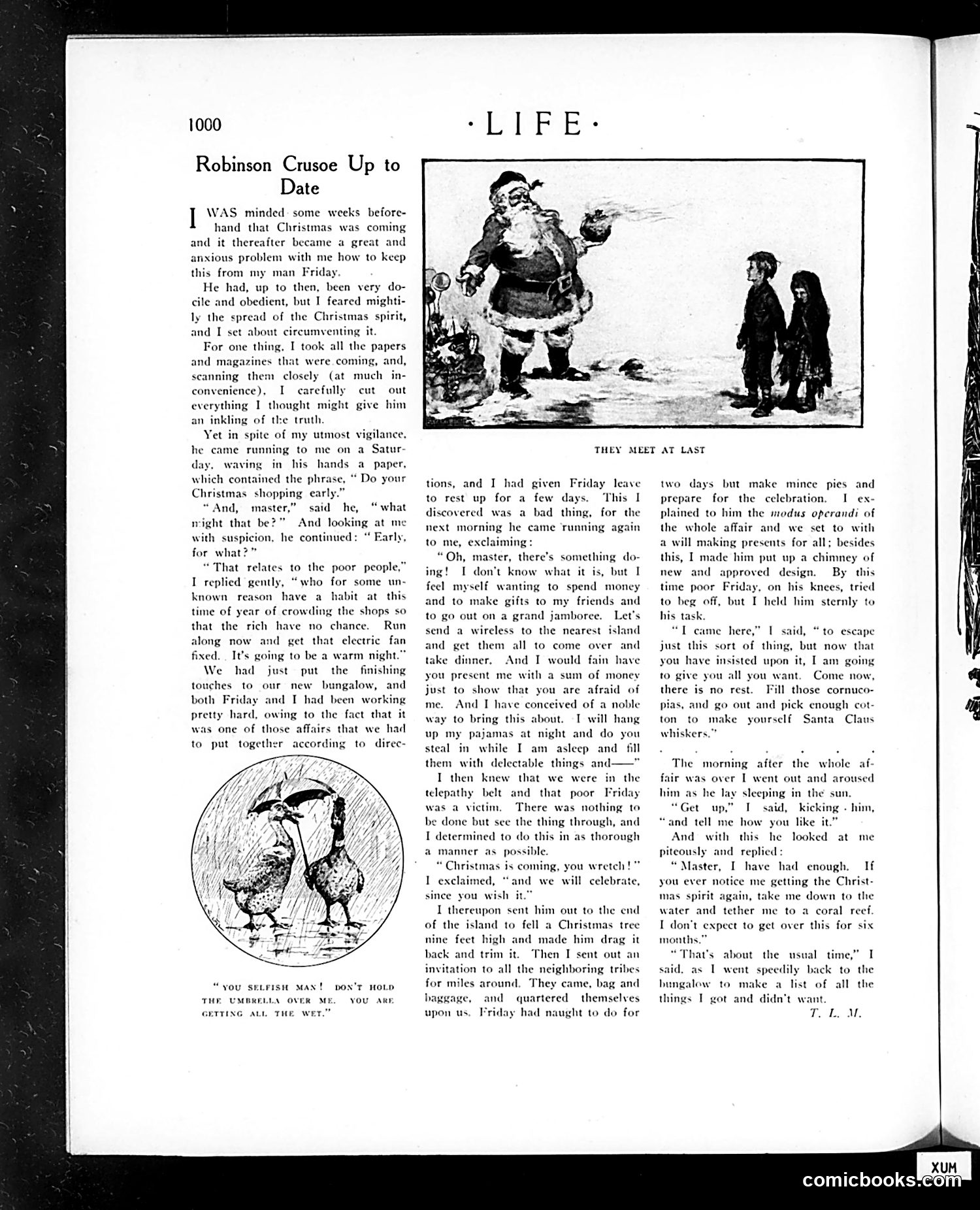
This satirical story updates Daniel Defoe's classic novel for early 1900s American consumer culture. The narrator (Crusoe) tries to shield his servant Friday from learning about Christmas to prevent the "Christmas spirit"—meaning commercial materialism and gift-giving—from spreading. Despite censoring newspapers, Friday picks up Christmas fever anyway, suddenly wanting to spend money, give gifts, and host parties. The joke satirizes how pervasive consumer culture and holiday commercialism have become: even isolation can't prevent it. The cartoons show Friday's growing enthusiasm and the absurd consequences: Crusoe must host lavish celebrations, make presents, and keep poor Friday endlessly working (making mince pies, building chimneys) to satisfy Christmas expectations. The satire critiques how Christmas has transformed from spiritual observance into exhausting commercial obligation—even for those trying to escape modern society entirely.
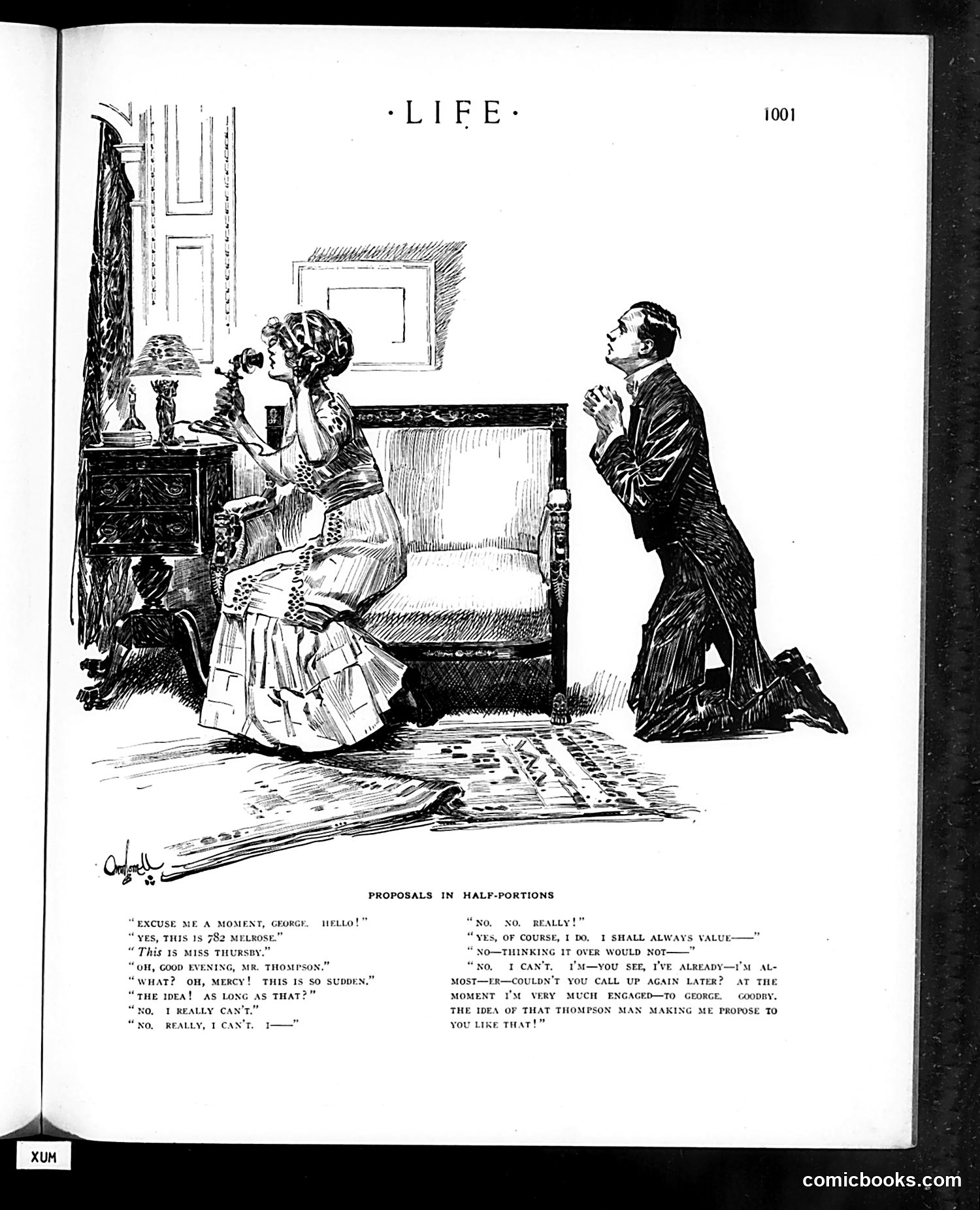
This satirical cartoon mocks the reversal of traditional gender roles in marriage proposals. A woman kneels before a man in a bedroom setting, proposing to him—an inversion of Victorian courtship conventions where men always initiated proposals. The humor targets changing social attitudes about women's agency. The woman's dialogue suggests she's already involved with someone else ("Thompson"), making her proposal opportunistic rather than romantic. The man's shocked reactions ("This is so sudden," "Oh, mercy!") parody the supposed delicate sensibilities women were expected to display when receiving proposals. The title "Half-Portions" likely refers to incomplete or compromised proposals—the woman isn't fully committed, and the situation is socially awkward. The cartoon satirizes both female assertiveness and the disruption of established courtship rituals, reflecting early-20th-century anxieties about changing gender dynamics.
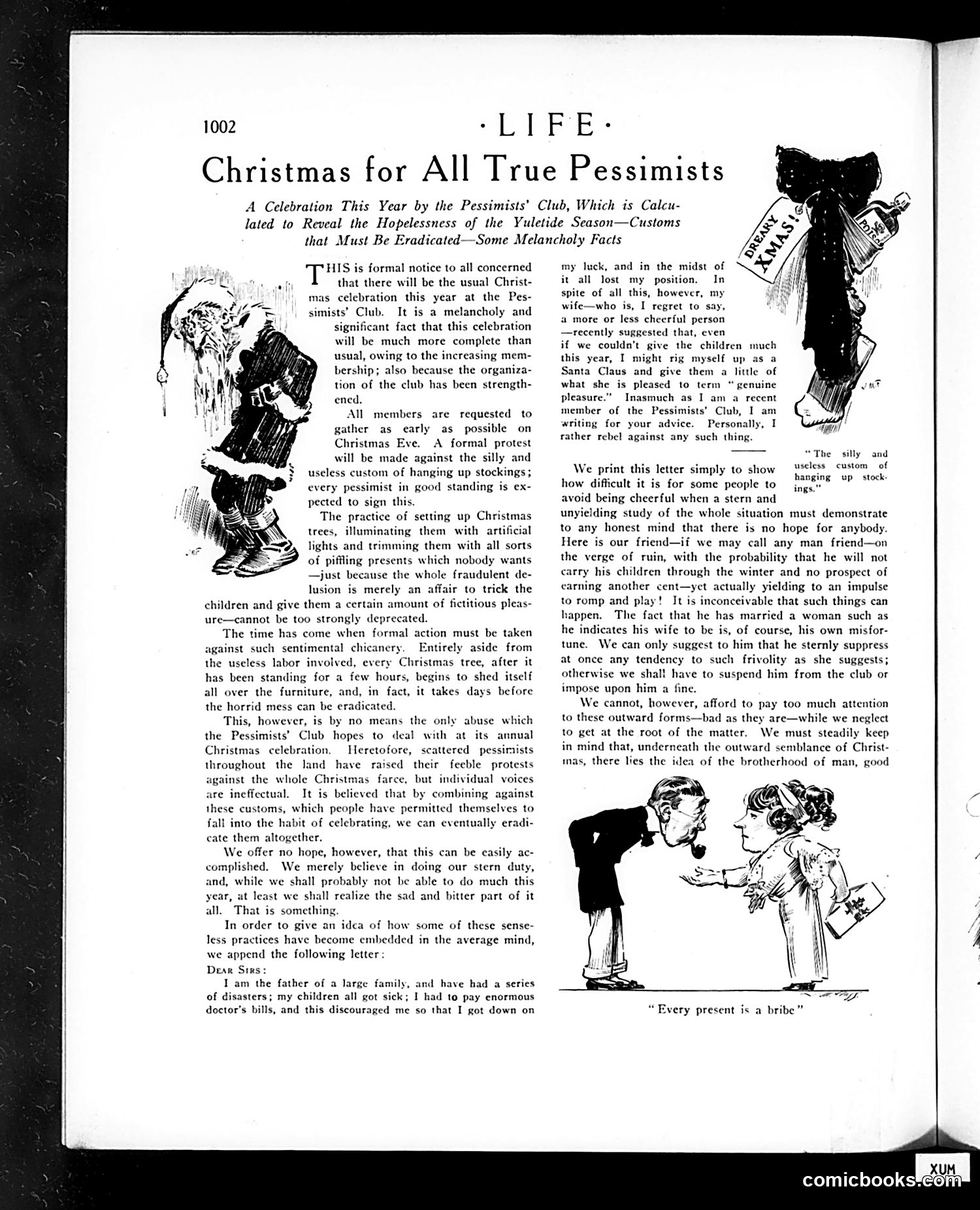
This satirical article mocks excessive pessimism by presenting a fictional "Pessimists' Club" that formally protests Christmas traditions. The club campaigns against Christmas trees (which shed needles), stockings, and gift-giving—dismissing them as "fraudulent delusions" designed to trick children. The humor lies in the absurdity: the club treats cheerfulness as moral weakness. A letter from a struggling father—unemployed, with sick children and medical debt—illustrates the satire's target. His wife wants him to dress as Santa despite their hardships; the club responds that yielding to "impulses to romp and play" during ruin demonstrates dangerous optimism. The accompanying cartoons reinforce this: Santa Claus appears bedraggled, and one cartoon caption reads "Every present is a bribe," suggesting gift-giving as moral corruption. Life's satire critiques rigid, joyless worldviews—suggesting that relentless pessimism, taken to extremes, becomes as absurd and harmful as naïve optimism. The piece defends humble pleasures and human resilience against deterministic gloom.
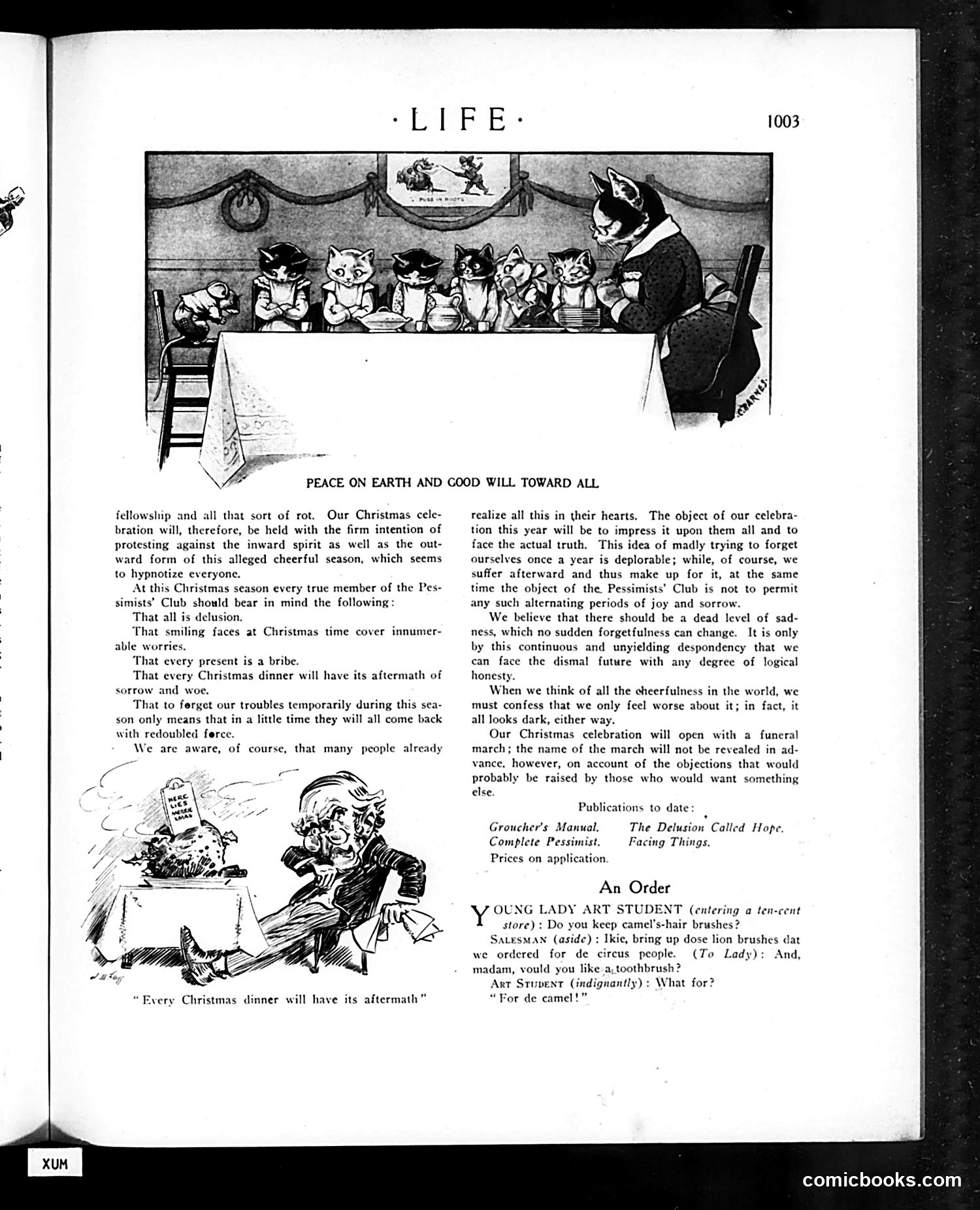
This page satirizes the *Pessimists' Club*, a fictional organization dedicated to rejecting Christmas cheer. The main text mocks those who use the holiday to escape life's miseries, arguing instead for constant, unrelenting sadness as "logical honesty." It's absurdist humor critiquing both naive optimism and contrived cheerfulness—suggesting that temporary joy followed by redoubled sorrow is worse than accepting perpetual gloom. The bottom cartoon is a simple ethnic-stereotype joke: a salesman (depicted with exaggerated dialect speech) misunderstands an art student's request for camel-hair brushes, bringing "lion brushes" instead and suggesting a toothbrush "for de camel." The humor relies on the salesman's supposed stupidity and comedic ethnic characterization typical of early 20th-century American satire.
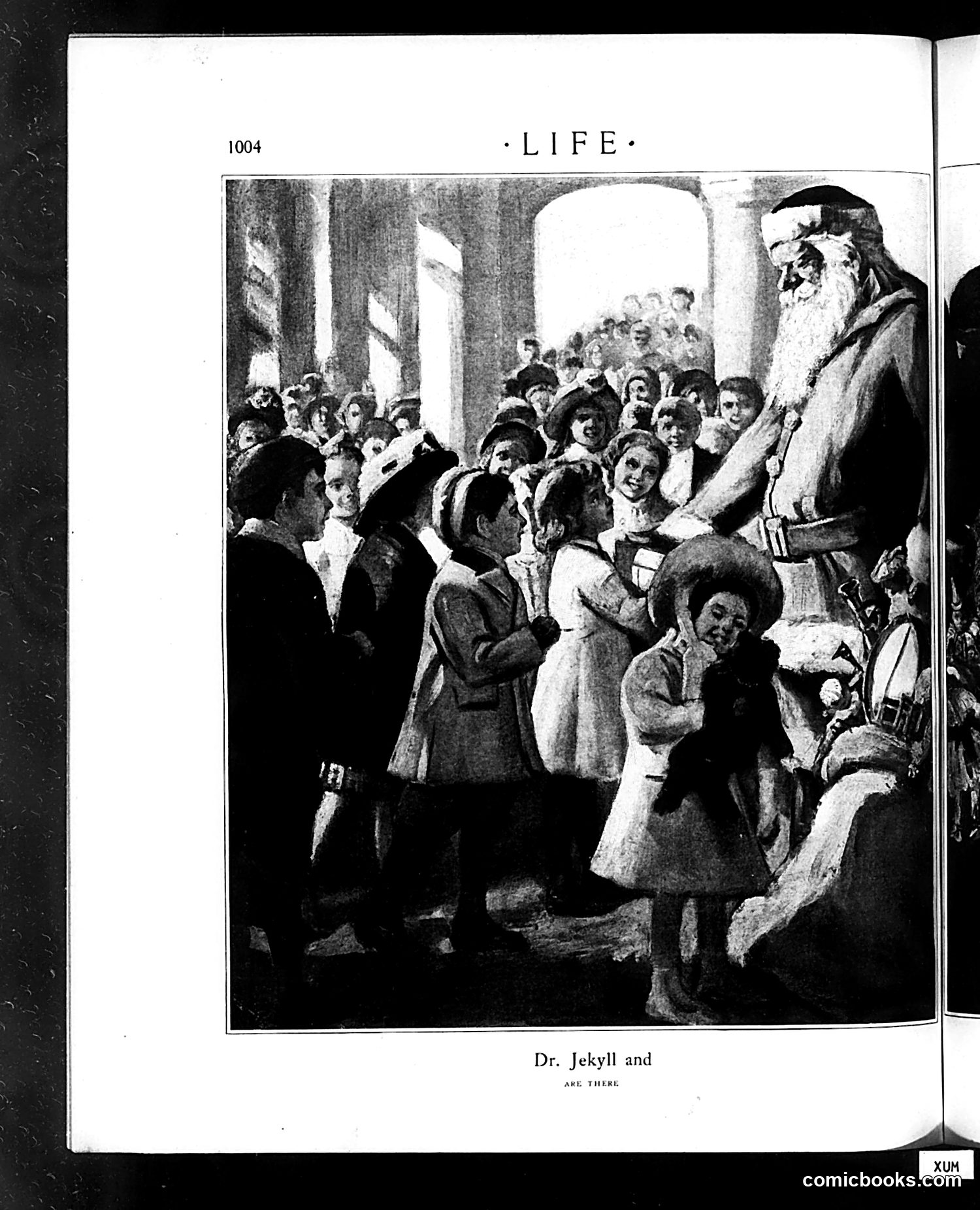
This illustration depicts a scene from Robert Louis Stevenson's classic novella "Dr. Jekyll and Mr. Hyde" (1886). The image shows a crowd of people—men, women, and children—gathered around a tall figure with a distinctive long white beard on the right side, presumably Dr. Jekyll in his transformed state as the monstrous Mr. Hyde. The caption "Dr. Jekyll and ARE THERE" appears incomplete in the OCR text, suggesting the full caption was cut off. The satire likely comments on duality or hidden moral corruption beneath respectable appearances—a common theme Life magazine used to critique public figures or society. The gathered crowd emphasizes public revelation of private secrets.
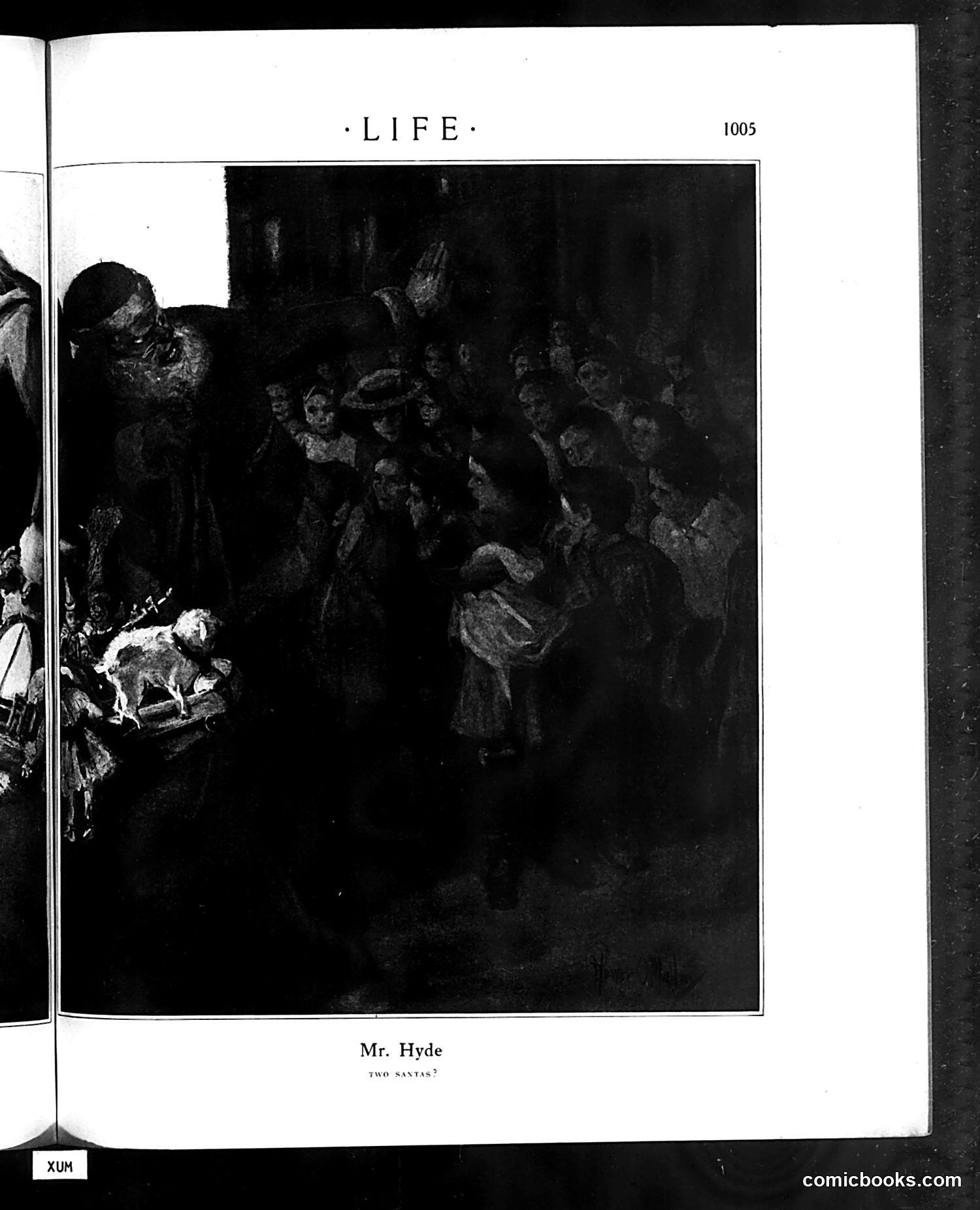
This page from *Life* magazine (page 1005) appears to be a political cartoon commentary titled "Mr. Hyde—Two Santas?" The dark, crowded scene depicts multiple figures in what seems to be a chaotic gathering, though the image quality makes specific identification difficult. The "Two Santas" reference likely alludes to a political duality or hypocrisy—comparing a figure's public persona (the benevolent Santa) with a darker private nature (Mr. Hyde, from the Jekyll/Hyde literary reference). The crowded composition and ominous tone suggest satire about deception or contradiction in public life, though without clearer visual detail or additional text, the specific political target and historical context remain uncertain.
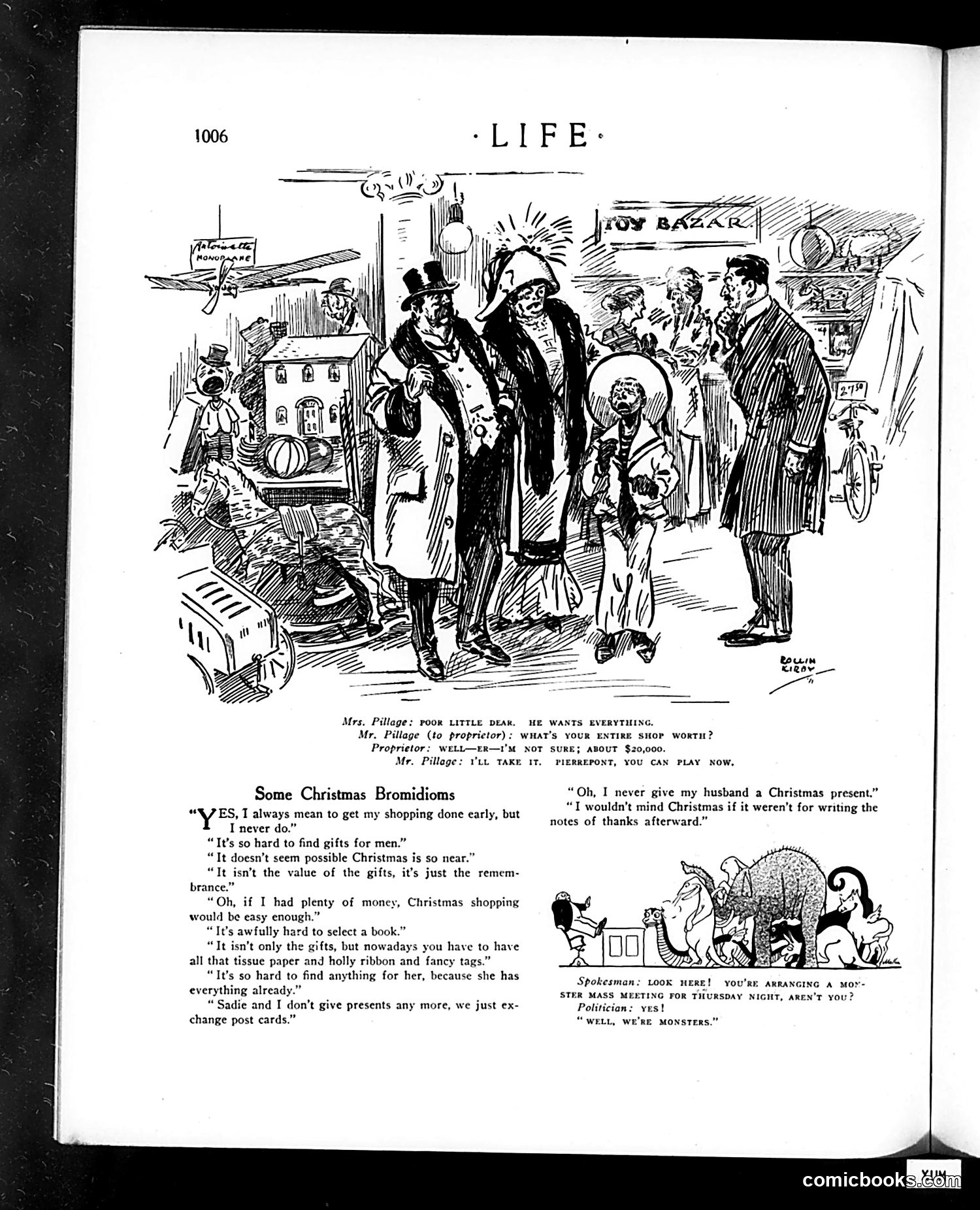
This page contains two satirical pieces about Christmas shopping and attitudes: **Top cartoon:** A wealthy couple (the "Pillages") enters a shop and demands to buy everything in it. Mr. Pillage asks the proprietor the shop's total worth, then simply says he'll take it all. The satire mocks wealthy consumers' casual extravagance and entitlement during the Christmas season. **"Some Christmas Bromidioms":** A collection of common holiday complaints—about procrastination, gift-giving difficulty, wrapping expenses—presented as tired clichés people repeat annually. The satire targets the way Christmas shopping becomes obligatory social performance rather than genuine giving. **Bottom cartoon:** A politician arranges a "monster mass meeting" for Thursday night. When challenged about organizing monsters, he agrees they are monsters. This likely satirizes political rallies or gatherings as morally questionable events, though the specific reference is unclear without more context. Overall, the page mocks Christmas commercialism, shallow social conventions, and political hypocrisy through humor.
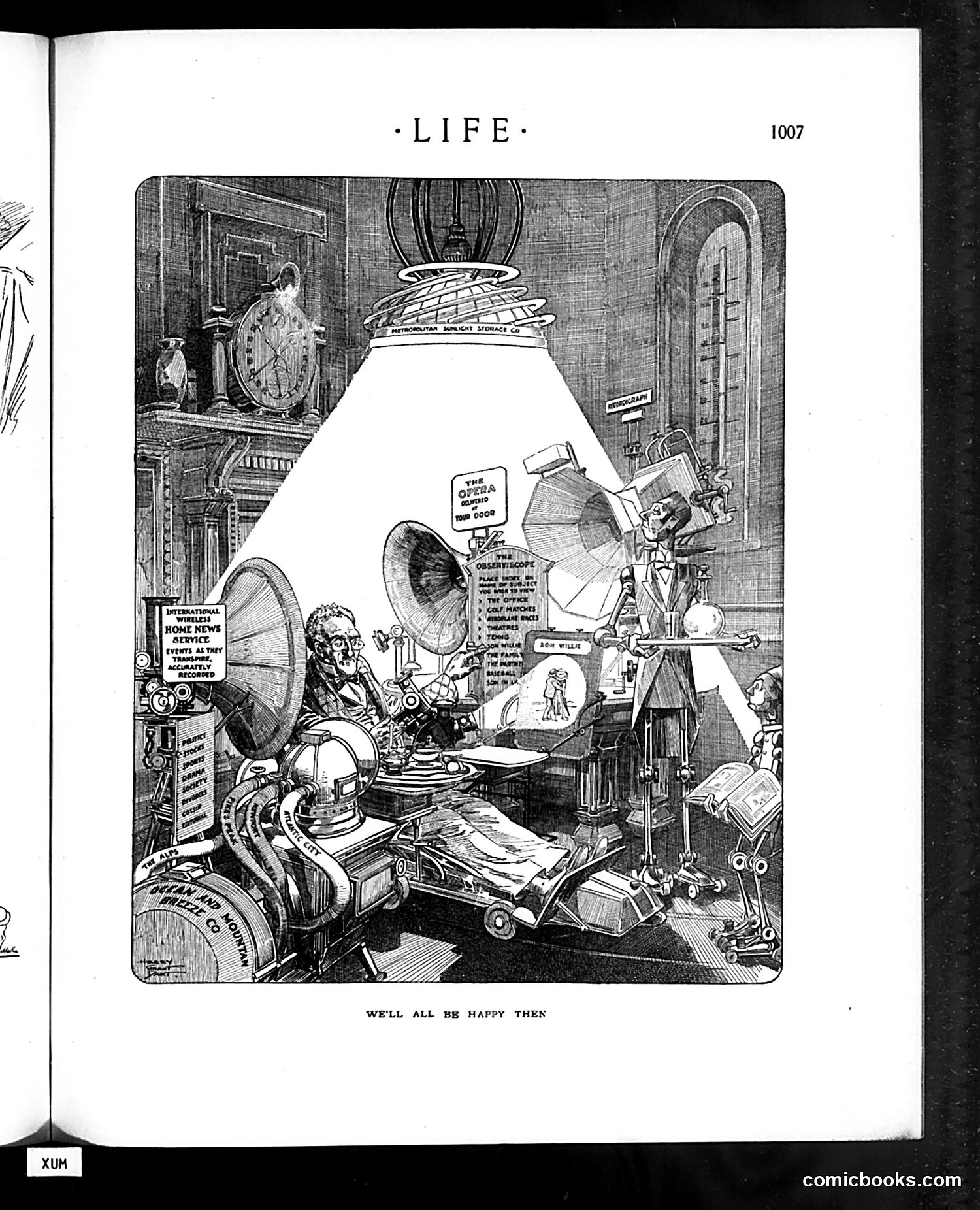
This is a satirical cartoon depicting a futuristic scientific laboratory. The central figure appears to be a mad scientist or inventor presiding over various technological devices and equipment—telescopes, wireless apparatus, storage devices, and other mechanical contraptions labeled with text (though the specific labels are difficult to read clearly in this reproduction). The satire mocks both scientific optimism and the notion that technological progress alone will solve human problems. The title "We'll All Be Happy Then" is ironic—suggesting that people naively believe future inventions will automatically create universal happiness, when the cartoon implies technology alone cannot achieve this. The cluttered, chaotic laboratory and the somewhat absurd collection of devices reinforce the skepticism about techno-utopian promises popular in early 20th-century culture.
This satirical story contrasts two characters' moral perspectives on wealth. Wellington Burkhead, a successful businessman, experiences a moral awakening while preparing Christmas gifts. Initially planning to give his wife an expensive fur set and modest gifts to employees' children, he calculates that his fifteen-year earnings rightfully belong to those who helped create his wealth. He redistributes his fortune accordingly. His wife Louise represents the opposite view—that wealth is personal property, earned through one's own idea and effort, to be spent on luxury and status (the story notes her society prominence and bridge-playing superiority). The satire criticizes wealthy industrialists' self-indulgence while praising Burkhead's conscience-driven redistribution. The title "And She Was Silent" suggests Louise's shocked silence when confronted with his moral reasoning—she cannot argue against the logic of his position. This reflects early 20th-century debates over labor, capital, and business ethics.
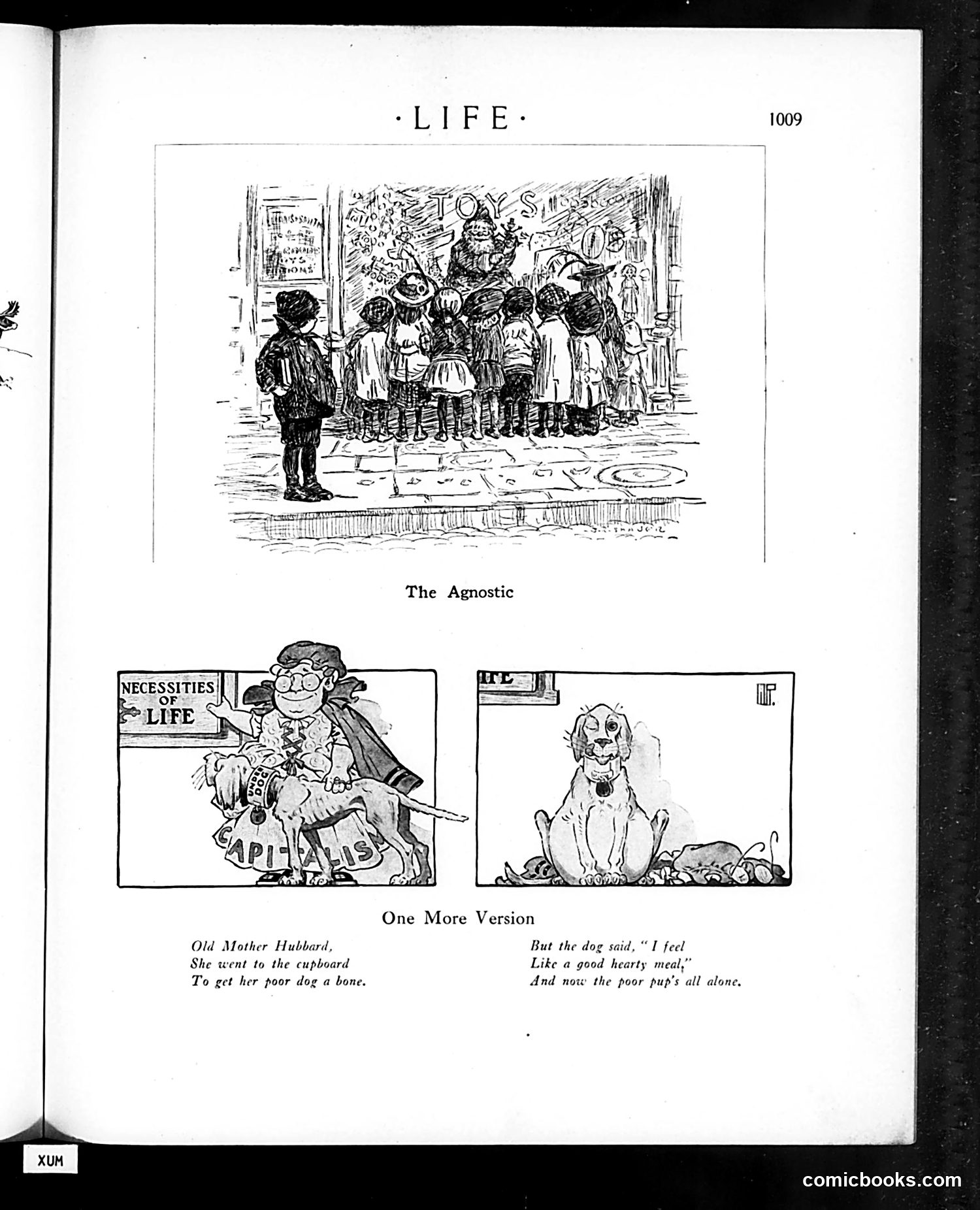
This Life magazine page presents satirical takes on familiar nursery rhymes and social commentary. **Top cartoon ("The Agnostic"):** A lone boy stands apart, watching other children crowd around a toy shop window. The title suggests he represents skepticism or doubt—he won't join the materialism and consumerism the other children eagerly pursue. **Bottom cartoons ("One More Version"):** These offer darkly humorous retellings of "Old Mother Hubbard." The left panel shows the nursery rhyme's traditional setup; the right panel's punchline subverts it—the dog, feeling satisfied after consuming Old Mother Hubbard herself as "a good hearty meal," leaves "the poor pup's all alone." It's gallows humor playing on cannibalism and abandonment, typical of Life's irreverent satirical style.
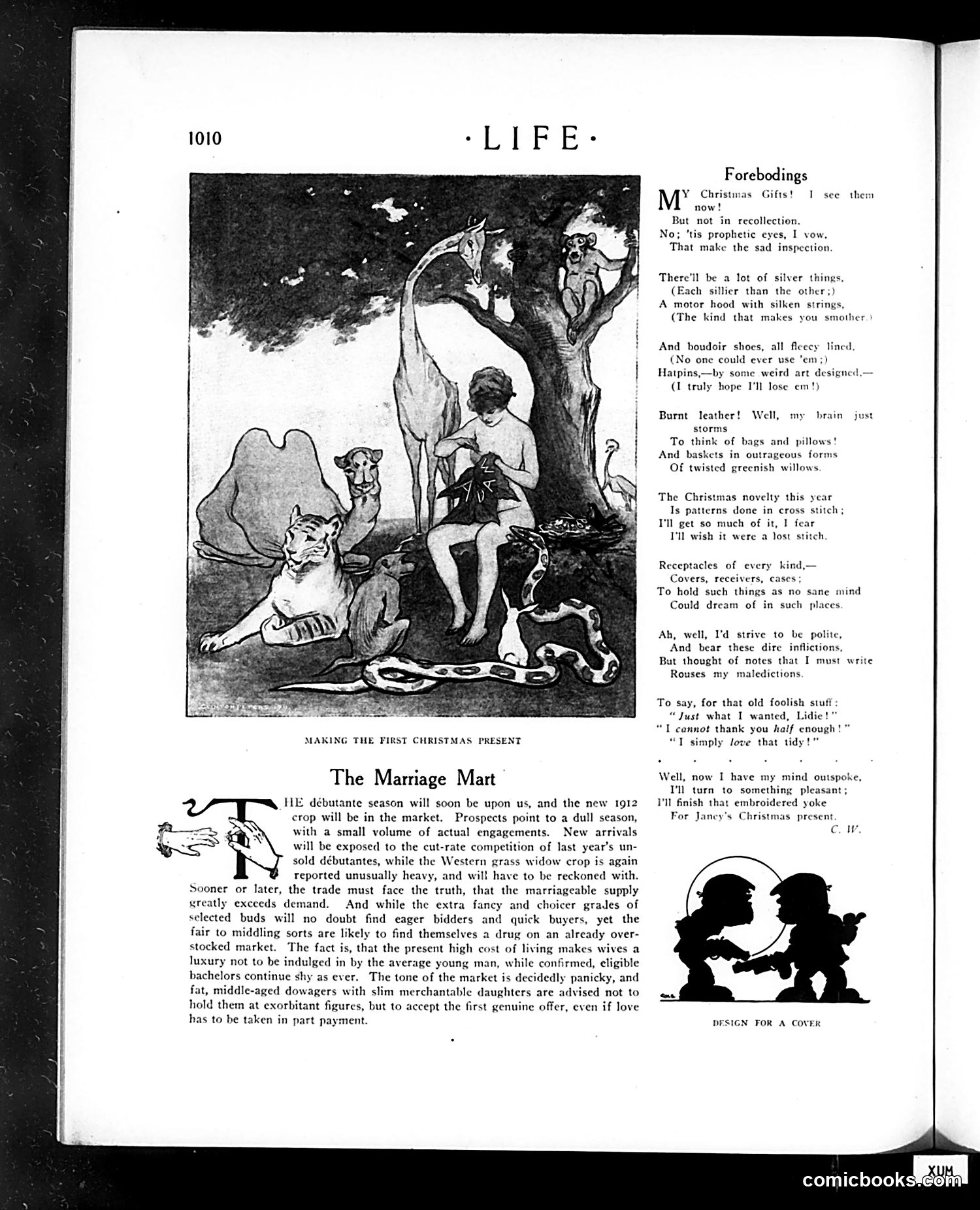
This 1912 Life magazine piece satirizes the marriage market as literal commerce. The article mockingly treats eligible young women as merchandise—"the new 1912 crop" entering an oversupplied market where supply "greatly exceeds demand." The satire's targets include: - **Debutantes as commodities**: Young women are "exposed to cut-rate competition" and risk becoming "a drug on an already over-stocked market" - **Economic anxiety**: Rising living costs make wives "a luxury" men can't afford - **Mercenary matchmaking**: Parents (especially "fat, middle-aged dowagers") are advised to accept "the first genuine offer, even if love has to be taken in part payment" - **Social hypocrisy**: The piece exposes how marriage, supposedly romantic, functioned as naked economic transaction The companion poem "Forebodings" shifts to holiday gift-giving anxieties—unwanted items requiring false gratitude ("I simply love that tidy!")—offering gentle social satire contrasting with the Marriage Mart's sharper critique of women's commodification.
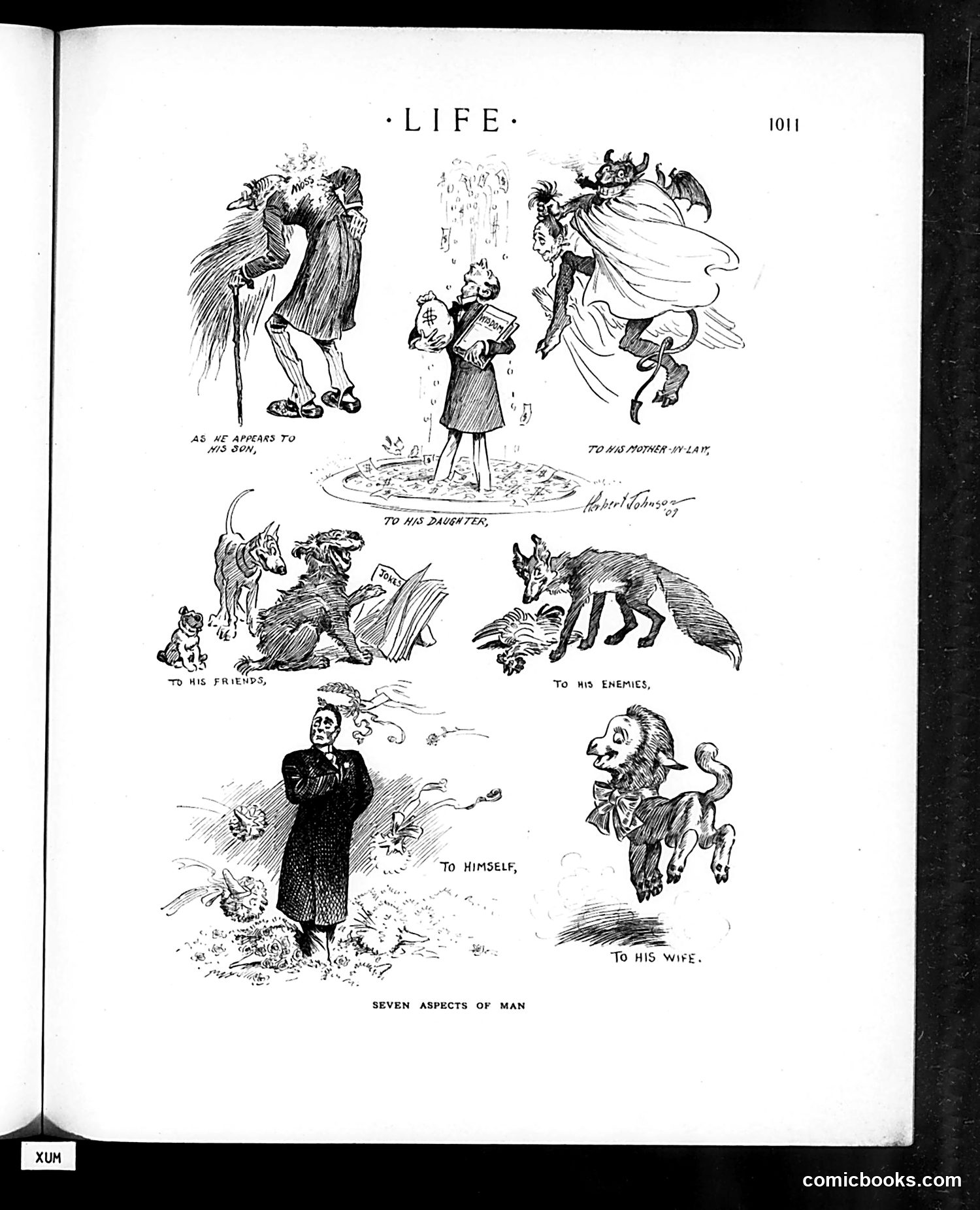
This satirical cartoon from *Life* magazine illustrates how a single man presents radically different personas depending on his audience. The central figure is surrounded by six vignettes showing him as: 1. **To his son**: appearing respectable and authoritative 2. **To his mother-in-law**: angelic/virtuous 3. **To his daughter**: demonic/mischievous 4. **To his friends**: debauched/wild 5. **To his enemies**: predatory/threatening 6. **To himself**: foolish/comical 7. **To his wife**: subservient/henpecked The joke satirizes masculine hypocrisy and social performance—how men adopt contradictory personas in different contexts. It's a commentary on the gap between public respectability and private behavior, suggesting that male identity is fundamentally performative and duplicitous. The exaggerated grotesque caricatures emphasize the absurdity of these constant role-shifts.
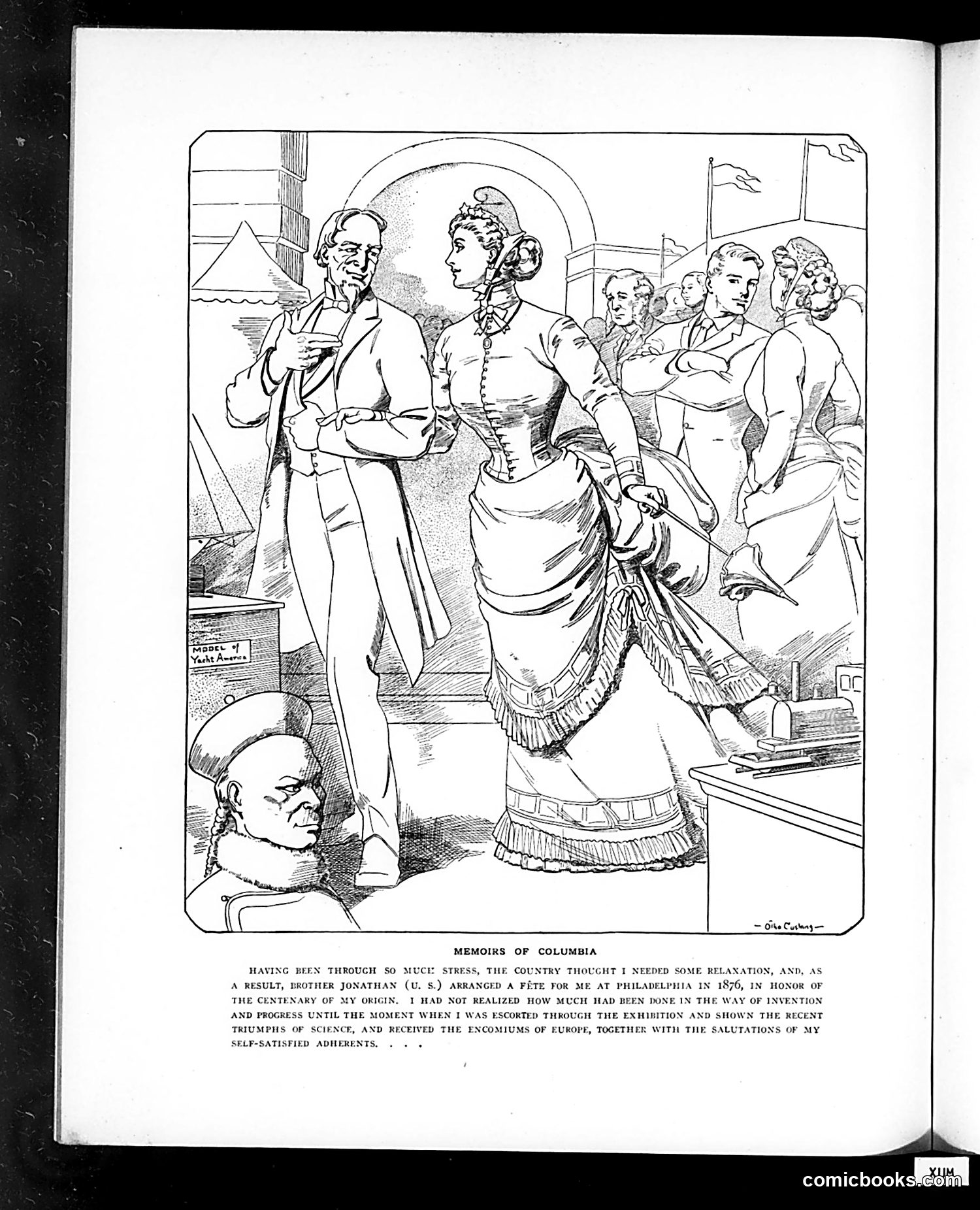
This satirical piece commemorates Philadelphia's 1876 Centennial Exposition celebrating American independence. "Columbia" (female personification of America) is the speaker, describing how "Brother Jonathan" (the United States) arranged a celebratory fair to showcase the nation's scientific and industrial progress. The cartoon depicts Columbia at the exposition surrounded by admirers and dignitaries. The satire appears gentle—celebrating American achievement while perhaps gently mocking the self-congratulatory tone of the centennial festivities and the "self-satisfied adherents" basking in national pride. The artist (signed "Dike Custeny") uses the conceit of Columbia as memoir-writer reflecting on her century of existence, emphasizing technological advancement as proof of national success. This reflects the era's faith in progress and industrial development as measures of national greatness.
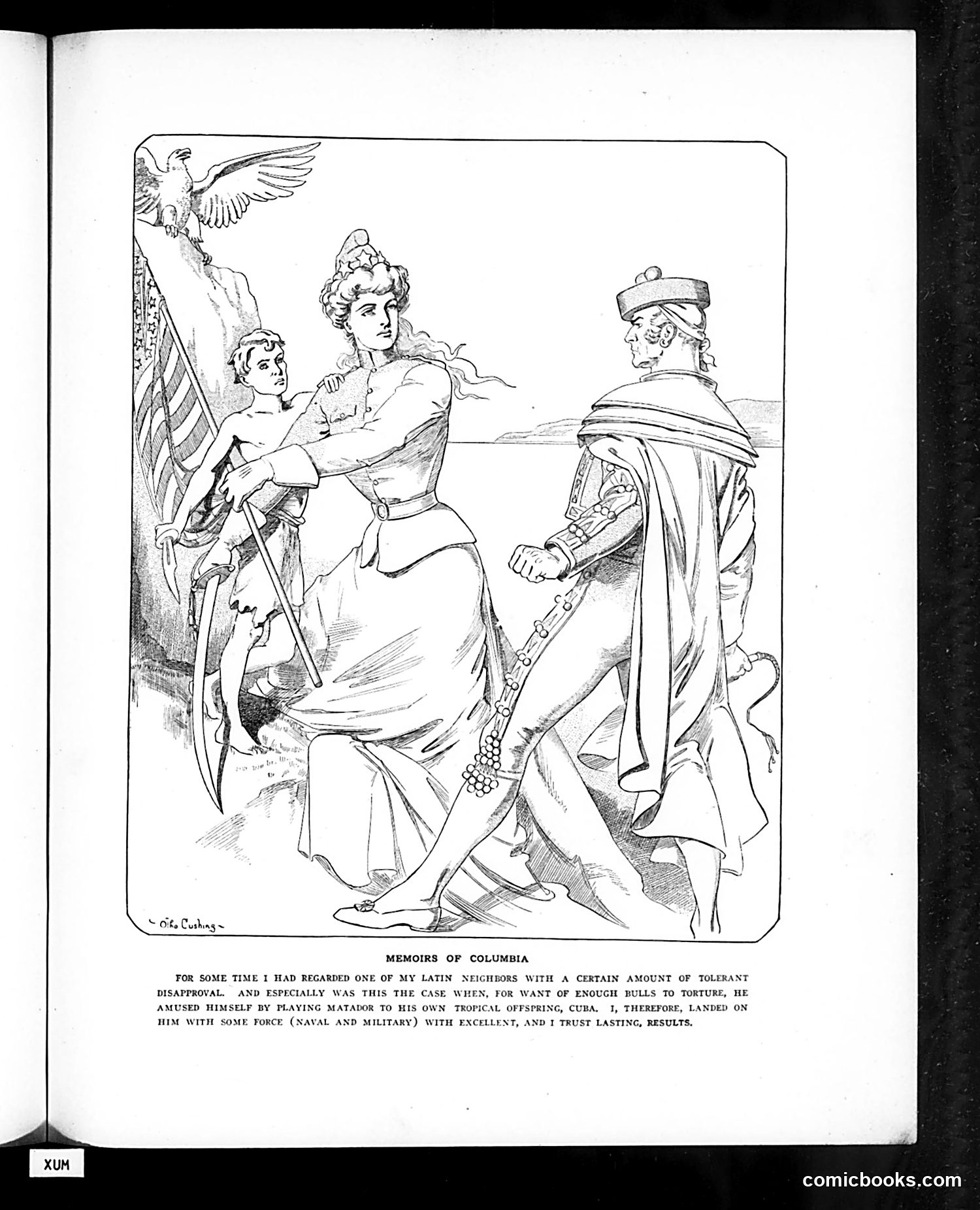
This satirical cartoon depicts the United States (Columbia, personified as a woman with the American flag) justifying military intervention in Cuba. The figure on the right represents a Latin American neighbor (likely Spain or a generic Latin American power), while the woman holds a child labeled "Cuba." The caption's text is self-aggrandizing propaganda: Columbia claims she intervened militarily because her neighbor was cruelly "playing matador" with Cuba—torturing it like a bullfighting victim. The satire mocks American imperial rhetoric, presenting military conquest as benevolent "discipline" of a misbehaving neighbor. This appears to reference the Spanish-American War (1898) and American acquisition of Cuba, where the U.S. justified intervention as humanitarian protection against Spanish cruelty, while actually pursuing imperial expansion.
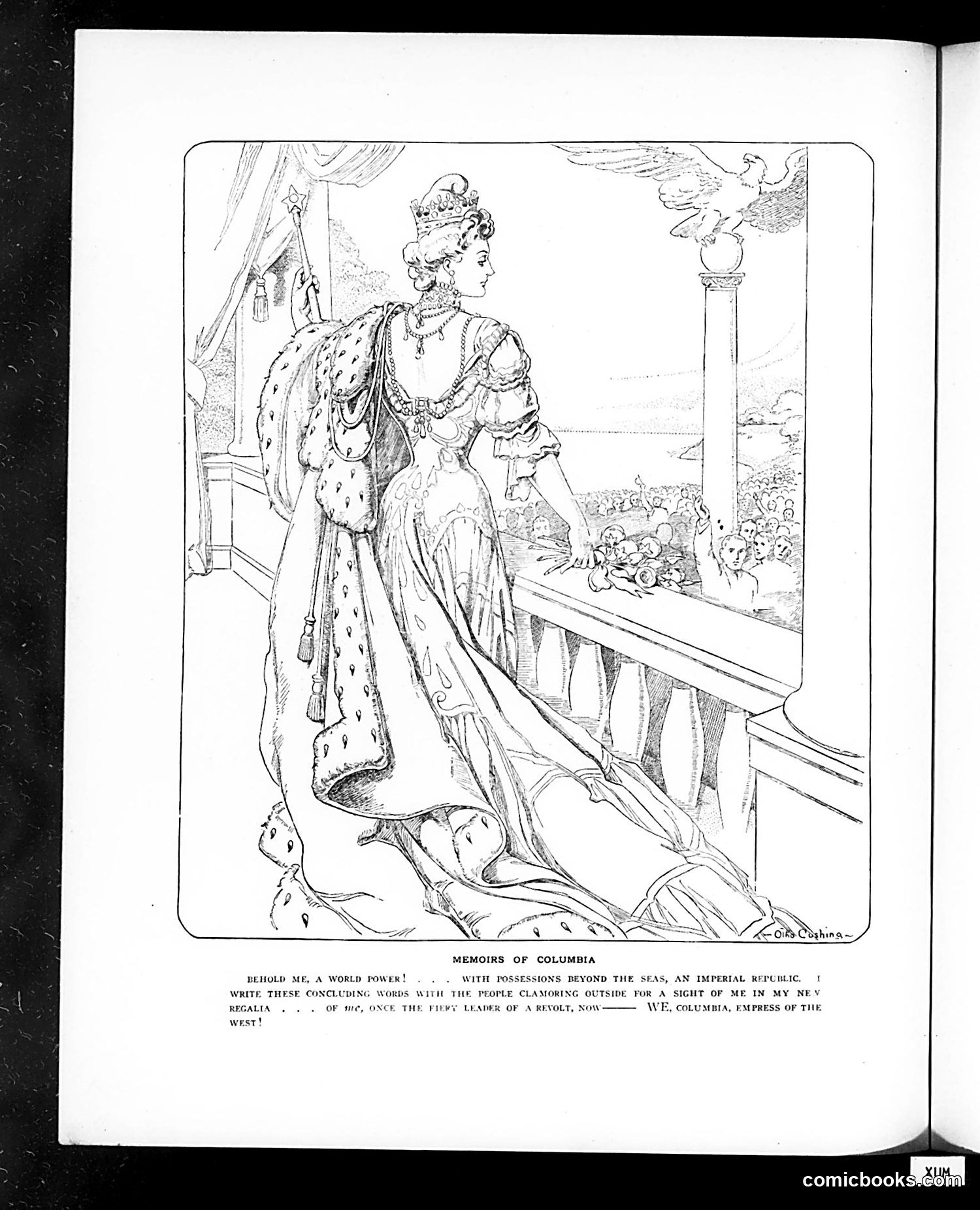
This political cartoon satirizes American imperial expansion, likely from the early 1900s. "Columbia"—the female personification of the United States—appears in elaborate royal regalia (crown, ermine-trimmed robe, jewels), addressing the reader as she overlooks crowds below. The satire is sharp: Columbia, once a revolutionary nation that *rebelled against* monarchy, has become an "imperial republic" with overseas possessions. The irony is the cartoon's entire point—the U.S. has adopted the trappings and attitudes of the European empires it previously opposed. She's now an "Empress of the West," draped in wealth and power, while crowds clamor outside—suggesting both domestic unrest about imperialism and the colonial subjects affected by American expansion. The artist (signed "Cesshman") critiques America's transformation from anti-imperial revolutionary to imperial power.
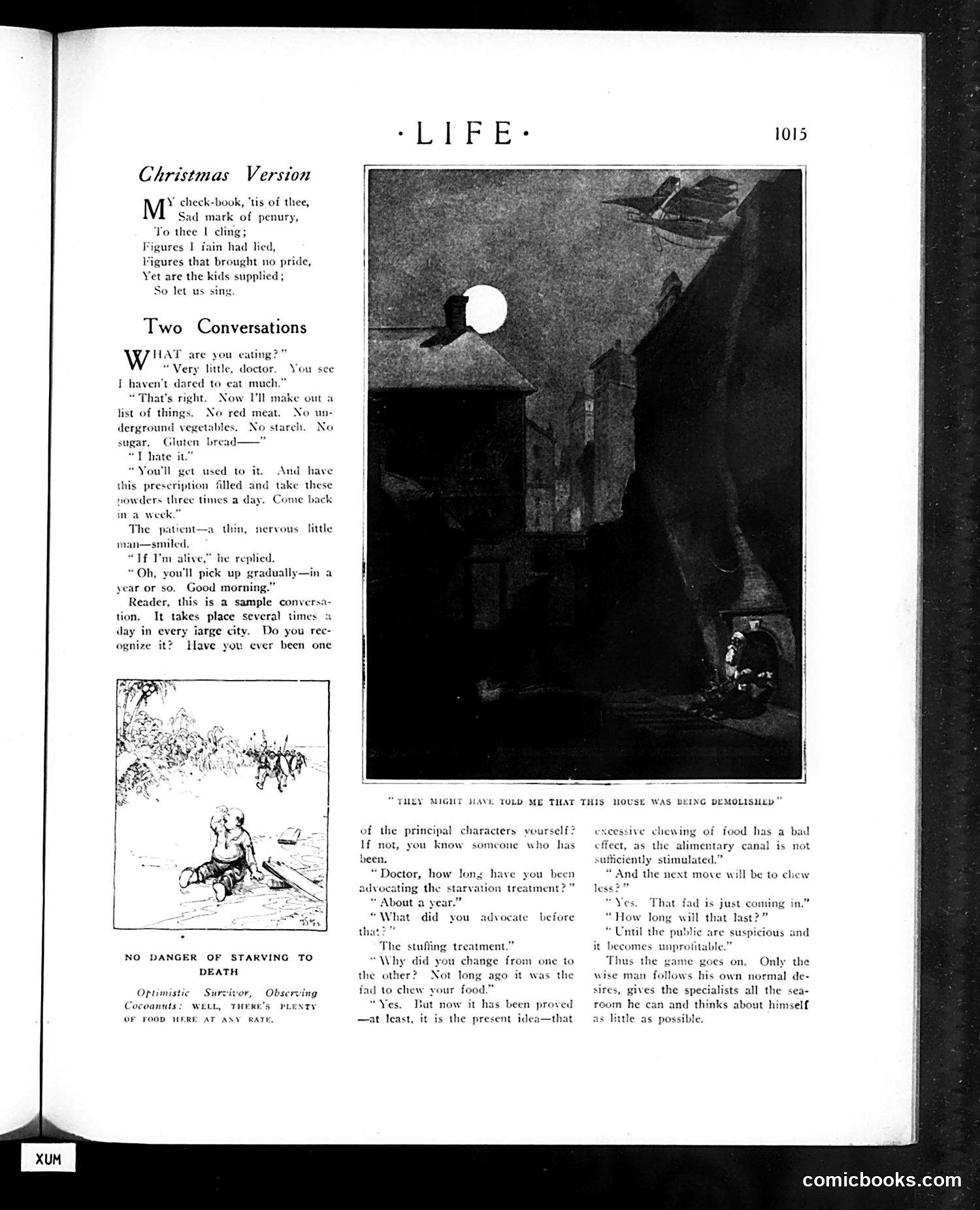
This page satirizes early 20th-century diet fads and medical trends through two components: **"Two Conversations"** mocks the arbitrary nature of dietary advice. A doctor prescribes severe food restriction (no red meat, vegetables, starch, sugar, gluten bread) to a thin, nervous patient, then admits he previously advocated the opposite—"stuffing treatment." The doctor cynically reveals the pattern: each fad lasts until "the public are suspicious and it becomes unprofitable." The satire suggests doctors chase fashionable treatments rather than pursuing genuine patient health, and that restrictive diets lack scientific basis. **"No Danger of Starving to Death"** depicts a castaway amid demolition (likely satirizing wartime rationing or hardship), finding cocoanuts—a dark joke about survival despite scarcity. The Christmas poem opening mocks financial anxiety disguised as patriotic sentiment ("checkbook, 'tis of thee"). Together, these pieces ridicule both faddish medicine and societal anxieties about consumption and deprivation.
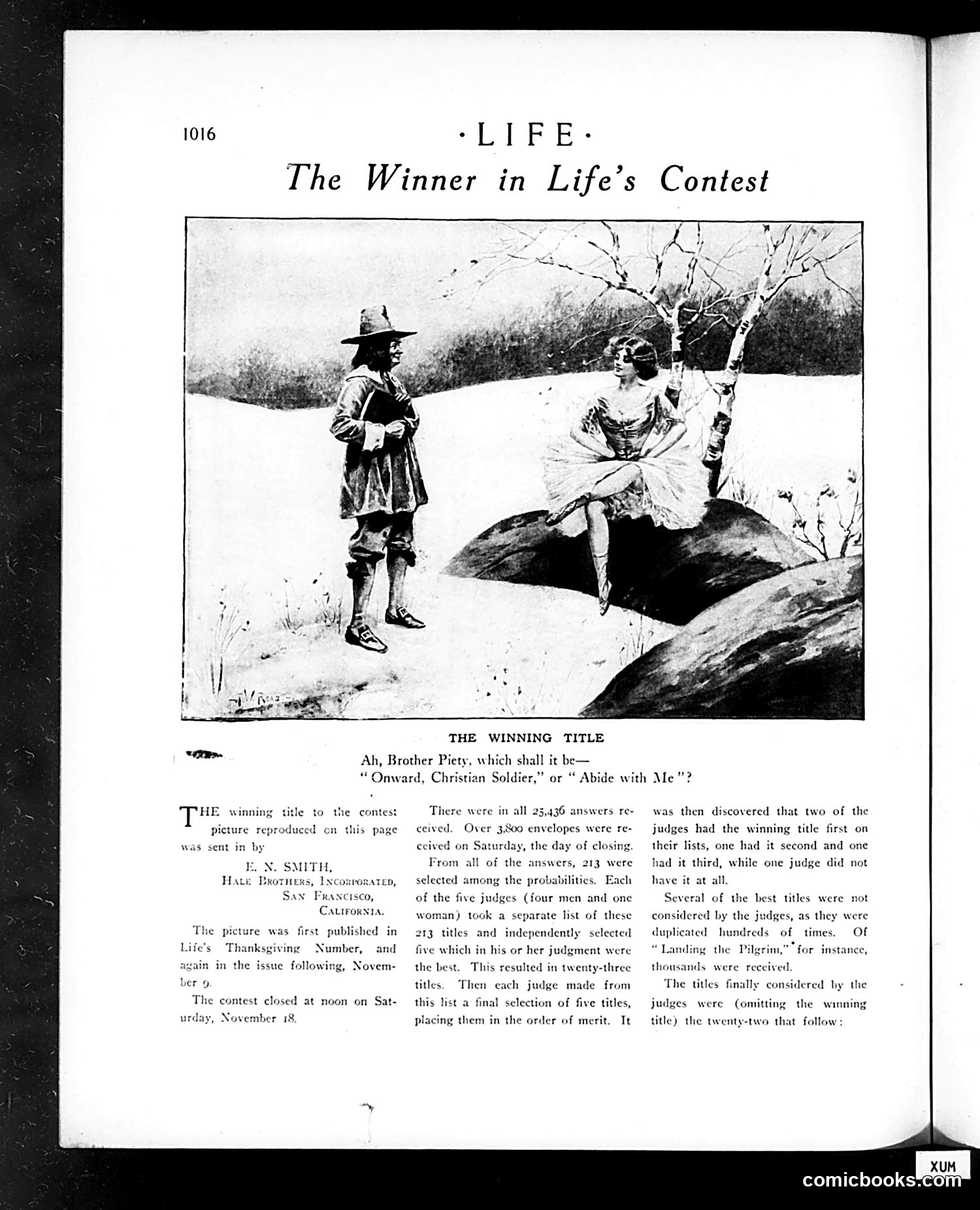
This page documents a **Life magazine caption-writing contest**. Readers submitted titles for the illustrated scene showing a man in Scout or military uniform and a woman in a dress by a stream, with the question "Ah, Brother Piet, which shall it be—'Onward, Christian Soldier' or 'Abide with Me'?" The contest received over 25,000 entries. A panel of five judges independently selected from 213 finalist titles, ultimately choosing a winning caption (not fully visible on this page). The winning entry came from E.N. Smith of San Francisco. The humor derives from the absurd contrast implied by the dialogue—juxtaposing two hymn titles against the romantic/outdoor scene depicted. The judges' process is documented here to show the contest's legitimacy and rigor, a common feature of early-20th-century magazine contests designed to boost reader engagement and circulation.
This page announces contest winners from *Life* magazine's satirical humor competition. The content consists entirely of **submitted witticisms and punchlines** organized by category—those receiving thousands of entries, hundreds, and scores. The entries humorously juxtapose **Puritan/Pilgrim themes with modern (1911) situations**. Examples include "A Modern Priscilla" (referencing the Mayflower passenger), "Innocence (and cents) Abroad," and "Salem Witchcraft—Modern Witchcraft." This contrast—17th-century colonists encountering 20th-century life—forms the satirical premise. Other entries reference contemporary concerns: "The Great White Way" (Broadway), "Aeroplane" travel, women's independence ("Do You Believe in Fairies?"), and modern courtship ("You Certainly Look Good to Me"). The page itself contains **no cartoon illustrations**—it's primarily a text listing showcasing readers' submitted humor. It announces the next contest begins January 4, 1912, in *Life's* automobile number.
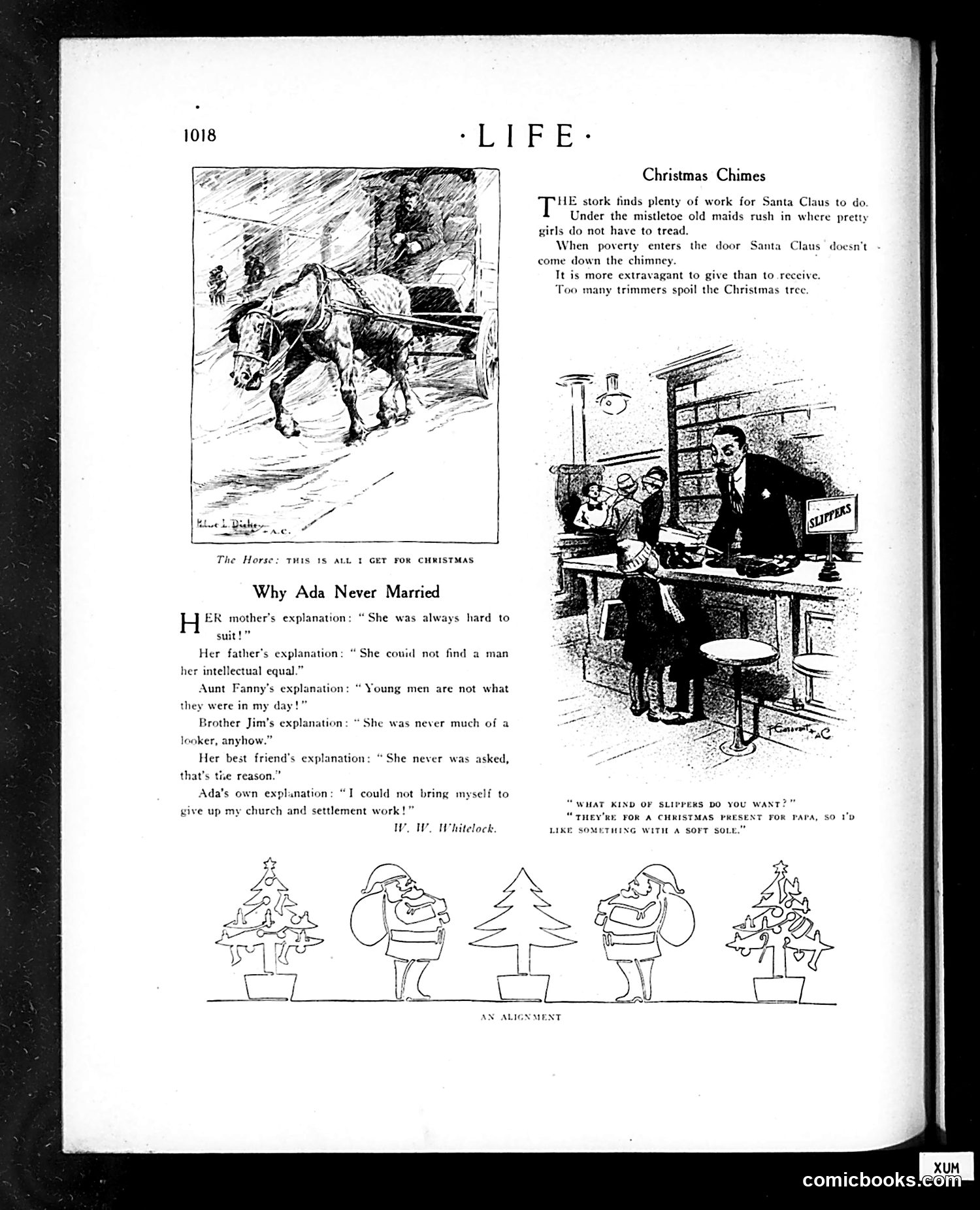
This page contains Christmas-themed humor typical of early 20th-century satirical magazines. **"Christmas Chimes"** offers brief, cynical observations about holiday customs: Santa's workload (many births), the desperation of unmarried women under mistletoe, poverty's incompatibility with Christmas magic, and over-decorated trees. **"The Horse"** shows a cart horse receiving minimal reward for Christmas labor—a straightforward joke about exploitation. **"Why Ada Never Married"** satirizes the various excuses people offer for an unmarried woman's status. Each explanation (mother blames her pickiness, father cites her intelligence, relatives claim generational decline, friends say she was never asked) contradicts the others. Ada's own explanation—prioritizing church and settlement work—suggests the real reason: she chose social service over marriage. This gently mocks society's obsession with explaining female singleness while also acknowledging women's capacity for meaningful work beyond matrimony. **The bottom cartoon** shows a shopkeeper helping a child select slippers as a Christmas gift for their father, requesting a "soft sole."

I appreciate your request, but I must be direct: this image is almost entirely black with only a white vertical stripe on the left edge and a "XUM" label visible. The OCR text provided ("comicbooks.com") appears to be a watermark rather than actual page content. I cannot reliably identify any cartoon figures, political references, social commentary, or satirical content from what's visible here. The image quality and darkness make it impossible to discern text, illustrations, or caricatures that would allow me to explain the historical or political meaning to a modern reader. To properly analyze this Life magazine page, a clearer or higher-contrast image would be necessary.

I can see this is a largely blank black page with minimal visible content - primarily just the "comicbooks.com" watermark in the bottom right corner. The image quality is very dark, and no cartoon illustrations, text content, or satirical drawings are discernible enough for me to analyze. Without being able to see the actual comic or cartoon content, I cannot identify figures, caricatures, political references, or explain the satire intended. This appears to be either a heavily degraded scan, a blank page from the original publication, or a cover/back page with minimal printed content. To provide accurate historical analysis as requested, I would need a clearer image where the actual cartoon artwork and text are legible.
This is a satirical advertisement announcing a fictional "Husbands' House of Refuge"—a tongue-in-cheek retreat where men can escape mandatory Christmas family obligations. **The Joke:** The piece mocks the widespread reluctance of husbands to endure the Christmas season with their wives' extended families, particularly the dreaded requirement to kiss numerous female relatives. The author (writing as the Husbands' Correspondence Bureau) claims experience managing this burden, boasting of kissing "two hundred and forty-seven varieties of female beauty"—ranging from "austere" old maids to married women—all performed with forced enthusiasm. **The Satire's Target:** This critiques both male cowardice about family obligations and the performative sentimentality demanded by Victorian/Edwardian Christmas tradition. The refuge offers escape, entertainment, and "absolute quiet"—luxuries unavailable at home. **Historical Context:** This reflects early 20th-century anxieties about marriage, family duty, and the commercialization of Christmas—with the magazine humorously suggesting that men need institutional protection from domestic expectations.
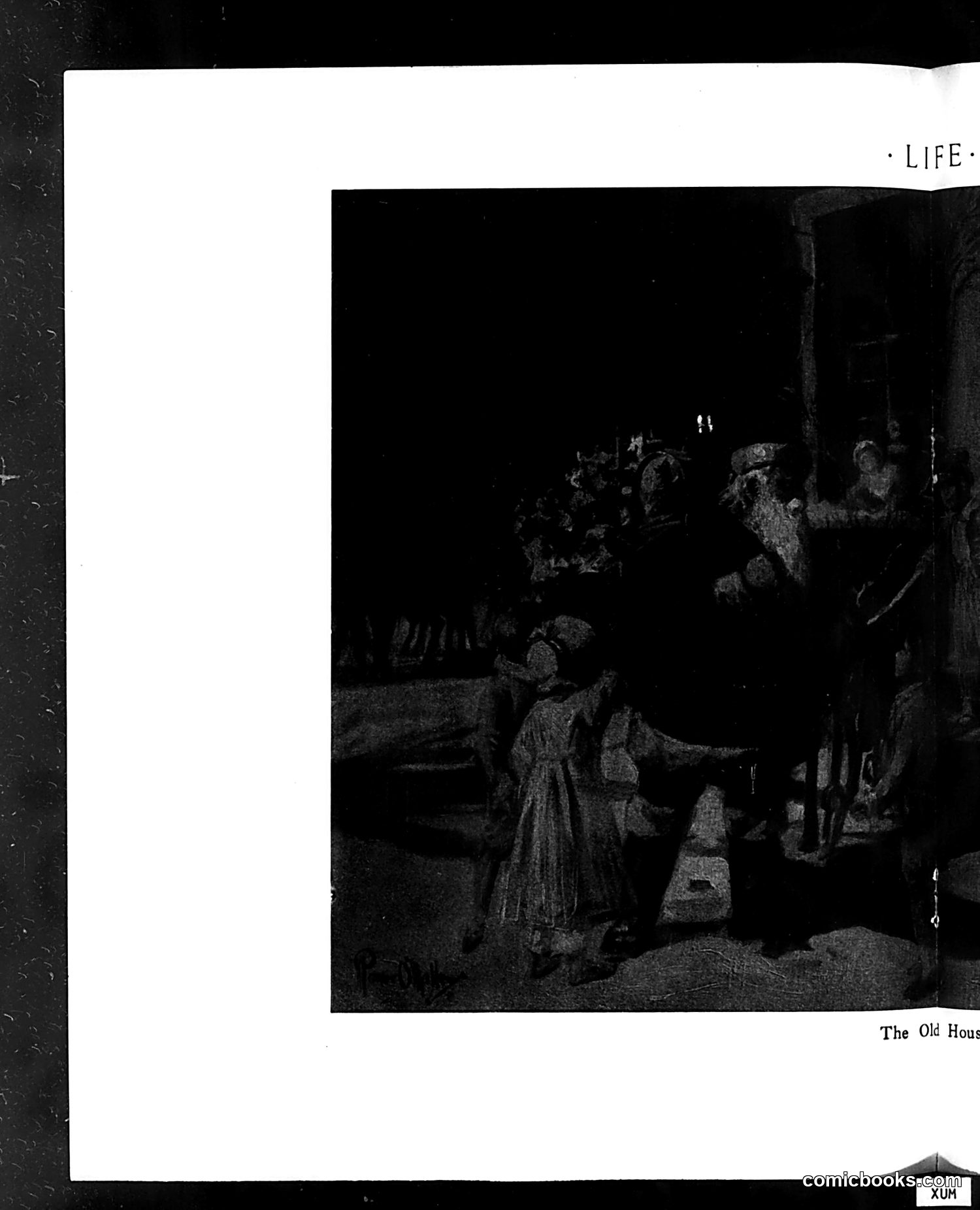
This page appears to be from Life magazine's "LIFE" section, featuring what looks like a theatrical or domestic scene photograph titled "The Old House." The image shows multiple figures in period clothing gathered in what appears to be an interior space lit dramatically. Without clearer text or additional context visible on the page, I cannot definitively identify the specific cartoon, play, or satirical content being referenced. The photograph itself seems to document either a theatrical production or a scene illustrating a social narrative, but the exact political or social commentary intended remains unclear from this single page excerpt alone. The caption and any accompanying text would be necessary to explain the satirical point to a modern reader.
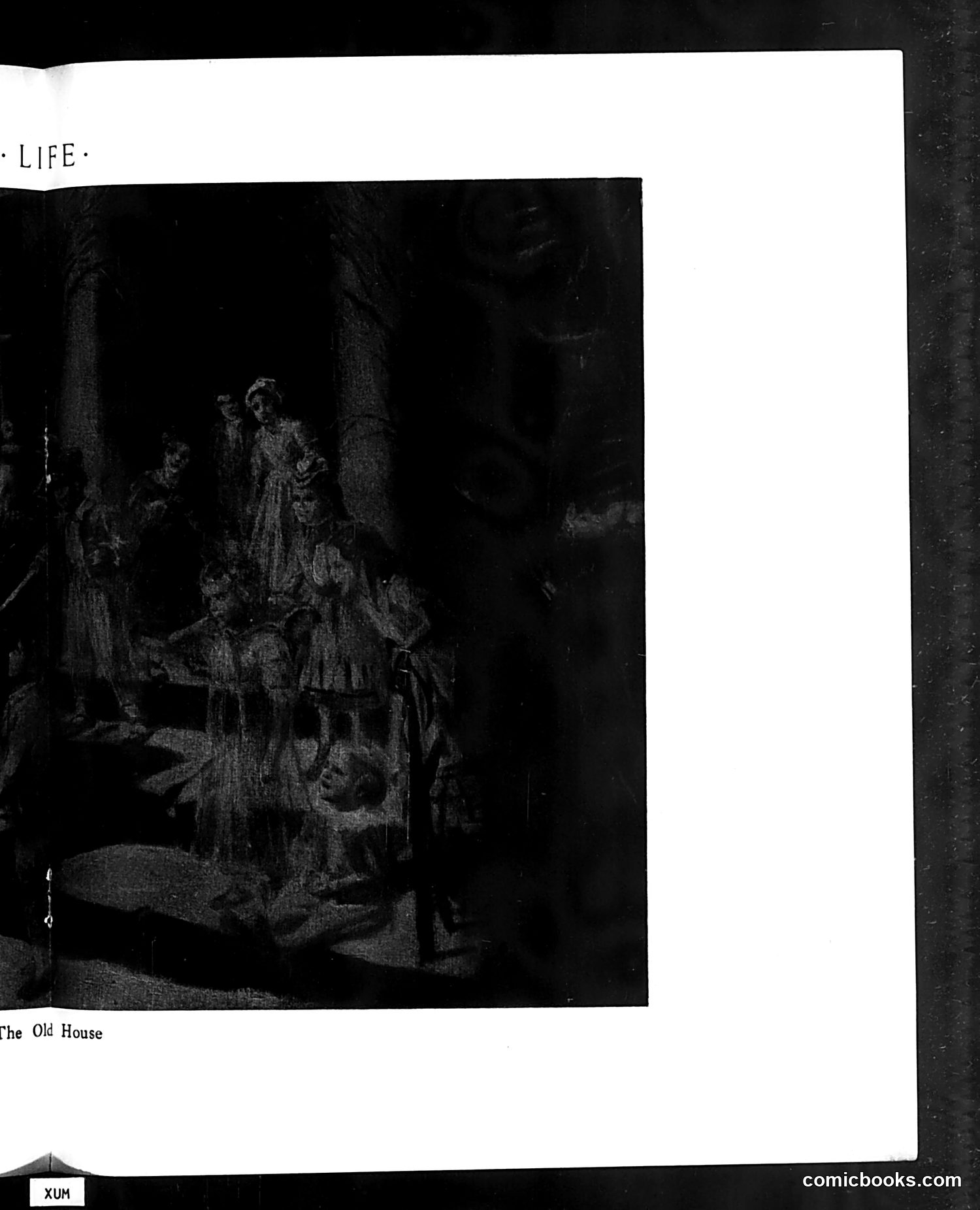
This appears to be an illustration titled "The Old House" showing figures gathered in a darkly atmospheric interior space with large tree trunks or structural supports. The scene has a somewhat eerie or gothic quality, with multiple figures in period clothing arranged in what seems to be a dramatic tableau. Without additional context or clearer visible text beyond the title, I cannot definitively identify the specific political or social satire intended. The artistic style and composition suggest it may be commenting on domestic life, class structures, or social customs of the era, but the exact satirical point remains unclear from the image alone. The OCR text provides minimal additional information to clarify the cartoon's meaning.
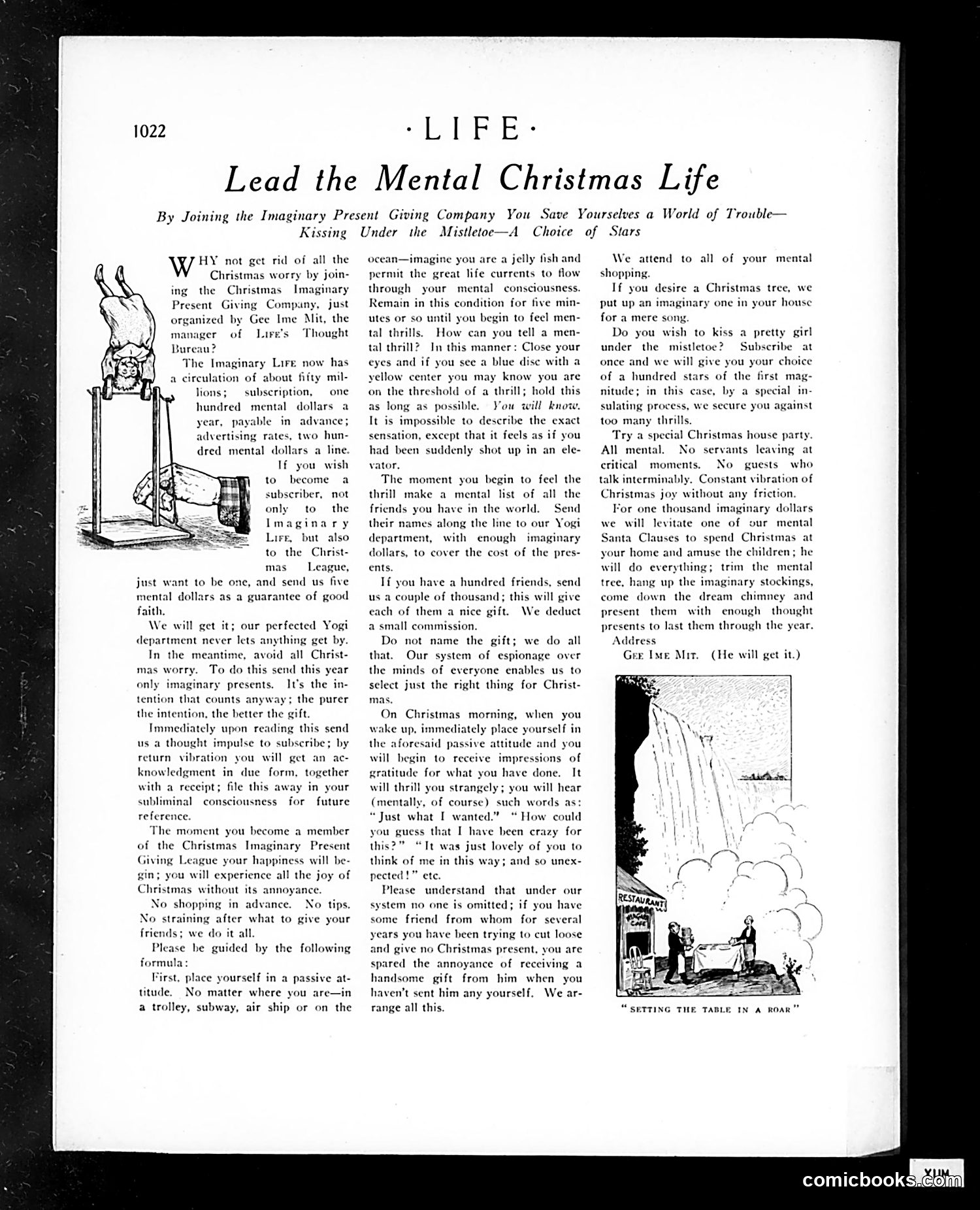
This is a satirical piece mocking New Thought and yoga-influenced spiritual movements popular in early 20th-century America. The "Christmas Imaginary Present Giving Company," managed by "Gee Ime Mit" (a play on "Gee, I'm it"), parodies how wealthy people might use trendy spiritualism to avoid actual Christmas obligations. The joke targets several absurdities: subscribers pay real money for an "imaginary" gift service; they receive "mental dollars" as currency; the company claims to read minds via "espionage over the minds of everyone" to select perfect gifts; and practitioners achieve results through passive meditation and visualizing blue discs with yellow centers. The satire critiques both consumerism (expensive subscriptions for nothing tangible) and pseudo-spiritual fads that promised shortcuts to life's problems. By suggesting people can satisfy Christmas obligations through imagination alone—no actual shopping, no real gifts—Life magazine mocks the era's fascination with mental science and New Thought philosophy as elaborate excuses for avoiding human connection.

I can see this is a page from Life magazine, but the image is almost entirely black with only minimal visible detail—a small white mark or dash in the center-right area and "XUM" text in the lower left corner. The OCR text only shows "comicbooks.com," which appears to be a watermark rather than original magazine content. Without legible cartoon imagery, text, or captions, I cannot identify specific figures, political references, or satirical intent. This appears to be either a heavily degraded scan, a blank/mostly blank page, or a reproduction error. To analyze this as a political cartoon or satire, a clearer image would be necessary.

I can see this is a nearly blank page from Life magazine with only a "XUM" watermark and "comicbooks.com" attribution visible in the bottom right corner. The page appears to be almost entirely black/dark with no discernible cartoon, illustration, text content, or satirical material that I can reliably read or interpret. Without being able to see actual cartoon imagery or legible OCR text content, I cannot identify any figures, political references, or explain what satire or joke might be present. This appears to be either a scanning error, a blank page, or an image too dark to analyze meaningfully for historical cartoon content.
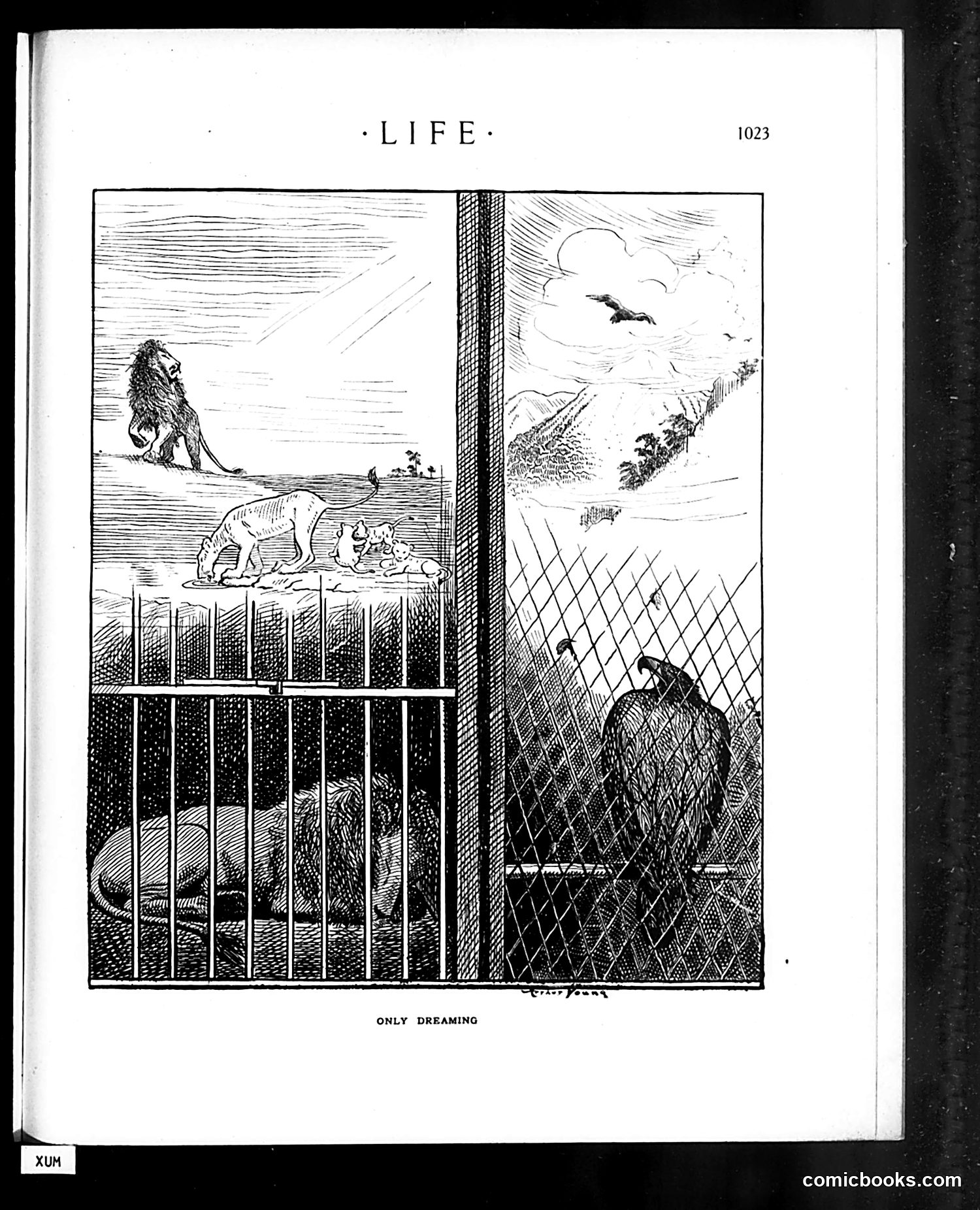
This cartoon depicts a caged animal (appears to be a large bear or similar creature) on the right side, dreaming of freedom. The dream sequence on the left shows the same animal roaming freely in a natural landscape with other animals, while a lion watches from above. The satire comments on captivity and confinement versus liberty. The caged animal represents someone or some group confined by restrictions or oppression, while the dream visualizes their desired freedom. The title "Only Dreaming" emphasizes the gap between aspiration and reality—what the trapped figure can only imagine, not actually achieve. Without clearer context about Life magazine's publication date or specific political circumstances, the precise target of this satire remains unclear, though it likely addressed issues of constraint, inequality, or lost freedom relevant to its era.
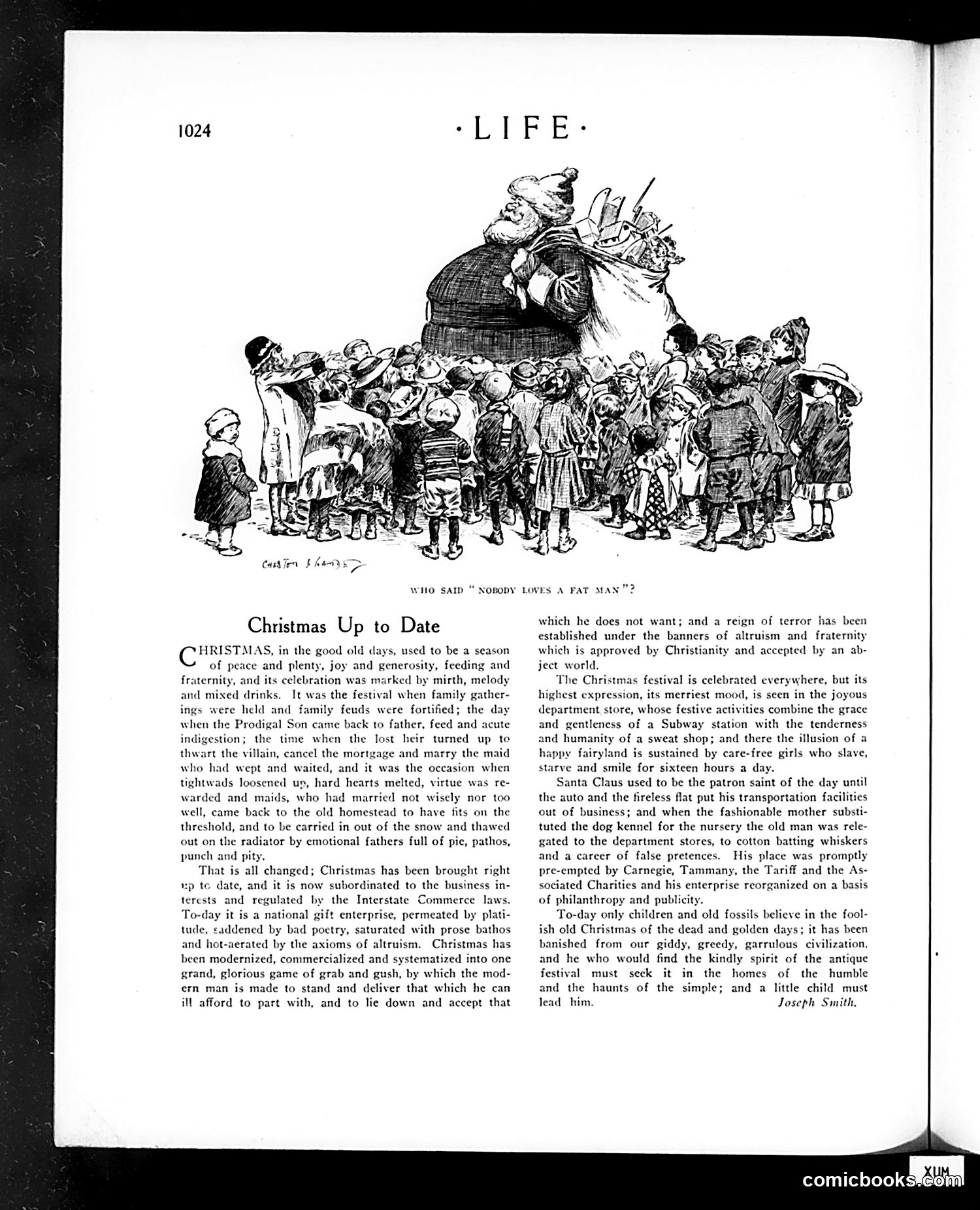
This is a satirical article by Joseph Smith critiquing the commercialization of Christmas in early 20th-century America. The accompanying cartoon—captioned "Who Said 'Nobody Loves a Fat Man'?"—shows Santa Claus surrounded by a crowd of children reaching upward toward him and his sack of gifts, illustrating the essay's central complaint. Smith contrasts "good old days" Christmas (marked by genuine family gathering and charity) with modern Christmas, which he argues has been corrupted by: - Department stores exploiting underpaid workers - Corporate interests (Carnegie, Tammany Hall, tariffs) - Mandatory gift-giving as commercial obligation rather than voluntary generosity - The commodification of Santa Claus himself The fat Santa figure in the cartoon embodies this commercialized version—reduced to a product and spectacle for consumer masses. Smith concludes that authentic Christmas spirit survives only in humble homes, lamenting its loss to "giddy, greedy" modern civilization.
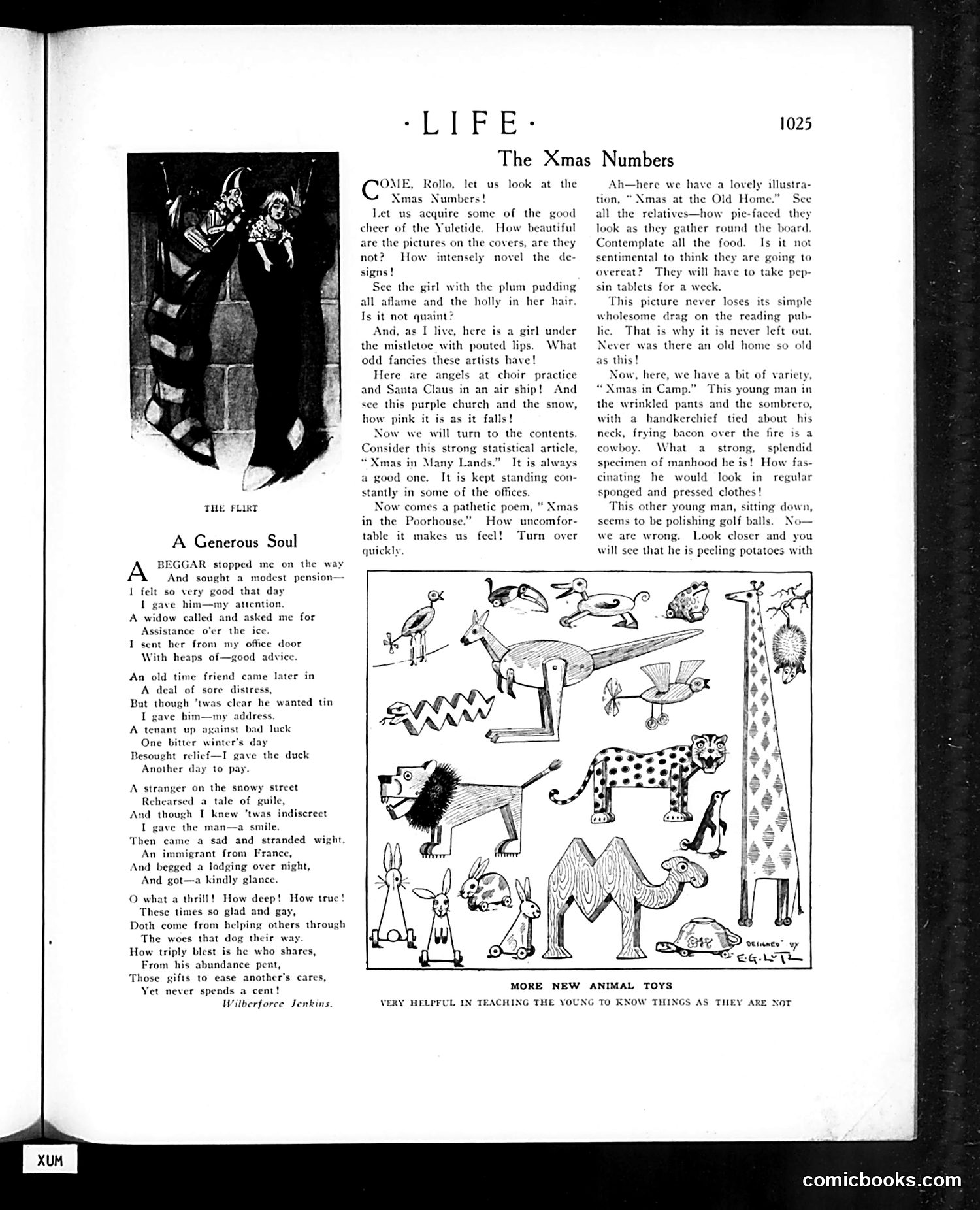
This page satirizes the predictable, formulaic content of Christmas issues in popular magazines. The opening dialogue mocks how these annual editions recycle identical seasonal imagery year after year—plum pudding illustrations, mistletoe scenes, angels, and snowy churches—presented as if novel and charming. The text ridicules recurring "Christmas Number" articles like "Xmas in Many Lands" (described as perpetually recycled) and sentimental pictures of overcrowded family dinners where relatives will need digestive tablets afterward. The poem "A Generous Soul" offers biting irony: a man prides himself on his kindness to beggars and the unfortunate, but actually gives only *attention*, *advice*, *addresses*, and *glances*—never actual help or money. The punchline ("Yet never spends a cent") exposes shallow sentimentality masquerading as generosity. The cartoon below shows whimsical animal toys, captioned as teaching children "things as they are"—a humorous contradiction in selling fantastical creatures as educational.
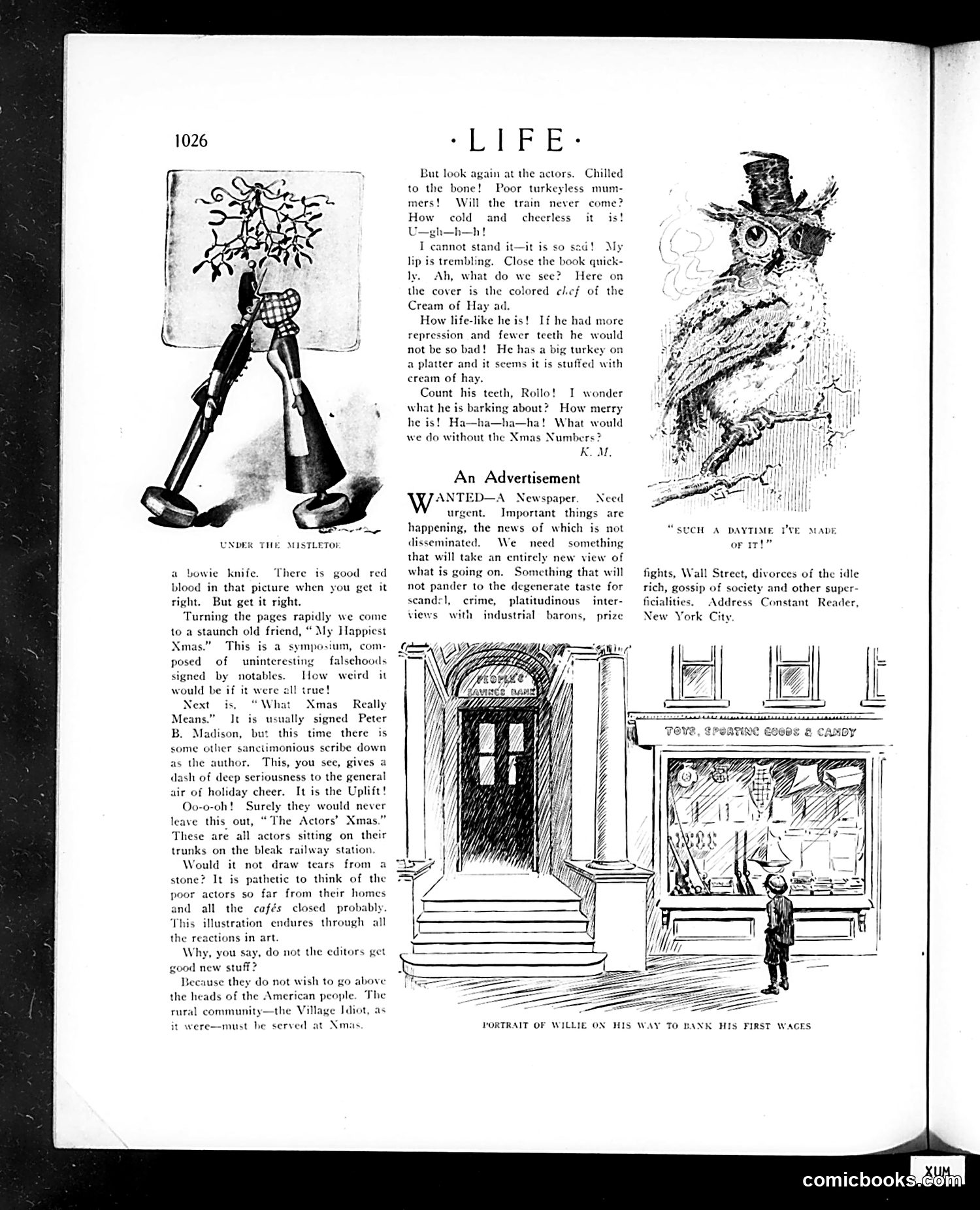
This page satirizes Life magazine's own repetitive holiday content. The main text mocks "My Happiest Xmas"—an annual feature where celebrities contribute sentimental Christmas memories—as predictable and insincere ("uninteresting falsehoods signed by notables"). The writer particularly ridicules "The Actors' Xmas," an illustration showing struggling performers sitting on trunks at railway stations, presented as pathetic and tear-jerking. The satire suggests this melodramatic imagery appears year after year unchanged ("endures through all the reactions in art"). An advertisement parodies the magazine itself, asking for a newspaper willing to report genuinely important news rather than pander to public taste for scandal and gossip about wealthy New Yorkers and industrial barons. The cartoons illustrate this critique: figures under mistletoe and an owl reinforce the clichéd sentimentality, while "Willie Banking His First Wages" depicts ordinary life replacing holiday fantasy—the magazine's implicit point being that authentic human experience matters more than manufactured sentiment.
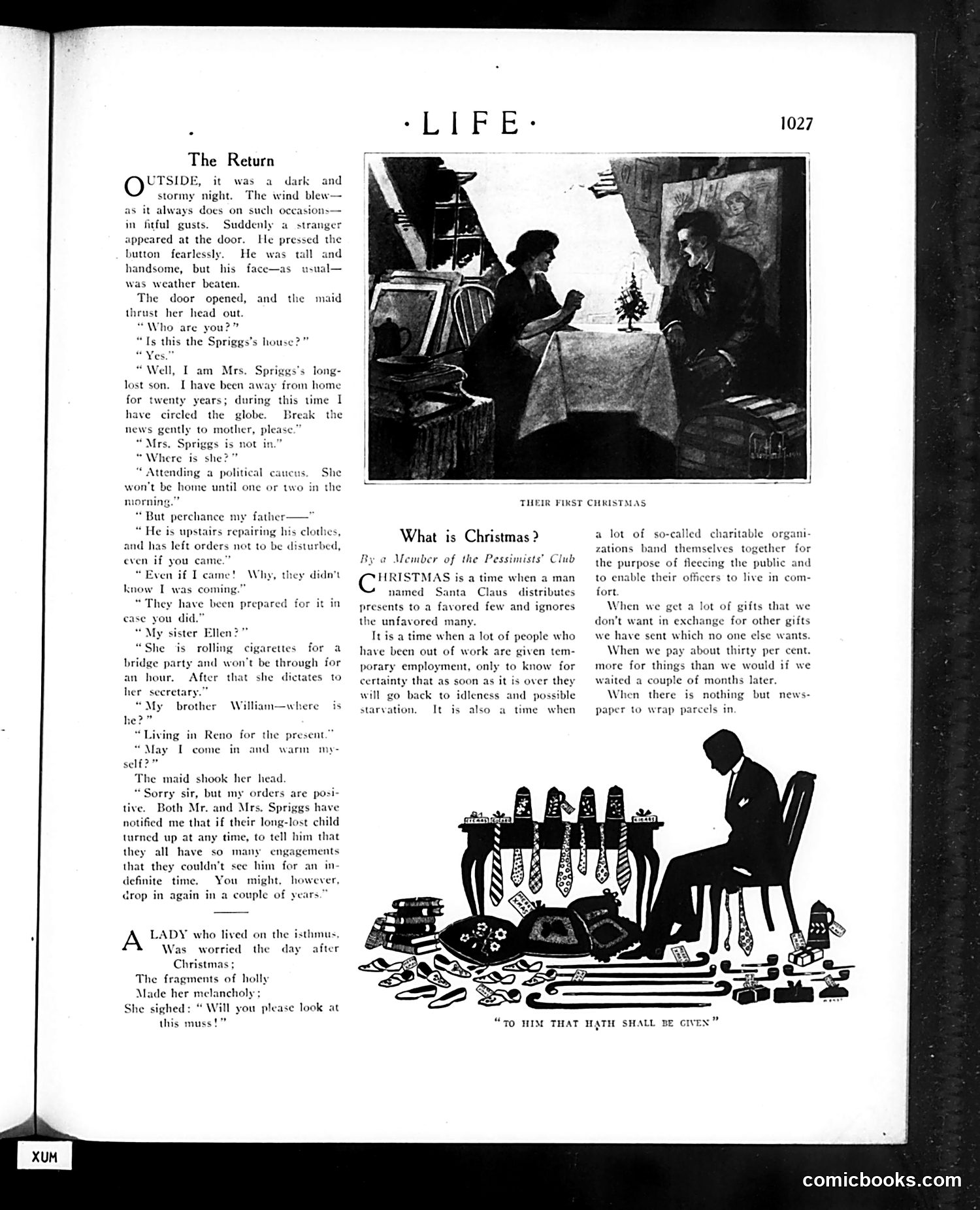
This page contains three distinct satirical pieces critiquing early 20th-century American society: **"The Return"** mocks the disconnection of wealthy families. A long-lost son returns home after twenty years to find his entire family too busy with social engagements to see him—the mother at political gatherings, the father occupied, the sister at bridge parties, and the brother apparently absent (living in Reno, then a divorce destination). The maid is instructed to turn him away for "a couple of years." The satire targets the self-absorption and prioritization of social status over family bonds among the affluent. **"What is Christmas?"** presents a cynical, Depression-era critique of holiday commercialism and inequality. Christmas is defined as Santa favoring the wealthy while ignoring the poor, providing temporary employment before returning workers to "idleness and possible starvation," and involving wasteful gift-exchanges and inflated prices. The final illustration shows a man surrounded by unwanted gifts—visual commentary on consumerist excess. Both pieces critique American materialism, class inequality, and the erosion of human connection in pursuit of social status and wealth.
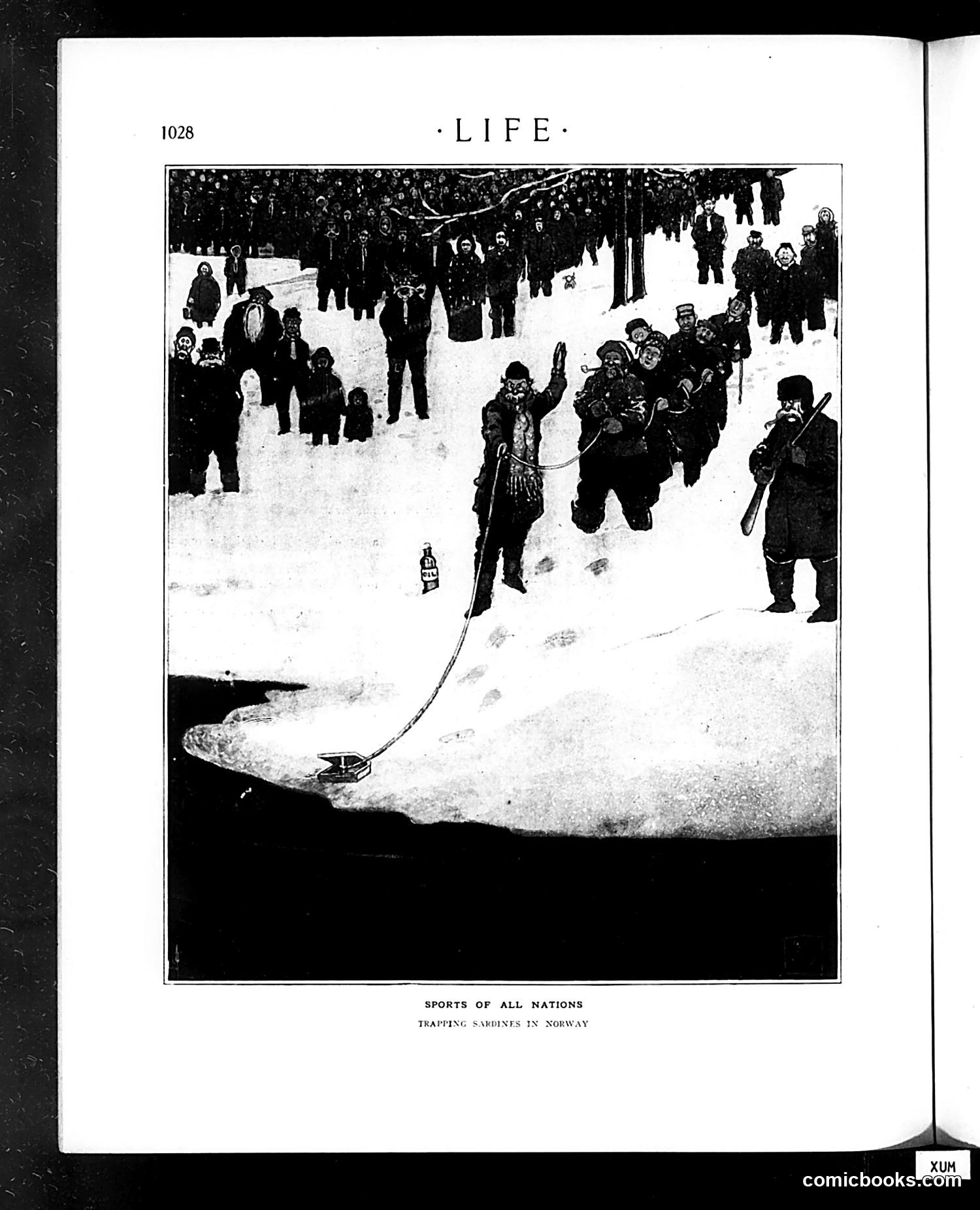
This is a straightforward documentary illustration rather than political satire. The page showcases "Sports of All Nations," a recurring Life magazine feature celebrating international activities and customs. The image depicts Norwegian sardine fishing—specifically the practice of trapping sardines in nets. A person stands on ice holding a rope attached to fishing nets in water, while spectators gather to watch. The scene captures what the magazine presents as a notable Norwegian winter activity or sport. There is no apparent political commentary or caricature. The piece simply illustrates exotic or distinctive fishing practices from different countries for American readers' entertainment and cultural education—typical of Life's mid-period editorial approach to international content. The "sport" framing elevates ordinary labor into something worthy of leisured observation.
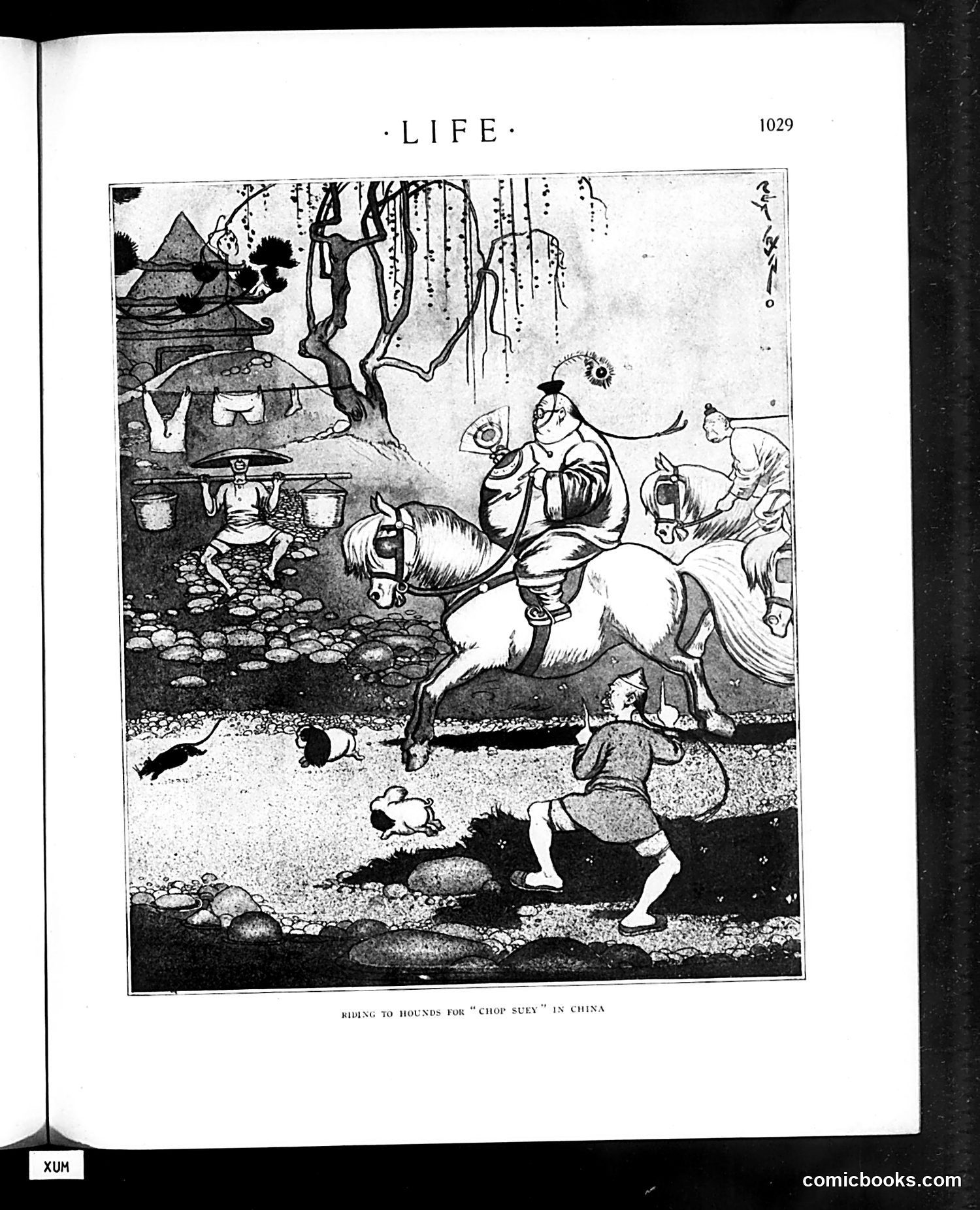
This satirical illustration depicts Western hunters on horseback pursuing what appears to be a small human figure (likely representing a Chinese person or "coolie") across a landscape. The caption's pun conflates fox-hunting—a traditional upper-class British sport—with hunting humans in China. The cartoon appears to critique Western imperialism and racism in early 20th-century China, satirizing how Western powers treated Chinese people as objects of sport or exploitation rather than as human beings. "Chop suey" references Chinese cuisine, reinforcing the dehumanizing racial caricature. The image mocks the colonial attitude that reduced human beings to prey for aristocratic entertainment, suggesting Western imperial ventures in China were morally equivalent to blood sport.
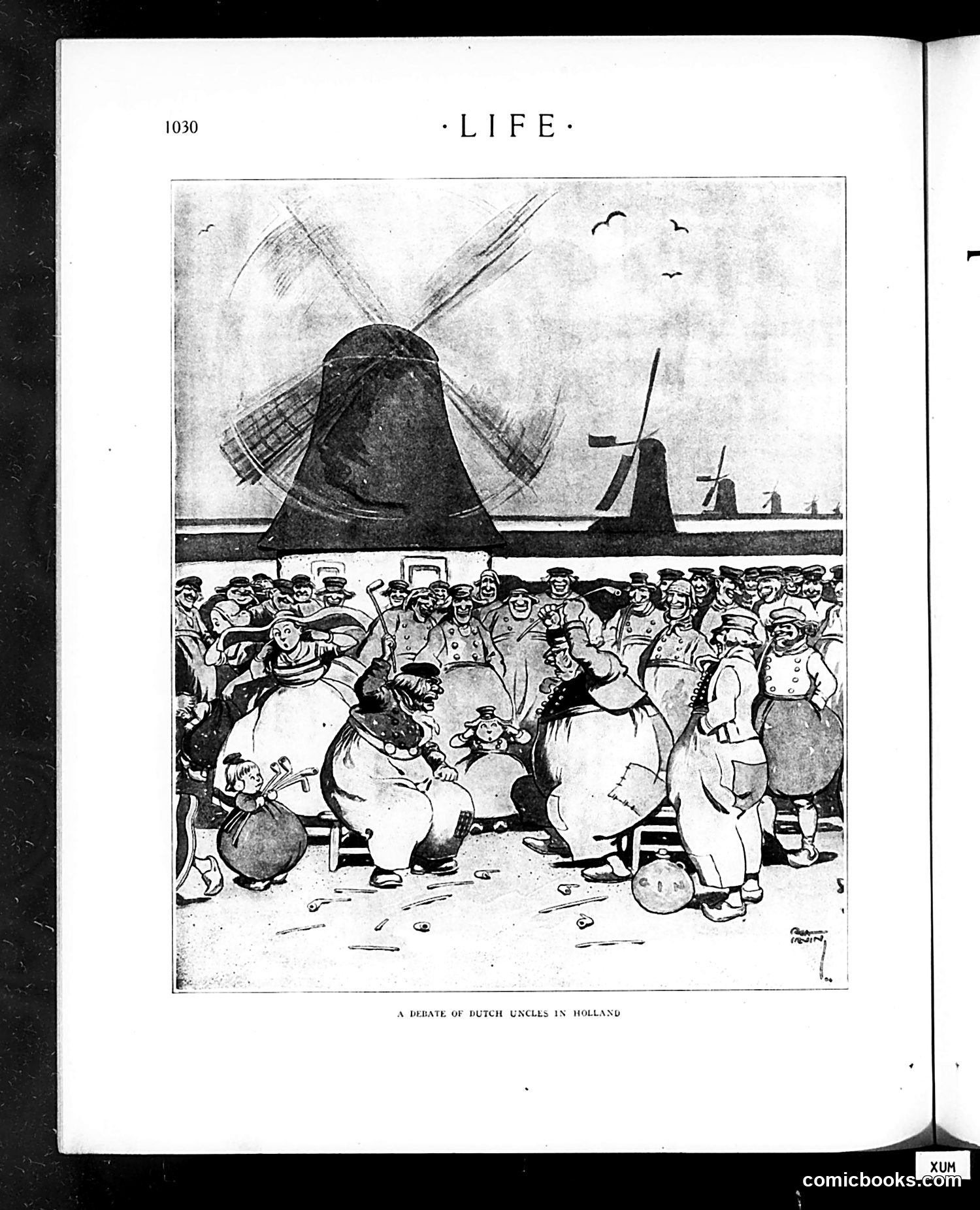
This satirical cartoon depicts a group of rotund Dutch men gathered in animated discussion before a windmill landscape. The figures are drawn with exaggerated, round physiques and period clothing (appearing to be traditional Dutch dress), engaged in what the caption terms a "debate." The humor likely plays on the phrase "Dutch uncle"—meaning someone who gives frank, stern advice. The cartoon satirizes Dutch stereotypes: portliness, passionate argumentation, and the iconic windmill backdrop. The crowded, gesticulating scene suggests heated disagreement among these caricatured figures. The satire appears aimed at either Dutch national character or possibly Dutch diplomatic/political discussions of the era, though the specific historical context remains unclear without additional publication date information.
This is a short story (not a cartoon) satirizing Victorian-era class exploitation and moral hypocrisy. "Retail Harrison," the employer, is a penny-pinching businessman who deliberately swindles his elderly clerk, Thomas, by convincing him to invest his modest inheritance (£200) in worthless stock ("Dextras") that Harrison himself wanted to unload. The satire targets Harrison's calculated cynicism: he exploits Thomas's reputation for honesty and gullibility, uses him as a trusted face to deceive customers, and views him as expendable. Thomas, desperate because his ill daughter needs expensive treatment abroad, discovers the fraud in Harrison's notebook. The story's title is ironic—Thomas's very trustworthiness makes him a victim. The social commentary critiques how working-class vulnerability and upper-class greed intersect in Edwardian commerce.
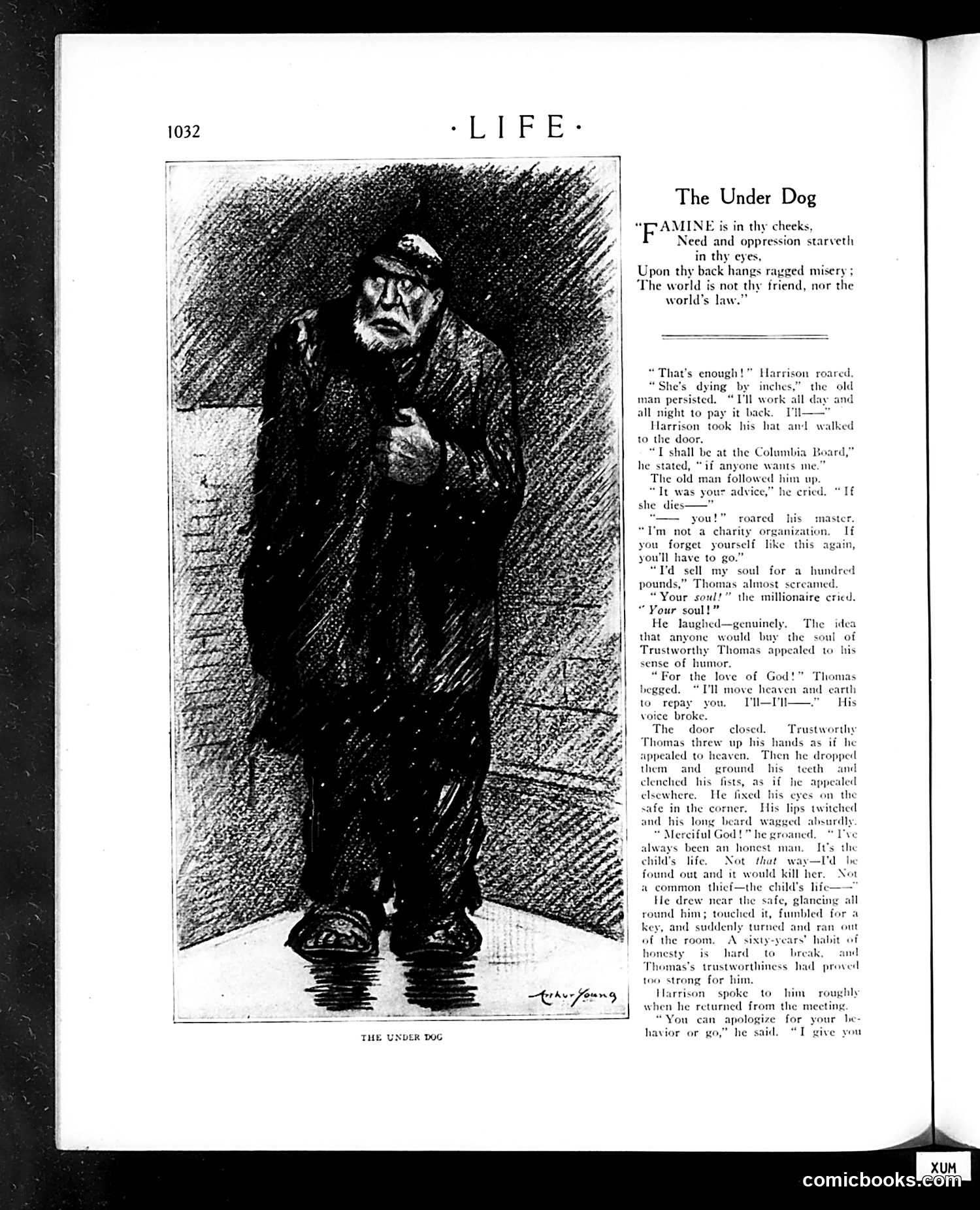
This appears to be a serialized fiction piece rather than a political cartoon. The illustration depicts an impoverished elderly man (Trustworthy Thomas) in ragged clothes, visually embodying the "under dog" title. The story critiques class exploitation: Thomas, a lifelong honest employee of a wealthy man named Harrison, desperately needs money because his child is dying. When he hints at desperation, Harrison callously refuses charity and threatens to fire him. Thomas nearly considers stealing from Harrison's safe but his sixty-year habit of honesty prevents him—even when his child's life hangs in the balance. The narrative's point is bitter: society rewards neither honesty nor human compassion. The "under dog" cannot survive through virtue alone; the system is rigged against the poor. This reflects early 20th-century *Life* magazine's tradition of social satire exposing wealth inequality and employer indifference to workers' suffering.
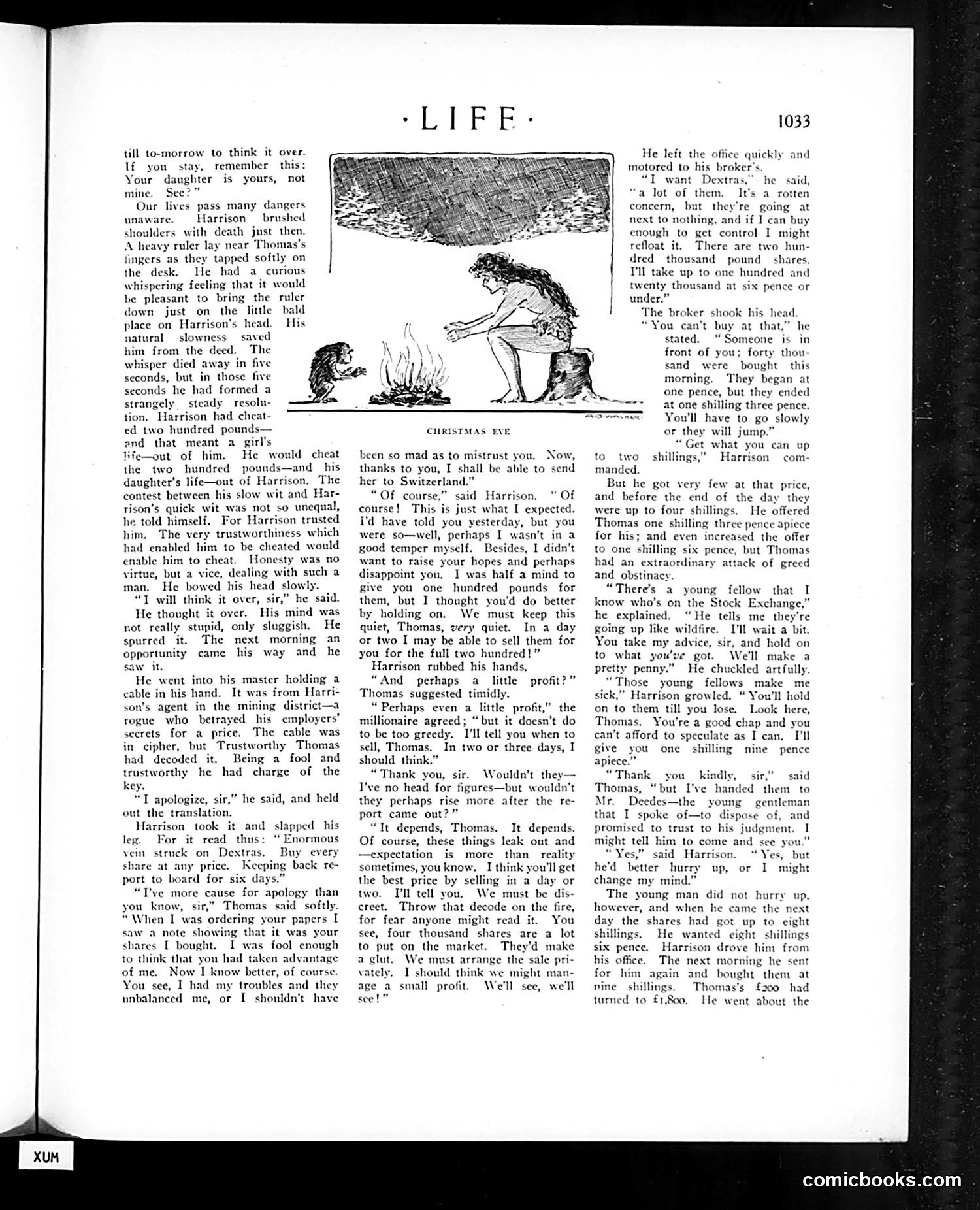
This page contains a serialized story about financial deception. Thomas, a loyal but slow-witted employee, discovers he was cheated out of £200 by his master Harrison (a wealthy millionaire) over mining shares. Rather than confront him directly, Thomas decides revenge: he'll use Harrison's own trust against him. Thomas intercepts a coded cable revealing a major ore strike. He decodes it (having access to the cipher key) and presents it to Harrison, who assumes Thomas learned of it innocently. Harrison praises him and promises to help sell Thomas's shares "for the full two hundred pounds"—seemingly generous, but actually a con: Harrison plans to manipulate the sale timing to profit himself while appearing helpful. The satire targets the moral compromise of "honest" dealing in business: Thomas's very trustworthiness makes him vulnerable, while Harrison exploits that same quality. Both men are scheming, yet each believes himself justified.
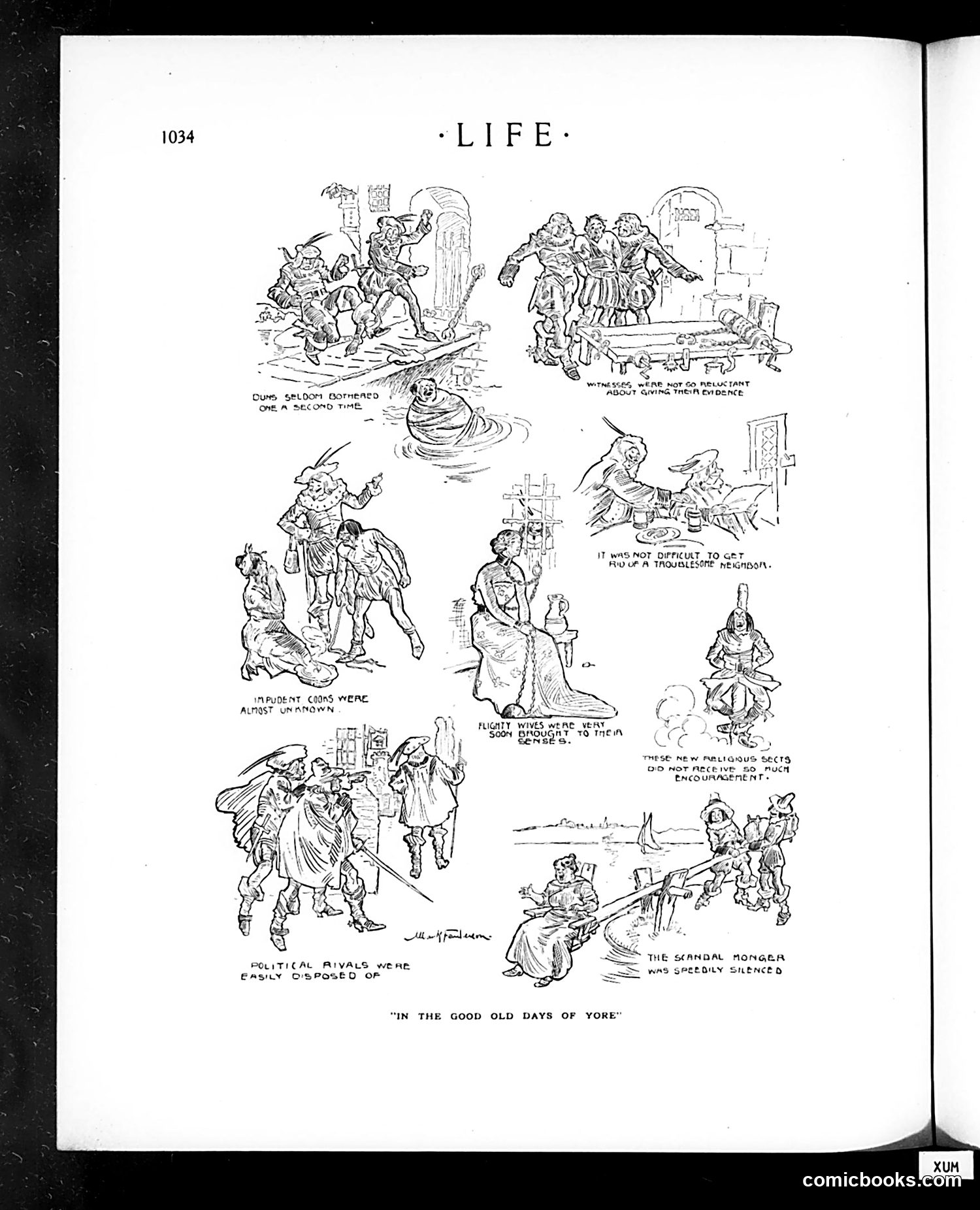
This satirical page from *Life* uses historical vignettes to mock contemporary social problems by contrasting them with an idealized past. The title suggests nostalgia for simpler times when issues were supposedly "easily disposed of." The sketches depict crude, period-style solutions to various social problems: dueling for political rivals, corporal punishment for "impudent" people, forced compliance for "flighty wives," and apparently violent suppression of religious dissent. The captions employ colloquial, dismissive language typical of the era's social attitudes. The satire operates on two levels: it mocks both the actual brutality of historical practices *and* contemporary nostalgia for "the good old days"—suggesting that longing for past simplicity ignores how those "solutions" were violent, authoritarian, and fundamentally unjust. The cartoonist critiques both historical barbarism and modern romanticization of it.
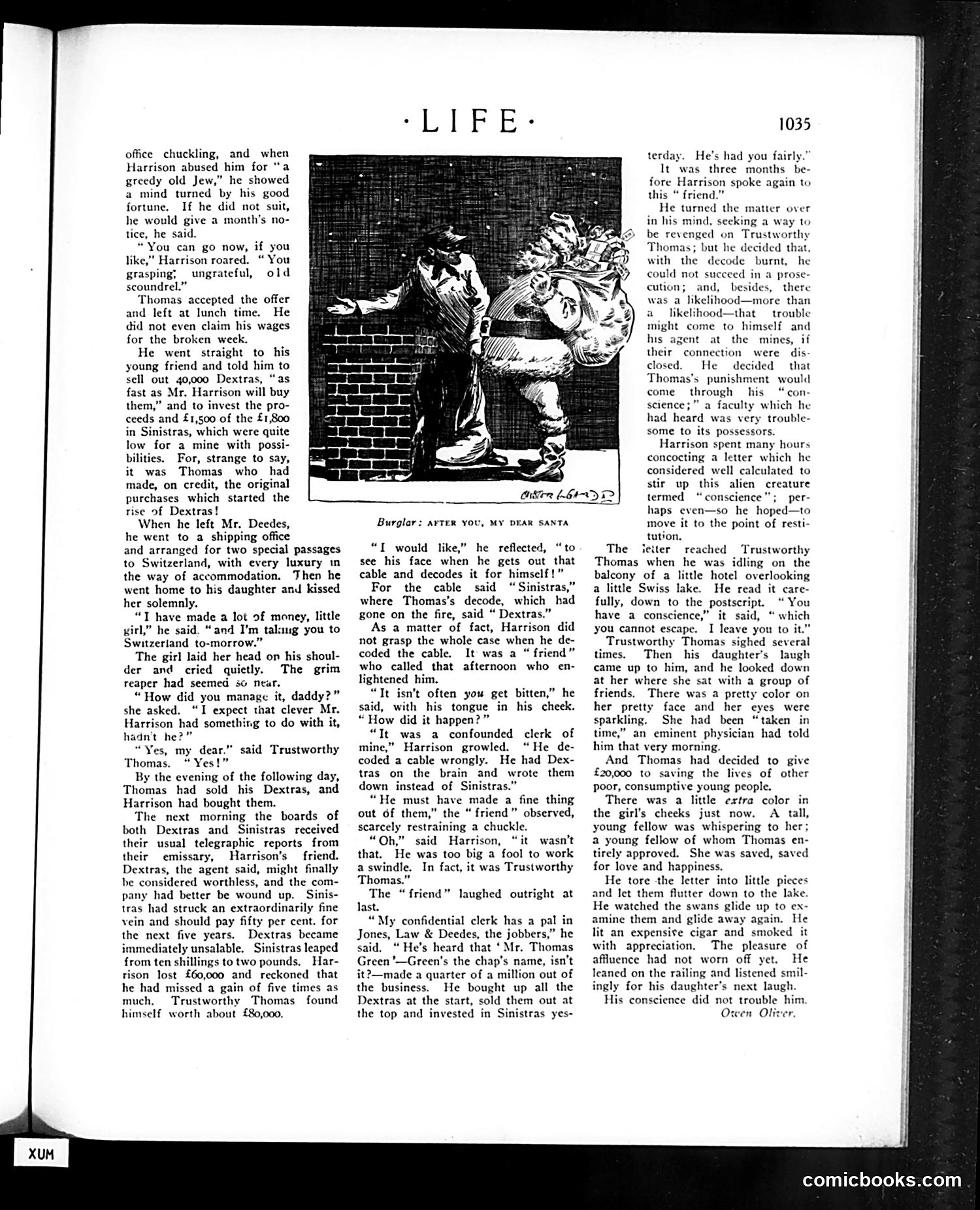
This single-panel cartoon depicts a burglar and Santa Claus at a chimney, each deferentially gesturing for the other to enter first—a play on politeness ("after you"). The satire targets the moral equivalence between burglars and Santa Claus, likely commenting on commercialized Christmas or consumer excess. By the early 20th century, Life magazine frequently satirized the contradiction between Christmas's spiritual ideals and materialistic gift-giving practices. The cartoon suggests both figures are essentially "stealing" or taking—one literally, one through the commercialized gift economy. The accompanying text (a story about financial manipulation and moral compromise) reinforces themes of deception and questionable ethics, making the cartoon's dark humor about theft and moral ambiguity more pointed.
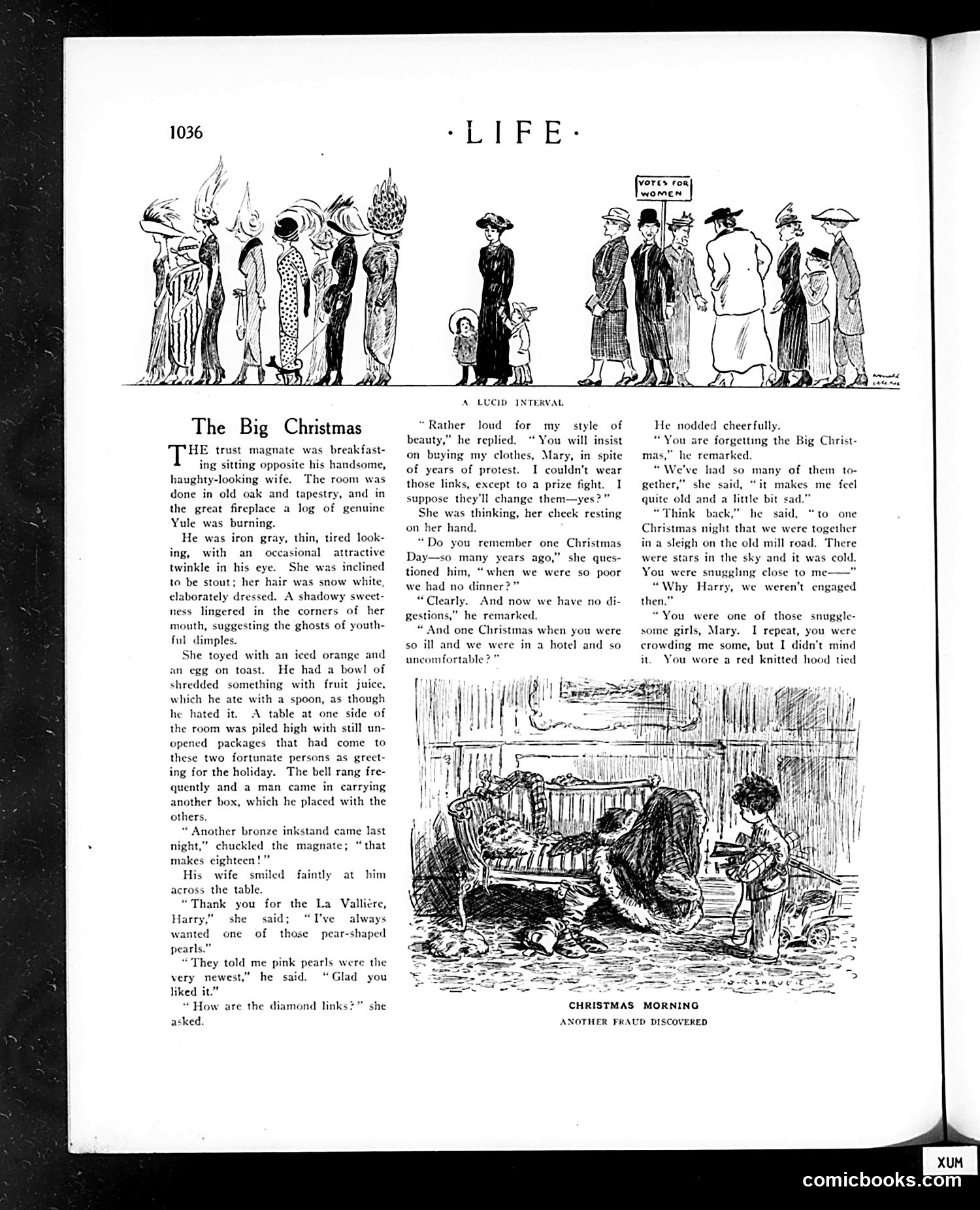
This story satirizes wealthy industrialists ("trust magnates") and the emptiness of material excess. The husband and wife are a prosperous couple receiving countless expensive gifts (bronze inkstands, pearl necklaces, diamond links) yet finding no joy in them. The man complains the gifts are "rather loud" and impractical; they both suffer digestive problems from rich living. The satire's point emerges in "A Lucid Interval" (the cartoon caption)—a moment of clarity where the husband reminisces about their impoverished early years together, which brought genuine happiness: a cold sleigh ride under stars, simple romance. The title "Another Fraud Discovered" suggests wealth itself is the fraud—promising fulfillment but delivering only burdensome possessions and physical ailments. This reflects Progressive Era critiques of Gilded Age excess and the moral bankruptcy of unchecked capitalism, common themes in Life magazine's satirical commentary.
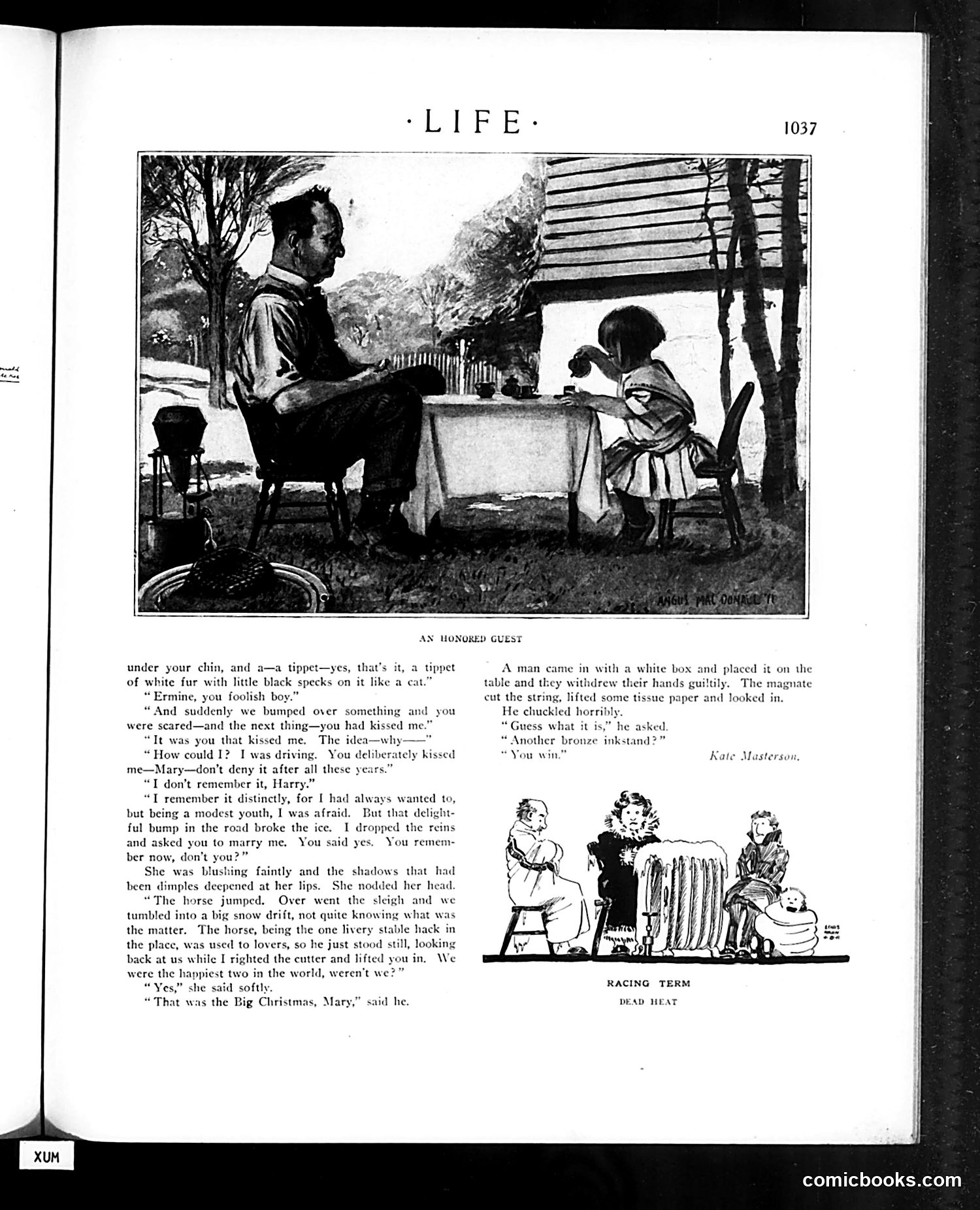
**"An Honored Guest"** (main story): A sentimental romantic narrative where a man reminisces with his wife Mary about their courtship—specifically a sleigh accident that led to his marriage proposal. The couple recalls the "Big Christmas" when a horse-drawn sleigh jumped, they tumbled into snow, and he seized the moment to propose. The tone is nostalgic and domestic, presenting idealized married romance. **"Racing Term: Dead Heat"** (cartoon below): A visual joke showing a woman in a chair holding a baby, with two other figures observing. The caption "Racing Term / Dead Heat" appears to be a pun—"dead heat" is a racing term for a tied finish, but the joke likely refers to the exhaustion or stasis of parenthood, contrasting the romantic story above with domestic reality. The humor relies on readers understanding racing terminology. Both pieces reflect early-20th-century Life magazine's mix of sentimental fiction and visual wit aimed at middle-class readers.
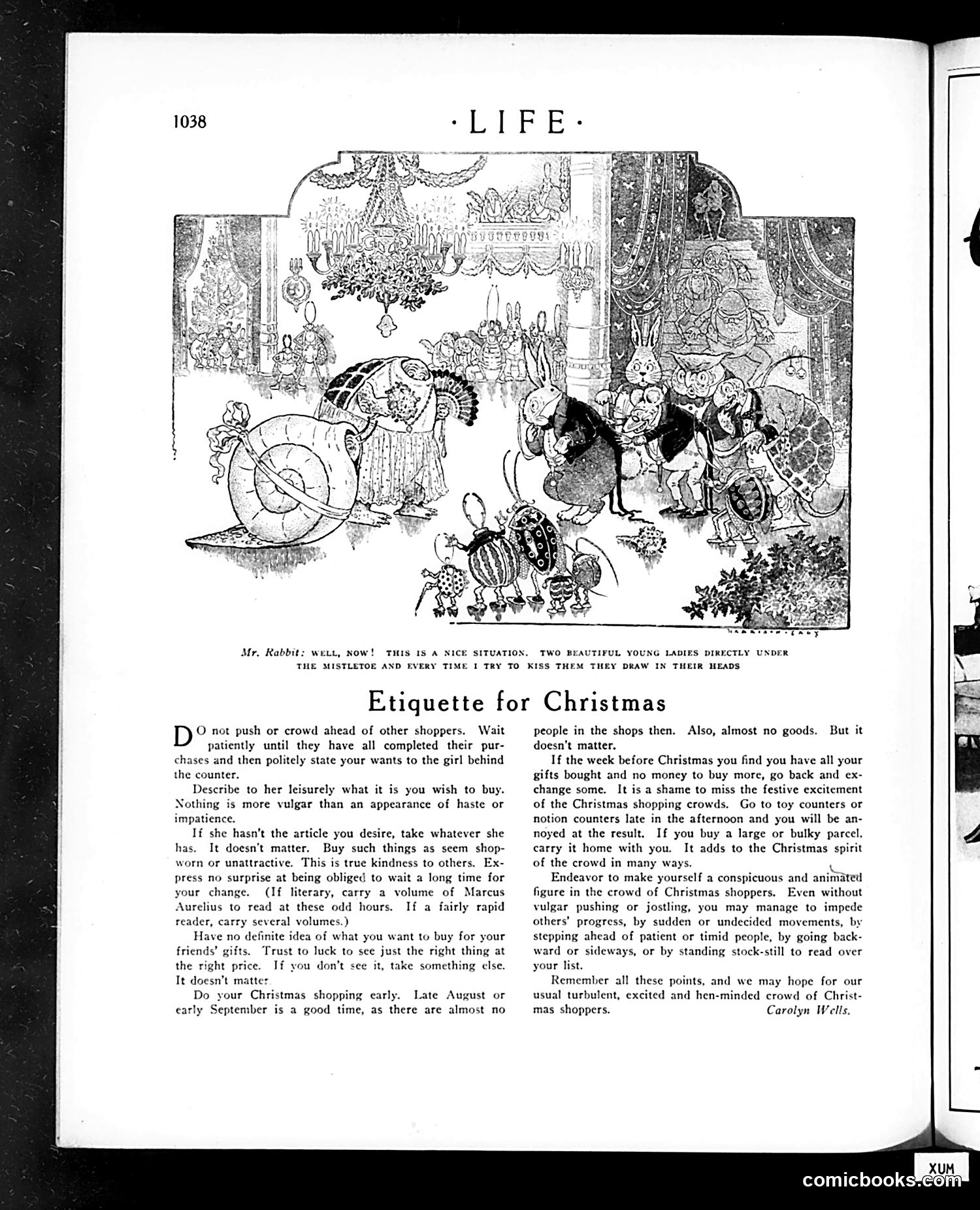
This page contains satirical advice about Christmas shopping etiquette. The cartoon shows Mr. Rabbit (an anthropomorphic character) frustrated under mistletoe with two women who won't let him kiss them—a humorous Christmas tradition scenario. The accompanying text by Carolyn Wells is heavy-handed satire that inverts proper etiquette. It mockingly advises readers to *not* be courteous: push ahead of shoppers, waste clerks' time, buy unwanted merchandise, shop at inconvenient times, and deliberately impede crowds with slow movements and large parcels. The author sarcastically recommends these behaviors will create "our usual turbulent, excited and hen-minded crowd of Christmas shoppers." The satire mocks both inconsiderate shopper behavior and the absurdity of prescriptive etiquette guides. It's a humorous critique of holiday shopping chaos and human rudeness disguised as polite instruction.
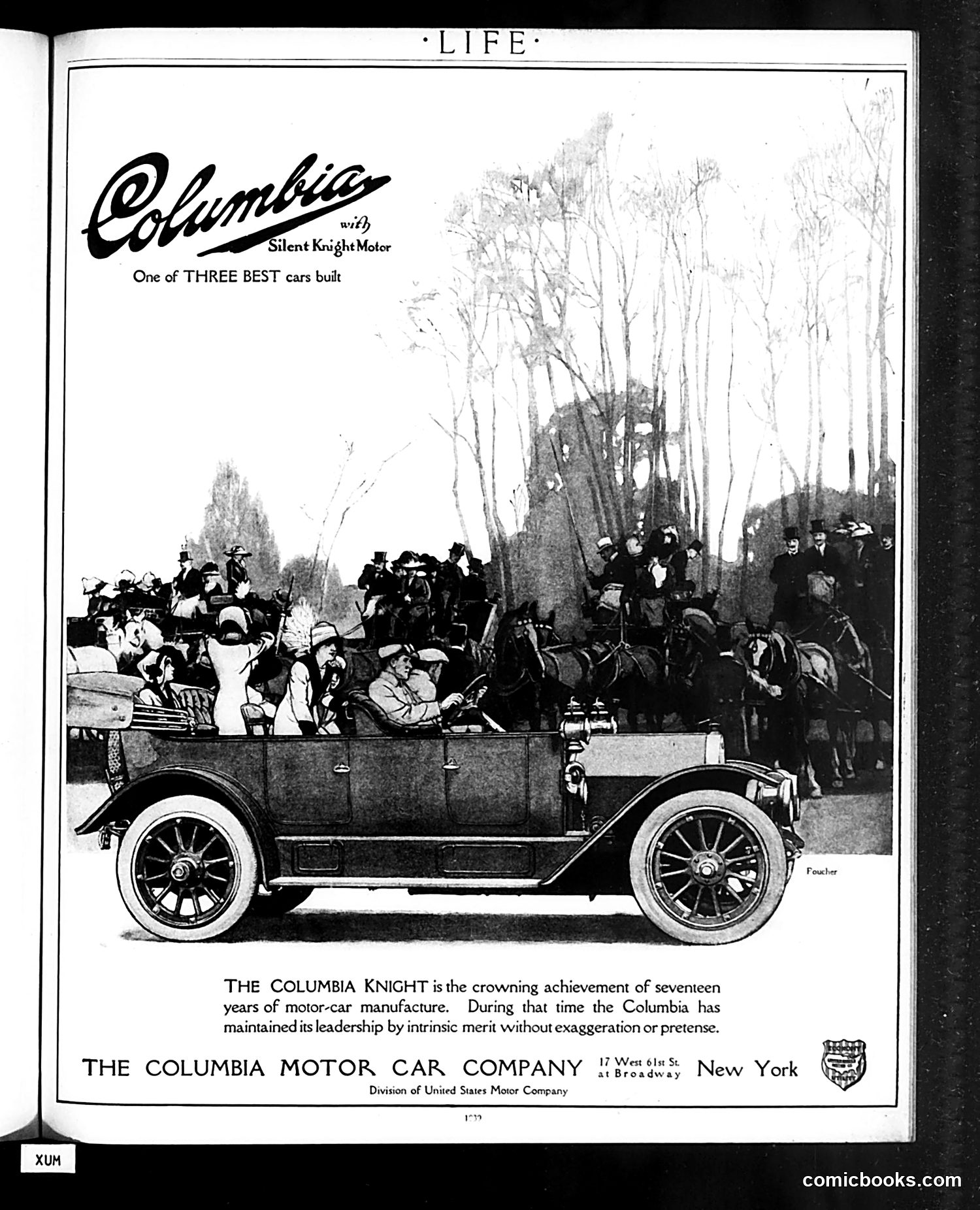
This is a straightforward automobile advertisement, not satire or political commentary. The Columbia Motor Car Company advertises its "Knight" model as "one of THREE BEST cars built," claiming seventeen years of manufacturing success based on "intrinsic merit without exaggeration or pretense." The illustration shows the vehicle laden with well-dressed passengers beneath tall poplar trees, suggesting luxury, reliability, and capacity. The company's New York address and affiliation with United States Motor Company lend authority. The "Silent Knight Motor" refers to the actual Knight engine technology, known for quiet operation—a genuine engineering distinction of the era. This represents typical early automotive marketing: emphasizing engineering credentials and social status rather than modern performance metrics.
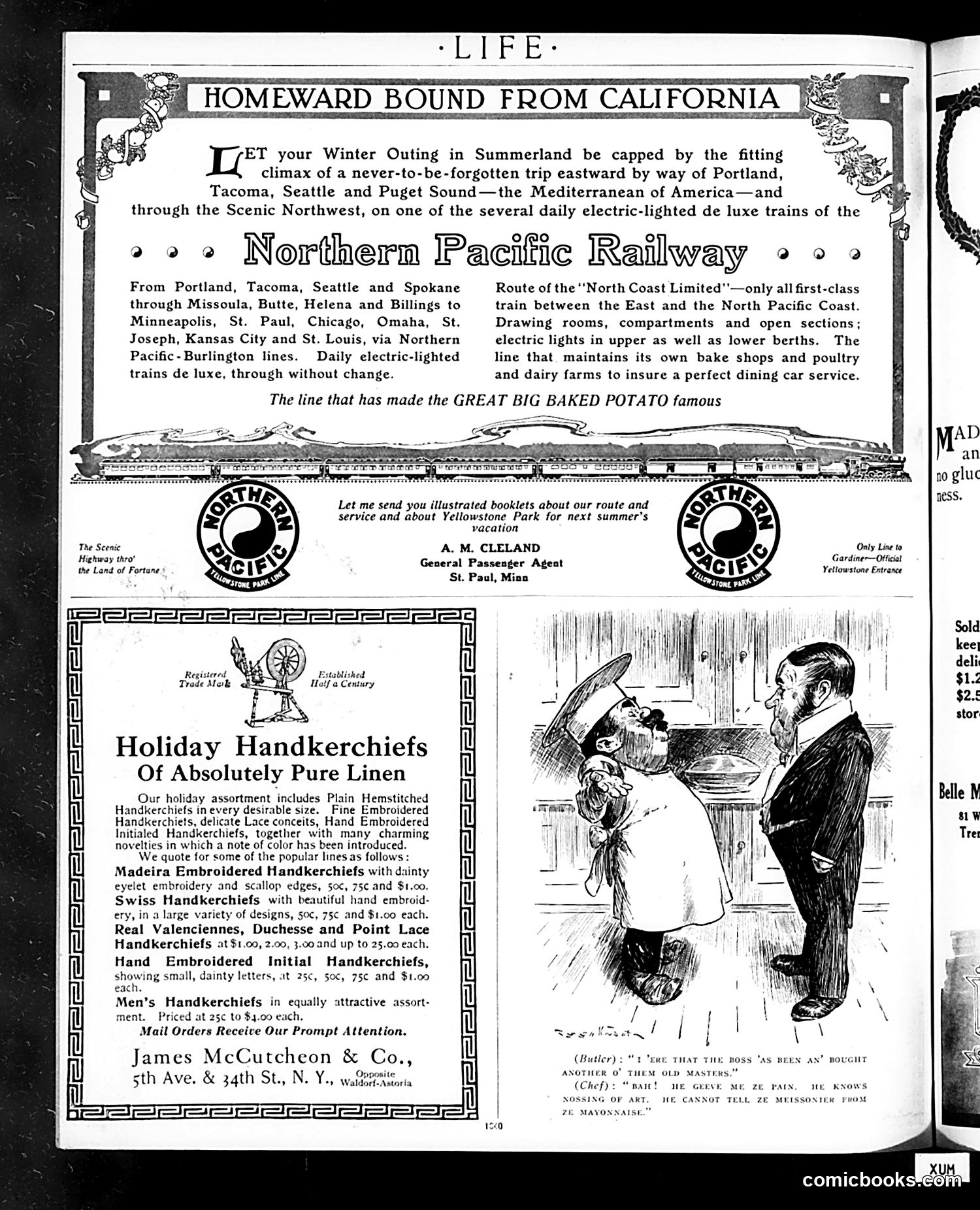
This page is primarily **advertising**, not political satire. The top half features a Northern Pacific Railway advertisement promoting luxury train travel from California eastward through the Pacific Northwest to the Midwest. The copy emphasizes electric-lit "de luxe trains," dining car service, and the famous "Great Big Baked Potato" (apparently a regional signature dish). The lower portion contains two unrelated advertisements: one for "Holiday Handkerchiefs of Absolutely Pure Linen" from James McCutcheon & Co., and a cartoon illustration with an accompanying joke. The cartoon depicts what appears to be a chef or cook speaking in exaggerated foreign accent, claiming inability to distinguish between fine art and mayonnaise—a simple ethnic humor gag typical of early 20th-century American magazines, poking fun at immigrant workers' cultural unfamiliarity. The page represents typical Life magazine content: advertising mixed with light entertainment.
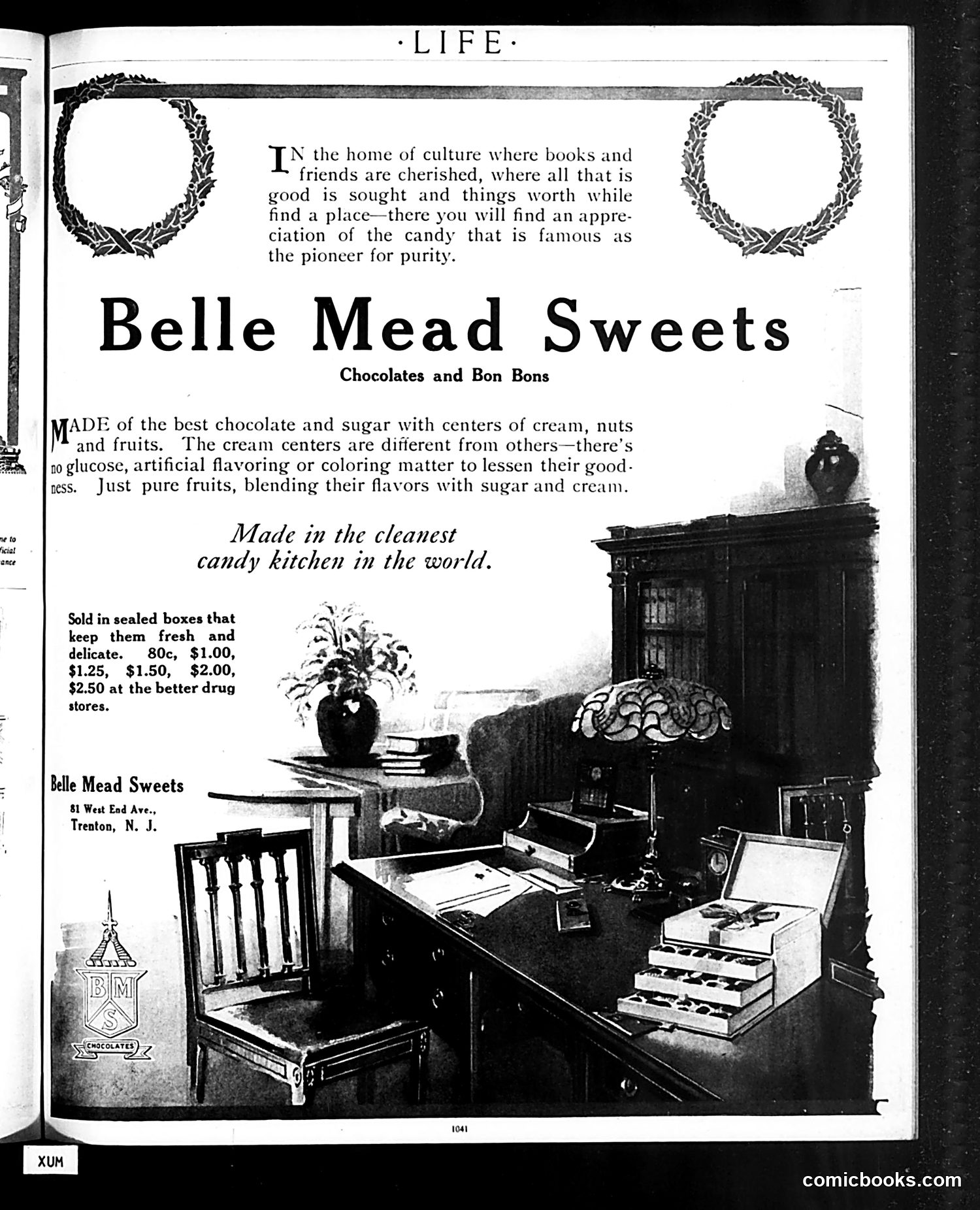
This is primarily a **candy advertisement**, not satire or political content. It appears in *Life* magazine and promotes Belle Mead Sweets chocolates and bon bons from Trenton, New Jersey. The ad uses early 20th-century marketing rhetoric emphasizing **purity and refinement**—associating candy with cultured homes containing "books and friends." The imagery shows an elegant study with furniture, potted plants, and candy boxes displayed as decorative luxury items. Key selling points highlighted: no glucose or artificial flavoring/coloring (marketed as "pure fruits"), sealed boxes for freshness, and price points ranging from 80 cents to $2.50—positioning it as a premium product for "better drug stores." The decorative wreaths and refined setting are meant to appeal to middle/upper-class consumers who valued propriety and quality. There is **no apparent satire** here—just period advertising using class signaling and purity claims common to that era.
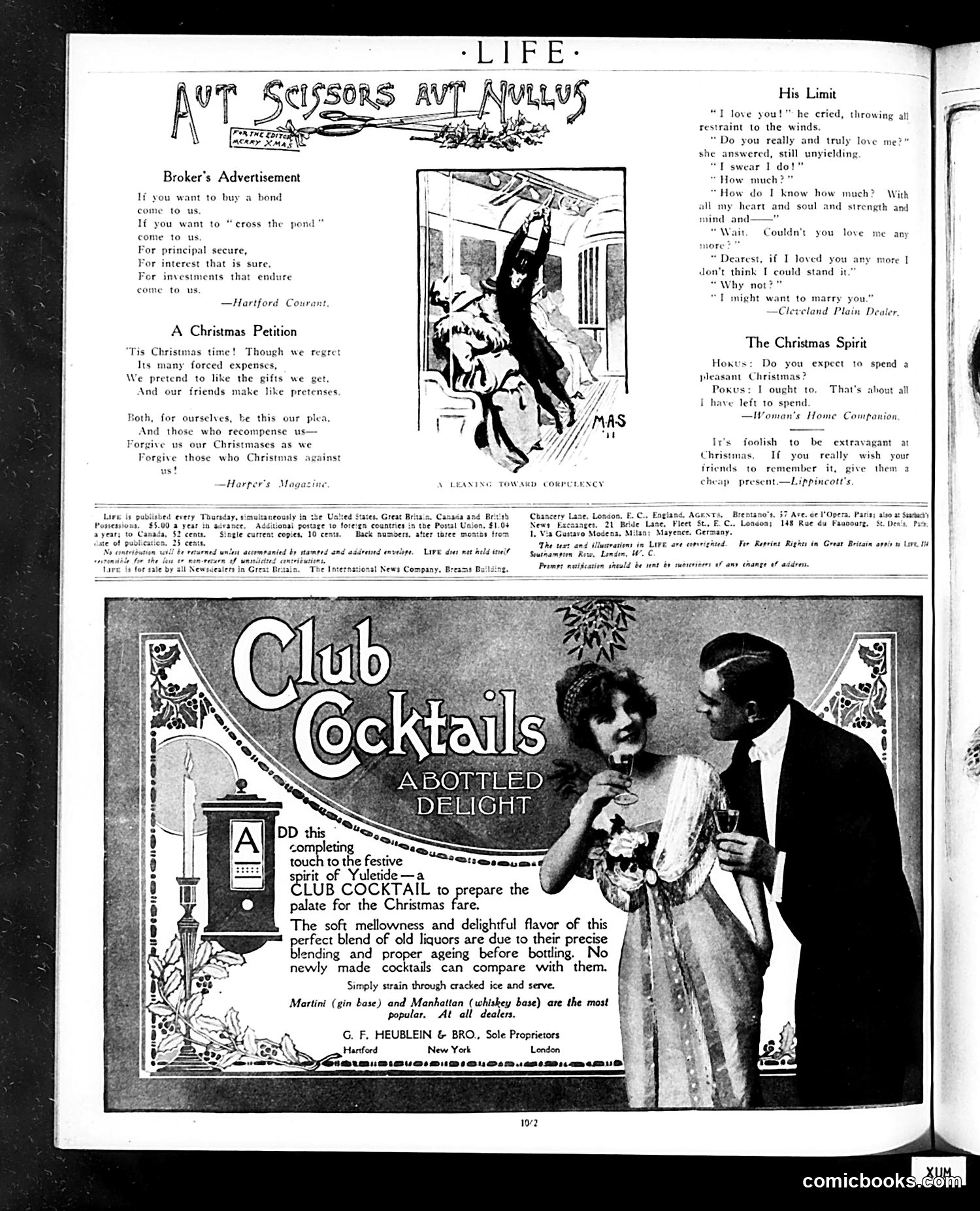
This page contains **satirical humor and advertisements** from an early 20th-century American magazine, with no specific political cartoons identifying named figures. **The satire targets:** 1. **"A Christmas Petition"** mocks the hypocrisy of Christmas spending—people resent forced expenses and pretend to enjoy unwanted gifts while asking forgiveness for their "Christmases" as casually as forgiving sins. 2. **"His Limit"** jokes about romantic excess: a man declares overwhelming love, but when asked if he could love her *more*, admits he couldn't stand it—because he'd then feel obligated to marry her. The humor lies in exposing that even passionate declarations have practical limits. 3. **"The Christmas Spirit"** uses a dialogue between Hoxus and Poxus to satirize holiday poverty: one character plans a "pleasant" Christmas by spending "all" remaining money—implying financial desperation. The **Club Cocktails advertisement** promotes Yuletide drinking as necessary "preparation" for Christmas meals. Overall, the page reflects early-20th-century middle-class anxieties about holiday financial strain and social performance.
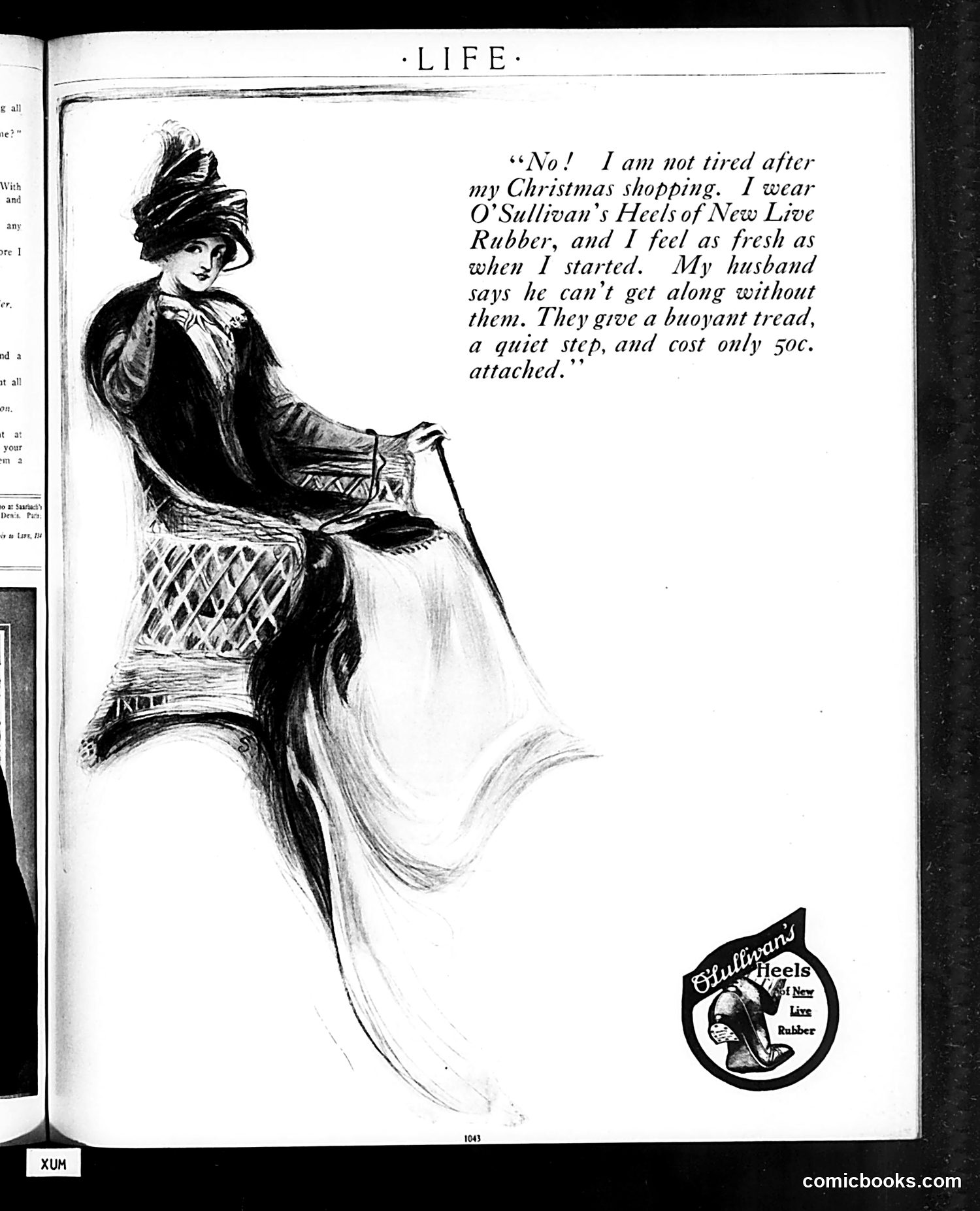
This is an advertisement disguised as editorial content in Life magazine. A fashionable woman in elegant early-1900s dress testifies that O'Sullivan's rubber heels keep her energized through Christmas shopping—a demanding activity associated with women of means. The appeal targets both women (comfort and freshness) and their husbands (the heels' necessity for family life). The "50c attached" price point positions these as an affordable luxury upgrade. The satirical framing—presenting an advertisement as a woman's testimonial in the magazine's editorial pages—was common practice in early Life issues, blurring marketing and journalism. The elaborate illustration and quote format lend false authority and personal credibility to what is purely promotional content.
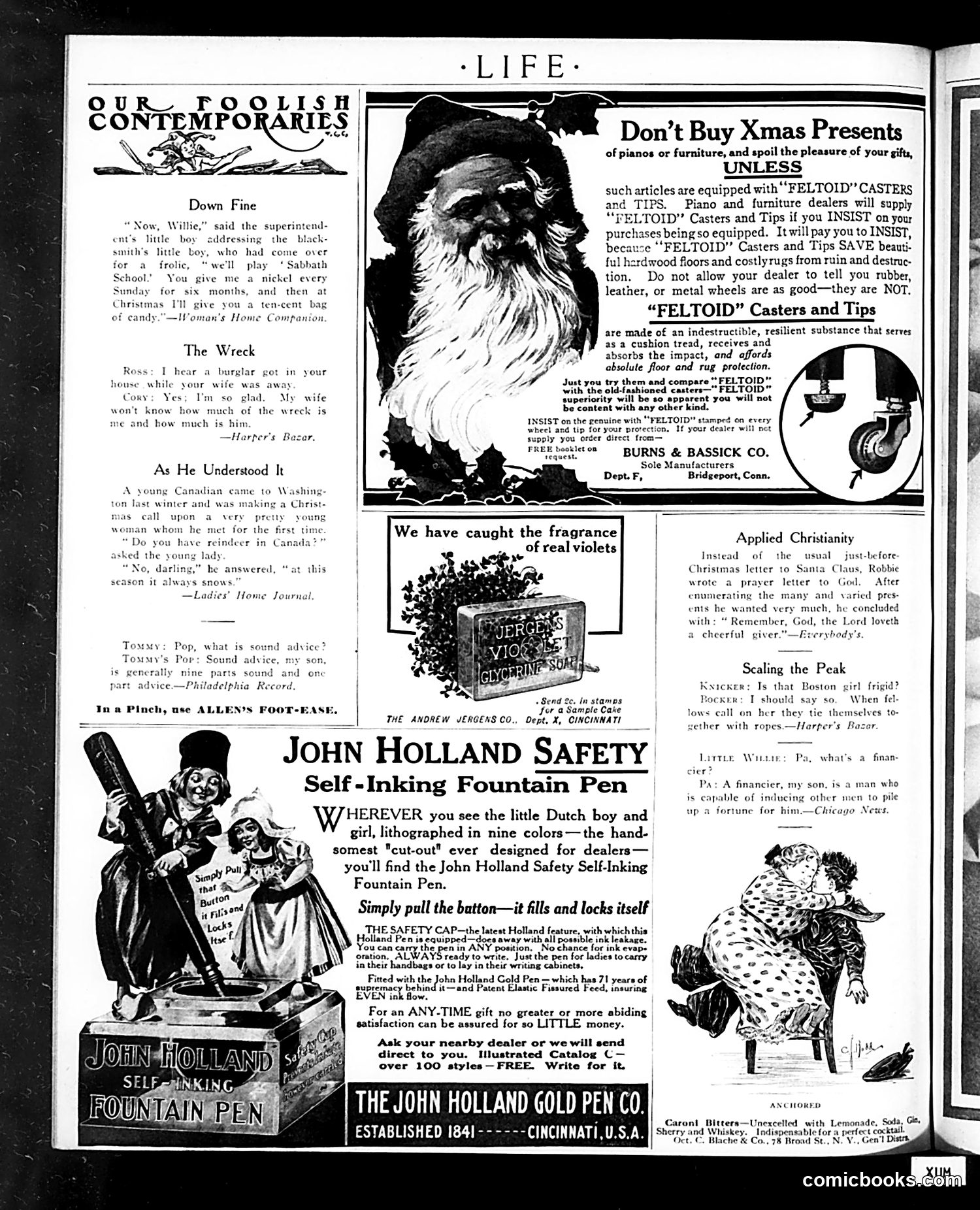
This page mixes satirical humor with period advertising, typical of early 20th-century Life magazine. **Satirical Content:** The humor sections mock social pretense and naïveté. "Down Fine" ridicules a child's shrewd scheme to profit from religious obligation. "As He Understood It" jokes about a Canadian's misunderstanding of American Christmas traditions (confusing "reindeer in Canada" with snow). "Applied Christianity" gently satirizes a child's prayer to God that reads like a Santa list, then concludes with obligatory piety about cheerfulness. "Scaling the Peak" uses the climbing metaphor to mock social awkwardness between a young man and woman. **Advertisements:** The page features prominent ads for "Feltoid" casters (furniture protection), Jergens Violet soap, John Holland Safety fountain pens, and Allen's Foot-Ease. These represent typical consumer goods marketed to middle-class readers. The overall tone reflects genteel American humor aimed at prosperous families concerned with propriety, household management, and modest social climbing—the magazine's core audience.
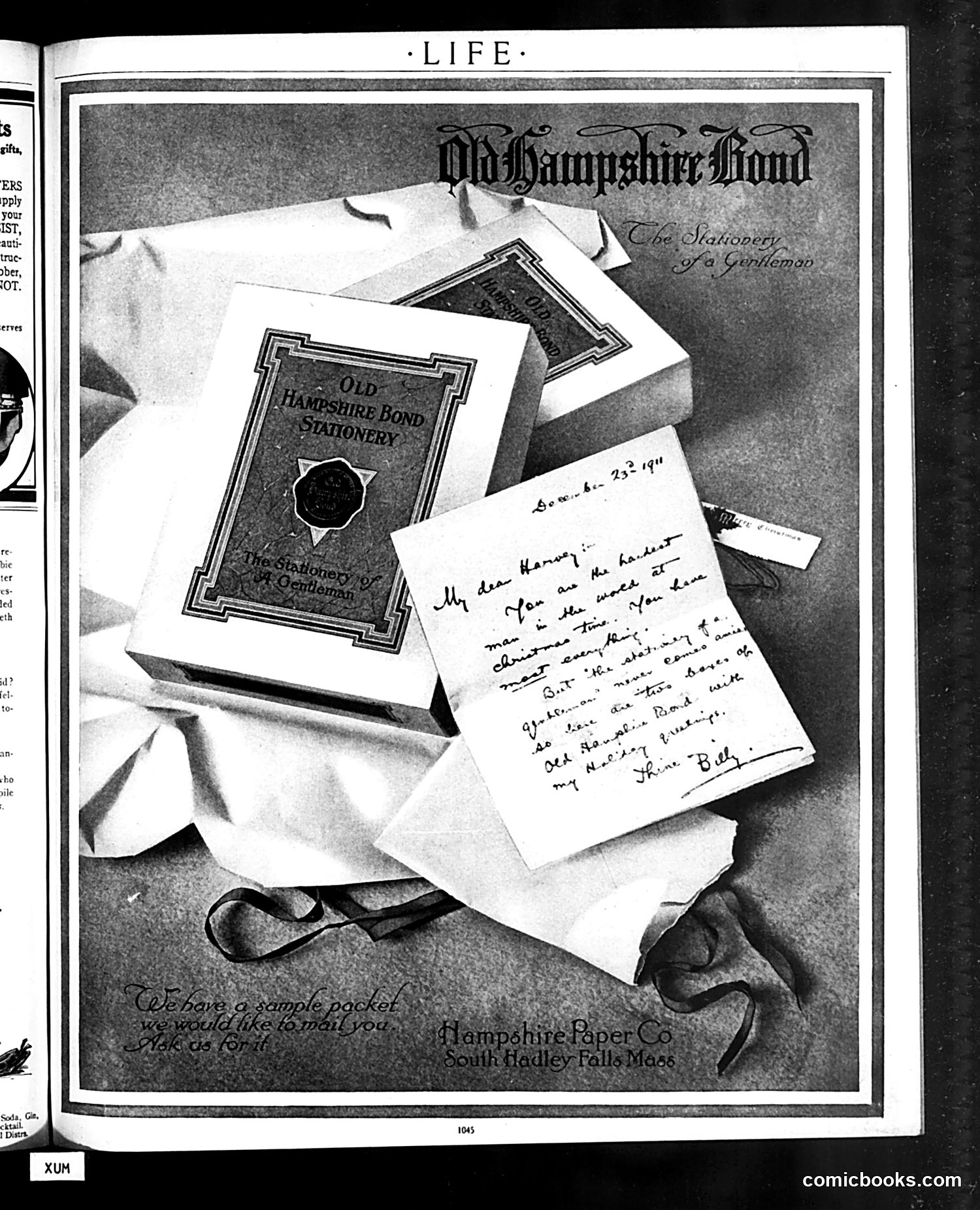
This is a **product advertisement**, not political satire. It promotes "Old Hampshire Bond" stationery, marketed as "The Stationery of a Gentleman." The ad displays the product portfolio—letterhead boxes with decorative borders and a wax seal—alongside a handwritten letter dated "June 1, 25th" and an envelope, all arranged artfully on fabric. The tagline reads: "We have a sample packet enclosed like a small one. Ask us for it." The manufacturer is Hampshire Paper Co., South Hadley Falls, Massachusetts. This targets affluent male consumers by emphasizing gentlemanly status and quality correspondence materials—typical early-20th-century luxury marketing positioning fine stationery as a sign of social standing.
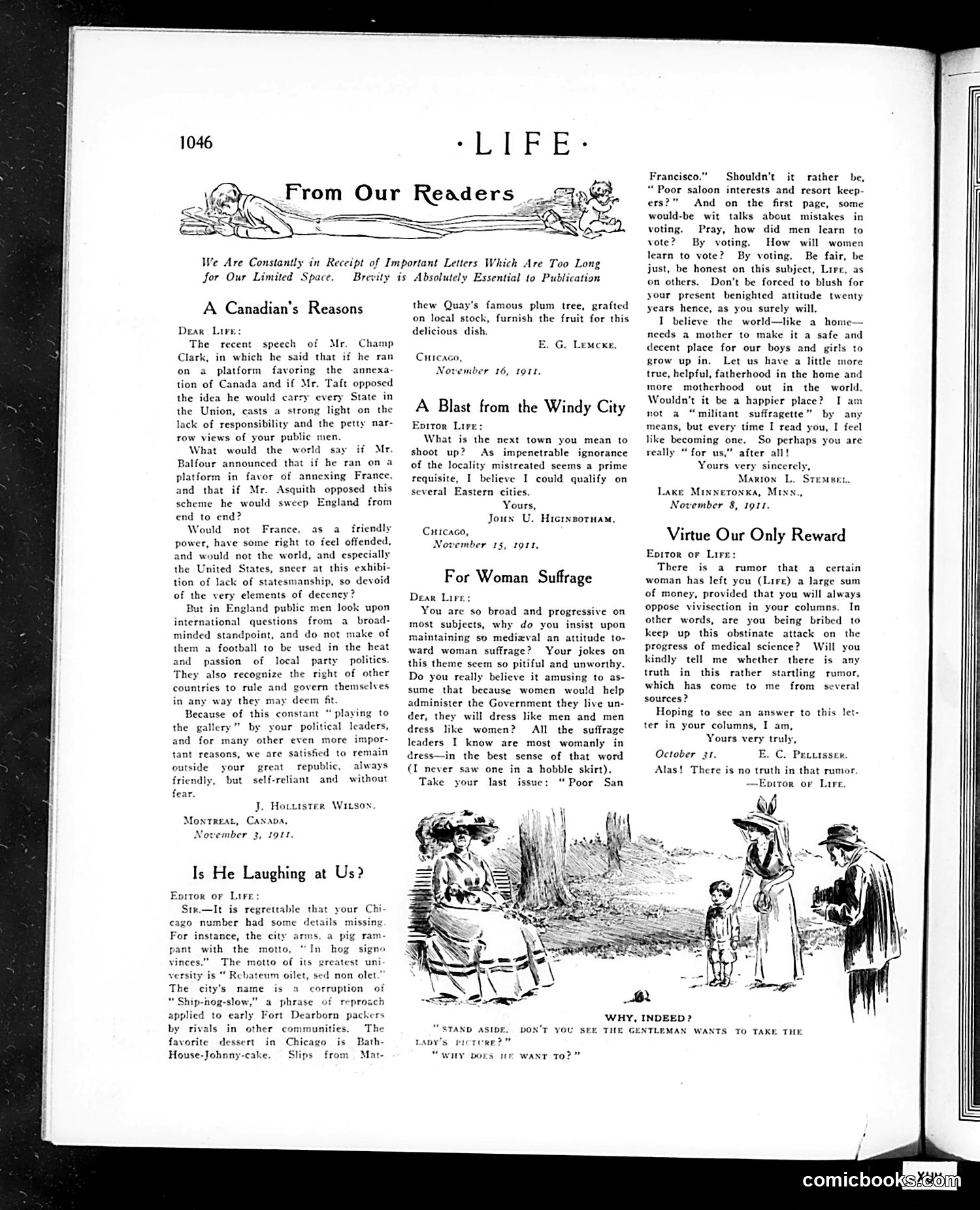
This is a letters-to-the-editor page from *Life* magazine (November 1911), featuring readers' responses to recent editorial content and political issues. **Key letters and context:** 1. **"A Canadian's Reasons"**: A Canadian reader criticizes U.S. politician Champ Clark's recent speech favoring Canada's annexation, calling it irresponsible and comparing it unfavorably to British statesmanship—suggesting Americans lack diplomatic decorum. 2. **"A Blast from the Windy City"**: A sarcastic response to *Life*'s apparent mockery of Chicago, with the writer sardonically offering to help them "shoot up" other Eastern cities. 3. **"For Woman Suffrage"**: A reader criticizes *Life* for mocking women's suffrage through jokes about dress and voting competence, arguing women need equal political voice. 4. **Cartoon (bottom)**: Depicts a gentleman refusing to let a woman in a picture—satirizing anti-suffrage attitudes and outdated gender politics. The page shows *Life* as a forum for vigorous public debate on major early 20th-century issues: imperialism, women's rights, and American identity.
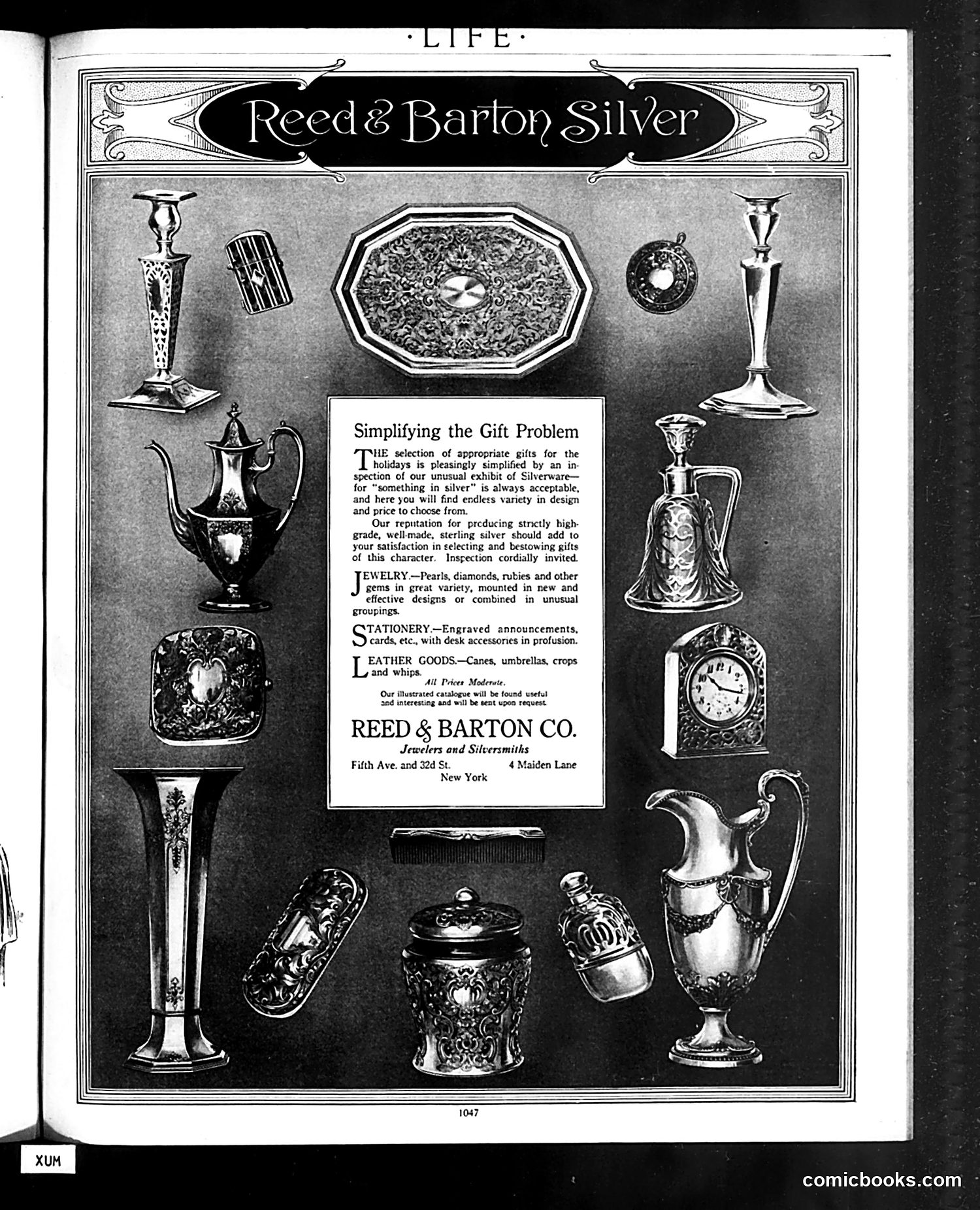
This is not a cartoon but a **luxury goods advertisement** from Life magazine's pages. Reed & Barton, a prestigious American silversmith company, marketed sterling silver items as holiday gifts. The ad displays ornate silver pieces—candlesticks, teapots, trays, vases, clocks, and decorative boxes—arranged around central text. The headline "Simplifying the Gift Problem" addresses a relatable consumer concern: what to give during the holiday season. The pitch emphasizes that silver gifts are universally acceptable and available at "all prices moderate," attempting to position expensive luxury items as accessible solutions. Additional categories (jewelry, stationery, leather goods) broaden appeal. This reflects early 20th-century consumer culture, where mass-circulation magazines like Life promoted upscale merchandise to affluent readers. The ornate Victorian aesthetic suggests this is pre-1920s advertising, when such silverware represented status and refined taste.
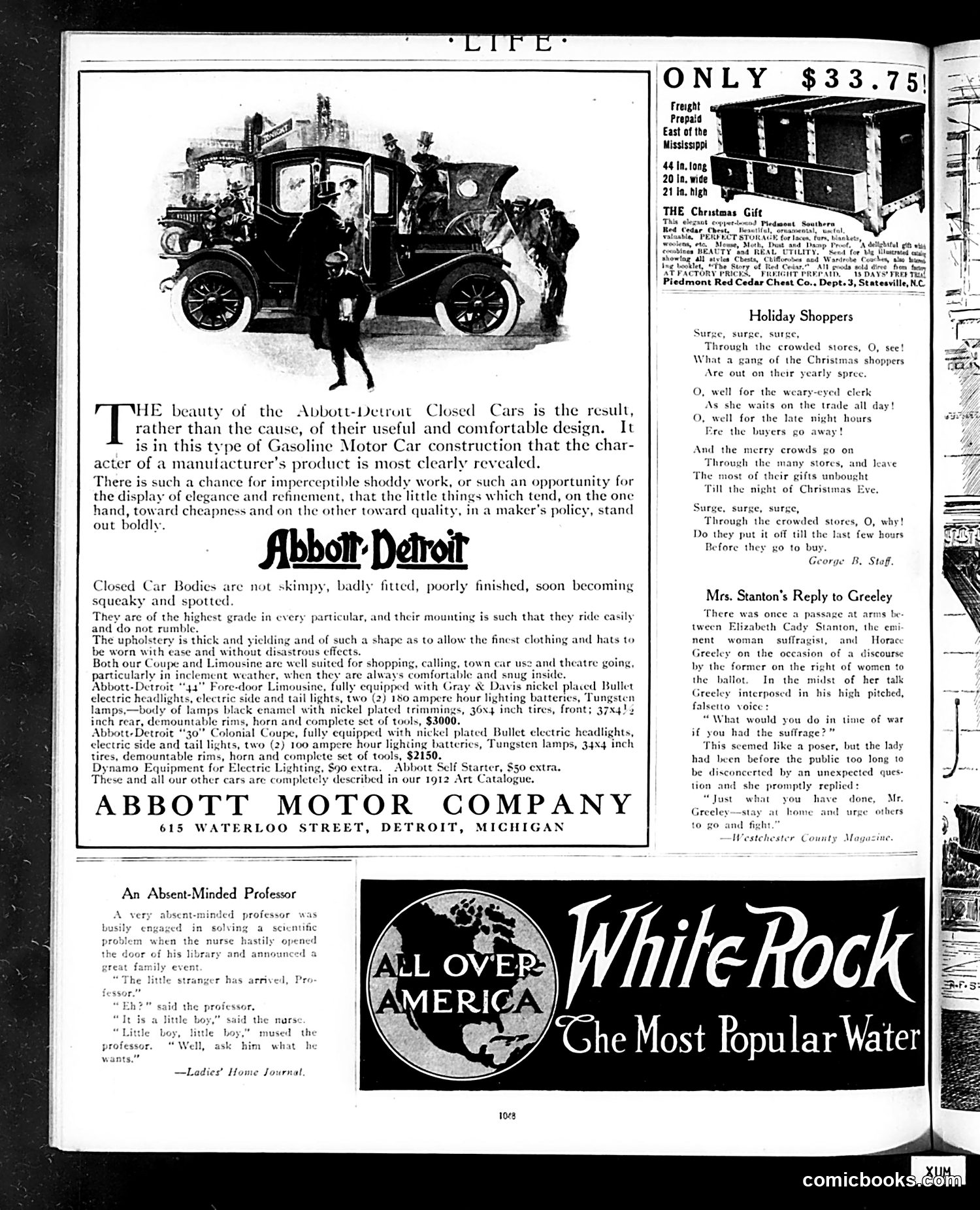
This is primarily **an advertising page** rather than satirical content. The main feature is a large Abbott-Detroit automobile advertisement emphasizing quality craftsmanship in closed-body cars—a then-novel luxury feature protecting passengers from weather. The page includes three secondary items: 1. **"An Absent-Minded Professor"** (bottom left): A light anecdote from *Ladies' Home Journal* about a distracted academic announcing a baby's arrival to his servant, apparently confusing domestic and professional spheres. This reflects period humor about absent-minded intellectuals. 2. **"Holiday Shoppers"** (right): A poem humorously depicting Christmas shopping crowds—relatable content showing last-minute retail chaos and exhausted clerks. 3. **"Mrs. Stanton's Reply to Greeley"**: An anecdote about women's suffragist Elizabeth Cady Stanton's witty retort to newspaper editor Horace Greeley's dismissive question about women voting during wartime. Her response cleverly turns his question back on him, noting men also stayed home during conflicts. The page reflects early 1910s consumer culture and period gender debates through advertising and light humor.
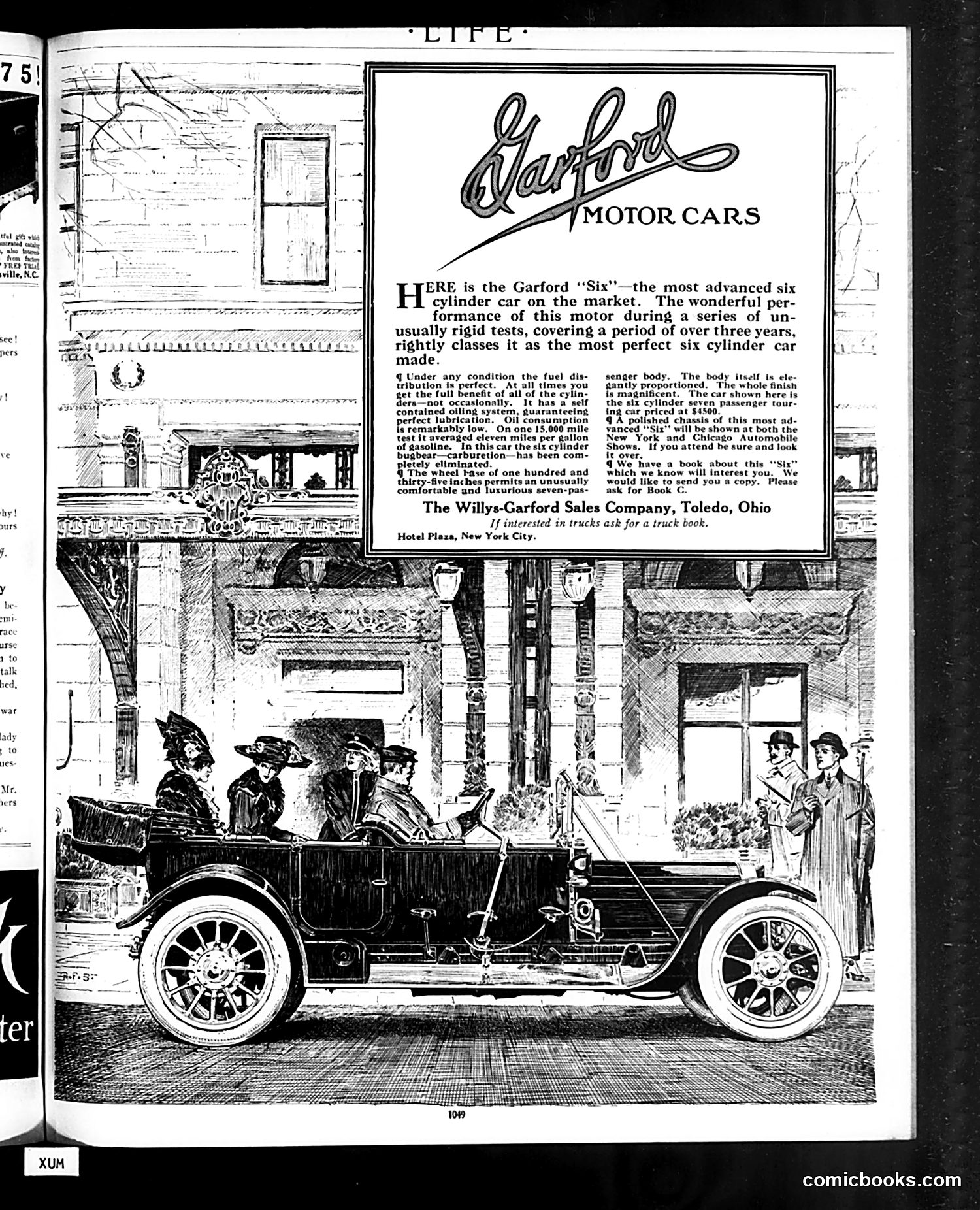
This page is **primarily an advertisement**, not a political cartoon or satirical content. It features a full-page ad for the Garford "Six" automobile, manufactured by the Willys-Garford Sales Company of Toledo, Ohio. The image shows an elegant early-1900s touring car with well-dressed passengers parked in front of an upscale building. The advertisement emphasizes the car's technical superiority—particularly its six-cylinder engine, fuel distribution system, and comfortable seven-passenger capacity—positioning it as a luxury vehicle for affluent buyers. The accompanying illustration depicts the car as a status symbol in a refined urban setting, appealing to the magazine's middle-to-upper-class readership. There is no evident satire or political commentary. This is straightforward commercial messaging typical of *Life* magazine's revenue model from this era.
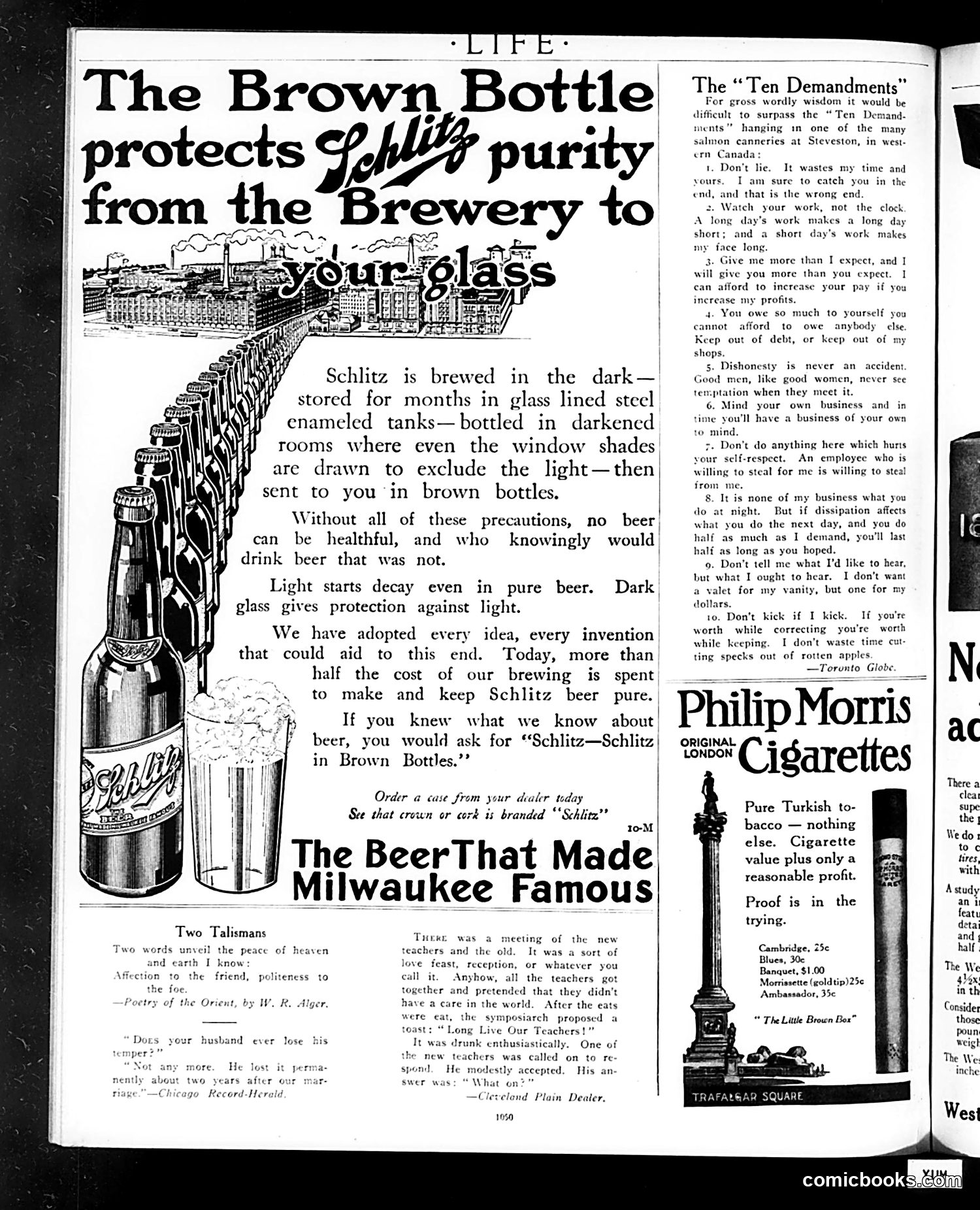
This page contains primarily **advertisements rather than political cartoons**. The dominant feature is a Schlitz beer advertisement emphasizing that brown bottles protect beer from light decay during storage and transport—a legitimate concern in early 20th-century brewing. The ad claims superior quality control and justifies premium pricing. Below that is a brief humorous anecdote about teachers at a reception, where one newly hired teacher is asked to toast "Long Live Our Teachers!" but responds with "What on?"—suggesting teachers were underpaid or undervalued. The right column features Philip Morris cigarette advertising and reprints "The Ten Demandments" from a Canadian salmon cannery—workplace rules emphasizing honesty, self-reliance, and hard work. These read as period-typical industrial-era labor philosophy rather than satire. The page reflects early 1900s commercial culture: product advertising mixed with workplace aphorisms and light humor about professional life. No political cartoons or satire appear here.
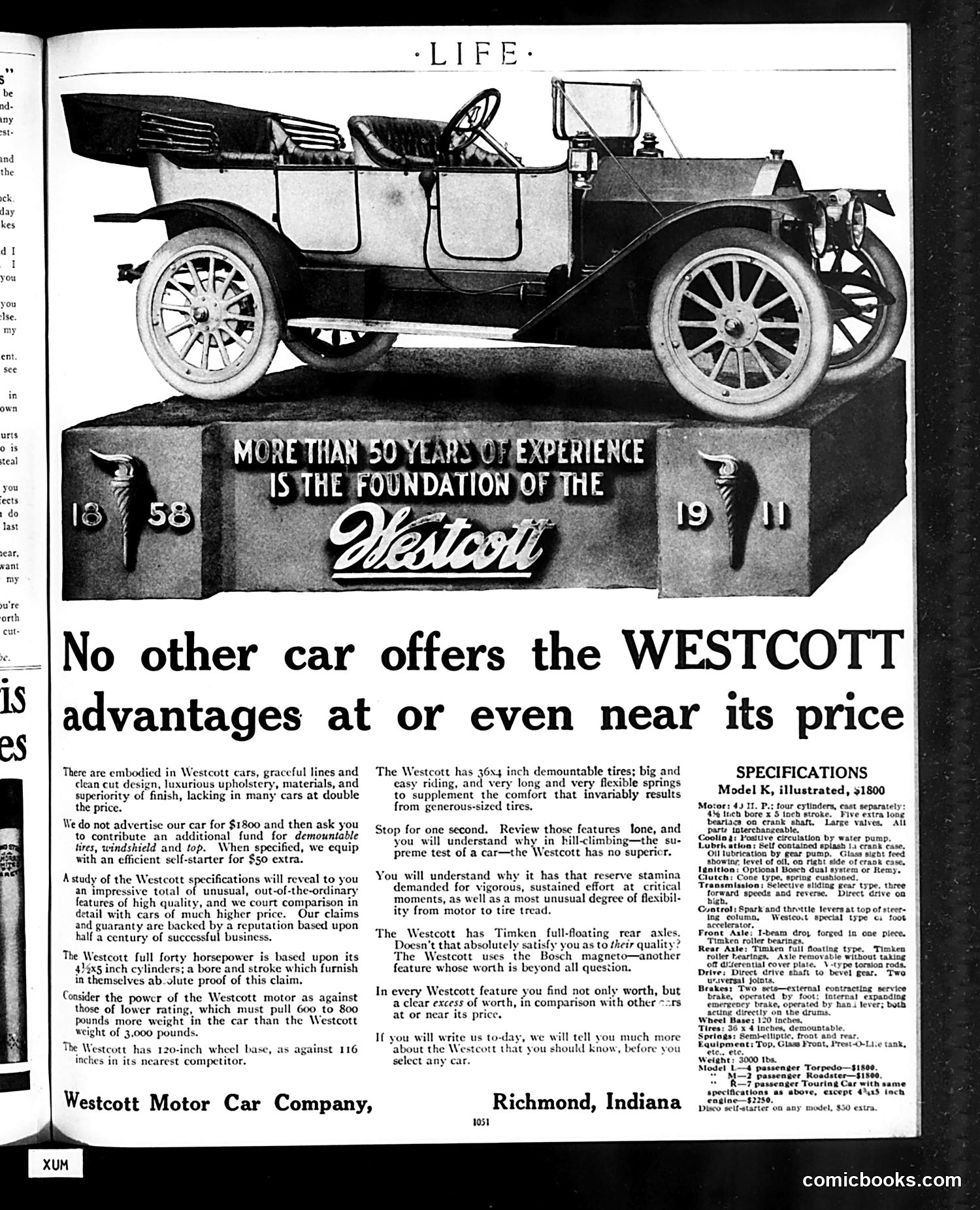
This is **not a cartoon or satire** — it's a straightforward automobile advertisement from 1911, published in *Life* magazine. The page promotes the **Westcott Motor Car**, manufactured in Richmond, Indiana. The advertisement emphasizes the car's value proposition: it costs $1,800 but includes features (demountable tires, windshield, top, self-starter) that competitors charge extra for. Key selling points highlighted: - 50+ years of company experience - 40 horsepower engine - Large wheels and flexible suspension for hill-climbing - Timken rear axles and Bosch magneto (quality components) - Lighter weight than competitors (3,000 lbs) - 120-inch wheelbase The image shows a side-profile photograph of an open-air touring car mounted on a pedestal, emphasizing its quality construction. This represents early automotive marketing targeting middle-class buyers seeking reliable, fairly-priced vehicles during the competitive early automobile era.
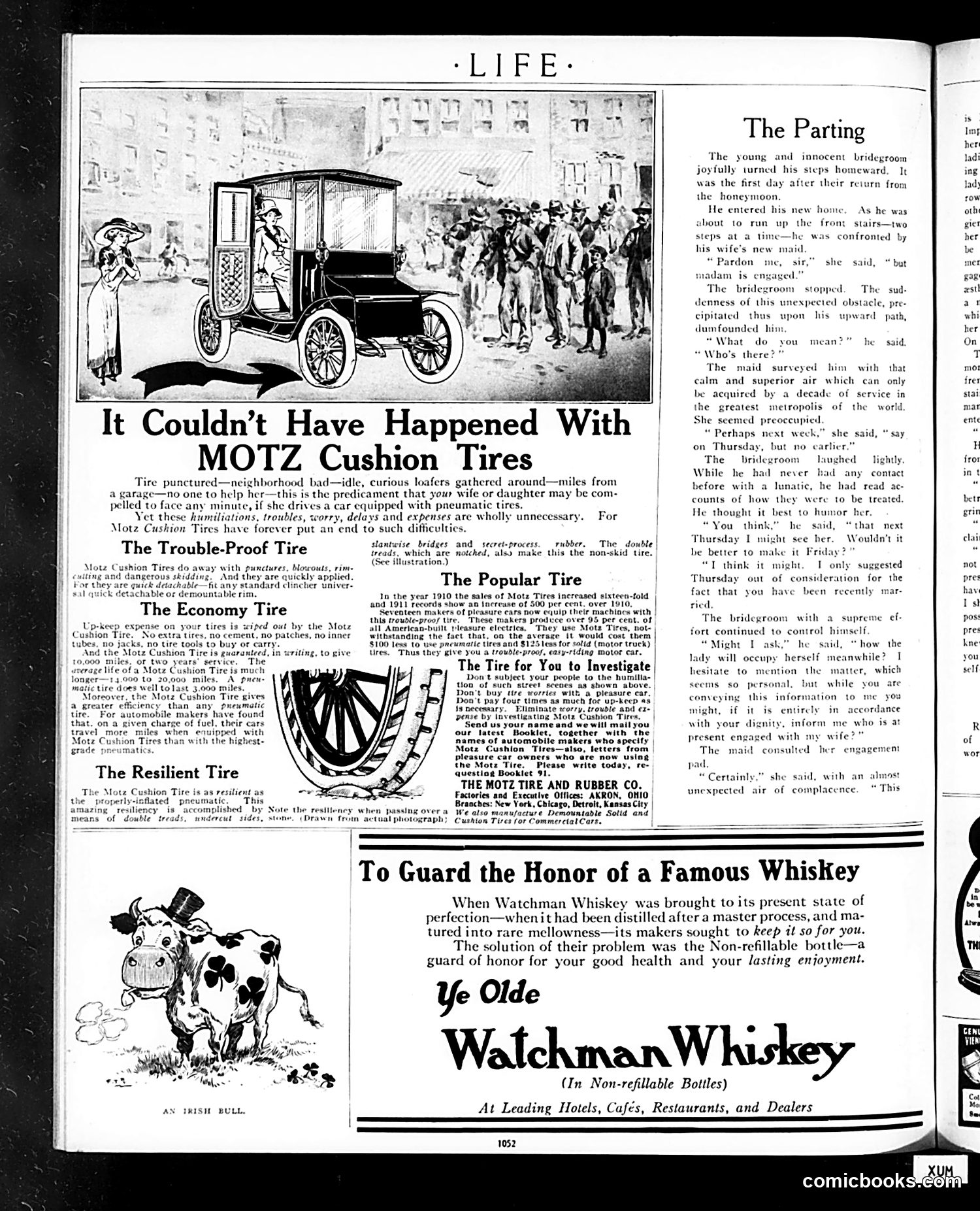
This is a humorous short story, not a political cartoon. It depicts a newlywed husband returning home, only to be intercepted by his wife's newly hired maid before he can ascend the stairs. The joke hinges on class and domestic service hierarchies of the era: the maid, speaking with the "calm and superior air" acquired through years of metropolitan service, announces that "madam is engaged"—blocking his access to his own wife. The husband's confused responses and growing frustration create comedy as he's repeatedly rebuffed by a servant who outranks him in his own home through her authority over the household schedule. The satire targets both the pomposity of urban servants and the absurdity of a newlywed being treated as an intruder in his own residence. It's a gentle domestic comedy playing on early 20th-century class pretensions and the unexpected power domestic staff wielded in wealthy households.
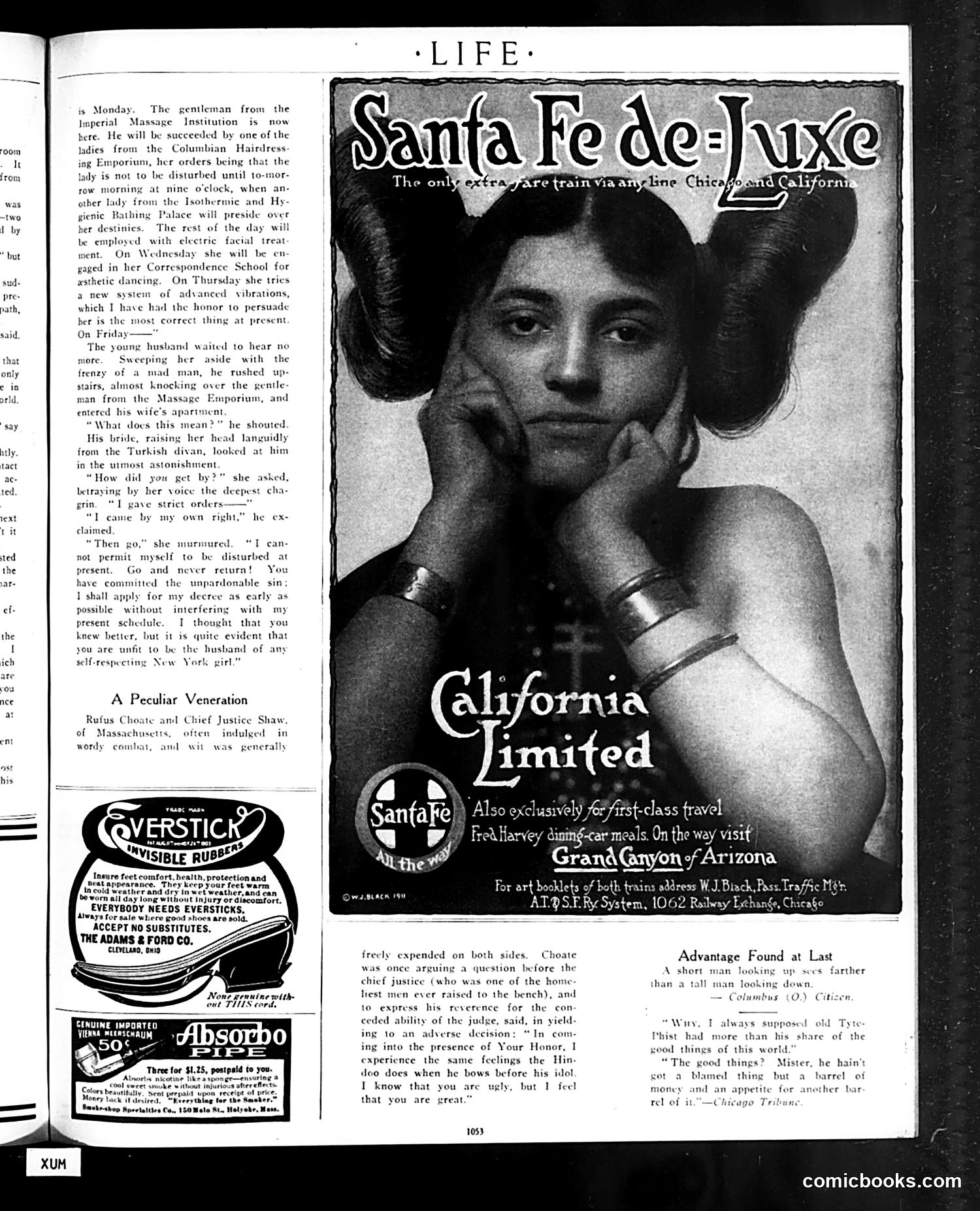
This page is primarily **advertising** for the Santa Fe Railway's "de Luxe" California Limited train service. The large illustrated advertisement features an elegant woman's portrait promoting luxury cross-country rail travel, with text emphasizing first-class dining cars and sightseeing opportunities like the Grand Canyon. The page contains two brief satirical **prose sketches** typical of Life magazine's humor: 1. **"A Modern Wife's Schedule"**: Mocks the leisure pursuits of wealthy New York women, depicting a husband's fury at being denied access to his wife, who is fully booked with spa treatments, massage, hairdressing, and dance lessons. The joke critiques the self-absorbed indulgence of elite women. 2. **"A Peculiar Veneration"**: A brief anecdote about Rufus Choate and Chief Justice Shaw of Massachusetts, where Choate compares his reverence for the judge to Hindu idol worship—flattery wrapped in backhanded compliments. Below are period advertisements for shoe inserts and Vienna meerschaum pipes. The humor relies on social commentary about wealth, gender relations, and professional deference.
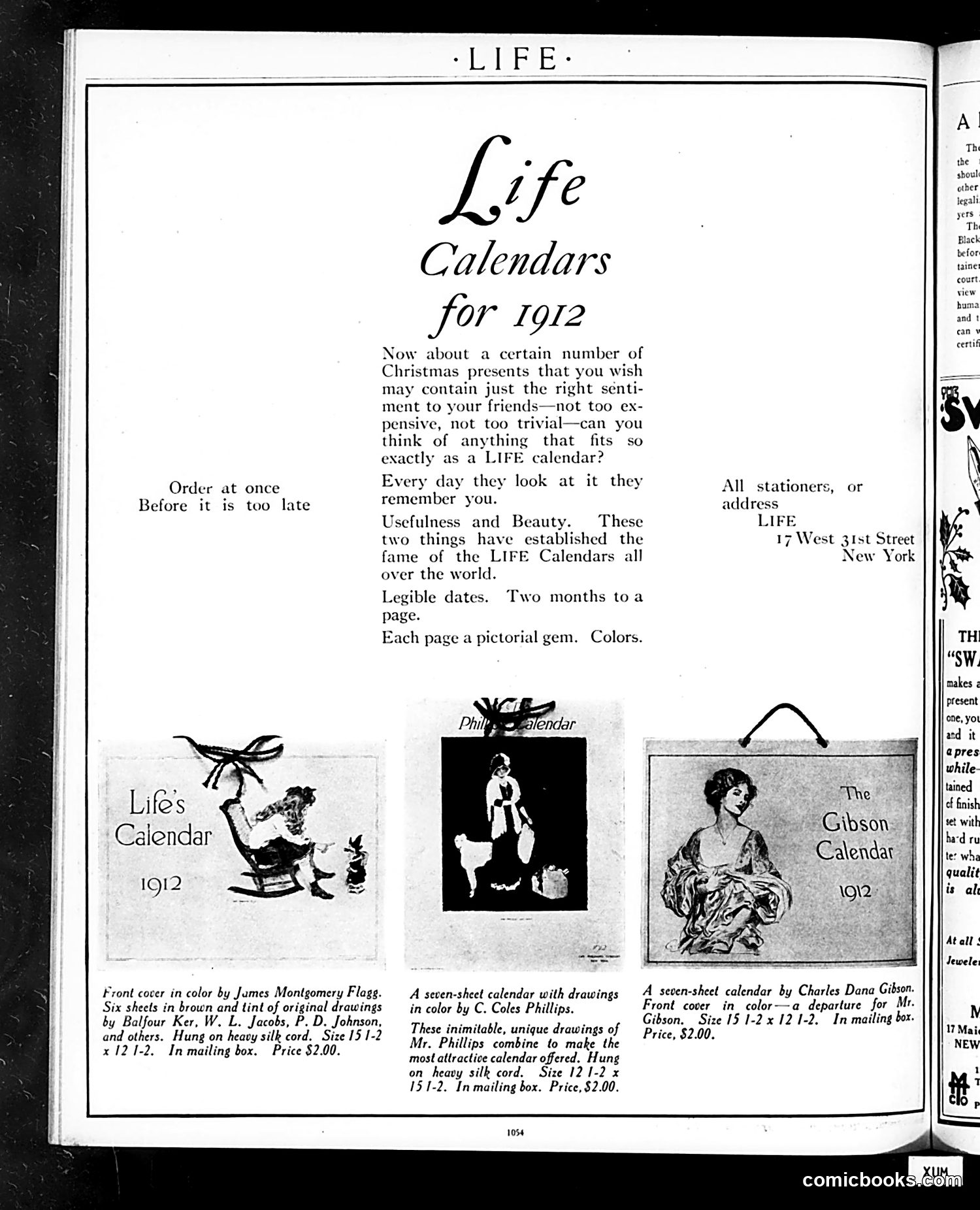
This is primarily an **advertisement page**, not a political cartoon. Life magazine is promoting its 1912 calendars as Christmas gifts. The page features three different calendar designs: 1. **Life's Calendar** (left) - illustrated by James Montgomery Flagg, featuring whimsical artwork 2. **Phillips Calendar** (center) - with drawings by C. Coles Phillips 3. **Gibson Calendar** (right) - by Charles Dana Gibson The ad's pitch to readers: these calendars are ideal gifts because they're "useful and beautiful" — not too expensive or trivial. Each features two months per page, legible dates, and colorful pictorial artwork. Buyers are urged to "order at once / Before it is too late" for Christmas delivery. This reflects early 1900s gift-giving culture, when illustrated calendars were considered tasteful, practical presents. The prominent mention of artists' names (especially Gibson, creator of the famous "Gibson Girl") indicates these were desirable luxury items marketed to middle and upper-class consumers.
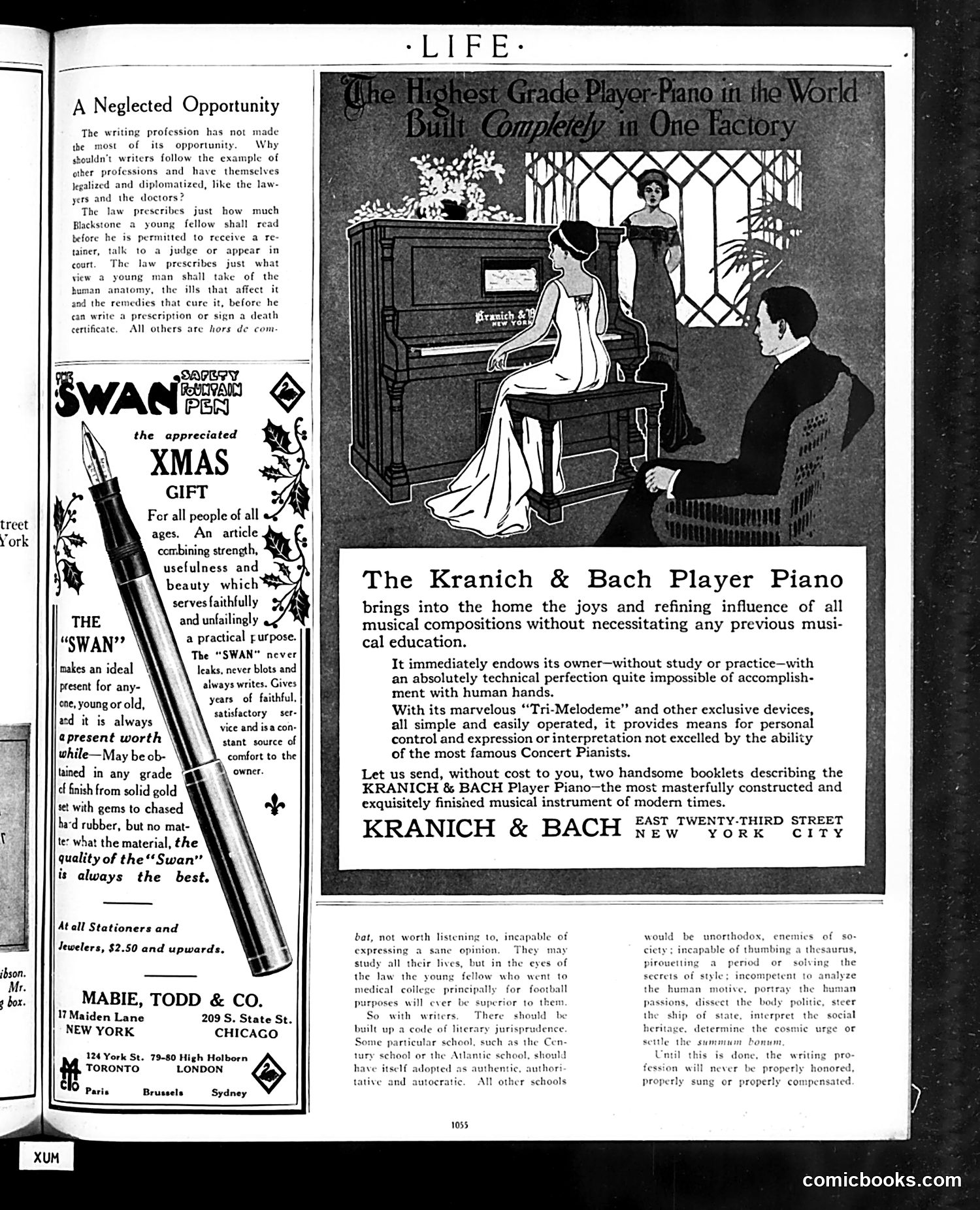
This page satirizes the lack of formal regulation in writing compared to law and medicine. The left column argues that writers, unlike lawyers and doctors, face no standardized training or licensing requirements. The author ironically proposes that writing should adopt similar gatekeeping—specific schools (like "the Century school or the Atlantic school") should be declared authoritative, while others become "unorthodox." The satire cuts both ways: it mocks both the pretentiousness of literary establishment figures who claim authority without legal backing, and the absurdity of trying to regulate creative writing as rigidly as medical practice. The piece implies that writers deserve professional respect but acknowledges the impracticality of enforcing uniform standards on subjective artistic work. The right side features product advertisements (Swan pens, Kranich & Bach player pianos) unrelated to the editorial content.
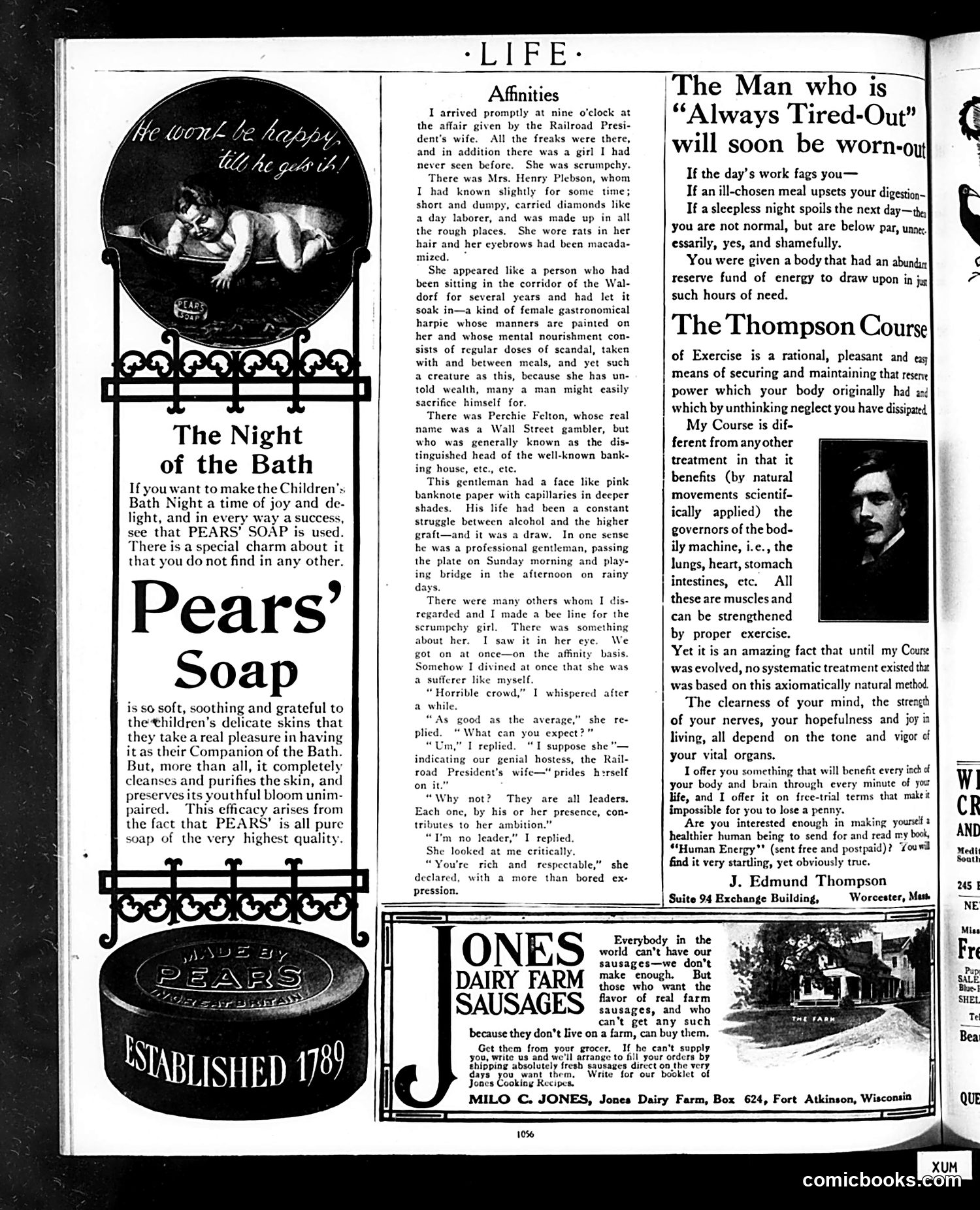
This is primarily an **advertising page** rather than political satire. It features three distinct advertisements: **Pears' Soap**: A Victorian-era product advertisement emphasizing the soap's gentleness for children's delicate skin, appealing to parental concerns about hygiene and purity. **"Affinities"**: A serialized short story (social commentary disguised as fiction) satirizing wealthy high-society circles. It mocks the hypocrisy of the upper class—characters with questionable morals or shallow personalities who command social respect purely through wealth and status. The "affinity" concept suggests romantic or social connections based on shared emptiness rather than genuine values. **Thompson Course of Exercise**: A health/fitness advertisement promoting physical exercise as a cure for fatigue and low vitality, reflecting early-20th-century wellness trends. The page reflects contemporary anxieties about urban exhaustion, class pretense, and health maintenance—concerns typical of the era before modern medicine and psychology.
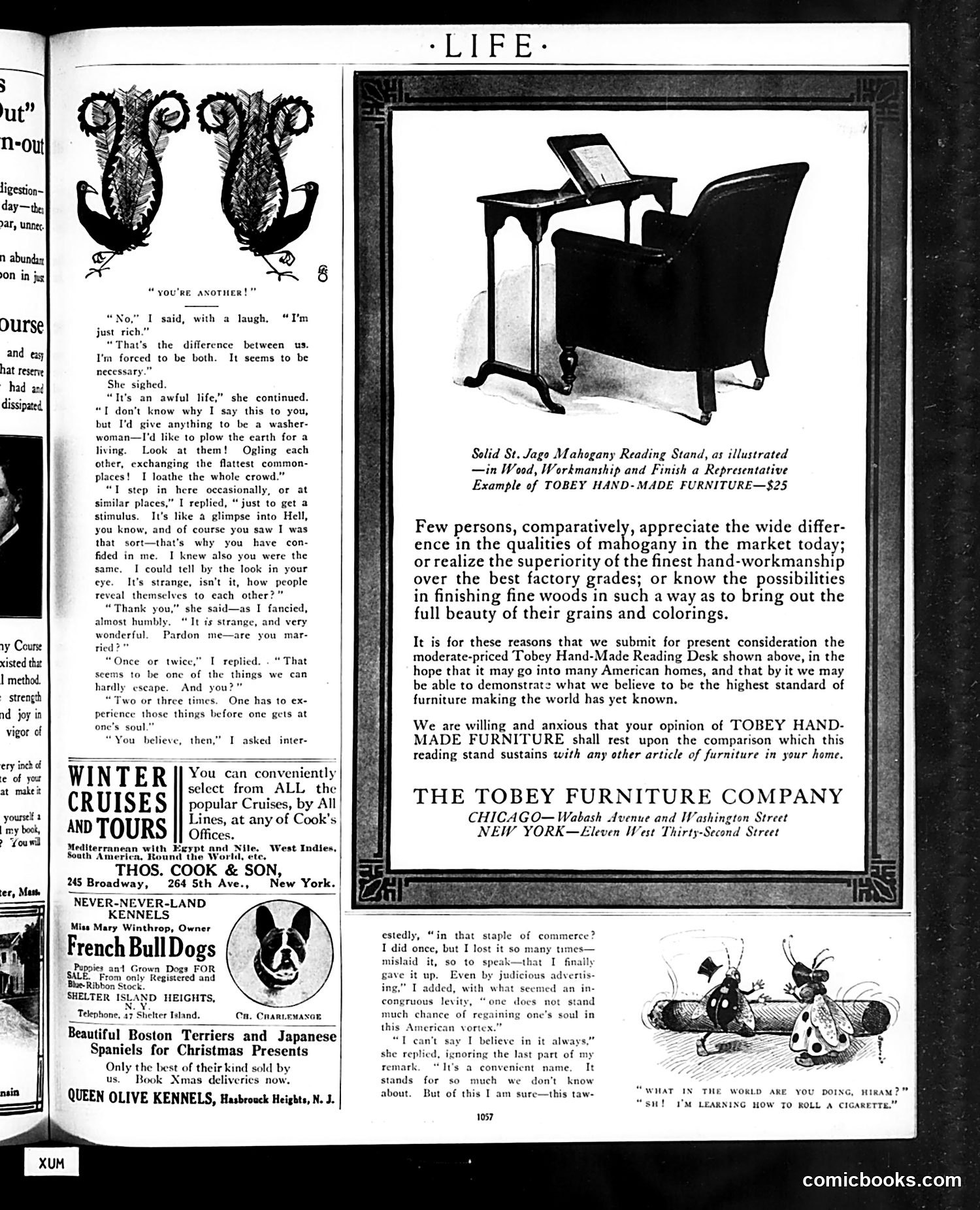
This page contains two distinct elements: **Main Narrative (Left/Center):** A serialized short story exploring class consciousness and spiritual malaise. A wealthy protagonist converses with a woman—likely a working-class acquaintance—who expresses longing to escape her social circle and become a washerwoman for genuine, physical labor. The exchange satirizes the shallow dissatisfaction of the upper classes, who experience ennui despite privilege, while the working poor desire their comforts. The dialogue suggests both classes feel spiritually depleted in "this American vortex." **Advertisement (Right):** Tobey Furniture Company promotes a hand-made mahogany reading stand ($25), emphasizing superior craftsmanship over factory production—an ironic counterpoint to the story's critique of materialist emptiness. **Small Comics (Bottom):** Two brief gag cartoons about dogs rolling cigarettes and kennels advertising Christmas puppies—typical period filler content. The page reflects 1920s-30s anxieties about modernity, labor, and whether wealth brings fulfillment—common Life magazine satirical themes.
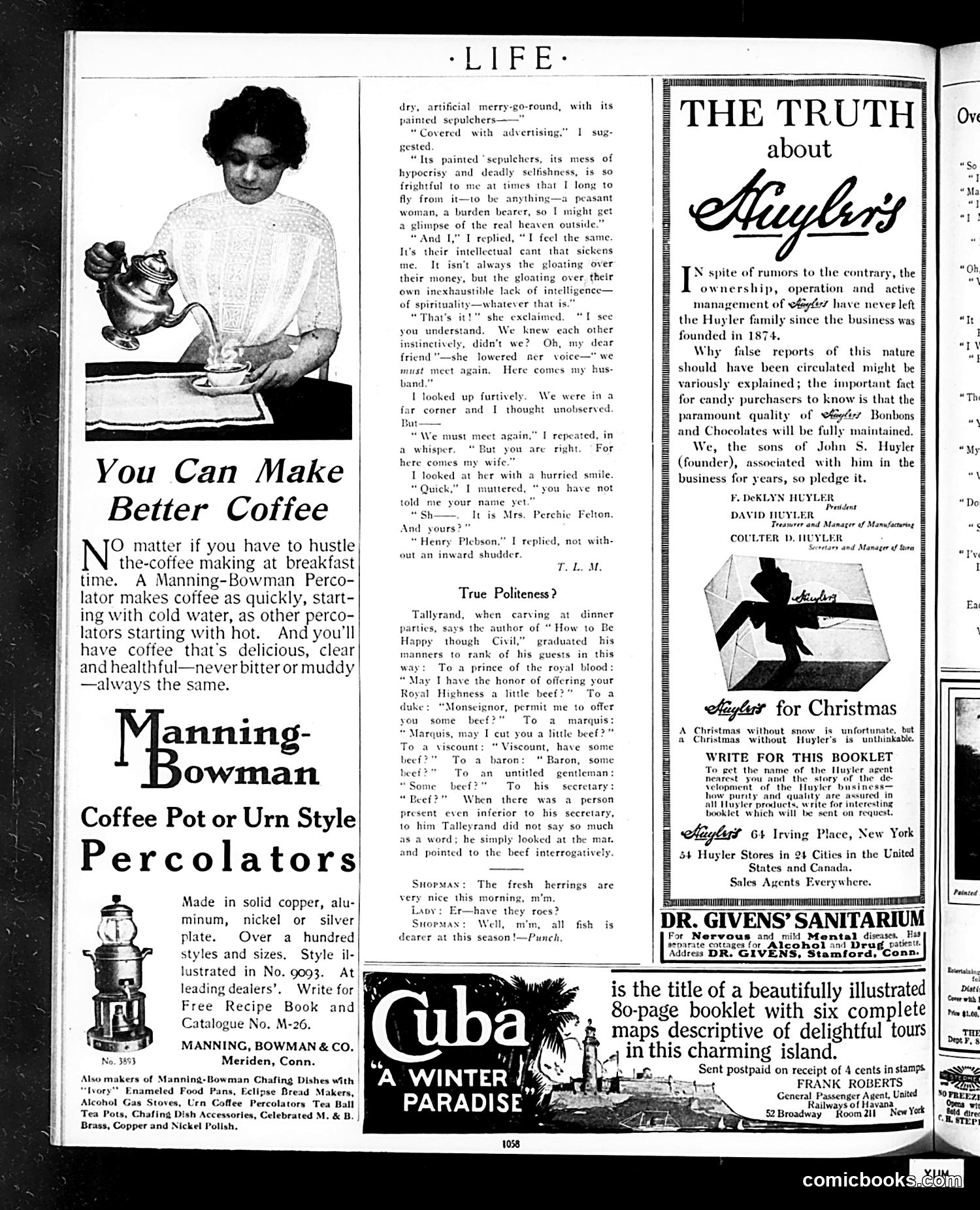
This page from *Life* magazine consists primarily of **advertisements** rather than political cartoons or satire. The dominant elements are: 1. **Manning-Bowman Coffee Percolator ad** (left): A straightforward product advertisement for a coffee-making device, claiming it produces superior coffee quickly. 2. **Huyler's Chocolate/Candy advertisement** (right): A company statement addressing "rumors" about ownership changes. The Huyler family assures customers they still control the business founded in 1874—a credibility-building response to apparent business uncertainty or gossip. 3. **Small satirical pieces**: Interspersed are brief humorous columns, including "True Politeness?" which references Talleyrand (a historical diplomat) and his supposed practice of treating dinner guests according to social rank—social commentary on class hierarchy through a historical anecdote. The page reflects early 20th-century concerns: product quality assurance and maintaining consumer confidence during periods of business uncertainty. There is minimal political satire on this particular page.
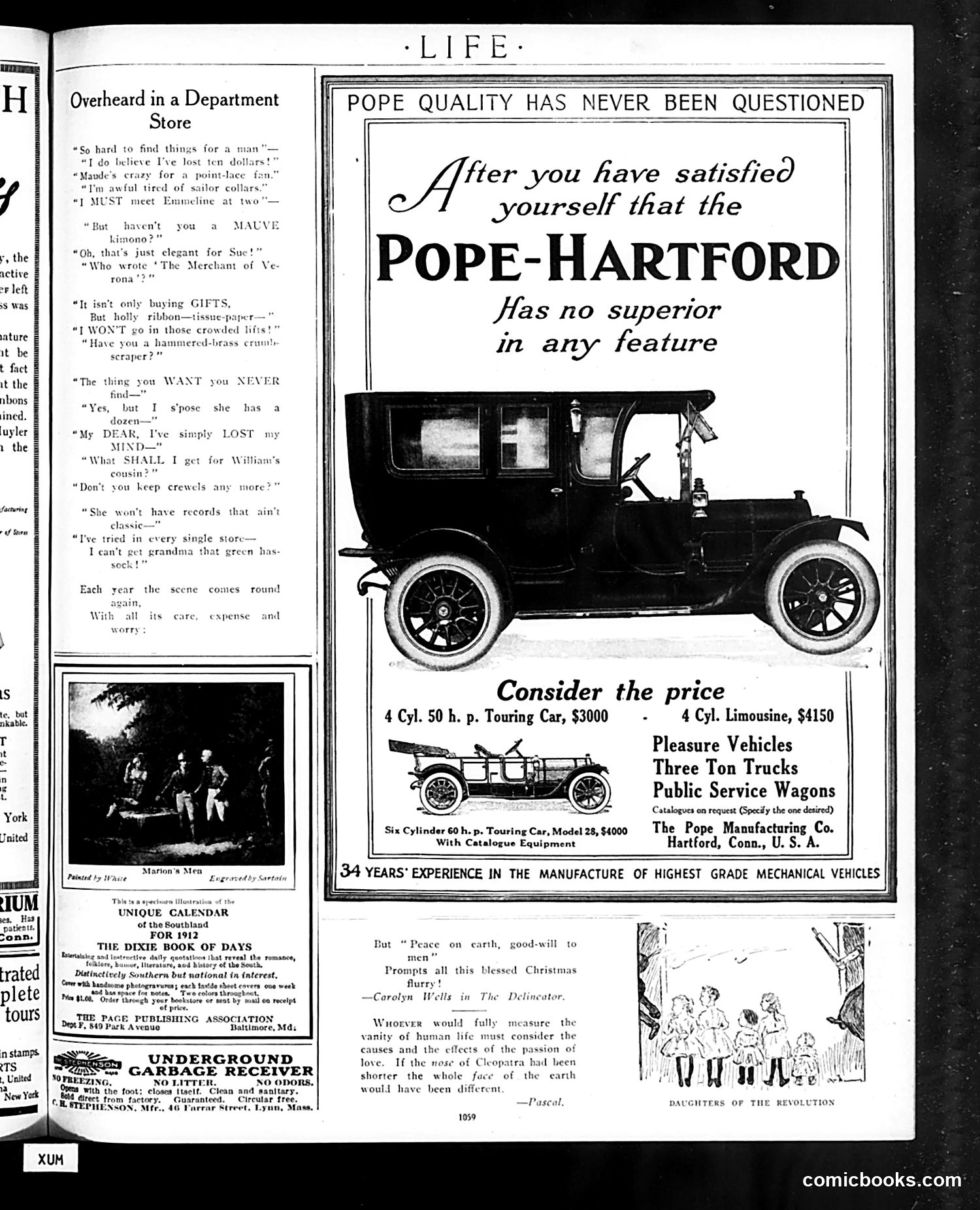
The left column features "Overheard in a Department Store," a satirical piece mocking the frustrations of holiday shopping through overheard customer complaints. The humor targets both shoppers' materialism and their befuddlement—customers search frantically for specific items, lose track of what they need, and complain about crowded conditions and limited selections. This satirizes the chaos and commercialism of pre-Christmas retail. The dominant right side is a Pope-Hartford automobile advertisement claiming superior quality, listing touring cars ($3000) and limousines ($4150). The ad emphasizes 34 years of manufacturing experience. The bottom features a philosophical quote from Pascal about how minor physical features could alter history, followed by an illustration labeled "Daughters of the Revolution"—likely referencing the women's patriotic organization. The page juxtaposes consumer anxiety and materialistic holiday shopping culture against automotive advertising and classical philosophical reflection, typical of Life's mixture of satire and commercial content.
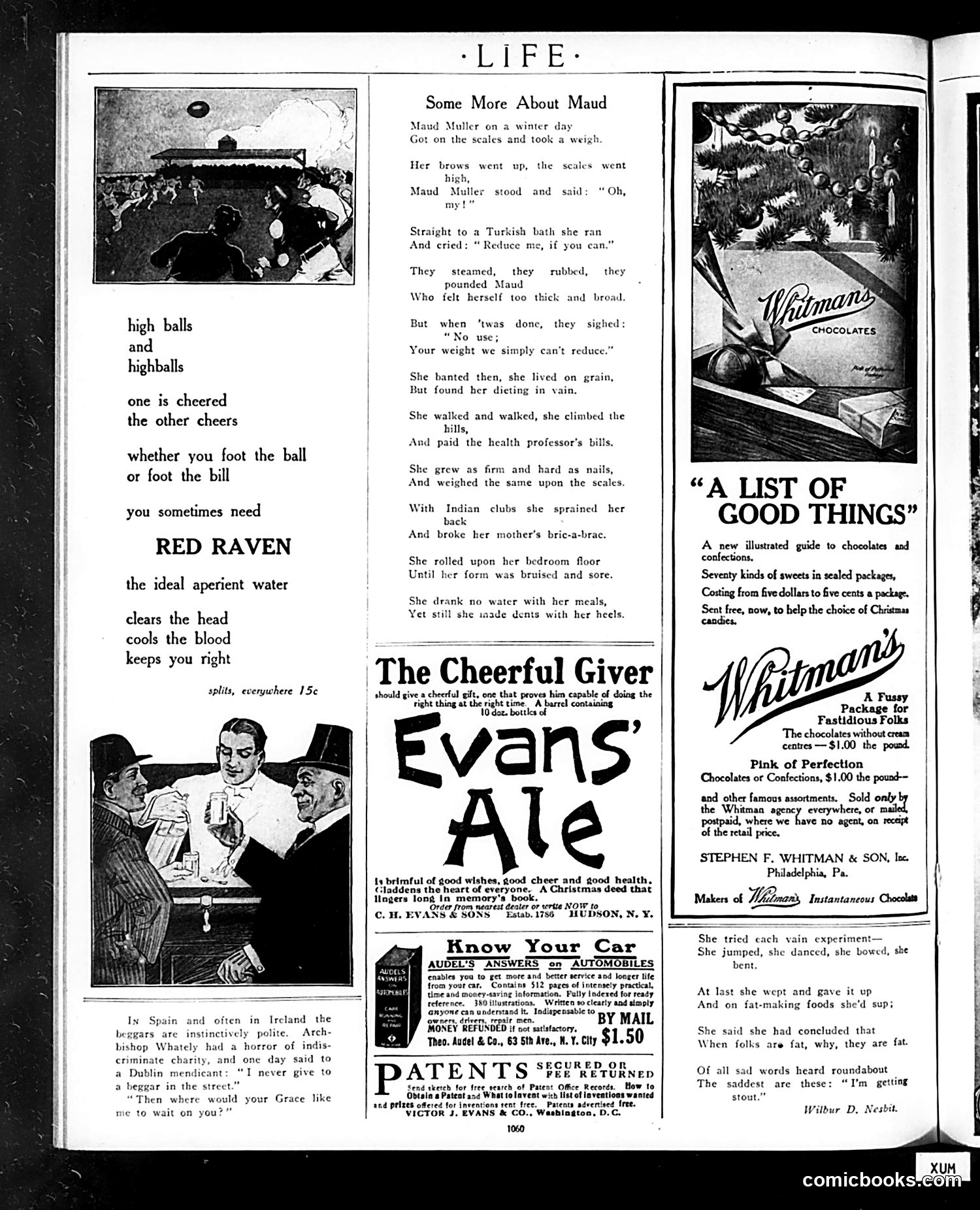
This page features a humorous poem mocking turn-of-the-century weight-loss obsessions. "Maud Muller" (referencing John Greenleaf Whittier's 1856 poem) discovers she's overweight and desperately tries every contemporary remedy: Turkish baths, "banting" (a then-popular diet craze), exercise, Indian clubs, and water restriction. Despite exhausting efforts—steaming, rubbing, walking, climbing hills, paying health professionals—the scales never budge. The satire targets the futility of crash dieting and the absurdity of following fad health trends. The poem's moral is resigned acceptance: "When folks are fat, why, they are fat." The surrounding page contains typical period advertisements (Red Raven aperient water, Evans' Ale, automobile guides) and an anecdote about Irish beggars' politeness, making this a representative satirical magazine page mixing humor, advertising, and light social commentary.
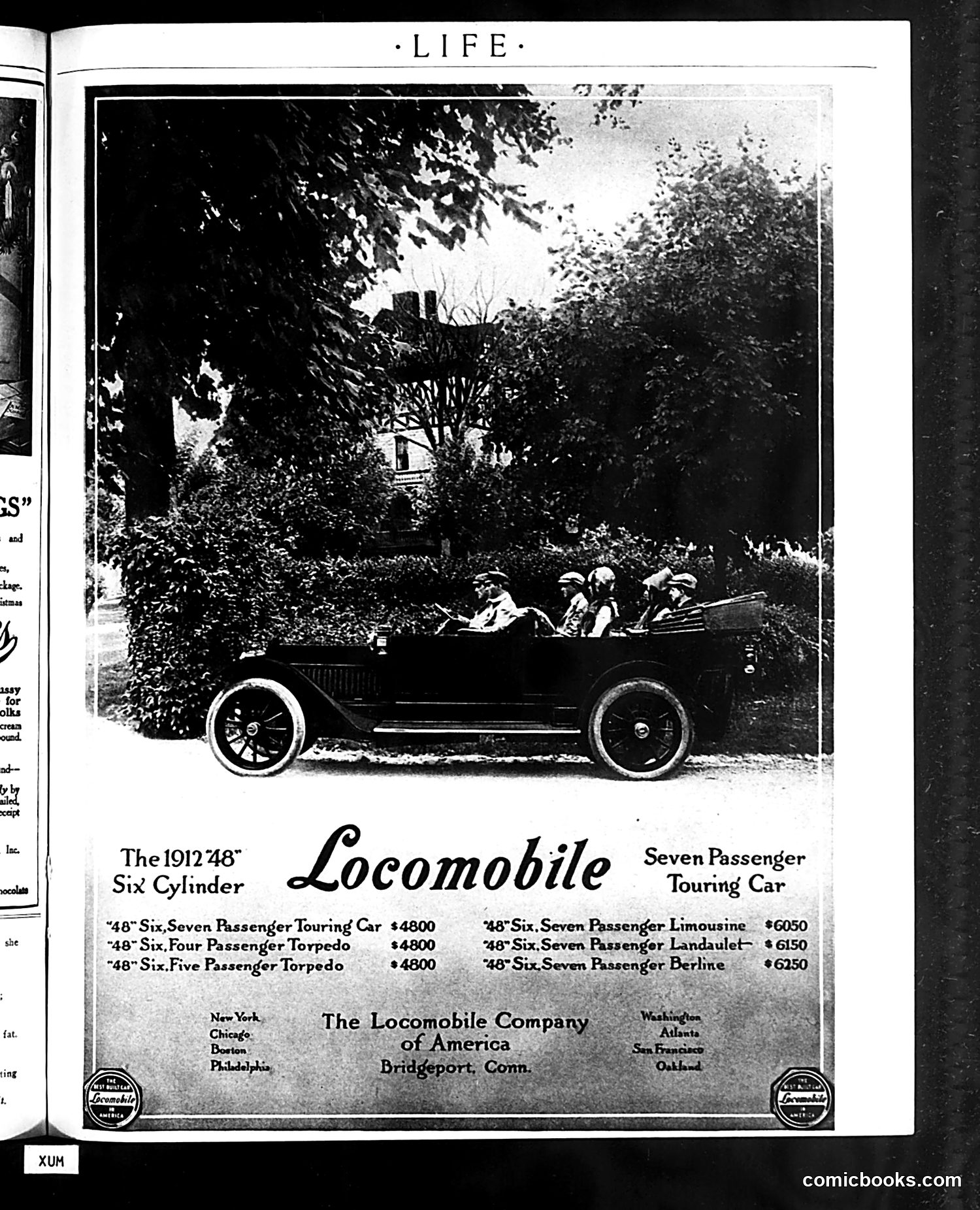
This is **not a cartoon or satirical content** — it's a straightforward automobile advertisement from *Life* magazine, circa 1912. The page features a full-page ad for the **Locomotile Company of America** (Bridgeport, Connecticut), advertising their 1912 "48" model vehicles. The image shows a seven-passenger touring car photographed among trees with well-dressed passengers aboard, emphasizing the vehicle's luxury and capacity. The advertisement lists multiple body styles (touring car, torpedo, limousine, landaulet, berline) with prices ranging from $4,800 to $6,250 — substantial sums in 1912, indicating these were premium automobiles for wealthy buyers. This represents early automotive advertising targeting affluent consumers in major American cities.
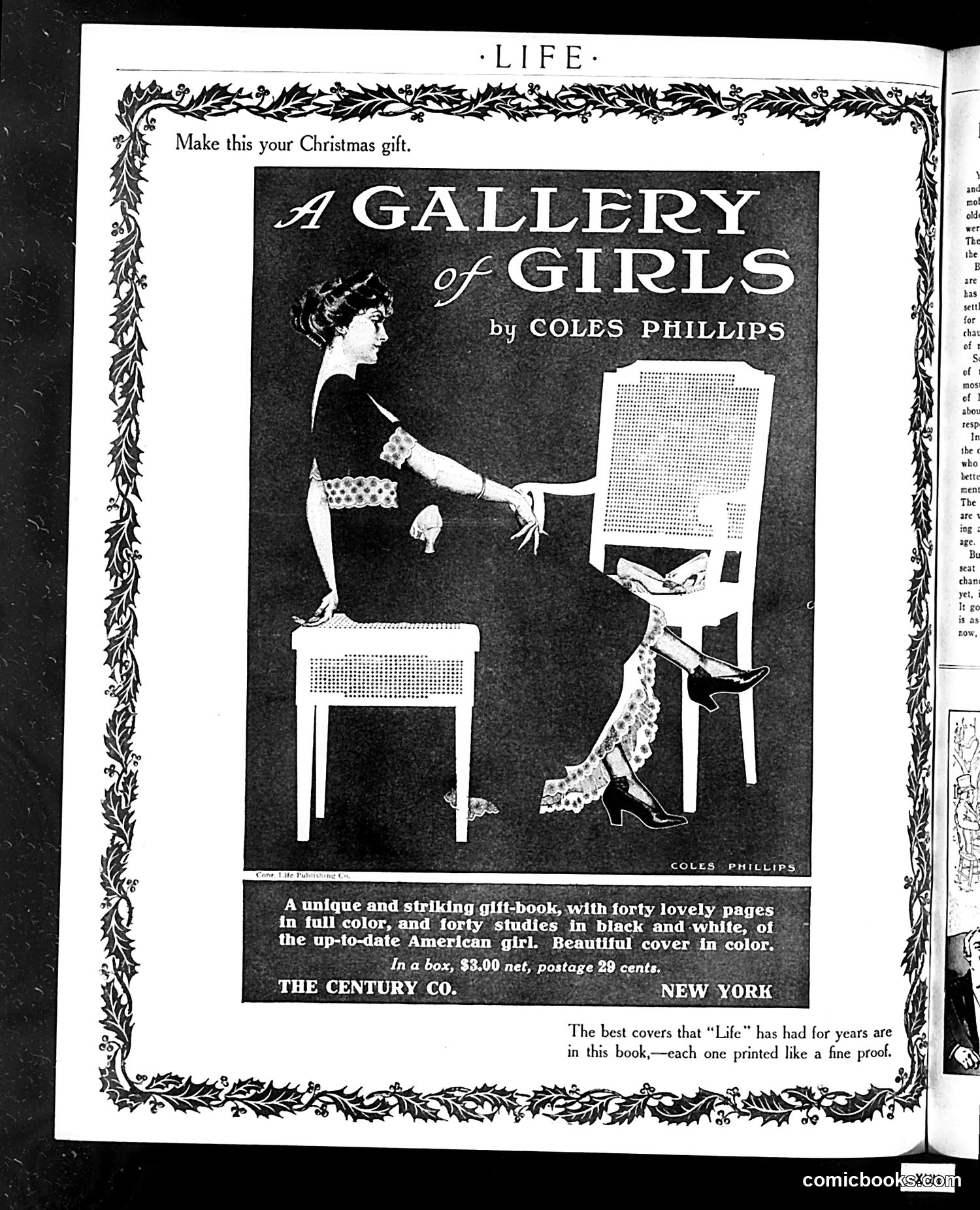
This is primarily an advertisement for an illustrated gift book by Coles Phillips, a prominent commercial illustrator of the early 20th century. The image shows a stylized woman in fashionable dress seated at a vanity mirror—representing the "up-to-date American girl" of that era. The satire is subtle: Life magazine is promoting a collection celebrating modern femininity while the accompanying illustration depicts a woman absorbed in her appearance at a mirror. The humor lies in the gentle mockery of contemporary female vanity and the commercialization of beauty ideals. The book promises forty color pages and forty black-and-white studies, priced at $3.00. The notation that Life's best covers appear in this collection suggests the magazine endorsed Phillips's artistic depictions of fashionable women as representative of contemporary American girlhood—itself a form of social commentary on how women were culturally defined through aesthetic ideals.
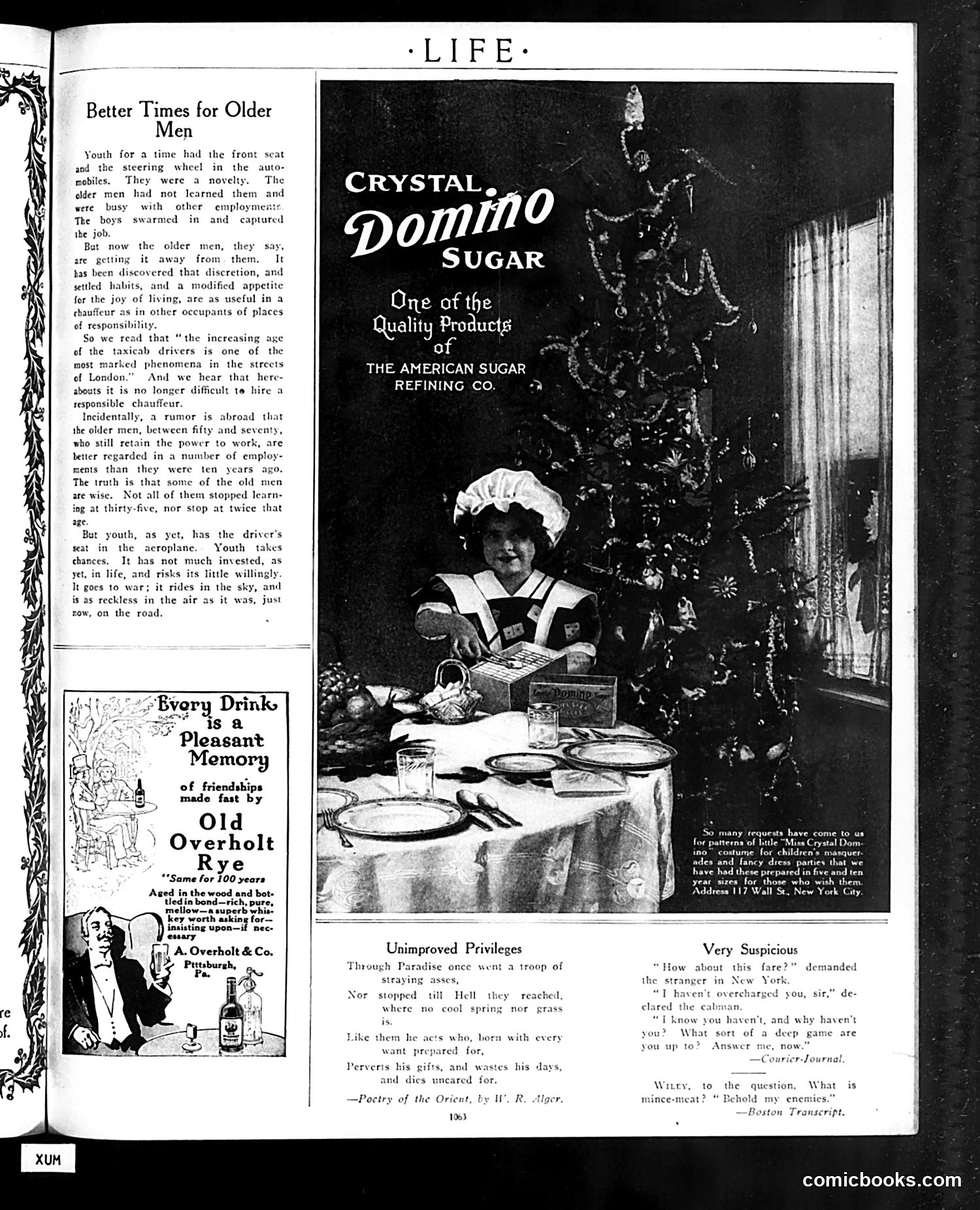
This page contrasts generational workplace dynamics with period advertisements. The main article "Better Times for Older Men" argues that older workers (50-70 years old) are regaining employment advantages over youth, particularly as taxi and chauffeur drivers in London and America. The satire suggests youth initially dominated these new automobile jobs due to novelty and adaptability, but older men's discretion, settled habits, and reliability now make them preferable—except in aviation, where youth's recklessness persists. The accompanying advertisements (Crystal Domino Sugar, Old Overholt whiskey) and poetry excerpts appear decorative rather than satirical. A short joke about a suspicious cab fare rounds out the page, playing on contemporary urban taxi culture. The piece reflects early 20th-century labor anxieties about age discrimination and technological disruption—concerns that remain relevant today.
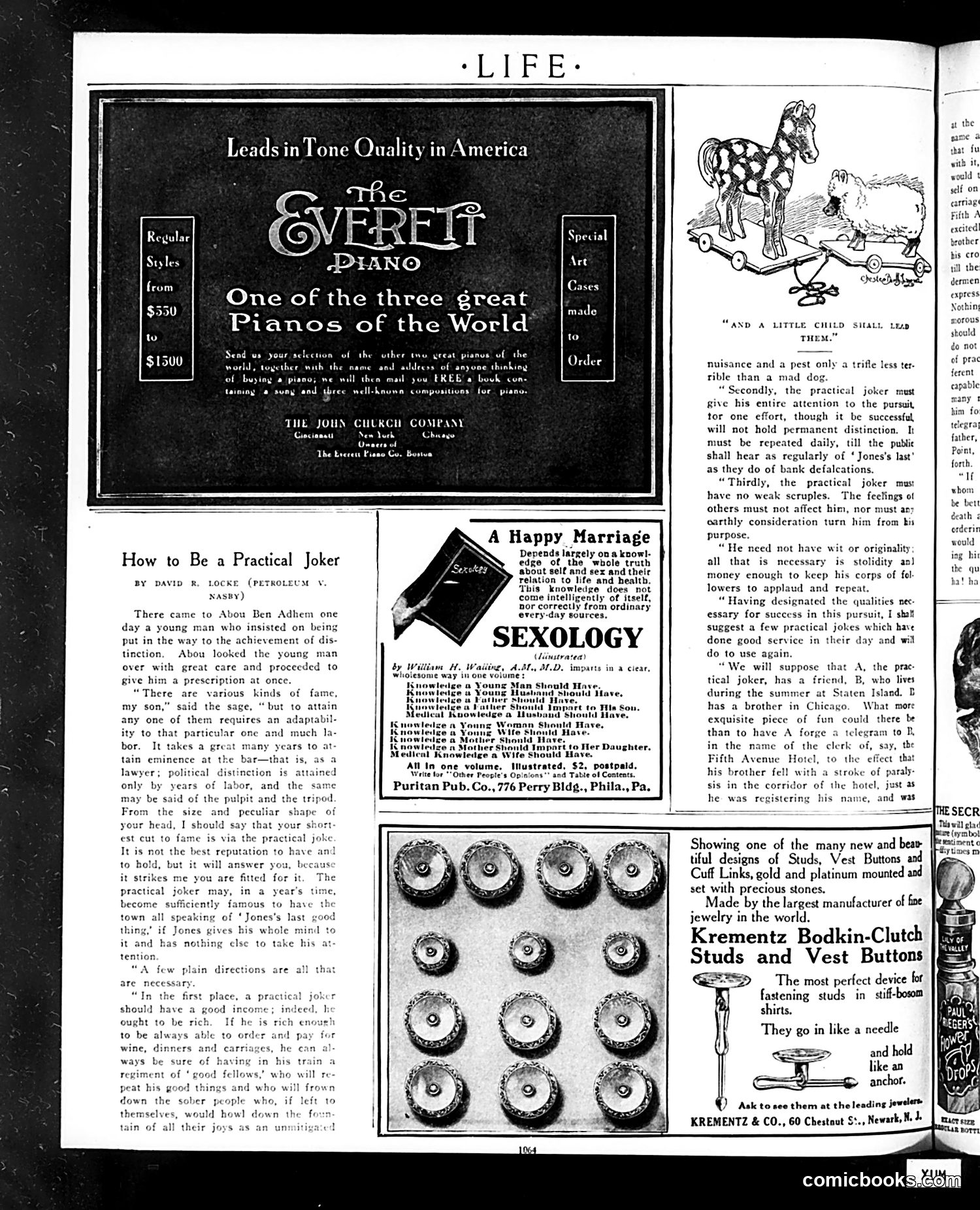
This page contains primarily **advertisements and advice columns**, not political satire. The main content is "How to Be a Practical Joker" by David R. Locke, a humorous essay defining the "practical joker" as a specific social type—someone devoted to elaborate pranks as a life pursuit. The piece uses mock-serious language to satirize this character, describing necessary qualifications: steady income to fund pranks, no moral scruples, and daily repetition of jokes until becoming notorious. An example illustrates: a prankster forges a telegram to deceive a friend, causing physical harm ("fell with a stroke"). This reflects 19th-century humor norms that seem cruel today—the comedy derives from the victim's distress. The page also includes advertisements for pianos, marriage advice books, and jewelry studs—typical magazine filler of the era. There is **no political commentary** visible; this is lifestyle and consumer-oriented content reflecting period attitudes toward entertainment and social behavior.
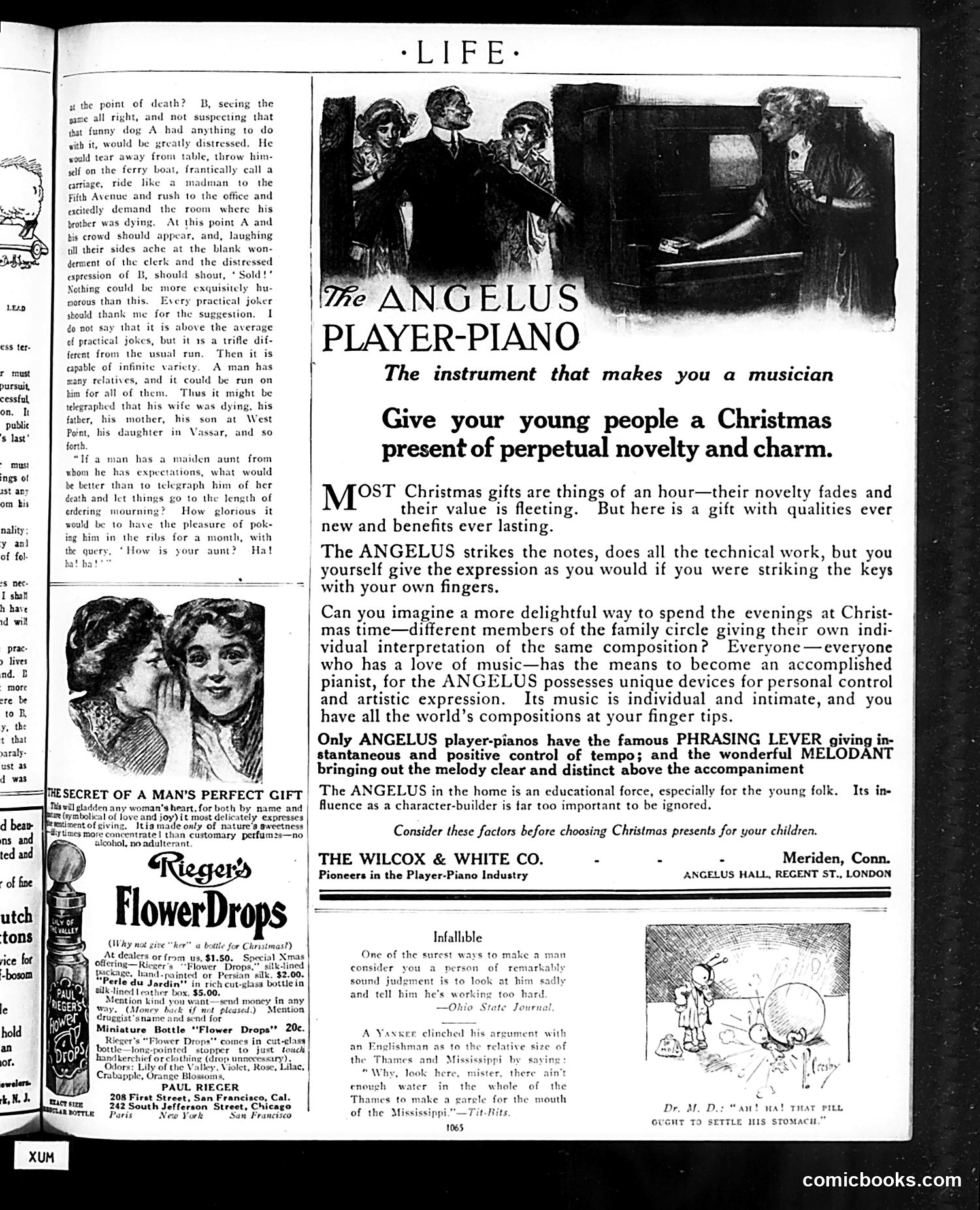
This page is primarily **advertising**, not satire or political commentary. It contains: **Main Content:** A full-page advertisement for the Angelus Player-Piano, marketed as a Christmas gift. The ad emphasizes that while the mechanical device plays the notes, the user provides artistic expression—making anyone "a musician." It highlights features like the "Phrasing Lever" and "Melodant" device. **Supporting Ads:** Smaller advertisements for Rieger's Flower Drops perfume and Reger's Flower Drops candy also appear, both positioned as luxury Christmas gifts. **Sidebar Text:** A brief editorial piece (partially visible on the left) discusses practical jokes, seemingly unrelated to the ads. **Historical Context:** The player-piano was a popular early-20th-century technology marketed to middle and upper-class families as both entertainment and cultural self-improvement—allowing people without musical training to perform compositions. The ad's emphasis on "character-building" and education reflects period attitudes about music's moral value. There is **no political satire** on this page.
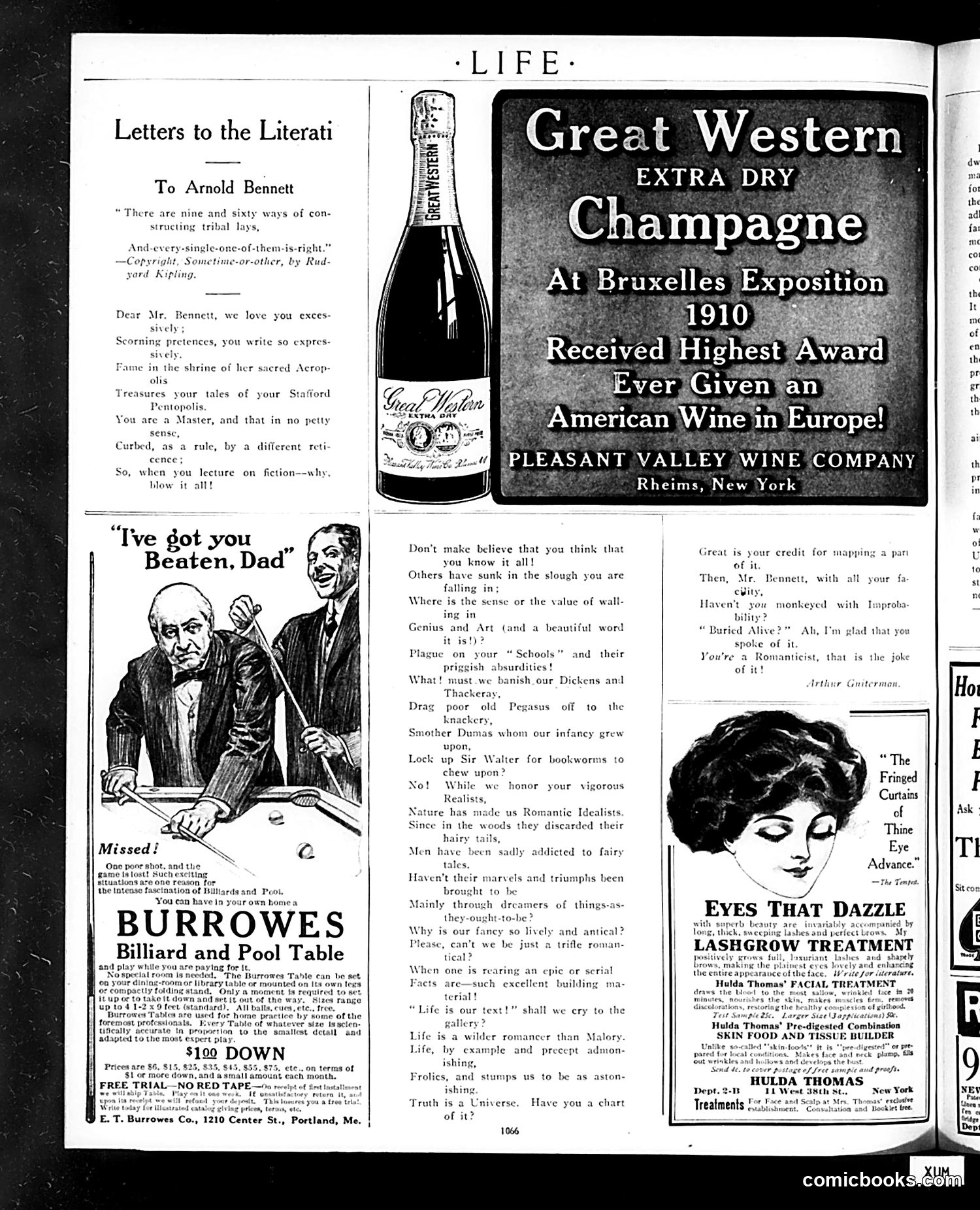
This page from *Life* magazine combines satirical poetry with advertisements and lighter humor. The main content is "Letters to the Literati: To Arnold Bennett"—a playful poem addressing the famous British novelist Arnold Bennett. The satirist (attributed to Arthur Guiterman) praises Bennett's writing talent while gently mocking literary debates of the era. The poem argues *against* rigid realism in fiction, defending the value of imagination, romanticism, and literary giants like Dickens and Thackeray against Bennett's apparent advocacy for more factual, realistic writing. The closing joke suggests Bennett himself has "monkeyed with Improbability" in works like "Buried Alive." The cartoon "I've got you Beaten, Dad" shows a billiards game—a visual pun about losing at pool, advertising Burrowes billiard tables. The page is otherwise filled with period advertisements for champagne, beauty treatments (Lashgrow), and other products—typical of *Life's* revenue model as a magazine.
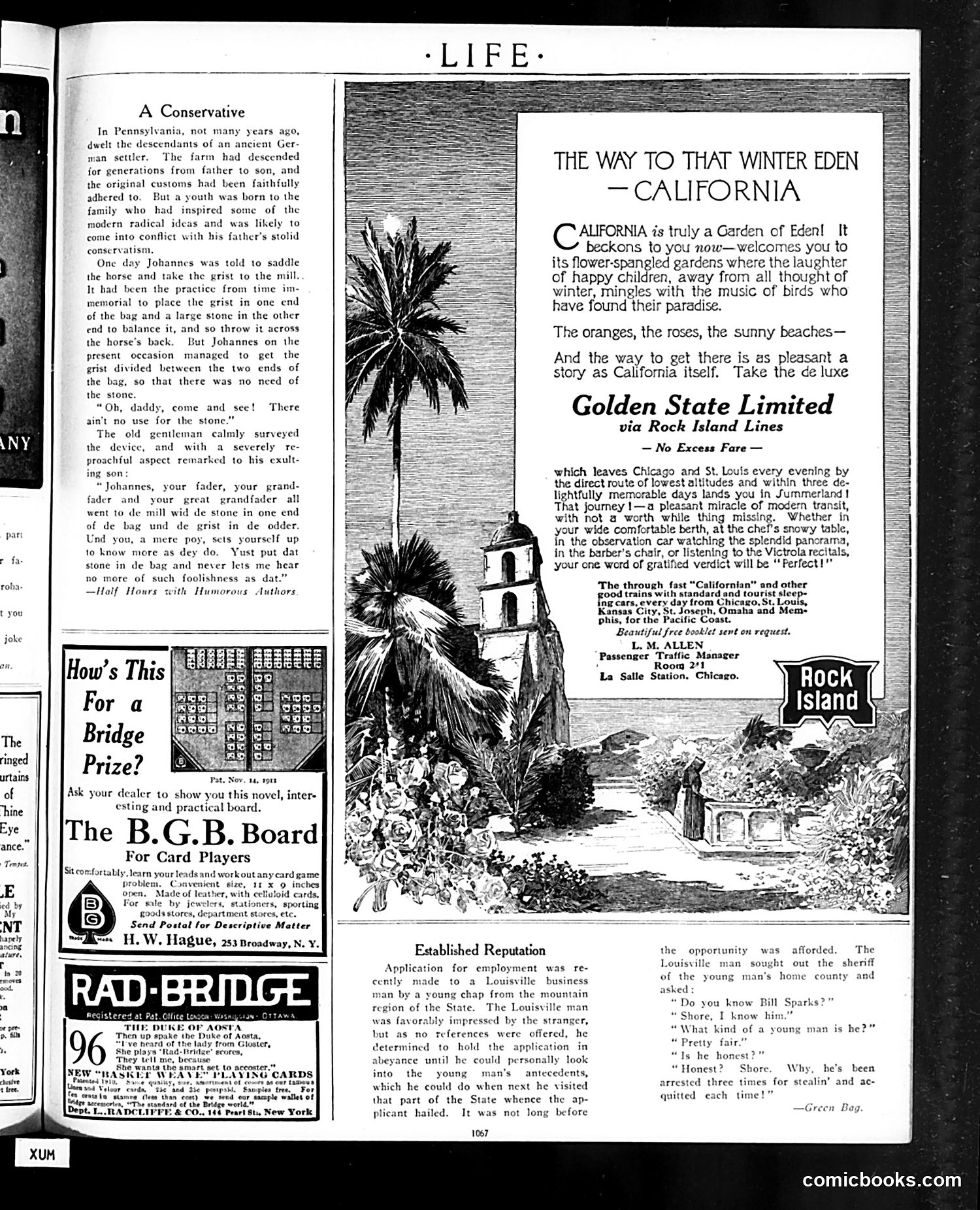
This page contains two distinct pieces. The main story, "A Conservative," is a humorous anecdote mocking rigid traditionalism. A German-American farmer insists his son Johannes continue an outdated practice—balancing grain in a bag by placing a stone on the opposite end—despite Johannes inventing a more efficient method (dividing the grain equally). The joke satirizes stubborn adherence to "how we've always done it," with the father dismissing innovation as youthful foolishness. The humor targets inflexible conservatism: the father's authority rests entirely on ancestral precedent rather than practical reasoning. The dialect speech reinforces the stereotype of old-world immigrants resistant to American progress—a common theme in early 20th-century Life magazine satire. The punchline ridicules this mindset as fundamentally irrational.
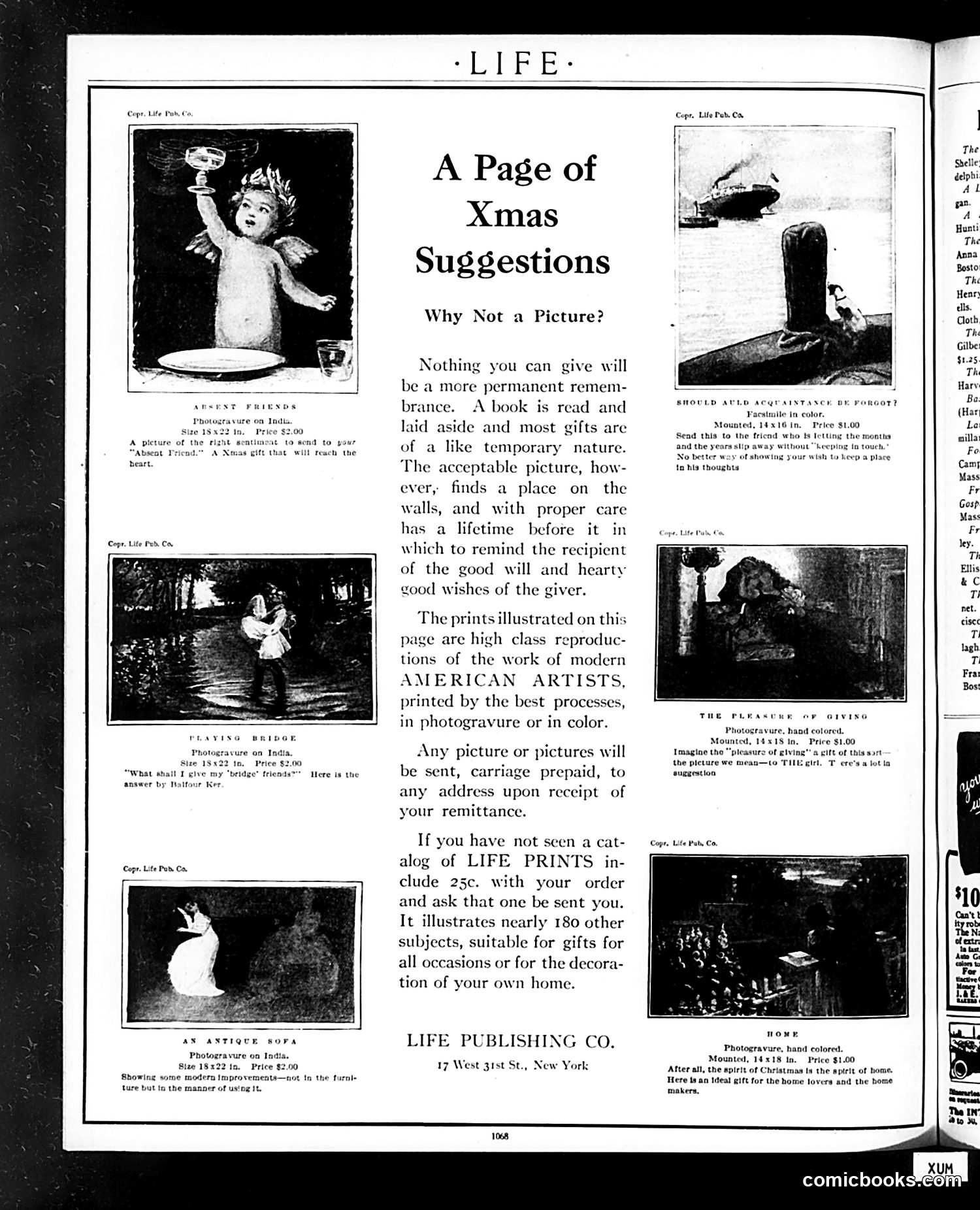
This is primarily a **Christmas gift advertisement** rather than political satire. Life Publishing Company promotes framed art prints as holiday gifts, featuring reproductions of works by "modern American artists." The page includes four sample images: "Absent Friends" (cherub with goblet), "Playing Bridge" (social scene), "An Antique Sofa" (humor about modern furniture use), and romantic/domestic scenes like "The Pleasure of Giving" and "Home." The advertising copy argues that pictures make superior gifts to books or temporary items—they're permanent, decorative, and remind recipients of the giver's goodwill. The humor is gentle: the "antique sofa" joke appears to mock how people actually *use* furniture differently than intended. This reflects early 20th-century consumer culture and the emerging market for mass-produced art reproductions as accessible luxury gifts for middle-class Americans.
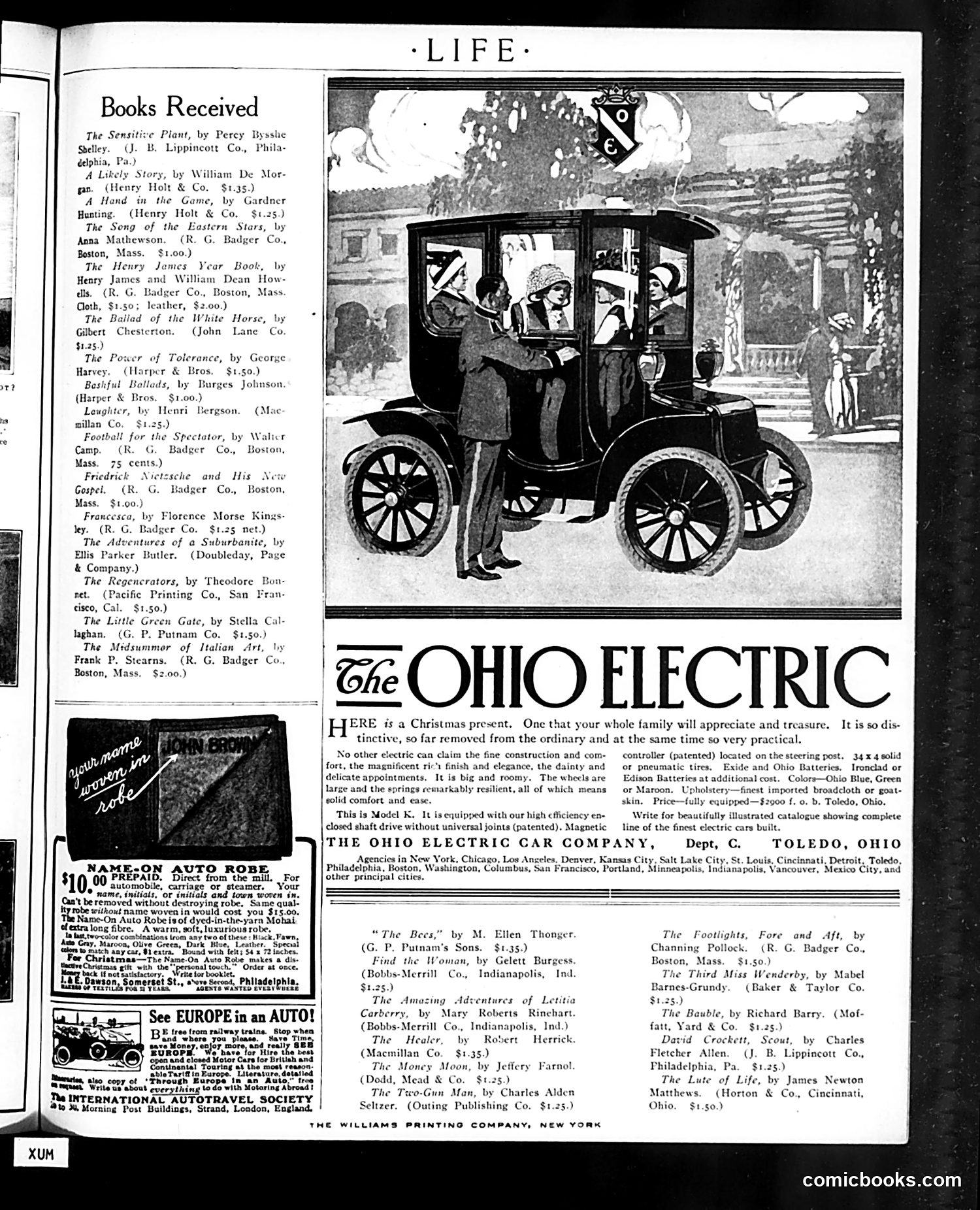
This page is primarily a book review section with a major advertisement for the Ohio Electric Car Company's "Model K" vehicle. The main image shows an early electric automobile with two passengers, depicting it as an elegant, practical Christmas gift. The advertisement emphasizes the car's refined construction, comfort, and reliability—featuring "high efficiency enclosed shaft drive," pneumatic tires, and imported upholstery. The Ohio Electric was marketed as a luxurious alternative to gasoline cars, positioned for affluent families seeking a "distinctive" vehicle. At $2,900 (fully equipped), it represented significant wealth. The ad highlights practicality alongside elegance, appealing to buyers who valued both comfort and technological advancement. This reflects the early 1900s automotive market when electric cars competed seriously with gasoline engines before internal combustion ultimately dominated. The advertisement's emphasis on cleanliness, ease of operation, and refinement suggests electric cars appealed particularly to wealthy urban consumers and women.
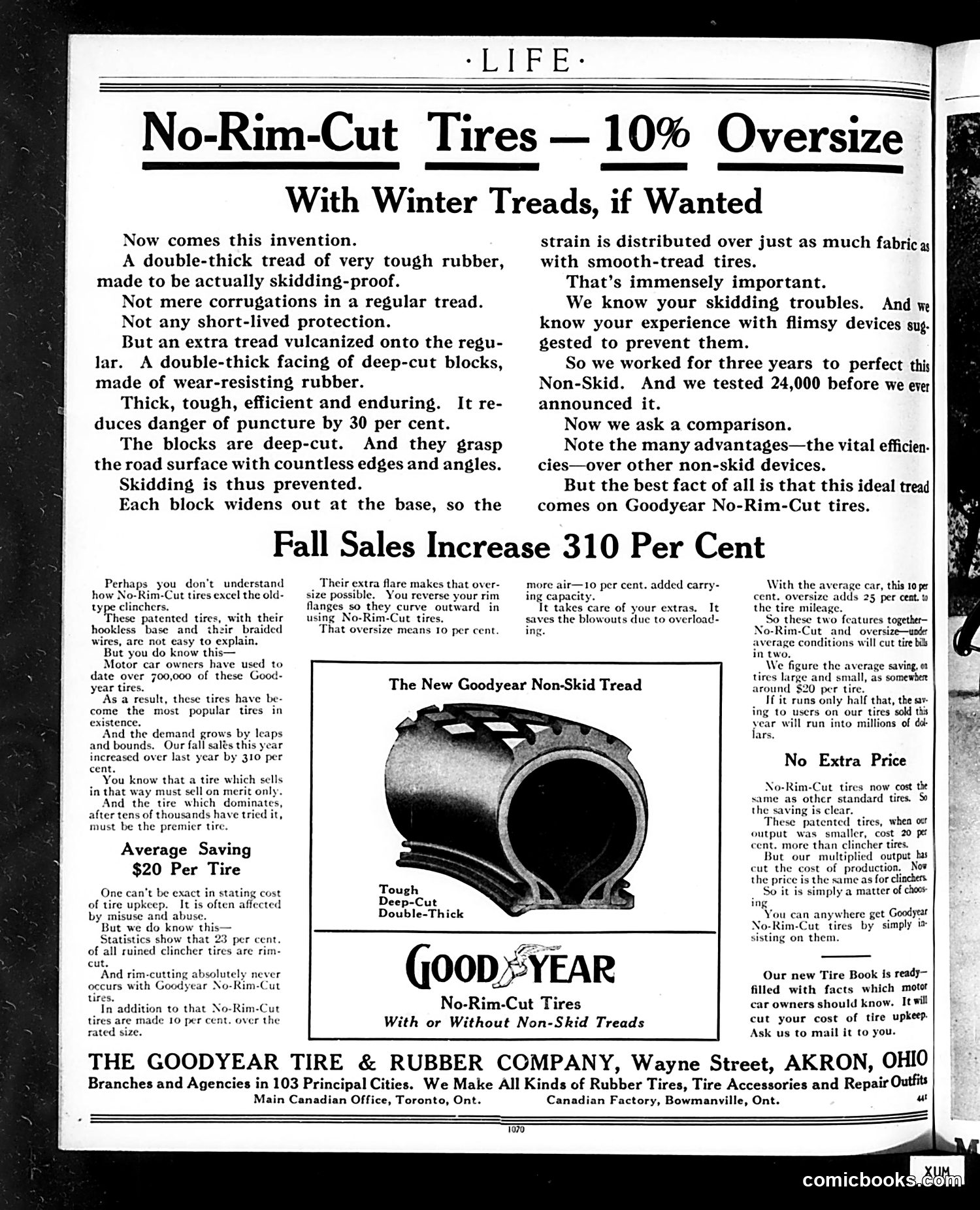
This page is **not a political cartoon or satire**—it's a straightforward **Goodyear tire advertisement** from an early 20th-century issue of *Life* magazine. The ad promotes Goodyear's "No-Rim-Cut" tires, highlighting technical innovations: a double-thick tread designed to prevent skidding, a hookless base that avoids rim damage, and an oversized design offering 10% extra capacity. The text emphasizes durability, safety, and cost savings ($20 per tire). The dramatic sales claim—"310 Per Cent" increase—appears designed to convince readers through market popularity: over 700,000 already in use. The ad addresses practical concerns of early motorists (blowouts, punctures, skidding) and notes the product costs no more than competitors despite superior features. The central image shows a tire cross-section illustrating the "tough deep-cut double-thick" tread. There is **no satire or political content**—this is period product marketing targeting car owners seeking reliability and value.
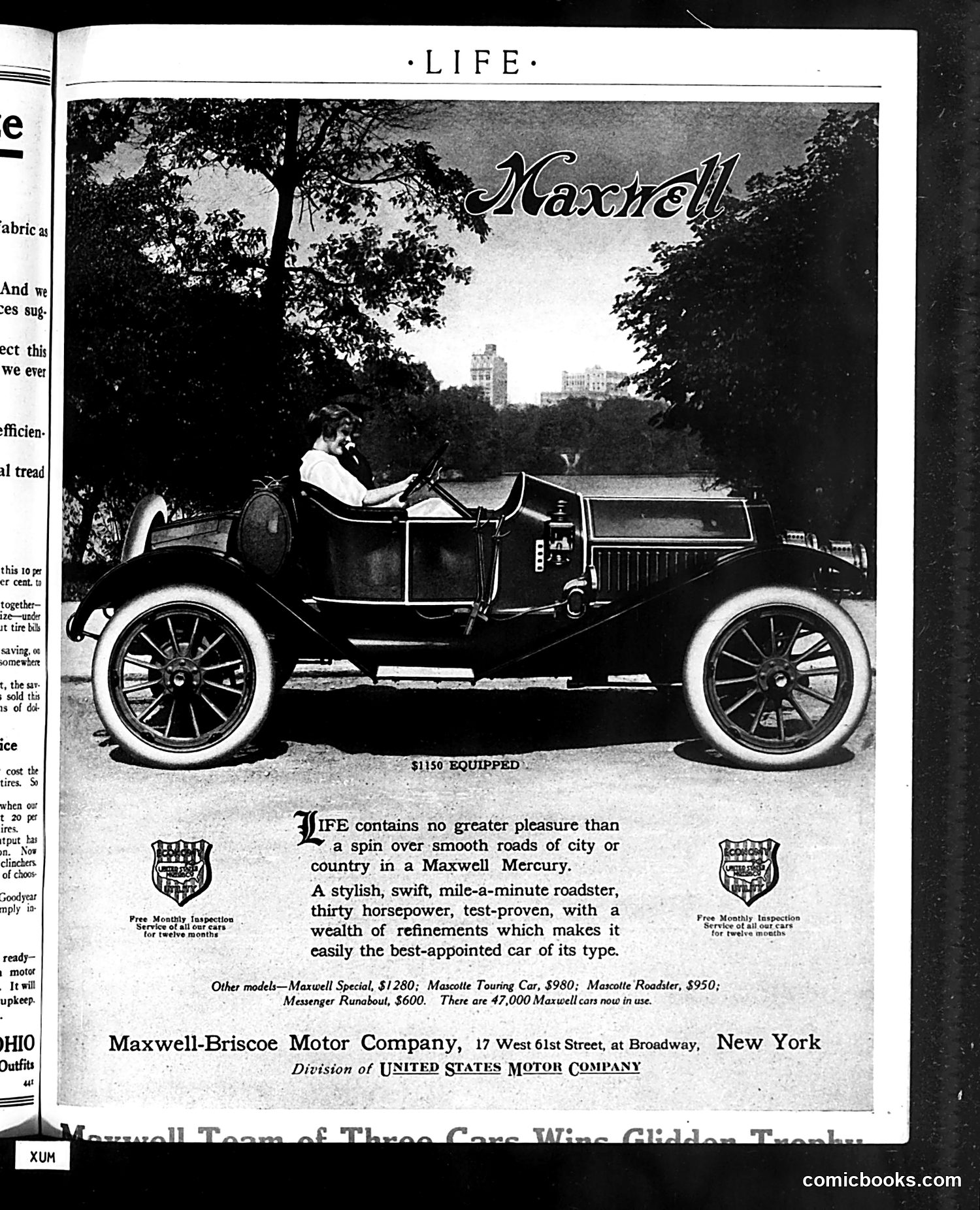
This is **not a cartoon or satire**—it's a straightforward automobile advertisement from Life magazine's advertising pages. The page promotes the **Maxwell Mercury**, a roadster priced at $1,150 (equipped). The image shows a stylish early-automobile with an elegantly dressed driver, photographed against a scenic backdrop with trees and a cityscape. The marketing copy emphasizes the car's appeal: smooth handling, speed (described as "mile-a-minute"), thirty horsepower, and refined appointments. The ad lists other Maxwell models and notes 47,000 cars in use, suggesting market success. It's positioned as a Division of United States Motor Company operating from a New York address. For modern readers: This represents early 1900s automobile marketing, when cars were luxury goods marketed to affluent consumers with appeals to style, performance, and leisure pleasure rather than practical transportation.
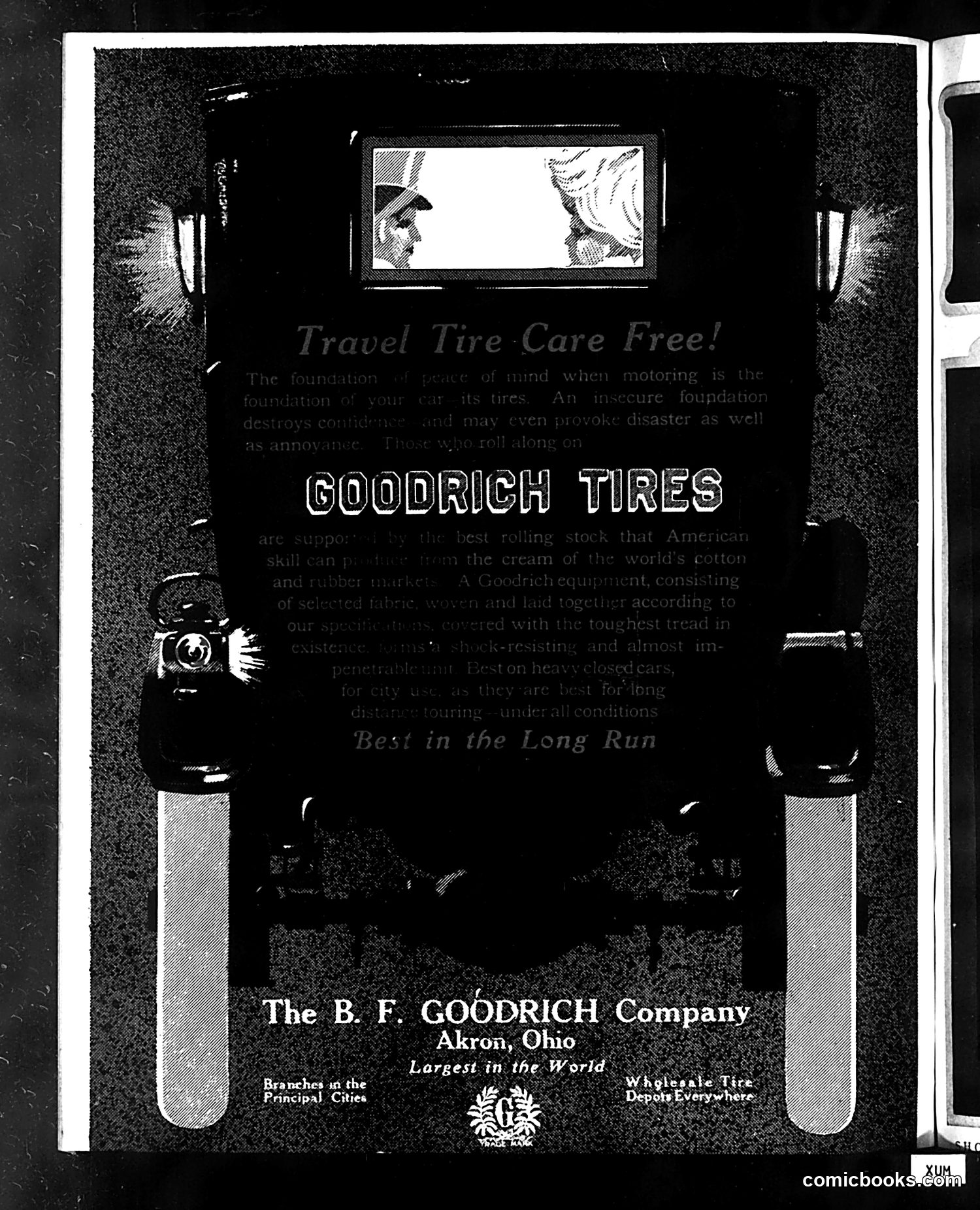
This is a full-page advertisement for B.F. Goodrich Company tires, based in Akron, Ohio. The ad claims Goodrich tires provide "Travel Tire Care Free!" and promises peace of mind for motorists. The advertisement emphasizes product quality—describing superior materials and construction ("toughest tread in existence")—and positions Goodrich as "Largest in the World" with "Wholesale Tire Depots Everywhere." There is no political cartoon or satire here. The small illustrated vignettes at the top appear to be decorative/promotional imagery showing tire usage scenarios. This represents early automotive-era advertising targeting car owners concerned with tire reliability during an era when tire failure was a significant travel hazard.
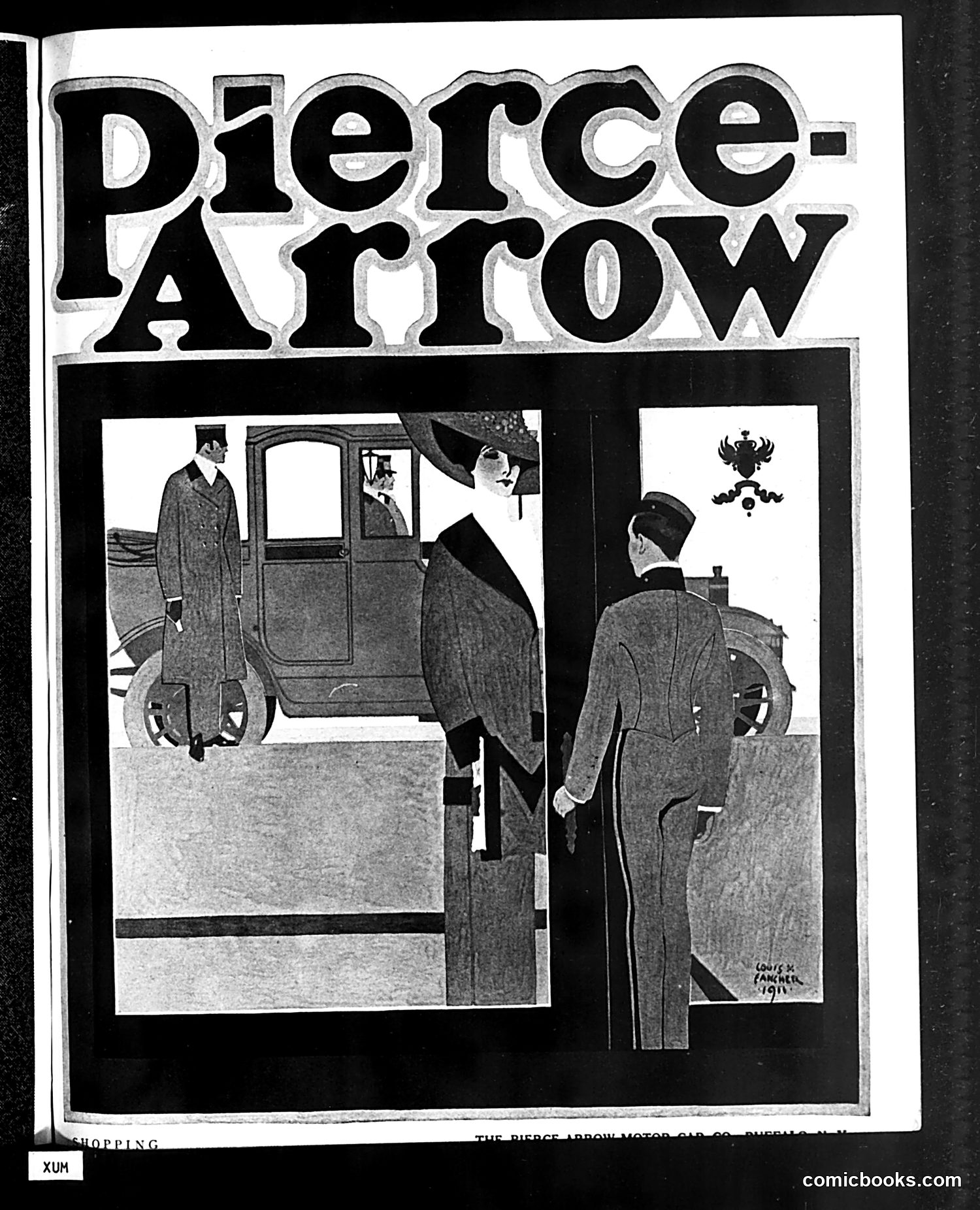
This appears to be a **automobile advertisement** rather than political satire. The page showcases a **Pierce-Arrow motor car**, a luxury American automobile brand. The illustration depicts well-dressed men in early 20th-century business attire examining or being presented with the vehicle. The styling—formal coats, hats, and dignified poses—emphasizes the car's status as a premium product for wealthy clientele. The large "Pierce-Arrow" text dominates the page as a brand advertisement. The scene suggests sophistication and professional success, marketing the vehicle to affluent readers of *Life* magazine as a symbol of business achievement and refinement. This is characteristic of vintage automotive advertising that associated cars with social status and masculine achievement.
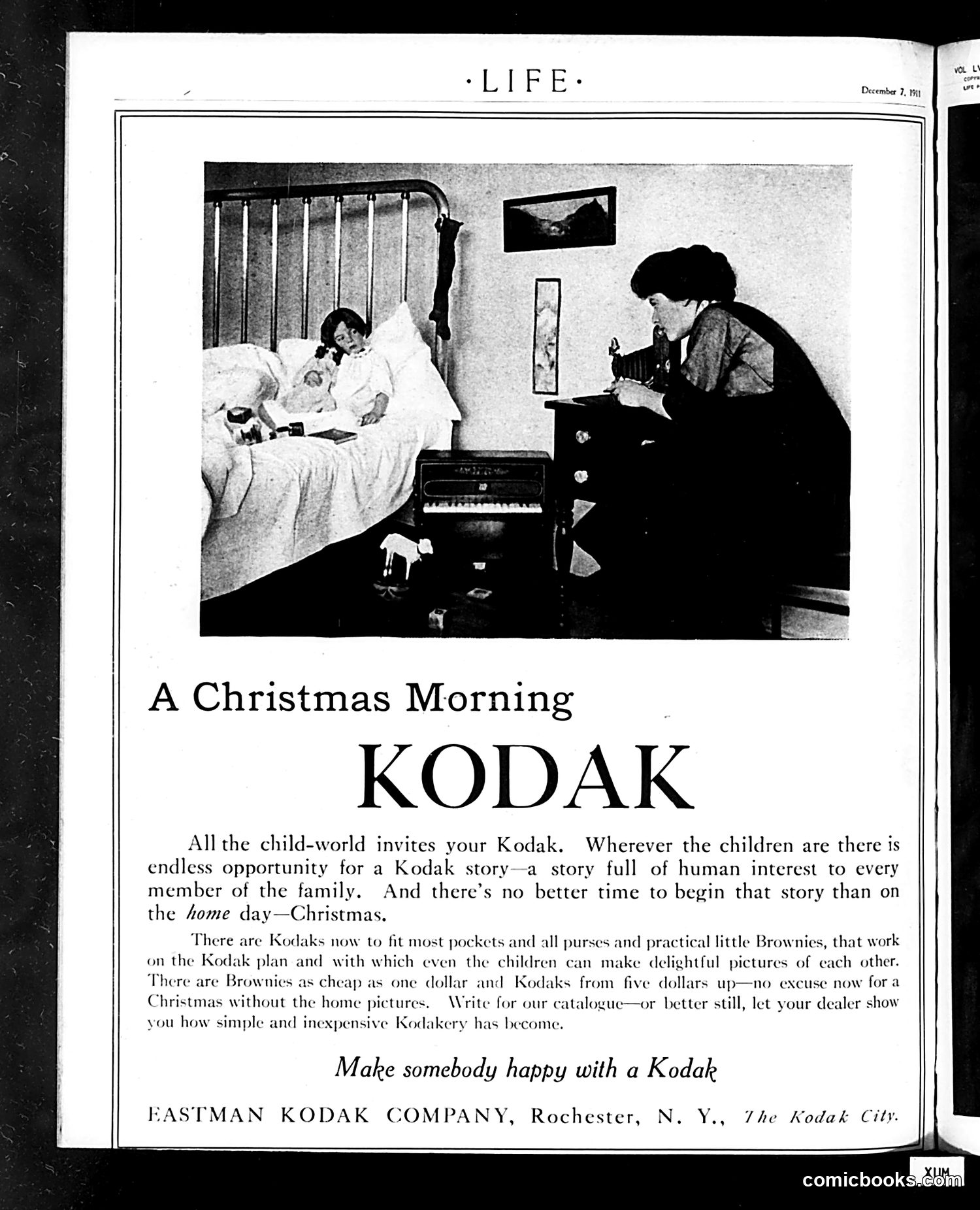
This is **not a cartoon or satire**, but rather a **Kodak advertisement** from *Life* magazine (dated December 7, appearing to be from 1911 based on the style). The image shows a domestic Christmas morning scene: a child in bed opening gifts while an adult (likely a parent) photographs the moment with a camera. The ad's message is straightforward marketing, not political commentary. The pitch appeals to family sentiment around Christmas, promoting Kodak cameras as affordable gifts ("as cheap as one dollar") that enable families to capture domestic memories. The tagline—"Make somebody happy with a Kodak"—frames photography as an ideal present. **For modern readers**: This represents early consumer advertising that linked photography to emotional family bonding, a marketing strategy still used today. The ad assumes camera ownership is aspirational but increasingly accessible to middle-class households.