
Life, 1911-12-07 · page 62 of 112
Life — December 7, 1911 — page 62: what you’re looking at
What you’re looking at
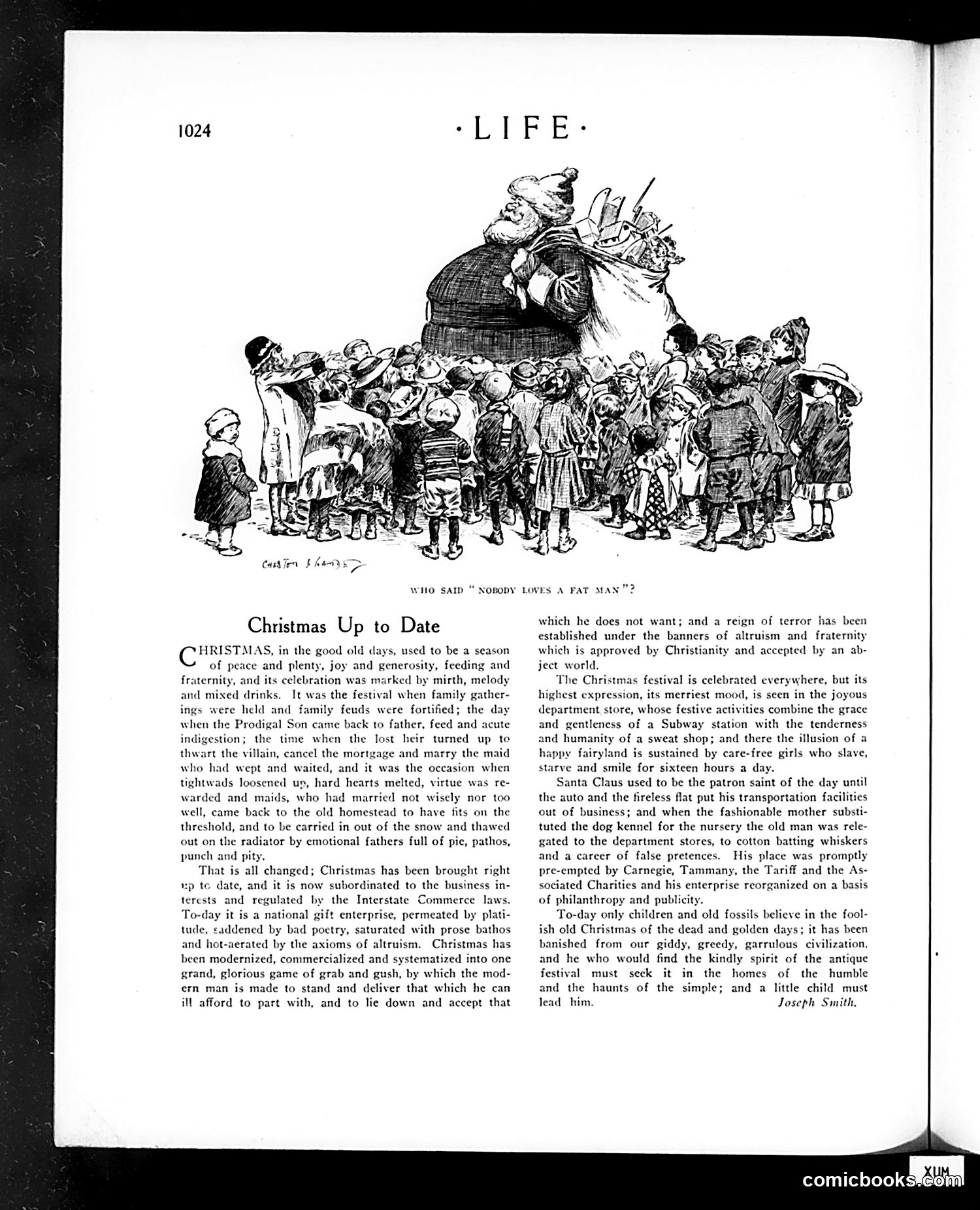
This is a satirical article by Joseph Smith critiquing the commercialization of Christmas in early 20th-century America. The accompanying cartoon—captioned "Who Said 'Nobody Loves a Fat Man'?"—shows Santa Claus surrounded by a crowd of children reaching upward toward him and his sack of gifts, illustrating the essay's central complaint. Smith contrasts "good old days" Christmas (marked by genuine family gathering and charity) with modern Christmas, which he argues has been corrupted by: - Department stores exploiting underpaid workers - Corporate interests (Carnegie, Tammany Hall, tariffs) - Mandatory gift-giving as commercial obligation rather than voluntary generosity - The commodification of Santa Claus himself The fat Santa figure in the cartoon embodies this commercialized version—reduced to a product and spectacle for consumer masses. Smith concludes that authentic Christmas spirit survives only in humble homes, lamenting its loss to "giddy, greedy" modern civilization.
📄 Transcribed text from this page (OCR, searchable)
Machine-transcribed from the original scan — historical spelling and the odd misread are preserved.
Casien fhe g a WHO SAID Christmas Up to Date HRISTMAS, in the good old days, used to be a season of peace and plenty, joy and generosity, feeding and fraternity, and its celebration was marked by mirth, melody and mixed drinks. It was the festival when family gather- ings were held and family feuds were fortified; the day when the Prodigal Son came back to father, feed and acute indigestion; the time when the lost heir turned up to thwart the villain, cancel the mortgage and marry the maid who had wept and waited, and it was the occasion when tightwads loosened un, hard hearts melted, virtue was re- warded and maids, who had married not wisely nor too well, came back to the old homestead to have fits on the threshold, and to be carried in out of the snow and thawed out on the radiator by emotional fathers full of pie, pathos, punch and pity. at is all changed; Christmas has been brought right up te date, and it is now subordinated to the business in- terests and regulated by the Interstate Commerce law To-day it is a national gift enterprise, permeated by plat tude, saddened by bad poetry, saturated with prose bathos and hot-aerated by the axioms of altruism. Christmas has been modernized, commercialized and systematized into one grand, glorious game of grab and gush, by which the mod- ern man is made to stand and deliver that which he can ill afford to part with, and to lie down and accept that “ Nopopy LOVES A FAT MAN”? which he does not want; and a reign of terror has been established under the banners of altruism and fraternity which is approved by Christianity and accepted by an ab- ject world. The Christmas festival is celebrated everywhere, but its highest expression, its merriest mood, is seen in the joyous department store, whose festive activities combine the grace and gentleness of a Subway station with the tenderness and humanity of a sweat shop; and there the illusion of a happy fairyland is sustained by care-free girls who slave, starve and smile for sixteen hours a day. Santa Claus used to be the patron saint of the day until the auto and the fireless flat put his transportation facilities out of business; and when the fashionable mother substi- tuted the dog kennel for the nursery the old man was rele- gated to the department stores, to cotton batting whiskers and a career of false pretences. His place was promptly pre-empted by Carnegie, Tammany, the Tariff and the As- sociated Charities and his enterprise reorganized on a basis of philanthropy and publicity. To-day only children and old fossils believe in the fool- ish old Christmas of the dead and golden days; it has been banished from our giddy, greedy, garrulous civilization, and he who would find the kindly spirit of the antique festival must seck it in the homes of the humble and the haunts of the simple; and a little child must lead him. Joseph Smith. comicbookMen 5