
Life, 1911-12-07 · page 42 of 112
Life — December 7, 1911 — page 42: what you’re looking at
What you’re looking at
This satirical story contrasts two characters' moral perspectives on wealth. Wellington Burkhead, a successful businessman, experiences a moral awakening while preparing Christmas gifts. Initially planning to give his wife an expensive fur set and modest gifts to employees' children, he calculates that his fifteen-year earnings rightfully belong to those who helped create his wealth. He redistributes his fortune accordingly. His wife Louise represents the opposite view—that wealth is personal property, earned through one's own idea and effort, to be spent on luxury and status (the story notes her society prominence and bridge-playing superiority). The satire criticizes wealthy industrialists' self-indulgence while praising Burkhead's conscience-driven redistribution. The title "And She Was Silent" suggests Louise's shocked silence when confronted with his moral reasoning—she cannot argue against the logic of his position. This reflects early 20th-century debates over labor, capital, and business ethics.
📄 Transcribed text from this page (OCR, searchable)
Machine-transcribed from the original scan — historical spelling and the odd misread are preserved.
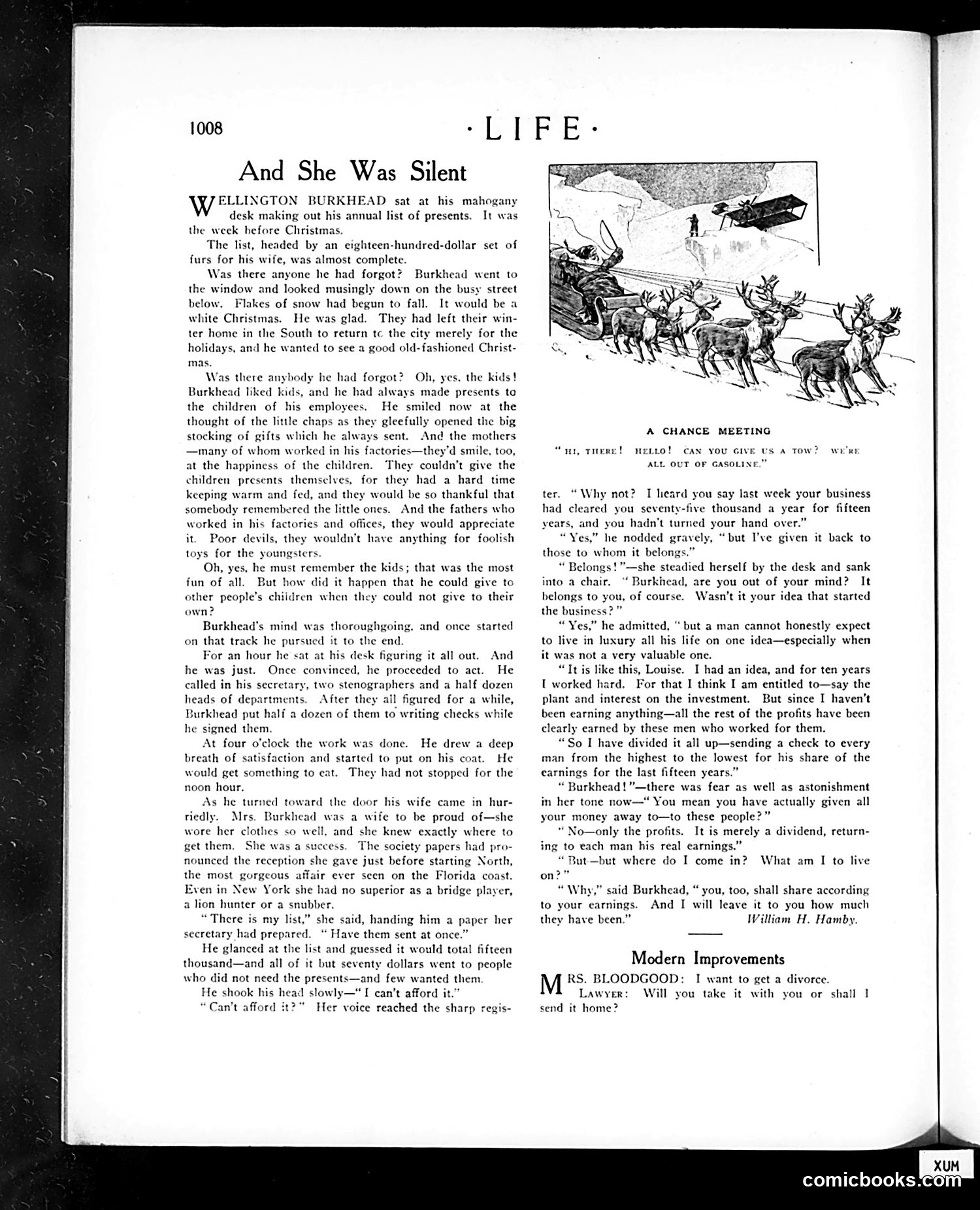
And She Was Silent ELLINGTON BURKHEAD sat at his mahogany desk making out his annual list of presents. It w the week before Christmas. The list, headed by an cighteen-hundred-dollar set of furs for his wife, was almost complete. Was there anyone he had forgot? Burkhead went to the window and looked musingly down on the busy street below, Flakes of snow had begun to fall. It would be a white Christmas. He was glad. They had left their win- ter home in the South to return tc the city merely for the holidays, and he wanted to see a good old-fashioned Christ- mas. Was there anybody he had forgot? Oh, yes. the kids! Burkhead liked kids, he had always made presents to the children of his employees. He smiled now at the thought of the little chaps as they gleefully opened the big stocking of gifts which he always sent. And the mothers —many of whom worked in his factories—they'd smile, too, at the happiness of the children. They couldn't give the children presents themselves, for they had a hard time keeping warm and fed, and they would be so thankful that somebody remembered the little ones. And the fathers who worked in his factories and offices, they would appreciate it. Poor devils, they wouldn't have anything for foolish toys for the youngsters. Oh, yes, he must remember the kids; that was the most fun of all. But how did it happen that he could give to other people’s chiidren when they could not give to their own? Burkhead’s mind was thoroughgoing, and once started on that track he pursued it to the end. For an hour he sat at his desk figuring it all out. And he was just. Once convinced, he proceeded to act. He called in his secretary, two stenographers and a half dozen heads of departments. After they ail figured for a while, Burkhead put half a dozen of them to writing checks while he signed them. At four o'clock the work was done. He drew a deep breath of satisfaction and started to put on his coat. He would get something to eat. They had not stopped for the noon hour. As he turned toward the door his wife came in hur- riedly. Mrs. Burkhead was a wife to be proud of—she wore her clothes so well, and she knew exactly where to get them. She was a success. The society papers had pro- nounced the reception she gave just before starting North, the most gorgeous affair ever seen on the Florida coast. Even in New York she had no superior as a bridge play a lion hunter or a snubber. “There is my list,” she said, handing him a paper her secretary had prepared. “ Have them sent at once.” He glanced at the list and guessed it would total fifteen thousand—and all of it but seventy dollars went to people who did not need the presents—and few wanted them. He shook his head slowly—“ I can’t afford it.” “Can't afford it? Her voice reached the sharp regis- A CHANCE MEETING MELLO! CAN YOU GIVE US A Tow?) We're ALL OUT OF GASOLINE.” ter. “Why not? I heard you say last week your business had cleared you seventy-five thousand a year for fifteen years, and you hadn't turned your hand over.” “Yes,” he nodded gravely, “but I've given it back to those to whom it belongs.” “ Belongs!”—she steadied herself by the desk and sank into a chair. “Burkhead, are you out of your mind? It belongs to you, of course. Wasn't it your idea that started the business?” “Yes,” he admitted, “ but a man cannot honestly expect to live in luxury all his life on one idea—especially when it was not a very valuable one. “Tt is like this, Louise. I had an idea, and for ten years U worked hard. For that I think I am entitled to—say the plant and interest on the investment. But since I haven't been earning anything—all the rest of the profits have been clearly earned by these men who worked for them. “So I have divided it all up—sending a check to every man from the highest to the lowest for his share of the earnings for the last fifteen years.” “ Burkhead! "—there was fear as well as astonishment in her tone now—" You mean you have actually given all your money away to—to these people?” “ No—only the profits. It is merely a dividend, return- ing to each man his real earnings.” “But—but where do I come in? What am I to live on?” “Why,” said Burkhead, “ you, too, shall share according to your earnings. And I will leave it to you how much they have been.” William H. Hamby. Modern Improvements RS. BLOODGOOD: I want to get a divorce. Lawyer: Will you take it with you or shall I send it home? comicbooks CO