
Life, 1911-12-07 · page 71 of 112
Life — December 7, 1911 — page 71: what you’re looking at
What you’re looking at
This page contains a serialized story about financial deception. Thomas, a loyal but slow-witted employee, discovers he was cheated out of £200 by his master Harrison (a wealthy millionaire) over mining shares. Rather than confront him directly, Thomas decides revenge: he'll use Harrison's own trust against him. Thomas intercepts a coded cable revealing a major ore strike. He decodes it (having access to the cipher key) and presents it to Harrison, who assumes Thomas learned of it innocently. Harrison praises him and promises to help sell Thomas's shares "for the full two hundred pounds"—seemingly generous, but actually a con: Harrison plans to manipulate the sale timing to profit himself while appearing helpful. The satire targets the moral compromise of "honest" dealing in business: Thomas's very trustworthiness makes him vulnerable, while Harrison exploits that same quality. Both men are scheming, yet each believes himself justified.
📄 Transcribed text from this page (OCR, searchable)
Machine-transcribed from the original scan — historical spelling and the odd misread are preserved.
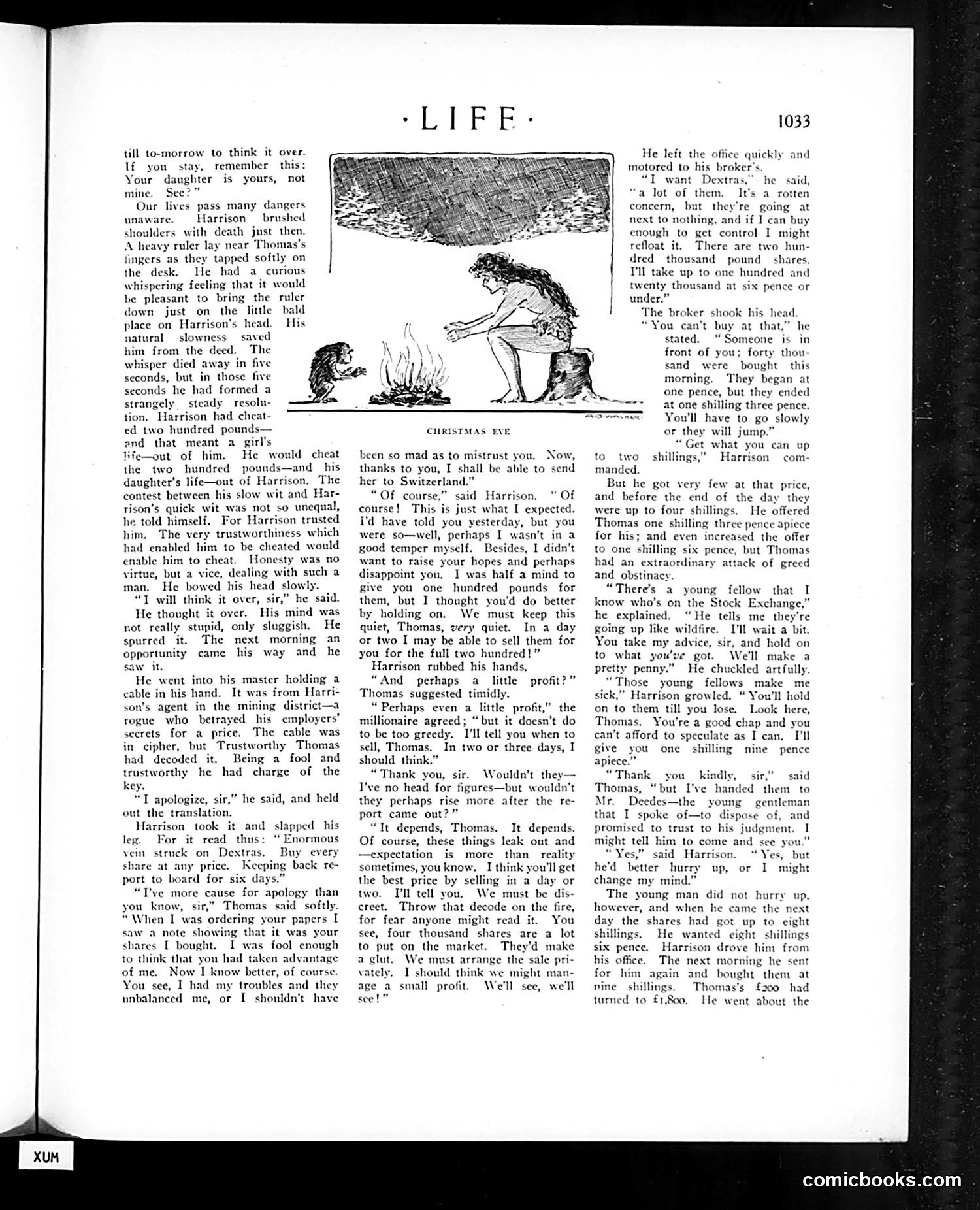
till to-morrow to think it over. lf you stay, remember this: Your daughter is yours, not mine. See?” Our lives pass many dangers unawar Harrison — brushed shoulders with death just then. A heavy ruler lay near Thomas's fingers as they tapped softly on the desk. He had a_ curious whispering feeling that it would be pleasant to bring the ruler down just on the little bald place on Harrison's head. His natural slowness saved him from the deed. The whisper died away in five seconds, but in those five seconds he had formed a strangely steady _resolu- tion. Harrison had cheat- ed two hundred pounds— and that meant a girl's life—out of him. He would cheat the two hundred pounds—and his daughter’s life—out of Harrison. The contest between his slow wit and Har- rison’s quick wit was not so unequal, he told himself. For Harrison trusted him. The very trustworthiness which had enabled him to be cheated would enable him to cheat. Honesty was no virtue, but a vice, dealing with such a man. He bowed his head slowly. “T will think it over, sir,” he said. He thought it over. His mind was not really stupid, only sluggish. He spurred it, The next morning an opportunity came his way and he saw it. He went into his master holding a cable in his hand. It was from Harri- son's agent in the mining district— rogue who betrayed his employers’ secrets for a price. The cable was in cipher, but Trustworthy Thomas had decoded it. Being a fool and trustworthy he had charge of the key. I apologize, sir,” he said, and held out the translation. Harrison took it and slapped his leg. For it read thus: “ Enormous vein struck on Dextras. Buy every share at any price. Keeping back re- port to board for six “T've more cause for apology than you know, sir,” Thomas said softly. When I was ordering your papers I saw a note showing that it was your shares I bought. I was fool enough to think that you had taken advantage of me. Now I know better, of course, You see, I had my troubles and they unbalanced me, or I shouldn't have CHRISTMAS EVE been so mad as to mistrust you. Now, thanks to you, I shall be able to send her to Switzerland.” “OF course,” said Harrison, “ Of course! This is just what I expected. i'd have told you yesterday, but you were so—well, perhaps I wasn’t in a good temper myself. Besides, I didn’t want to raise your hopes and perhaps disappoint you. I was half a mind to give you one hundred pounds for them, but I thought you'd do better by holding on. We must keep this quiet, Thomas, very quiet. In a day or two I may be able to sell them for you for the full two hundred!” Harrison rubbed his hands, “And perhaps a little profit?” Thomas suggested timidly. “Perhaps even a little profit,” the millionaire agreed; “but it doesn’t do to be too greedy. I'll tell you when to sell, Thomas. In two or three days, I should think.” “Thank you, sir. Wouldn't they— I've no head for figures—but wouldn't they perhaps rise more after the re- port came out?” “Tt depends, Thomas. It depends. Of course, these things leak out and —expectation is more than reality sometimes, you know. I think you'll get the best price by selling in a day or two. I'll tell you. We must be dis- creet. Throw that decode on the fire, for fear anyone might read it. You see, four thousand shares are a lot to put on the market. They'd r a glut. We must arrange the sale pri vately. I should think we might man- age a small profit. We'll see, we'll see!” 1033 He left the office quickly and motored to his broker's. “IT want Dextras,” lot of them. It’s a rotten concern, but they're going at next to nothing, and if I can buy enough to get control I might refloat it. There are two hun- dred thousand pound shares. I'll take up to one hundred and twenty thousand at six pence or under.” The broker shook his head. “You can’t buy at that,” he stated. “Someone is in front of you; forty thou- sand were bought this morning. They began at one pence, but they ended at one shilling three pence. You'll have to go slowly or they will jump.” Get what you can up shillings,” Harrison com- he said, to two manded. But he got very few at that price, and before the end of the day they were up to four shillings. He offered Thomas one shilling three pence apiece for his; and even increased the offer to one shilling six pence, but Thomas had an extraordinary attack of greed and obstinacy “There’s a young fellow that I know who's on the Stock Exchange,” he explained. “He tells me they're going up like wildfire. I'll wait a bit. You take my advice, sir, and hold on to what you've got. We'll make a pretty penny.” He chuckled artfully. “Those young fellows make me sick,” Harrison growled. “ You'll hold on to them till you lose. Look here, Thomas. You're a good chap and you can’t afford to speculate as I can. I'll € you one shilling nine pence apiece.” “Thank you kindly, sir,” said Thomas, “but I've handed them to Mr. Deedes—the young gentleman that I spoke of—to dispose of, and promised to trust to his judgment. I might tell him to come and see you.” “Yes,” said Harrison. “Yes, but he'd better hurry up, or I might change my mind.” The young man did not hurry up, however, and when he came the next the shares had got up to eight shillings. He wanted eight shillings six pence. Harrison drove him from his office. The next morning he sent for him again and bought them at nine shillings. Thomas's £200 had turned to £1,800, He went about the comicbooks.com