
Life, 1911-12-07 · page 73 of 112
Life — December 7, 1911 — page 73: what you’re looking at
What you’re looking at
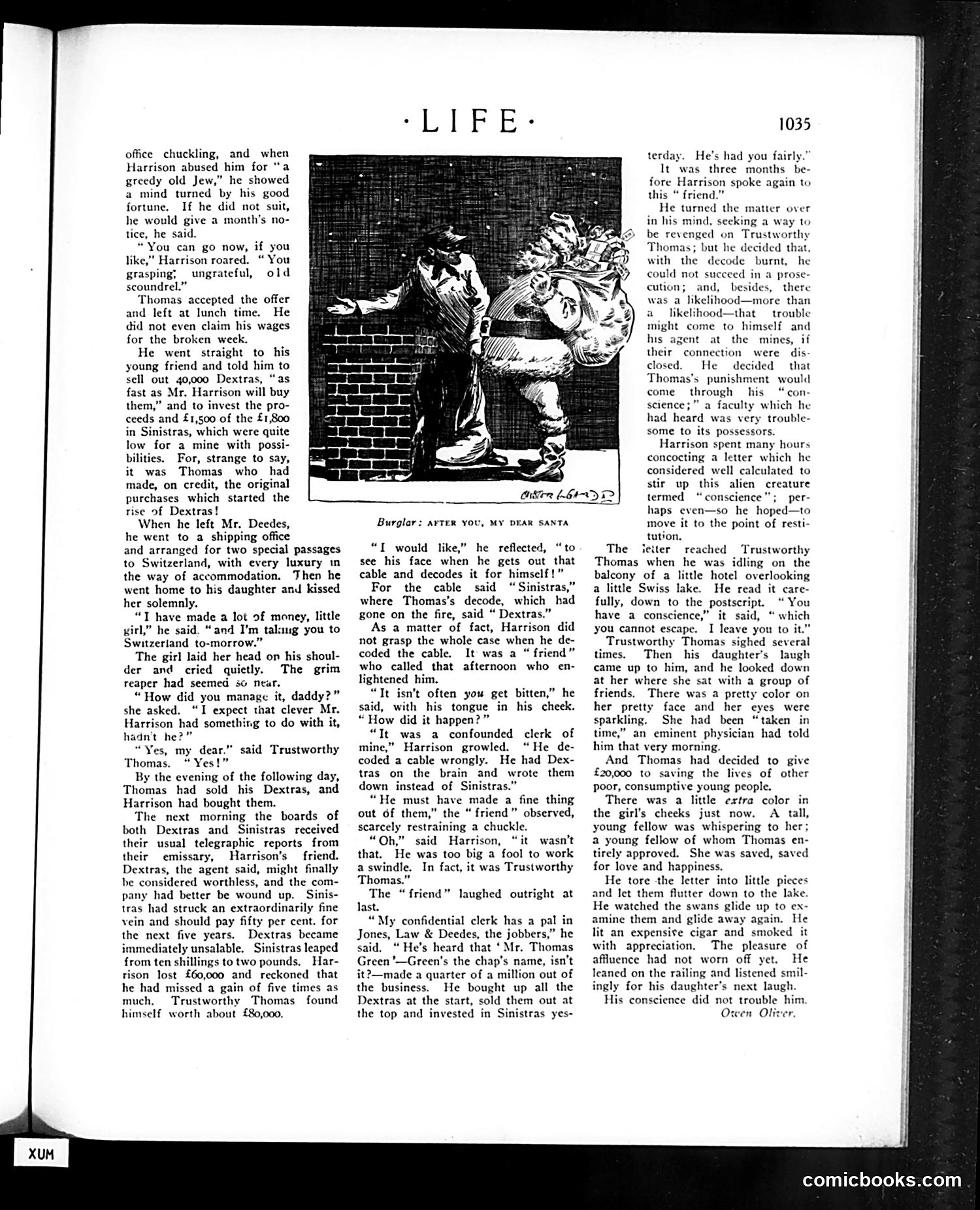
This single-panel cartoon depicts a burglar and Santa Claus at a chimney, each deferentially gesturing for the other to enter first—a play on politeness ("after you"). The satire targets the moral equivalence between burglars and Santa Claus, likely commenting on commercialized Christmas or consumer excess. By the early 20th century, Life magazine frequently satirized the contradiction between Christmas's spiritual ideals and materialistic gift-giving practices. The cartoon suggests both figures are essentially "stealing" or taking—one literally, one through the commercialized gift economy. The accompanying text (a story about financial manipulation and moral compromise) reinforces themes of deception and questionable ethics, making the cartoon's dark humor about theft and moral ambiguity more pointed.
📄 Transcribed text from this page (OCR, searchable)
Machine-transcribed from the original scan — historical spelling and the odd misread are preserved.
office chuckling, and when Harrison abused him for “a greedy old Jew,” he showed a mind turned by his good fortune. If he did not suit, he would give a month’s no- tice, he said. “You can go now, if you like,” Harrison roared. “ You grasping; ungrateful, old scoundrel.’ Thomas accepted the offer and left at lunch time. He did not even claim his wages for the broken week. He went straight to his young friend and told him to sell out 40,000 Dextras, “as fast as Mr. Harrison will buy them,” and to invest the pro- ceeds and £1,500 of the £1,800 in Sinistras, which were quite low for a mine with possi- bilities. For, strange to say, it_ was Thomas who had made, on credit, the original purchases which started the OnSlre b.Gt-°D D> 1035 terday. He’s had you fair! It was three months be fore Harrison spoke again to this “ friend.” He turned the matter over in his mind, seeking a way to be revenged on Trustworthy Thomas; but he decided that, with the decode burnt, he could not succeed in a prose- cution; and, besides, there was a likelihood—more than a likelihood—that trouble might come to himself and his agent at the mines, if their connection were dis- closed. He decided that Thomas's punishment would come through his“ con- science; a faculty which he had heard was very trouble- some to its possessors. Harrison spent many hours concocting a letter which he considered well calculated to stir up this alien creature termed “conscience”; per- rise of Dextras! When he left Mr. Deedes, he went to a shipping office and arranged for two special passages to Switzerland, with every luxury in the way of accommodation. Then he went home to his daughter and kissed her solemnly. “T have made a lot of money, little girl,” he said. “and I'm talaug you to Switzerland to-morrow.” The girl laid her head on his shoul- der and cried quietly. The grim reaper had seemed so near. “How did you manage it, daddy?” she asked. “I expect that clever Mr. Harrison had something to do with it, hadn't he?” “Yes, my dear.” Thomas. “ Yes!” By the evening of the following day, Thomas had sold his Dextras, and Harrison had bought them. The next morning the boards of both Dextras and Sinistras received their usual telegraphic reports from their emissary, Harrison’s friend. Dextras, the agent said, might finally be considered worthless, and the com- pany had better be wound up. Sinis- tras had struck an extraordinarily fine vein and should pay fifty per cent. for the next five years. Dextras became immediately unsalable. Sinistras leaped from ten shillings to two pounds, Har- rison lost £60,000 and reckoned that he had missed a gain of five times as much, Trustworthy Thomas found himself worth about £80,000, said Trustworthy Burglar: avTeER YOU, MY DEAR SANTA “TI would like,” he reflected, “to see his face when he gets out that cable and decodes it for For the cable said ras,” where Thomas's decode, which had gone on the fire, said “ Dextras.” As a matter of fact, Harrison did not grasp the whole case when he de- coded the cable, It was a “friend” who called that afternoon who en- lightened him. “Tt isn’t often you get bitten,” he said, with his tongue in his cheek. “ How did it happen?” “Tt was a confounded clerk of mine,” Harrison growled. “He de- coded a cable wrongly. He had Dex- tras on the brain and wrote them down instead of Sinistras.” “He must have made a fine thing out of them,” the “friend” observed, scarcely restraining a chuckle. “Oh,” said Harrison, “it wasn’t that. He was too big a fool to work a swindle. In fact, it was Trustworthy Thomas.” The “friend” laughed outright at last. “My confidential clerk has a pal in Jones, Law & Deedes, the jobbers,” he said. “He's heard that ‘Mr. Thomas Green ’—Green’s the chap’s name, isn’t it?—made a quarter of a million out of the business. He bought up all the Dextras at the start, sold them out at the top and invested in Sinistras yes- haps even—so he hoped—to move it to the point of resti- tution, The ieiter reached Trustworthy Thomas when he was idling on the balcony of a little hotel overlooking a little Swiss lake. He read it care- fully, down to the | ostseript. “You have a conscienc it said, “ which you cannot escape. I leave you to it.” Trustworthy Thomas sighed several times. Then his daughter’s laugh came up to him, and he looked down at her where she sat with a group of friends, There was a pretty color on her pretty face and her eyes were sparkling. She had been “taken in time,” an eminent physician had told him that very morning. And Thomas had decided to give £20,000 to saving the lives of other poor, consumptive young people, There was a little extra color in the girl's cheeks just now. A tall, young fellow was whispering to her; a young fellow of whom Thomas en- tirely approved. She was saved, saved for love and happiness. He tore -the letter into little pieces and let them flutter down to the lake. He watched the swans glide up to ex- amine them and glide away again. He lit an expensive cigar and smoked it with appreciation. The pleasure of affluence had not worn off yet. He leaned on the railing and listened smil- ingly for his daughter’s next laugh. His conscience did not trouble him Owen Oliver. comicbooks.com