
Life, 1911-12-07 · page 31 of 112
Life — December 7, 1911 — page 31: what you’re looking at
What you’re looking at
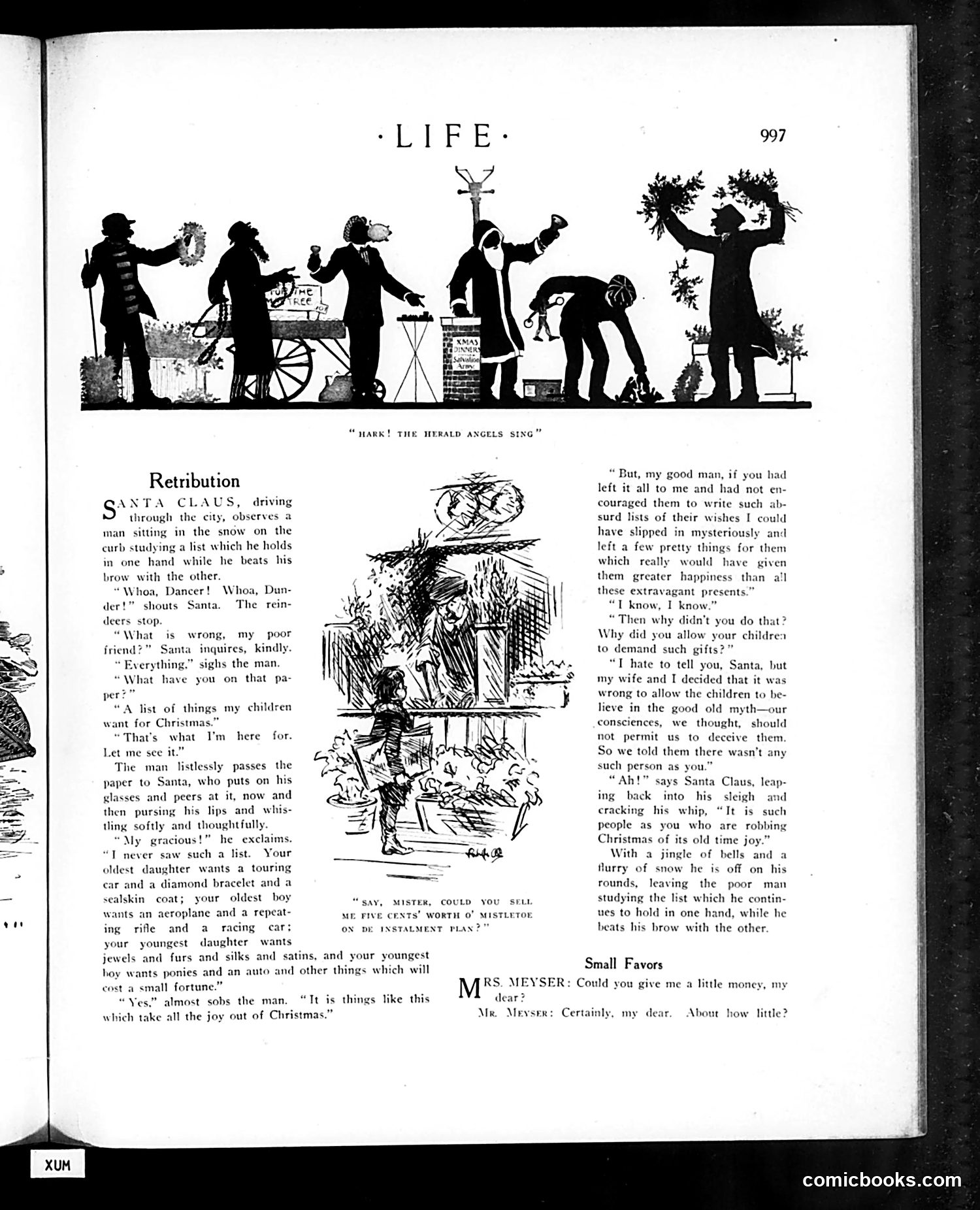
This story satirizes modern parenting and consumerism circa early 20th century. A poor man sits despairing over his children's extravagant Christmas wish list (touring cars, diamond bracelets, aeroplanes, racing cars). Santa Claus encounters him and criticizes the situation—not because the gifts are expensive, but because the father has *stopped telling children Santa exists*, believing it's dishonest. Santa argues this "rational parenting" backfires: children who don't believe in Santa lose the *magic* of modest surprises and instead demand material luxuries from parents directly. By destroying the Santa myth for conscience's sake, the father has inadvertently created greedy, materialistic children. The satire targets progressive early-1900s parenting philosophy that rejected "deception" in favor of brutal honesty—suggesting such moral superiority actually harms childhood wonder and family joy. The point: sometimes useful myths are worth preserving.
📄 Transcribed text from this page (OCR, searchable)
Machine-transcribed from the original scan — historical spelling and the odd misread are preserved.
Retribution ANTA CLAUS, driving through the city, observes a man sitting in the snow on the curb studying a list which he holds in one hand while he beats his brow with the other. “Whoa, Dancer! Whoa, Dun- der!” shouts Santa, The rein- deers stop. “What is wrong, my poor friend?” Santa inquires, kindly. “ Everything,” sighs the man. “What have you on that pa- per? “A list of things my children want for Christmas.” “That's what I'm here for. Let me The listlessly passes the paper to Santa, who puts on his glasses and peers at it, now and then pursing his lips and whis- tling softly and thoughtfully. “My gracious!” he exclaims. “T never saw such a list. Your oldest daughter wants a touring car and a diamond bracelet and a sealskin coat; your oldest boy wants an aeroplane and a repeat ing rifle and a racing car: your youngest daughter | wants “SAY, MISTER, COULD YoU SFLI. ME FIVE CENTS’ WORTH 0" MISTLETOE ON DE INSTALMENT Play?” jewels and furs and silks and satins, and your youngest hoy wants ponies and an auto and other things which will cost a small fortune.” “Yes.” almost sobs the man. which take all the joy out of Christmas.” “Tt is things like this dear? Mr. Meyser: Certa “But, my good man, if you had left it all to me and had not en- couraged them to write such ab- surd lists of their wishes I could have slipped in mysteriously and left a few pretty things for them which really would have given them greater happiness than all these extravagant presents.” I know, I know “Then why didn’t you do that? Why did you allow your childrea to demand such gifts?” “T hate to tell you, Santa, but my wife and I decided that it was wrong to allow the children to be- lieve in the good old myth—our consciences, we thought, should not permit us to deceive them So we told them there wasn’t any such person as you.” “Ah!” says Santa Claus, leap- ing back into his sleigh and cracking his whip, “It is such people as you who are robbing Christmas of its old time joy.” With a jingle of bells and a flurry of snow he is off on his rounds, leaving the poor man studying the list which he contin- ues to hold in one hand, while he beats his brow with the other. Small Favors M®s MEYSER: Could you give me a little money, my nly, my dear. About how little? comicbooks.com