
A complete issue · 69 pages · 1891
Judge — 1891
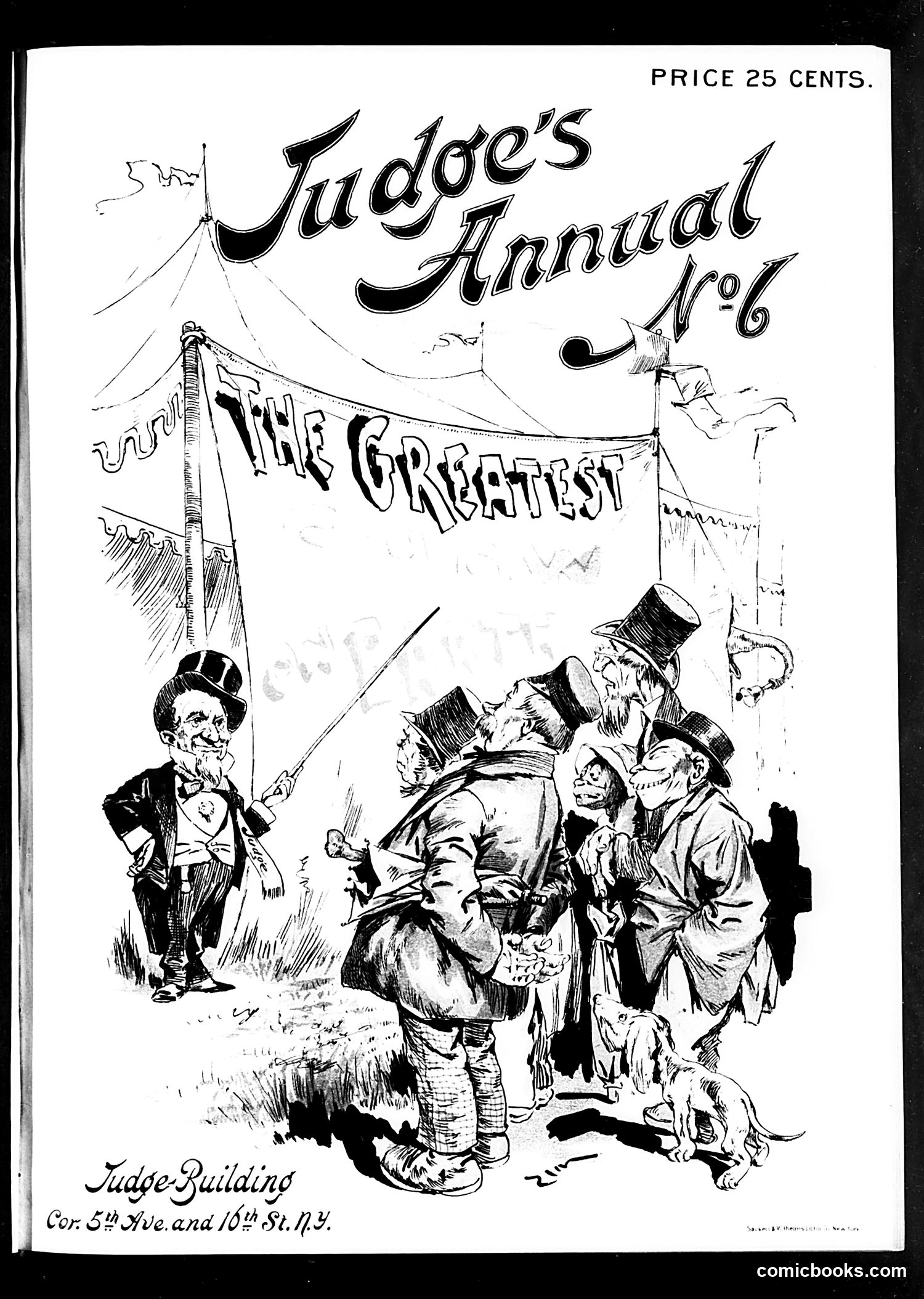
This is the cover of Judge magazine's annual anthology (Issue No. 6), priced at 25 cents. The illustration depicts a circus tent labeled "THE GREATEST," with a ringmaster-like figure on the left holding a pointer/baton, addressing a group of well-dressed men in top hats gathered beneath the tent. The satire appears to mock prominent political or business figures of the era as circus performers or attractions—a common Judge magazine trope. The "greatest" tent suggests ironic commentary on inflated claims or self-importance. The caricatured faces and formal dress indicate these are recognizable public figures, likely politicians or wealthy industrialists, though specific identifications aren't evident from the image alone. The overall message suggests these figures are being treated as entertainers or frauds worthy of ridicule.
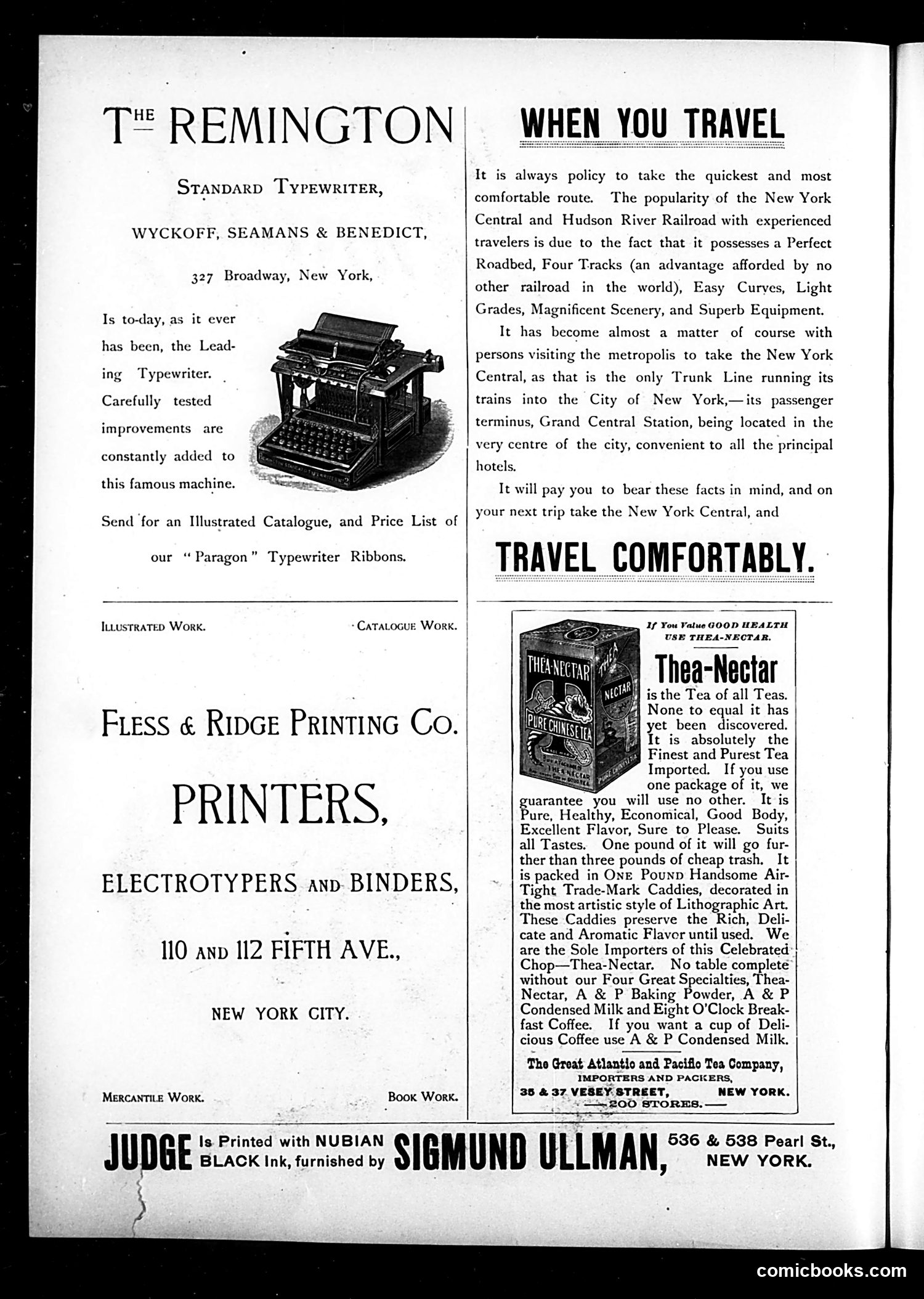
This page is primarily **advertising content** rather than satirical cartoons. The left side advertises the Remington Standard Typewriter through Wyckoff, Seamans & Benedict, featuring an illustration of the machine itself. Below that are ads for Fless & Ridge Printing Co. and Judge's own printing services. The right side contains travel advertising for the New York Central Railroad, emphasizing its superiority for reaching Manhattan, and a substantial advertisement for **Thea-Nectar tea**, promoted as "the finest and purest tea imported" by the Great Atlantic and Pacific Tea Company. The bottom notes that Judge magazine was printed using Nubian Black Ink from Sigmund Ullman. This represents typical late-19th/early-20th century magazine monetization through advertising rather than editorial satire.
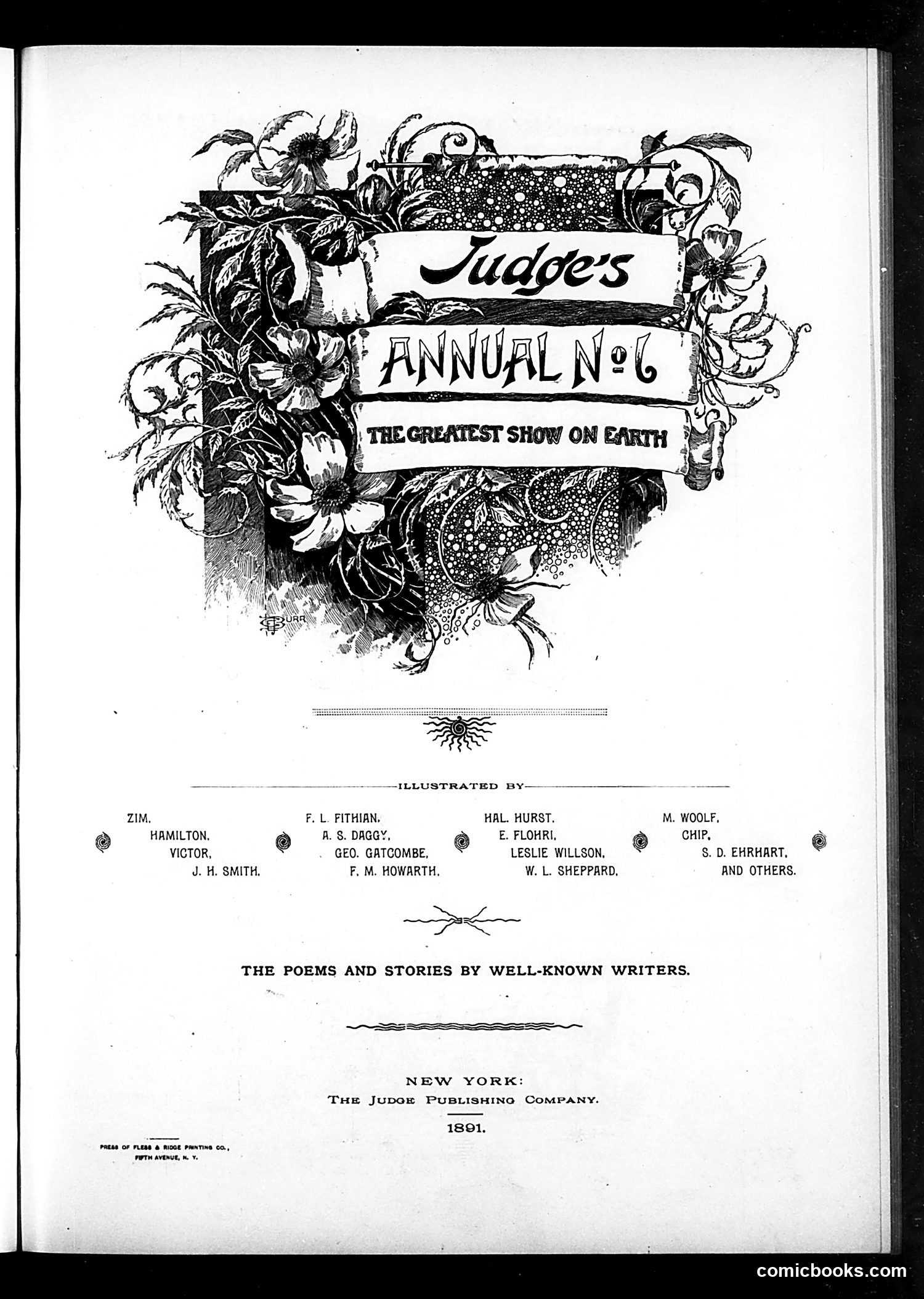
This is the title page for Judge magazine's sixth annual collection, subtitled "The Greatest Show on Earth." The ornate decorative border features flowering plants and botanical elements framing three horizontal banners with the publication's title. The page credits multiple illustrators (Hamilton, Fithian, Hurst, Woolf, and others) and notes the collection contains "poems and stories by well-known writers." Published by The Judge Publishing Company in New York in 1891, this represents a compilation volume of the year's satirical content. The "Greatest Show on Earth" subtitle was P.T. Barnum's famous circus slogan, suggesting Judge positioned itself as America's premier satirical spectacle—implying contemporary politics and society deserved mockery equivalent to circus entertainment.
This page from Judge magazine (1891) features a satirical illustration showing an adult figure (likely representing authority or a political leader) surrounded by several smaller figures depicted as children or childlike characters. The cartoon appears to critique someone's management style or leadership approach—possibly suggesting they treat serious matters or subordinates in an undignified or infantilizing manner. The specific identities of the figures remain unclear without additional context, but the composition suggests commentary on either political leadership, corporate management, or social hierarchy of the 1891 era. The style is typical of Judge's satirical approach to contemporary affairs. The ornate copyright notice confirms this as legitimate magazine content from The Judge Publishing Company.
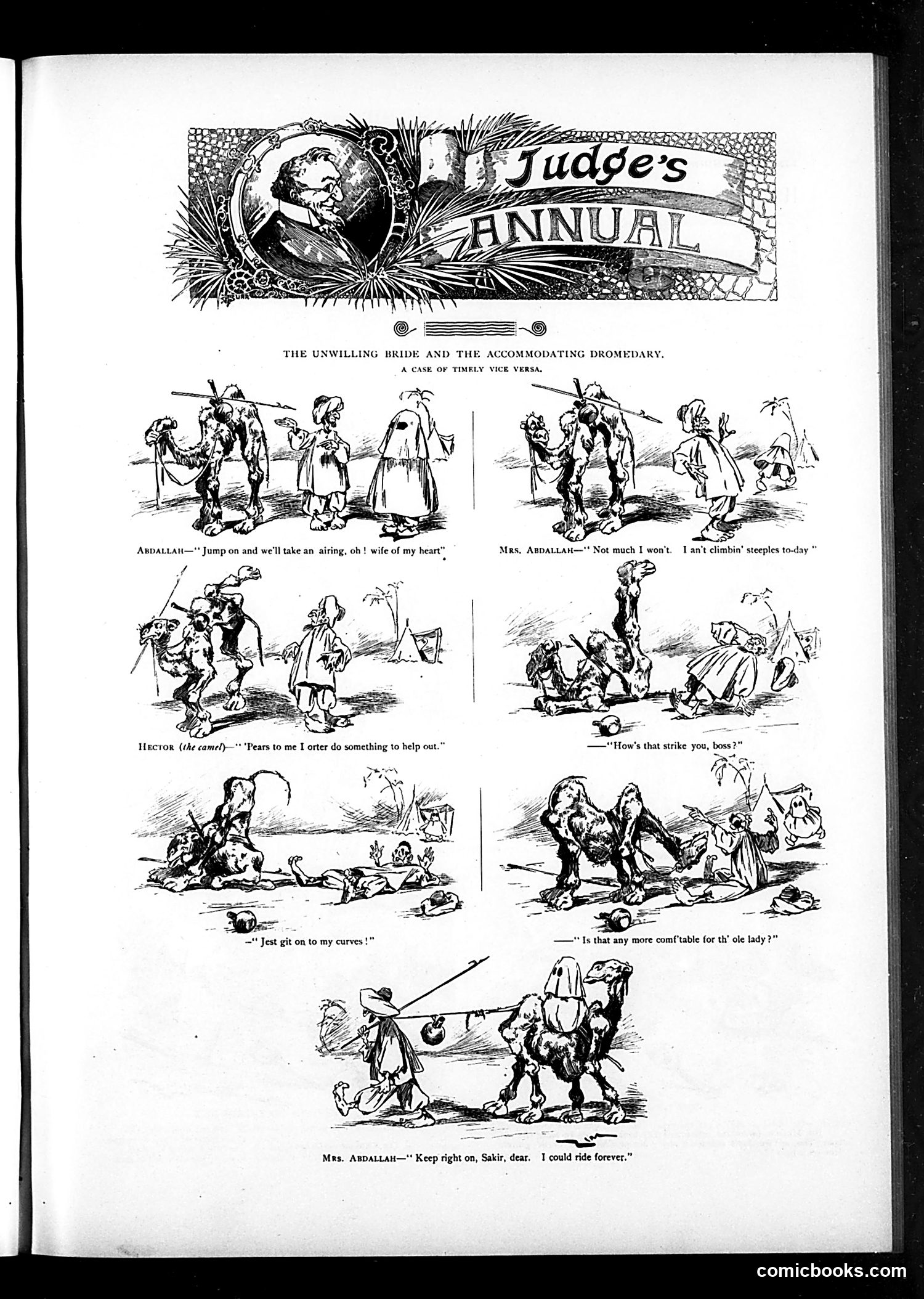
This page satirizes a marriage between a Western woman (Mrs. Abdallah) and an Arab man (Abdallah), depicted through a series of comedic vignettes showing their journey on a camel. The humor relies on racial and cultural stereotypes common to 1890s-era American satire. The "vice versa" in the title suggests role-reversal: typically, an "unwilling bride" would resist marriage, but here Mrs. Abdallah enthusiastically embraces desert life and camel-riding, while her husband and servants struggle. The cartoon mocks both the "exotic" orientalist fantasy and suggests the woman's unexpected contentment subverts expectations. The dromedary (camel) serves as both literal transport and comedic prop—its discomfort mirrors the men's dismay at this unconventional arrangement. The satire targets attitudes about cross-cultural marriage and female agency, though filtered through deeply problematic ethnic caricature typical of Judge's era.
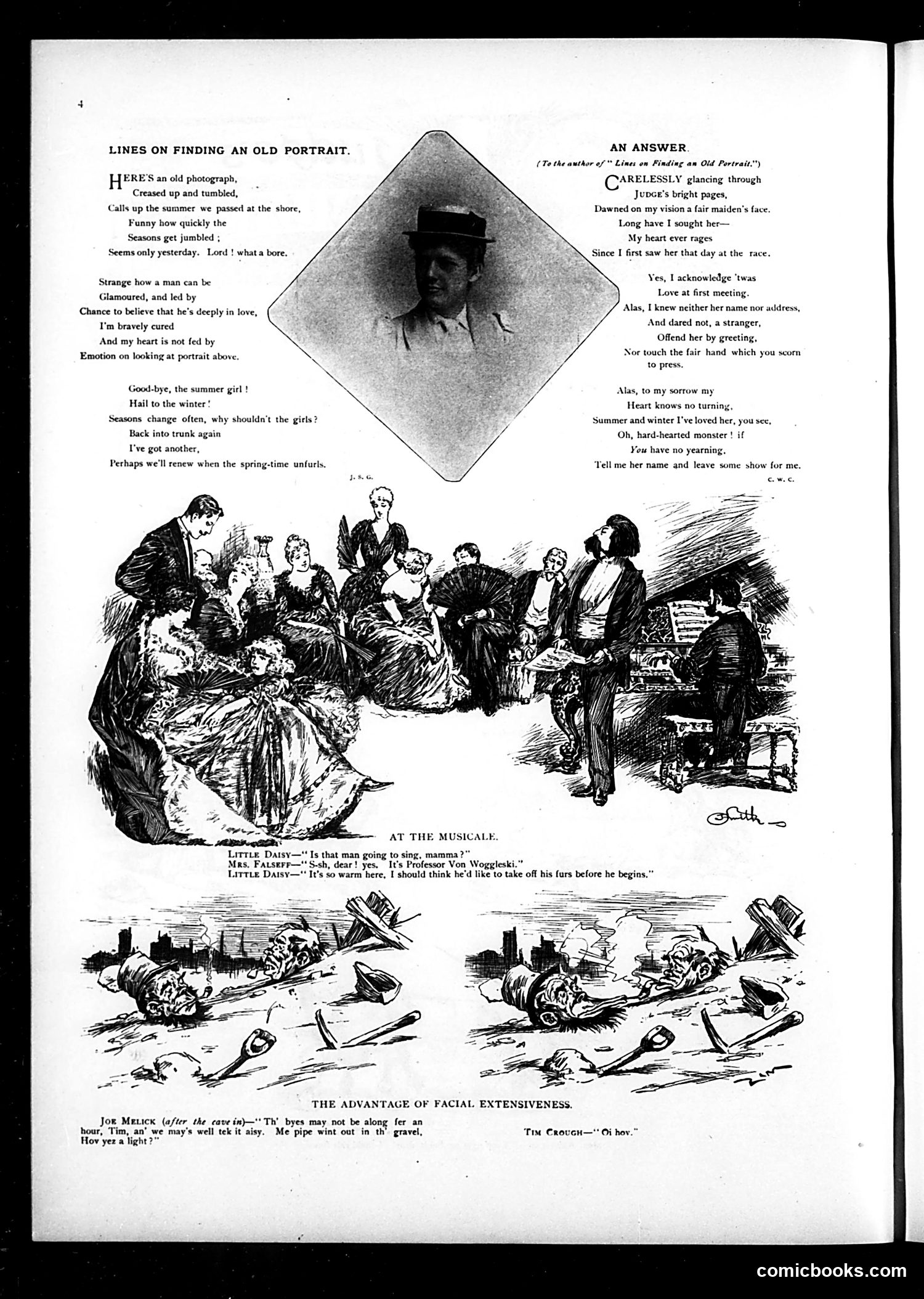
This page from *Judge* magazine contains three separate humorous pieces: **"Lines on Finding an Old Portrait"** and **"An Answer"**: A witty exchange between two male contributors. The first casually dismisses a summer romance found in an old photo, treating romantic attachments as seasonal amusements. The answer calls him out—the responder claims to have fallen in love with a woman he glimpsed in *Judge* magazine at a race, asking the author to identify her. The satire mocks both shallow male romanticism and the absurdity of seeking to contact strangers through magazine publication. **"At the Musicale"**: A brief joke about a child asking if a man will sing, with the mother identifying him as "Professor Von Woggleski"—likely a German name used for comedic effect, suggesting a pompous or ridiculous performer. **"The Advantage of Facial Extensiveness"**: A working-class joke showing two miners after a cave-in. One's face is so broad his pipe remained dry in the gravel while his face was buried—"facial extensiveness" being a crude joke about having an unusually wide face.
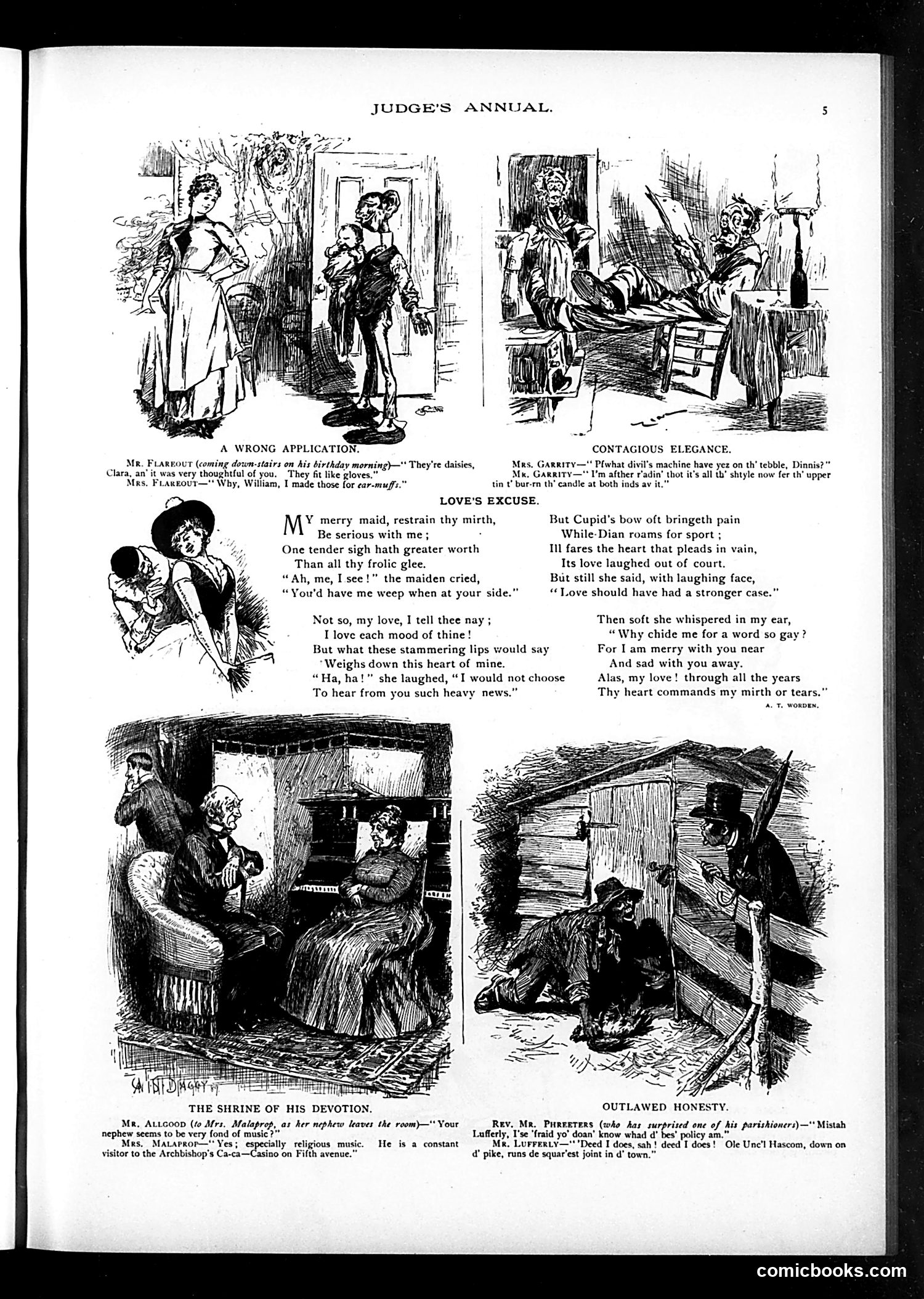
This page contains five separate humorous sketches typical of late-19th-century American satirical magazines: **"A Wrong Application"** and **"Contagious Elegance"** depict Irish-American characters (indicated by phonetic dialect) in domestic scenes—one involving daisies mistaken for ear-muffs, the other about fashionable candle-burning. **"Love's Excuse"** is a sentimental poem about romantic misunderstanding, where a man wants his lover serious but she prefers merriment. **"The Shrine of His Devotion"** jokes that a nephew's "religious music" obsession actually means frequenting the Archbishop's Casino on Fifth Avenue (satirizing both fake piety and gambling). **"Outlawed Honesty"** features African-American dialect characters, with a minister expressing concern about a parishioner's honesty, who claims a local bootlegger runs the "squarest" illegal operation. The page relies on ethnic stereotypes (Irish and Black dialect) common to period humor, social commentary about class pretense, and romantic comedy—typical Judge magazine fare of the era.
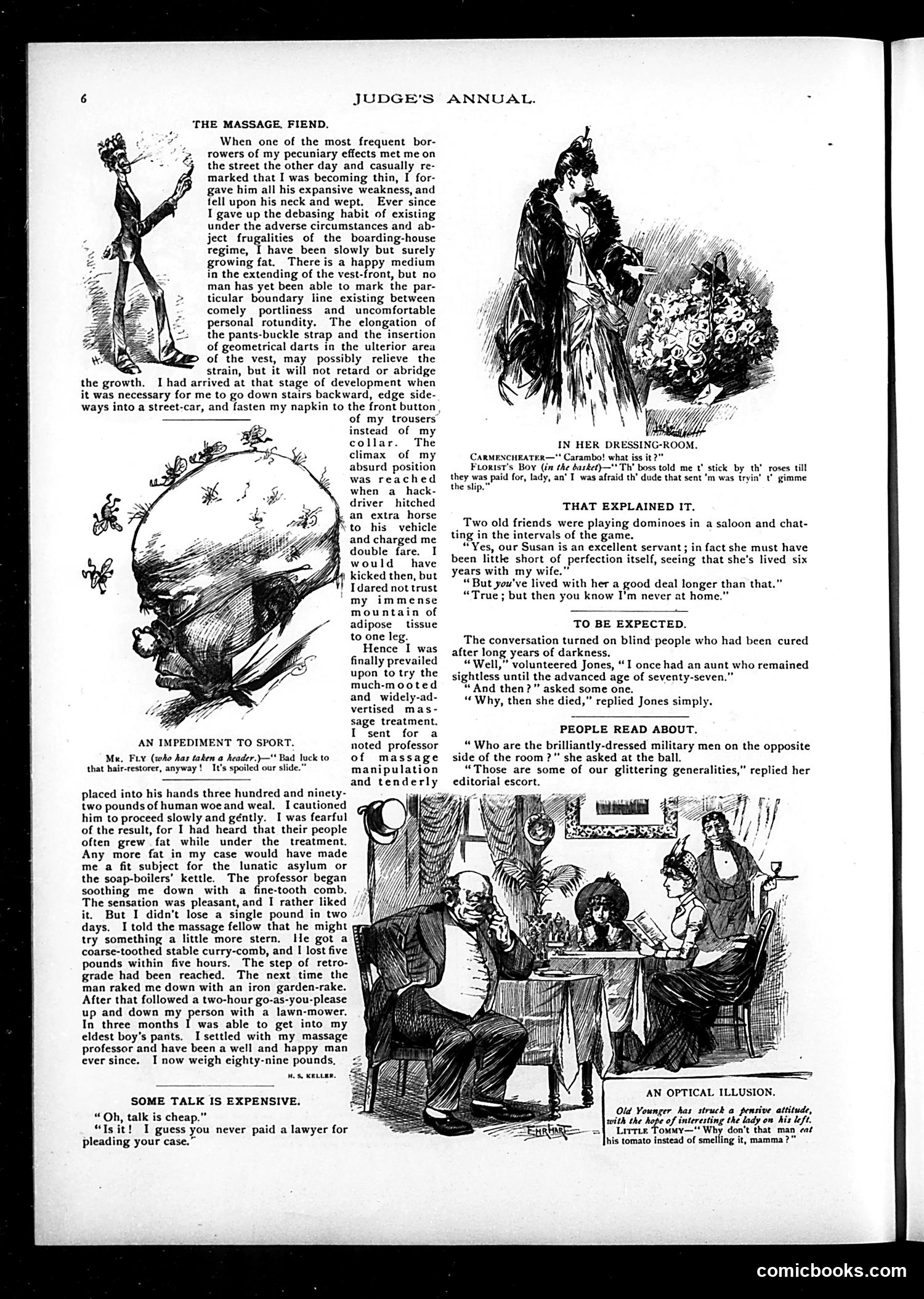
This page from Judge's satirical annual contains several humorous sketches mocking late 19th-century American social types and fads. **"The Massage Fiend"** is the main article, satirizing the contemporary craze for massage therapy as a weight-loss treatment. The narrator describes becoming obese after abandoning boarding-house life, then submitting to increasingly brutal "massage" treatments—progressing from combs to garden rakes—that accomplish nothing. The satire targets both the absurdity of fad health treatments and the vanity of wealthy men concerned with their expanding waistlines. The accompanying cartoons mock related social pretensions: a woman in her dressing room dismissing a florist's boy, conversations about servants and the blind, and a final joke about "glittering generalities" (likely satirizing empty political rhetoric) being applied to military men at a ball. The humor assumes readers' familiarity with contemporary wellness crazes and class anxieties about appearance and servants.
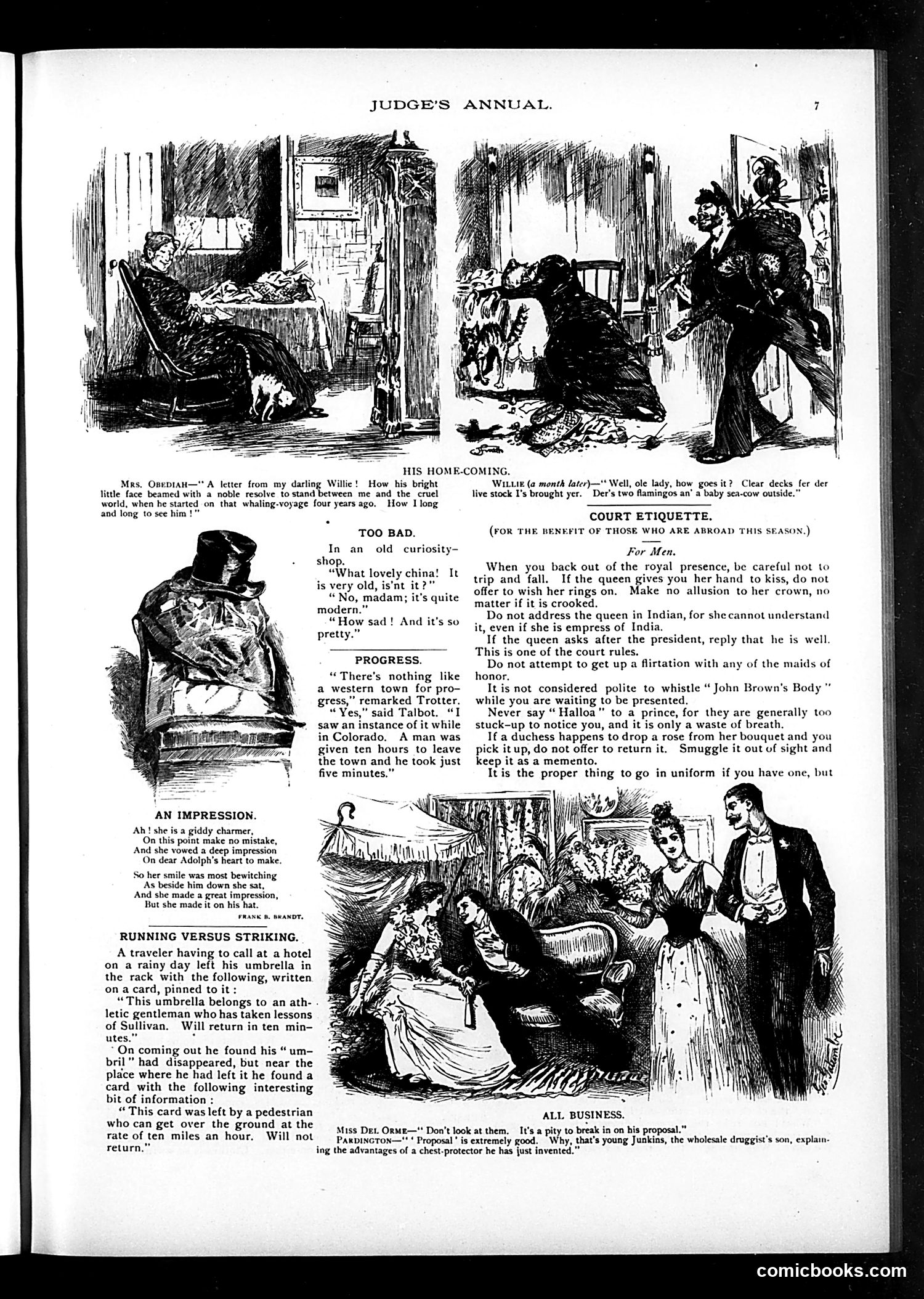
This page contains multiple satirical sketches and humorous anecdotes typical of late 19th-century American humor: **"His Home-Coming"** shows a mother's joy at receiving a letter from her son Willie, who departed on a whaling voyage years prior—satirizing sentimental Victorian family attachments. **"An Impression"** mocks a flirtatious woman who makes such a forceful impression on a man that she literally crushes his hat—a visual pun on the phrase "make an impression." **"Running Versus Striking"** ridicules western frontier "progress" through anecdotes about umbrellas and speed, suggesting rough frontier justice (the "ten hours to leave town" reference implies violent expulsion). **"Court Etiquette"** provides mock-serious advice for Americans abroad at royal courts, poking fun at American ignorance of British formality and their tendency to behave informally in formal settings—particularly the joke about whistling "John Brown's Body" (an abolitionist anthem) before the queen. The sketches employ typical Victorian-era humor: puns, social awkwardness, and gentle mockery of American manners and frontier roughness.
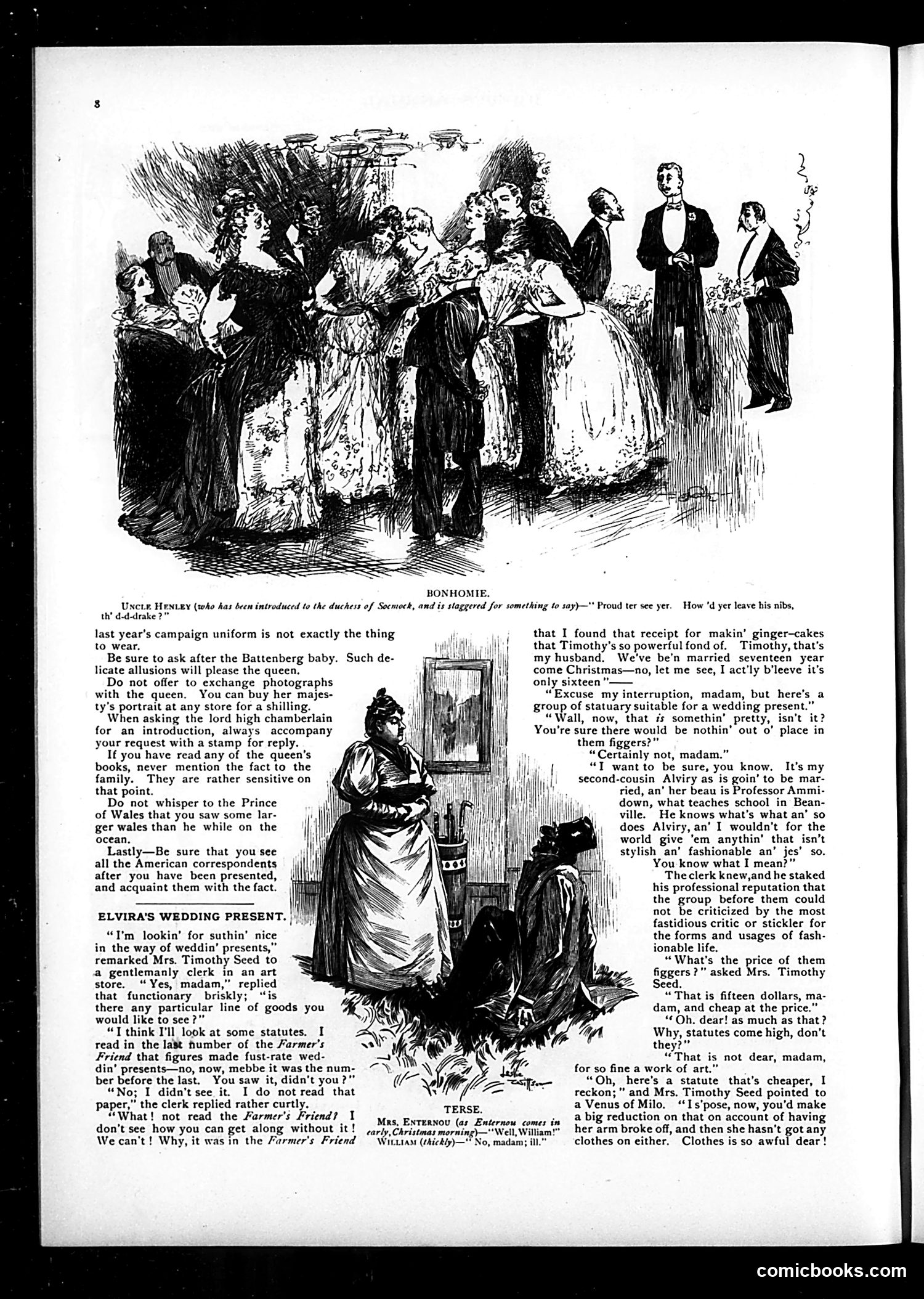
This page contains two satirical pieces lampooning American rural/provincial manners: **"Bonhomie"** (top): A humorous dialogue where Uncle Henry, newly introduced to British nobility (the Duchess of Somerck), is awkwardly coached on proper etiquette—don't mention the queen's books, don't exchange photos with royalty, bring a stamp for replies. The satire mocks Americans' anxiety about appearing unsophisticated before the British aristocracy. **"Elvira's Wedding Present"** (bottom): Mrs. Timothy Seed, a rural American woman, shops for wedding statuary while constantly referencing the *Farmer's Friend* magazine as her guide to propriety. She hagggles over a Venus de Milo statue, noting its cheapness since "her arm broke off" and she lacks clothes. The joke satirizes how unsophisticated rural Americans approach "high culture" and art, treating classical sculpture like practical household goods to be negotiated on price. Both pieces mock American provincialism and the gap between rural sensibilities and refined taste, a common Judge magazine theme.
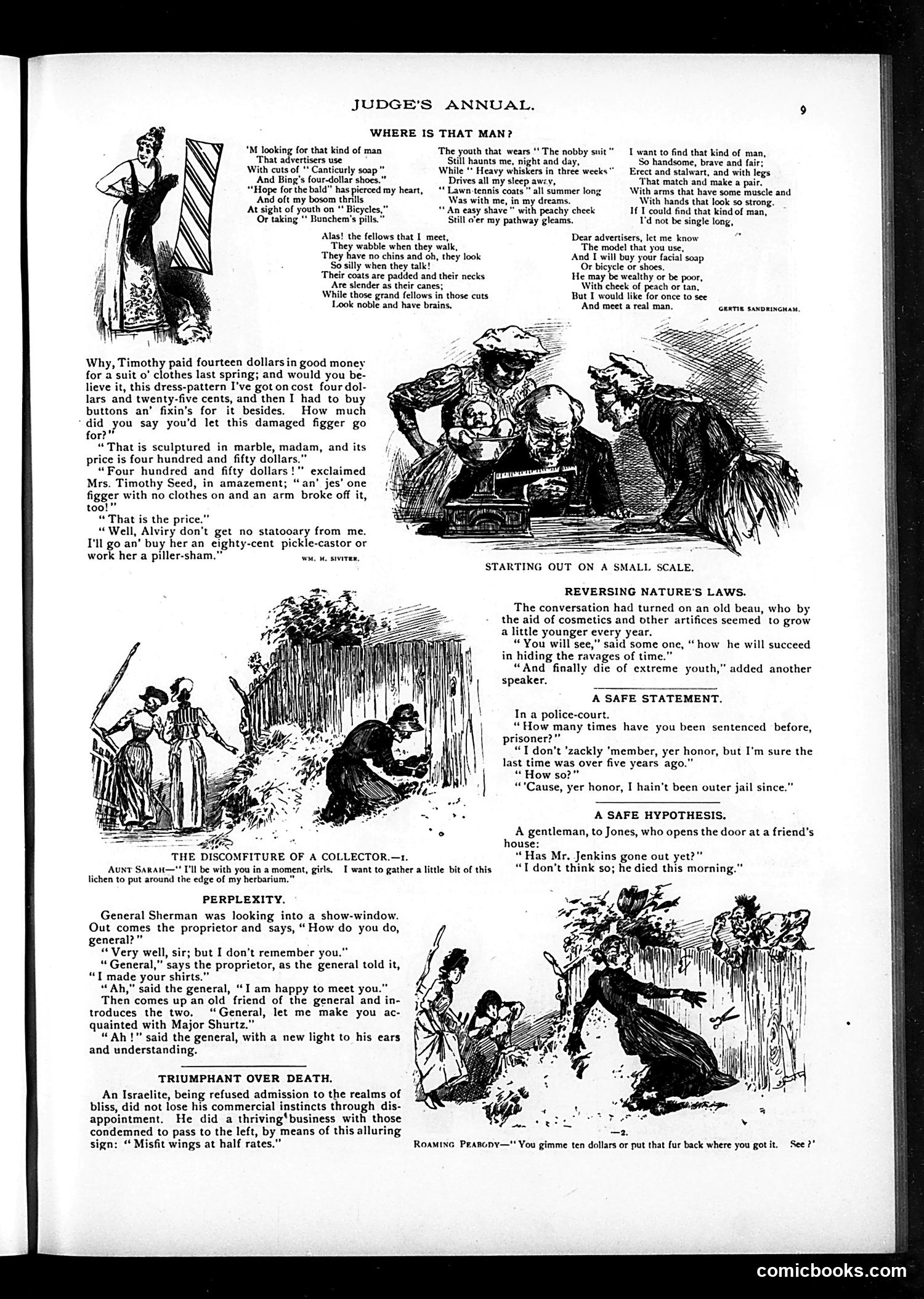
This page from Judge satirizes **false advertising and artificial beauty standards** of the Gilded Age. The main poem "Where Is That Man?" mocks misleading product advertisements. Women are shown longing for idealized men from ads—handsome figures promoting "Cantucurly soap," hair-loss remedies, and bicycles—while real men disappoint by comparison. The satire targets both deceptive advertising and women's unrealistic expectations it creates. Supporting sketches reinforce this theme: - **"Discomfiture of a Collector"**: A woman obsesses over botanical specimens, suggesting shallow materialism. - **"Perplexity"**: General Sherman's confusion over a shirt-maker's name plays on surface-level identity. - **"Triumphant Over Death"**: An irreverent joke about a Jewish merchant selling "misfit wings at half rates" to the damned—dark humor about commercial opportunism. The page critiques **consumer culture**, **false promises in marketing**, and the **gap between advertising fantasies and reality**—themes remarkably contemporary despite the 19th-century context.
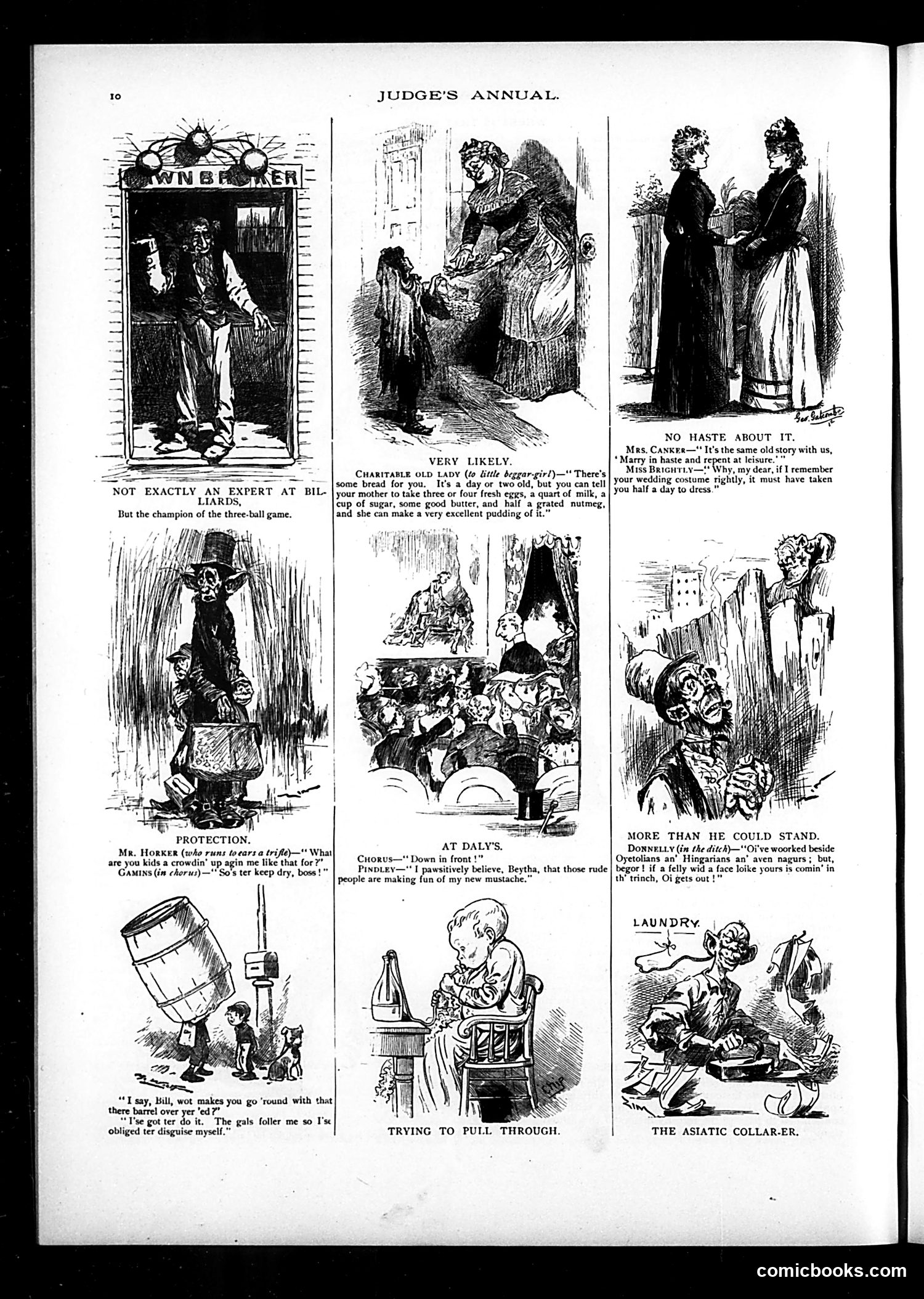
This page from Judge's satirical annual contains nine separate comic vignettes mocking various social types and situations of the era: **Recurring themes include:** - Working-class characters in poverty (children sheltering under a barrel, a man disguising himself from admirers) - Class condescension (a wealthy lady giving stale bread while prescribing expensive pudding ingredients to a beggar) - Domestic marital discord (the "Haste About It" sequence about hasty weddings) - Immigrant stereotypes (heavy dialect in "More Than He Could Stand," featuring an Irish character refusing to work alongside Asian laborers) - Gender stereotypes (women's vanity about fashion, laundry work) The "Asiatic Collar-er" title references Chinese laundry workers, a common occupation for Chinese immigrants in America, depicted here with typical period caricature and condescension. Overall, the page reflects Judge's satirical approach: mocking both the poor's struggles and the wealthy's obliviousness, while reinforcing period prejudices about immigrants and ethnic groups.
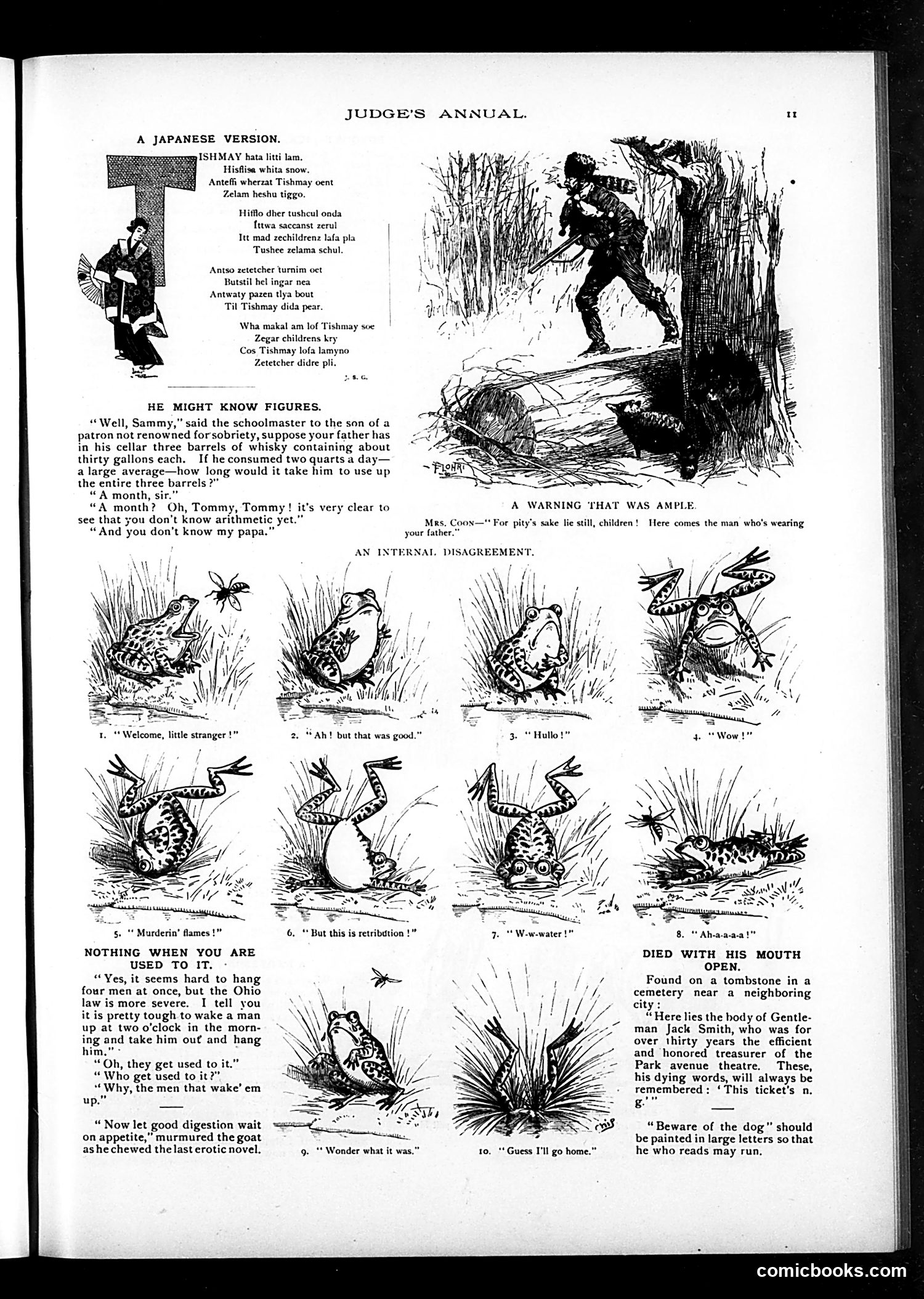
This page contains several unrelated humorous pieces typical of late-19th/early-20th century American satire: **"A Japanese Version"** mocks Japanese-accented English through garbled phonetic spelling—reflecting period prejudice and the "yellowface" comedy common at the time. **"He Might Know Figures"** is a joke about a drunkard father. The schoolmaster expects the boy to fail at arithmetic, but the boy correctly calculates based on his father's actual drinking habits—the humor relies on the assumption that alcoholism among the lower classes was so prevalent it required practical knowledge. **"An Internal Disagreement"** shows frogs arguing in a swamp—likely political allegory, though the specific reference is unclear. **"Nothing When You Are Used to It"** jokes darkly about executions becoming routine, and includes a quip about a goat eating scandalous novels. **Other brief items** include a gravestone epitaph for a theater treasurer and warnings about dogs. The overall tone reflects Judge's mix of social commentary, ethnic humor, and dark comedy typical of the era.
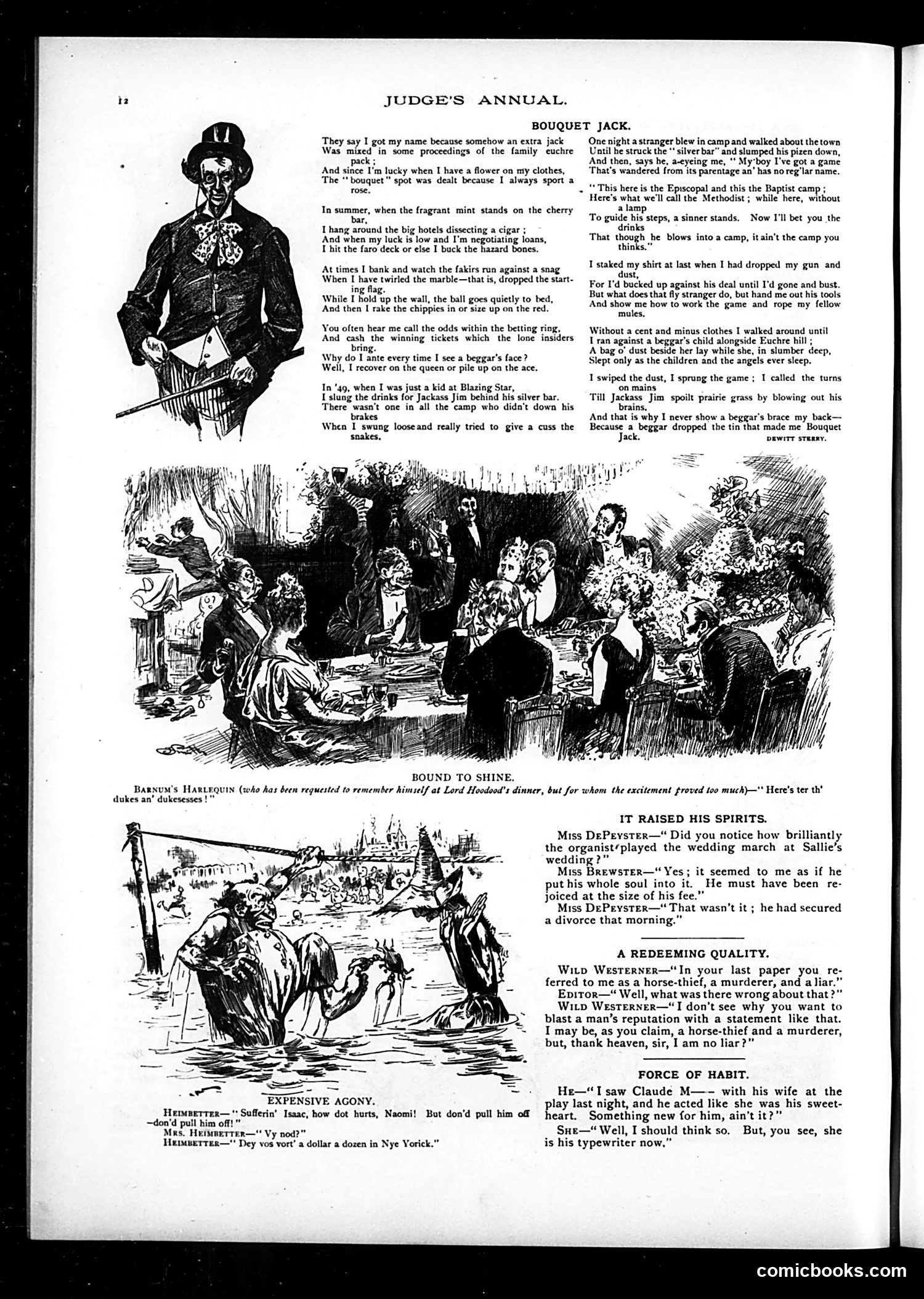
This page contains satirical humor typical of late-19th-century Judge magazine: **"Bouquet Jack"** is a narrative poem about a gambling drifter in Gold Rush California ('49) who gains his nickname from luck with cards. The satire depicts the rough frontier life: saloons, faro games, betting rings. Jack's redemptive moment comes when he steals from a beggar child, uses those winnings to learn a con game, then—wracked by guilt—never refuses beggars again. It's sentimental frontier moralizing dressed as tough-guy cynicism. **Lower cartoons** include brief social satires: a minister playing wedding music brilliantly after securing a divorce (mocking clergy hypocrisy); a "Wild Westerner" objecting to being called a liar while accepting murderer/thief accusations (absurdist humor); and a husband acting affectionate toward his wife because "she is his typewriter now" (commentary on wives as secretaries/workers). The humor relies on period-specific assumptions about frontier types, clerical scandal, and gender roles.
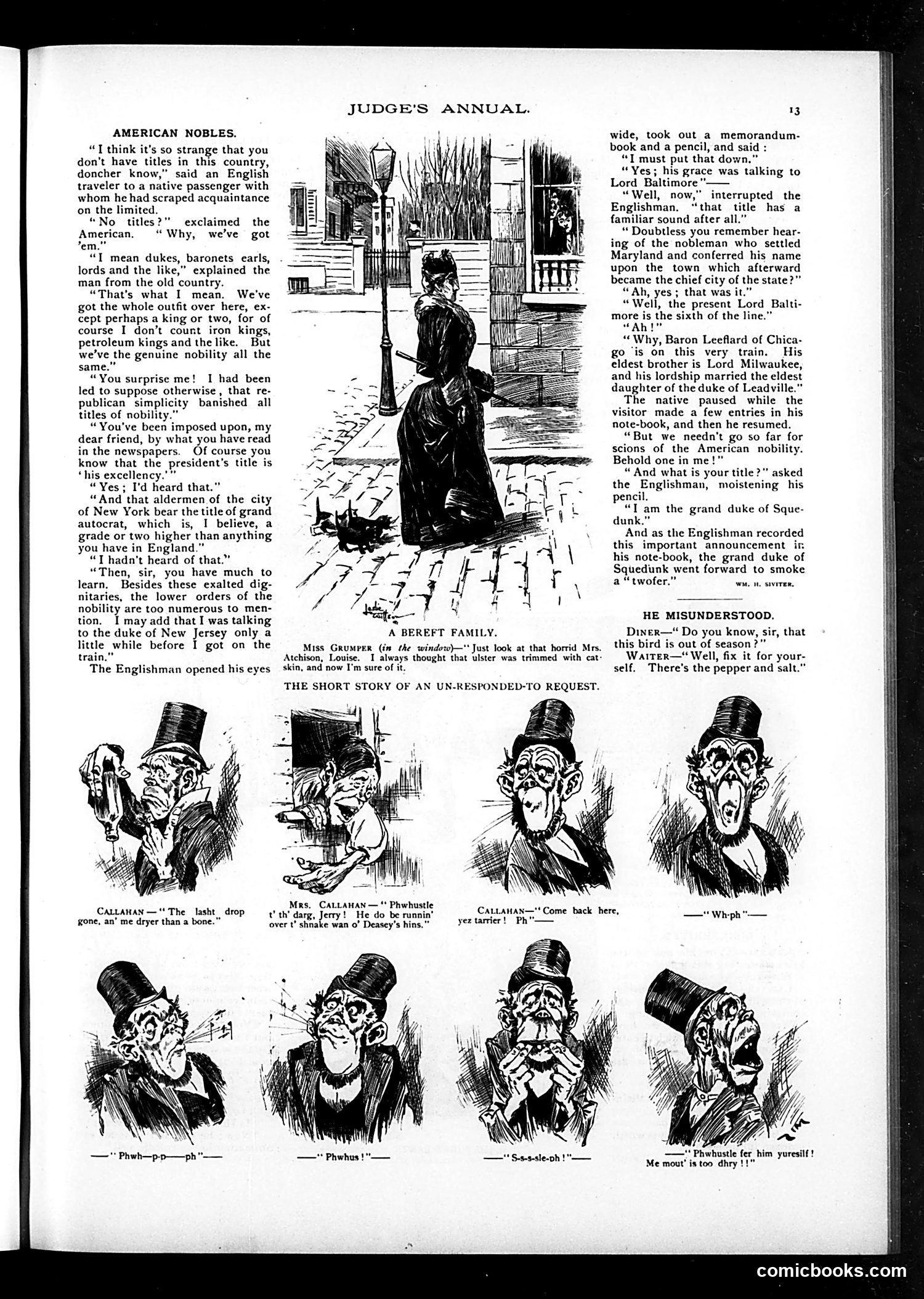
**"American Nobles"** satirizes American pretension and class aspiration. An English traveler, expecting a classless republic, is shocked to learn Americans DO have "nobility"—but it's absurdly democratic. The American explains: city aldermen are "grand autocrats," there's a "duke of New Jersey," "Lord Milwaukee," and a "grand duke of Squedunk" (a made-up place). The joke targets two things: (1) Americans' tendency to inflate minor positions into grandiose titles, and (2) the persistence of class hierarchies in a supposedly egalitarian society. The Englishman earnestly records these "important" announcements, mocking both his gullibility and American social pretension. **"The Short Story of an Un-Responded-To Request"** shows a man (Callahan) repeatedly asking his wife Mrs. Callahan for something (likely alcohol—"the lasht drop gone"), using increasingly desperate facial expressions and phonetic Irish dialect ("Phwhustle," "Phwhustle fer him yerself!"). His request goes ignored. The humor derives from marital comedy and exaggerated Irish immigrant characterization.
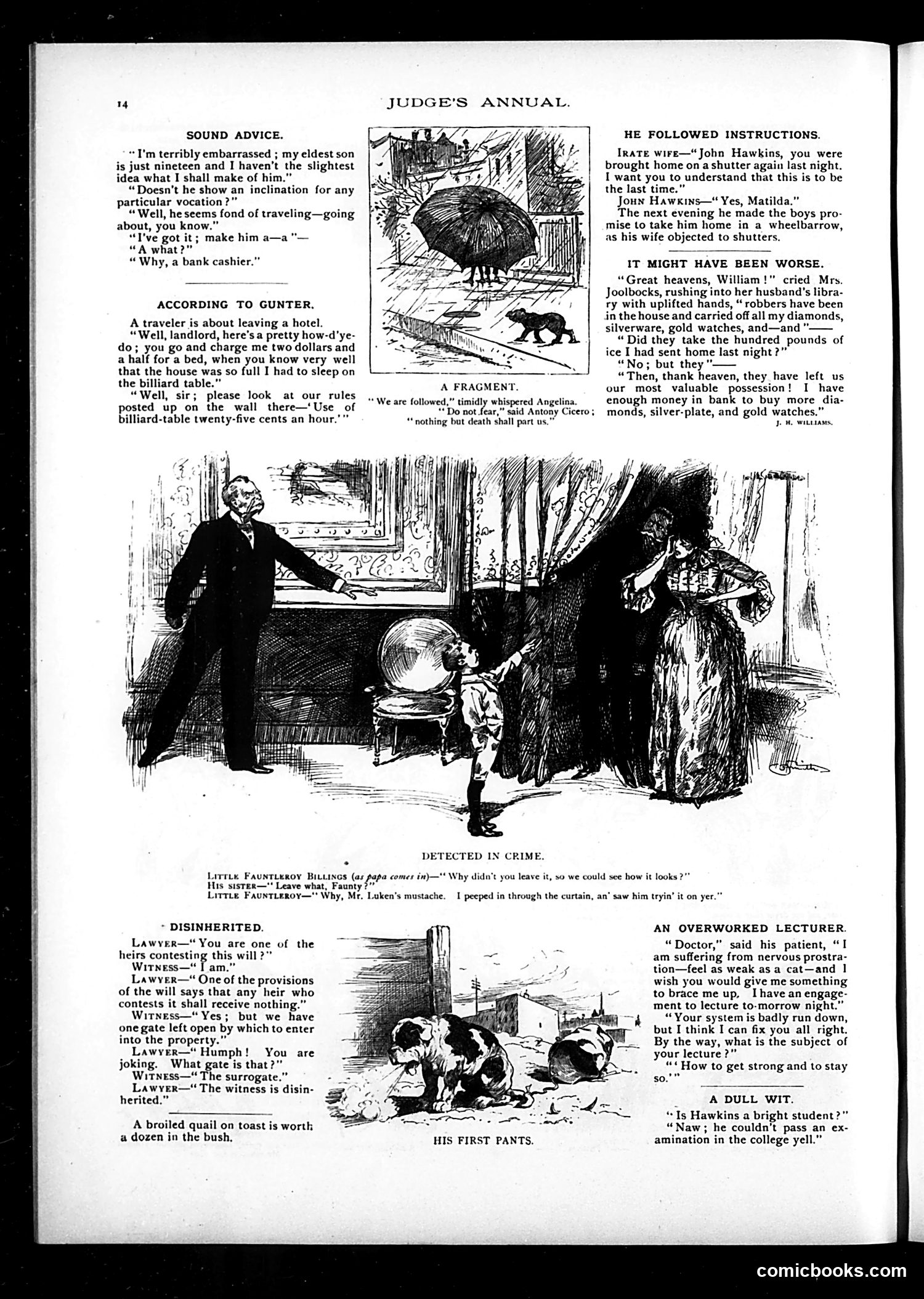
This page from *Judge* magazine contains multiple brief comic sketches typical of late 19th-century American humor. The satire targets: **Parental anxiety**: A father seeks advice about his wandering son, gets told to make him a "bank cashier"—the joke being that travelers make poor employees, yet this is considered suitable guidance. **Hotel billing disputes**: A guest complains about sleeping on a billiard table; the landlord charges him the posted billiard-table rate, turning the guest's complaint into a revenue opportunity through absurd literal interpretation. **Marriage humor**: Several sketches mock domestic life—wives scolding drunk husbands, a husband relieved robbers didn't steal ice (more valuable than diamonds in his view), and a child's innocent observation about a guest's mustache. **Legal absurdity**: A heir contesting a will that disinherits contestants finds a loophole through the surrogate court. **Professional irony**: A lecturer on "getting strong" admits to his doctor he feels weak—undercutting his credibility. The humor relies on wordplay, logical absurdities, and exaggerated character types recognizable to contemporary readers.
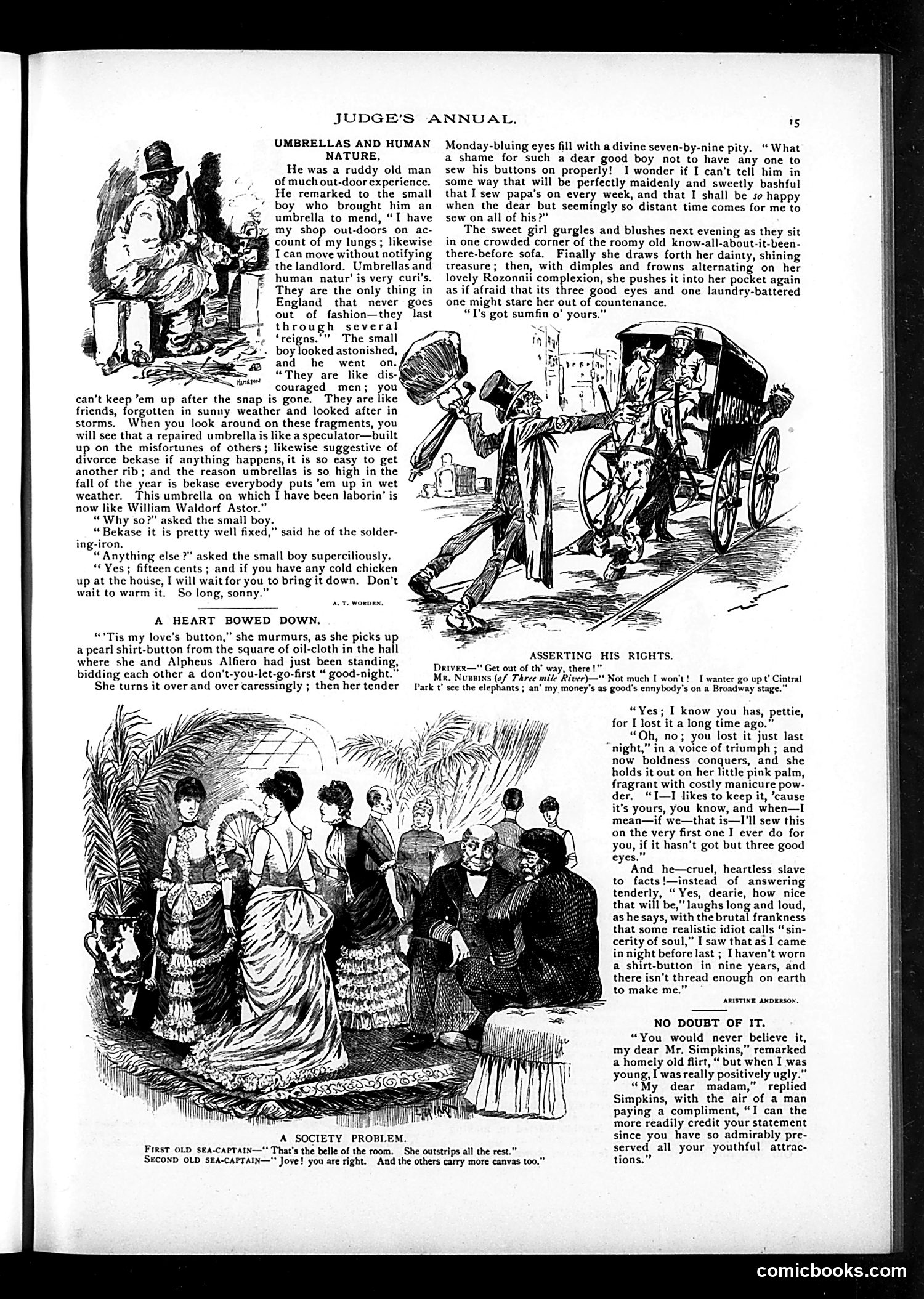
This page contains three separate humorous stories typical of *Judge* magazine's satirical approach. **"Umbrellas and Human Nature"** features an elderly umbrella repairman philosophizing to a boy, drawing absurd comparisons between umbrellas and human nature—they can't stay "up" without support, they're forgotten in good times but valued in hardship, etc. The joke culminates when he compares a repaired umbrella to William Waldorf Astor (a wealthy American expatriate), saying it's "pretty well fixed"—a pun on the umbrella's repair and Astor's wealth. **"A Heart Bowed Down"** sentimentally depicts a young woman finding a lost shirt button from a suitor, romanticizing it as an opportunity to offer sewing help—a socially acceptable way to show interest. The humor lies in her overwrought emotions and demure scheming over a trivial object. **"A Society Problem"** shows two sea captains discussing a woman at a social gathering, comparing her to ships. One "outstrips" others despite carrying less "canvas" (sail)—mocking socialite pretension and the arbitrary nature of popularity.
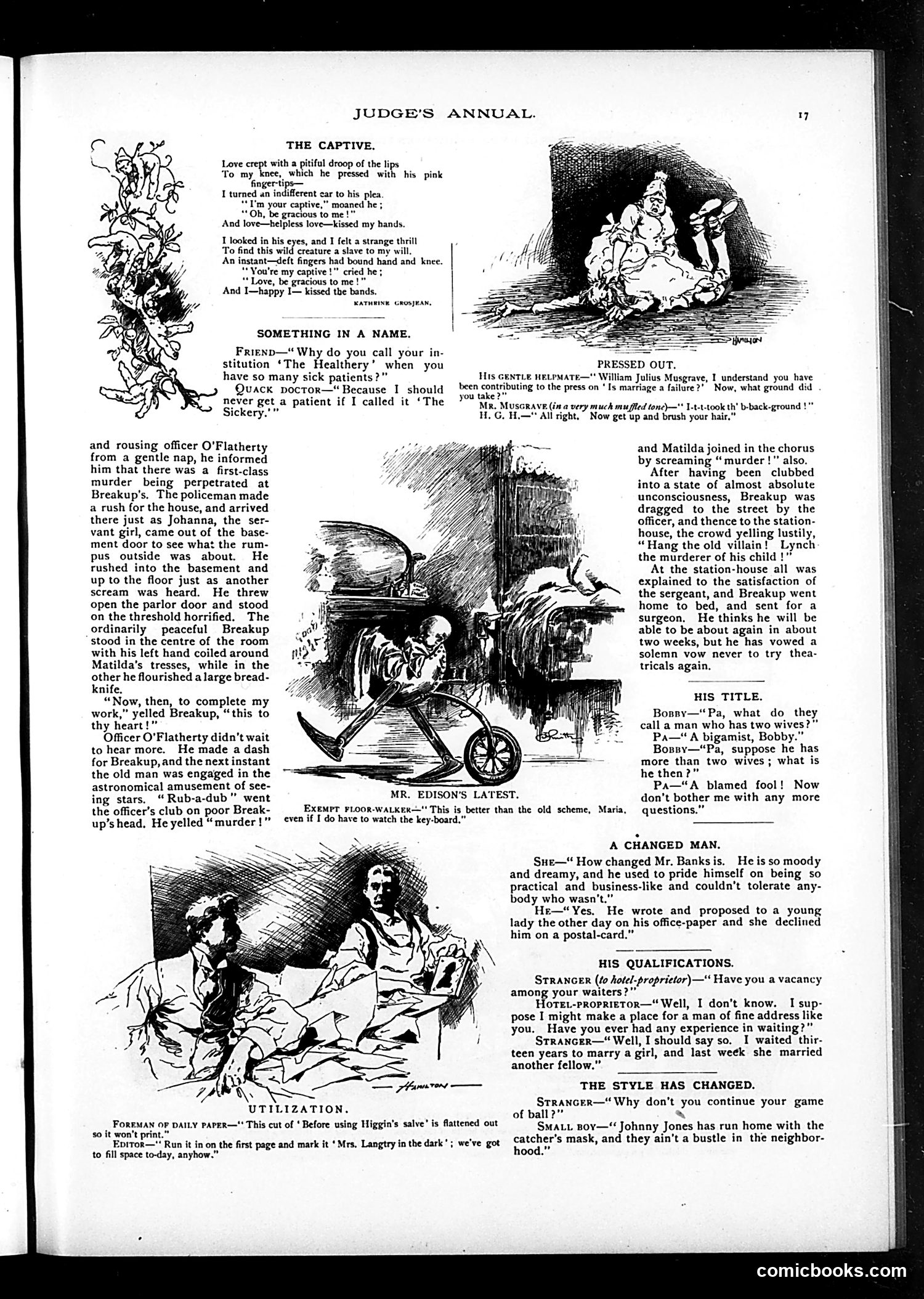
This page contains several unrelated humorous sketches typical of Judge's satirical style: **"The Captive"** is a romantic poem about lovers playfully "capturing" each other, illustrated with a sentimental sketch. **"Something in a Name"** mocks medical fraud: a quack doctor calls his establishment "The Healthery" rather than "The Sickery" to attract patients—satirizing deceptive marketing in healthcare. **"Pressed Out"** jokes about marital discord: a husband admits taking the "back-ground" in a debate about whether marriage fails, suggesting his wife dominates him. **"Mr. Edison's Latest"** references Thomas Edison's innovations, showing a floor-walker monitoring workers via some device—likely satirizing new surveillance technology in retail. **Additional sketches** include jokes about bigamy, a changed businessman, and a waiter's employment qualifications. The illustrations use exaggerated caricature typical of period humor magazines. The overall tone mocks domestic life, quackery, technology's intrusion into work, and social pretension—common Judge targets.
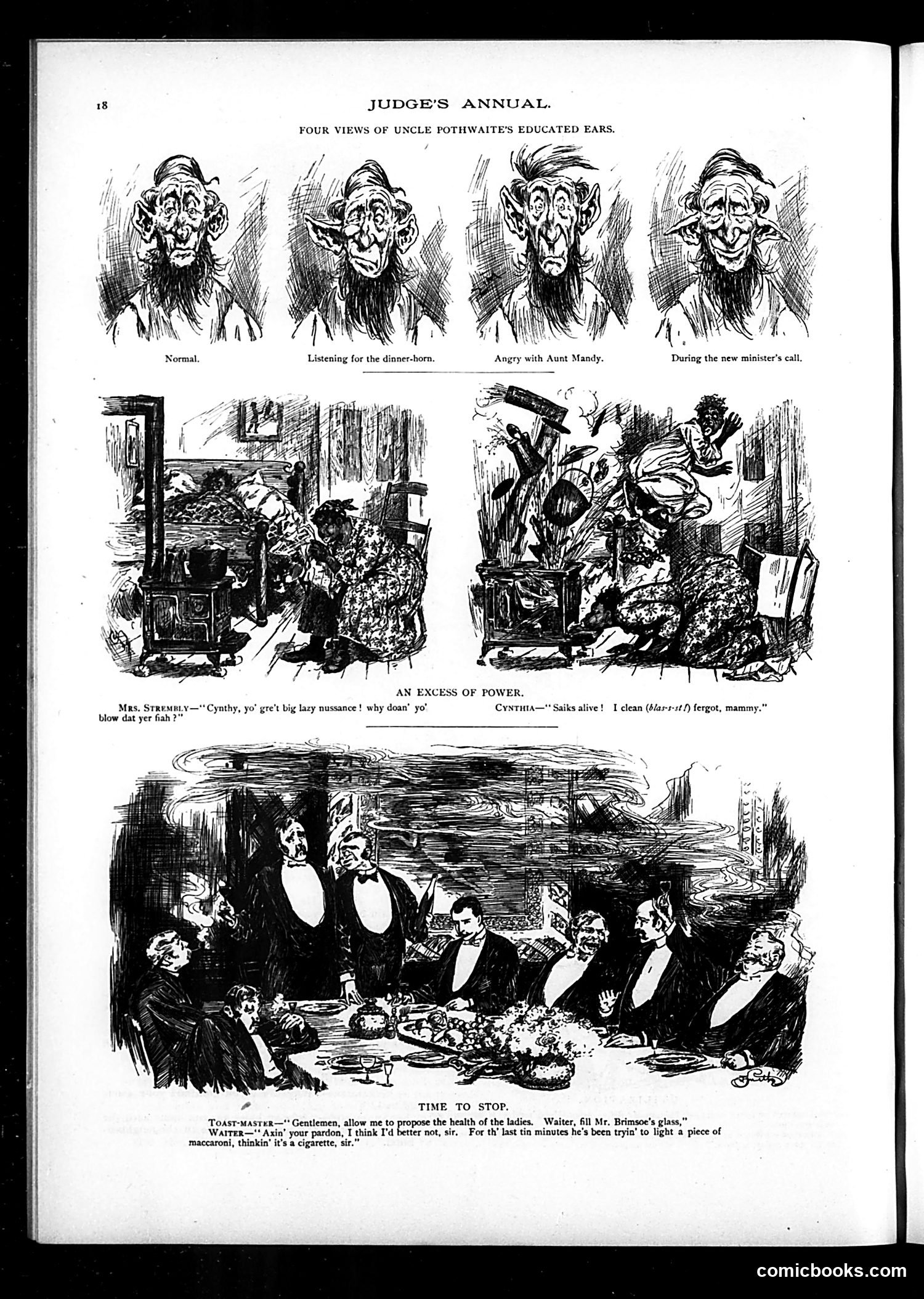
This page contains three separate satirical cartoons: **Top section** shows "Uncle Pothwaite's Educated Ears" — four exaggerated facial expressions (Normal, Listening for the dinner-horn, Angry with Aunt Mandy, During the new minister's call) mocking a character's comically expressive features, likely poking fun at rural or working-class dialect humor popular in the era. **Middle section**, "An Excess of Power," depicts domestic chaos where women (Mrs. Strembly and Cynthia) are wildly energetic and destructive indoors — satirizing female energy or "New Woman" anxieties of the period. **Bottom section**, "Time to Stop," shows a formal dinner where a drunk guest (Mr. Brimsoe) has become so intoxicated he's attempting to light pasta as a cigarette. The waiter refuses to serve him more alcohol, mocking excessive drinking at social gatherings. All reflect turn-of-century American humor: exaggerated dialects, class comedy, domestic disorder, and alcohol-fueled absurdity.
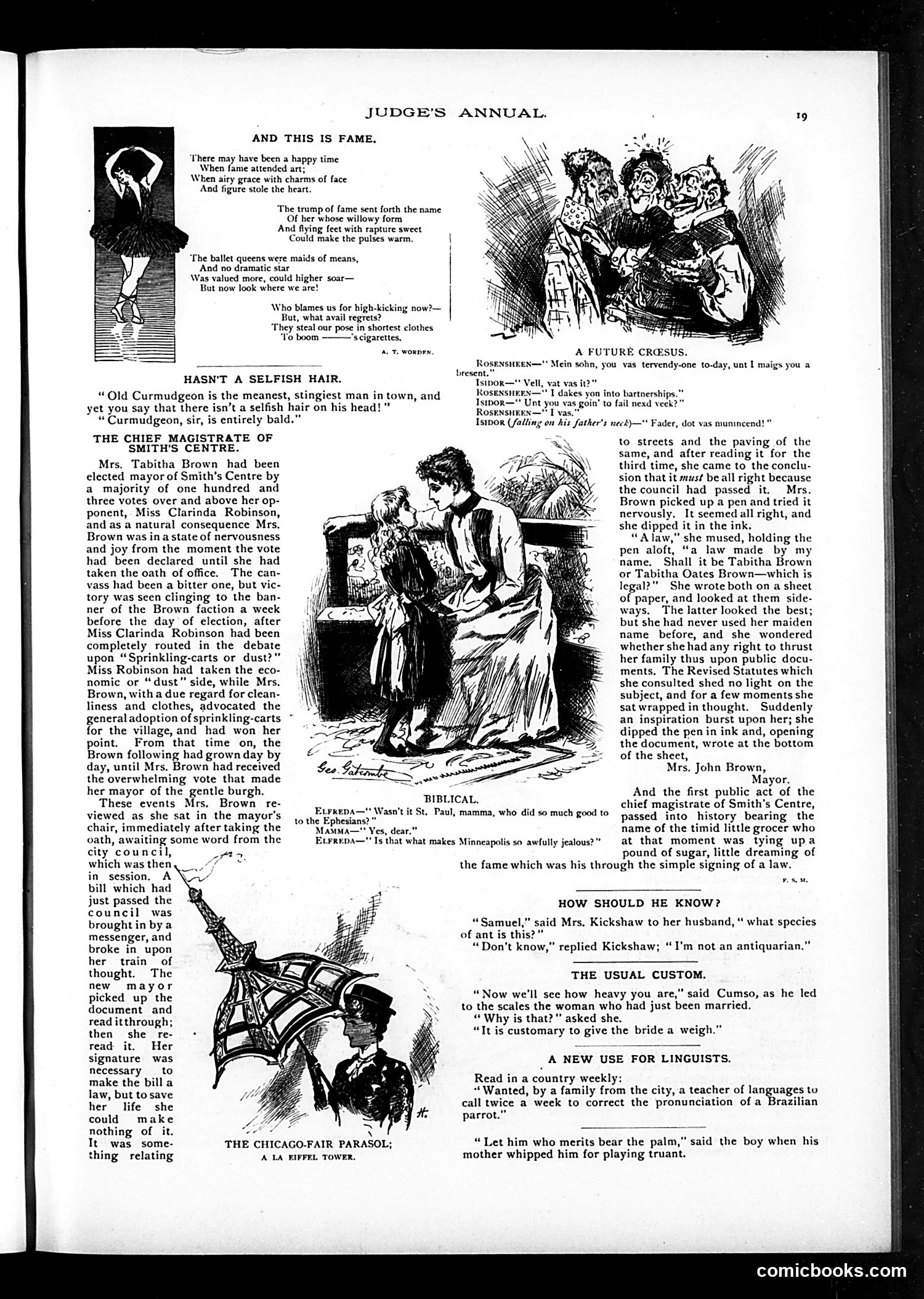
This page from *Judge*, a late-19th/early-20th-century satirical magazine, contains several unrelated humorous pieces: **"And This Is Fame"** critiques the decline of dignity in entertainment, specifically women performers. The poem laments that ballet dancers once represented grace and elegance, but now (implied: the present era) debase themselves by engaging in high-kicking acts and promoting cigarettes for commercial gain—a sharp comment on commercialism and changing entertainment standards. **"The Chief Magistrate of Smith's Centre"** humorously depicts a newly elected female mayor, Mrs. Tabitha Brown, paralyzed by indecision over whether to sign official documents as "Tabitha Brown" or "Tabitha Oates Brown" (her maiden name), ultimately choosing a third option: "Mrs. John Brown, Mayor"—gently satirizing women's uncertain status regarding identity and authority in civic life. The page also includes brief comic snippets ("A Future Cresus," "Biblical," etc.) typical of *Judge's* miscellaneous humor format, plus illustrations complementing the satire.
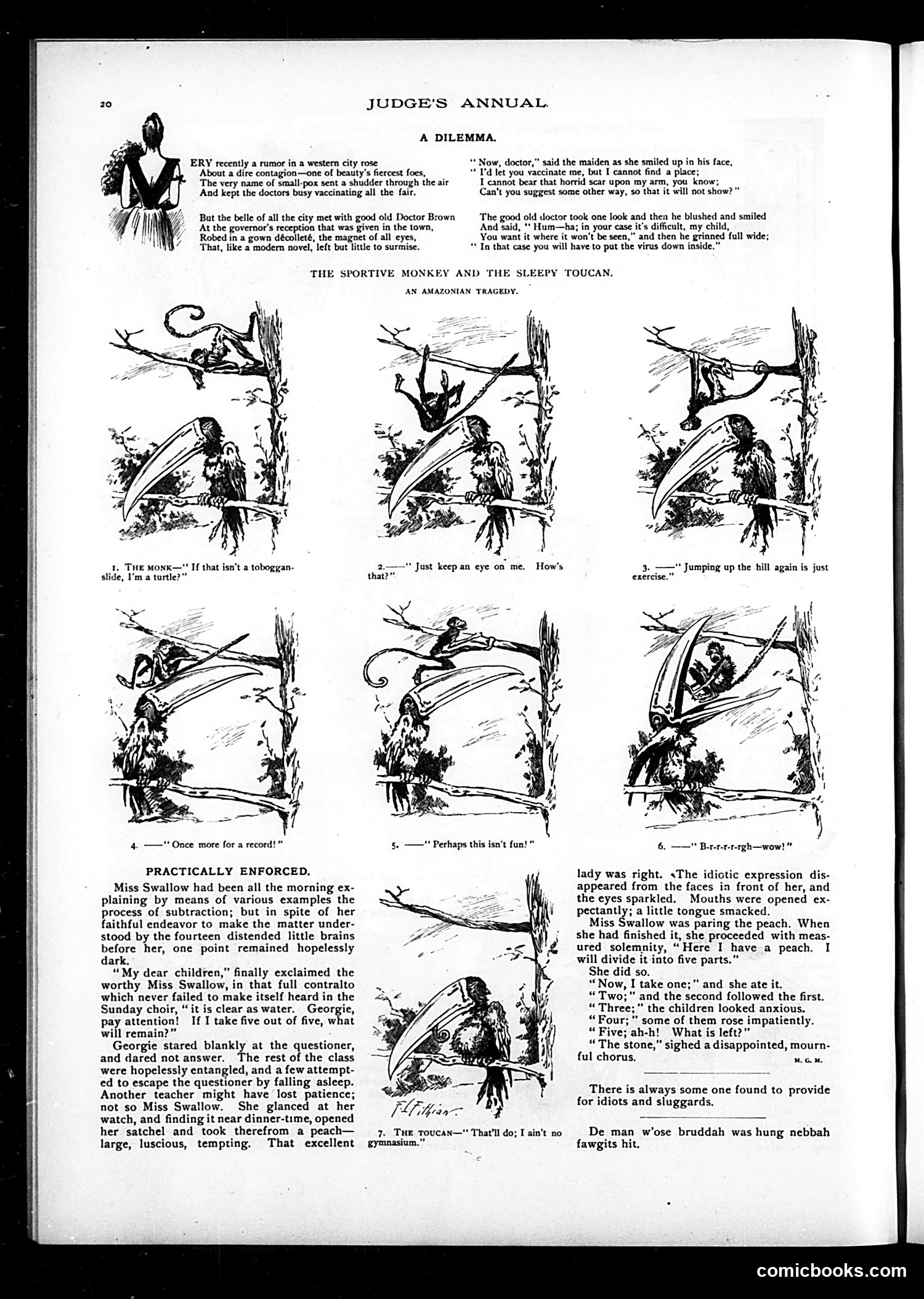
**"A Dilemma"** satirizes the social vanity of wealthy women during a smallpox vaccination campaign in an unnamed western city. A beautiful young woman ("the belle of all the city") seeks vaccination but refuses the visible arm scar it leaves—a mark of the procedure's necessity. Doctor Brown's final suggestion ("the virus down inside") is a euphemistic joke implying an intimate/internal location, playing on her vanity and the era's prudish sensibilities. The satire targets women prioritizing appearance over public health during a genuine contagion threat. **"The Sportive Monkey and the Sleepy Toucan"** is a sequential animal comic strip showing a monkey and toucan engaged in acrobatic play on a tree branch—likely simple visual humor without political content. **"Practically Enforced"** depicts a teacher, Miss Swallow, using practical demonstration (dividing a peach) to teach distracted schoolchildren basic subtraction—humorous commentary on pedagogical methods and student attention spans. The final line ("provide for idiots and sluggards") uses period dialect as a punchline.
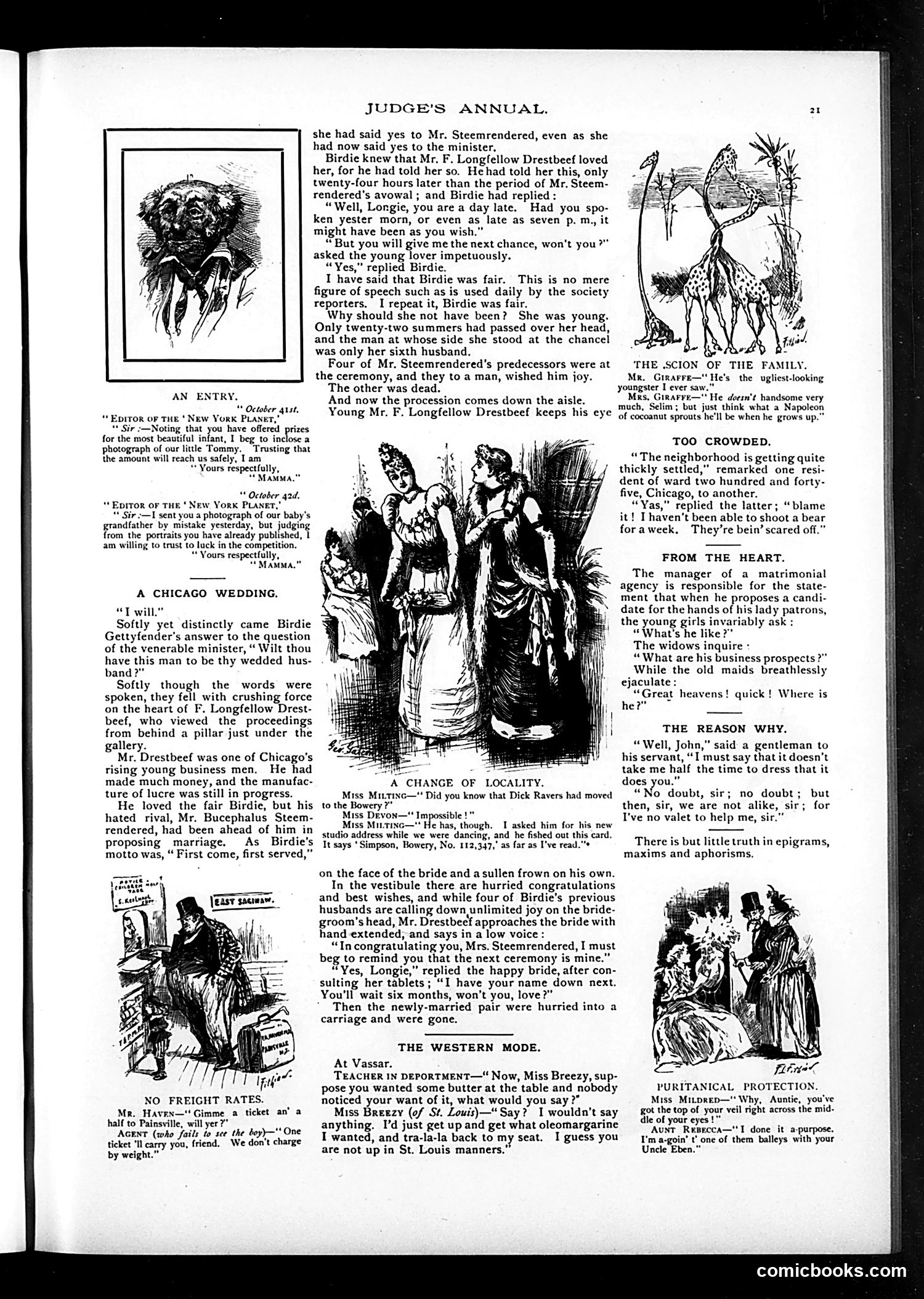
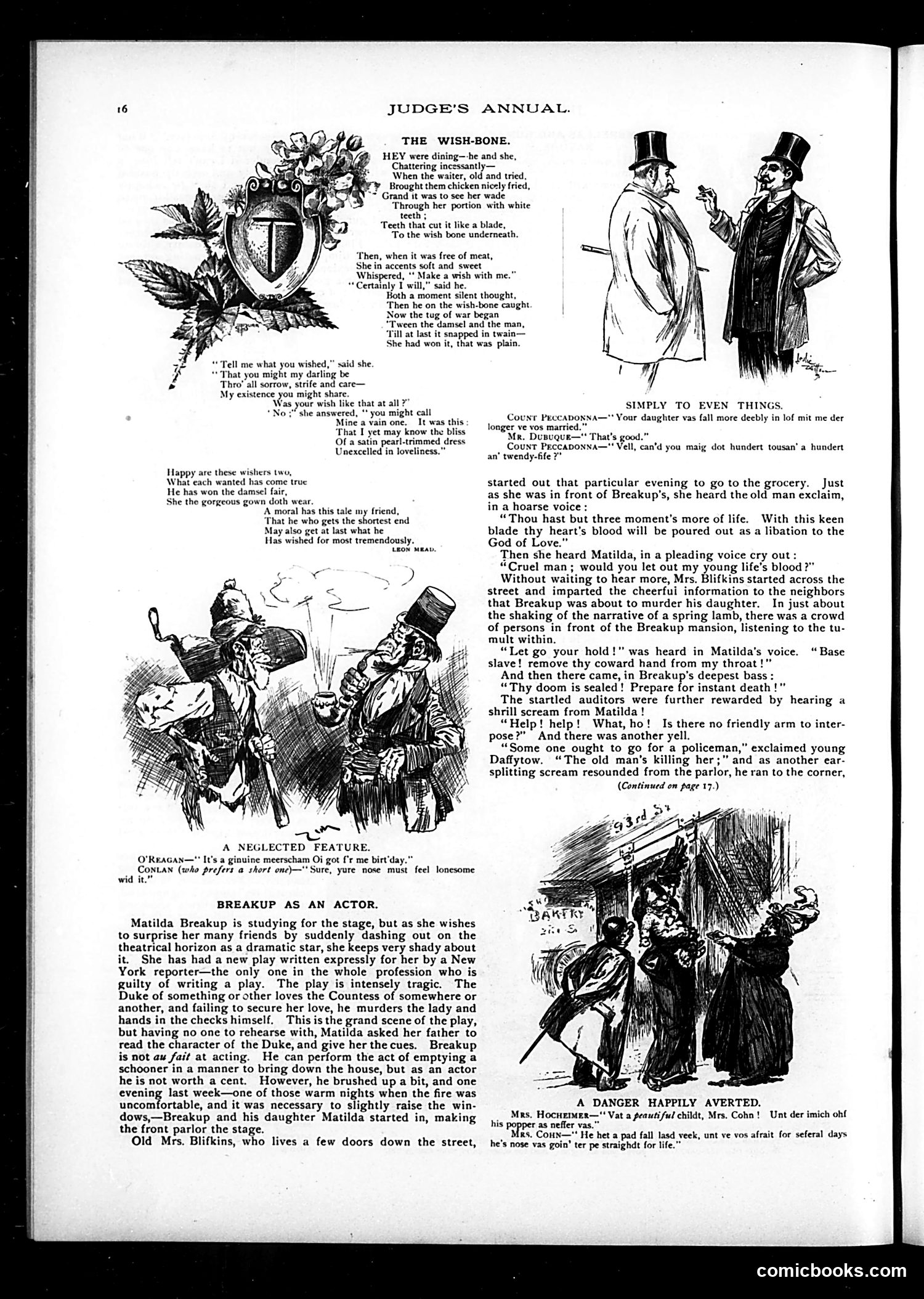
This page contains multiple short humorous pieces mocking American social conventions and pretensions. **"A Chicago Wedding"** is the main feature—a satirical story about Birdie Gettyfender, who marries her sixth husband while her previous lover watches from behind a pillar. The joke targets wealthy Chicago businessman culture: Birdie treats marriage as a transactional game ("First come, first served"), casually promising her new husband's rival that he'll be "next" after a six-month wait. The satire ridicules both the frivolous attitudes toward marriage among the wealthy and the men who accept such arrangements. **Supporting items include:** - Letters mocking parents submitting ugly babies to a beauty contest - "No Freight Rates"—a joke about a boy's weight being underestimated - Brief social commentary pieces on changing neighborhoods and etiquette The overall satirical target is **Gilded Age excess, romantic carelessness, and social climbing** in urban America, presented through exaggerated scenarios highlighting the absurdity of contemporary mores.
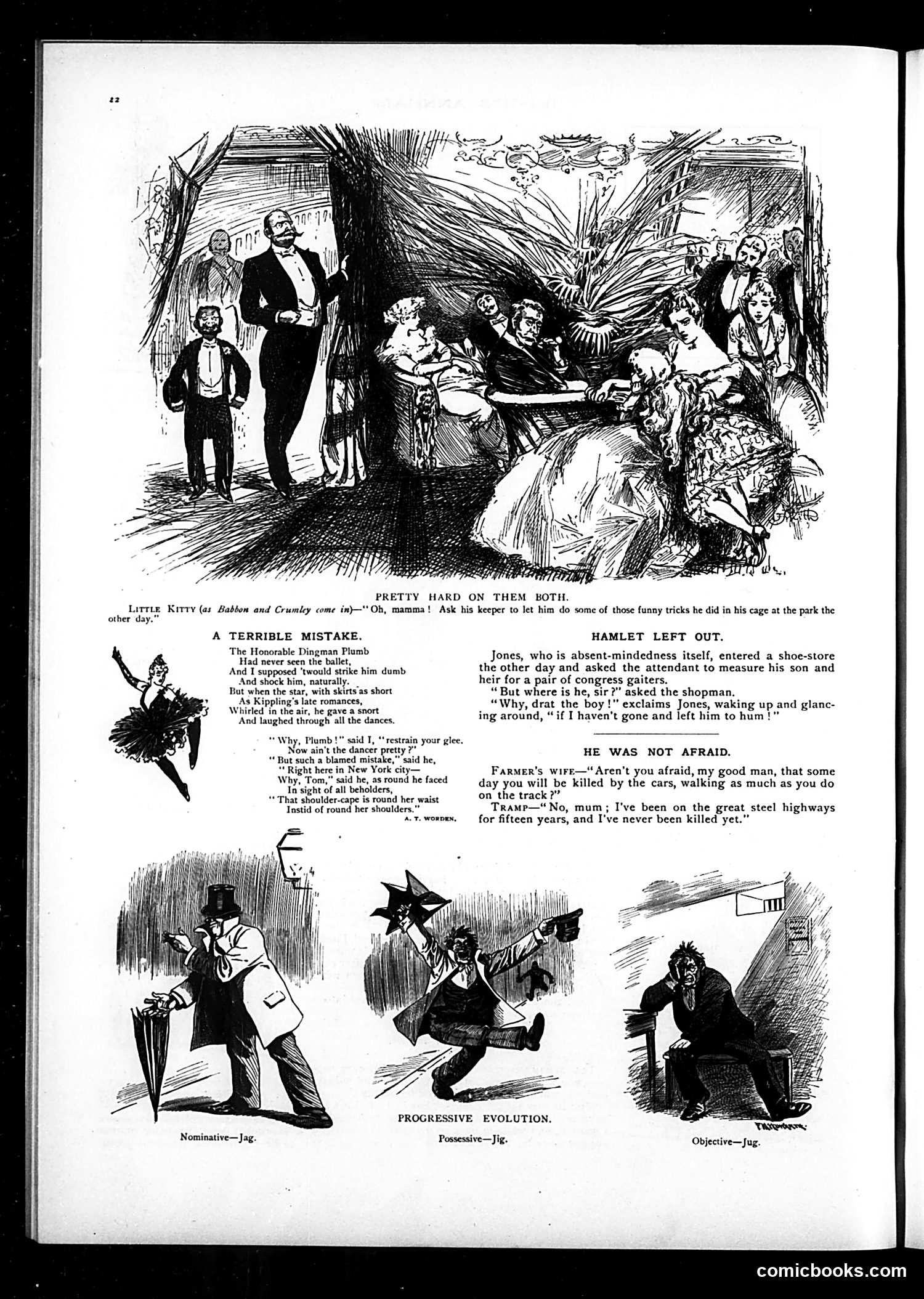
This page contains several satirical sketches mocking contemporary figures and social situations: **Top cartoon**: "Pretty Hard on Them Both" depicts Little Kitty comparing a visiting performer (likely a famous dancer or entertainer) to animals doing tricks in a cage—a cutting insult to the visitor's talent or dignity. **"A Terrible Mistake"**: The Honorable Dingman Plumb is mocked for absent-mindedness. Having attended a ballet with scandalously short skirts (compared to Kipling's recent works), he confuses the dancer's shoulder cape placement, then leaves his son behind at a shoe store—satirizing both his lack of attention and the era's shocked reaction to modern dance costumes. **"Hamlet Left Out"**: Jones absent-mindedly measures his son for shoes but forgets the boy is there, creating dark humor about parental inattention. **"He Was Not Afraid"**: A tramp boasts of fifteen years walking railroad tracks without injury—satirizing either the tramp's foolish fearlessness or society's callous indifference to working-class danger. **Bottom section**: "Progressive Evolution" shows a drunk man in three grammatical cases—wordplay on linguistic decline through intoxication.
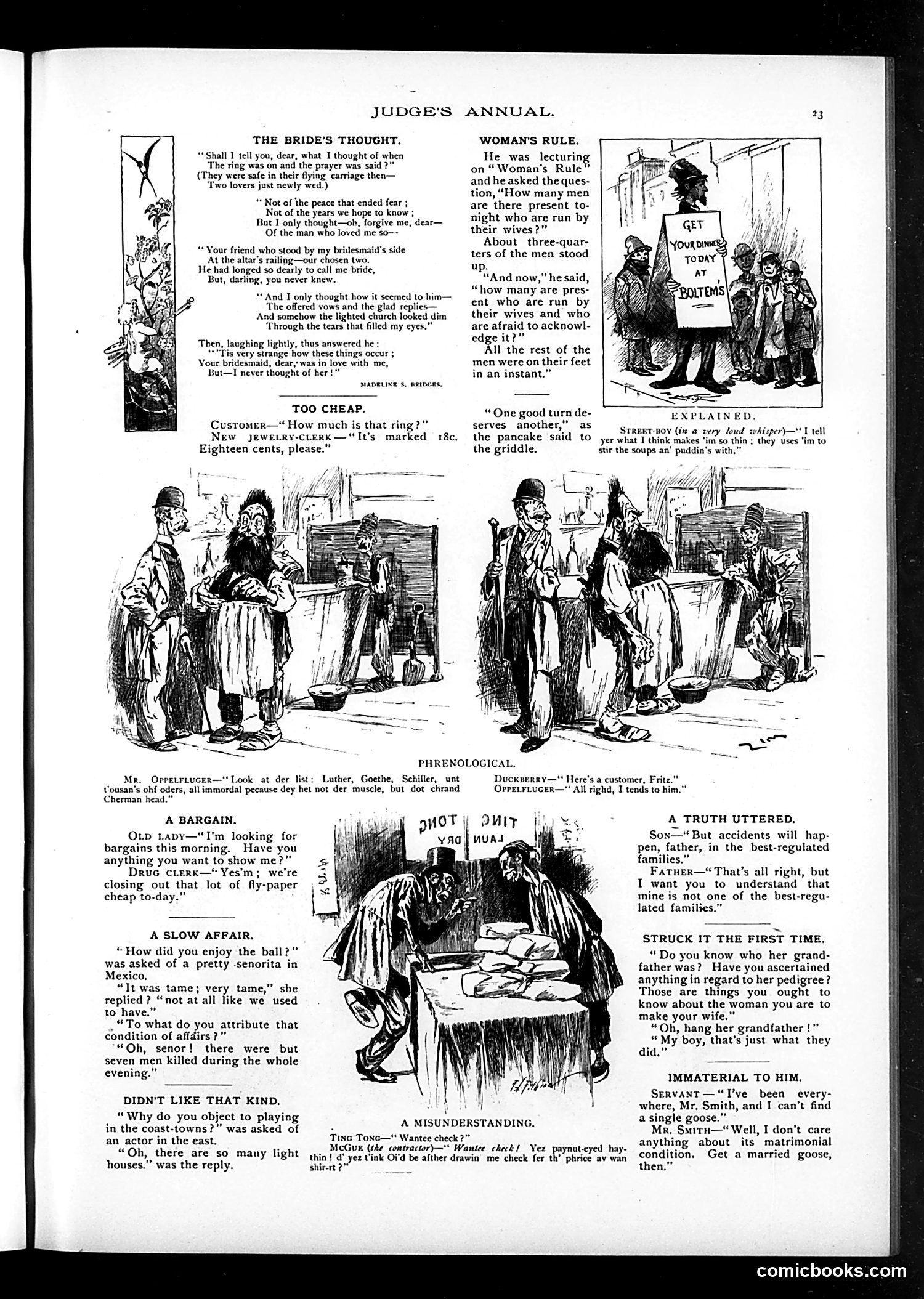
This page from Judge presents various short humorous pieces typical of late 19th/early 20th-century American satire: **"The Bride's Thought"** satirizes romantic self-deception—the bride imagines the groom was deeply moved, but he was actually thinking about her bridesmaid who loved him. **"Woman's Rule"** mocks male hypocrisy about marriage: a lecturer asks men who are "run by their wives" to stand; only three-quarters do, revealing most men are controlled by their wives but fear admitting it publicly. **Other sketches** include: a customer buying cheap fly-paper as a "bargain"; an actor avoiding coastal towns because of "light houses" (pun on "light o' loves"/affairs); ethnic caricatures in crude dialect humor; and a servant unable to find a goose, prompting the master to request "a married goose"—suggesting married women are similarly unsatisfactory. The page reflects period attitudes toward gender relations, marriage anxieties, and ethnic stereotyping common to Judge's humor, emphasizing male dominance anxieties and marital discord for laughs.
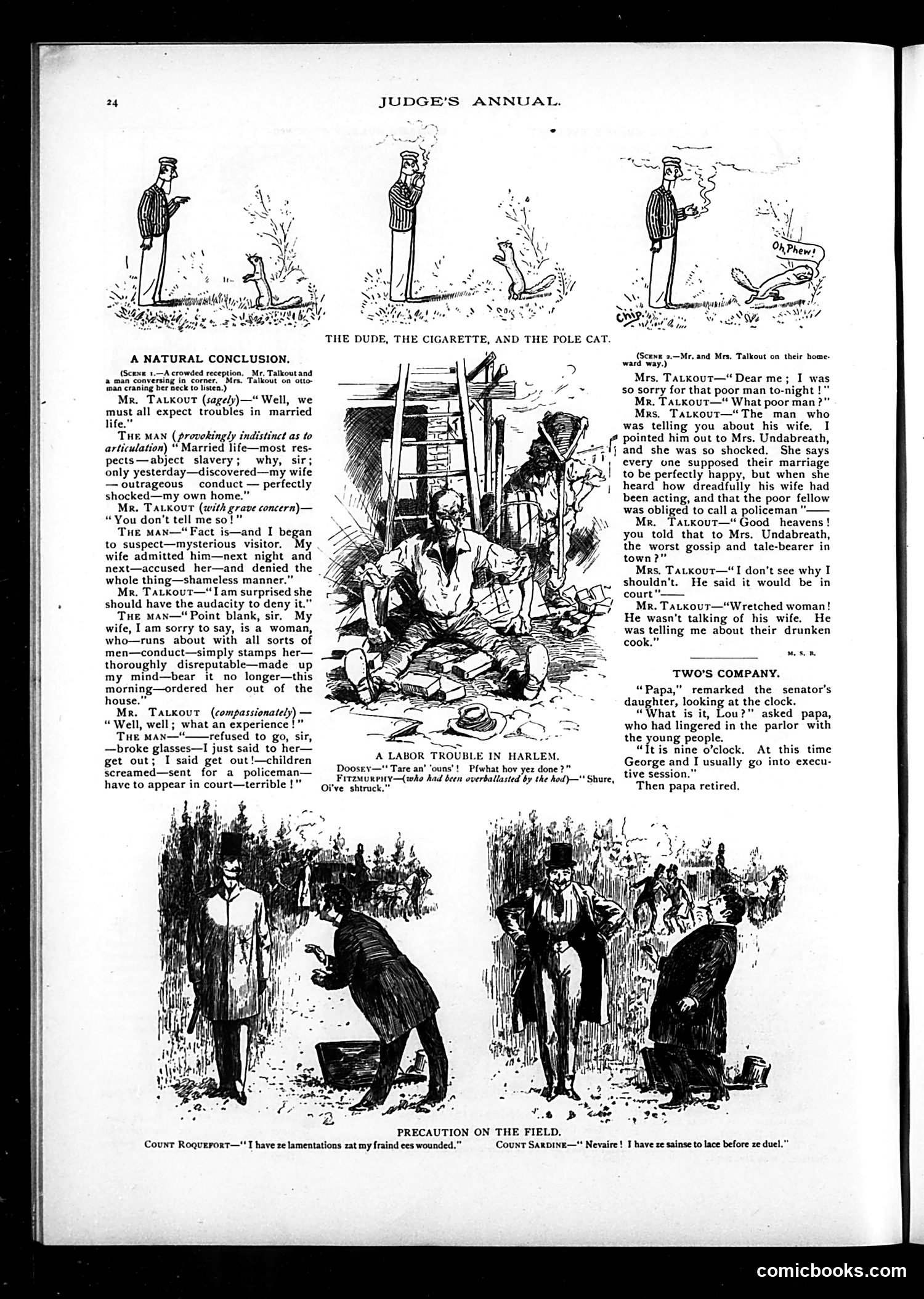
This page contains three separate comedic sketches satirizing American social life: **"A Natural Conclusion"** mocks how gossip spreads. Mr. Talkout hears a man's complaint about his wife's misconduct and domestic chaos. Mrs. Talkout eavesdrops, then tells the scandal-mongering Mrs. Undabreath—only to learn the man was actually complaining about his *cook*, not his wife. The joke: female gossips amplify rumors without listening carefully, creating false scandals. **"Two's Company"** jokes about courtship conventions. A senator's daughter asks her father to leave the parlor at 9 p.m., claiming she and her suitor need "executive session" (private time). The implication—romantic privacy—is deliberately coy. **"Labor Trouble in Harlem"** and **"Precaution on the Field"** use ethnic dialect humor (Murphy's Irish brogue) and dueling references, typical of period American comedy. The satire targets: gossiping women, romantic courtship rituals, and working-class struggles—all Gilded Age social preoccupations.
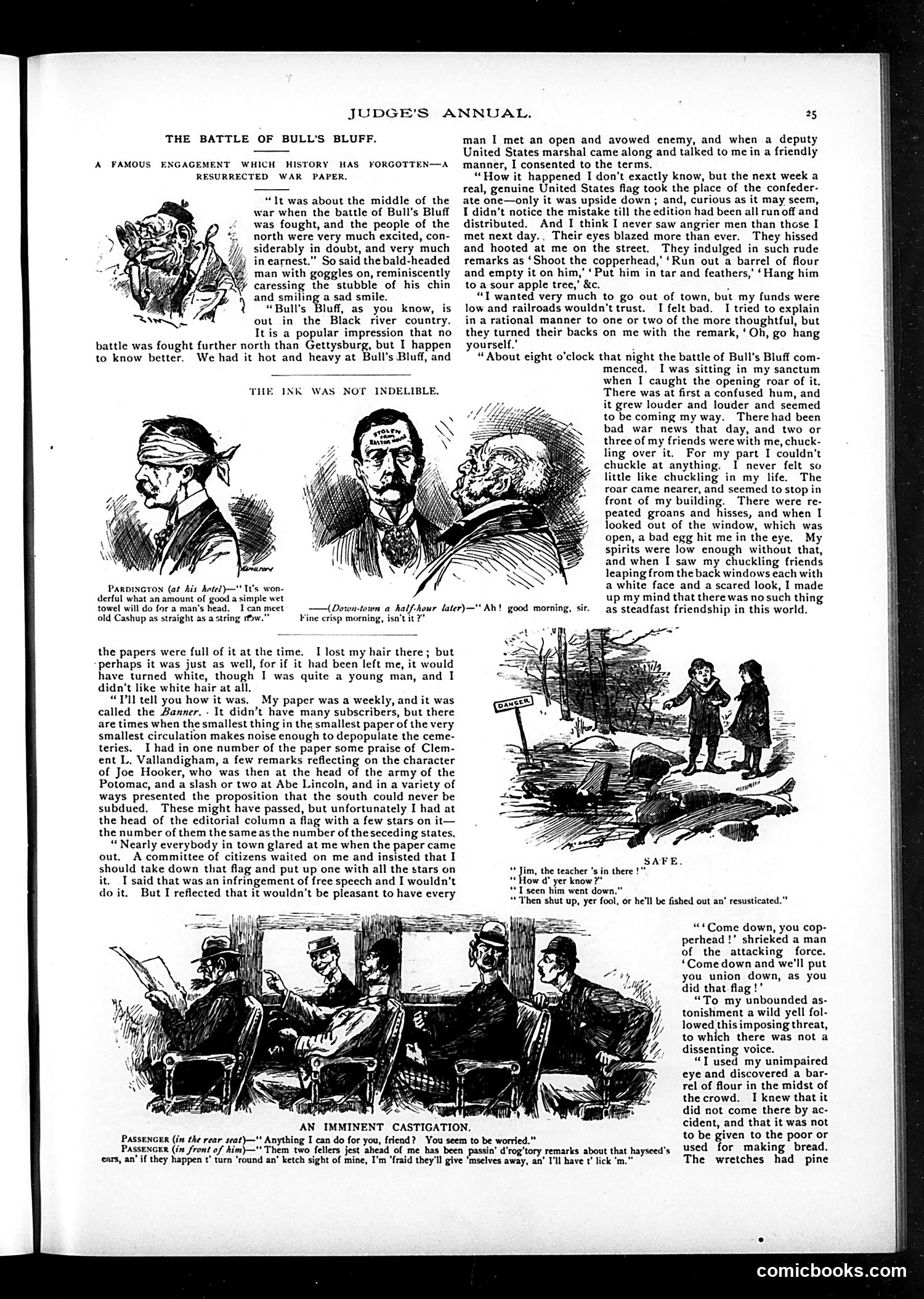
This page satirizes Civil War-era Northern politics through a newspaper editor's anecdote. The main story describes a weekly paper called the *Banner* that published pro-Southern editorials and displayed a Confederate flag (with fewer stars than the Union flag). When angry townspeople demanded he remove it, the editor complied—but the replacement Union flag was hung upside down, an accidental insult that enraged the community even more. The satire targets Copperheads (Northern anti-war Democrats): the editor's sympathetic portrayal of Confederate causes and initial resistance to patriotic pressure, combined with his passive-aggressive "mistake," mocks their obstruction of the war effort. The smaller cartoons depict period characters and social commentary typical of *Judge* magazine's humor. The piece uses ironic humor to ridicule those who undermined Northern war aims, whether through explicit disloyalty or calculated negligence.
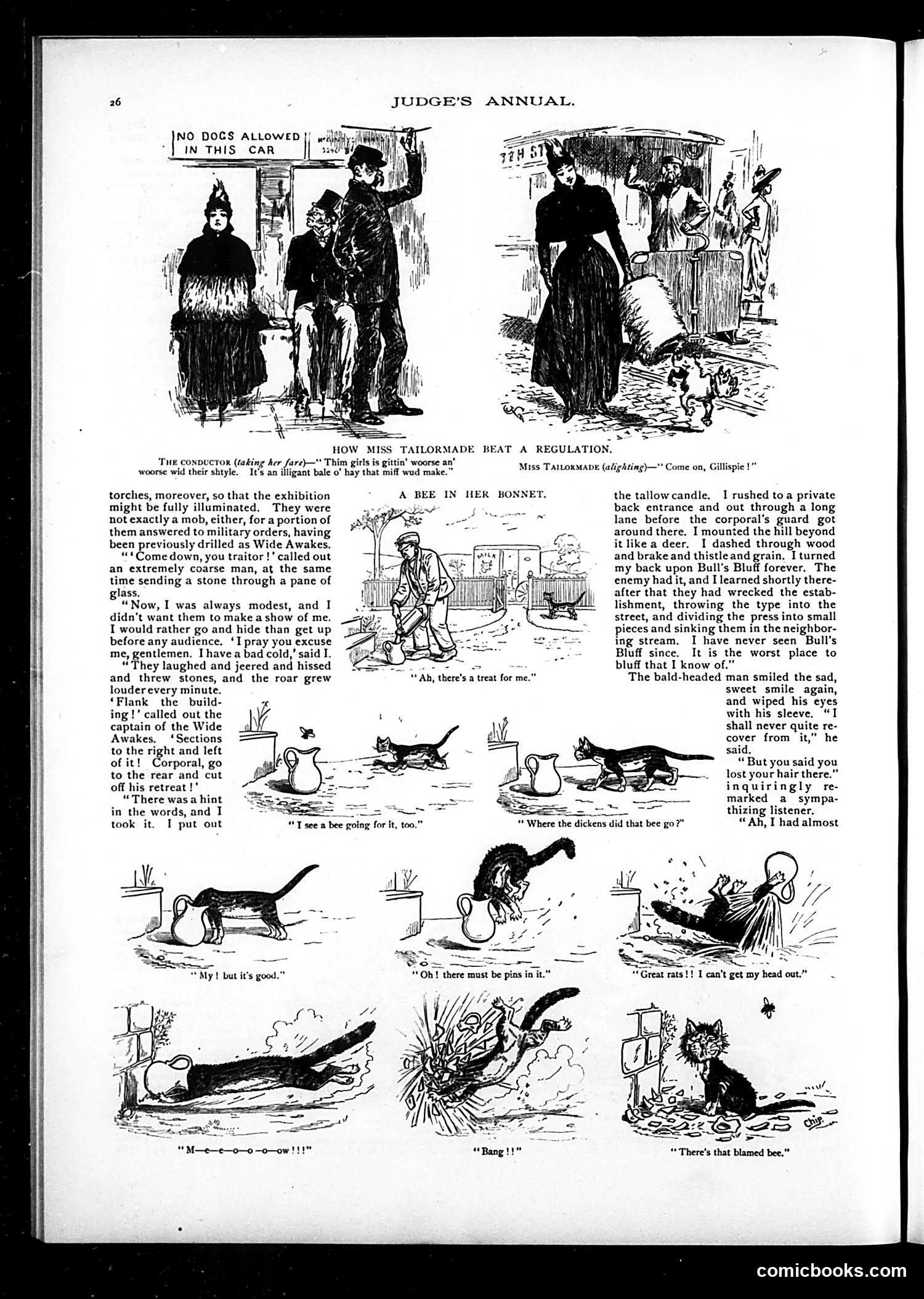
This page contains multiple satirical cartoons and a narrative anecdote from what appears to be the Civil War era. **Top cartoons**: "How Miss Tailormade Beat a Regulation" mocks fashionable women wearing oversized bustles/hoop skirts too wide for public transportation—the conductor complains about their "style." The second shows a woman with an enormous bonnet catching a bee, illustrating impractical fashion. **Main narrative**: A bald man recounts fleeing from a "Wide Awakes" mob—a Civil War-era Republican paramilitary organization known for torchlit processions and intimidation. He describes being chased from Bull's Bluff (a real 1861 battle site) by uniformed militia, escaping through woods. The punchline: he lost his hair during this terrifying flight, explaining his current baldness. **The satire**: Judge ridicules both frivolous women's fashion excess and partisan political violence. The juxtaposition suggests both are absurd concerns of American society—one trivial, one dangerous—reflecting post-war attitudes toward reconstruction-era divisions.
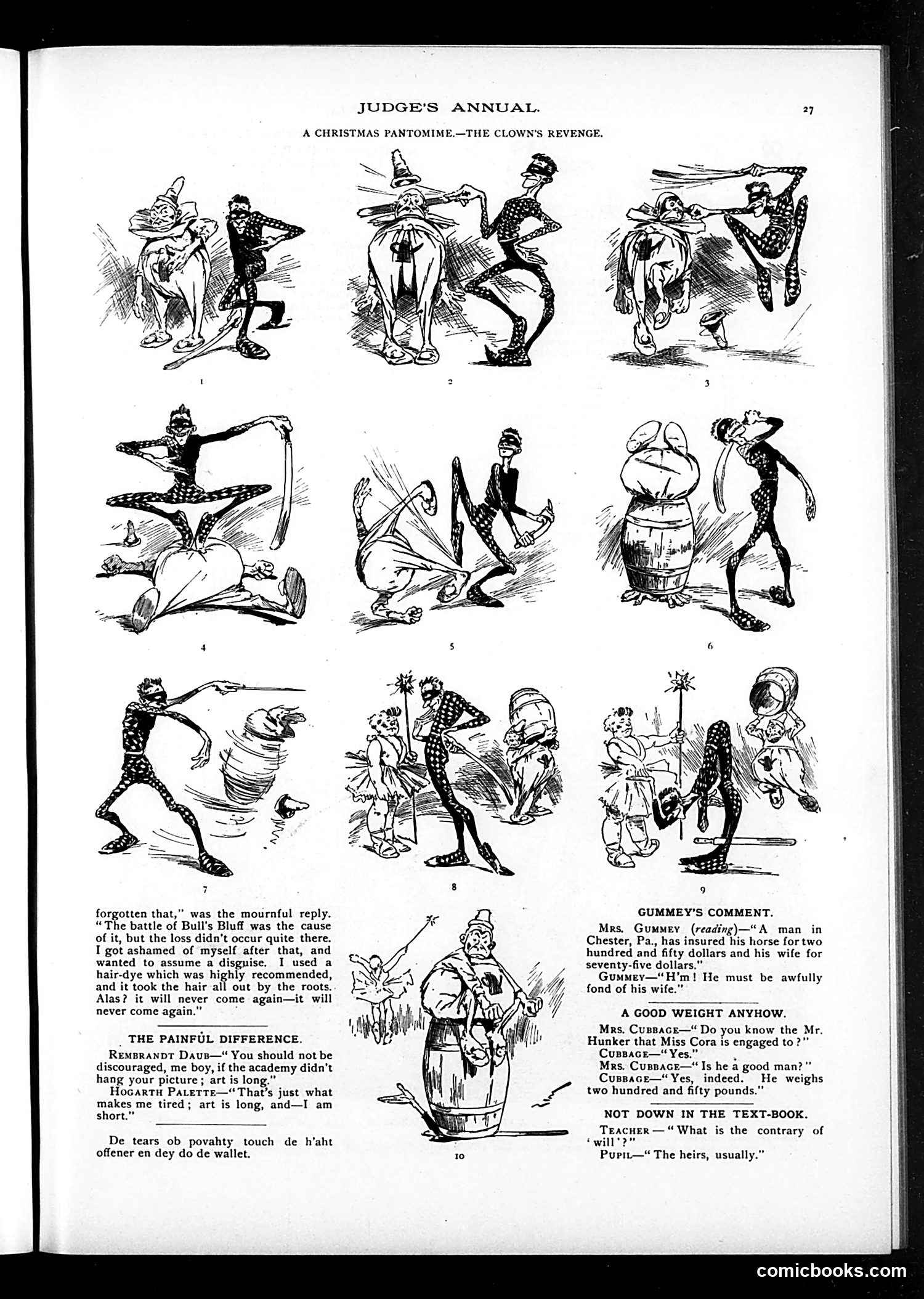
This page presents a multi-panel comic strip (panels 1-10) depicting a pantomime narrative, likely a theatrical performance. The numbered illustrations show a clown character interacting with various figures in slapstick situations—tumbles, collisions, and physical comedy typical of Victorian-era pantomime entertainment. Below the main comic strip are several brief humor pieces, including: - A dialogue about a soldier who lost his hair after the Battle of Bull's Bluff (a Civil War reference), attributing his baldness to shame and a failed hair-dye remedy - A joke contrasting artistic longevity with human shortness - Several domestic humor exchanges about insurance, marriage, and a student's joke about inheritance The page exemplifies *Judge* magazine's mix of visual comedy and witty wordplay, targeting educated readers familiar with current events (the Civil War) and literary/philosophical references. The humor relies on visual slapstick alongside verbal irony about class, courtship, and social pretension.
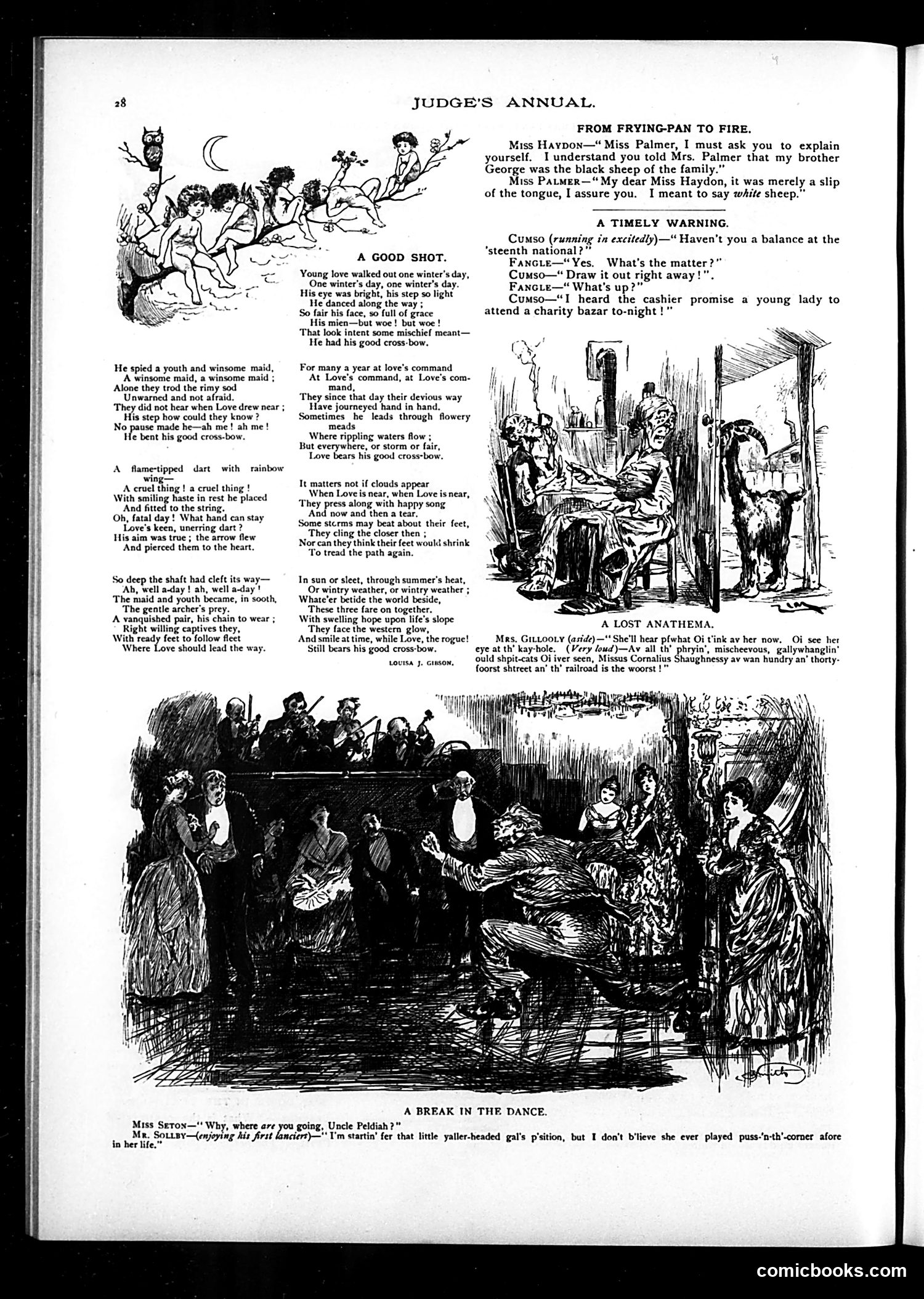
This page contains several brief satirical pieces typical of late-19th-century American humor: **"A Good Shot"** is a romantic poem illustrated with Cupid imagery, celebrating love's "arrow" striking young couples. It's sentimental rather than satirical. **"From Frying-Pan to Fire"** jokes about a social gaffe: Miss Palmer claims she called someone a "black sheep" but meant "white sheep"—a transparent and awkward non-apology that compounds the offense. **"A Timely Warning"** satirizes financial anxiety: Cumso urgently tells his friend to withdraw bank deposits because the cashier promised to attend a charity bazaar tonight—implying the bank will fail without him present. It mocks both financial panic and the assumption that one person's absence causes institutional collapse. **"A Lost Anathema"** depicts an Irish woman (indicated by dialect spelling) loudly cursing a neighbor, unaware someone's listening at the keyhole. **"A Break in the Dance"** shows a brief social scene with minimal context visible. The page emphasizes class distinctions, ethnic humor, and relationship dynamics typical of Judge's satirical voice.
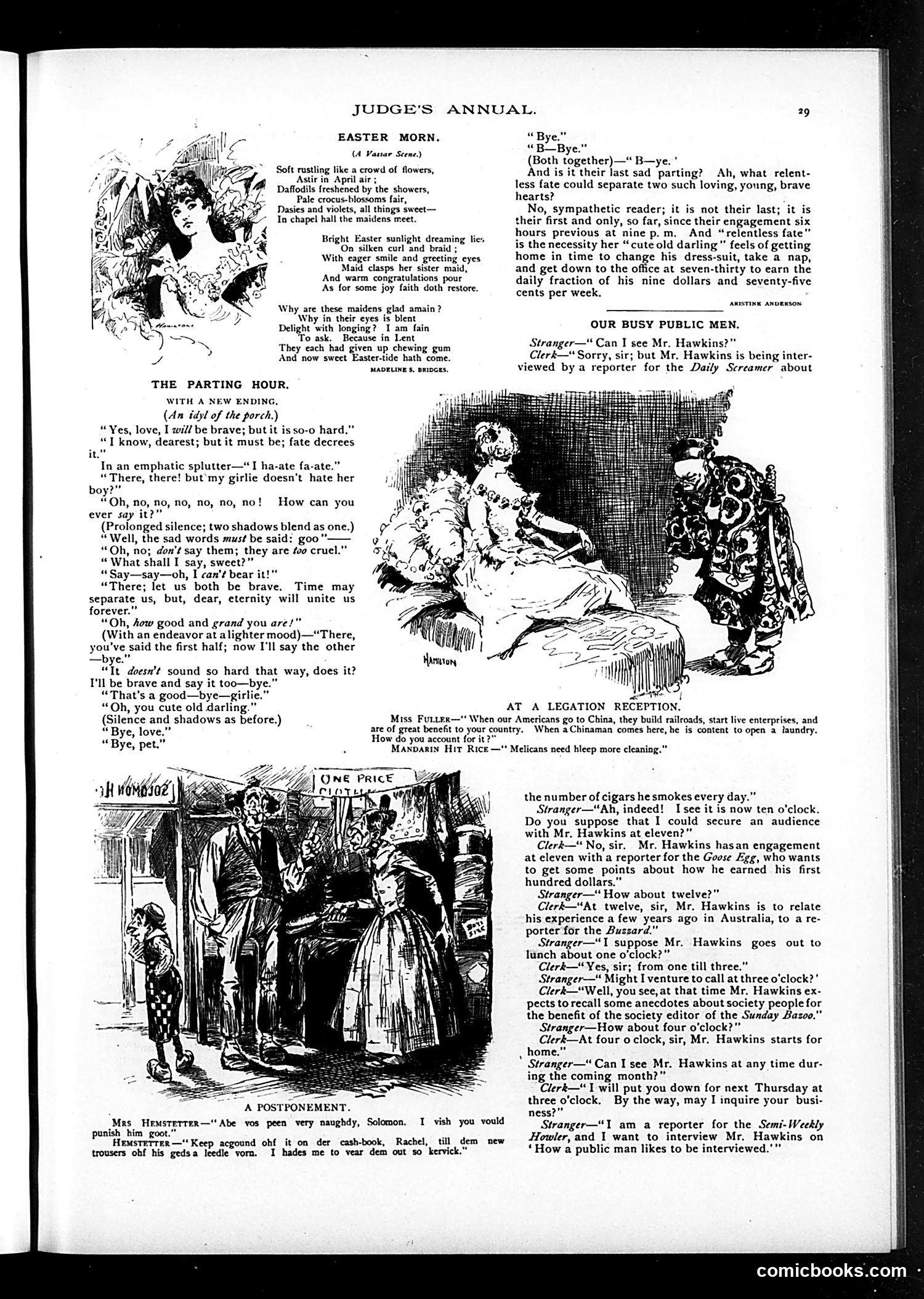
This page from Judge contains three distinct satirical pieces mocking American social conventions and media culture: **"Easter Morn"** and **"The Parting Hour"** are sentimental love poems parodying Victorian romance literature. The joke is revealed in the prose commentary: young lovers dramatically bid farewell after their *first* engagement (six hours old), not their last. The "relentless fate" separating them is merely the practical need for him to return home, nap, change clothes, and get to work to earn his meager weekly wage—undermining the overwrought emotional performance. **"Our Busy Public Men"** satirizes the American media's obsession with interviewing prominent figures. A stranger attempts to meet "Mr. Hawkins" but discovers he's perpetually unavailable, booked solid with reporters from competing publications (*Daily Screamer*, *Goose Egg*, *Bussard*, *Sunday Bazoo*). The satire critiques both the relentless news cycle and public figures' vanity in granting endless interviews about trivial accomplishments. Together, these pieces mock sentimental excess and media sensationalism of the era.
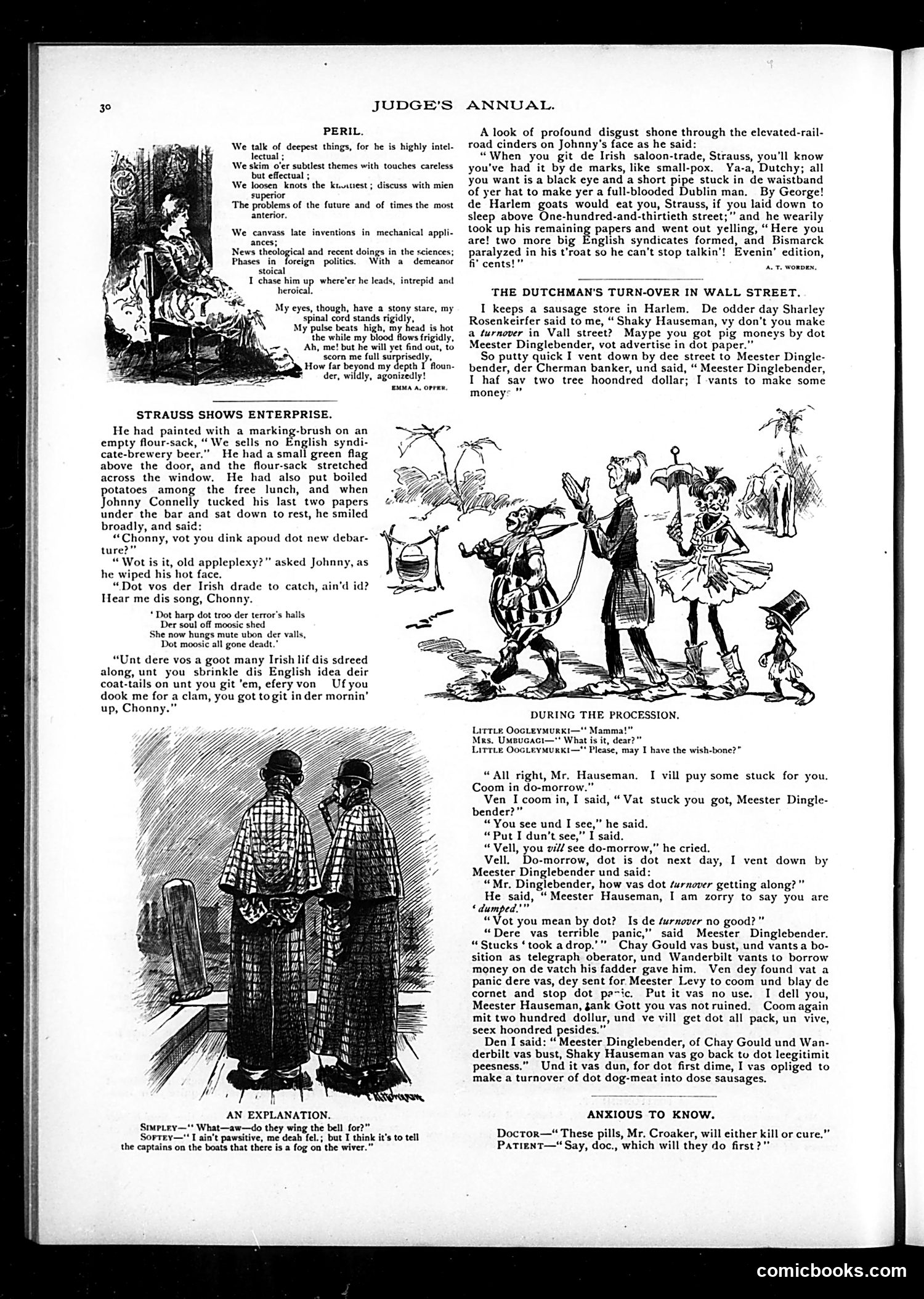
This page contains three satirical pieces mocking German and Irish immigrant stereotypes in late 19th-century America. **"Strauss Shows Enterprise"** ridicules a German saloon owner (Strauss) attempting to attract Irish customers by serving boiled potatoes and posting nationalist Irish imagery. An Irish newspaper vendor (Johnny Connelly) sarcastically dismisses the scheme, warning that attracting Irish patrons will only bring trouble—suggesting ethnic tension and the idea that Irish clientele were considered problematic or rowdy. **"The Dutchman's Turn-Over in Wall Street"** depicts a naive German immigrant (Hauseman) being swindled by a German banker (Dinglebender) in a stock scheme. The broken English dialogue emphasizes immigrant gullibility and financial inexperience, playing on class anxieties about working-class immigrants losing savings to con artists. Minor jokes include ethnic humor about Irish and German accents rendered through misspellings. The overall theme: immigrants as either troublesome (Irish) or easily duped (German), reflecting period prejudices.
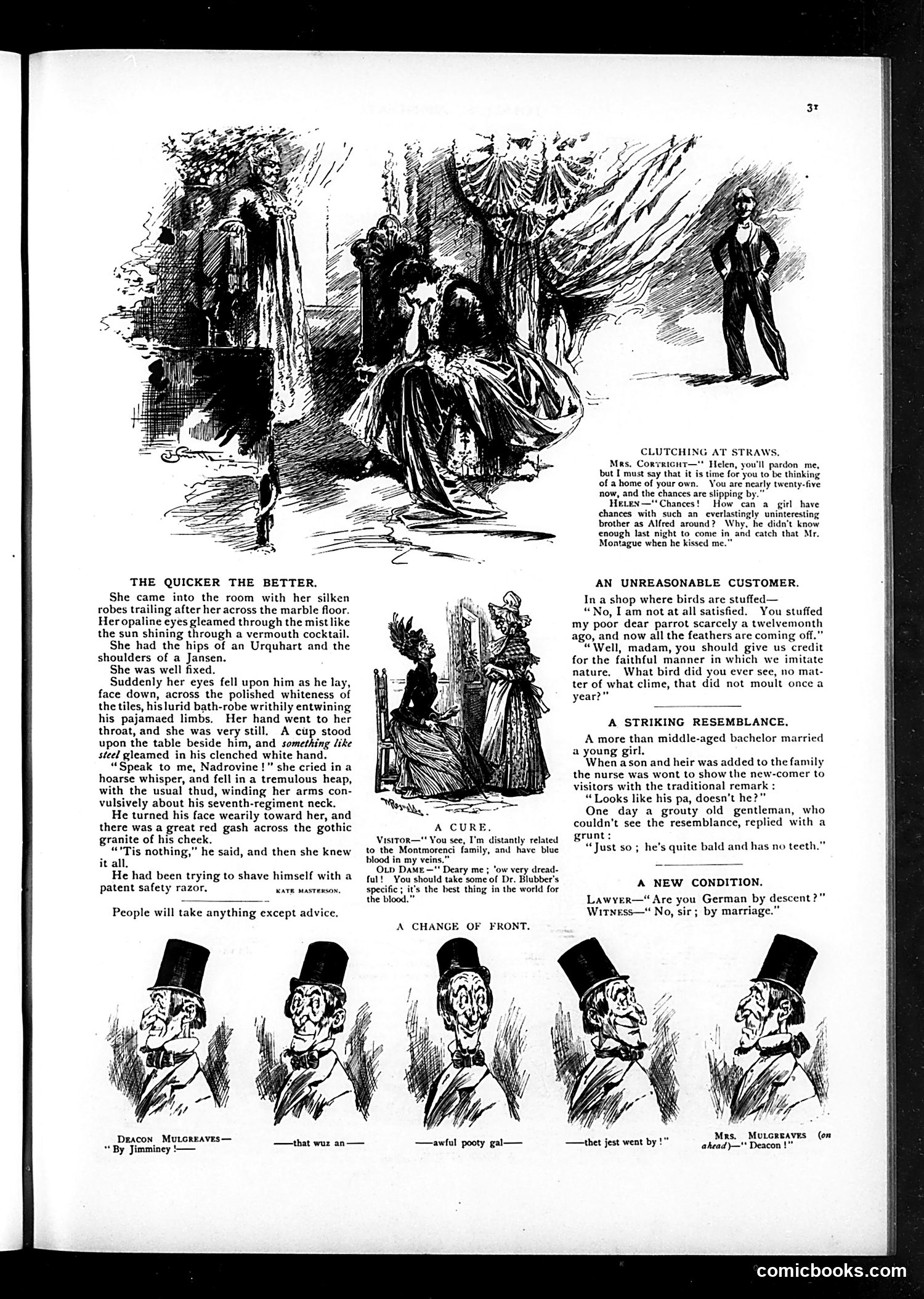
This page from *Judge* magazine contains several short humorous sketches typical of late-19th/early-20th-century satirical journalism. **"The Quicker the Better"** mocks overwrought romantic fiction—the flowery prose about a woman discovering her lover injured is undercut by the reveal that his "dramatic wound" comes from a safety razor accident. The satire targets melodramatic literary conventions. **"Clutching at Straws"** jokes about a young woman blaming her unmarried status on her brother Alfred's failure to "catch" a suitor (Mr. Montague) kissing her—she expects her brother to interrupt and force a proposal, reflecting period marriage customs. **"An Unreasonable Customer"** presents a complaint about a taxidermied parrot molting; the humor lies in applying natural animal behavior to a stuffed specimen. **"A Striking Resemblance"** plays on an old man's bluntness—when told a newborn resembles his father, he sarcastically agrees, noting both are bald and toothless (typical of infants and elderly men). **"A New Condition"** contains a brief joke about German descent through marriage rather than ancestry. The bottom section shows caricatured faces labeled "Deacon Mulgreaves," likely repeated character humor from the magazine's ongoing features.
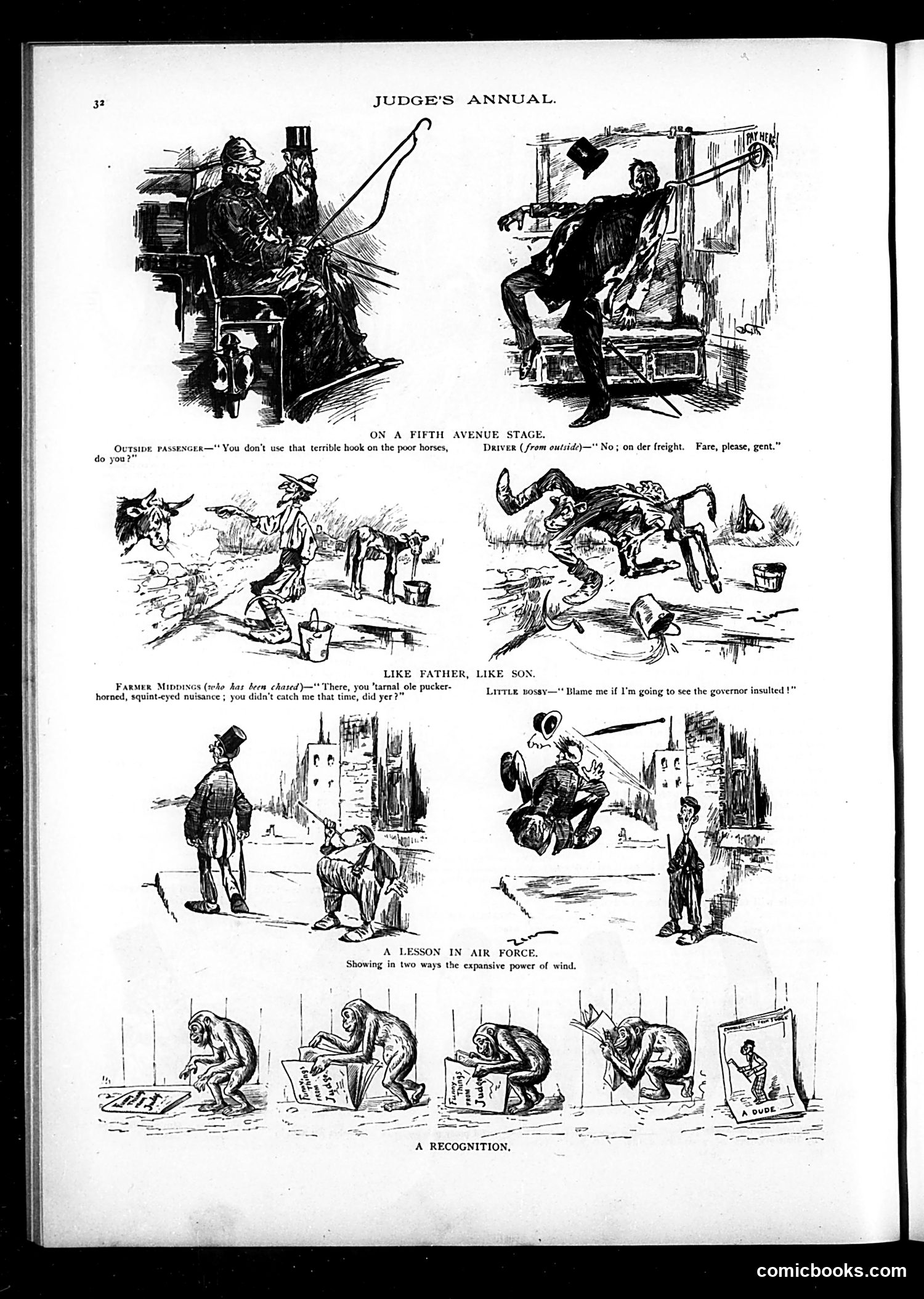
This page contains several satirical sketches from *Judge* magazine mocking American life and character types: **"On a Fifth Avenue Stage"**: A wealthy Fifth Avenue passenger lectures a cab driver about animal cruelty, only to learn the driver uses the hook on freight, not horses—satirizing sanctimonious upper-class moralizing. **"Like Father, Like Son"**: Shows a farmer and child mimicking each other's behavior (implied violence/roughness), satirizing how lower-class children inherit their parents' crude manners and temperament. **"A Lesson in Air Force"**: Two panels depicting a man's hat blown off by wind, showing wind's "expansive power"—simple physical comedy. **"A Recognition"**: A sequential strip (bottom) appears to show someone progressively recognizing themselves, likely in a mirror or reflection, suggesting vanity or self-delusion. These sketches typify *Judge*'s class-based humor, mocking both wealthy pretension and working-class coarseness through exaggerated character types and physical comedy.
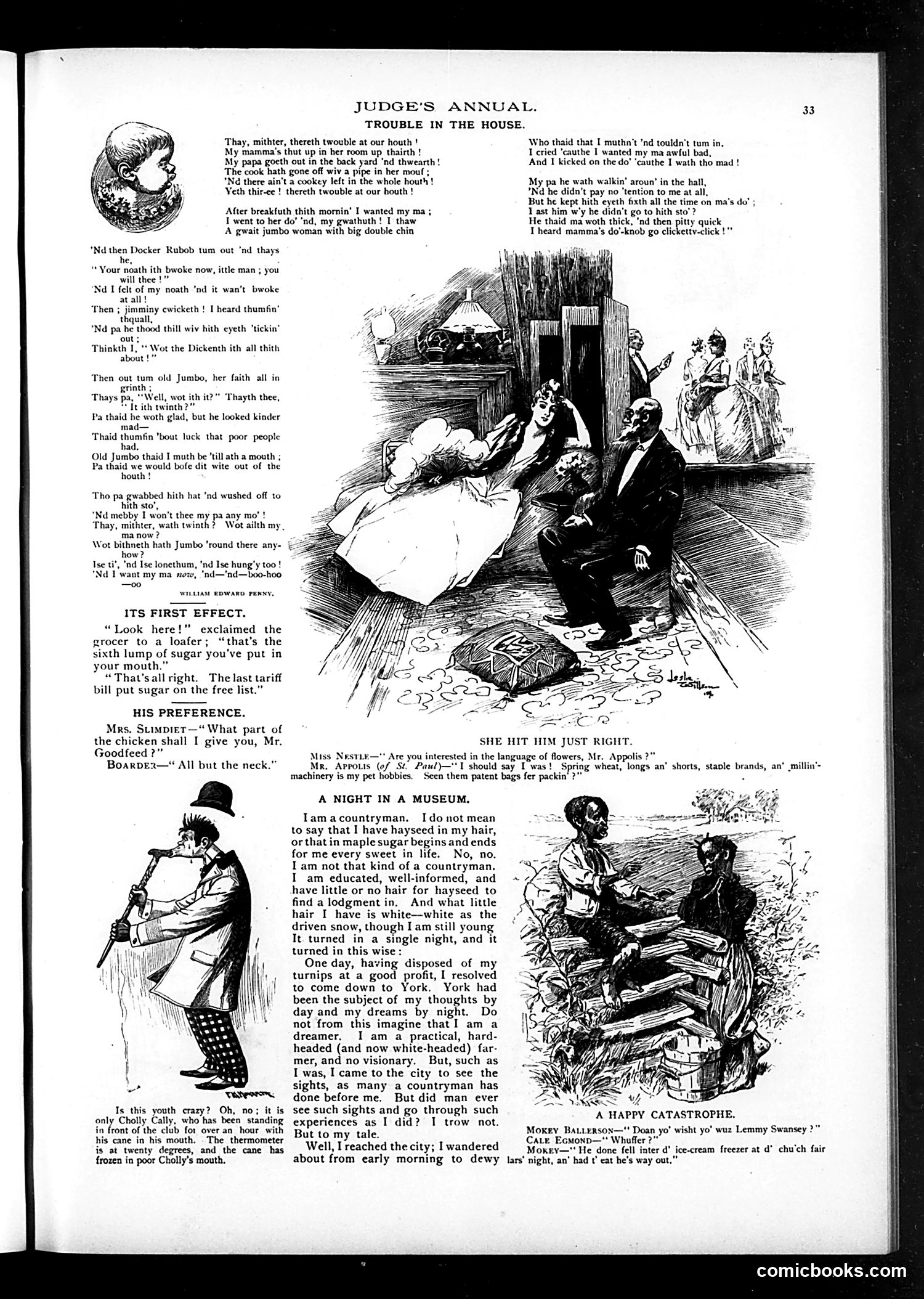
This page from *Judge* contains several distinct satirical pieces: **"Trouble in the House"** (main narrative poem with illustration): A child recounts domestic chaos—his mother confined to her room, father angry in the backyard, the cook departed. A large woman ("gwait jumbo woman") visits; the father is visibly agitated ("eyeth 'tickin' out"). The child learns the visitor is pregnant ("twinth"—twins), causing the father to angrily order both out. The satire targets marital infidelity and illegitimacy, presented through a child's innocent, dialect-heavy perspective (phonetic speech representing lower-class speech patterns). **"Its First Effect"**: Dark humor about tariff policy—a grocer complains a loafer repeatedly steals sugar, justifying it by claiming recent tariff legislation made sugar "free." **"A Night in a Museum"**: A countryman's narrative begins, suggesting forthcoming satire of rural naïveté encountering urban sophistication. The page employs *Judge*'s characteristic blend of domestic scandal, class commentary, and political humor through vernacular dialect and exaggerated illustration.
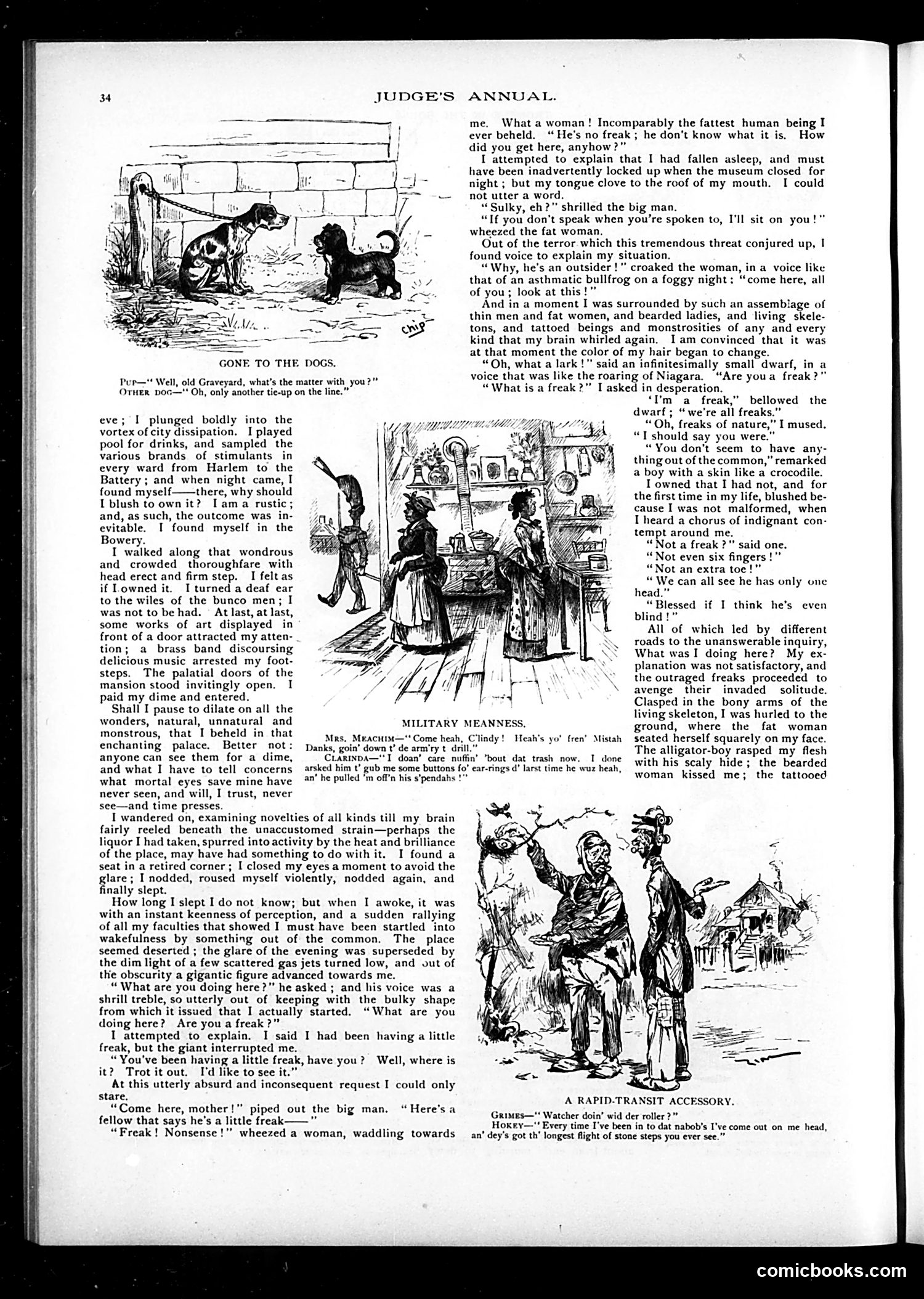
This page contains two distinct satirical pieces from Judge magazine, a 19th-century American humor publication. **"Gone to the Dogs"** is a narrative story mocking a naive country visitor to New York who, after drinking and carousing in the Bowery, falls asleep in what appears to be a museum of human curiosities. He awakens to find himself among the "freaks"—people with extreme physical characteristics displayed for public amusement—who assume *he* is the attraction rather than a legitimate visitor. The satire targets both the visitor's gullibility and the era's exploitation of people with disabilities or unusual appearances for entertainment. **"Military Meanness"** (visible at page bottom) depicts African American domestic workers, using exaggerated dialect typical of late-19th-century racist caricature. The crude humor appears to mock their speech patterns. Both pieces reflect Judge's satirical approach—though "Gone to the Dogs" offers social commentary on gullibility and exploitation, while the second piece relies on racist stereotyping common to the era, which modern readers would recognize as deeply offensive.
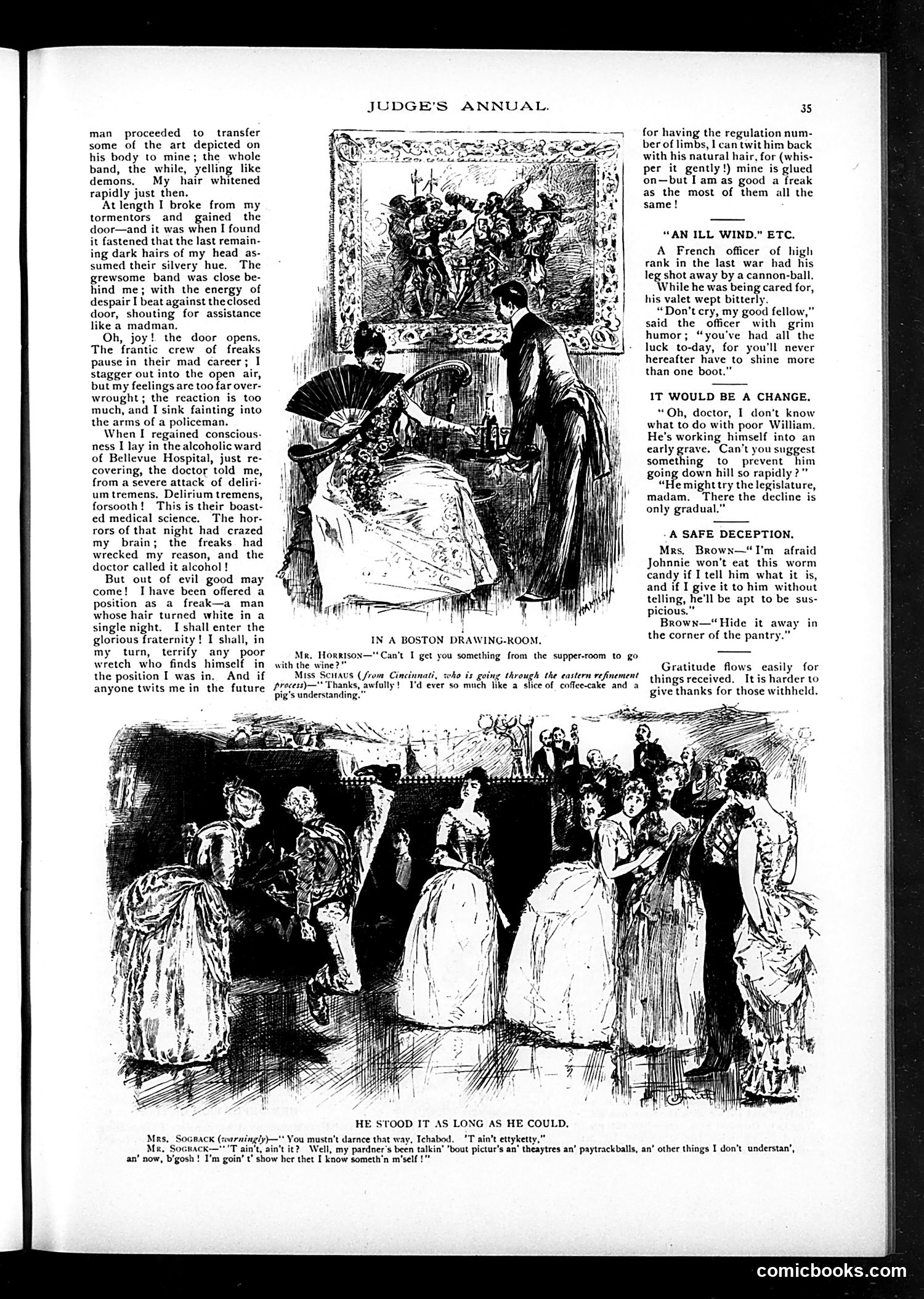
This page contains three separate humorous pieces typical of Judge's satirical style: 1. **Main narrative** (top): A first-person account of visiting a circus or carnival freak show, where tattooed performers attack the narrator, supposedly turning his hair white from fright. The joke's twist: doctors diagnose him with delirium tremens (alcohol-induced psychosis), dismissing his wild story. He's then offered a job as a freak himself—a man whose hair turned white overnight—though he reveals his hair is glued on. 2. **"In a Boston Drawing-Room"** (middle): Social satire depicting a rustic visitor ("from Cincinnati") trying to appear refined but misunderstanding etiquette, asking for "coffee-cake and a pig's understanding"—apparently confusing genteel conversation with crude behavior. 3. **Three brief jokes** (right): Including one about a French officer who loses a leg but jokes about only needing to shine one boot, and a doctor suggesting the legislature as a cure for overwork (implying politicians accomplish nothing/decline gradually). The page satirizes American social pretensions, medical incompetence, and working-class bewilderment at "refinement."
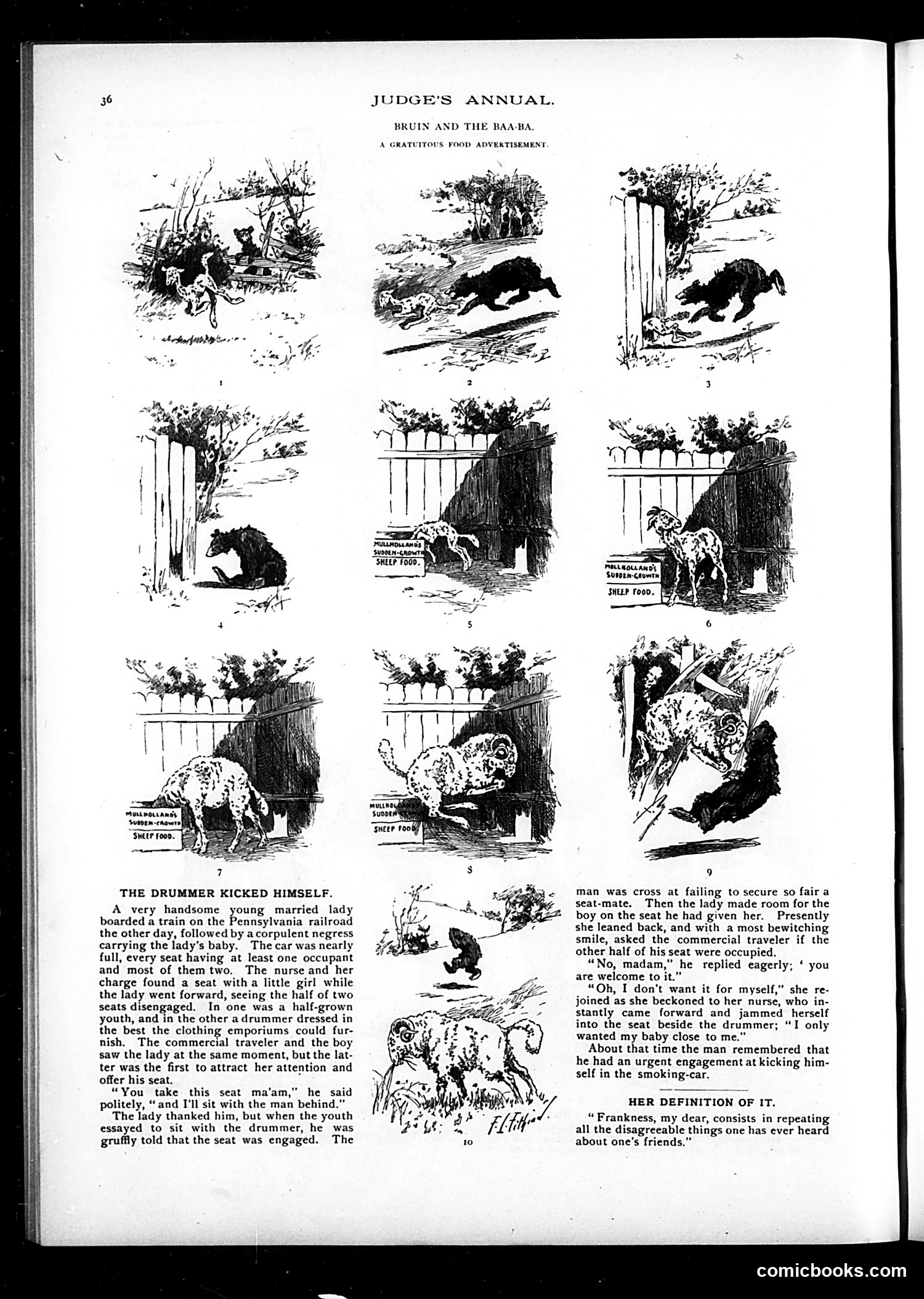
This is a humorous story-cartoon satirizing a traveling salesman's (drummer's) misogyny and poor judgment. A well-dressed young woman boards a train with her nurse and baby. A boy politely offers her his seat; she accepts but then invites her nurse to sit beside the drummer instead of herself—trapping him with the Black nursemaid he clearly finds objectionable. The satire targets the drummer's racist assumptions and his belief that offering the seat would earn him female companionship. His humiliation—having to retreat to the smoking car—is presented as deserved comeuppance. The woman's clever maneuver exposes his hypocrisy: he was only "polite" to impress her, not from genuine courtesy. The second item, "Her Definition of It," is an unrelated quip about false frankness among friends.
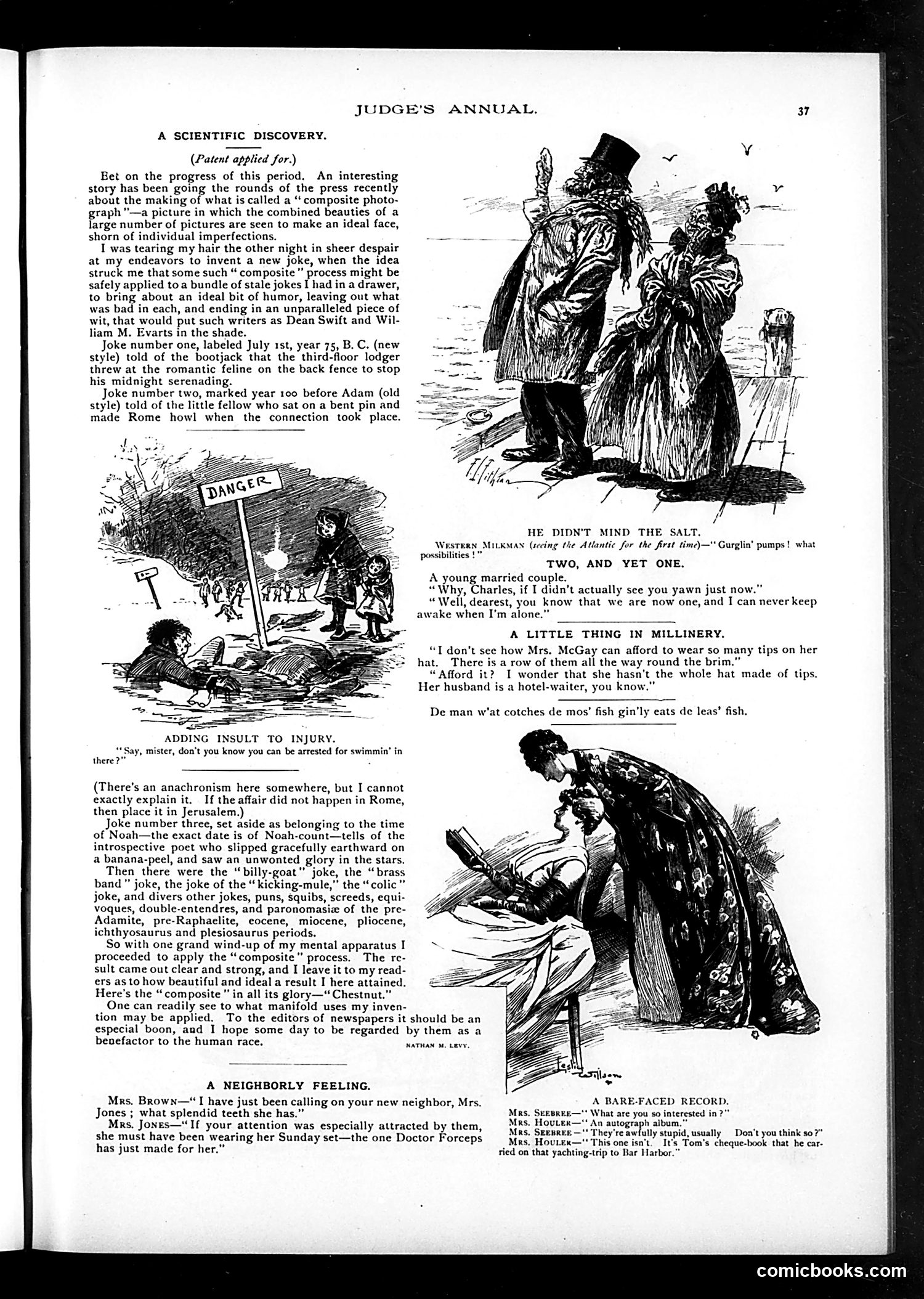
This page from Judge's satirical annual contains several brief humorous pieces satirizing everyday American life: **"A Scientific Discovery"** mocks both composite photography (a contemporary fad) and joke-writing itself. The author ironically claims to have "composited" ancient, stale jokes into one perfect jest, presenting the result as "Chestnut"—slang for an old, worn-out joke. The satire is self-aware: the piece jokes about how difficult it is to create original humor. **Other brief vignettes** include social observations: a Western milkman seeing the ocean, a newlywed couple's marital complaint, gossip about a hotel-waiter's wife's millinery extravagance, and commentary on fishing and swimming laws. **The cartoons** illustrate these pieces with period-appropriate line drawings showing Victorian-era characters in mundane situations. The satire targets middle-class pretensions, matrimonial tedium, and social climbing—typical Judge magazine fare. The overall tone is gentle mockery of ordinary life rather than sharp political critique, aimed at the magazine's educated, upper-middle-class readership.
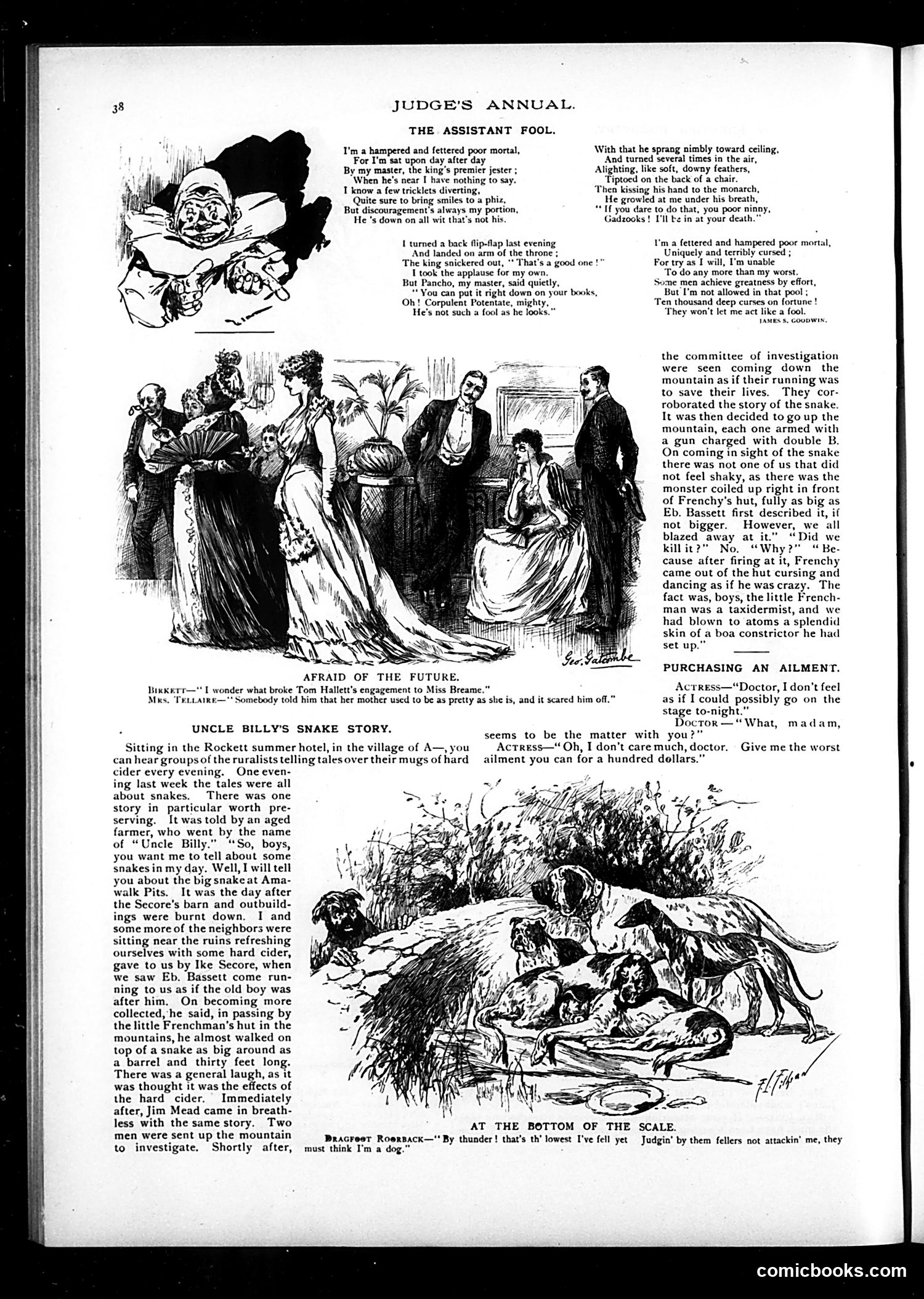
This page contains three distinct pieces of satire: **"The Assistant Fool"** (poem with illustration): A court jester complains that his superior, Pancho, steals credit for his jokes. When the assistant performs a successful acrobatic trick before the king, Pancho claims it as his own wit, leaving the assistant powerless and frustrated. This satirizes workplace hierarchies and creative theft. **"Afraid of the Future"** (brief cartoon): A woman warns a man away from marrying her friend by revealing the friend's mother was once beautiful—implying the daughter will age poorly. This mocks anxious, appearance-obsessed courtship attitudes. **"Uncle Billy's Snake Story"**: A tall tale about an impossibly large boa constrictor in the mountains that turns out to be a taxidermist's specimen. This satirizes rural storytelling culture and exaggeration. **"Purchasing an Ailment"**: An actress tells her doctor she needs an illness for sympathy, willing to pay $100 for one. This mocks theatrical dramatics and dishonesty.
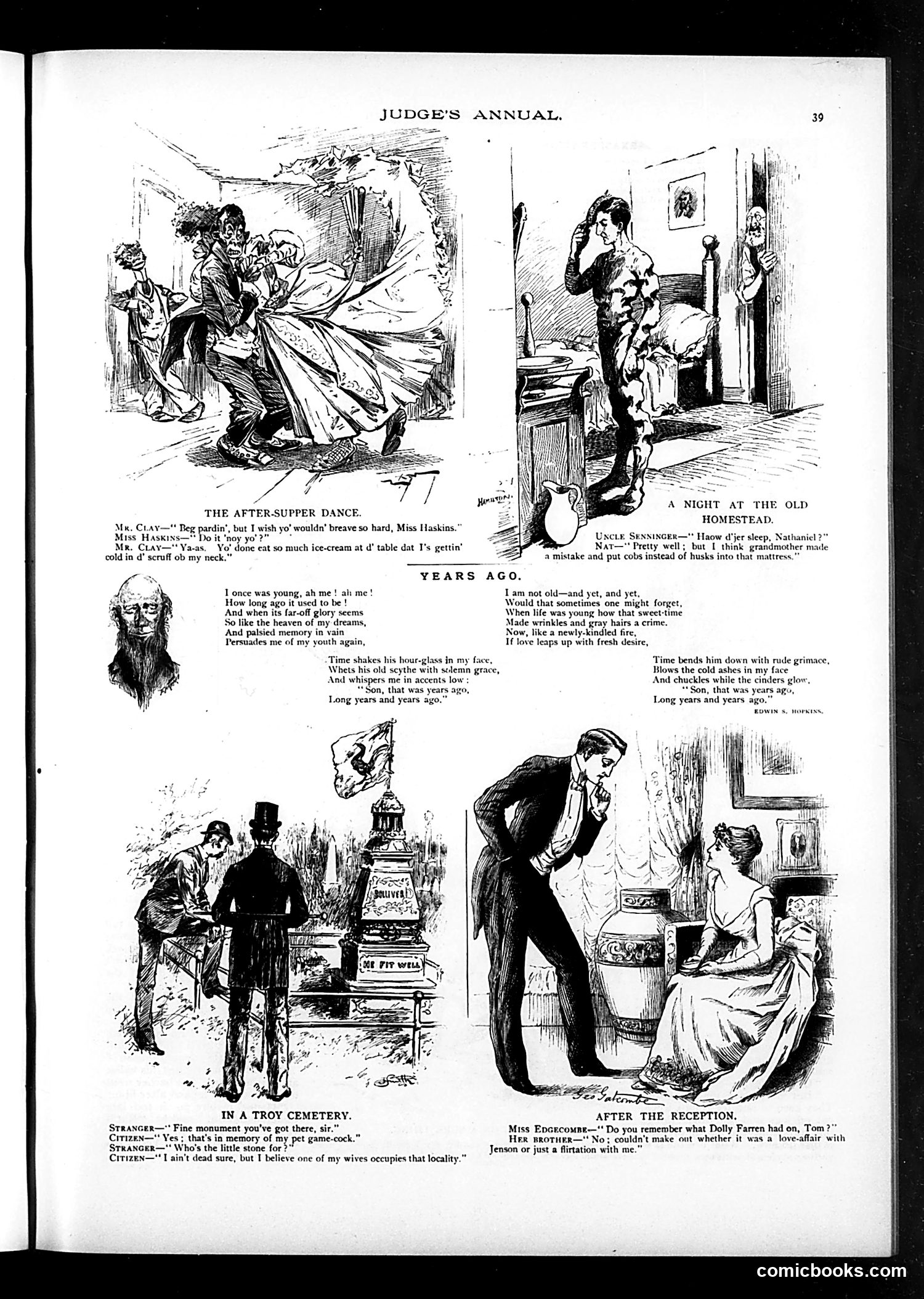
This page contains four separate humorous sketches typical of late-19th-century American satirical humor: **"The After-Supper Dance"** and **"A Night at the Old Homestead"** depict domestic comedy—clumsy dancing and rustic discomfort (sleeping on corn cobs instead of husks). **"Years Ago"** is a sentimental poem about aging, using Time as a personified figure who "shakes his hour-glass" and "whispers" reminders of mortality. It contrasts youthful vigor with inevitable decline. **"In a Troy Cemetery"** jokes darkly about a man who erected a monument to his pet game-cock, then casually admits he's uncertain which of his deceased *wives* is buried in another plot—satirizing both rural eccentricity and callous marital indifference. **"After the Reception"** appears to mock gossip about a woman's romantic entanglements. The humor targets rural life, aging, infidelity, and the absurdities of small-town society—typical Judge content mixing sentimental verse with crude social comedy.
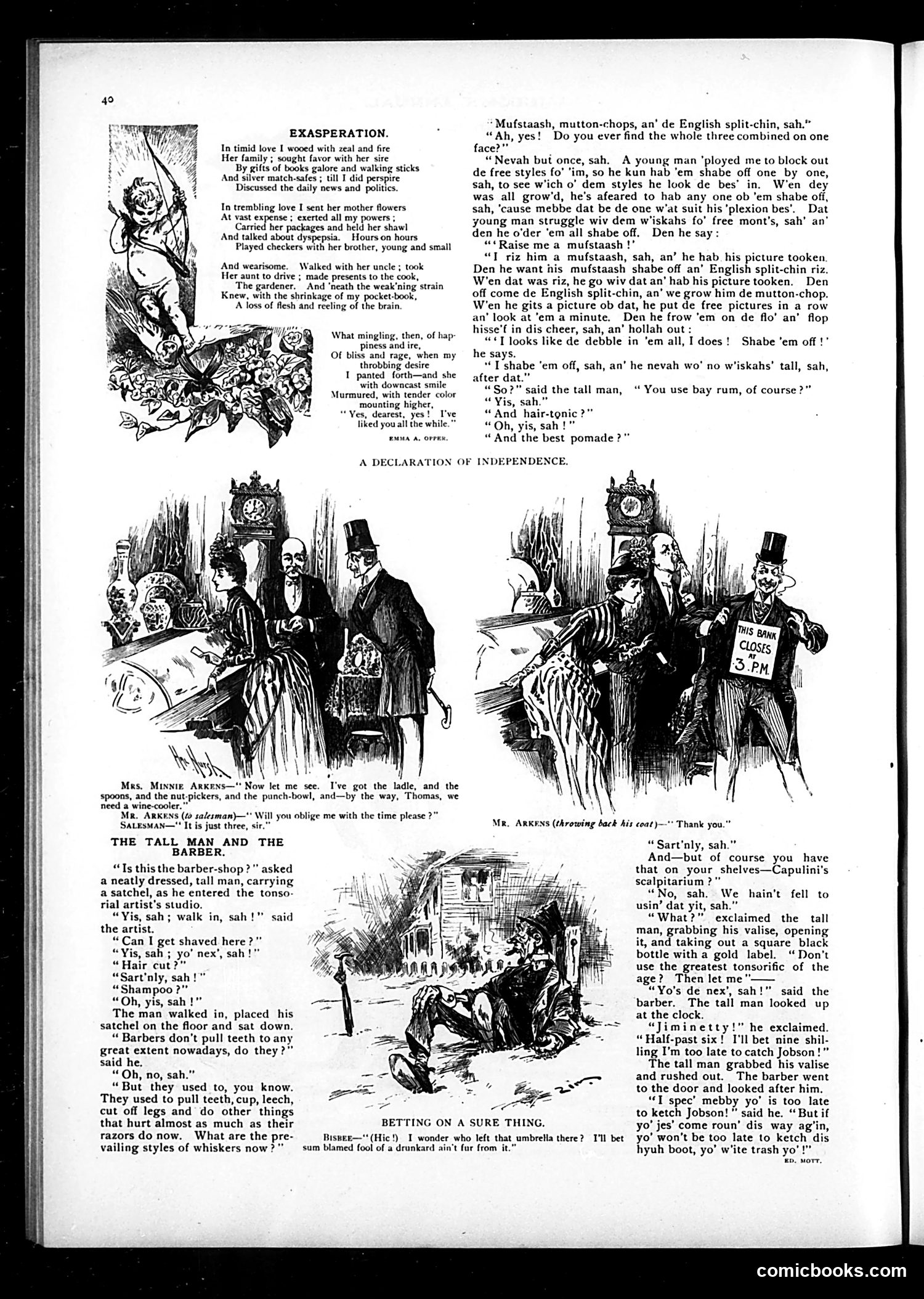
This page contains multiple satirical pieces typical of late 19th-century American humor: **"Exasperation"** depicts a suitor who exhausts himself courting his beloved's entire family—buying gifts, discussing politics, playing checkers—only to receive a tepid "I've liked you all the while" as her acceptance. The satire targets the excessive social rituals and financial burden of courtship. **"A Declaration of Independence"** shows a married couple where the wife announces she's keeping household items (ladle, spoons, punch-bowl) for herself, asserting financial independence from her husband. This reflects contemporary debates about women's property rights. **"The Tall Man and the Barber"** features dialect humor (likely representing Black vernacular of the era) discussing facial hair styles and barbering history. The tall man appears to be testing the barber's knowledge. **"Betting on a Sure Thing"** depicts a drunk man blaming someone else for leaving an umbrella, only to be revealed as that person himself—commenting on self-deception. All employ period-typical stereotypes and social commentary about marriage, class, and gender relations.
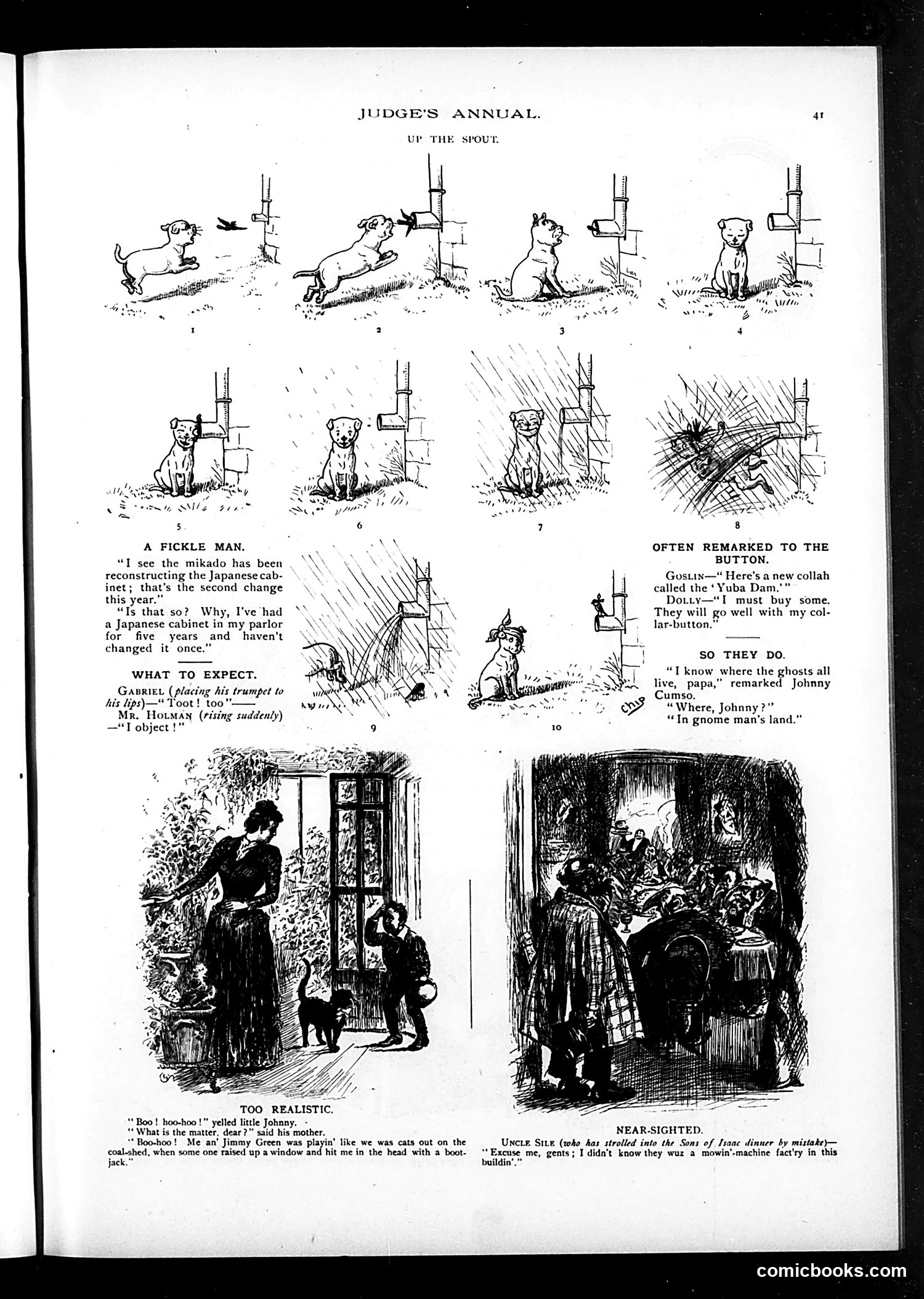
This page from Judge's *Annual* contains six separate humor pieces typical of late 19th-century American satire: **"A Fickle Man"** mocks someone who obsesses over Japanese cabinets (furniture) following Japan's political instability—contrasting real-world volatility with domestic permanence. **"What to Expect"** is a brief gag about a man objecting to trumpet sounds. **"Often Remarked to the Button"** jokes about a new collar style called "Yuba Dam" (likely referencing the Yuba River or dam construction) paired with collar buttons—seemingly absurd fashion coordination. **"So They Do"** presents children's humor about "gnome man's land" (pun on "no man's land"). **"Too Realistic"** shows a child injured during imaginative play, emphasizing overly literal recreation. **"Near-Sighted"** features Uncle Silé accidentally wandering into a "Sons of Isaac" (Jewish fraternal organization) dinner, mistaking it for a factory—playing on ethnic confusion and immigrant experiences. These represent period-typical humor: puns, cultural references, and gentle mockery of social pretension and confusion.
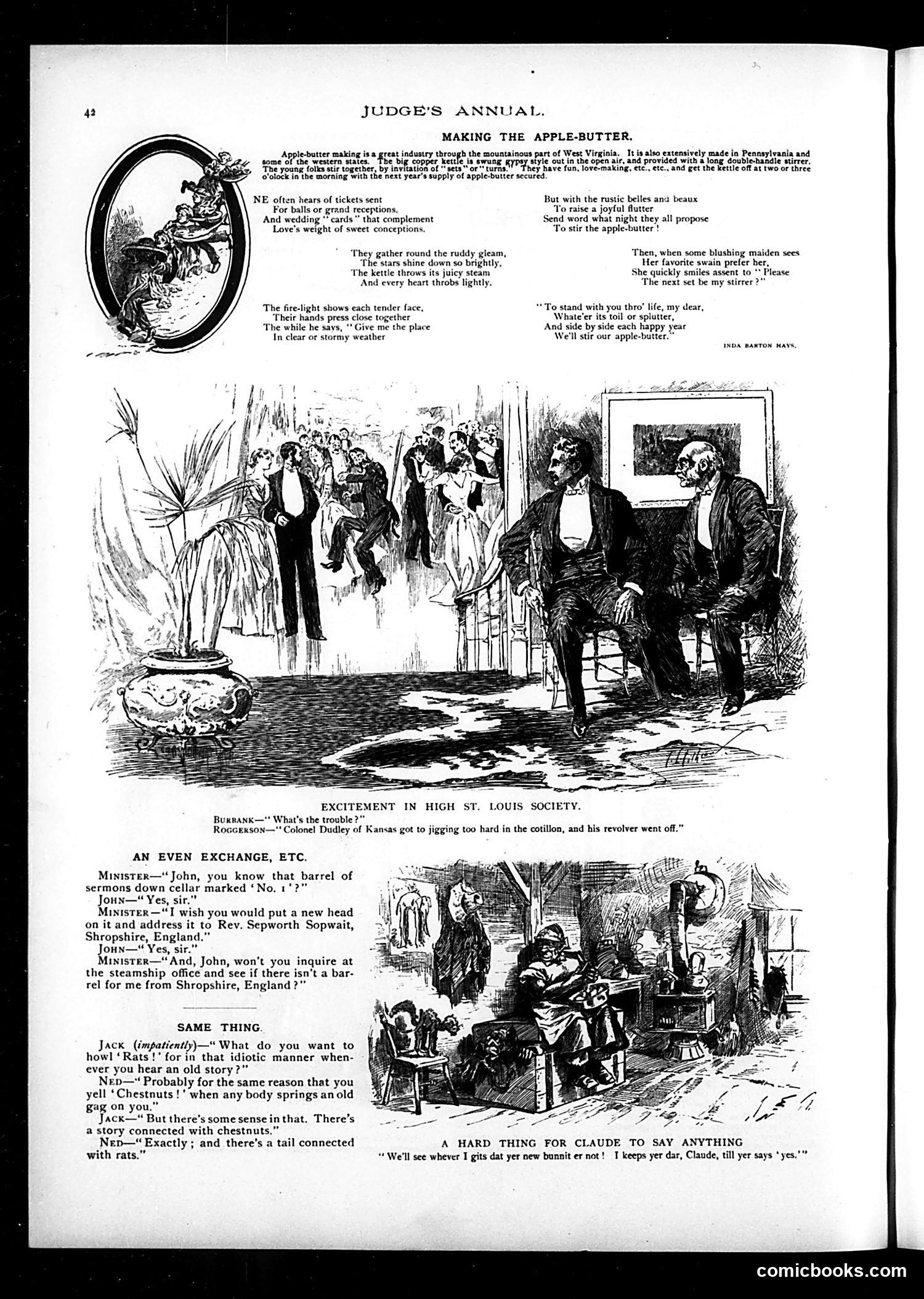
This page contains three unrelated humor pieces typical of Judge's satirical magazine format: **"Making the Apple-Butter"** celebrates a rural courtship tradition in West Virginia and Pennsylvania. Young people gather to stir large kettles of apple butter, creating romantic opportunities. The poem and accompanying vignette romanticize this frontier custom as innocent courting—young men and women work together with explicit matchmaking intent ("the next set be my stirrer?"). **"Excitement in High St. Louis Society"** is a one-liner joke mocking wealthy urban society. A Kansas colonel becomes so enthusiastic dancing a cotillon (formal dance) that his revolver accidentally fires—satirizing both frontier violence and the absurdity of armed gentlemen at formal balls. **"An Even Exchange" and "Same Thing"** are brief comedic dialogues. The first jokes about a minister exchanging barrels of old sermons with an English counterpart. The second plays on the phrase "rats!" as old-story criticism, equivalent to calling something a "chestnut" (tired joke). These pieces reflect Judge's blend of rural Americana, city society mockery, and wordplay humor typical of 1880s-90s American satire.
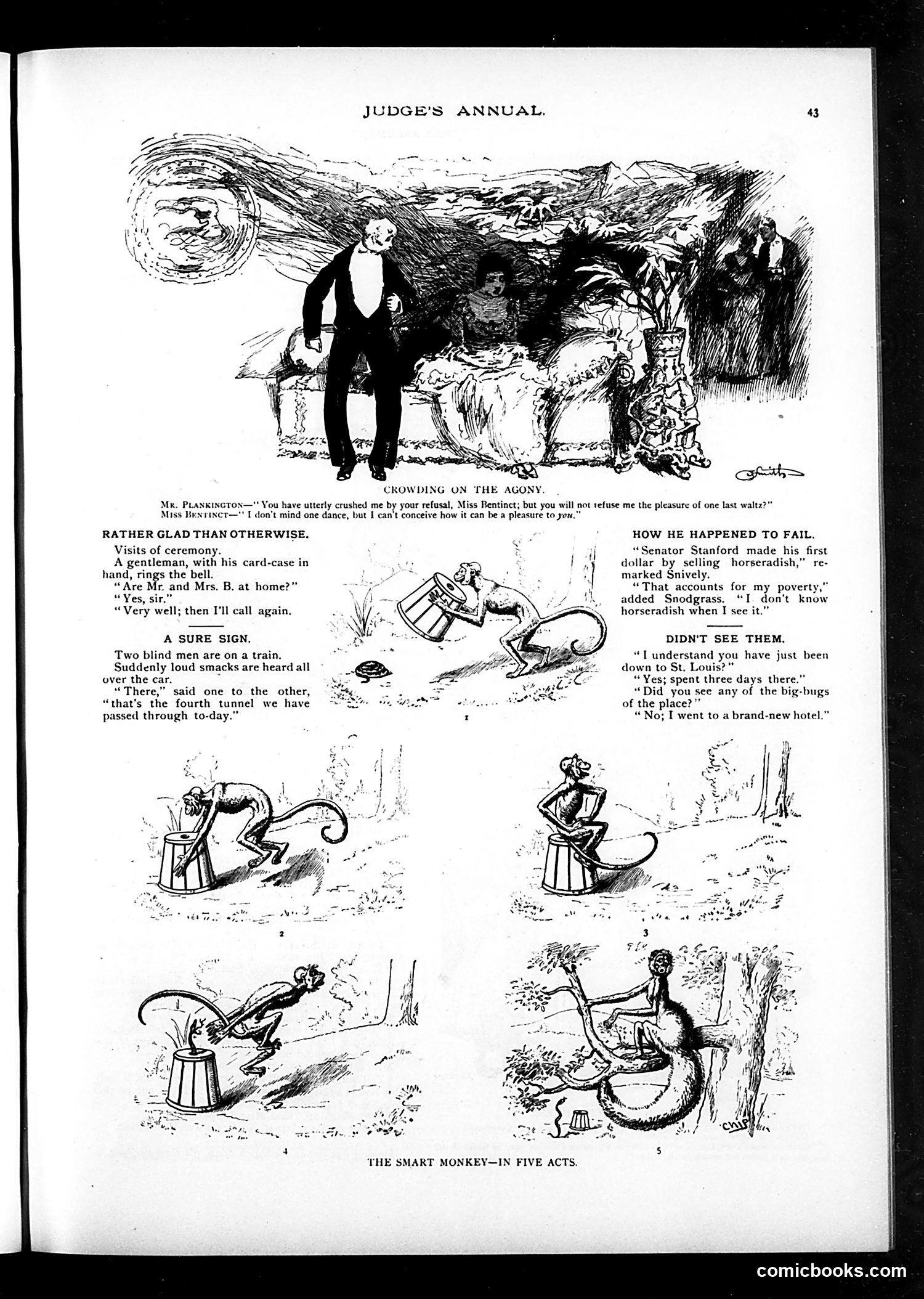
This page contains multiple satirical humor pieces from an American satirical magazine: **"Crowding on the Agony"** depicts a rejected suitor persisting awkwardly after romantic refusal—mocking overeager courtship behavior and lack of social grace. **"Rather Glad Than Otherwise"** satirizes insincere social visits: a gentleman visits to leave his calling card but hopes the hosts aren't home, mocking the tedious formality of Victorian-era social calls. **"A Sure Sign"** is a joke about blind men on a train: loud smacking sounds indicate tunnel passages, playing on blind people's reliance on acoustic cues. **"How He Happened to Fail"** jokes about self-made wealth: referencing Senator Stanford's horseradish fortune, a character claims poverty because he doesn't recognize horseradish—mocking ignorance as an excuse for failure. **"Didn't See Them"** satirizes poor travel experiences: a visitor to St. Louis stayed at a brand-new (inferior) hotel and therefore avoided meeting the city's prominent citizens—implying new hotels were beneath respectable society. **"The Smart Monkey"** (bottom) appears to be a sequential comic about a monkey performing acrobatic tricks.
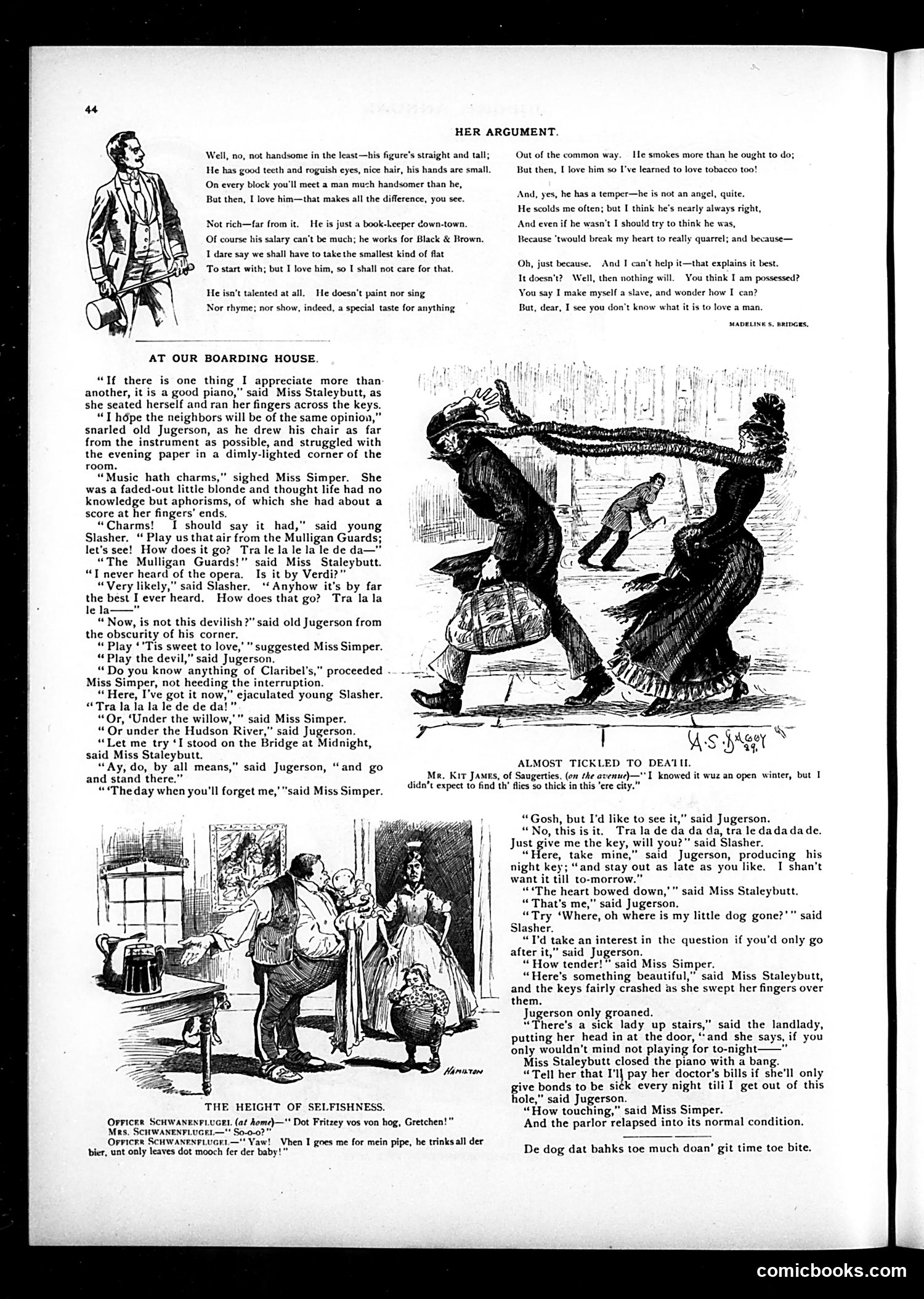
**"Her Argument"** presents a woman defending her love for an ordinary, untalented man with modest means. The satire targets romantic idealization—she overlooks his plainness, smoking habit, and bad temper because she loves him. The poem's point is ironic: her "argument" that love transcends logic actually proves she's being illogical, enslaving herself to devotion. **"At Our Boarding House"** satirizes drawing-room life and social pretension. Miss Staleybutt plays piano while the curmudgeonly Jugerson, trapped in a boarding house, suffers in a corner. Young Slasher and Miss Simper offer clichéd musical suggestions ("The Mulligan Guards," operatic references). Jugerson's sarcastic asides mock both the pretentious musicality and the forced social performance of communal living. The humor derives from his irritation at inescapable gentility and the boarders' vapid cultural posturing. Both pieces target Victorian sentimentality and social constraints.
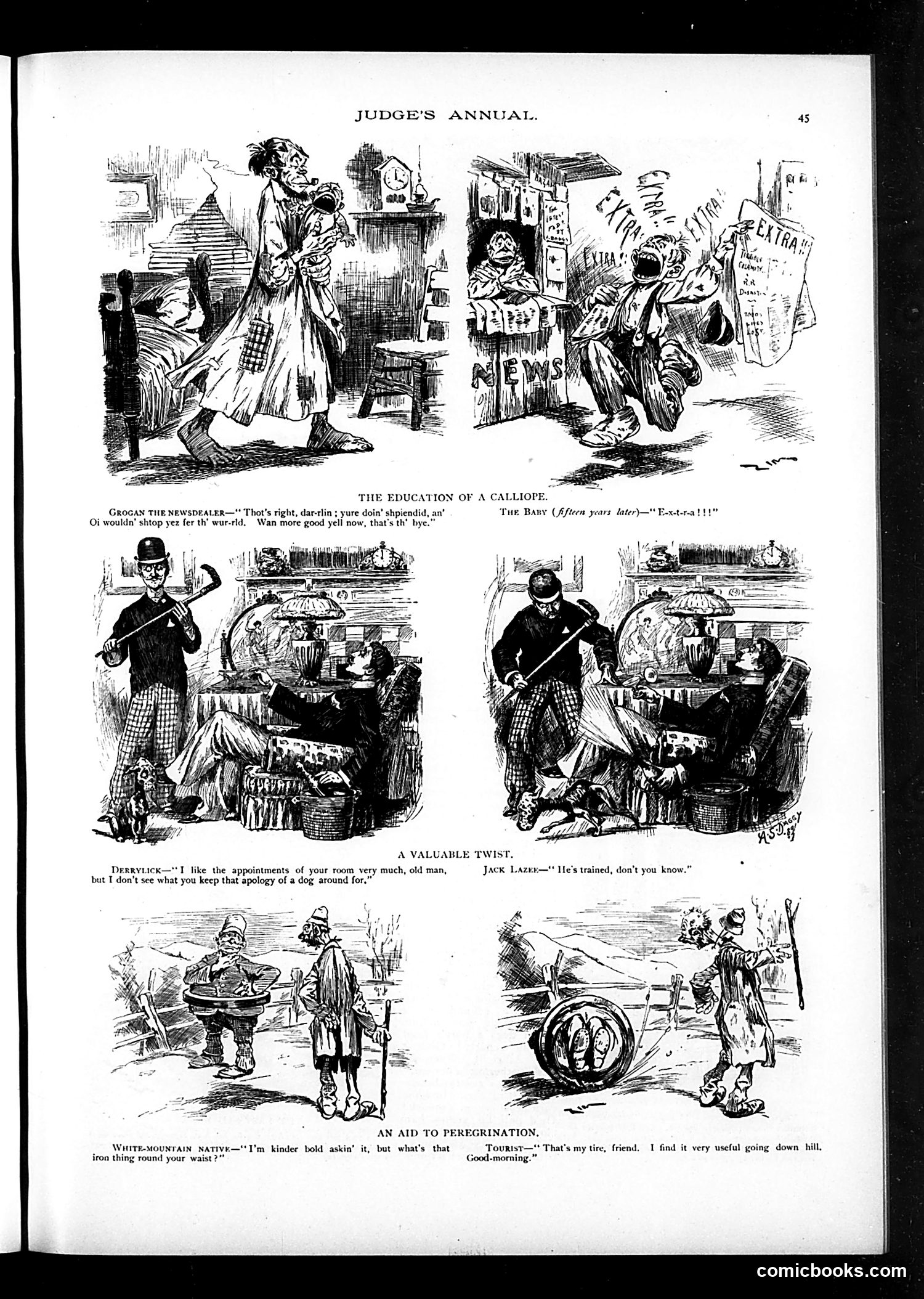
This page from *Judge* contains three separate satirical vignettes poking fun at various social types and situations: **Top panel** ("The Education of a Callope"): A newsdealer encourages a street urchin to yell newspaper headlines louder, mocking both the aggressive hawking tactics of street vendors and the sensationalism of urban journalism. **Middle panels** ("A Valuable Twist"): A visitor compliments a man's room appointments but insults his dog; the man responds the dog is "trained." The joke plays on class pretension—the man reframes his shabby dog as deliberately kept for some purpose, preserving dignity. **Bottom panels** ("An Aid to Peregrination"): A mountain native asks about a tourist's belt, confused about the purpose of the metal object (likely a watch chain or buckle). The tourist explains it's his car tire, useful "going down hill"—satirizing both rural ignorance and urban tourist experiences. The humor relies on dialect humor, class anxieties, and the collision between rural and urban American life typical of *Judge's* era satire.
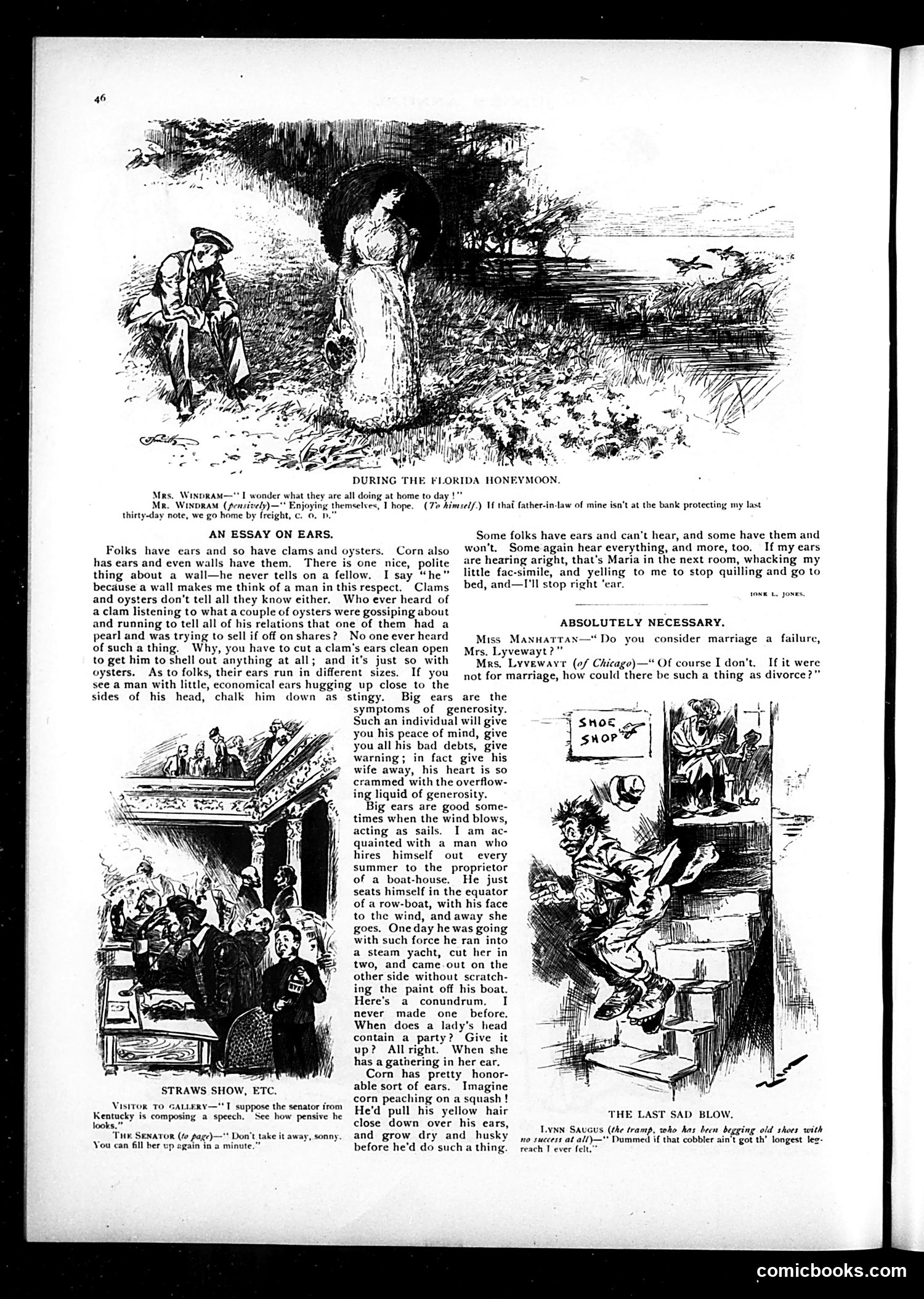
This page contains several disconnected satirical pieces typical of Judge's humor: **"During the Florida Honeymoon"** depicts a newlywed couple where the husband anxiously worries his father-in-law isn't protecting his financial note at the bank—satirizing the financial anxieties and family obligations underlying romantic getaways. **"An Essay on Ears"** is absurdist humor comparing human ears to those of clams, oysters, and corn, then relating ear size to character traits (small ears = stinginess; large ears = generosity). It includes a nonsensical joke about a man with enormous ears acting as a sail in a rowboat. **"Absolutely Necessary"** offers a cynical joke: a woman argues marriage isn't a failure because without it, divorce wouldn't exist—mocking both matrimonial optimism and the era's growing divorce rate. The remaining sketches appear to be brief society jokes about a senator being drunk and a beggar's misfortune. Overall, the page exemplifies Judge's mix of domestic humor, wordplay, and gentle social commentary targeting middle-class anxieties and matrimonial follies.
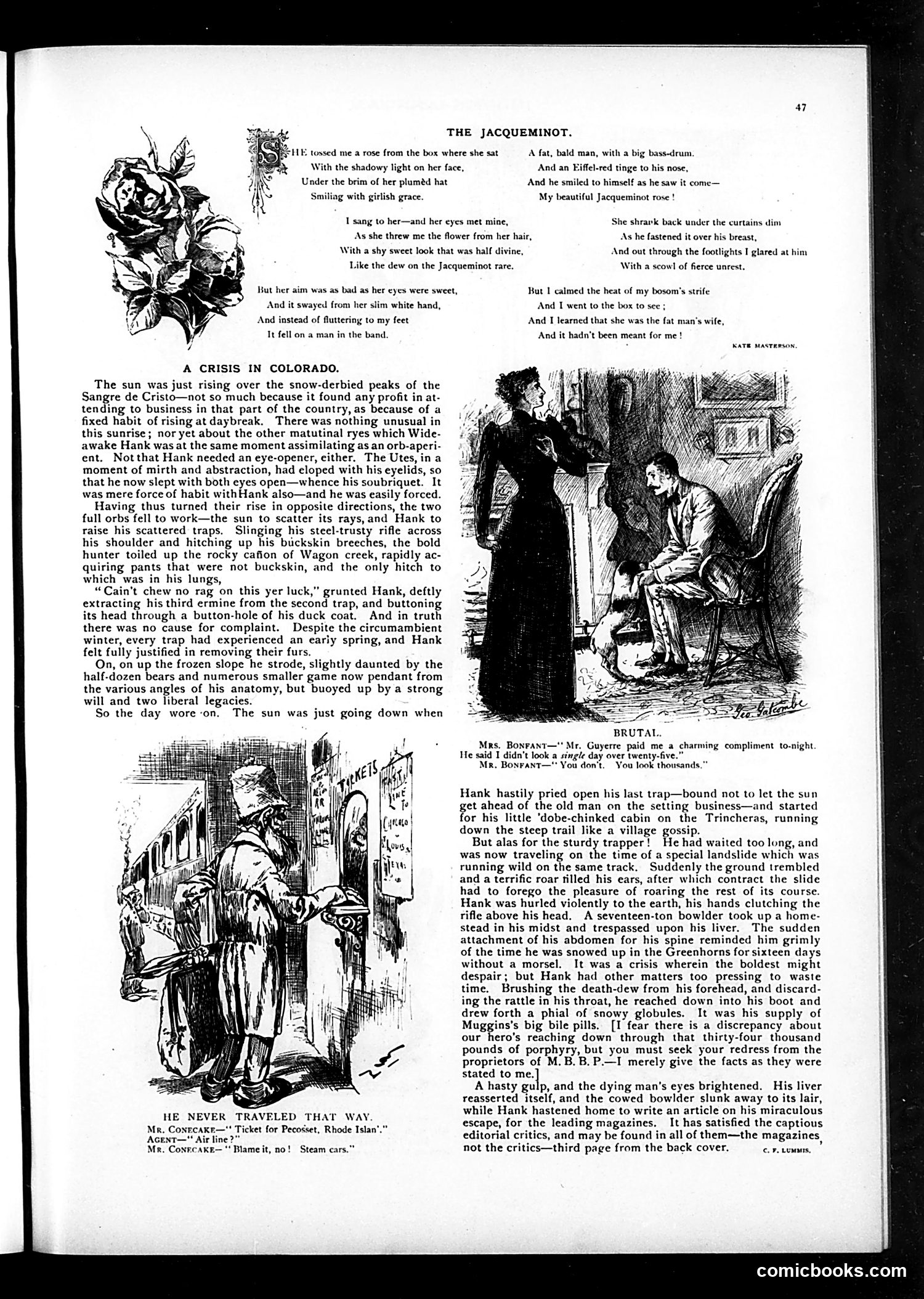
**The Jacqueminot** (top): A romantic poem about a theater-goer who receives a rose from a woman he admires, only to discover she's the wife of a fat, bald man with a prominent nose (likely a caricature, though the specific figure is unclear). The joke is disappointment—the romantic gesture wasn't meant for him. **A Crisis in Colorado** (main text): A humorous frontier tale featuring "Wide-awake Hank," a trapper with permanently open eyes (the Utes stole his eyelids). The story describes his successful fur-trapping day in the Sangre de Cristo mountains, ending when a massive landslide interrupts his descent home. The humor derives from exaggerated frontier dialect, absurdist physical comedy (the eyeless condition), and tall-tale conventions common to American humor of this era.
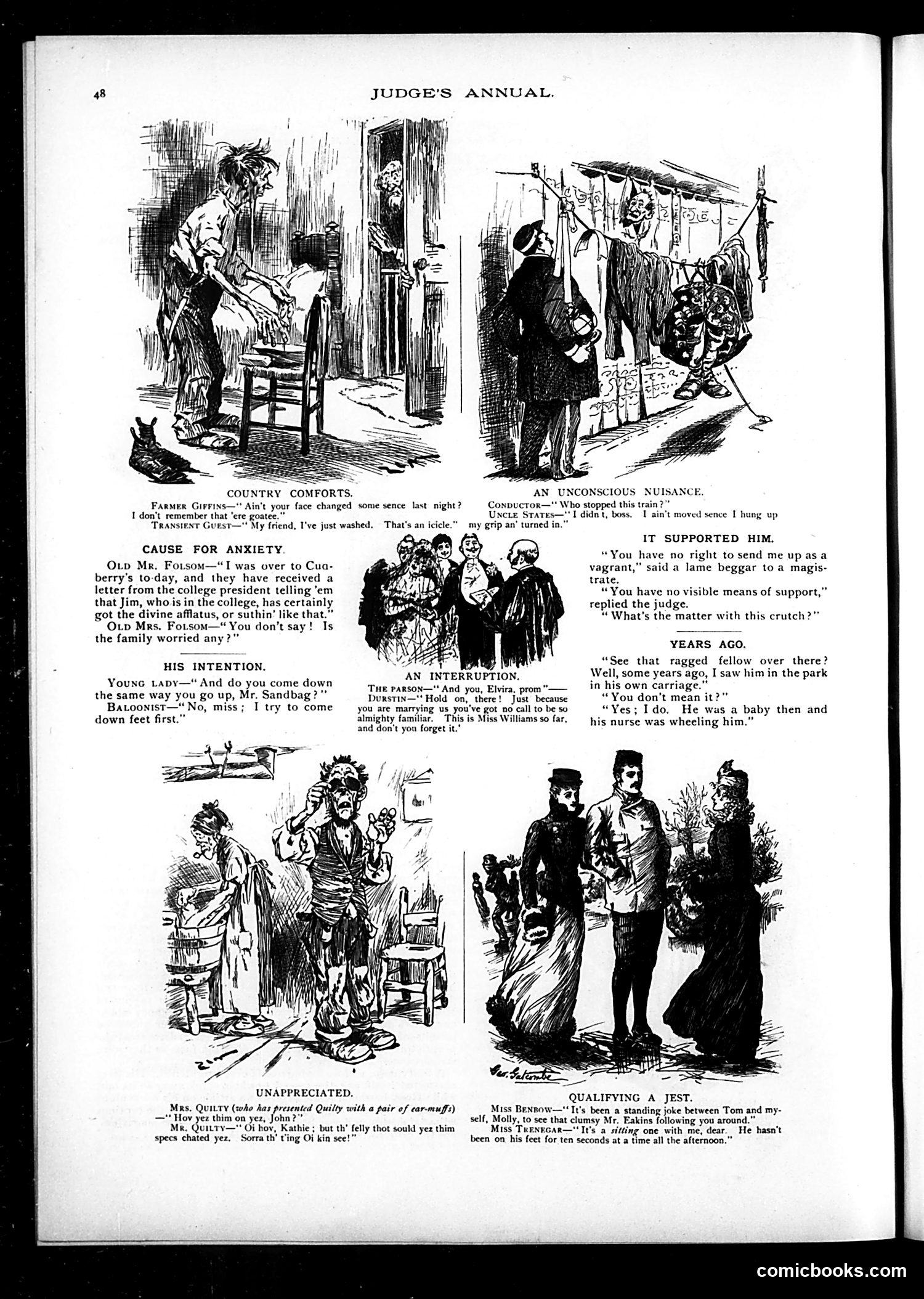
This page collects six brief satirical sketches typical of late-19th-century humor magazines: **"Country Comforts"** mocks rural dialect and manners—a transient guest's face has changed from dirt/weathering. **"Cause for Anxiety"** plays on college pretension: a farmer worries his son has acquired "divine afflatus" (artistic inspiration), suggesting educated affectation threatens family stability. **"His Intention"** is a simple pun: a balloonist explains he descends "feet first"—implying crashes. **"Unappreciated"** depicts Irish working-class dialect (phonetic spelling) where a man dismisses his wife's gift. **"An Interruption"** satirizes formality: a bride corrects a parson mid-ceremony for using her first name without permission—humor from rigid propriety. **"It Supported Him"** jokes darkly: a beggar's crutch serves as his "means of support" (literally and financially). The remaining sketches exploit class differences, dialect humor, and wordplay typical of Gilded Age American satire, with no specific political figures identifiable.
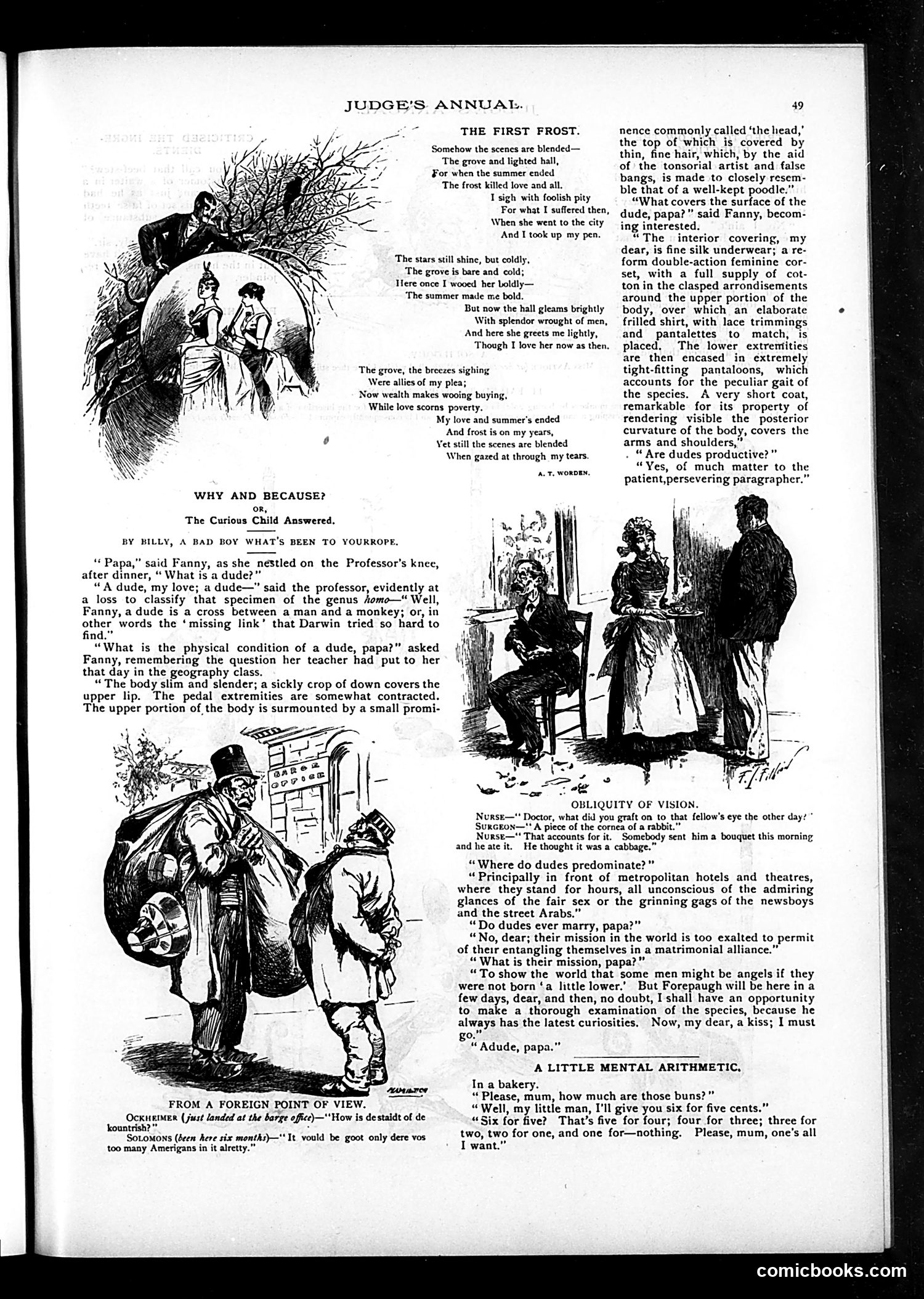
This page contains satirical content mocking the "dude"—a late 19th-century figure of ridicule representing an ostentatious, fashionable young man. **Main content:** A dialogue between Professor and his daughter Fanny, who asks what a "dude" is. The Professor delivers an exaggerated pseudo-scientific description: a "cross between a man and a monkey," with a sickly mustache, contracted feet, and an unnaturally small head. He notes dudes congregate near hotels and theaters, dress absurdly (tight pants, short coats emphasizing posterior curvature), and exist merely to display that some men are "not born a little lower"—implying they're barely human. **The satire:** Dudes are presented as vacuous, parasitic creatures—effeminate, wealthy enough to waste time loitering publicly, and so shallow they cannot marry or contribute meaningfully to society. **Historical context:** This reflects 1880s-90s American anxiety about changing masculinity and urban leisure culture among the wealthy. The comparison to circus animals (Forepaugh's menagerie is mentioned) reinforces that dudes are curiosities rather than proper men. The page also includes unrelated humorous sketches and verses.
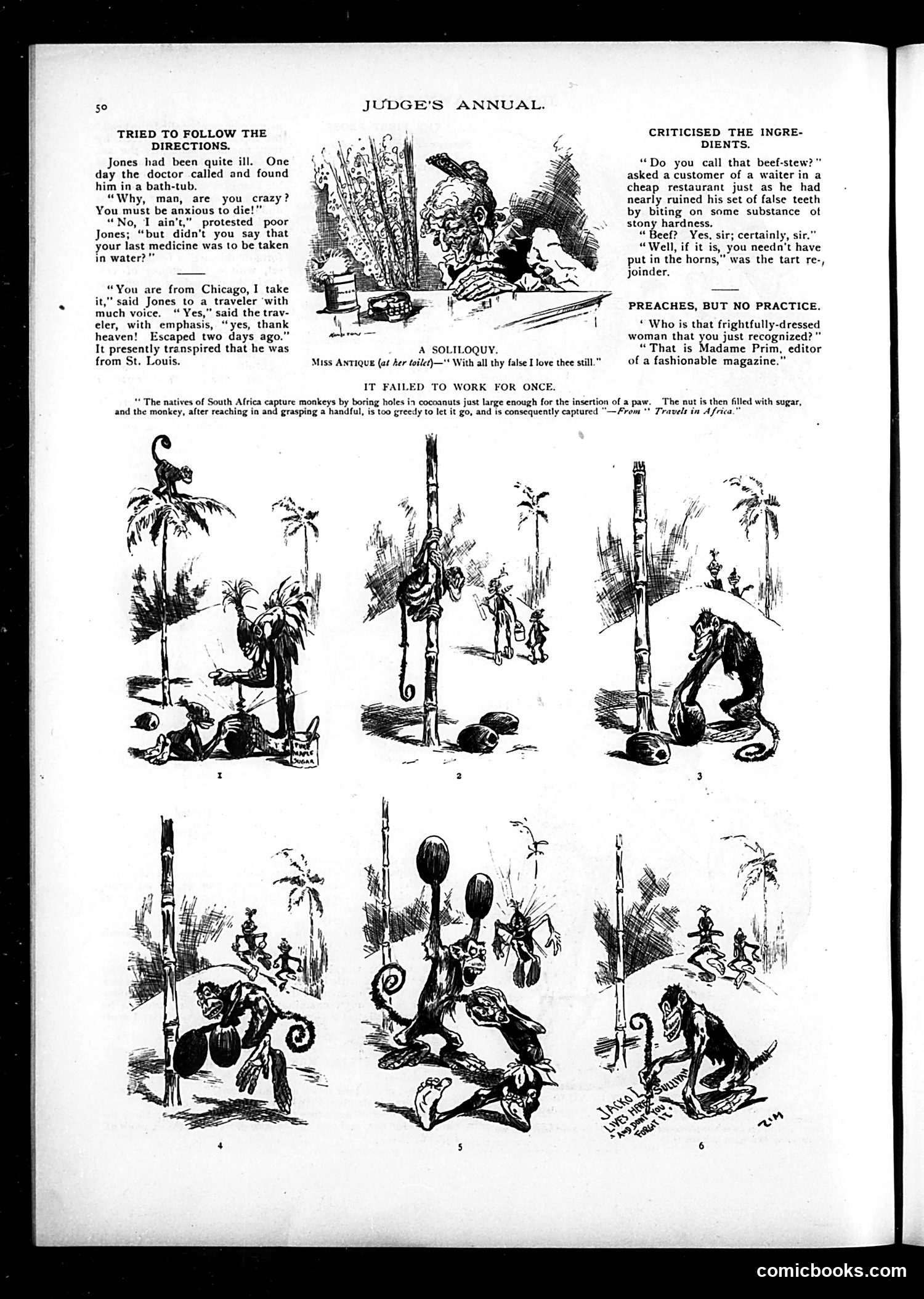
This page contains several brief humorous anecdotes typical of Judge's satirical style: **"Tried to Follow the Directions"** mocks a patient's literal interpretation—he bathes in water because the doctor said medicine "must be taken in water," a joke about stupidity. **"A Soliloquy"** appears to be a caption about vanity, with Miss Antique admiring herself despite her flaws. **"It Failed to Work for Once"** is an extended caption explaining an African monkey-trap mechanism, used as a metaphor (though the connection to the accompanying illustration is unclear). **"Criticised the Ingredients"** satirizes cheap restaurant food quality—a customer's false teeth are damaged by what appears to be non-beef material in the "beef stew," allowing him a cutting retort. **"Preaches, But No Practice"** targets hypocrisy: a fashionable magazine editor who advocates refined style dresses poorly herself. The six numbered illustrations below appear to show monkeys interacting with palm trees and coconuts, presumably depicting the trap mechanism described above.
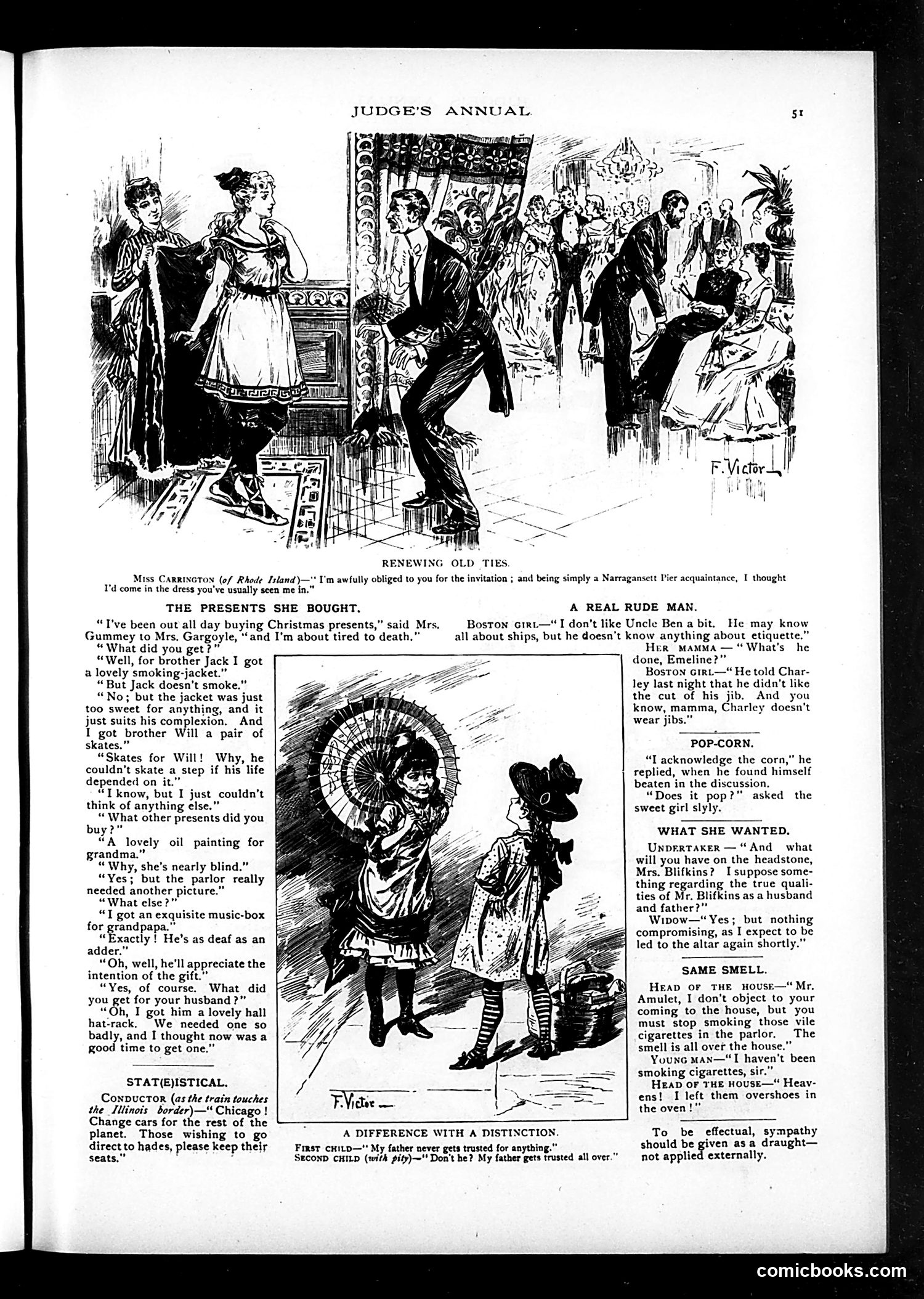
This page from *Judge's Annual* contains multiple short humorous anecdotes typical of late-19th/early-20th-century satirical magazines. **Main Cartoons:** The top illustration shows "Renewing Old Ties"—a social gathering where Miss Carrington casually mentions wearing her usual Narragansett Pier vacation dress to a formal event, suggesting careless informality about social conventions. **The Jokes Target:** - **"The Presents She Bought"**: A woman buys completely impractical gifts (a smoking jacket for a non-smoker, skates for someone who can't skate, a painting for a near-blind grandmother). The satire mocks thoughtless gift-giving and prioritizing appearance over utility. - **"A Real Rude Man"**: A sailor's crude nautical language ("didn't like the cut of his jib") offends a Boston girl unfamiliar with seafaring terms. - **Other brief jokes** mock poor etiquette, misunderstandings, and social pretension. The humor relies on Victorian-era social anxieties about proper behavior, gender roles, and class distinction—topics that dominated *Judge*'s satirical commentary.
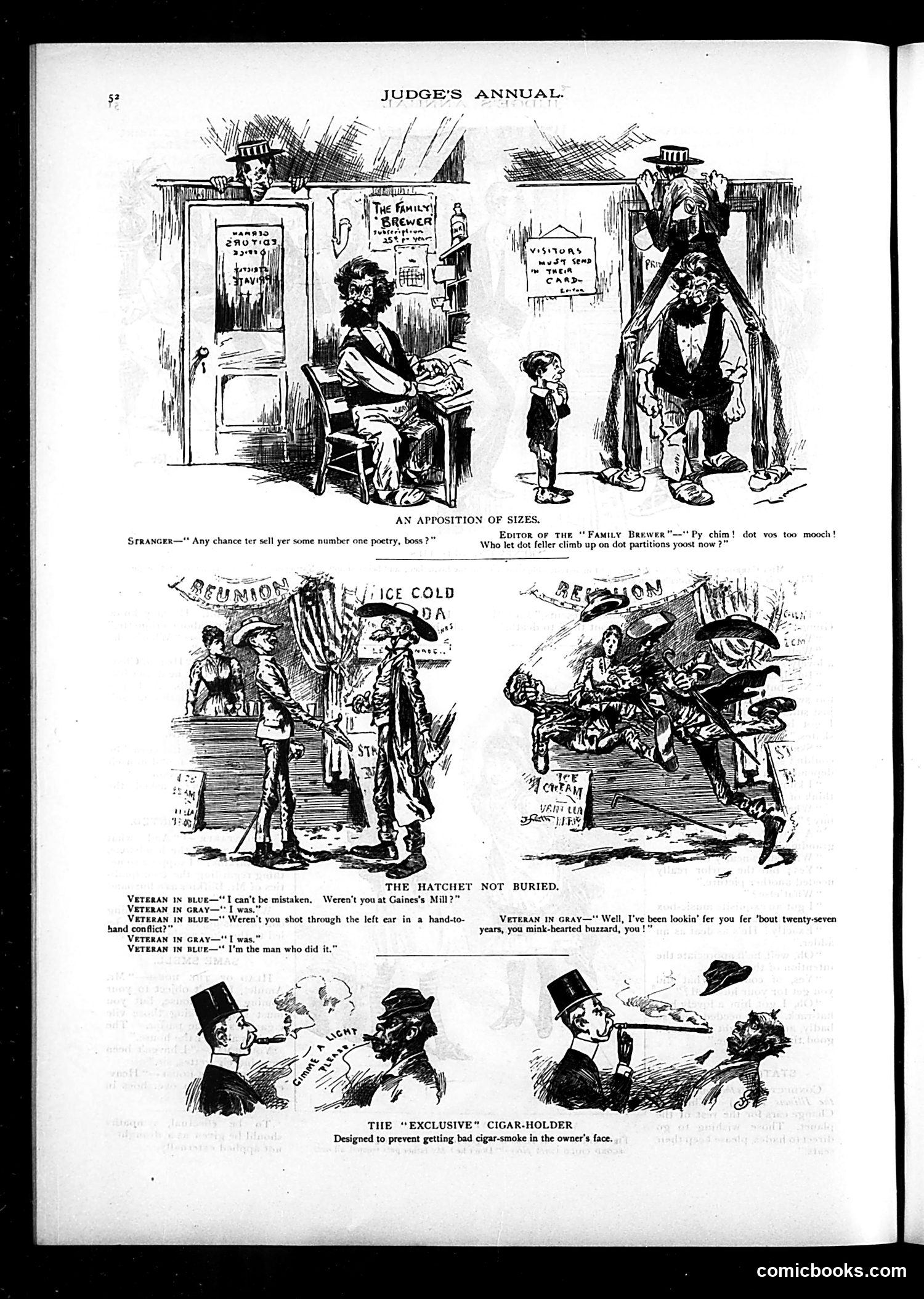
This page from *Judge* magazine contains several satirical cartoons: **"An Apposition of Sizes"** contrasts a small stranger seeking to sell poetry to a large editor with a huge man towering over children at a newspaper office—satirizing scale and proportion in publishing. **"The Hatchet Not Buried"** depicts two Civil War veterans (Union and Confederate) who recognize each other from a specific battle (Gaines's Mill). The humor lies in their unexpected reunion: one shot the other through the ear decades ago, and the victim has apparently been searching for his shooter all these years, greeting him with mock aggression ("mink-hearted buzzard"). This satirizes the lingering resentments and personal grudges from the Civil War, suggesting old wounds—literal and figurative—weren't truly healed despite official reconciliation efforts. **"The 'Exclusive' Cigar-Holder"** shows a device designed to redirect cigar smoke away from the smoker's face—a humorous commentary on absurd consumer inventions and bourgeois vanity. The overall tone reflects *Judge*'s satirical approach to American social and political issues of its era.
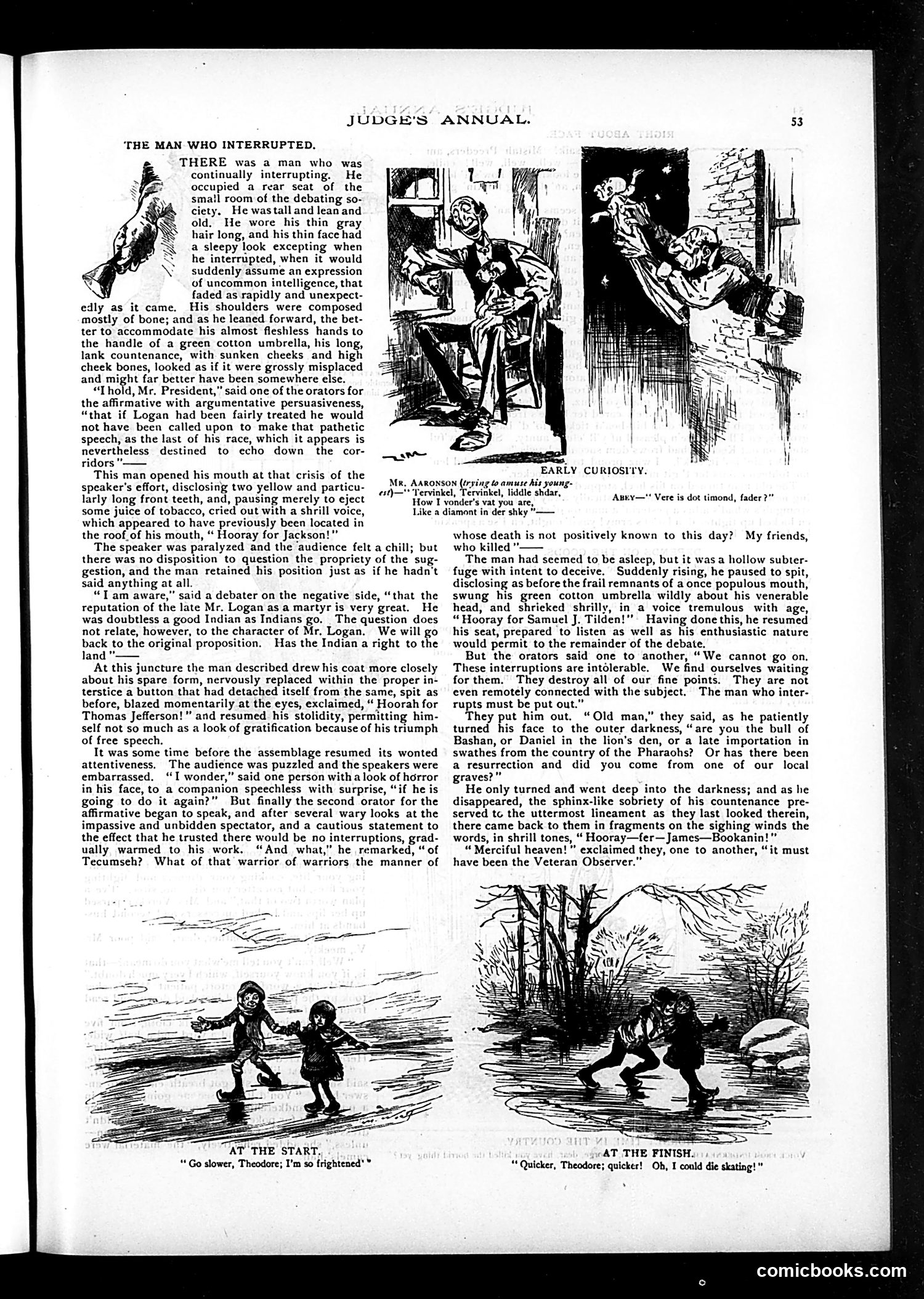
This page satirizes a tedious debate society regular—"the man who interrupted." The humor lies in his absurd, irrelevant interjections during serious philosophical debates about Native American rights and John Logan. The character is a gaunt, elderly man with yellowed teeth who repeatedly shouts non-sequiturs like "Hooray for Jackson!" and "Hoorah for Thomas Jefferson!"—political endorsements completely unrelated to the speakers' arguments about whether Indians have land rights and the legacy of figures like Tecumseh. The satire mocks both the interrupter's senile irrelevance and, by extension, the pomposity of debate society culture itself. His random patriotic outbursts suggest that such forums attract cranks whose contributions derail serious discourse with emotional, disconnected rhetoric rather than reasoned argument. The smaller cartoons ("At the Start" / "At the Finish") appear to humorously contrast children's courage, likely unrelated to the main story.
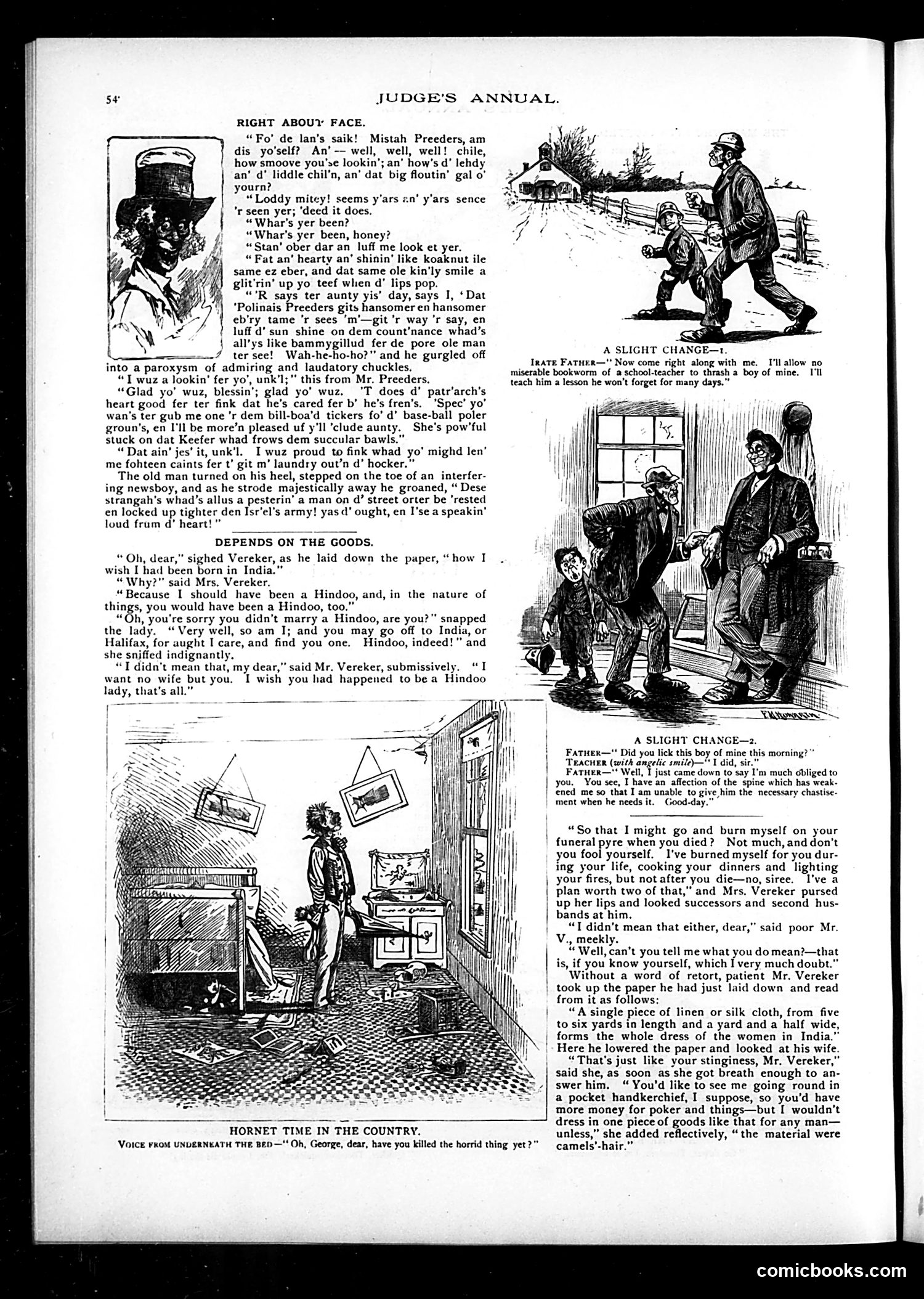
This page contains three separate satirical pieces from Judge's Annual: **"Right About Face"**: A dialect-heavy sketch mocking an encounter between an African American man and a white employer (Mr. Preeders). The humor relies on exaggerated speech patterns and the servant's obsequious behavior, reflecting racist stereotypes common to this era's "humor." **"Depends on the Goods"**: A marital squabble where Mr. Vereker wishes he'd married a Hindu woman (implying they self-immolate on husbands' funeral pyres). His wife sharply rejects this, ultimately mocking his stinginess when he reads that Indian women wear simple single garments. The satire targets both romantic naiveté and domestic penny-pinching. **"A Slight Change"**: A brief exchange where a father thanks a teacher for beating his son, explaining his own physical weakness prevents him from administering punishment himself. The humor derives from the father outsourcing parental discipline. All three pieces reflect early-20th-century American attitudes toward race, gender, and corporal punishment—now historically notable for their casual prejudices rather than their intended comedic effect.
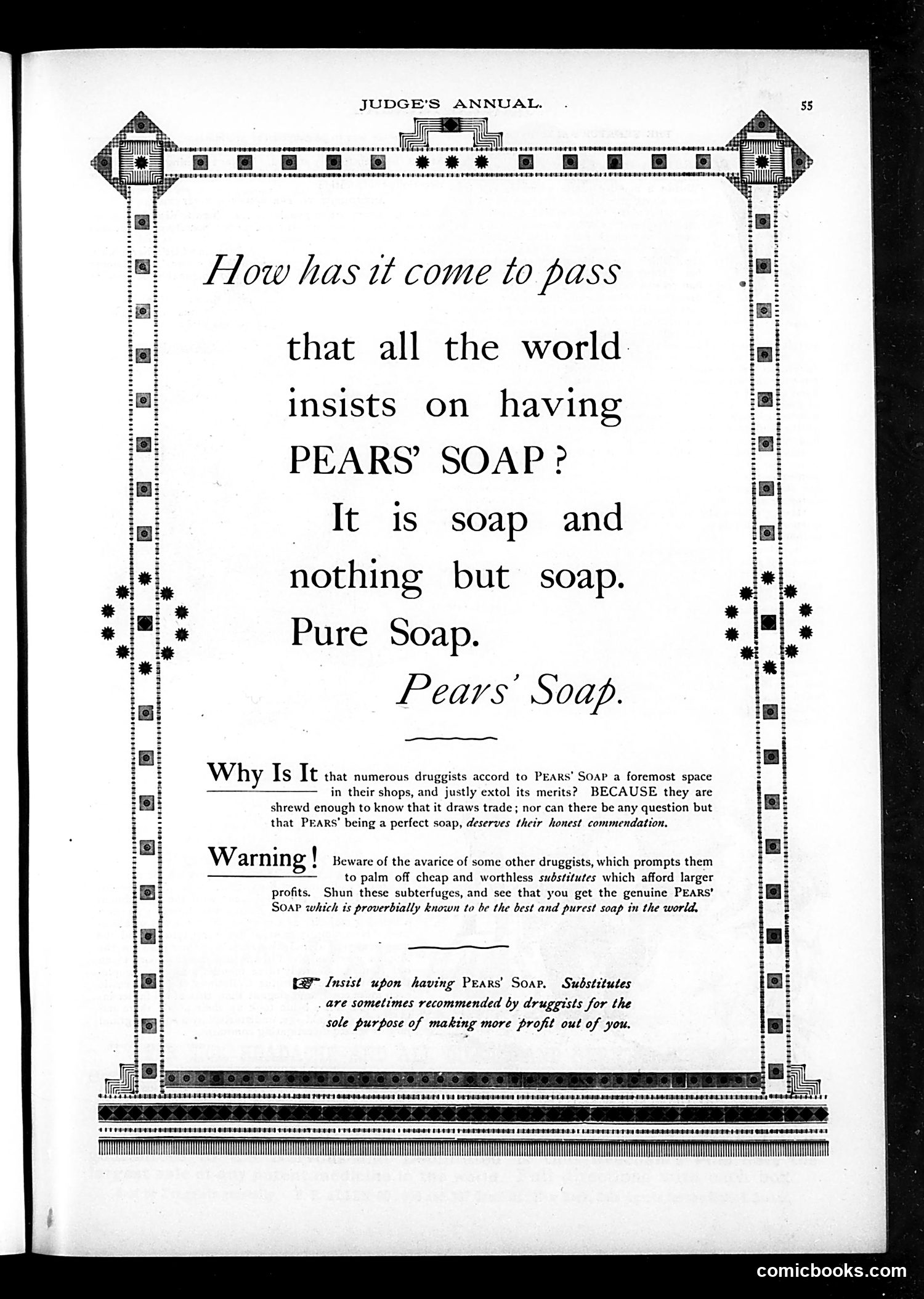
This is **not a cartoon or satire**, but rather a **paid advertisement** for Pears' Soap disguised as editorial content in Judge magazine. The page mimics the magazine's satirical style with ornamental borders and rhetorical questioning ("How has it come to pass...") to appear as commentary rather than advertising. The ad employs a common sales tactic: it praises the product's quality while simultaneously warning against cheaper substitutes that druggists allegedly push for higher profit margins. The language emphasizes purity and authenticity ("Pure Soap," "best and purest soap in the world"), implicitly suggesting competitors are adulterated or inferior. This represents late-19th/early-20th-century advertising disguised as magazine content—a practice that blurs editorial and commercial boundaries. The "Warning!" section particularly reveals the ad's true purpose: discouraging consumers from accepting alternatives, benefiting Pears' market dominance.
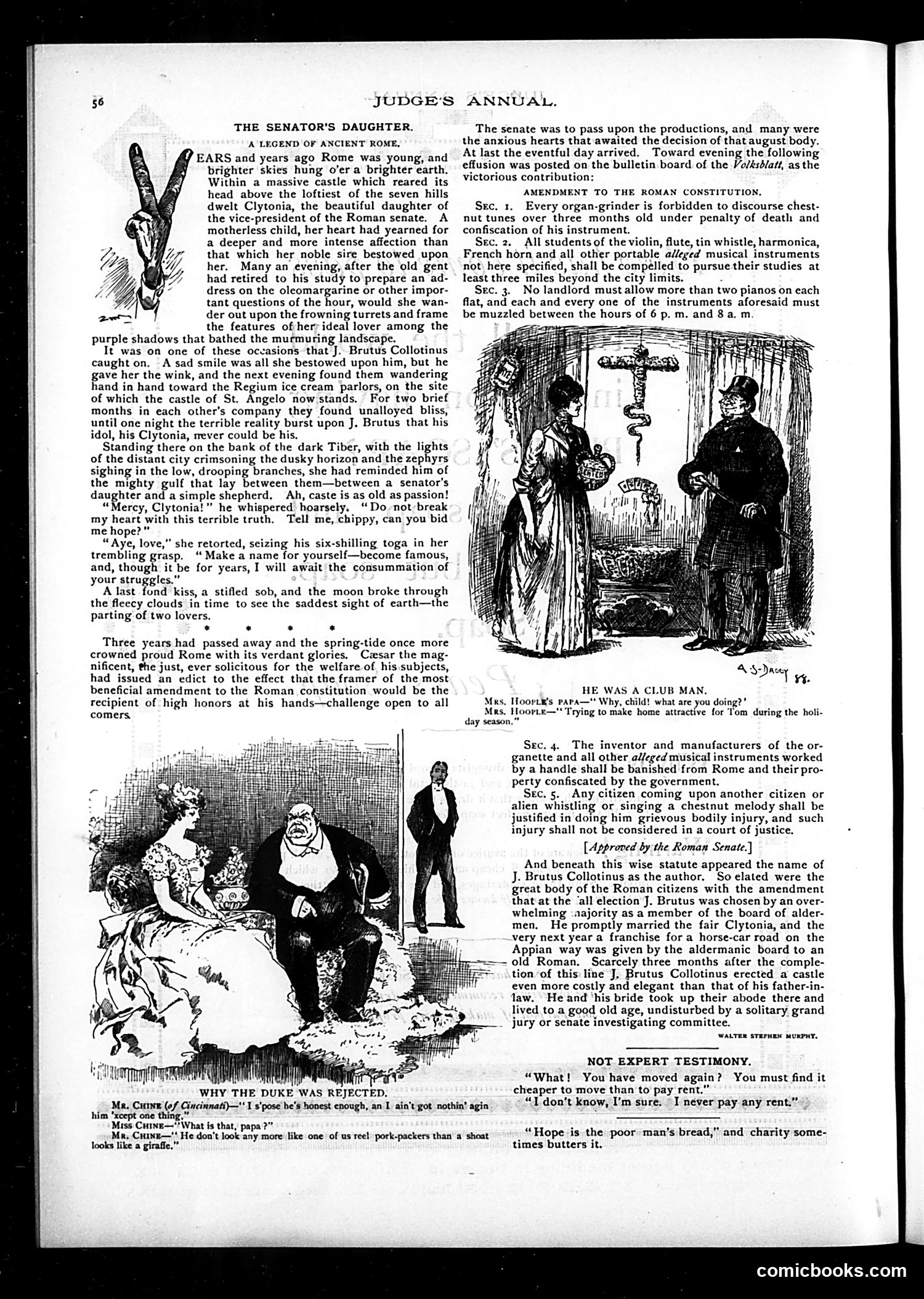
This is a mock-serious romantic legend set in ancient Rome, but it's actually satirizing contemporary American social class barriers. The story follows J. Brutus Collotinus, a humble shepherd, and Clytonia, a senator's daughter, whose romance fails because of their class difference—"caste is as old as passion!" To prove himself worthy, Brutus enters a Roman constitutional contest. His winning amendment restricts organ-grinders and street musicians, limiting "alleged musical instruments" and forbidding certain tunes. The satire mocks both rigid class stratification in America and the trivial municipal ordinances cities actually passed to regulate street noise and immigrant musicians. The ironic "historical" framing elevates petty modern urban complaints to mock-epic status. The separate cartoon below ("Why the Duke Was Rejected") continues this class-consciousness theme, showing a Cincinnati family rejecting a suitor for not resembling their profession—pork-packers.
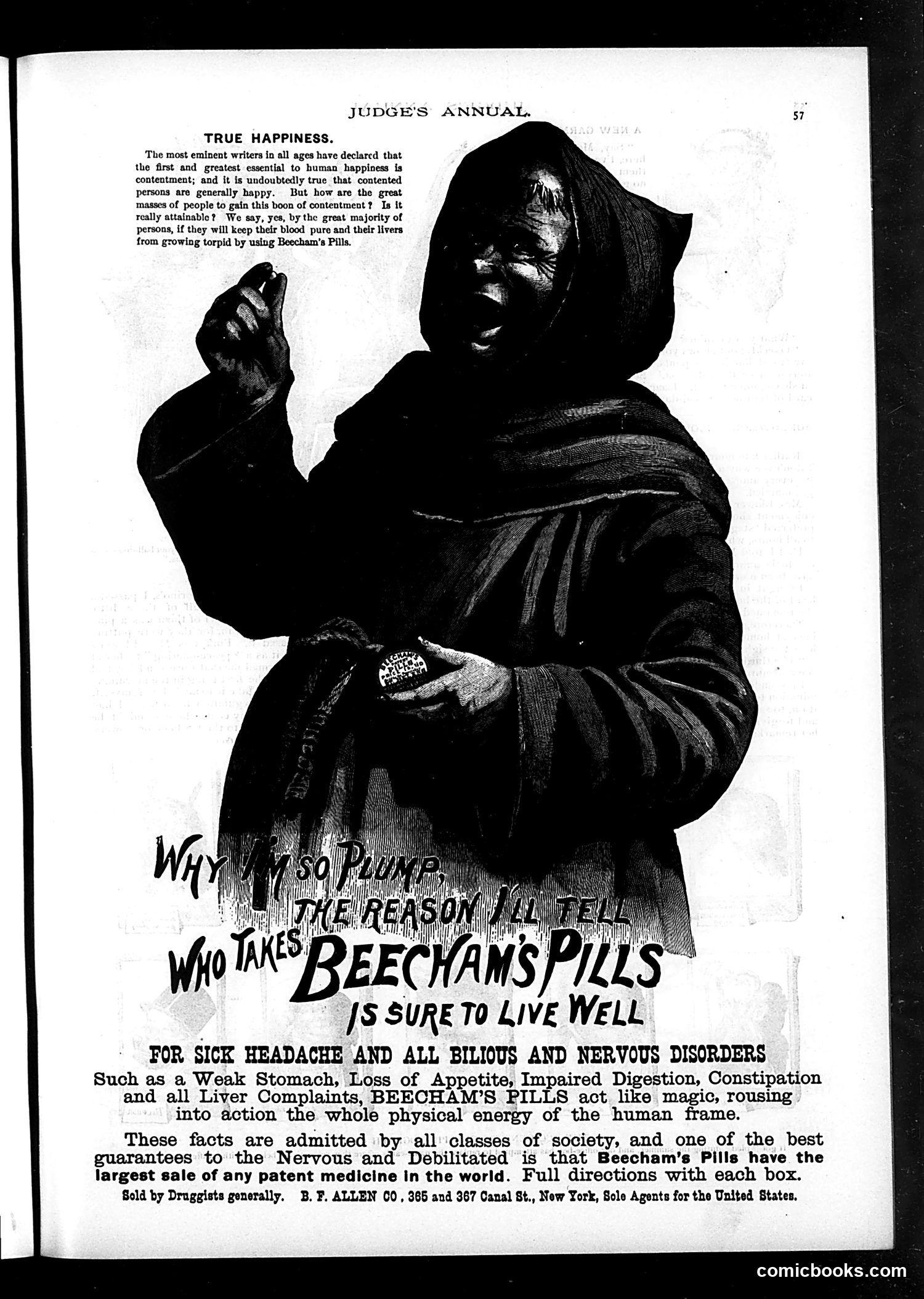
This is primarily a **patent medicine advertisement** for Beecham's Pills, not satire. The page presents an ironic editorial essay claiming that true happiness requires contentment, then pivots to suggest that contentment is achievable through—of all things—a commercial laxative. The accompanying illustration shows a figure in dark robes appearing to hold or examine pills, visually representing the product's supposed miraculous properties. The satire here is implicit rather than explicit: Judge's editors are gently mocking the era's widespread faith in patent medicines as cure-alls. By framing Beecham's Pills as the solution to achieving philosophical contentment itself, they highlight the absurdity of medicinal marketing claims. The ad boasts the pills have "the largest sale of any patent medicine in the world"—emphasizing how popular such dubious remedies were with the American public, regardless of actual efficacy. This reflects early 20th-century skepticism toward unregulated pharmaceutical advertising.
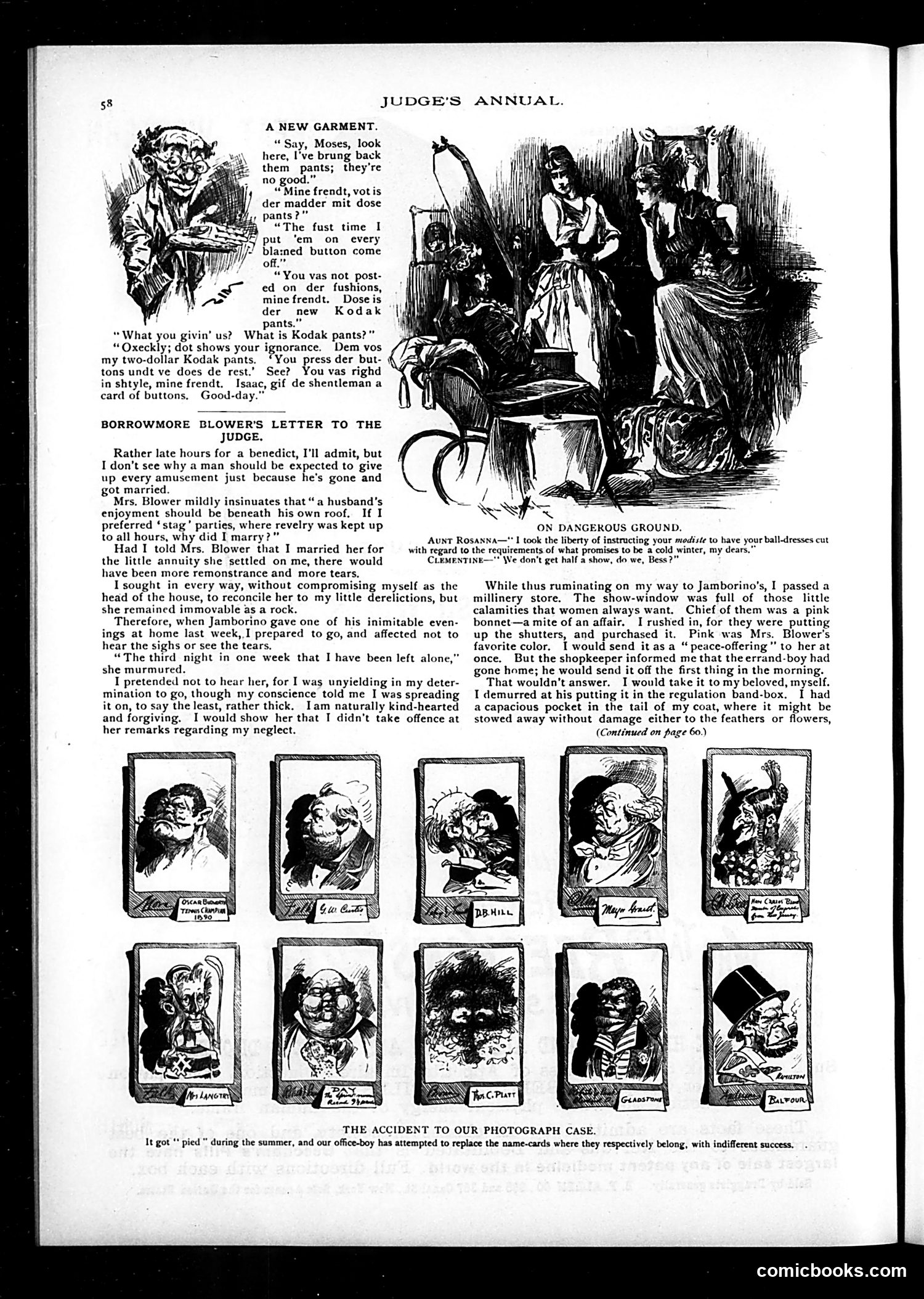
**"A New Garment"** satirizes Kodak's famous advertising slogan "You press the button, we do the rest." A Jewish peddler (stereotypically characterized through dialect) sells shoddy pants as "Kodak pants"—buttons fall off immediately, but he claims this is fashionable because, like Kodak cameras, "you press de buttons undt ve does de rest." The joke mocks both the ubiquity of Kodak's marketing and plays on period ethnic stereotypes. **"Borrowmore Blower's Letter"** presents a husband's self-justifying account of neglecting his wife for bachelor parties. He buys her a peace-offering bonnet but stubbornly continues to his evening out anyway—illustrating the satirical point about marital selfishness and masculine entitlement. **"The Accident to Our Photograph Case"** explains that the ten portrait cards below are replacements for damaged originals, humorously acknowledging production errors. All content reflects late-19th-century social attitudes and advertising culture.
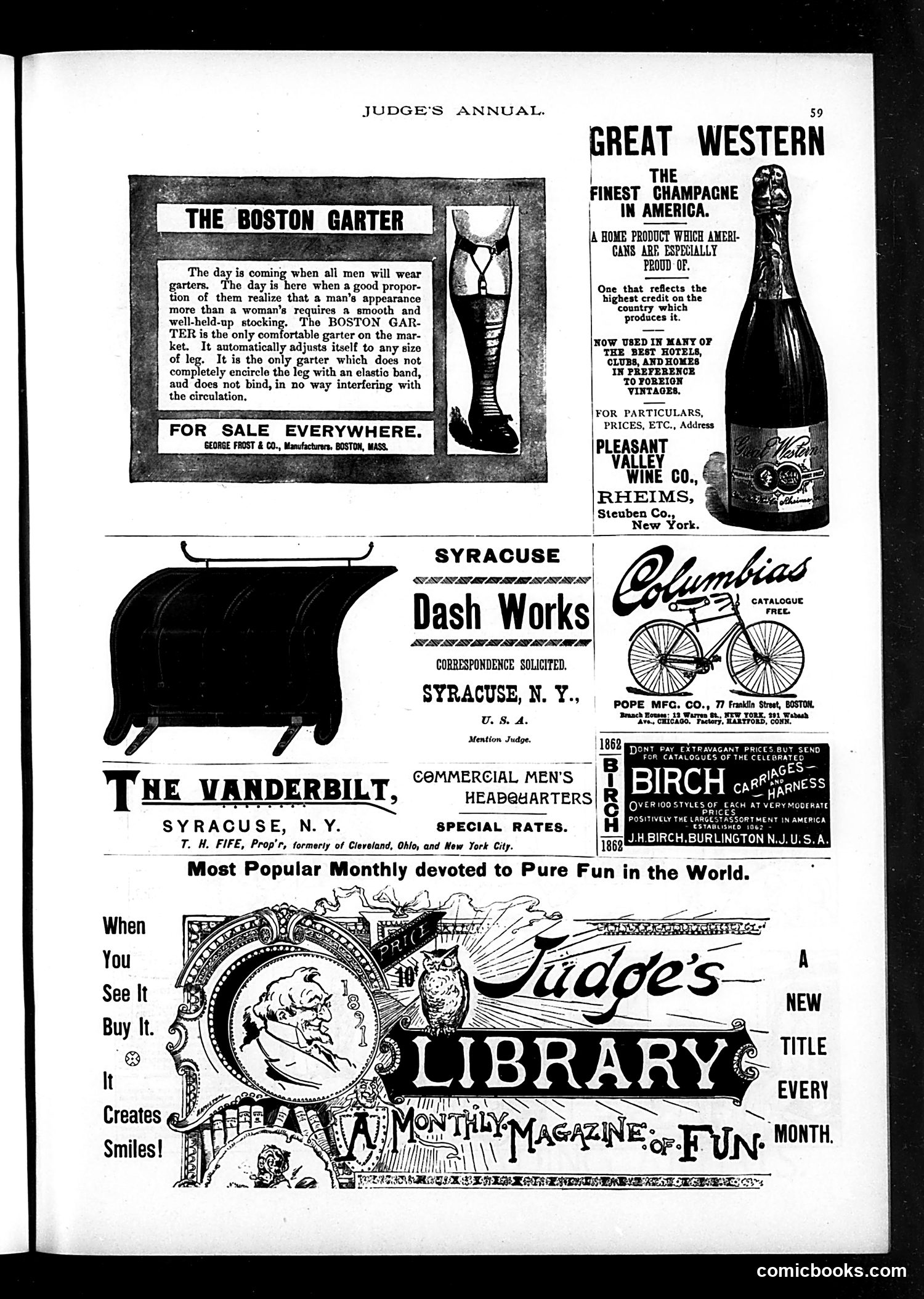
This is primarily an **advertising page** from Judge magazine, not a satirical cartoon. The page showcases various commercial products and services typical of the late 19th/early 20th century: **Key Advertisements:** - **The Boston Garter**: Men's hosiery support, marketed with claims about male appearance and circulation - **Great Western Champagne**: American wine positioned as patriotically superior to foreign imports - **Syracuse Dash Works**: Industrial manufacturing - **The Vanderbilt Hotel**: Syracuse hospitality - **Columbia Bicycles**: Bicycles with catalogue offer - **Birch Harnesses**: Horse equipment - **Judge's Library**: The magazine's own monthly publication promoting "pure fun" The page reflects contemporary consumer culture and American commercial pride (the champagne ad specifically touts domestic production). There's no apparent political satire—it's straightforward period advertising designed to generate revenue for the publication while promoting goods to Judge's readership.
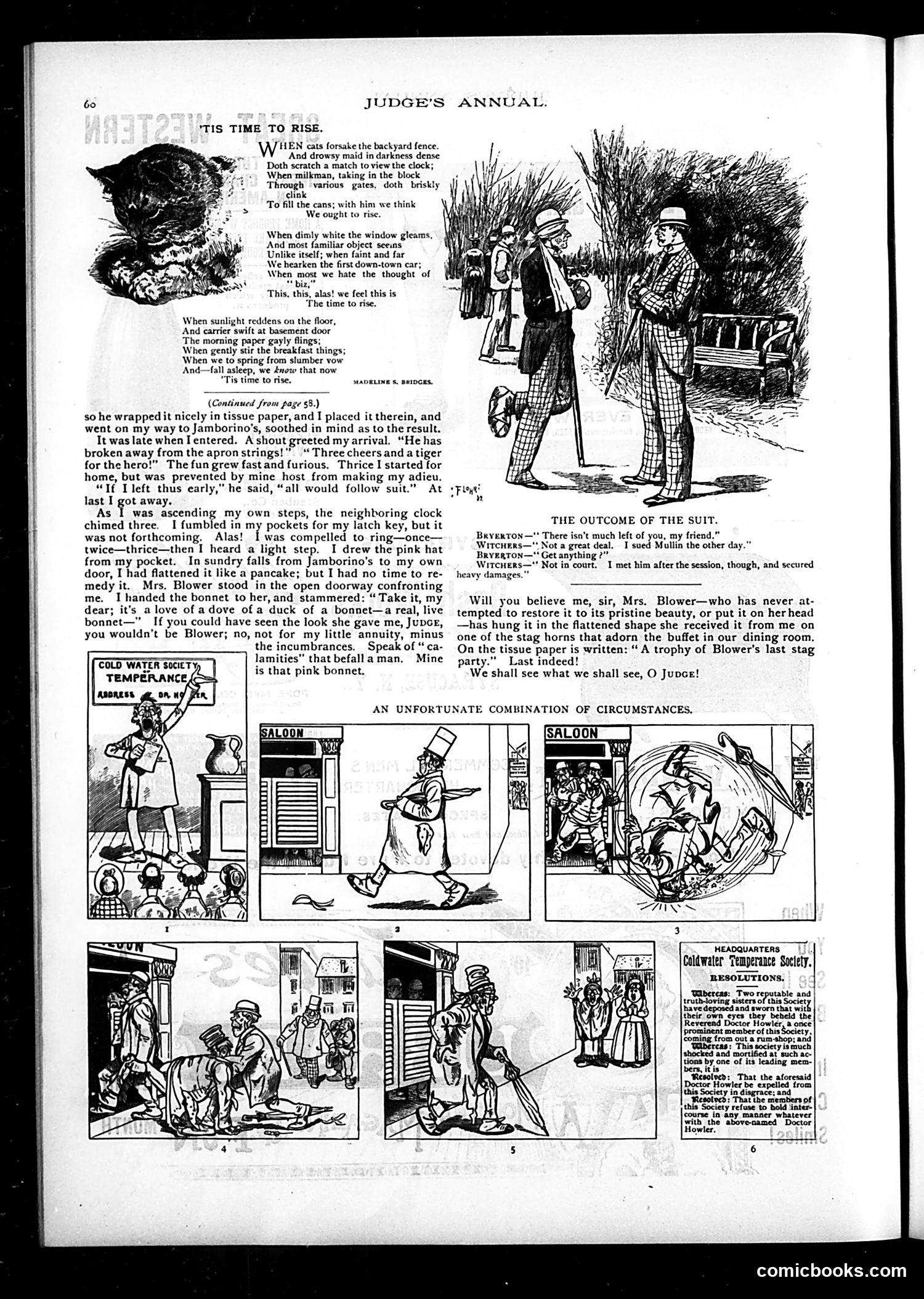
This Judge magazine page contains several satirical pieces mocking everyday American life and temperance hypocrisy. **"'Tis Time to Rise"** is a humorous poem about the various morning moments when one *should* wake up—yet doesn't, culminating in "fall asleep, we know that now / 'Tis time to rise." It's gentle satire on human laziness. **The main story** concerns a man who gives his wife a crushed pink bonnet from a night out, stammering excuses. She displays it mockingly as a "trophy of Blower's last stag party"—satirizing masculine carousing. **"The Outcome of the Suit"** jokes about legal damages obtained through violence rather than courts. **"An Unfortunate Combination of Circumstances"** targets temperance society hypocrisy: the Coldwater Temperance Society passes resolutions to expel Reverend Doctor Howler after witnesses claim seeing him exit a rum-shop. The cartoon panels show his humiliating discovery and expulsion—mocking the sanctimoniousness of prohibition advocates.
This is a title page or advertisement rather than a political cartoon. It promotes "Celebrated Sothern Pianos" as the preferred choice of leading artists. The page features decorative illustrations: a fish (top right) and what appear to be ornamental designs or emblems (bottom left). The diagonal text arrangement emphasizes the piano brand name. This is essentially advertising content placed within Judge magazine's annual publication. It capitalizes on artistic credibility by claiming endorsement from "leading artists," a common marketing strategy of the era. Without additional context about the Sothern piano company or specific artist endorsements, this appears to be straightforward commercial promotion rather than satirical commentary.
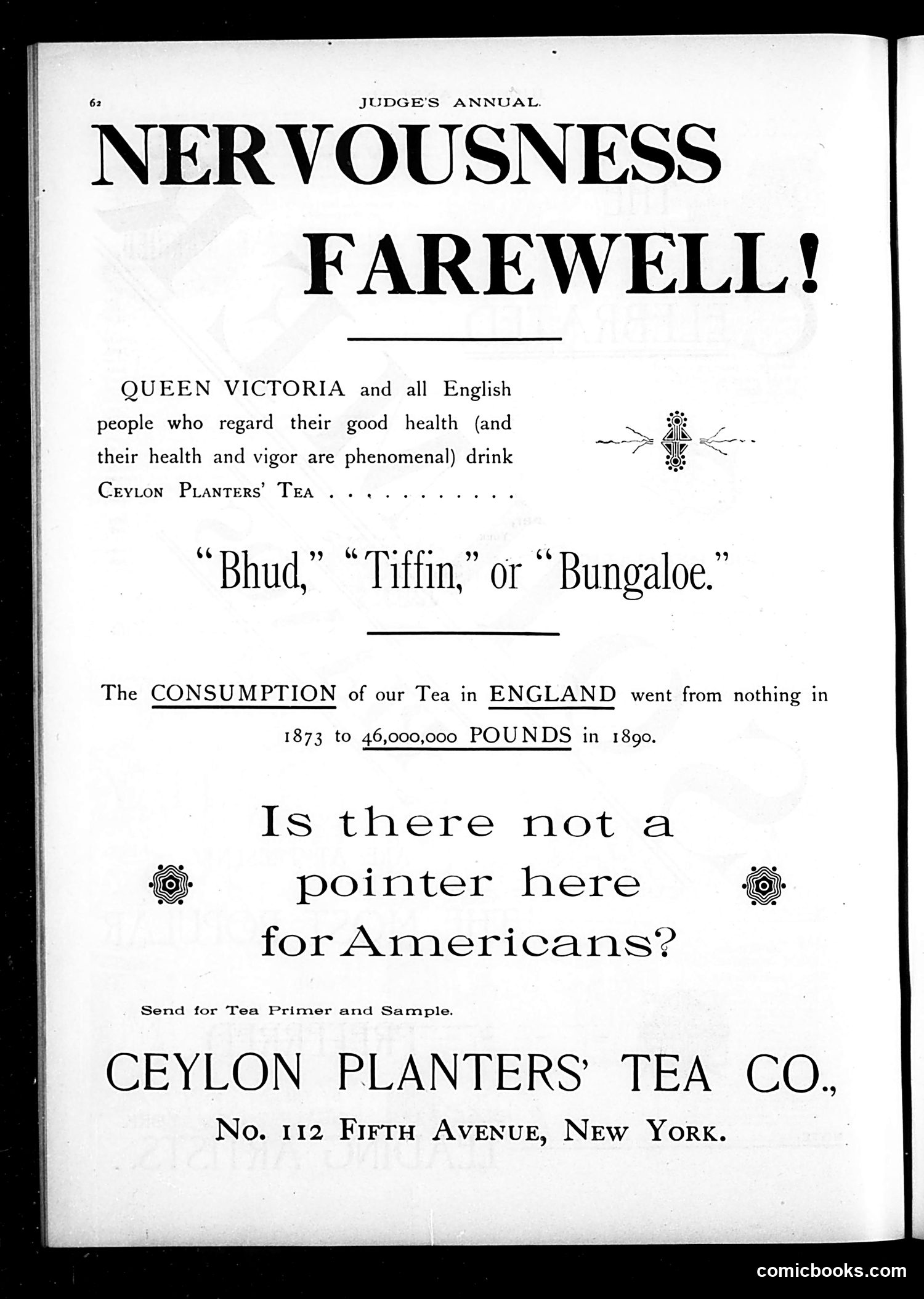
This is primarily a **Ceylon Planters' Tea Company advertisement**, not a political cartoon. The page uses patriotic appeals and competitive marketing rather than satire. The ad claims that Queen Victoria and English people attribute their excellent health to Ceylon Planters' Tea, citing dramatic consumption growth in England (46 million pounds by 1890, from nothing in 1873). The phrase "Is there not a pointer here for Americans?" is a marketing challenge—suggesting Americans should adopt the tea for similar health benefits. The references to "Bhud," "Tiffin," and "Bungaloe" are British colonial terms (Indian/Anglo-Indian vocabulary), emphasizing the tea's exotic, prestigious origin from Ceylon (Sri Lanka). Rather than satirizing anything, Judge's editorial staff is simply selling advertising space to a commercial product, using patriotic and health-conscious appeals typical of late 19th-century marketing.
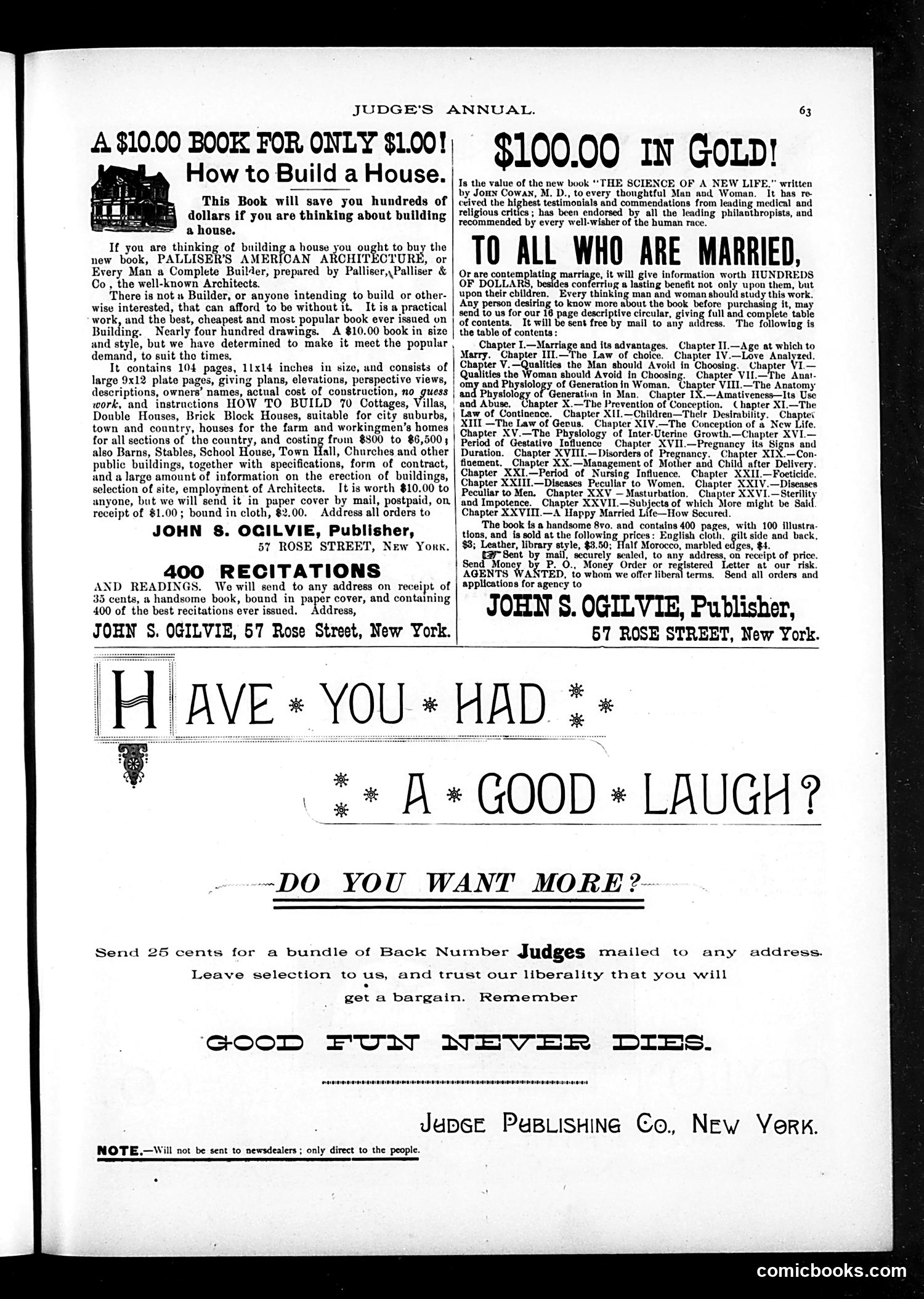
This page is primarily **advertising and promotional content**, not a cartoon or satirical piece. The layout features multiple book advertisements from Judge Publishing Company, New York, circa the late 1800s. The main ads promote: 1. **"How to Build a House"** — a $10 book sold for $1, offering practical architectural plans 2. **"400 Recitations and Readings"** — a collection of performance pieces 3. **"The Science of a New Life"** by John Cowan — a health/medical guide offering "$100 in gold" value, with extensive chapters on marriage, reproduction, and physiology The page concludes with a light-hearted call-to-action ("Have you had a good laugh? Do you want more?") encouraging readers to subscribe to back issues. **Historical context**: These advertisements reflect late-Victorian interests in self-improvement literature, practical domesticity, and medical/sexual education presented in respectable terms. The "Science of a New Life" book represents the era's growing frankness about reproductive topics within marriage.
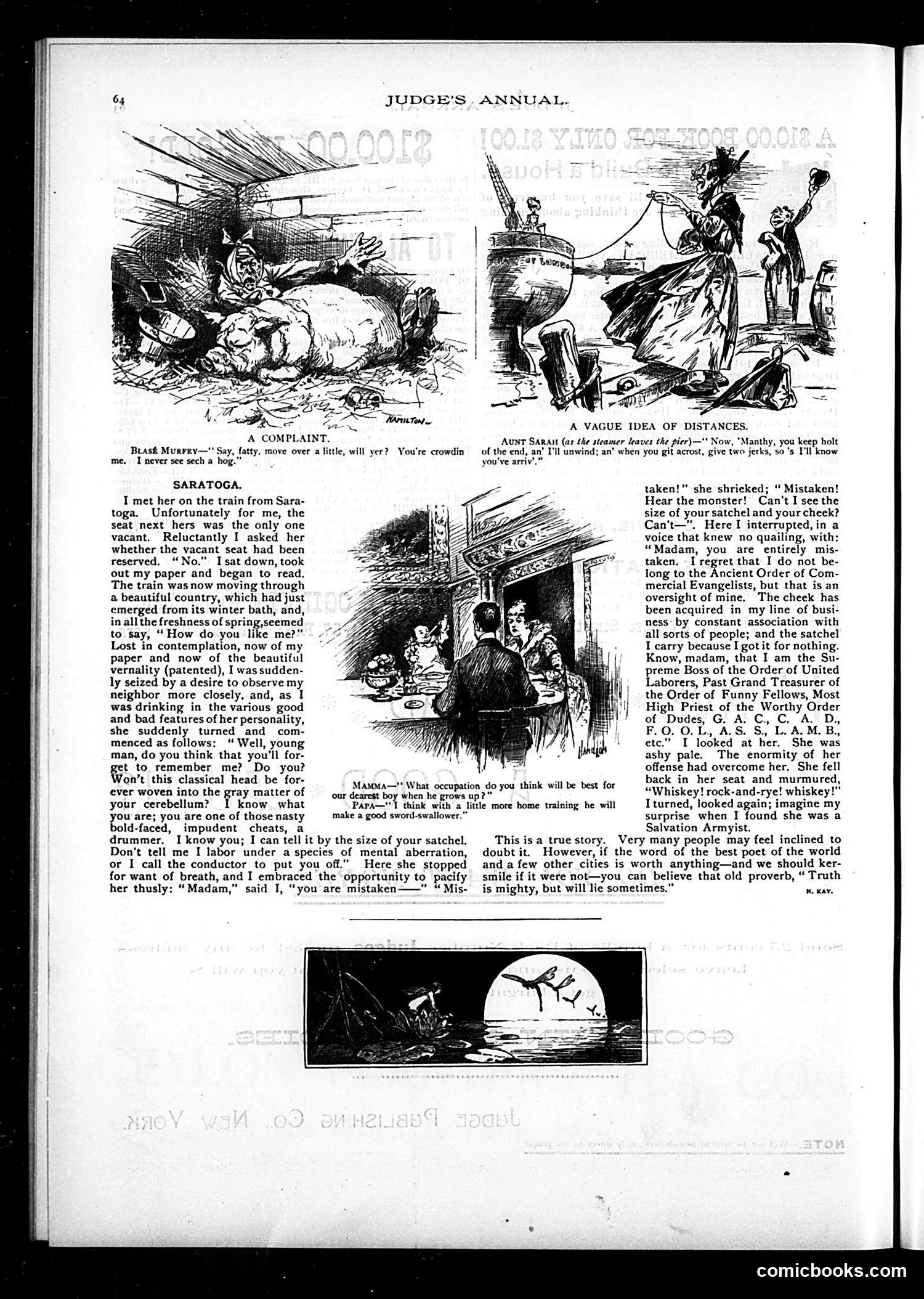
This page contains three distinct satirical pieces mocking American social types: **"A Complaint"** (top left): Shows a fat man on a train being confronted by a thin passenger. The joke plays on physical contrast and working-class rudeness—the thin man calls the fat passenger a "hog" for taking up too much space. **"A Vague Idea of Distances"** (top right): An elderly rural woman (Aunt Sarah) hands her companion a rope, instructing her to hold one end while crossing water and "give two jerks" when she arrives. The satire mocks rural ignorance about distance and basic geography—the woman apparently believes you can hand-signal across an impossibly wide expanse. **"Saratoga"** (center): A longer narrative about a man on a train insulted by an aggressive female passenger who assumes he's a traveling salesman ("drummer") based on his satchel and bold manner. He responds with an absurdly inflated list of fake fraternal memberships, reducing her to shock. The twist ending reveals she's a Salvation Army member—suggesting ironic redemption or moral comeuppance. All three mock pretension, ignorance, and social-class friction common to 1880s-90s America.
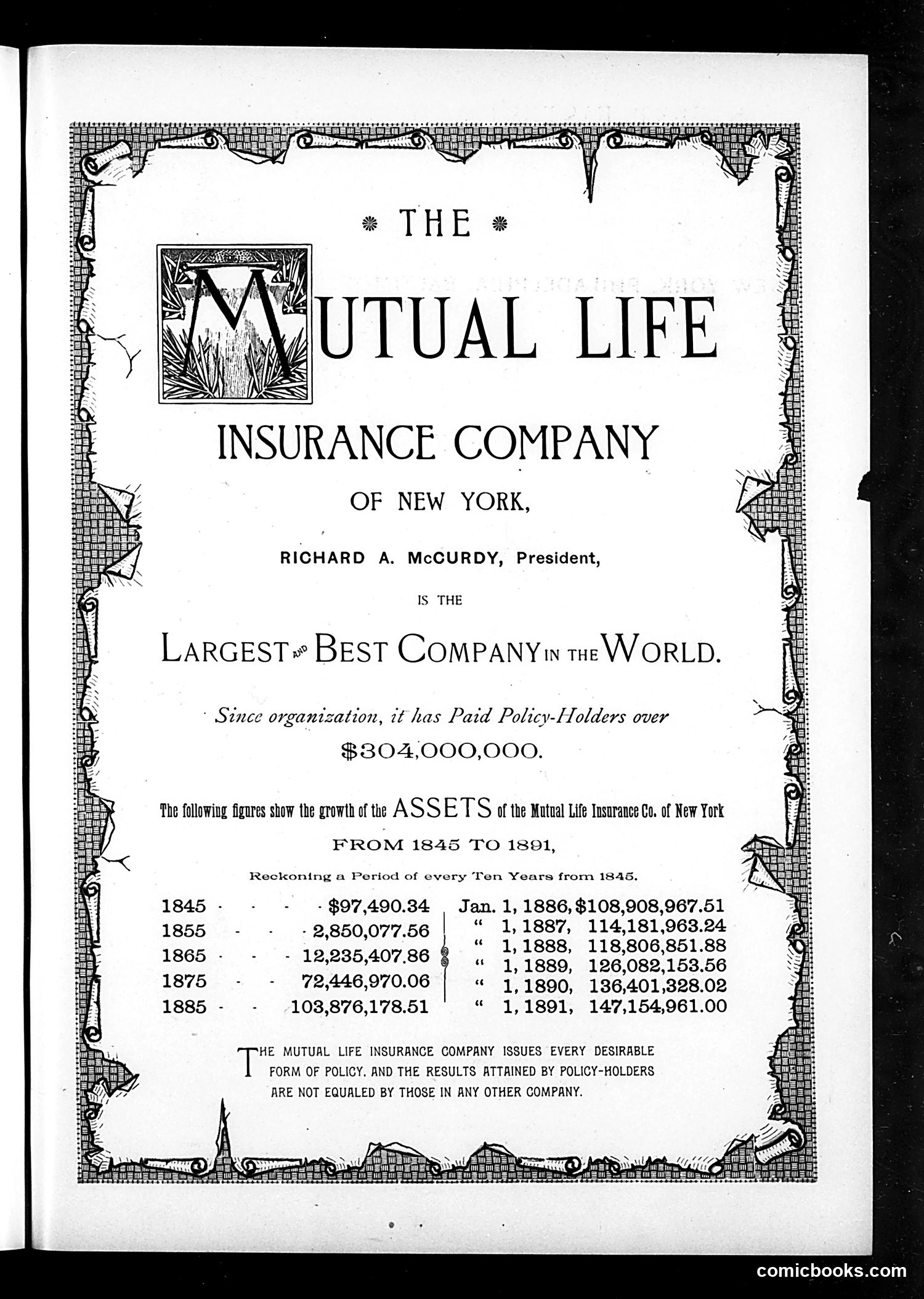
This is a **company advertisement**, not a satirical cartoon. The Mutual Life Insurance Company of New York uses this Judge magazine page to promote itself as the world's "largest and best" insurer under President Richard A. McCurdy. The page presents financial data spanning 1845-1891, showing dramatic asset growth from roughly $97,000 to over $147 million—meant to demonstrate stability and success. The company claims it has paid policyholders over $304 million since founding and boasts superior policy terms. The ornate border and prominent placement in Judge (a satirical weekly) suggest this paid advertising. The claims are purely promotional, with no satirical commentary visible. To modern readers, the figures might seem modest by contemporary standards, but in the 1890s, these numbers represented massive corporate wealth and were designed to inspire confidence in the insurer's reliability.
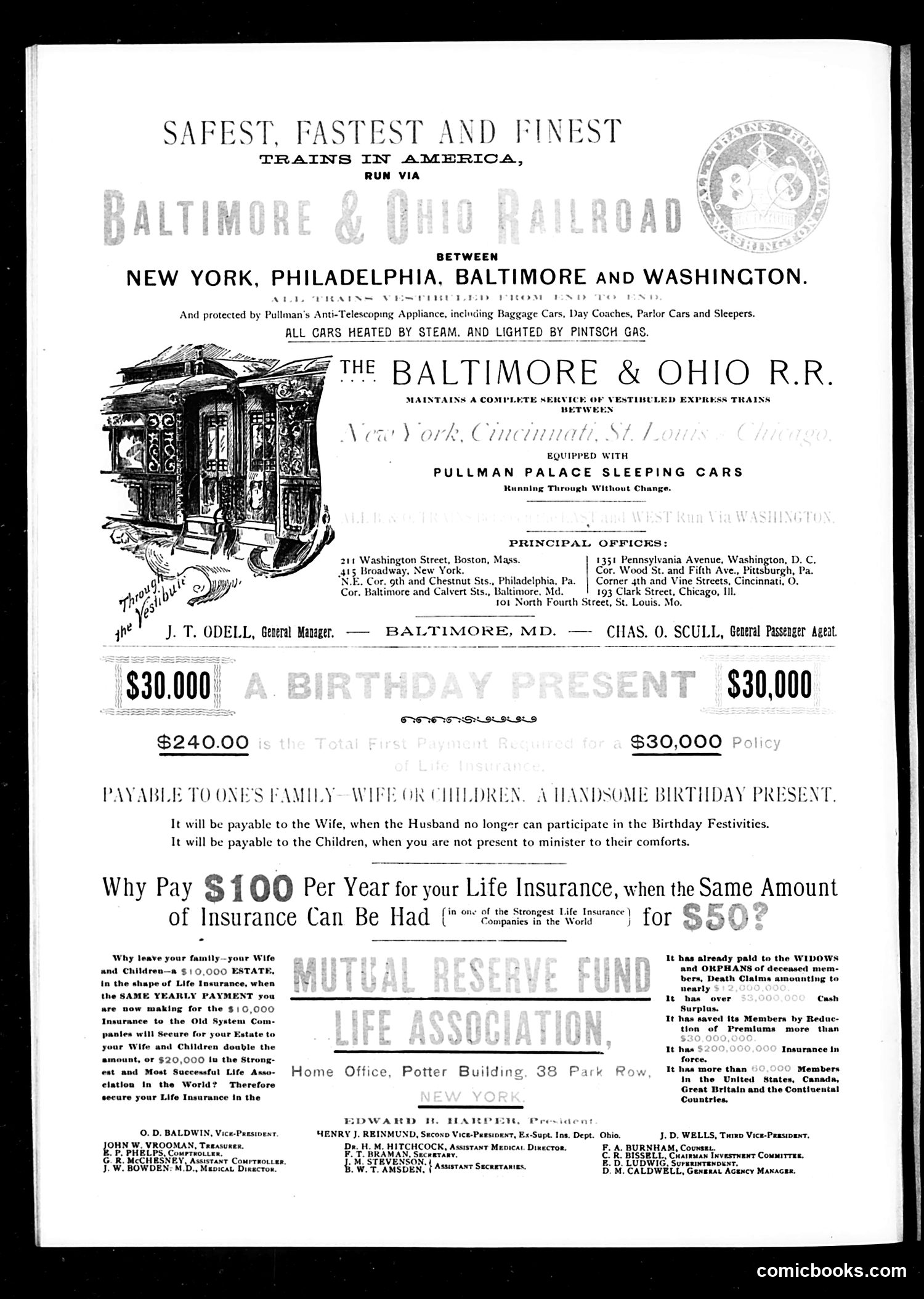
This is primarily an **advertisement page**, not a political cartoon. It contains two distinct ads: 1. **Baltimore & Ohio Railroad advertisement** promoting express train service between New York, Philadelphia, Baltimore, and Washington, featuring Pullman Palace sleeping cars. This emphasizes safety and comfort features like Pintsch gas lighting and steam heating. 2. **Mutual Reserve Fund Life Association insurance advertisement** taking up most of the lower half. The pitch compares their $50/year premiums to competitors' $100/year rates for equivalent $30,000 coverage. The ad emphasizes that payouts go to families ("wife or children") as birthday presents when the policyholder can no longer participate in celebrations—a euphemistic way of saying upon death. The insurance ad includes organizational details and lists of company officers. Both ads exploit late-19th-century anxieties about travel safety and financial security for families. This appears to be from a *Judge* magazine issue used primarily for commercial advertising revenue rather than satirical content.
I can see this is a page from *Judge* magazine (as indicated by the watermark), but the image is almost entirely black with minimal visible content. There is a white vertical line or border on the left edge, and some faint scattered marks, but no clearly legible cartoon, text, or illustrations are discernible. This appears to be either a blank page, a heavily damaged or poorly scanned page, or possibly the back cover of an issue. Without visible cartoon content or readable text beyond the watermark, I cannot identify specific figures, political references, or satirical points that would have been present on this page when originally published. To provide meaningful historical context, a clearer image would be necessary.