
Judge, 1891 · page 21 of 69
Judge — 1891 — page 21: what you’re looking at
What you’re looking at
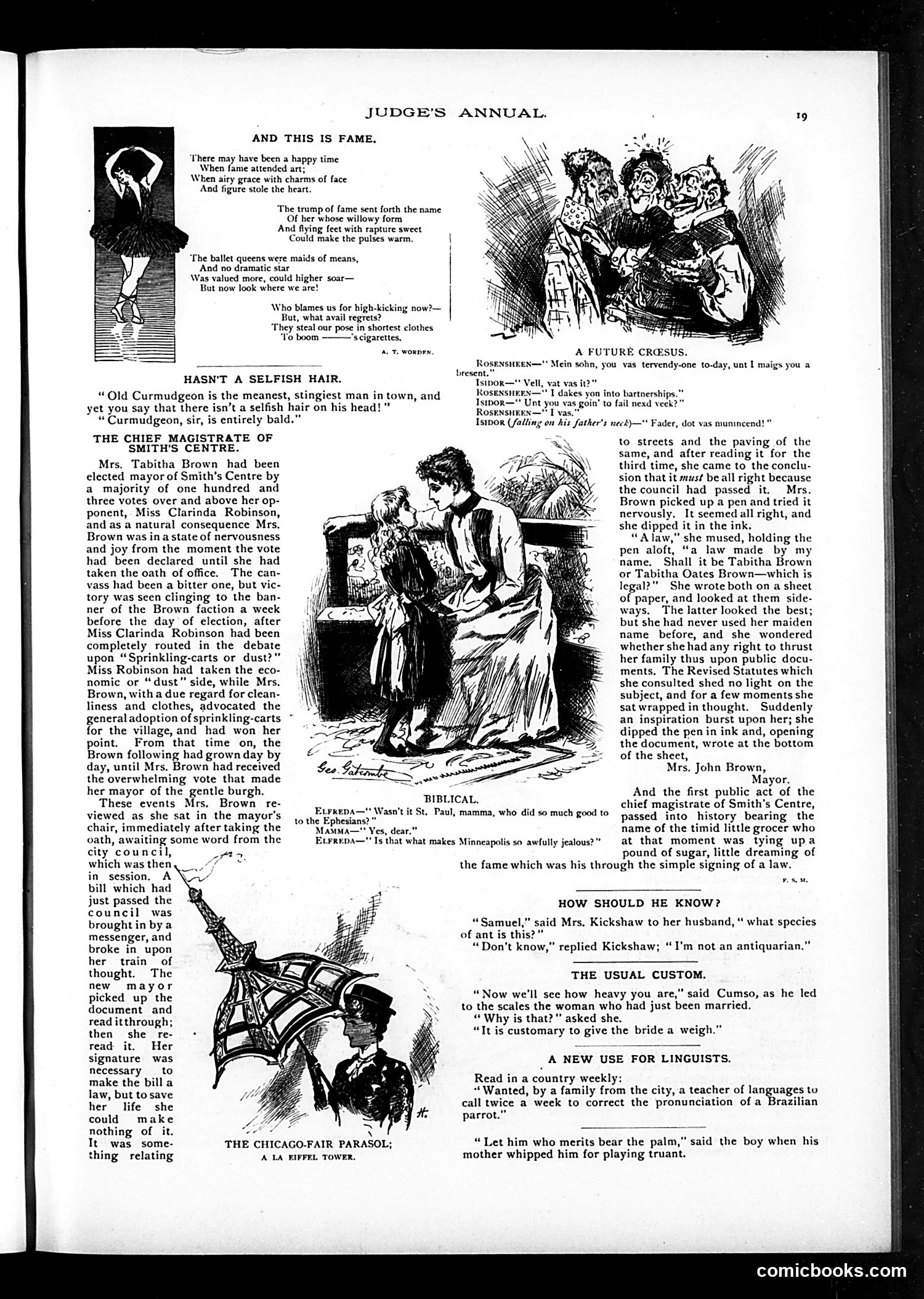
This page from *Judge*, a late-19th/early-20th-century satirical magazine, contains several unrelated humorous pieces: **"And This Is Fame"** critiques the decline of dignity in entertainment, specifically women performers. The poem laments that ballet dancers once represented grace and elegance, but now (implied: the present era) debase themselves by engaging in high-kicking acts and promoting cigarettes for commercial gain—a sharp comment on commercialism and changing entertainment standards. **"The Chief Magistrate of Smith's Centre"** humorously depicts a newly elected female mayor, Mrs. Tabitha Brown, paralyzed by indecision over whether to sign official documents as "Tabitha Brown" or "Tabitha Oates Brown" (her maiden name), ultimately choosing a third option: "Mrs. John Brown, Mayor"—gently satirizing women's uncertain status regarding identity and authority in civic life. The page also includes brief comic snippets ("A Future Cresus," "Biblical," etc.) typical of *Judge's* miscellaneous humor format, plus illustrations complementing the satire.
📄 Transcribed text from this page (OCR, searchable)
Machine-transcribed from the original scan — historical spelling and the odd misread are preserved.
JUDGE'S ANNUAL. AND THIS IS FAME, There may have been a happy time When fame attended art; When airy grace with charms of face And figure stole the heart. ‘The trump of fame sent forth the name Of her whose willowy form And flying feet with rapture sweet Could make the pulses warm. ‘The ballet queens were maids of means, ‘And no dramatic star Was valued more, could higher soar— But now look where we are! Who blames us for high-kicking now?— But, what avail regrets? They steal our pose in shortest clothes ‘Yo boom “scigarettes. ALT. WORDEN. A FUTURE CRESUS. —_ - RoseNsitkeN—" Mein sohn, you vas tervendy-one to-day, unt I maigs you a HASN'T A SELFISH HAIR. bbressal Isipor. “ Old Curmudgeon is the meanest, stingiest man in town, and Kosenst yet you say that there isn’t a selfish hair on his head!” “Curmudgeon, sir, is entirely bald.” I dakes yon into bartnerships.”” goin’ to fail nexd veek?” is father’s neck) —"* Fader, dot vas munincend!" THE CHIEF MAGISTRATE OF SMITH'S CENTRE. Mrs, Tabitha Brown had been elected mayor of Smith's Centre by a majority of one hundred and three votes over and above her op- ponent, Miss Clarinda Robinson, and as a natural consequence Mrs. Brown was ina state of nervousness and joy from the moment the vote had been declared until she had taken the oath of office. The can- vass had been a bitter one, but vic- tory was seen clinging to the ban- ner of the Brown faction a week before the day of election, after Miss Clarinda Robinson had been completely routed in the debate upon “Sprinkling-carts or dust?” Miss Robinson had taken the eco- nomic or “dust” side, while Mrs. Brown, with a due regard for clean- liness and clothes, advocated the general adoption of sprinkling-carts * for the village, and had won her point. From that time on, the Brown following had grown day by day, until Mrs. Brown had received the overwhelming vote that made her mayor of the gentle burgh. These events Mrs. Brown re- viewed as she sat in the mayor's chair, immediately after taking the BIBLICAL, “* Wasn't it St, Paul, mamma, who did so much good to to streets and the paving of the same, and after reading it for the third time, she came to the conclu- sion that it must be all right because the council had passed it. Mrs. Brown picked up a pen and tried it nervously, It seemed all right, and she dipped it in the ink. “A law,” she mused, holding the pen aloft, “a law made by my name. Shall it be Tabitha Brown or Tabitha Oates Brown—which is legal?” She wrote both on a sheet of paper, and looked at them side- ways. The latter looked the best; but she had never used her maiden name before, and she wondered whether she had any right to thrust her family thus upon public docu- ments, The Revised Statutes which she consulted shed no light on the subject, and for a few moments she sat wrapped in thought. Suddenly an inspiration burst upon her; she dipped the pen in ink and, opening the document, wrote at the bottom of the sheet, Mrs. John Brown, Mayor, And the first public act of the chief magistrate of Smith's Centre, passed into history bearing the name of the timid little grocer who oath, awaiting some word from the city council, Yt which was then fe at that moment was tying upa pound of sugar, little dreaming of the fame which was his through the simple signing of a law. in session. A bill which had ‘py nam Just passed the : HOW SHOULD HE KNOW? council was , ‘i brought in by a “Samuel,” said Mrs, Kickshaw to her husband, “ what species of ant is this?” messenger, and ie : aoe broke in upon “Don't know,” replied Kickshaw; “I'm not an antiquarian. her train of thought. The new mayor THE USUAL CUSTOM. i “Now we'll see how heavy you are,” said Cumso, as he led betty es to the scales the woman who Bad just been married. read itthrough; —— “ Why is that?" asked she. then she re- vd “It is customary to give the bride a weigh.” read it. Her ) 4 “a = signature’ was A NEW USE FOR LINGUISTS. necessary _to make the billa law, but to save her life she Read in a country weekly: “Wanted, by a family from the city, a teacher of languages tu Y p call twice a week to correct the pronunciation of a Brazilian could make VM parrot. nothing of it. SwNSE TE MSE “Let him who merits bear the palm,” said the boy when his mother whipped him for playing truant. It was some- THE CHICAGO-FAIR PARASOL; thing relating A LA EIFFEL TOWER. comicbooks.com