
Judge, 1891 · page 58 of 69
Judge — 1891 — page 58: what you’re looking at
What you’re looking at
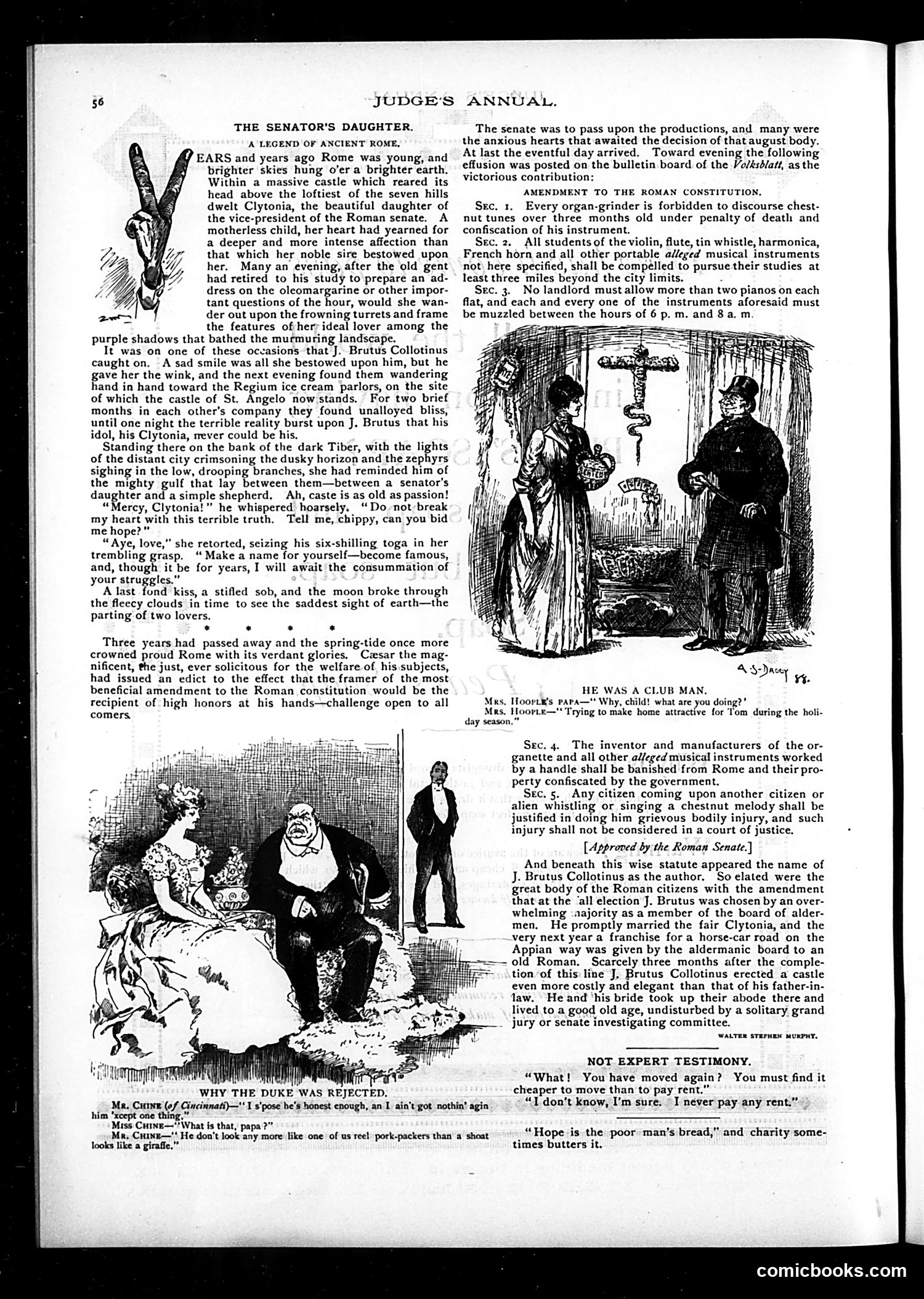
This is a mock-serious romantic legend set in ancient Rome, but it's actually satirizing contemporary American social class barriers. The story follows J. Brutus Collotinus, a humble shepherd, and Clytonia, a senator's daughter, whose romance fails because of their class difference—"caste is as old as passion!" To prove himself worthy, Brutus enters a Roman constitutional contest. His winning amendment restricts organ-grinders and street musicians, limiting "alleged musical instruments" and forbidding certain tunes. The satire mocks both rigid class stratification in America and the trivial municipal ordinances cities actually passed to regulate street noise and immigrant musicians. The ironic "historical" framing elevates petty modern urban complaints to mock-epic status. The separate cartoon below ("Why the Duke Was Rejected") continues this class-consciousness theme, showing a Cincinnati family rejecting a suitor for not resembling their profession—pork-packers.
📄 Transcribed text from this page (OCR, searchable)
Machine-transcribed from the original scan — historical spelling and the odd misread are preserved.
JUDGE'S ANNUAL. THE SENATOR'S DAUGHTER. A LEGEND OF ANCIENT ROME, ? EARS and years ago Rome was young, and Y brighter skies hung o’er a brighter earth, Within a massive castle which reared its head above the loftiest of the seven hills dwelt Clytonia, the beautiful daughter of the vice-president of the Roman senate. A motherless child, her heart had yearned for a deeper and more intense affection than that which her noble sire bestowed upon her. Many an evening, after the old gent had retired to his study to prepare an ad- dress on the oleomargarine or other impor- tant questions of the hour, would she wan- der out upon the frowning turrets and frame the features of hery ideal lover among the purple shadows that bathed the murmuring landscape. It was on one of these occasions that J. Brutus Collotinus caught on. A sad smile was all she bestowed upon him, but he gave her the wink, and the next evening found them wandering hand in hand toward the Regium ice cream parlors, on the site of which the castle of St. Angelo now stands. For two brief months in each other's company they found unalloyed bliss, until one night the terrible reality burst upon J. Brutus that his idol, his Clytonia, rever could be his. Standing there on the bank of the dark Tiber, with the lights of the distant city crimsoning the dusky horizon and the zephyrs sighing in the low, drooping branches, she had reminded him of the mighty gulf that lay between them—between a senator's daughter and a simple shepherd. Ah, caste is as old as passion! “Mercy, Clytonia!” he whispered hoarsely. ‘Do not-break my heart with this terrible truth. Tell me, chippy, can you bid me hope?” “Aye, love,” she retorted, seizing his six-shilling toga in her trembling grasp.“ Make a name for yourself—become famous, and, though it be for years, I will await the consummation of your struggles.” A last fond kiss, a stifled sob, and the moon broke through the fleecy clouds in time to see the saddest sight of earth—the parting of two lovers. * . . * Three years had passed away and the spring-tide once more crowned proud Rome with its verdant glories, Casar the mag- nificent, the just, ever solicitous for the welfare of his subjects, had issued an edict to the effect that the framer of the most beneficial amendment to the Roman constitution would be the recipient of high honors at his hands—challenge open to all comers, WHY THE DUKE WAS REJECTED, Ma, Cure (of Cincinnati)—"'I s'pose he’s honest enough, an I ain't got nothin’ agin him ‘xcept one thing,” Miss Cuine—"'What is that, papa?” Ma. Citnz—'* He don't look any more like one of us reel) pork-packers than’ a shoat looks like a giraffe,” The senate was to pass upon the productions, and many were the anxious hearts that awaited the decision of that august body. At last the eventful day arrived. Toward evening the following effusion was posted on the bulletin board of the Vo/ksb/att, as the victorious contribution: AMENDMENT TO THE ROMAN CONSTITUTION, Sec. 1. Every organ-grinder is forbidden to discourse chest- nut tunes over three months old under penalty of death and confiscation of his instrument. Sec. 2, All students of the violin, flute, tin whistle, harmonica, French horn and all other portable a//eged musical instruments not here specified, shall be compelled to pursuetheir studies at least three miles beyond the city limits. Sec. 3. No landlord must allow more than two pianos on each flat, and each and every one of the instruments aforesaid must be muzzled between the hours of 6 p. m. and 8 a.m HE WAS A CLUB MAN, A—"* Why, child! what are you doing?’ ying to make home attractive for Tom during the holi- Mrs. Hoorte’s Sec. 4. The inventor and manufacturers of the or- ganette and all other ad/eged musical instruments worked by a handle shall be banished from Rome and their pro- perty confiscated by the government, Sec. 5. Any citizen coming upon another citizen or alien whistling or singing a chestnut melody shall be justified in doing him grievous bodily injury, and such injury shall not be considered in a court of justice. [Approved bythe Roman Senate.] And beneath this wise statute appeared the name of J. Brutus Collotinus as the author. So elated were the great body of the Roman citizens with the amendment that at the ‘all election J. Brutus was chosen by an over- whelming :aajority as a member of the board of alder- men. He promptly married the fair Clytonia, and the very next year a franchise for a horse-car road on the Appian way was given by the aldermanic board to an old Roman. Scarcely three months after the comple- tion of this line J, Brutus Collotinus erected a castle even more costly and elegant than that of his father-in- law. He and ‘his bride took up their abode there and lived to a good old age, undisturbed by a solitary grand jury or senate investigating committee. WALTER STEPHEN MURPHY, NOT EXPERT TESTIMONY. “What! You have moved again? You must find it cheaper to move than to pay rent.” “I don’t know, I'm sure. » I néver pay any rent.” “Hope is the poor man’s bread,” and charity some- times butters it. comicbooks.com