
A complete issue · 72 pages · 1889
Judge — 1889
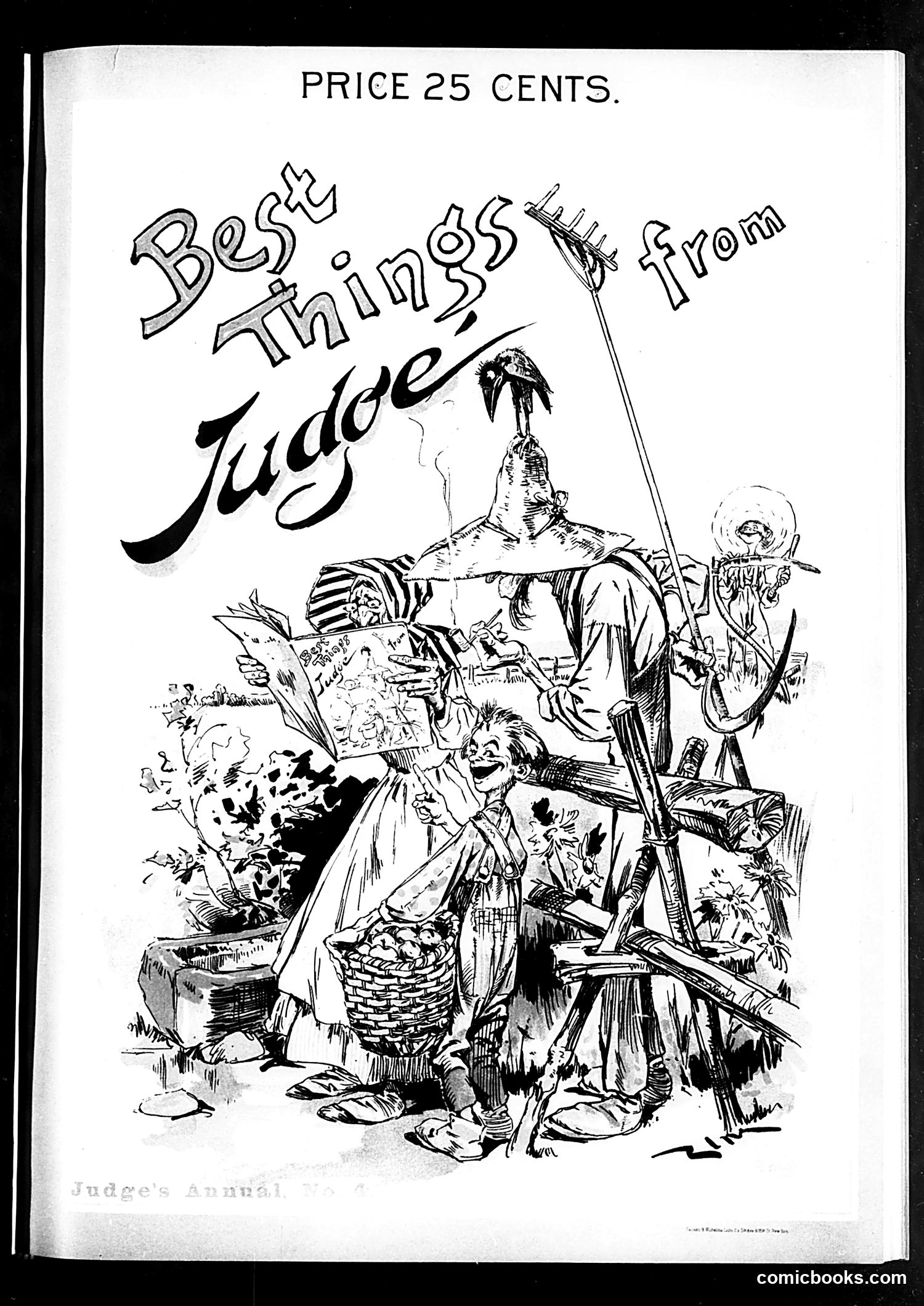
This is a cover page from *Judge* magazine (priced 25 cents), featuring a whimsical illustration rather than political satire. The image depicts what appears to be a scarecrow or straw man as a judge or authority figure, surrounded by various characters including what seems to be a fool or jester, a woman with a basket, and other fantastical figures in a garden or rural setting. The title "Best Things from Judge" suggests this is a collection or anthology issue. Without clearer context or identifying details in the artwork, the specific satirical target remains unclear—it may reference judicial incompetence, foolish authority, or social commentary on rural life, but the exact reference is difficult to determine from the image alone.
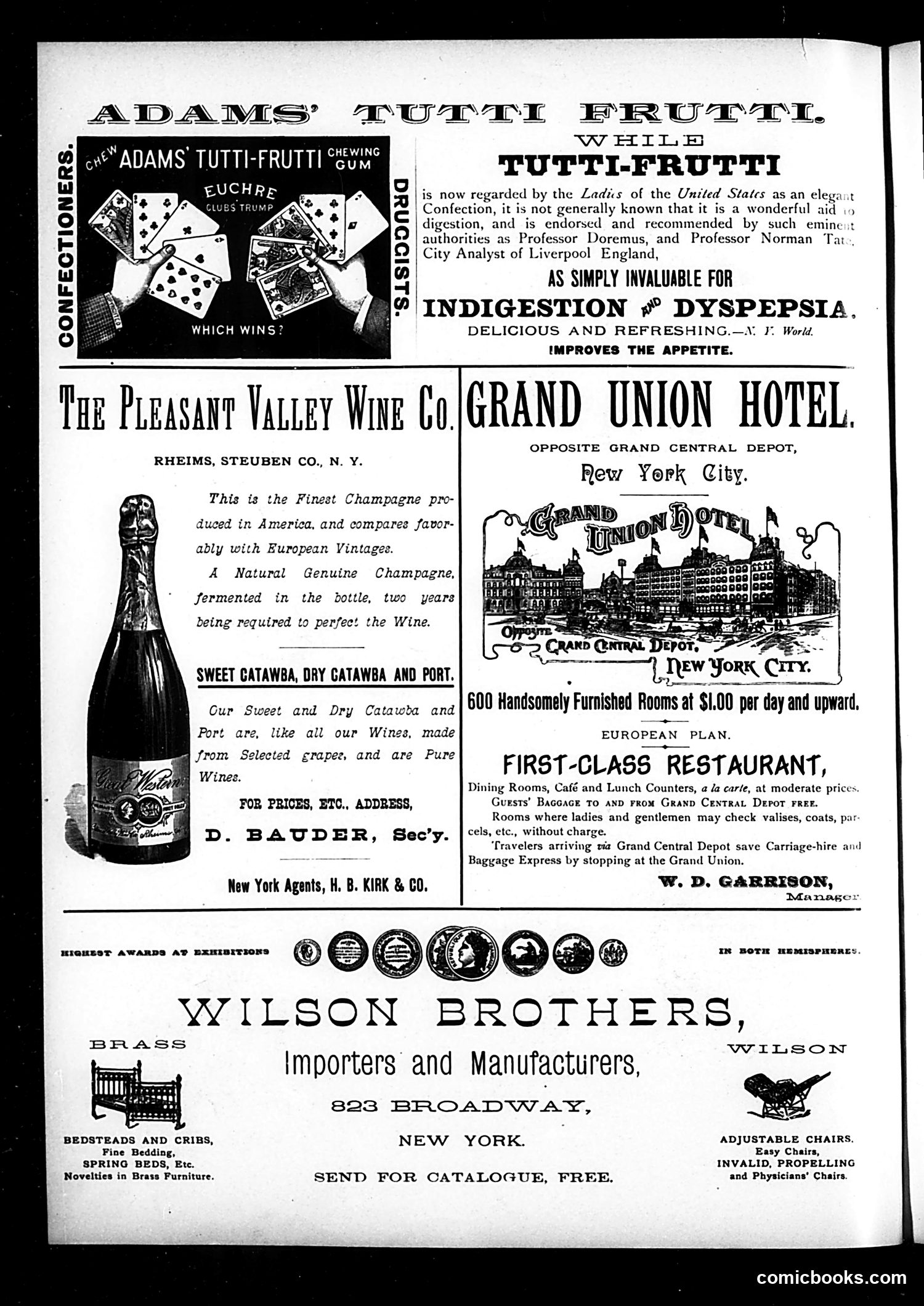
This page is primarily **advertisements** rather than editorial content or satire. The top features an Adams' Tutti-Frutti chewing gum ad with playing cards and the question "Which Wins?" — likely a simple product comparison gimmick with no clear political meaning. Below are commercial ads for luxury goods: champagne from The Pleasant Valley Wine Co., the Grand Union Hotel in NYC, and Wilson Brothers brass furniture and medical equipment. The only notable claim is Adams' assertion that Tutti-Frutti is "invaluable for indigestion and dyspepsia" — a common patent-medicine style health claim from this era, before modern FDA regulations. This reflects the period's unregulated product advertising practices. No political satire or caricature is evident on this page.
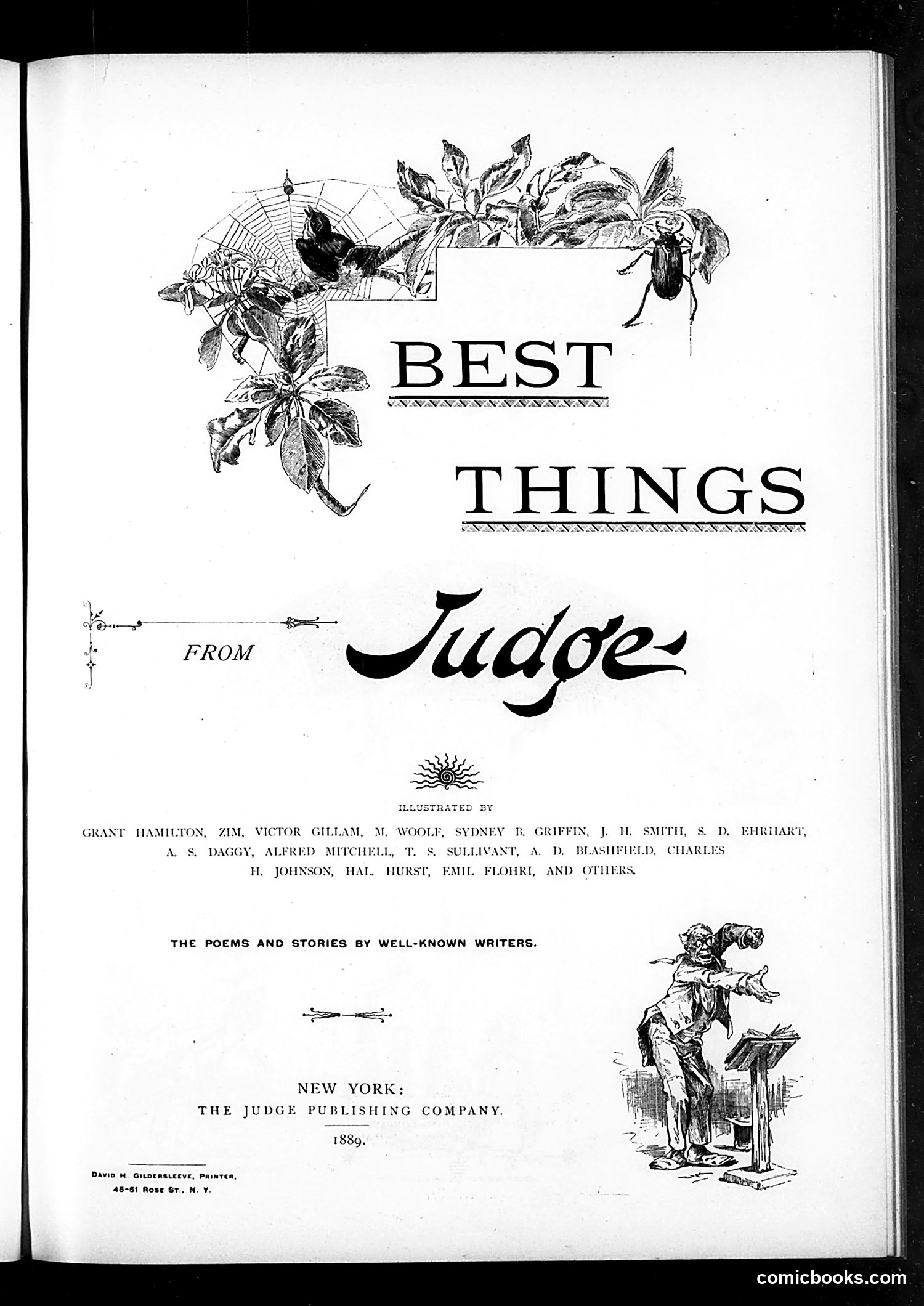
This is a title page for "Best Things from Judge," an 1889 collection of poems and stories from the satirical magazine. The decorative botanical illustrations and cherubic figure reading aren't political cartoons but rather ornamental design elements typical of late 19th-century book presentation. The page credits numerous illustrators (Grant Hamilton, Zim, Victor Gillam, and others who were prominent Judge contributors) and notes the content comprises "poems and stories by well-known writers." Rather than containing specific political satire, this appears to be a retrospective anthology—essentially advertising Judge magazine's literary and artistic output to potential book buyers in 1889. The imagery emphasizes taste, culture, and quality rather than political commentary.
This is a copyright page from **Judge magazine, 1889**. The decorative illustration above the copyright notice depicts figures in period dress seated on an ornate black bench or throne, with classical and allegorical elements surrounding them (including what appear to be cherubs or mythological figures). The image likely serves as the magazine's masthead or decorative titlepiece rather than a specific political cartoon. Without additional context text on this page, the exact satirical meaning is unclear. The elaborate classical framing suggests themes of justice, authority, or American civic institutions—appropriate for a publication called "Judge"—but the specific figures and their identities cannot be definitively determined from the image alone.
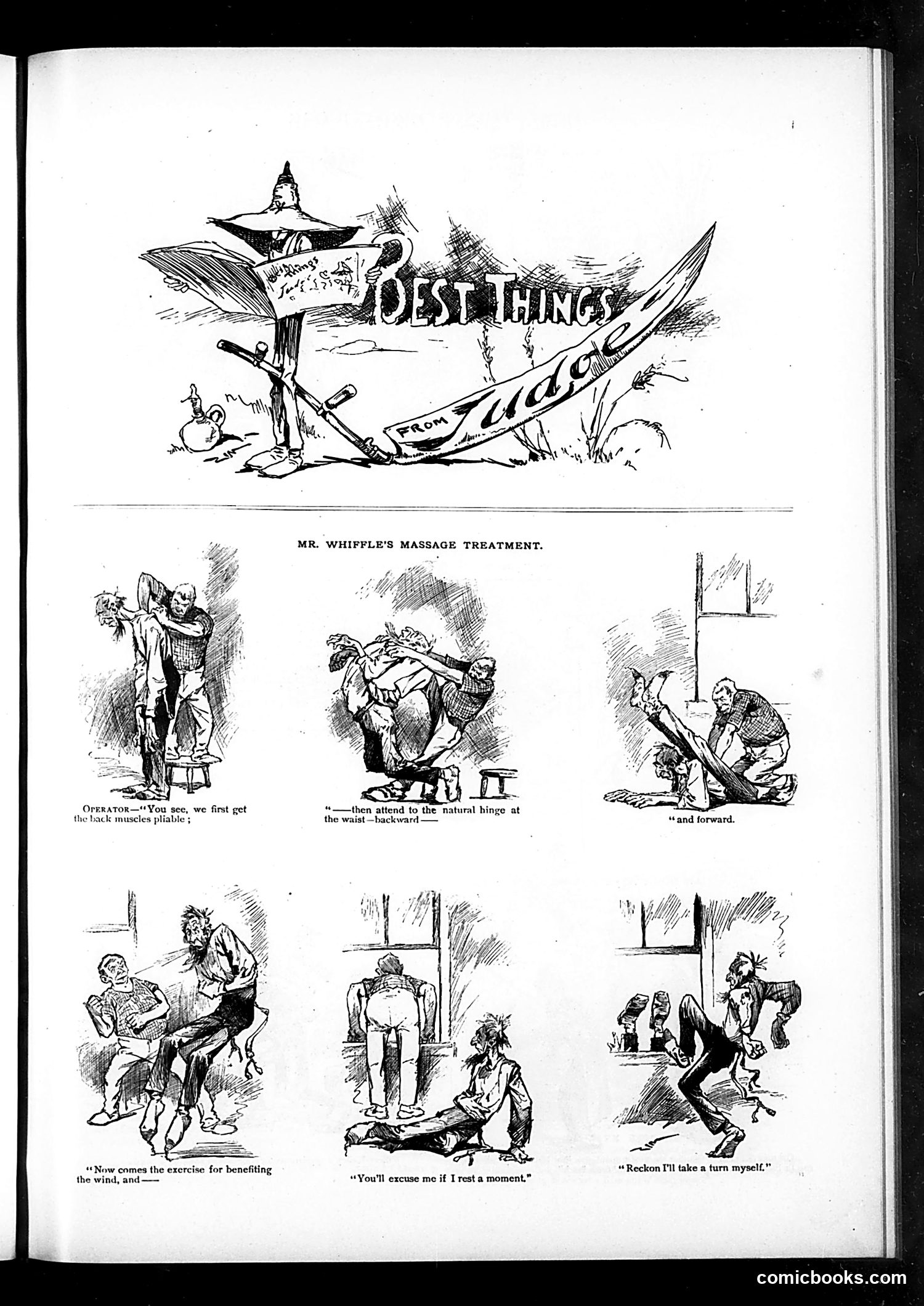
This satirical comic strip mocks a charlatan health practitioner named Mr. Whipple who promises physical "treatment" through increasingly ridiculous and violent exercises. The sequence shows him subjecting a client to contortions—bending backward, stretching forward, and generally manhandling the patient while using pseudo-scientific jargon about "back muscles" and "natural hinge at the waist." The humor targets the early 20th-century wellness industry's dubious practitioners who exploited Americans' health anxieties with pseudoscientific methods. By the final panels, even Whipple and onlookers want a turn administering the "treatment"—suggesting the scheme's absurdity is obvious to everyone. The brutality depicted satirizes how such practitioners prioritized spectacle and profit over actual patient benefit.
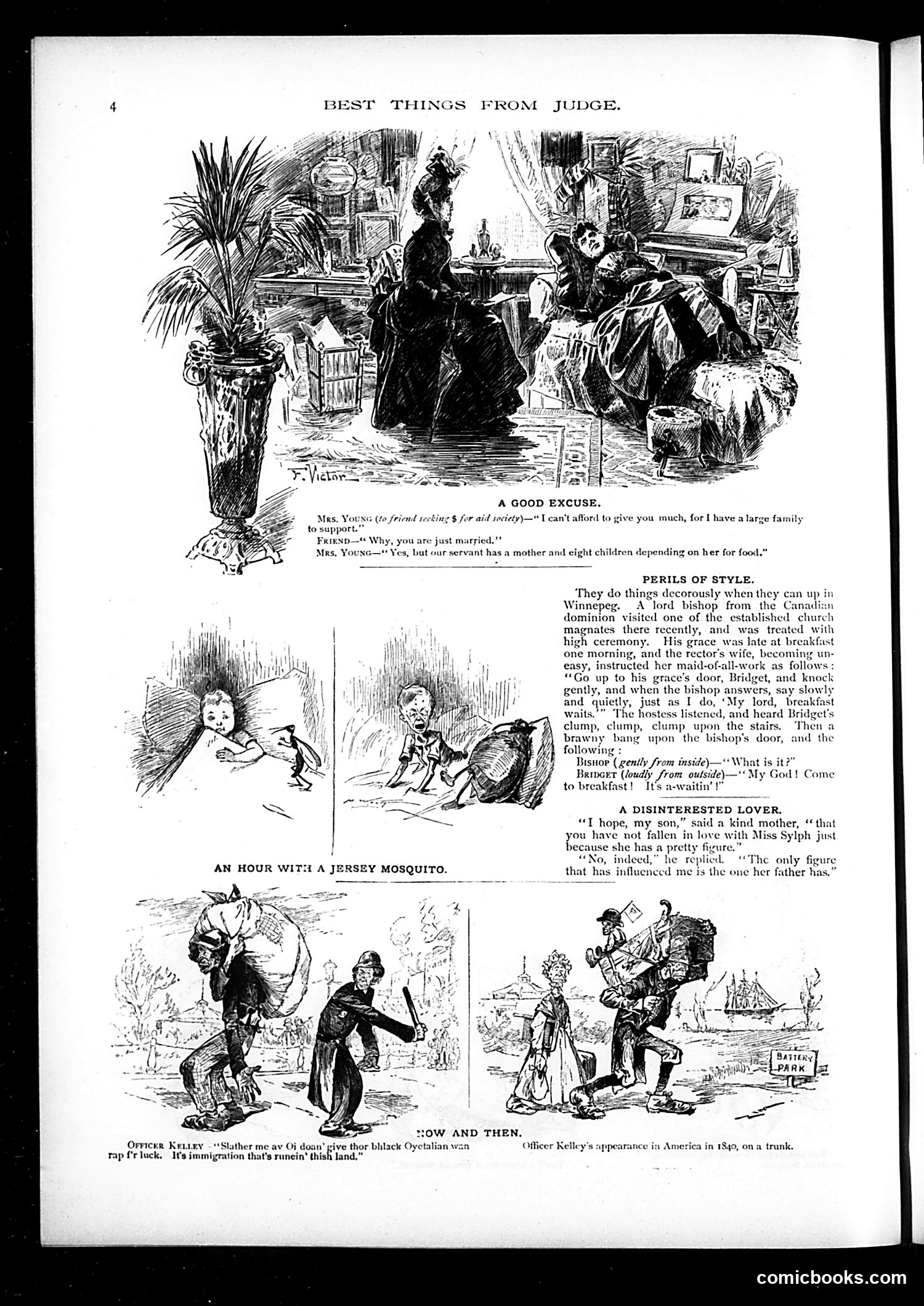
This page contains four separate satirical pieces mocking Victorian-era social hypocrisy and manners: **"A Good Excuse"** ridicules wealthy women's charitable claims—Mrs. Young refuses a donation citing family expenses, yet her servant supports eight dependents on wages. **"Perils of Style"** satirizes pretentious Canadian Anglican formality. A maid, instructed to announce the bishop's breakfast "decorously," instead loudly shouts "My God! Come to breakfast!"—the humor lies in failed attempts at gentility. **"A Disinterested Lover"** mocks mercenary courtship: a young man claims not to love a woman for her beauty, only for her father's wealth—presented as refreshing "honesty." **"Now and Then"** features Officer Kelley, an Irish-American stereotype (evident from dialect spelling "Slather me av Oi doan'"), complaining about Black Oyster-sellers in 1840s America, contrasting with his contemporary appearance. This reflects period anti-immigrant and racial stereotyping. These pieces exemplify Judge's satirical formula: exposing class pretension and social absurdity through exaggerated dialogue and caricature.
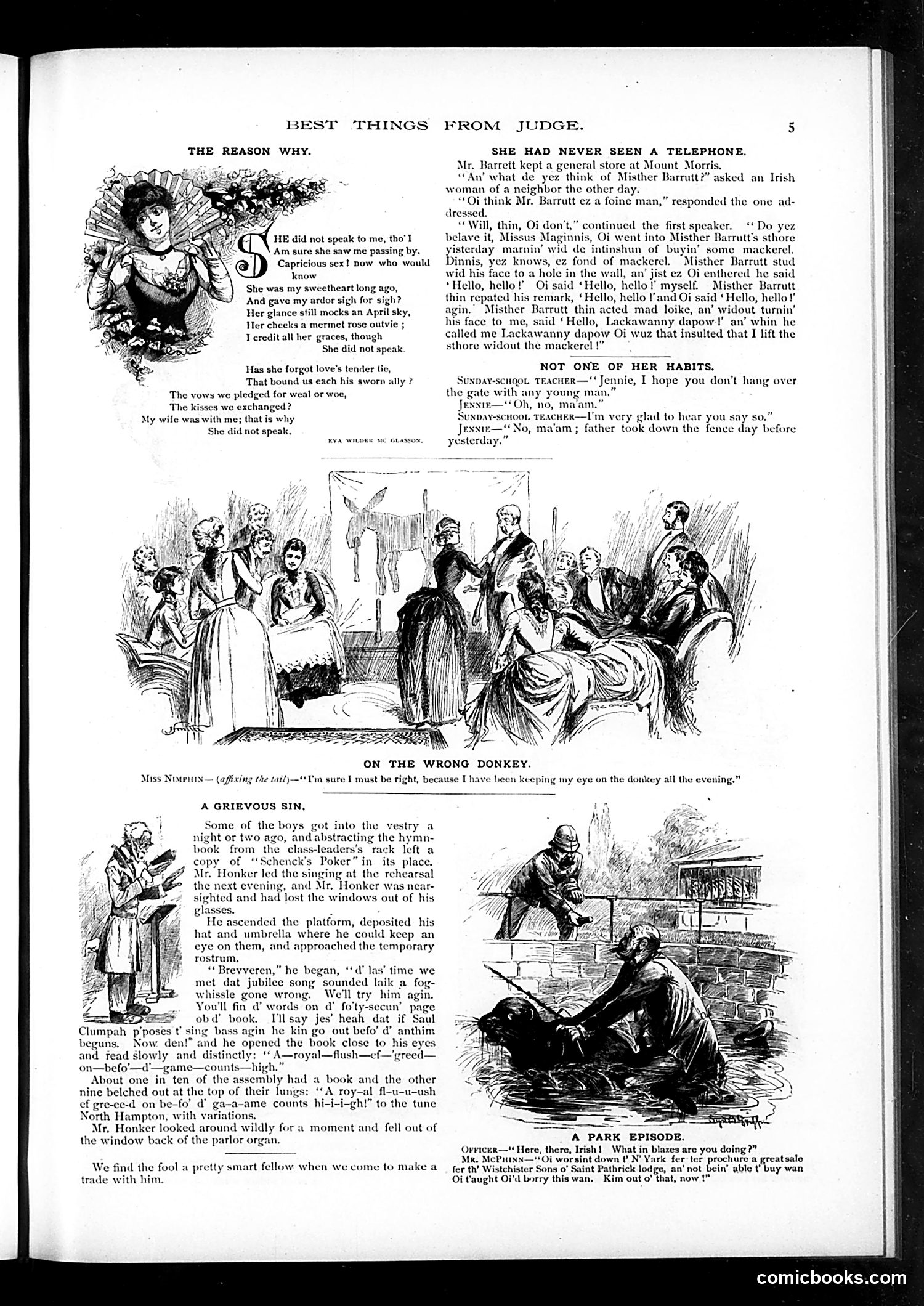
This page contains four humorous vignettes satirizing Irish immigrants and small-town American life: **"The Reason Why"**: A man complains his former sweetheart ignored him—but his wife was present, so the woman deliberately avoided acknowledging him to prevent scandal or jealousy. **"She Had Never Seen a Telephone"**: An Irish grocer customer, unfamiliar with telephones, becomes offended when Mr. Barrett speaks into one, interpreting his "Hello" repetitions as mocking insults rather than phone communication. **"On the Wrong Donkey"** and **"A Grievous Sin"**: Slapstick sketches involving mishaps—one about pinning a tail on a donkey, another where a nearsighted church leader unknowingly sings poker-hand terminology instead of hymn lyrics. **"A Park Episode"**: Irish dialect humor about someone borrowing a carriage. The satire primarily targets Irish immigrants through exaggerated dialect and supposed unfamiliarity with modern technology and customs, reflecting common ethnic stereotyping in Gilded Age American humor magazines.
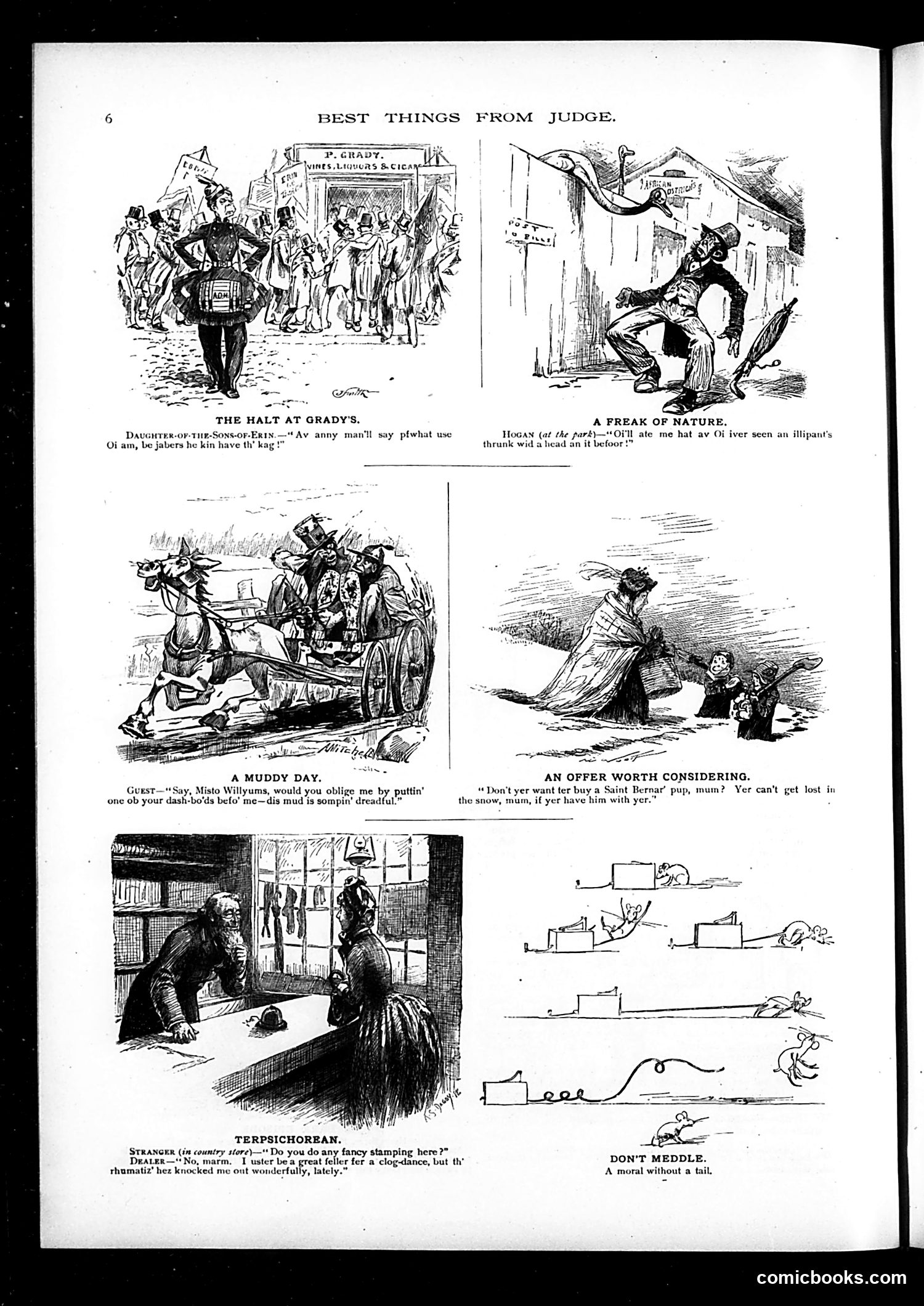
This is a page of six satirical vignettes from *Judge* magazine, using dialect humor and social stereotypes common to late-19th-century American comedy. **The cartoons mock:** 1. **"The Halt at Grady's"**: An Irish immigrant ("Sons of Erin") uses malapropism—claiming someone can "have the keg" if they question his usefulness. 2. **"A Freak of Nature"**: An Irishman claims he's never seen an elephant with a head on it—absurdist humor playing on dialect speech. 3. **"A Muddy Day"**: A Black servant (dialect: "Misto Willyums") is asked to put a dashboard board down in mud—physical comedy based on racial caricature. 4. **"An Offer Worth Considering"**: A woman tries selling a Saint Bernard puppy as a snow-navigation aid—wordplay on the dog's rescue-dog reputation. 5. **"Terpsichorean"**: A country storekeeper claims rheumatism ended his "clopdance" (clog dancing) career—playing on rural speech patterns. 6. **"Don't Meddle"**: Illustrated moral showing a tail-less animal—whimsical visual pun. These rely on ethnic/regional stereotypes, dialect humor, and physical comedy typical of period satire.
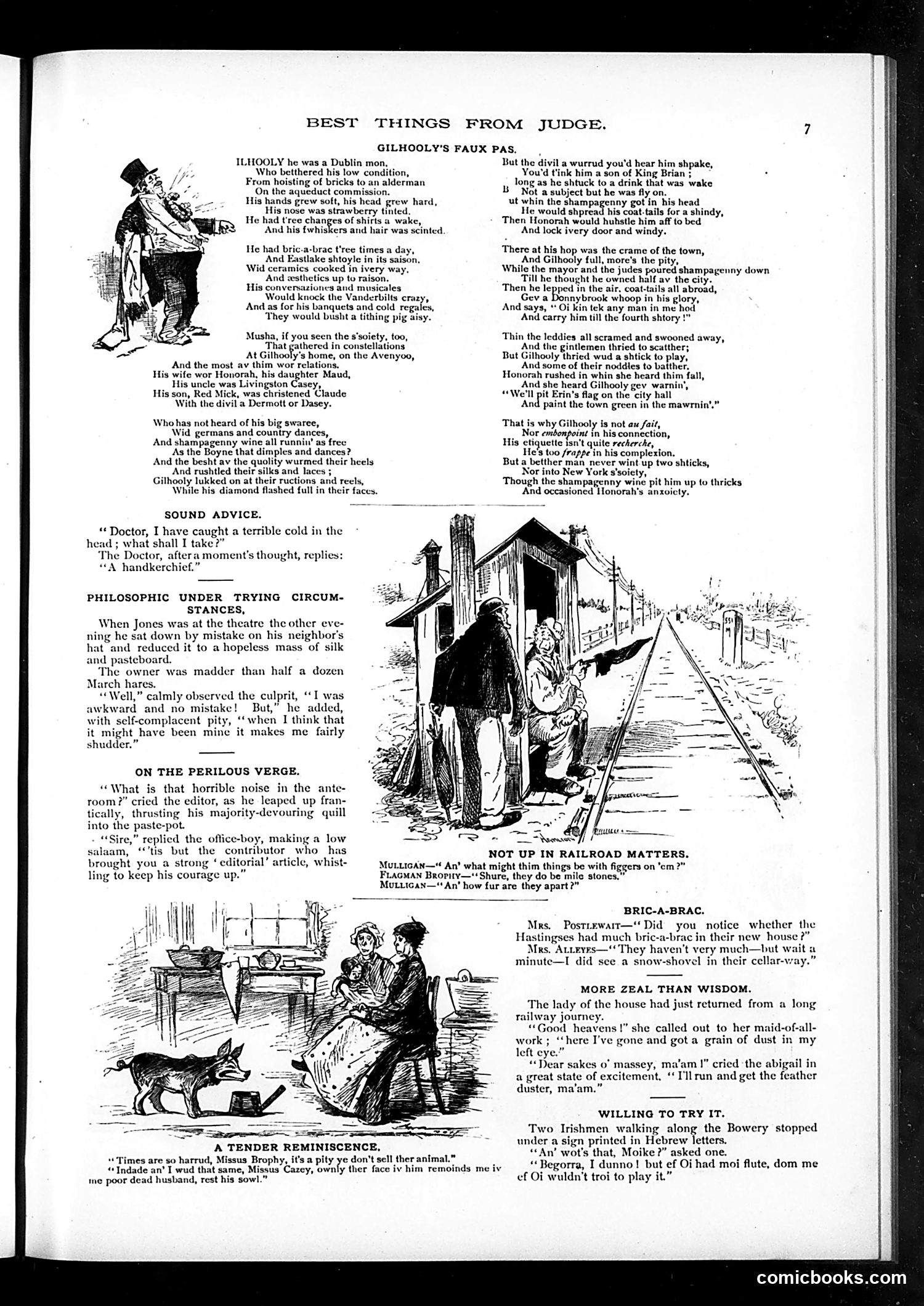
This satirical poem mocks Irish-American social climbing. **Gilhooly**, an Irish immigrant who rose from manual labor to city alderman, attempts to adopt upper-class manners and aesthetics—acquiring bric-a-brac, hosting musicales and elaborate dinners, changing his family names to sound refined (Honorah becomes Maud, Dermott becomes Claude). The satire peaks at his drunken behavior: after champagne, he becomes belligerent, threatens violence, and loudly proclaims nationalist sentiment ("Erin's flag on the city hall"), destroying the refined image he'd carefully constructed. The poem's message: **nouveau riche pretension fails; Irish working-class identity reasserts itself under alcohol**. The exaggerated Irish dialect emphasizes the character's fundamental incompatibility with high society, despite material success. This reflects period attitudes about ethnic and class boundaries—the implication being that genuine refinement cannot be purchased, only inherited.
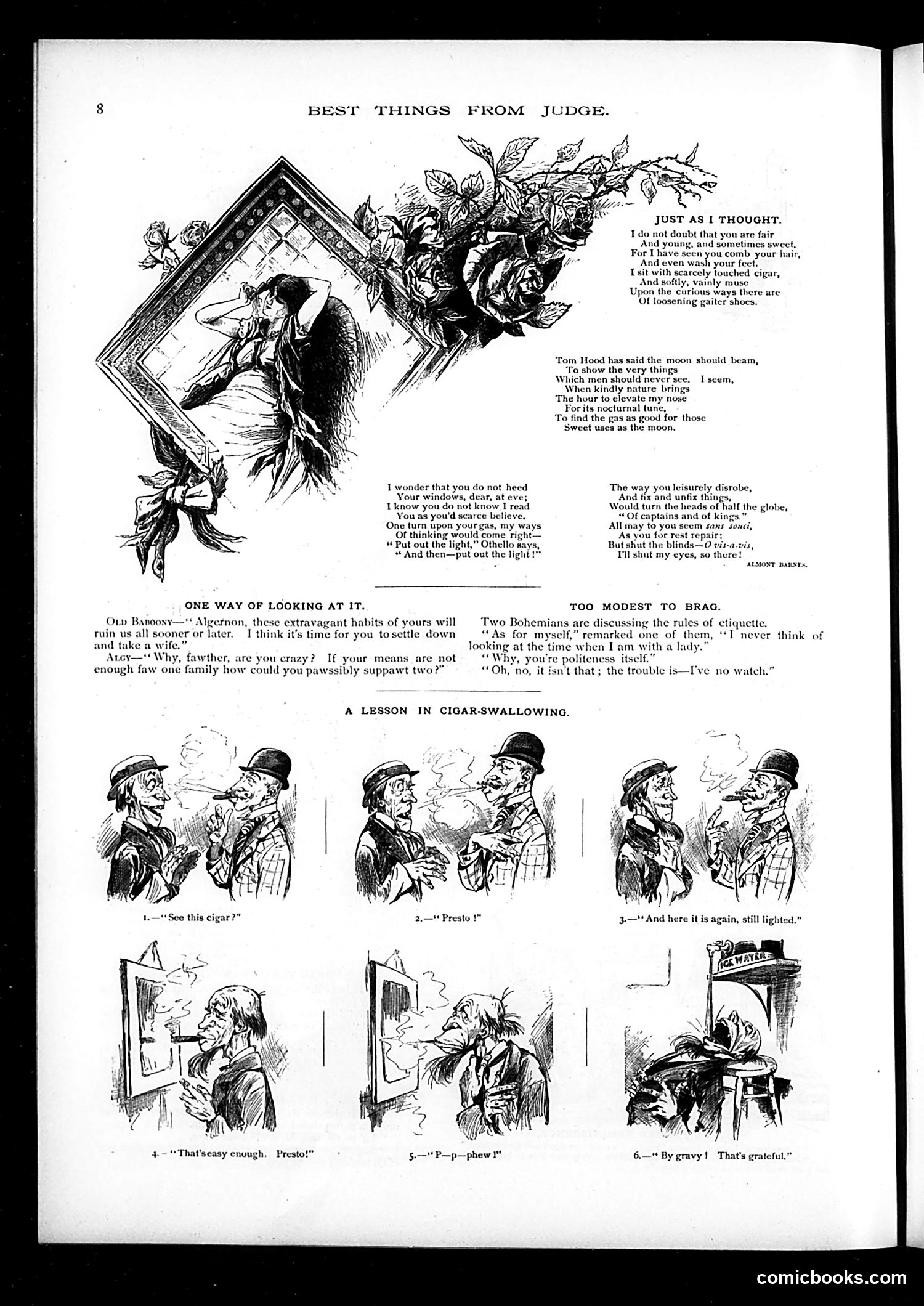
This six-panel comic depicts a street hustle or con. One man shows another a cigar, claiming he can swallow it (panel 1: "See this cigar?"). The second man, intrigued, says "Presto!" (panel 2), then the first man actually swallows it (panel 3: "And here it is again, still lighted"). The con becomes clear in panels 4-6: the first man asks the victim to try the trick himself. The victim attempts it (panel 4), then spits it out violently (panel 5: "P—p—phew!"), discovering he's been tricked into swallowing a cigar. Panel 6 shows him at an ice-water station, grateful for relief. The joke satirizes gullibility and street scams—a simple trick where someone demonstrates a seemingly impossible feat, then dupes an onlooker into attempting it themselves. The victim's distress and need for water emphasizes the prank's unpleasant consequence.
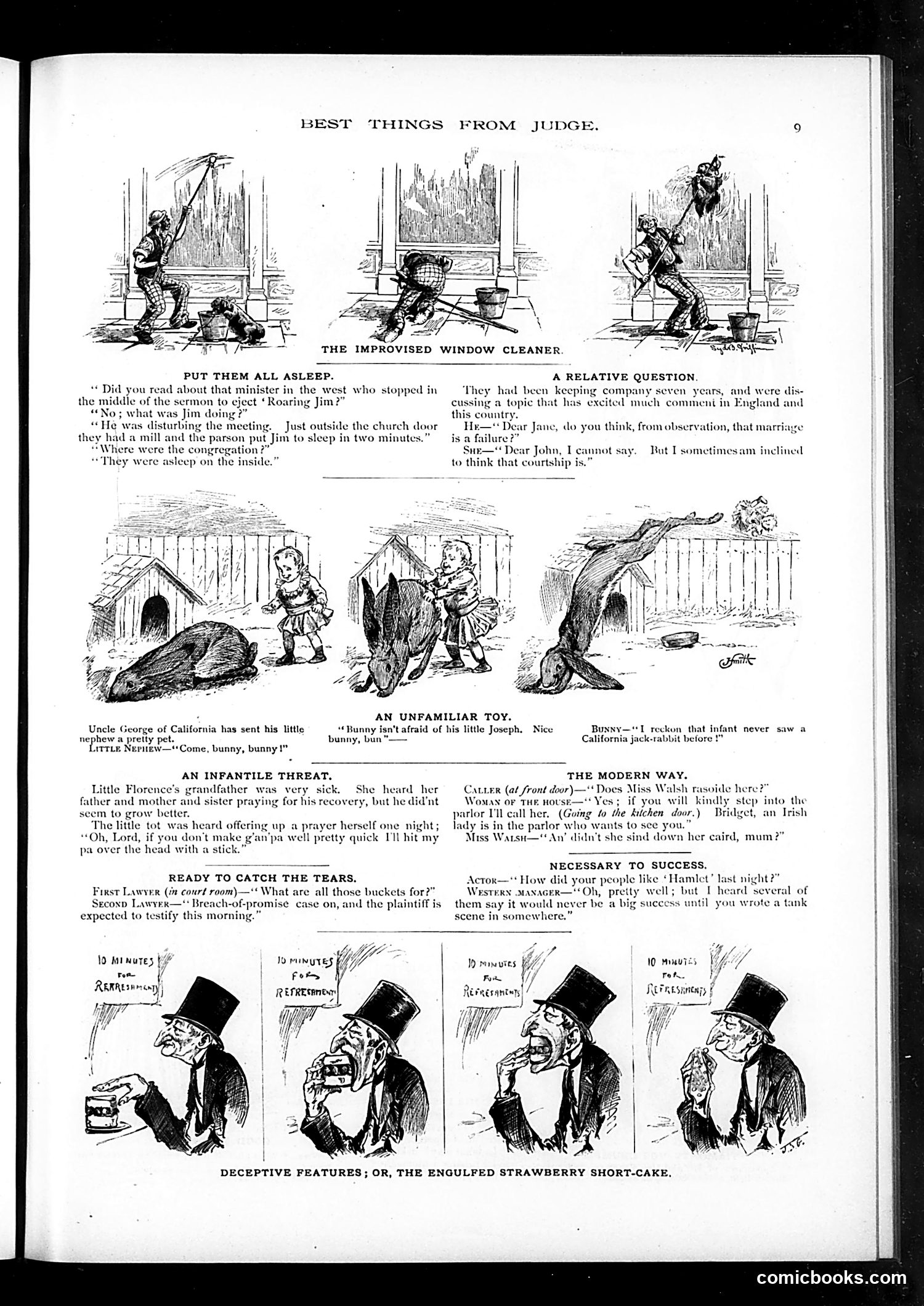
This page collects humorous short jokes and cartoons mocking various social situations circa late 19th century. **Key satirical targets:** - **Sermon interruption**: Mocks both tedious preaching and congregations so bored they fall asleep - **Marriage commentary**: Questions whether marriage is actually a "failure"—suggesting skepticism about matrimonial bliss - **Child's prayer**: Dark humor about a child threatening God to heal her grandfather faster - **Breach-of-promise lawsuit**: Satirizes emotional women expected to cry copiously in court over romantic betrayals - **Irish servant mockery**: Ridicules an Irish maid's pretensions ("didn't she sind down her caird") - **Theater success**: Implies plays need gimmicks, not talent - **Bottom cartoon**: A man's face distorts progressively while eating shortcake—visual joke about indulgence or greed The overall tone reflects class-conscious, somewhat cynical humor typical of Judge's satirical approach to American manners and morality.
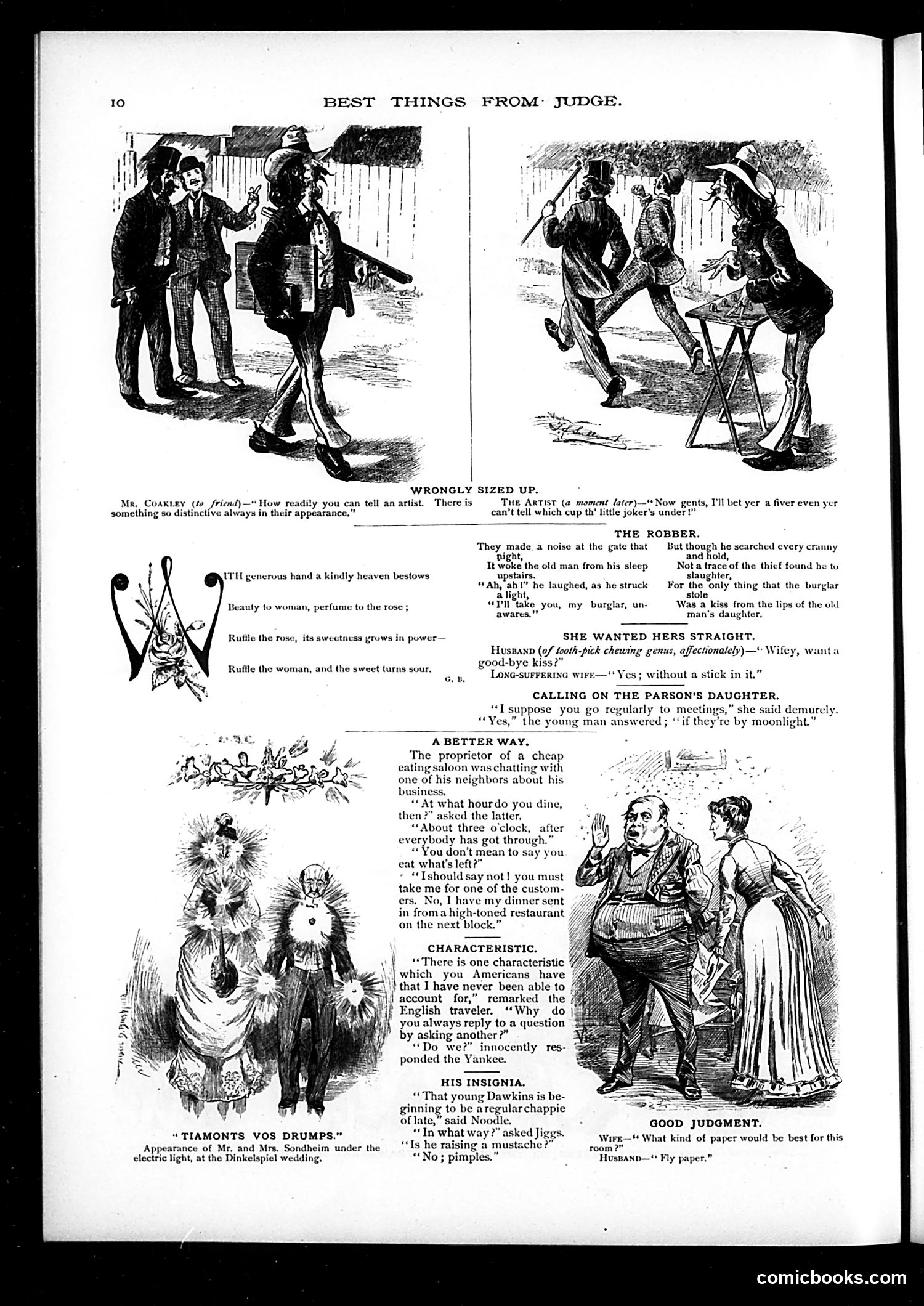
This page collects humorous short sketches typical of Judge magazine's satirical content. The cartoons mock social pretensions and domestic life: **"Wrongly Sized Up"** contrasts a snobbish art connoisseur who claims to recognize artists by appearance with a street performer doing a shell game—both making confident claims they can't back up. **"The Robber"** presents sentimental Victorian humor: a burglar steals only a kiss from the homeowner's daughter, treating theft as romance. **"She Wanted Hers Straight"** mocks marital dynamics—a wife rejects her husband's affectionate tooth-pick chewing, wanting direct affection without quirks. Other sketches satirize American rudeness ("Characteristic"), social climbing (cheap restaurant owner), and courtship pretense (moonlight church visits). The poetry section ("With generous hand...") provides sentimental verse contrasting with the humor. Overall, the page reflects Gilded Age satirical comedy targeting middle-class manners, romance conventions, and American character—gentle mockery rather than sharp political commentary.
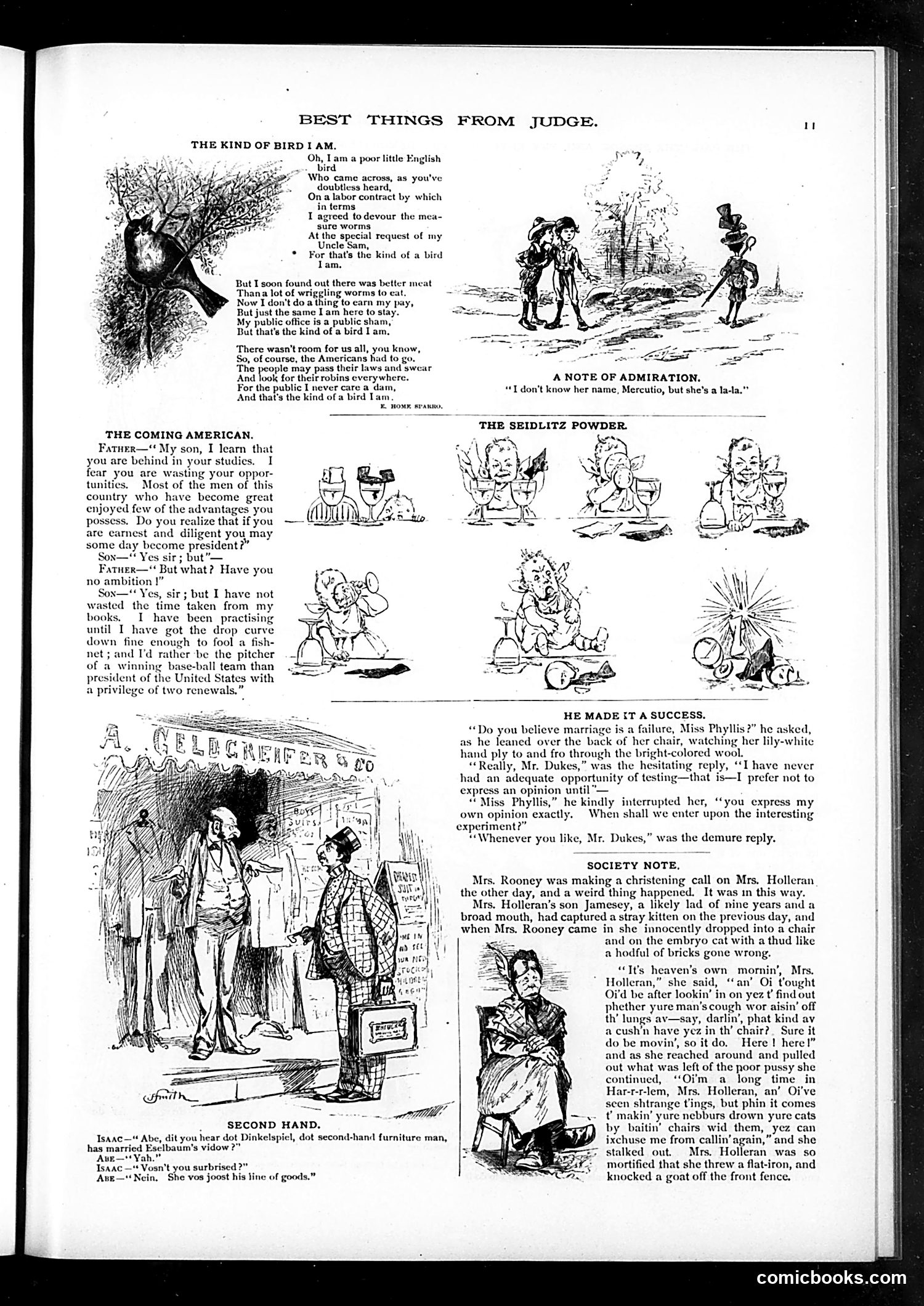
This page contains several satirical pieces typical of Judge's American humor: **"The Kind of Bird I Am"** mocks British birds imported to control agricultural pests. The poem's speaker is a contract laborer who abandoned his job devouring "measure worms" but remains, doing no work while collecting pay—satirizing both immigrant workers and government inefficiency. **"The Coming American"** jokes that a boy prefers becoming a baseball pitcher to president, reflecting late-19th-century anxieties about American youth priorities and civic duty. **"The Seidlitz Powder"** series are visual gags about digestive remedies causing chaos. **"Second Hand"** plays on Jewish immigrant stereotypes, with "Yiddish" dialect humor about a furniture dealer marrying a widow—the punchline being she fits his merchandise line. **"He Made It a Success"** satirizes courtship etiquette through coy dialogue about marriage as an "experiment." **"Society Note"** depicts an Irish immigrant woman (indicated by dialect spelling) accidentally sitting on a cat during a social call, creating embarrassing chaos—ethnic humor common to period Judge content. The page reflects Judge's reliance on immigrant stereotypes and class-based comedy.
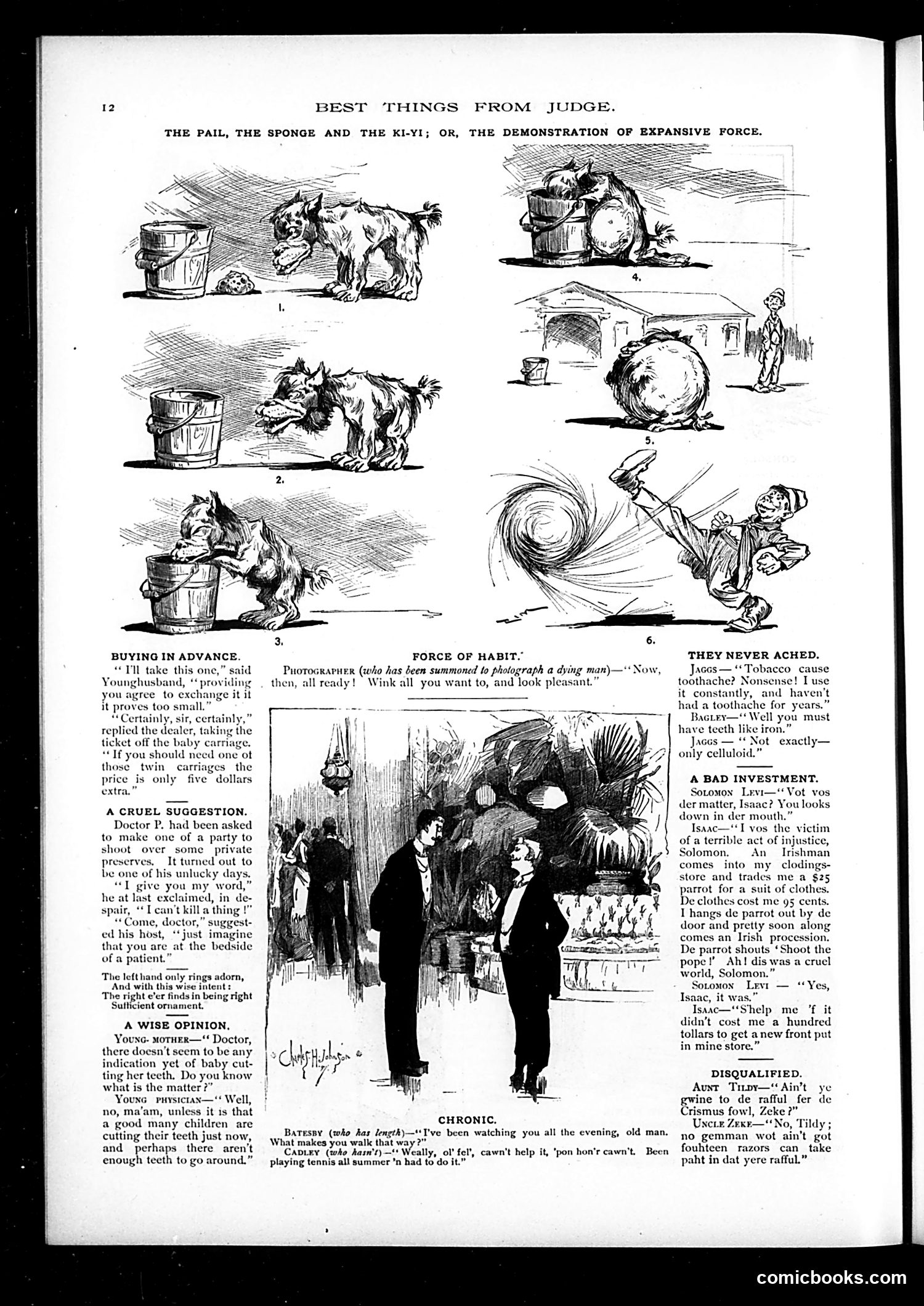
This page contains multiple short humorous sketches typical of late 19th/early 20th-century satirical magazines. **"Buying in Advance"** mocks middle-class consumer culture—a dealer persuades a customer to buy a baby carriage by suggesting he might need a larger twin carriage later, upselling through unnecessary planning. **"A Cruel Suggestion"** jokes that a doctor who's a poor hunter should imagine his prey as dying patients, darkly implying doctors are better at killing than hunters. **"Force of Habit"** depicts a photographer instructing a dying man to pose pleasantly for his photograph—satire on mechanical professional detachment. **"They Never Ached"** features ethnic humor (appears to be Irish-American characters) playing on stereotypes about tobacco use and cheap dentures ("celluloid"). **"A Bad Investment"** and **"Disqualified"** use dialect humor with Jewish and African-American characters respectively, common in period Judge content, depicting financial mishaps and rural life. The page emphasizes class anxieties, professional absurdity, and relies heavily on ethnic stereotyping typical of the era.
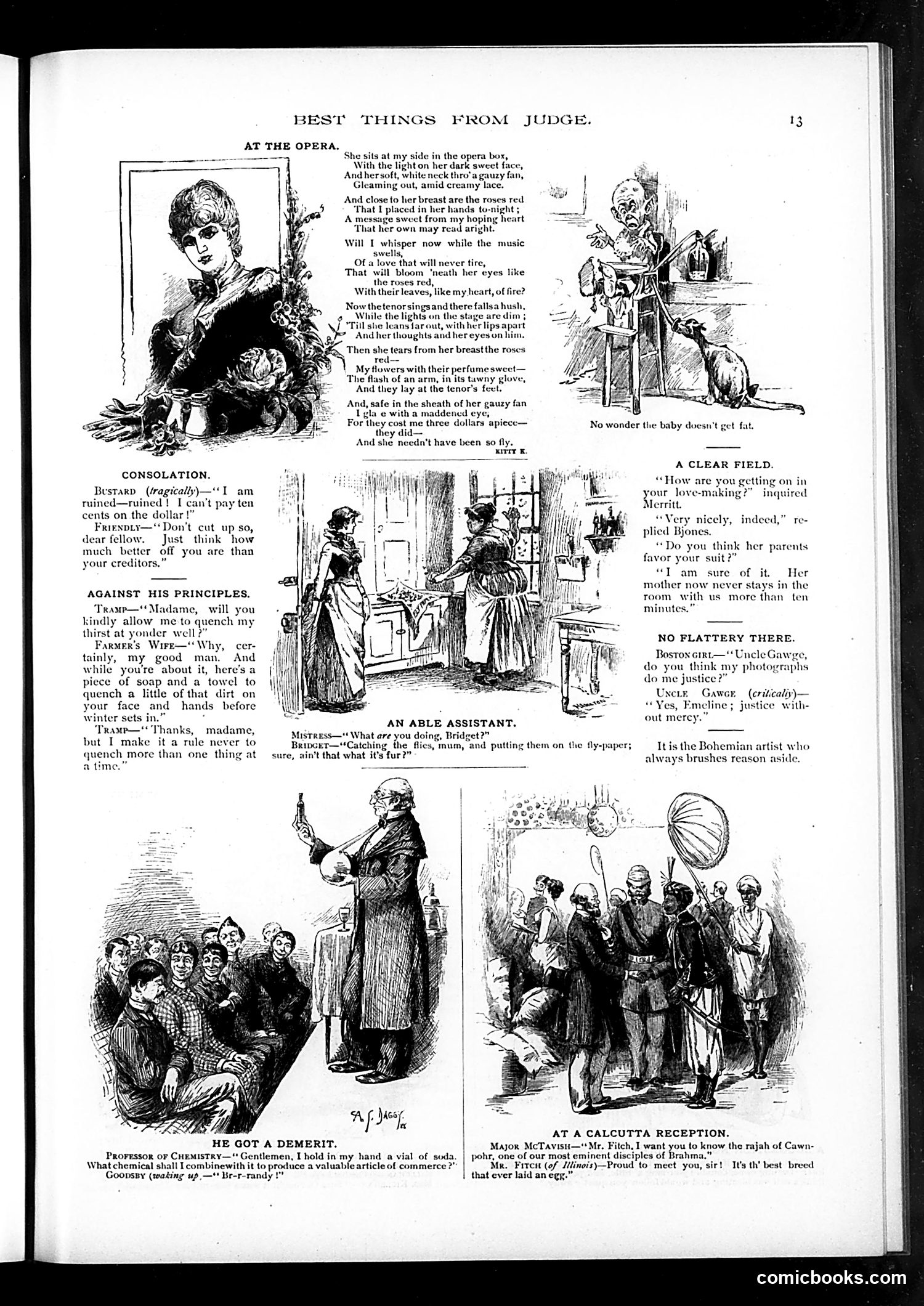
This page collects humorous short pieces typical of Judge magazine's satirical content. Key items: **"At the Opera"**: A romantic poem undercut by a punchline—the speaker gives roses to his date, who immediately throws them at the tenor performer instead. The joke: his expensive gesture (three dollars) is rejected for a stranger, deflating his romantic pretensions. **"Consolation" & "Against His Principles"**: Brief gags about a bankrupt man and a tramp's hygiene, using class-based humor common to the era. **"An Able Assistant"**: A servant girl catches flies to put on flypaper—obvious but presented as clever housekeeping. **"At a Calcutta Reception"**: A reference to India that appears to make an ethnic joke about breeding/heritage, though the exact meaning is unclear without more context. Overall, these represent Judge's blend of romantic satire, working-class humor, and period-specific social commentary aimed at middle-class readers.
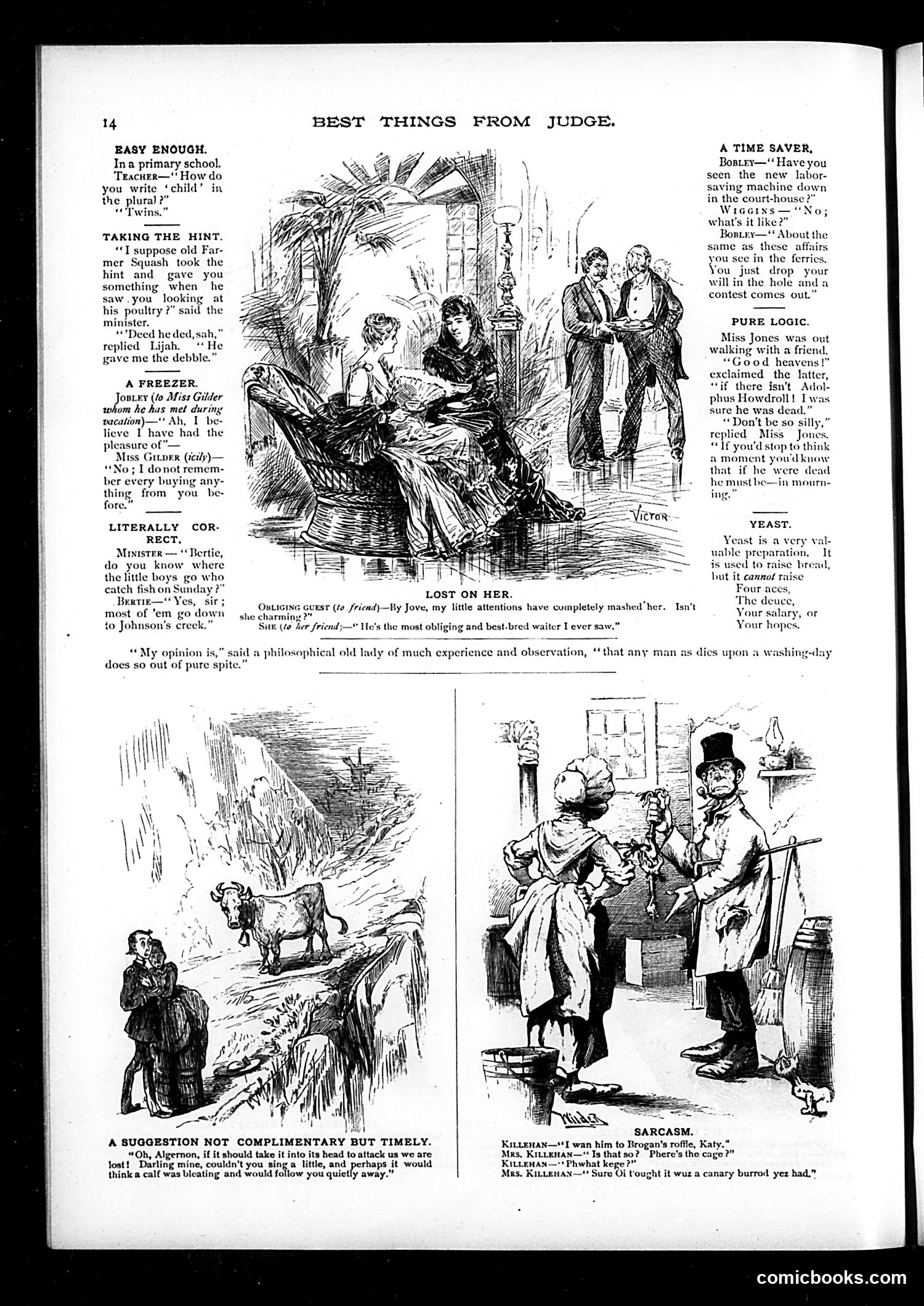
This page collects humorous short jokes and satirical cartoons typical of late 19th-century American humor. The content includes: **Social satire:** - "Easy Enough" mocks primary school education's simplicity - "Literally Correct" jokes about religious hypocrisy (catching fish on Sunday) - "Pure Logic" satirizes overwrought Victorian sentimentality about death and mourning **Class humor:** - "A Time Saver" ridicules both legal bureaucracy and the working class - "Sarcasm" features Irish immigrants (indicated by dialect spelling like "Oi" and "Phwhat"), a common target of period humor **Domestic/gender comedy:** - "Lost on Her" depicts flirtation and romantic pursuit - The final quote mocks wives, suggesting men die out of spite on laundry day—typical misogynistic "humor" The cartoons use detailed Victorian-era sketches. Overall, the page reflects Judge's formula: gentle mockery of institutions, class stereotyping (especially of Irish immigrants), and domestic friction between spouses—standard satirical fare for the publication's educated, upper-class readership.
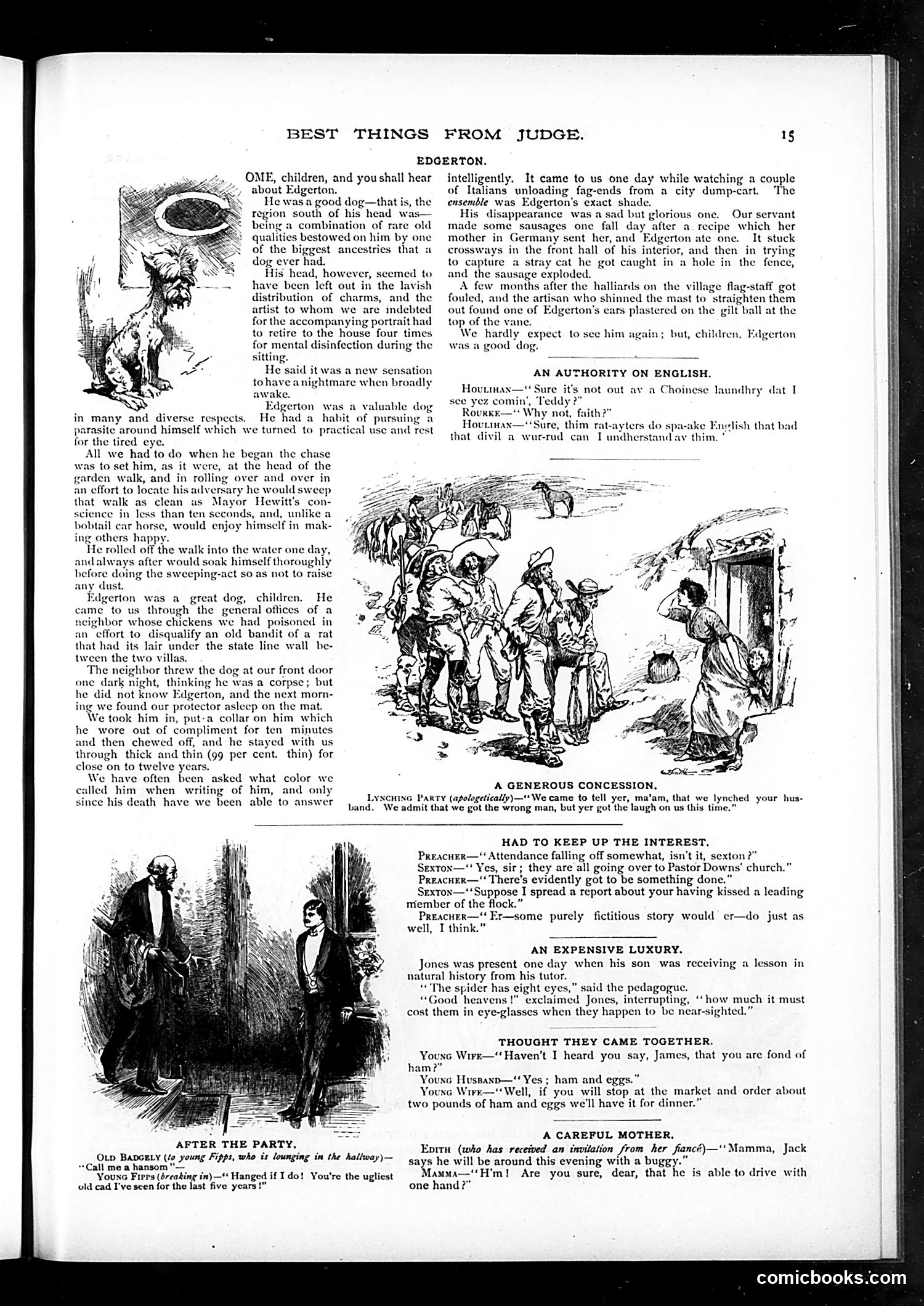
This page collects humorous anecdotes and jokes from Judge magazine's archive. The main feature, "Edgerton," is a sentimental-comic tribute to a homely dog whose physical appearance (particularly his head) was remarkably ugly. The joke relies on visual humor—the accompanying sketch emphasizes the dog's unattractive features. The narrative recounts Edgerton's various mishaps with darkly comic outcomes, including his death via exploding sausage and subsequent dismemberment. Below are brief joke vignettes satirizing various American social types: Irish laborers mangling English, Chinese laundry workers, a lynching party offering backhanded apologies, and clergy members scheming to compete with rival churches through scandal-mongering. The humor reflects Judge's typical late-19th-century satirical approach: irreverent, relying on ethnic stereotypes, and mocking respectability while celebrating ordinary absurdity and vice.
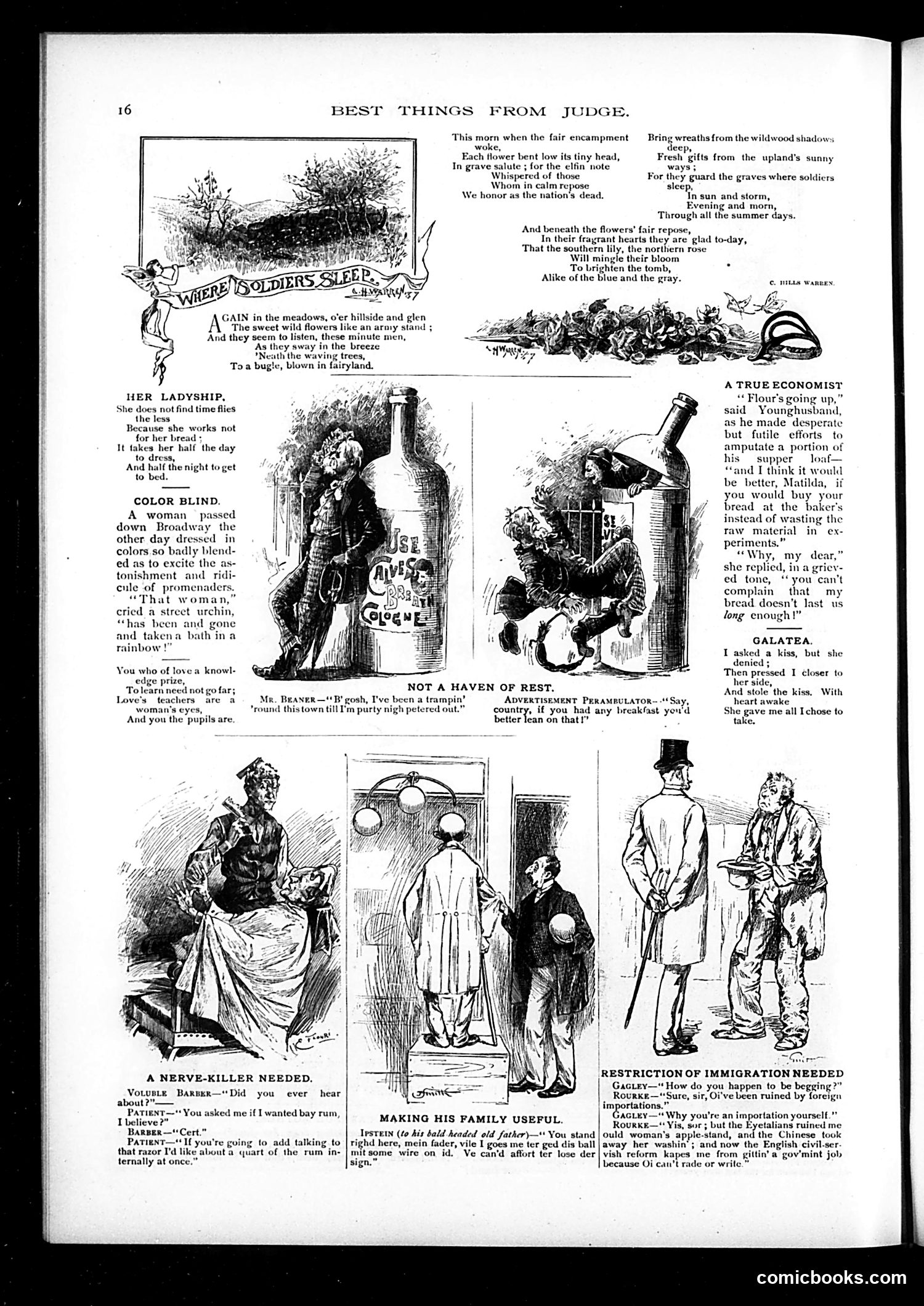
This page contains multiple satirical cartoons and poems addressing American social issues circa the Gilded Age: **"Where Soldiers Sleep"** (top): A sentimental poem honoring fallen soldiers, emphasizing reconciliation between North and South ("blue and the gray"). **"Her Ladyship"**: Mocks idle wealthy women who spend excessive time on appearance and leisure despite not working. **"Color Blind"**: Ridicules a woman's poor fashion sense—a street child jokes she "took a bath in a rainbow." **"Not a Haven of Rest"**: A barber's chatty nature annoys customers seeking quiet. **"Making His Family Useful"**: Depicts immigrant family using a bald father's head as a lamp base—xenophobic humor about poor immigrant resourcefulness. **"A True Economist"**: Satirizes a penny-pinching husband criticizing his wife's homemade bread as wasteful, while she defends its longevity. **"Restriction of Immigration Needed"**: An Irish beggar blames Chinese laborers and Italian immigrants for ruining his livelihood—reflects period anti-immigrant sentiment and labor anxiety. The page reflects era prejudices: gender roles, class anxieties, and xenophobia toward immigrants.
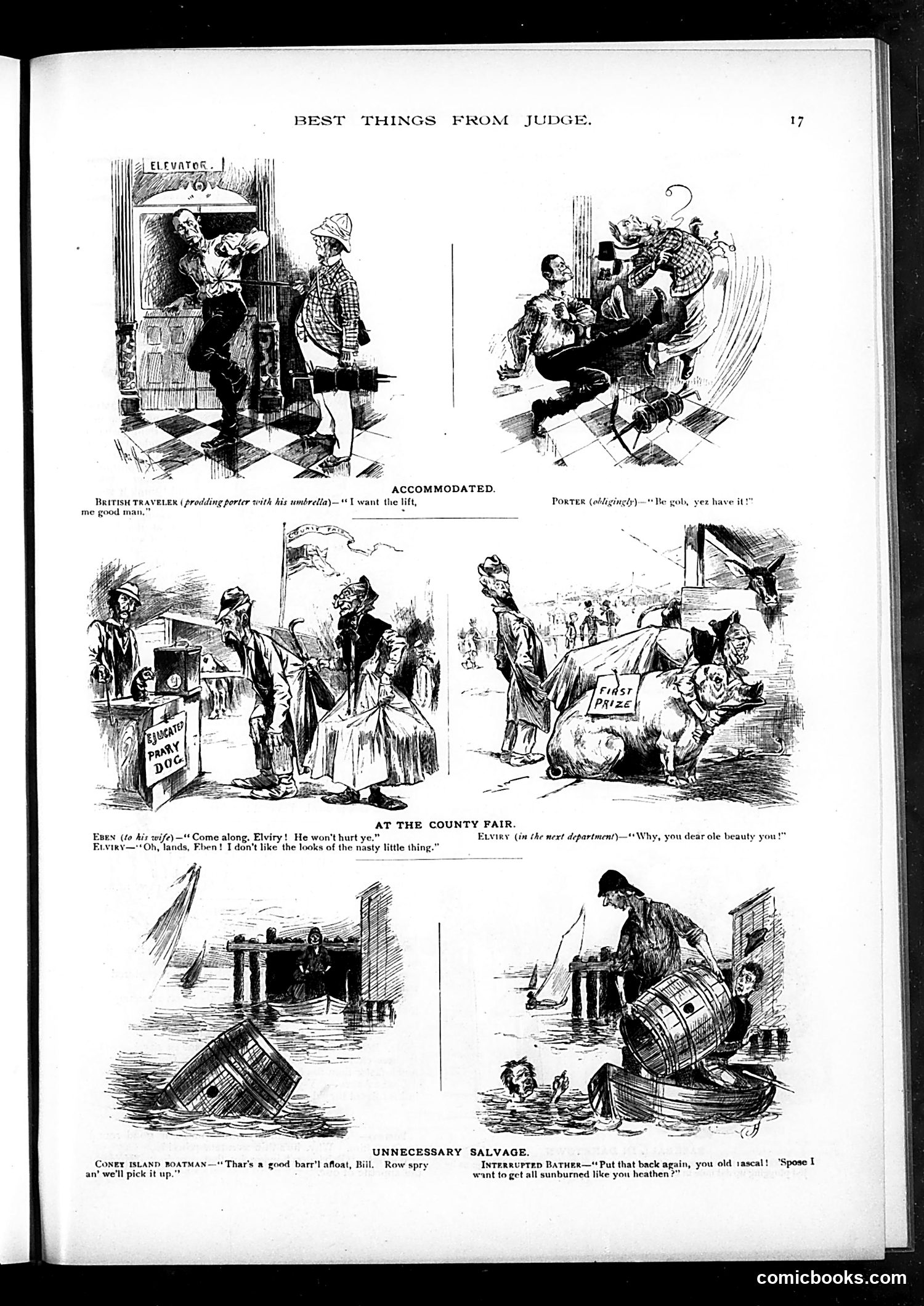
This page contains four separate satirical comic sketches: **"Accommodated"**: A British traveler demands an elevator ("lift") from a porter, who obliges by physically lifting him—a literal interpretation of the request that mocks upper-class British pomposity and the class dynamics of service work. **"At the County Fair"**: A husband urges his wife to view livestock, but she's distracted by flirtation with another man in the next exhibit area. The joke plays on marital dynamics and rural fair settings. **"Unnecessary Salvage"**: Two scenes at Coney Island where a boatman spots floating debris and wants to salvage it, but an interrupting bather objects—he's trying to avoid getting sunburned and doesn't want the debris blocking his sun exposure. The humor lies in vanity superseding practicality. These sketches represent *Judge* magazine's typical humor: situational comedy based on class pretension, gender relations, and the absurd literalism of common expressions.
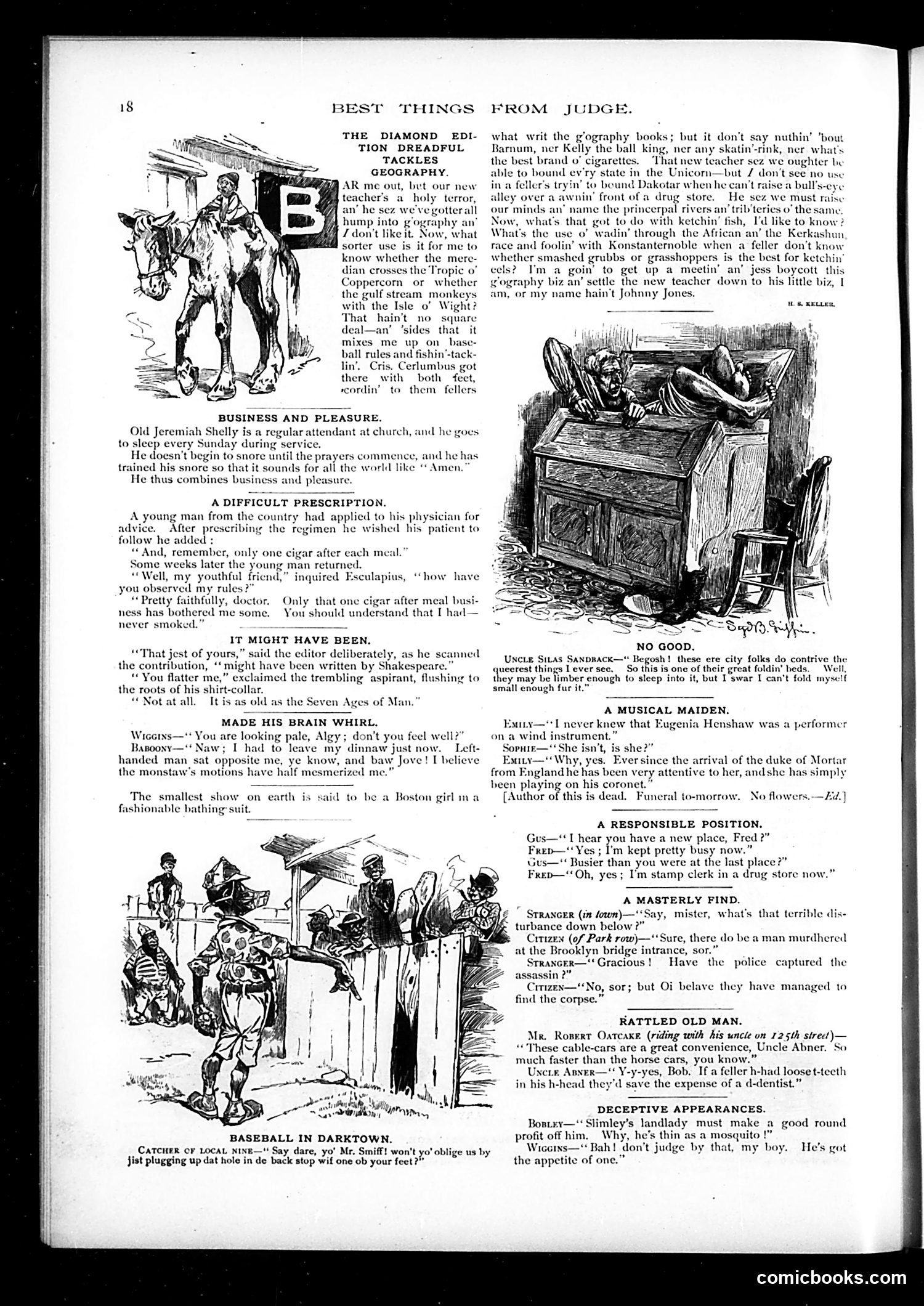
This page from Judge magazine contains several short humorous sketches typical of late 19th-century American satire: **Main cartoon (top left)**: A boy complains that geography is useless—he'd rather learn about baseball, fishing, and cigarettes than obscure geographical facts. The satire mocks both rigid school curricula and youth culture priorities. **Other sketches include**: - A man who trained his snore to sound like "Amen" during church prayers - A country doctor's patient confused about smoking one cigar "after meals" - A newspaper editor's backhanded compliment about a submitted story - Racist humor involving "Darktown" baseball players (reflecting common period stereotypes) - City folks struggling with folding beds - A woman playing "on" a visiting duke's affections via his coronet The humor relies on wordplay, malapropisms, dialect comedy, and gentle social observation about American life. The racism toward Black Americans was unfortunately standard for this era's humor magazines.
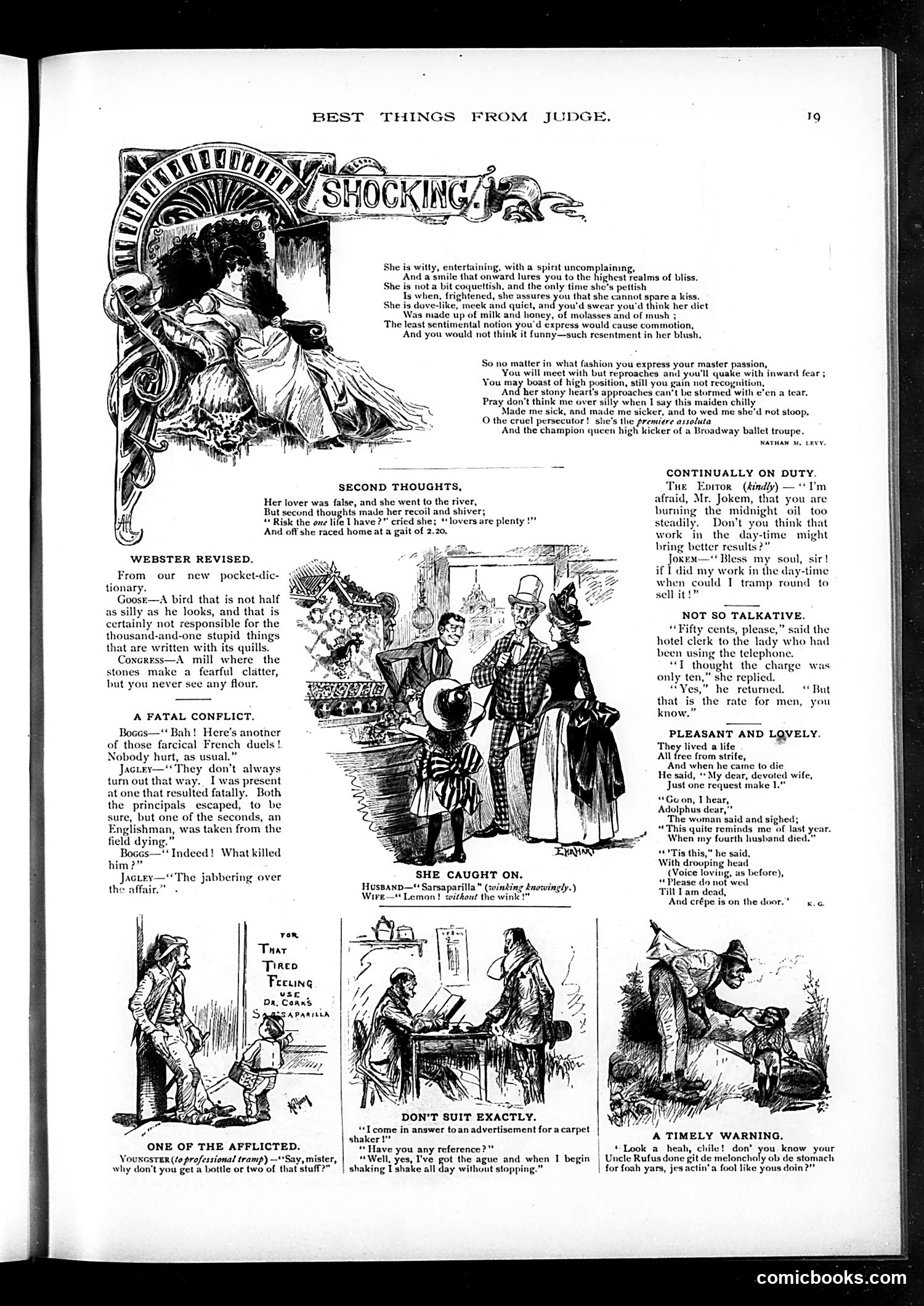
This page from *Judge* magazine contains multiple short humorous pieces typical of late 19th-century American satire: **"Shocking"** mocks idealized romantic poetry about women, presenting a cruel twist: the "maiden" is actually a harsh Broadway chorus dancer who rejected the suitor entirely. **"Second Thoughts"** jokes about a woman contemplating suicide who decides life is worth living—then races home at high speed (2.20 likely refers to a horse's speed record). **Dictionary definitions** satirize Congress as a useless "mill" producing no actual results, and geese as less foolish than the people writing about them. **"A Fatal Conflict"** presents a joke about a ridiculous French duel where principals escape unharmed but a British second dies from the two men's endless arguing. **Various brief comedic scenarios** mock workplace fatigue, telephone charges, marital devotion, and African American dialect humor (common but now considered offensive). The humor relies on wordplay, unexpected twists, and social observation rather than political commentary.
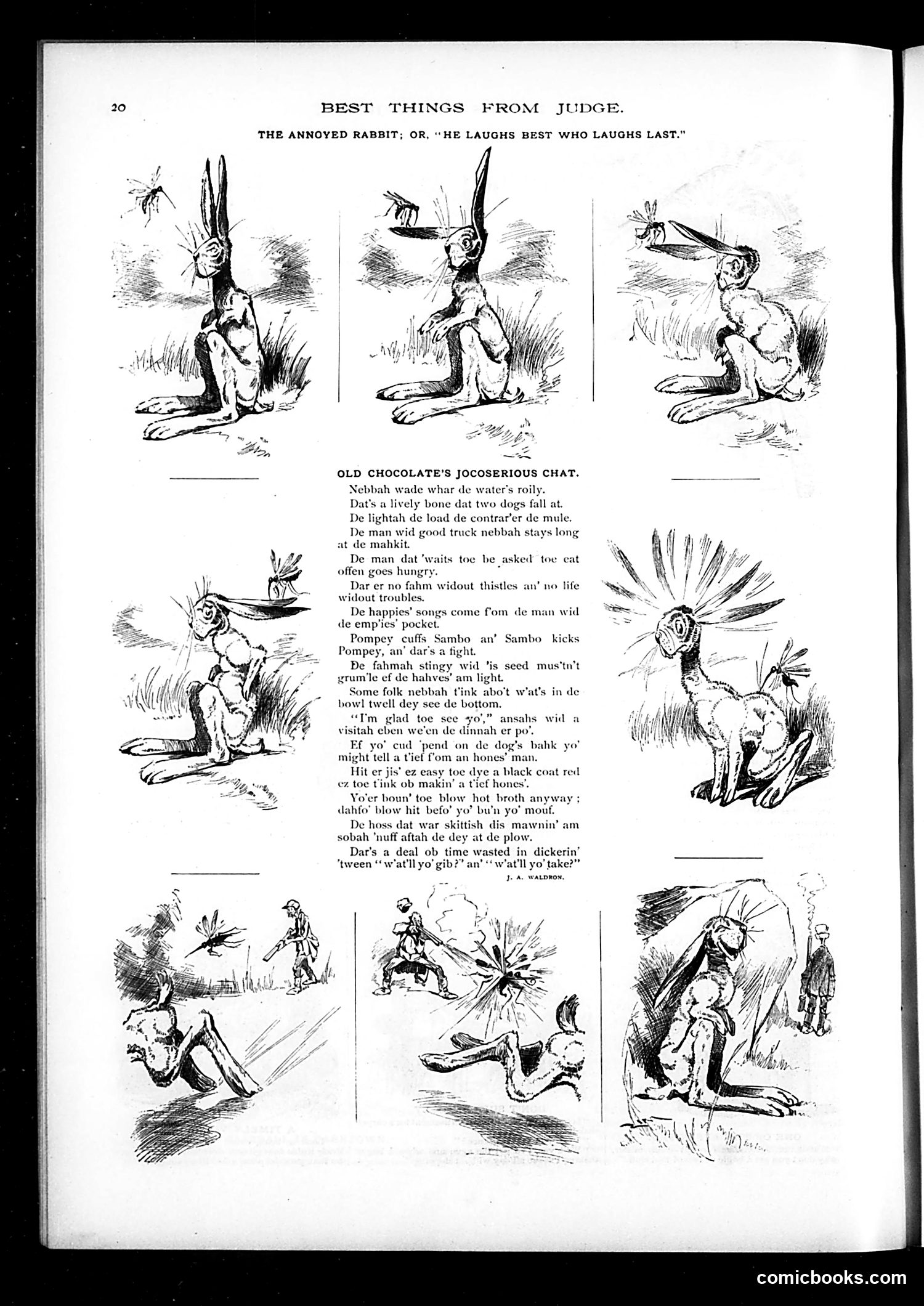
This page contains two distinct comic features. The top section shows a rabbit's sequential reaction to annoyance—depicted in six panels showing increasing agitation and eventual retaliation—illustrating the proverb "he laughs best who laughs last." Below is a collection of folk aphorisms attributed to "Old Chocolate," presented in dialect. The piece appears to be a stereotypical representation of African American vernacular speech from the late 19th century, offering homespun wisdom about farming, human nature, and life's hardships. Topics include mule-driving, harvesting, honesty, and practical survival. The satirical intent is unclear without additional context, though the framing of folk wisdom through heavy dialect was common in period humor magazines, often reflecting—or reflecting upon—racial attitudes of the era. The attribution to "J. A. Waldron" suggests a specific cartoonist's work.
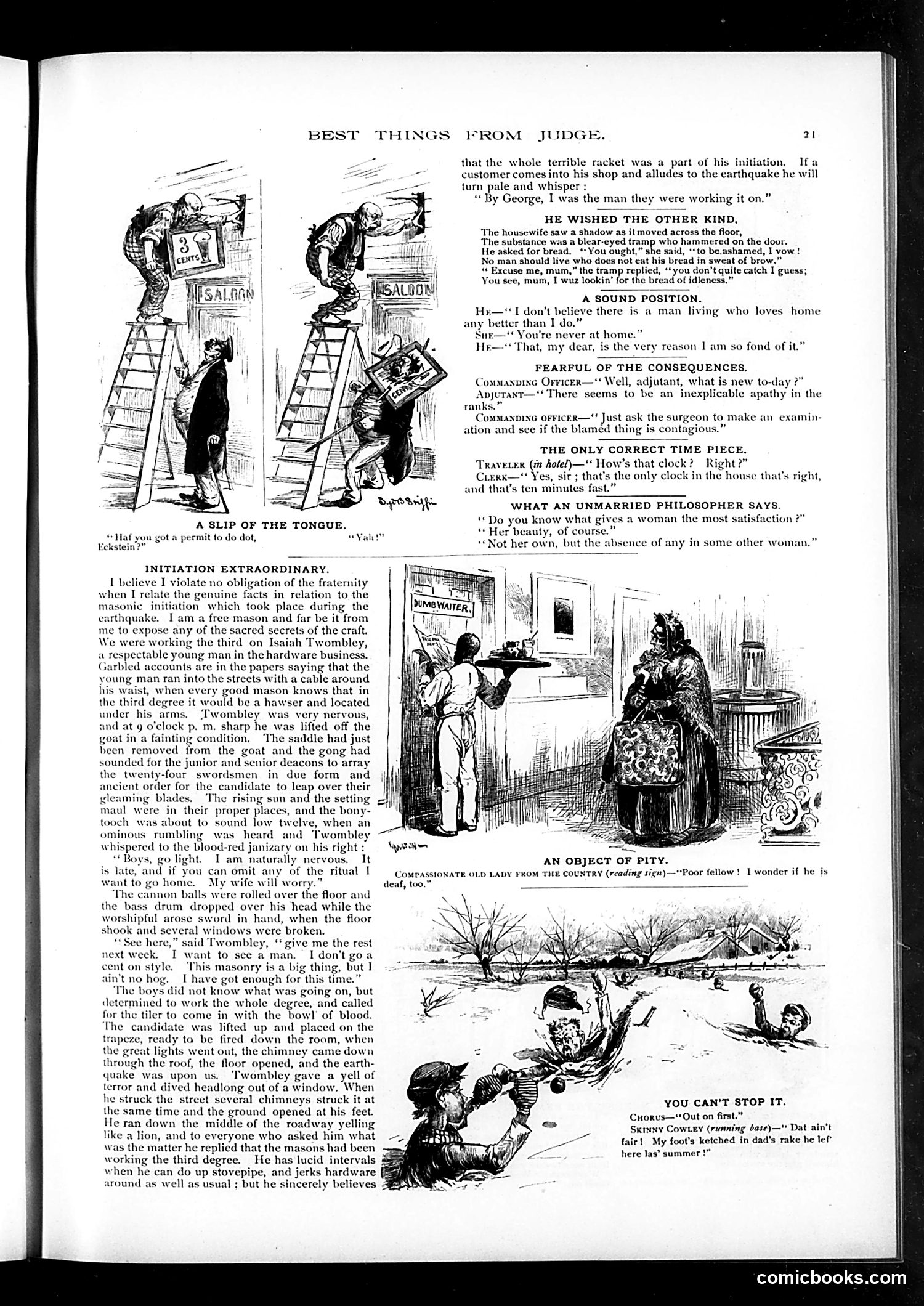
This page from *Judge* contains several brief satirical sketches mocking social pretensions and human nature: **"A Slip of the Tongue"**: A mason climbing a ladder is caught admitting he orchestrated an elaborate prank—apparently claiming credit for the recent earthquake itself as his "initiation" joke. **"Initiation Extraordinary"**: The longest piece satirizes Freemasonry rituals. During an actual earthquake, masons performing a third-degree initiation on Isaiah Twombley can't distinguish real disaster from ceremonial drama. The candidate begs to postpone—he's had enough ritual without actual danger—but the masons persist until the quake forces genuine evacuation. The satire targets fraternal lodge secrecy and their absurd pomposity. **Other sketches** mock domestic hypocrisy ("He Wished the Other Kind"), romantic philosophy, and charity. The **illustrations** show period-appropriate figures—the tramp, the housewife, the lodge members. The "Object of Pity" sketch depicts a homeless man, with a country woman's pitying comment visible. The humor relies on recognizing Masonic ritual as both ridiculous and secretive—targets of 19th-century satirists.
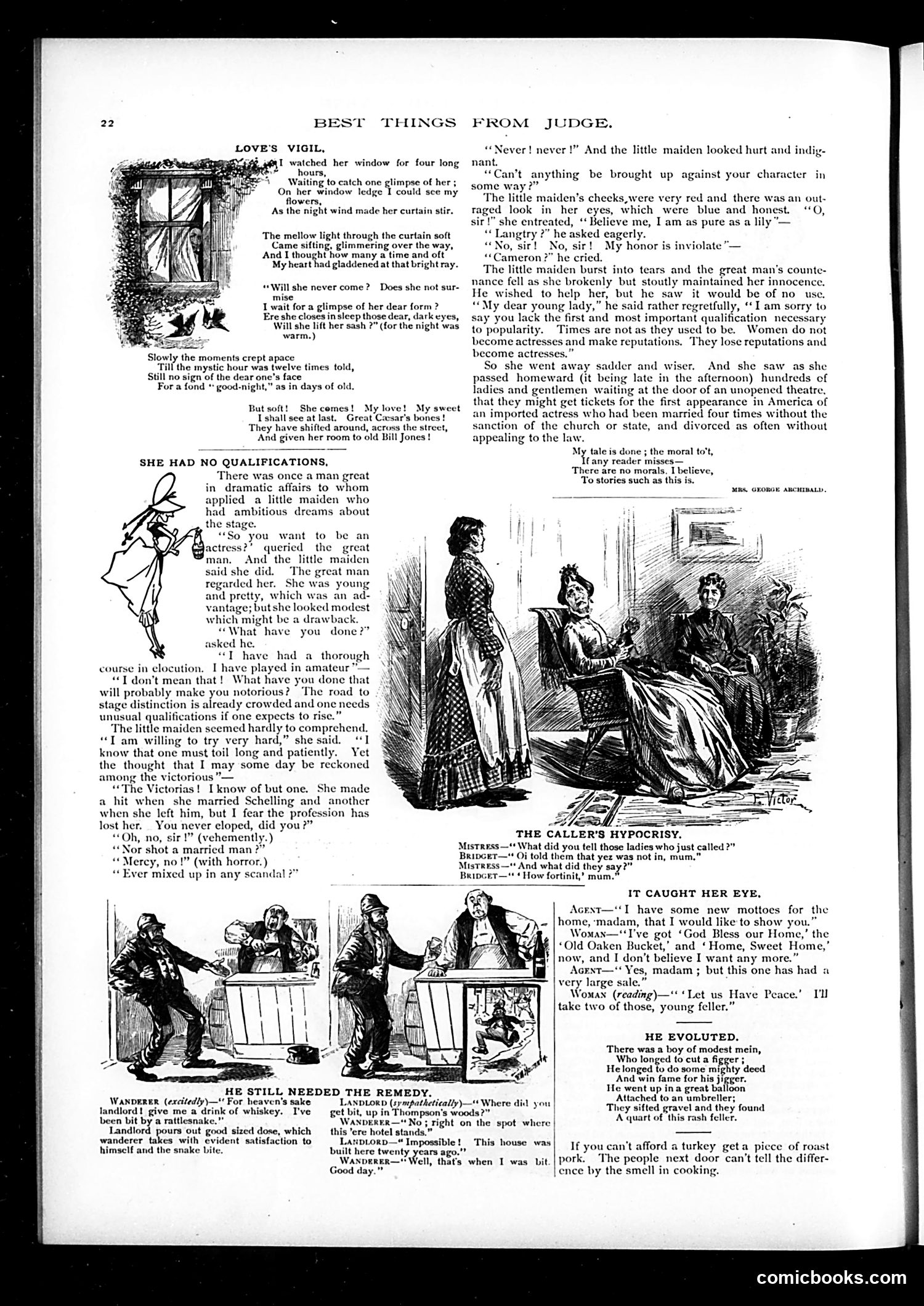
This satirical story critiques the theatrical profession and society's sexual double standards. A modest, virtuous young woman seeks stage success, but a theatre manager insists she cannot succeed without notoriety—specifically, a scandalous romantic or sexual past. He hopefully asks if she's eloped, had an affair with a married man, or been involved in scandal, naming "Langtry" and "Cameron" (likely references to notorious actresses of the era). The girl's innocent virtue becomes her fatal liability. The story concludes by showing that while she waits outside a theatre to see an *imported* actress who has been married four times and divorced repeatedly—without church sanction or legal process—society celebrates *that* woman's success. The satire attacks the hypocrisy: women are required to be virtuous for respectability, yet theatrical success demands notoriety and sexual transgression. The system rewards scandal while punishing propriety.
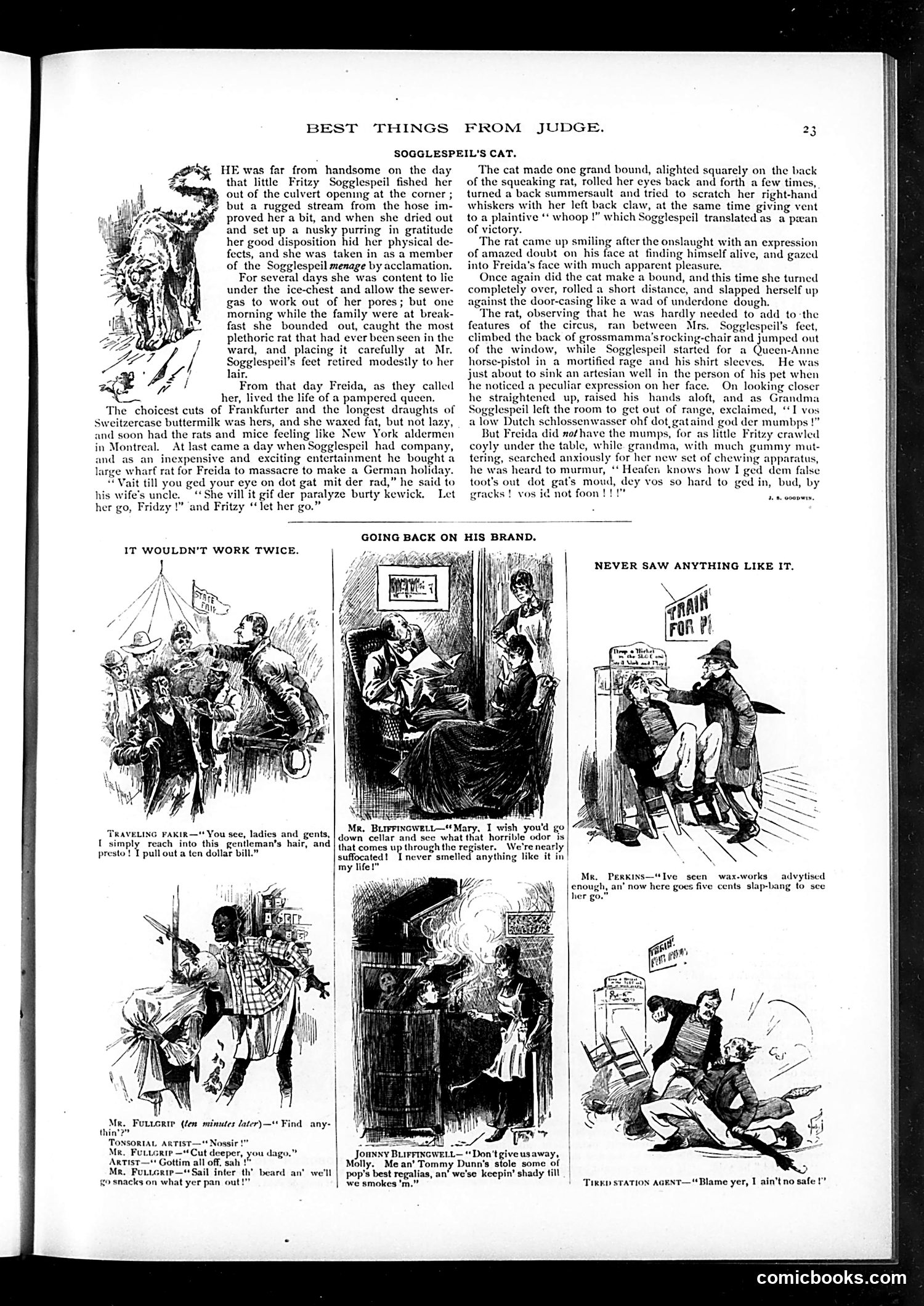
This page contains several satirical comic strips poking fun at German-American immigrant culture and domestic mishaps of the era. **"Sogglespeil's Cat"** is the lead story: A German family's rescued cat proves completely incompetent at catching rats—repeatedly failing absurdly while a rat escapes. The punchline reveals Sogglespeil's false teeth fell into the cat's mouth during the chaos. The humor targets German-Americans through exaggerated dialect ("Vait till you ged your eye on dot gat"). The smaller strips below mock various schemes and pretensions: a traveling con artist's hair-trick ("It Wouldn't Work Twice"), a landlord discovering mysterious smells ("Going Back on His Brand"), and con men advertising fake entertainments. **Context:** Judge magazine regularly satirized immigrant communities, particularly Germans, using crude dialect humor. These pieces reflect early 20th-century American attitudes toward foreigners while depicting domestic working-class or lower-middle-class mishaps for comedic effect. The humor is broad physical comedy combined with ethnic stereotyping.
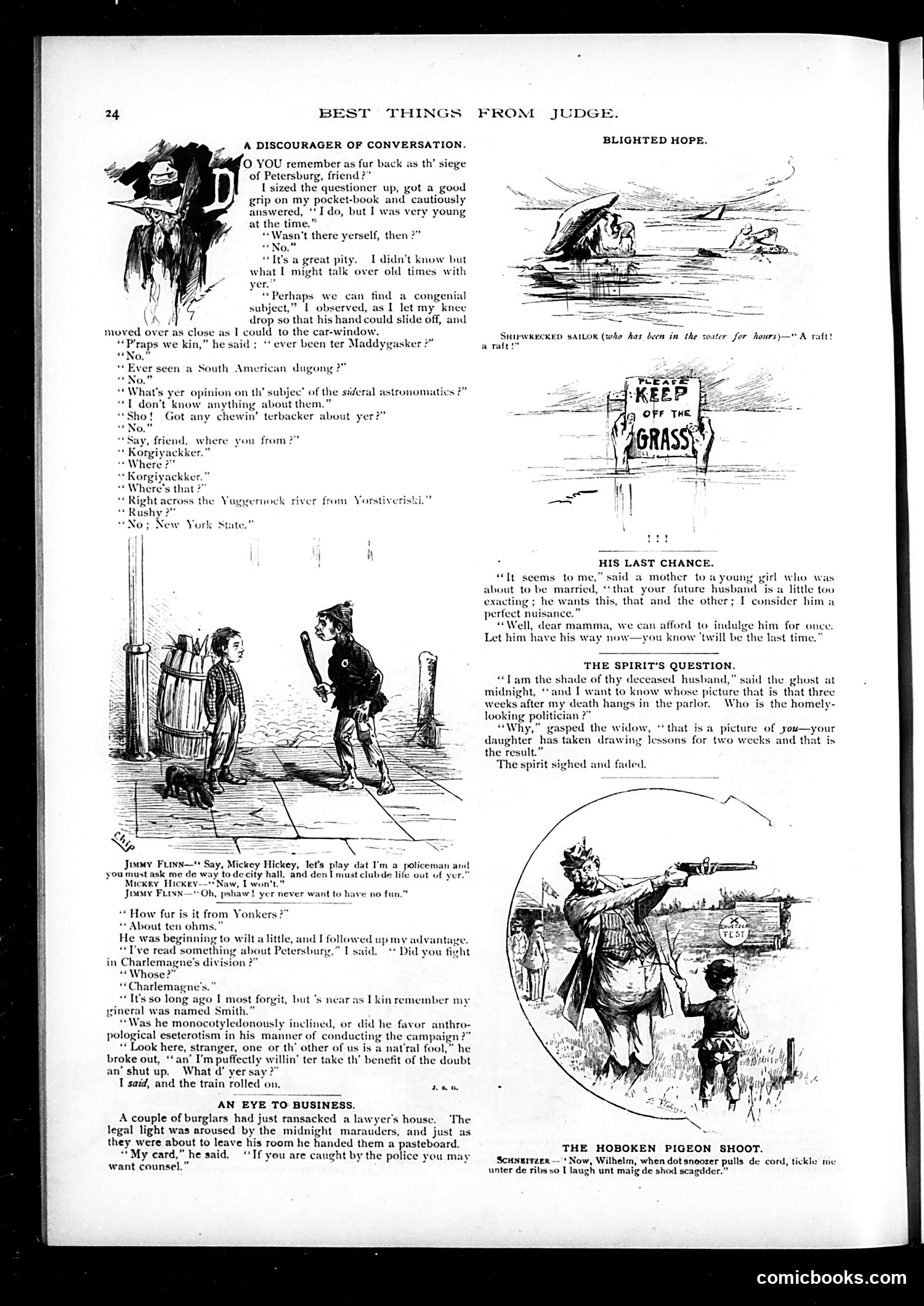
This page contains several satirical vignettes typical of late 19th-century American humor: **"A Discourager of Conversation"** depicts a tedious bore on a train pestering a trapped passenger with increasingly absurd questions (about Madagascar, dugongs, astronomy, obscure rivers). The joke satirizes social awkwardness and unwanted conversation—the passenger finally escapes by out-absurding the questioner, who admits "one or th' other of us is a nat'ral fool." **"An Eye to Business"** mocks a lawyer's mercenary nature: even during a burglary, he hands the criminals his business card, offering legal counsel if they're caught. **"His Last Chance"** jokes about indulging a disappointing fiancé—a mother tells her daughter to let him have his way now since it will be the last time (implying marriage will change that). **"The Spirit's Question"** presents a widow's ghost-husband discovering her portrait of a politician in the parlor, humiliated at being replaced by an unattractive politician. **"The Hoboken Pigeon Shoot"** (bottom) uses German dialect humor, apparently depicting hunting preparation.
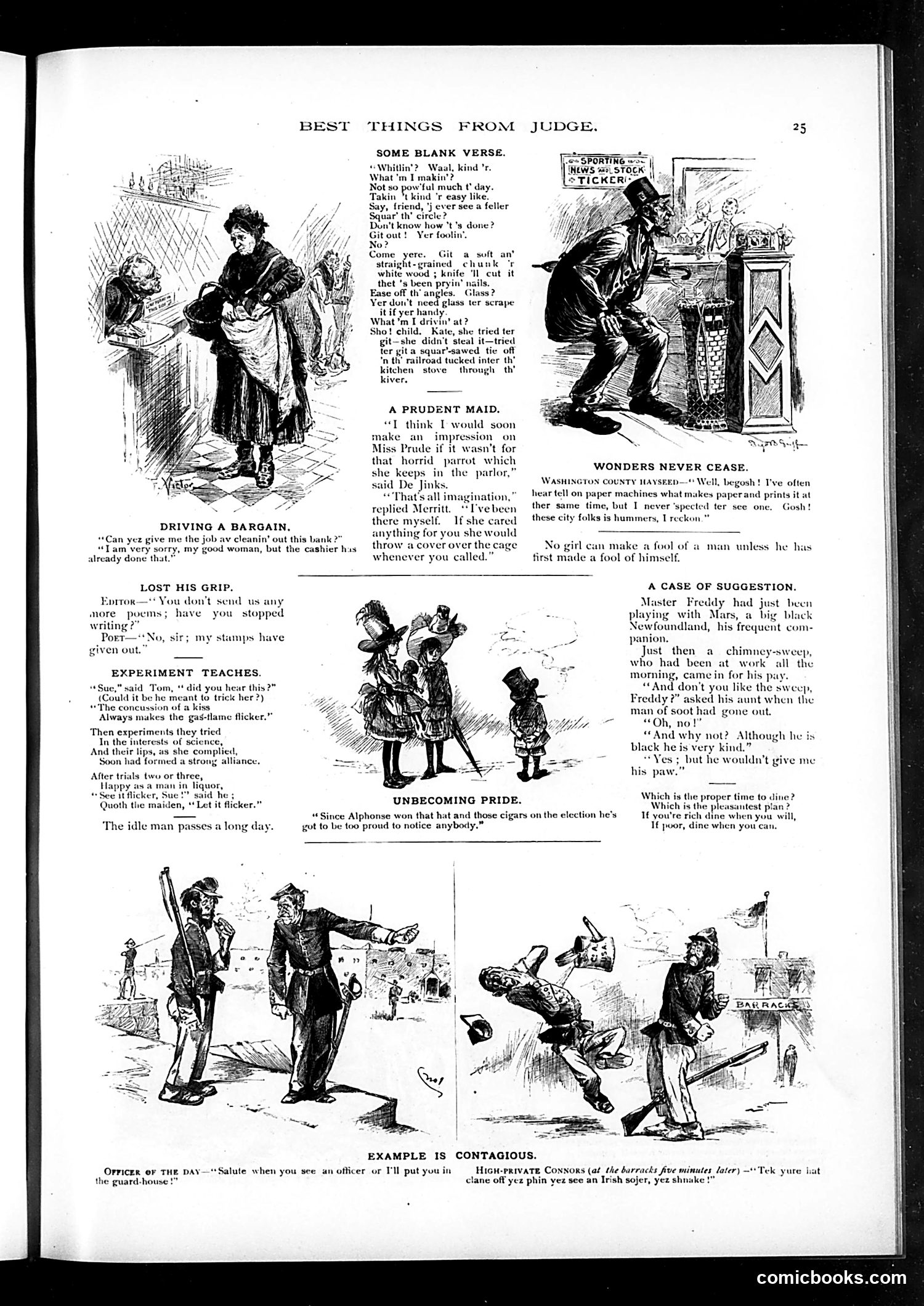
This page contains multiple short humorous sketches satirizing late 19th-century American life and character types. **Key Sketches:** "Driving a Bargain" mocks Irish immigrant workers (indicated by dialect) seeking menial jobs after financial crises. "Some Blank Verse" uses rural dialect humor, depicting an uneducated farmer attempting to explain geometry to a child through nonsensical analogies—satire of rural ignorance. "A Prudent Maid" jokes about courtship propriety: a parrot in a parlor prevents improper behavior during visits, implying the bird serves as an unwilling chaperone. "Wonders Never Cease" ridicules rural visitors' amazement at industrial machinery (paper-making presses), mocking unsophisticated observers. "Unbecoming Pride" satirizes working-class pretension: a man winning election items (hat, cigars) becomes insufferably proud. "A Case of Suggestion" uses a child's logic: after playing with a black dog, the child rejects a black chimney sweep, conflating the two by color alone. Throughout, Judge employs ethnic dialects (Irish, rural) and class-based humor typical of Gilded Age satire.
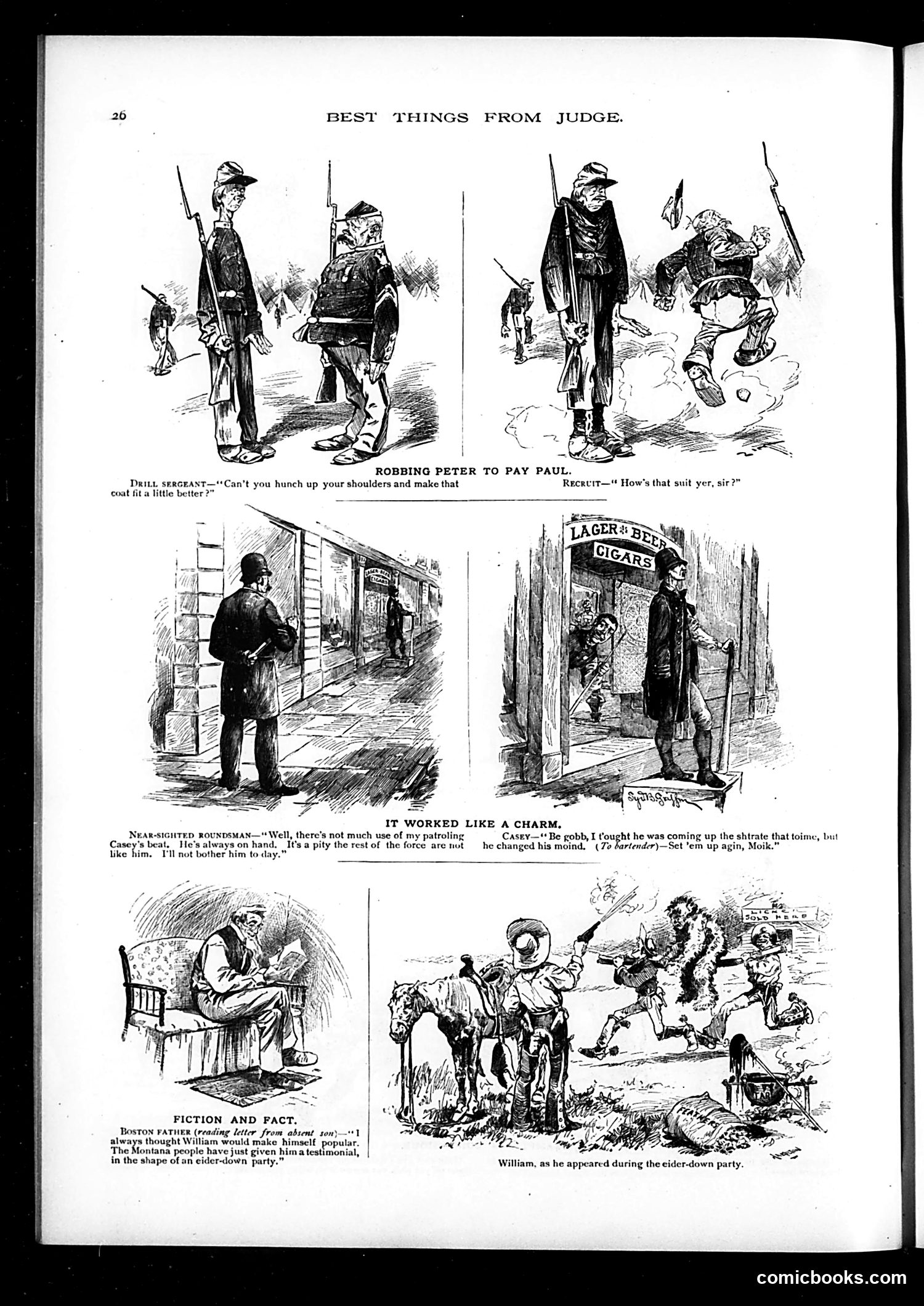
This page collects several satirical cartoons mocking military recruitment and police inefficiency circa early 1900s. **"Robbing Peter to Pay Paul"** shows drill sergeants trying to make ill-fitting uniforms work on recruits by having them hunch their shoulders—satirizing military incompetence and poor supply management. **"It Worked Like a Charm"** depicts a nearsighted policeman ("roundsman") who relies on Casey, a fellow officer, to actually patrol the beat while he loafs. A bartender mentions Casey changed his routine, yet the lazy officer won't notice the difference—mocking corrupt police departments where some officers do no real work. **"Fiction and Fact"** shows a Boston father reading that his son William received a testimonial in Montana—but it's actually an "eider-down party" (a tarring and feathering), a violent frontier form of mob justice. The joke contrasts civilized Eastern expectations with brutal Western vigilantism. The cartoons reflect Progressive-era skepticism toward institutions (military, police) and frontier justice.
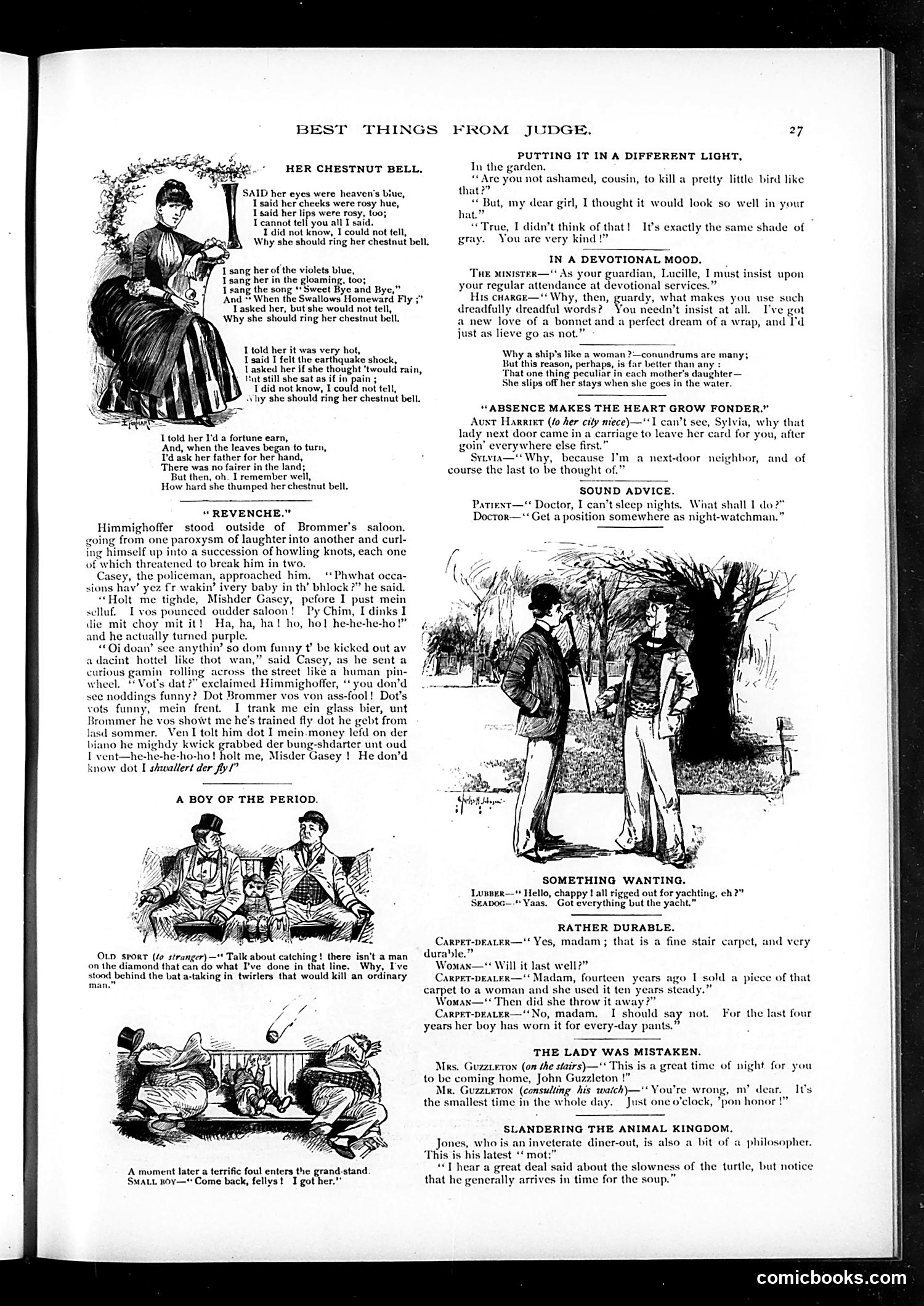
This page from the satirical magazine **Judge** contains several short humorous pieces typical of late 19th-century American comedy: **"Her Chestnut Bell"** is a sentimental poem mocking the romantic suitor—a young man professes love through poetry and promises, but the woman rings her bell in frustration, apparently unimpressed by his courtship. **"Revenge"** depicts an immigrant ("Himmighoffer") laughing hysterically after being kicked out of a saloon, explaining to a policeman that the bartender trained a fly to catch money—which the drunk swallowed, then burped up the fly. The humor relies on ethnic stereotype dialect and crude physical comedy. **"A Boy of the Period"** contrasts a sportsman boasting about catching ability with a actual moment when he fails to catch a foul ball, which a young boy manages instead—inverting expectations for comic effect. The remaining snippets offer brief observational jokes about women, fashion, social pretense, and relationships—typical Judge content satirizing middle-class manners and gender dynamics of the era.
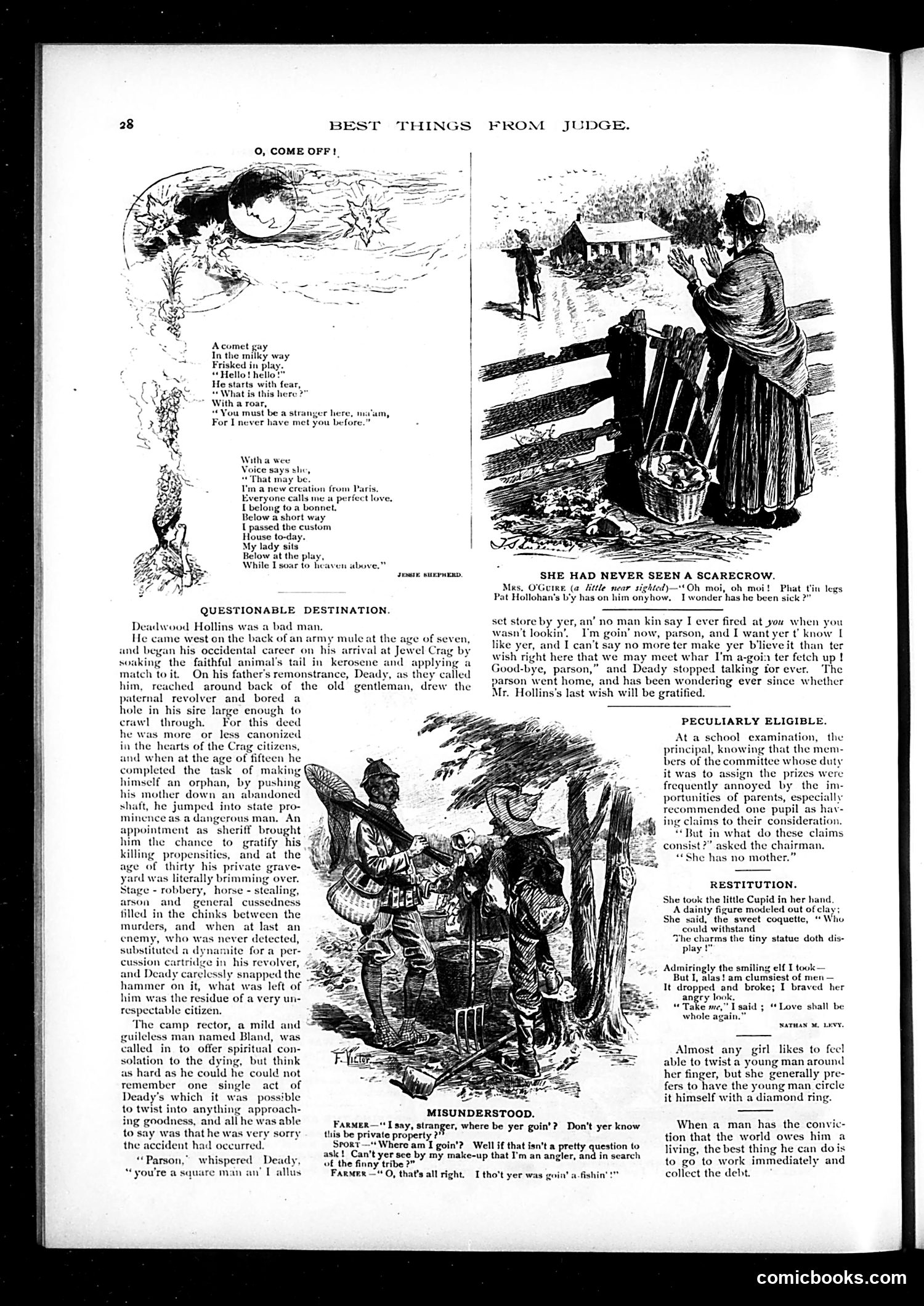
This page from the satirical magazine *Judge* contains several distinct pieces of social commentary: **"O, Come Off!"** (top left): A whimsical poem about a comet encountering celestial bodies—likely absurdist humor with no clear political target. **"Questionable Destination"**: A frontier morality tale mocking the romanticization of Western outlaws. Deadwood Hollins is an irredeemable criminal (murderer, arsonist, horse thief) whom locals paradoxically "canonize." The humor lies in the camp rector's inability to find *any* good deed to mention at his funeral—satirizing how frontier society glorified violent men while ignoring their actual crimes. **"Peculiarly Eligible"** and **"Restitution"**: Brief social comedies about courtship and gender relations—the latter mocking a girl's manipulative charm. **"Misunderstood"** (bottom): A frontier dialogue poking fun at regional dialect and miscommunication. The page targets 19th-century American myths about the "Wild West," revealing the gap between romantic frontier narratives and brutal reality. The satire suggests respectable society's uncomfortable hypocrisy in admiring outlaws.
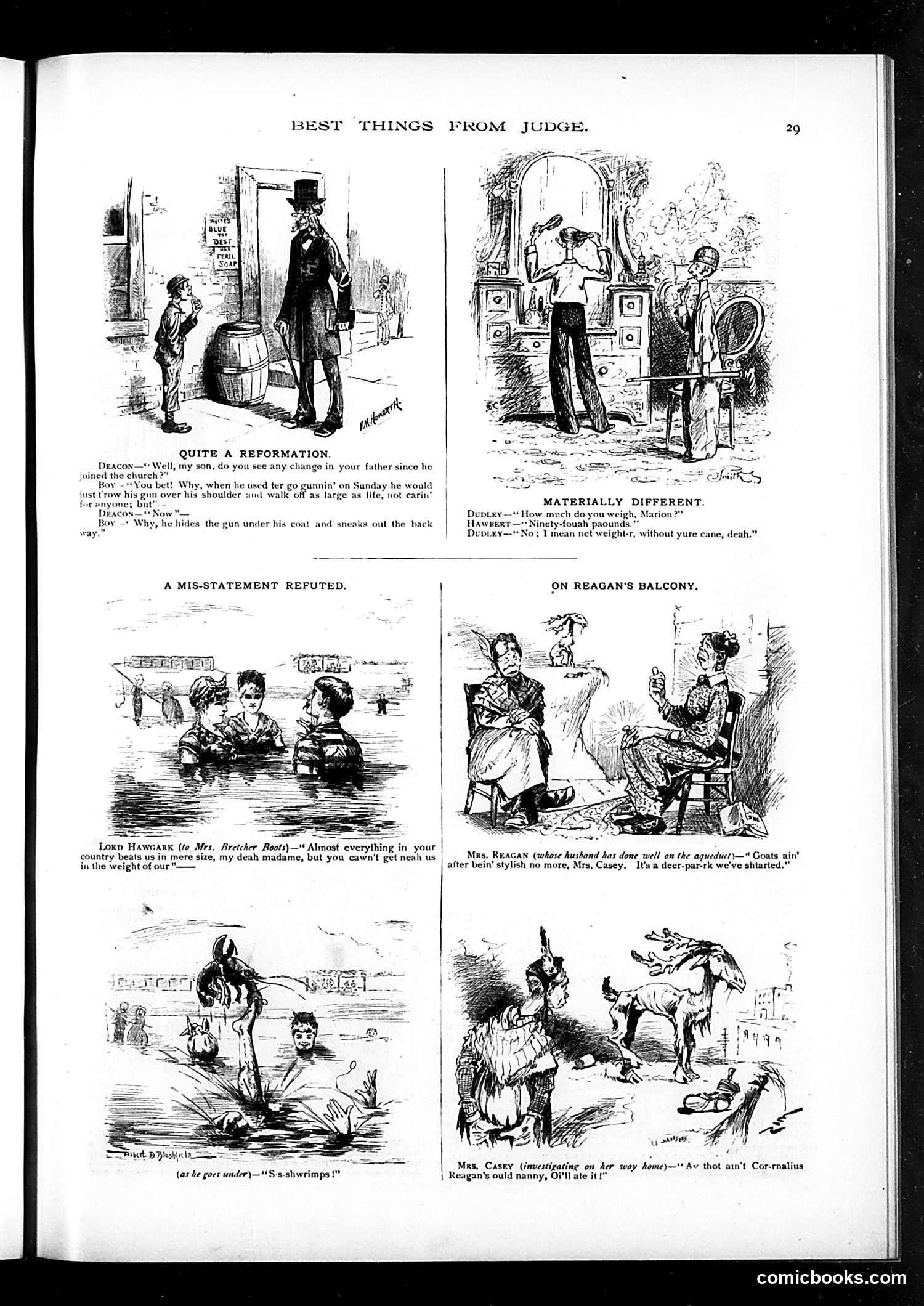
This page contains four separate satirical comics from Judge magazine, each with distinct humor: **"Quite a Reformation"** mocks hypocrisy: a boy notes his father's behavior hasn't genuinely changed after church—he still sneaks his gun out on Sundays, just more furtively now. **"A Mis-Statement Refuted"** uses a visual punchline: a British gentleman (indicated by accent) brags that England exceeds America in "weight," then sinks into water while claiming to be shrimp, undermining his boast through physical comedy. **"Materially Different"** plays on vanity: when asked her weight, a woman claims "ninety-four pounds," but the other character specifies "without your cane"—implying she's heavier and relies on her walking stick for support. **"On Reagan's Balcony"** satirizes Irish immigrant pretension: Mrs. Reagan, whose husband profited from aqueduct work, now keeps deer instead of goats to appear stylish, while her former nanny dismissively suggests she'd eat the old goat anyway. All employ stereotyped accents and class-based humor typical of 1880s-90s American satire.
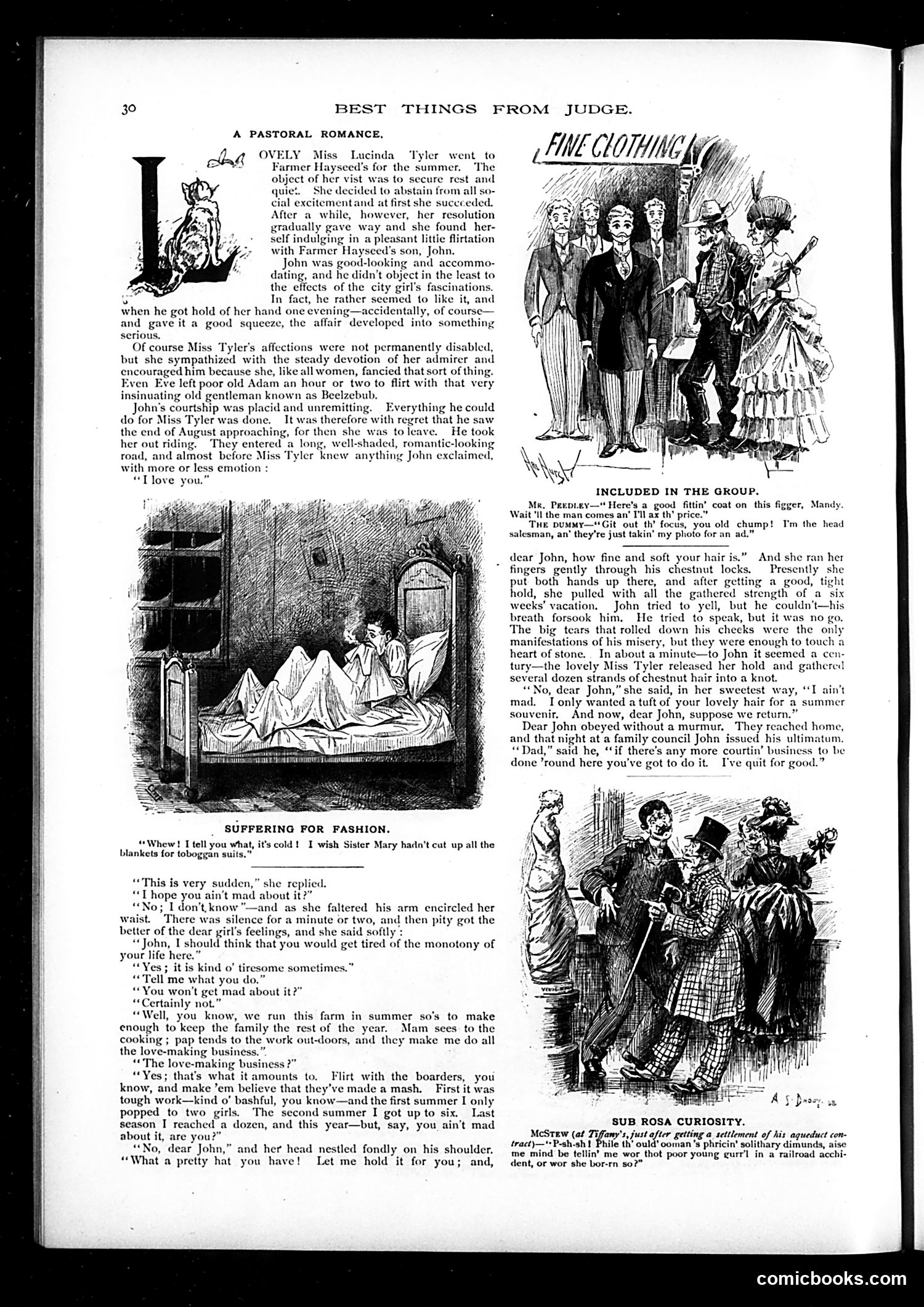
This page contains three interconnected satirical pieces mocking romantic and social conventions of the era. **"A Pastoral Romance"** presents a city girl (Miss Lucinda Tyler) seduced by rural charm into a summer flirtation with a farmer's son named John. The twist: John reveals the "love-making" is literally his family's summer business—he's paid to flirt with female boarders. The satire targets both the artificiality of rural romance and the transactional nature of courtship. **"Suffering for Fashion"** (bottom left) shows a woman complaining about cold while her sister has cut up blankets for fashionable toboggan suits—mocking women's willingness to endure physical hardship for fashion. **"Sub Rosa Curiosity"** (bottom right, partially visible) appears to satirize social pretension or gossip, though details are unclear from this excerpt. The overall message: romantic sentiment and social aspiration often mask mercenary or ridiculous motivations beneath polite surfaces.
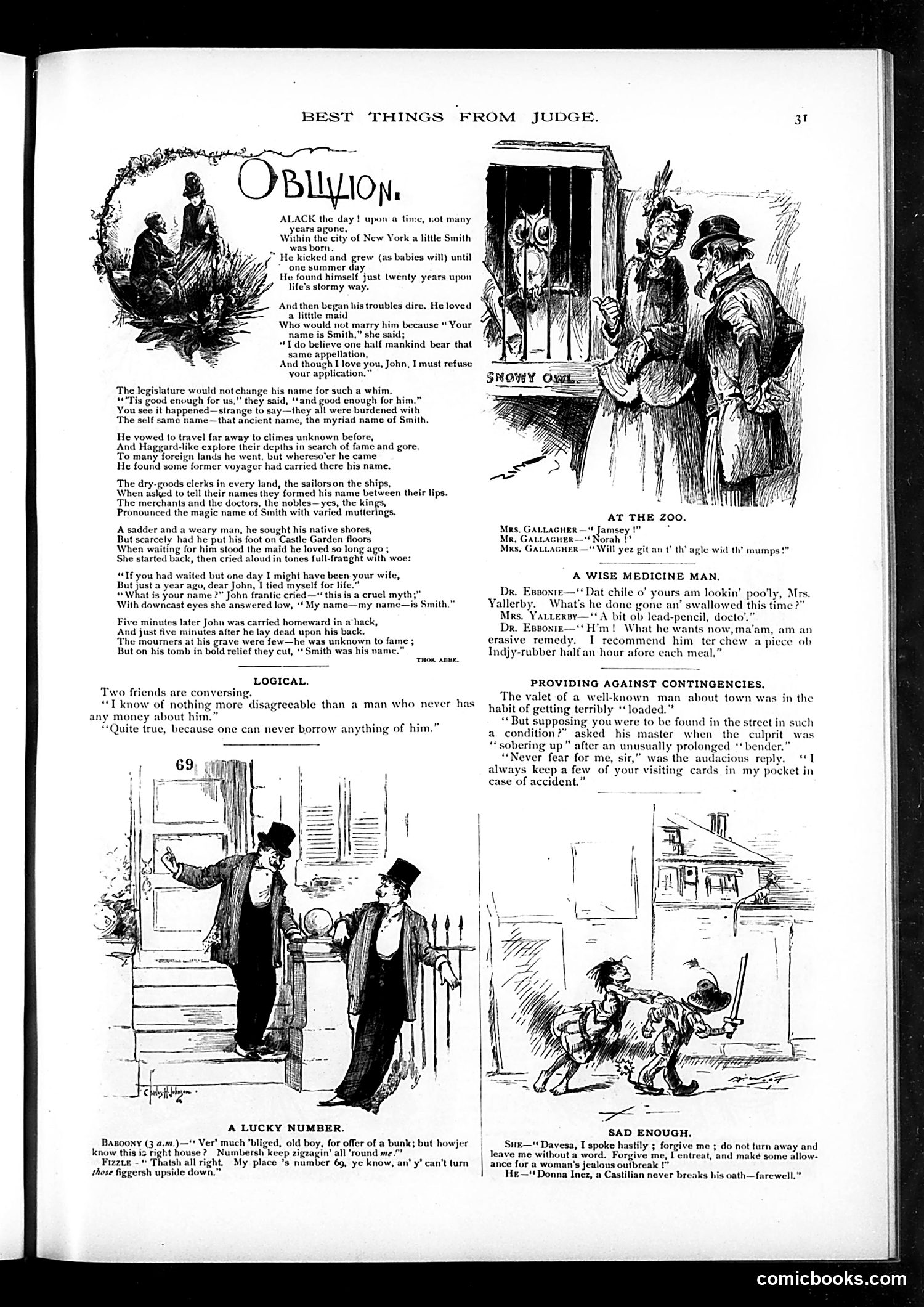
This page contains multiple unrelated satirical pieces typical of Judge magazine's format. The main story, "Oblivion," is a lengthy humorous narrative about a man named John Smith cursed by his common surname. No matter where he travels—to foreign lands, Castle Garden—he discovers others already bear the same name. The joke culminates when his long-lost love also turns out to be named Smith, driving him to suicide. The satire mocks the banality of extremely common names and the absurdity of fate. The smaller pieces include conventional comic scenarios: a "Logical" observation about borrowing money, a drunk man grateful for numbered housing (69 cannot be inverted), Irish dialect humor about a doctor recommending rubber erasers, and a valet's solution to drunken street incidents (carrying his employer's calling cards). The final piece, "Sad Enough," appears to be melodramatic dialogue between a jealous woman and her lover, parodying overwrought romantic fiction popular in the era. All content relies on Victorian-era sensibilities and conventional joke structures now largely unfamiliar to modern readers.
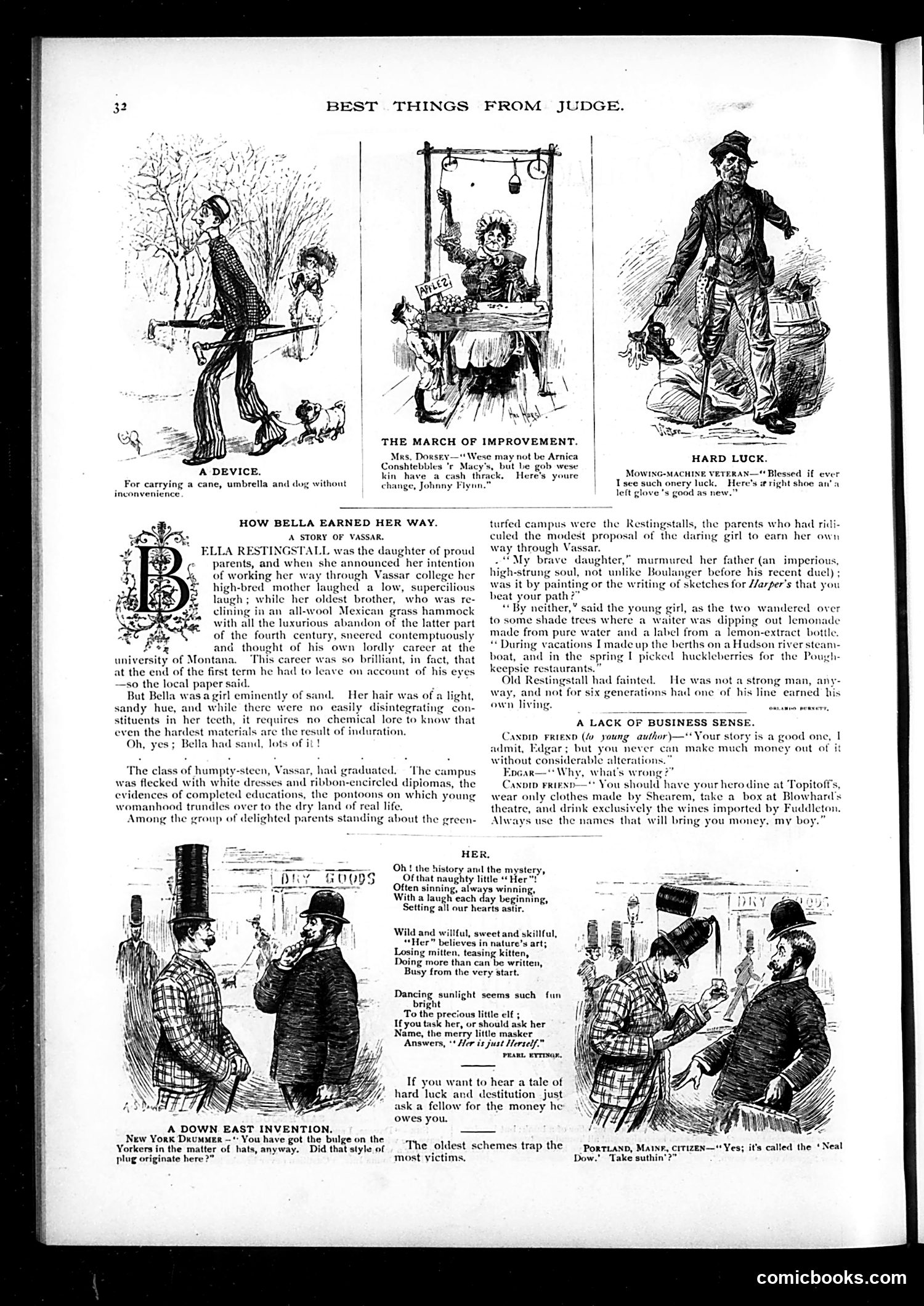
This page contains several satirical pieces mocking social pretensions and economic realities of late 19th-century America. **"How Bella Earned Her Way"** ridicules wealthy Vassar College families. Bella's snobbish parents mock her plan to work her way through college, but she determinedly finds employment on Hudson River steamboats and picking huckleberries. The satire targets class hypocrisy: the parents' horror at honest labor despite their comfortable circumstances. **"The March of Improvement"** appears to mock superficial self-improvement among the upper classes. **"A Lack of Business Sense"** satirizes a struggling young author who lacks commercial savvy. A friend explains he must name-drop expensive establishments (restaurants, theaters, imported goods) in his fiction to attract paid advertising—making the story a vehicle for product placement rather than art. **"A Down East Invention"** is a brief joke about regional hat styles. The humor reflects Judge's typical audience of affluent urbanites, poking fun at both pretentious wealth and artistic naïveté, while tacitly endorsing commercial values.
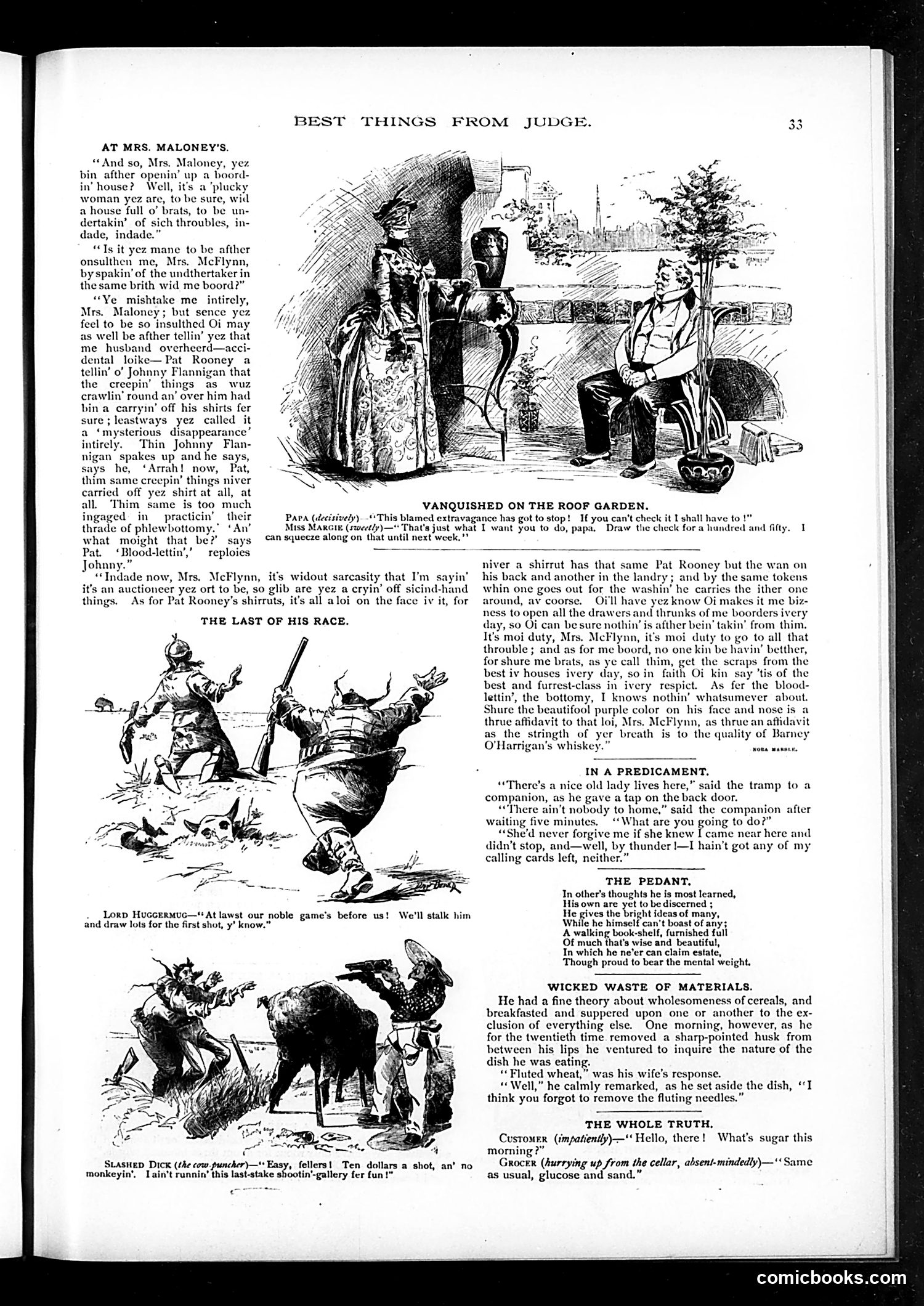
This page collects humorous short pieces and illustrations typical of Judge magazine's satirical content. **"At Mrs. Maloney's"** features Irish-immigrant characters (indicated by their dialect and names) gossiping about boarding-house life. The humor relies on ethnic stereotyping—exaggerated Irish brogue and comedic misunderstandings about "blood-letting" (phlebotomy), which Mrs. Maloney confuses with literal shirt-stealing. **"Vanquished on the Roof Garden"** depicts a daughter manipulating her father into giving her money by pretending to comply with his demand to stop spending—she requests a check for $150 instead. **"The Last of His Race"** shows hunting scenes, likely satirizing the era's obsession with blood sports. Other brief pieces include a tramp's social embarrassment and "The Pedant"—mocking someone who parrots others' ideas without original thought. The page exemplifies Judge's working-class humor, ethnic caricature, and gentle domestic satire typical of late-19th/early-20th-century American magazines.
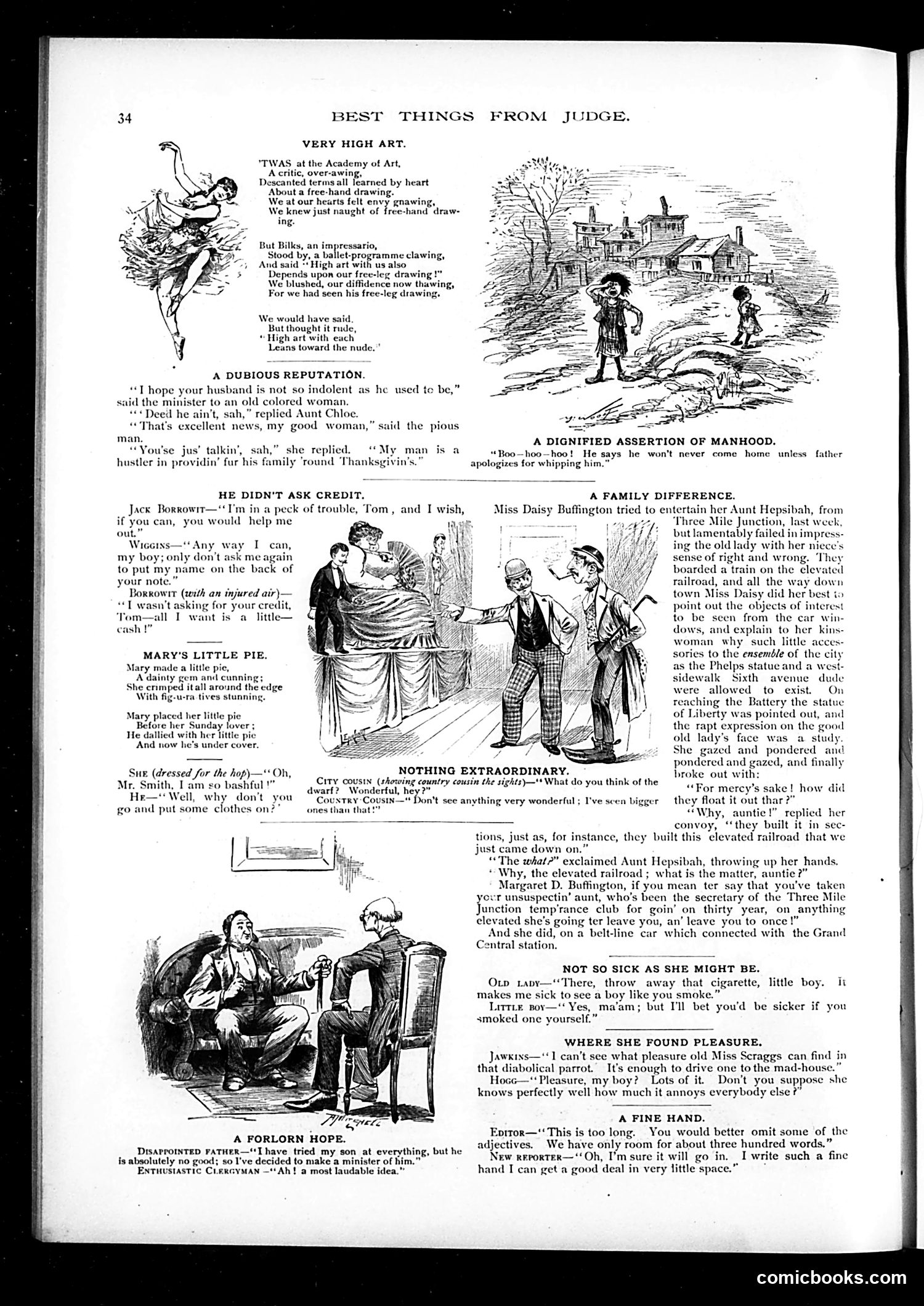
This page contains several satirical vignettes typical of Judge's humor: **"Very High Art"** mocks pretentious art criticism—a pompous Academy of Art critic uses learned jargon about "free-hand drawing," but a ballet impresario deflates this by pointing out that ballet dancing is also "high art," just with "free-leg drawing." The satire targets artistic snobbery. **"A Dubious Reputation"** plays on racial stereotypes common to the era, featuring dialogue with "Aunt Chloe," an African American character, about her husband being industrious around Thanksgiving—a period-typical joke. **"A Family Difference"** satirizes generational disconnect. Aunt Hepsibah from rural "Three Mile Junction" visits her niece in New York City. When shown the Statue of Liberty and told about the elevated railroad, she misunderstands "elevated" as literally floating and becomes scandalized that her temperance-club-secretary reputation might be compromised by riding such a thing. The remaining items are brief humor snippets on credit, dating, and children's impertinence—standard Judge fare mocking middle-class social situations.
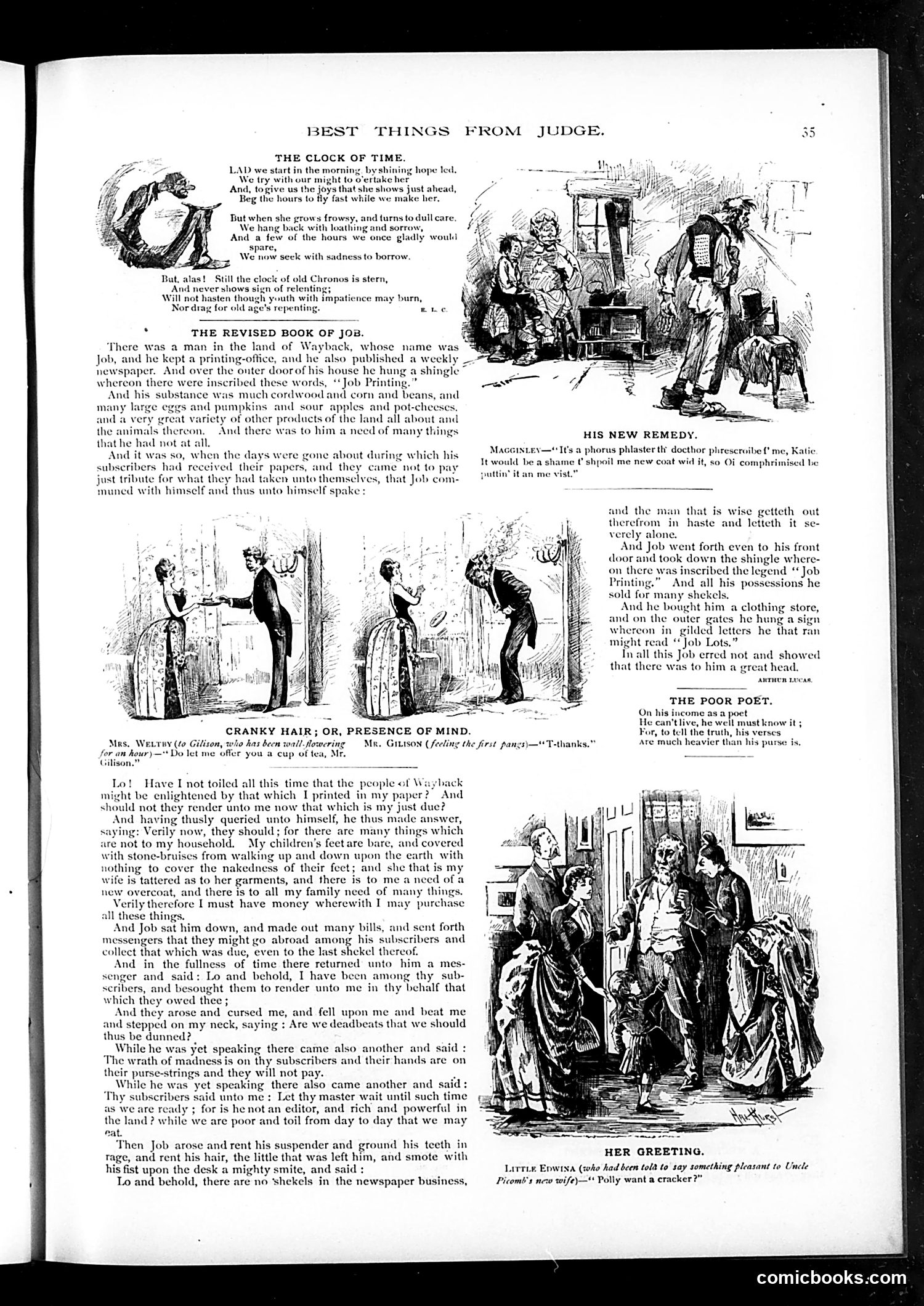
This page contains three satirical pieces poking fun at Victorian-era frustrations: **"The Clock of Time"** is a poem lamenting how time seems to drag in old age after racing by in youth—a universal complaint about mortality rendered as social commentary. **"The Revised Book of Job"** is the main satirical piece, a biblical parody mocking struggling newspaper publishers. It depicts a printer named Job who starts a printing business but can't collect payment from subscribers. Despite sending messengers to demand money, subscribers refuse to pay, offering excuses that they're poor workers while Job is wealthy and powerful. The satire critiques deadbeat subscribers and the precarious economics of 19th-century newspaper publishing. **"Cranky Hair; or, Presence of Mind"** appears to be a brief humorous dialogue (with accompanying illustrations) about social awkwardness—a man offering tea to someone after they've been ignored. The page illustrates Judge magazine's specialty: satirizing middle-class economic anxieties and social pretensions through exaggerated characters and biblical/classical parodies.
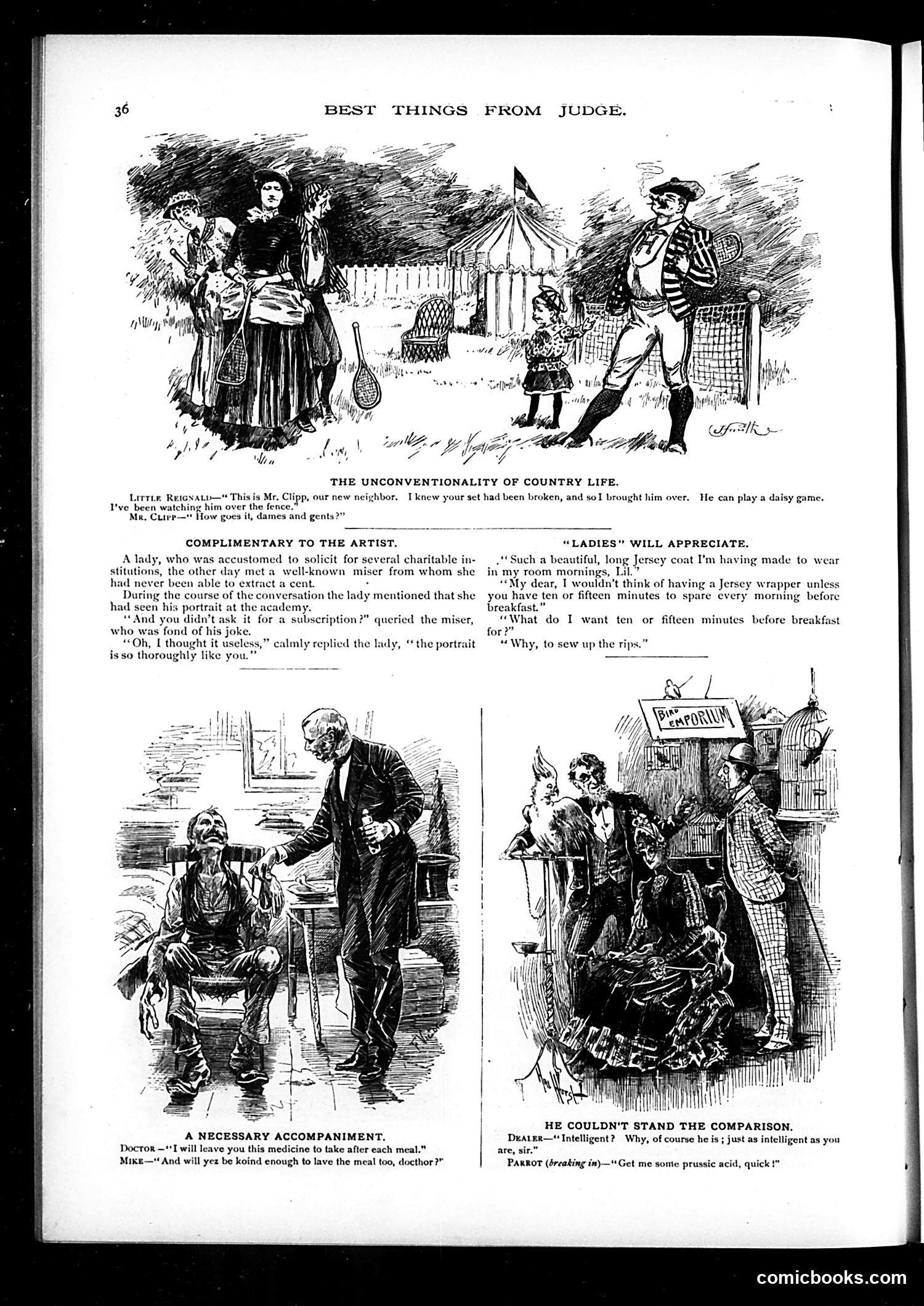
This page contains four separate satirical cartoons from Judge magazine, a late-19th-century American humor publication: 1. **"The Unconventionality of Country Life"**: Rural neighbors are depicted as crude and unsophisticated, playing crude games and treating social conventions casually—contrasting with urban propriety. 2. **"Complimentary to the Artist"**: A miser insults a portrait painter by saying the portrait is unflattering, implying the artist made him look bad. The lady's retort—that it's actually a perfect likeness—suggests the miser's own ugly appearance, not poor artistry. 3. **"A Necessary Accompaniment"**: A working-class Irishman (Mike) asks a doctor to provide food with medicine, implying poverty-era humor about the Irish struggling financially. 4. **"He Couldn't Stand the Comparison"**: A dealer praises a man's intelligence by comparing it to someone else's, but a parrot (apparently present) becomes so insulted by being compared unfavorably that it demands prussic acid (poison)—dark humor suggesting the parrot would rather die than endure such comparison. These exemplify Victorian-era social satire targeting class, ethnicity, and vanity.
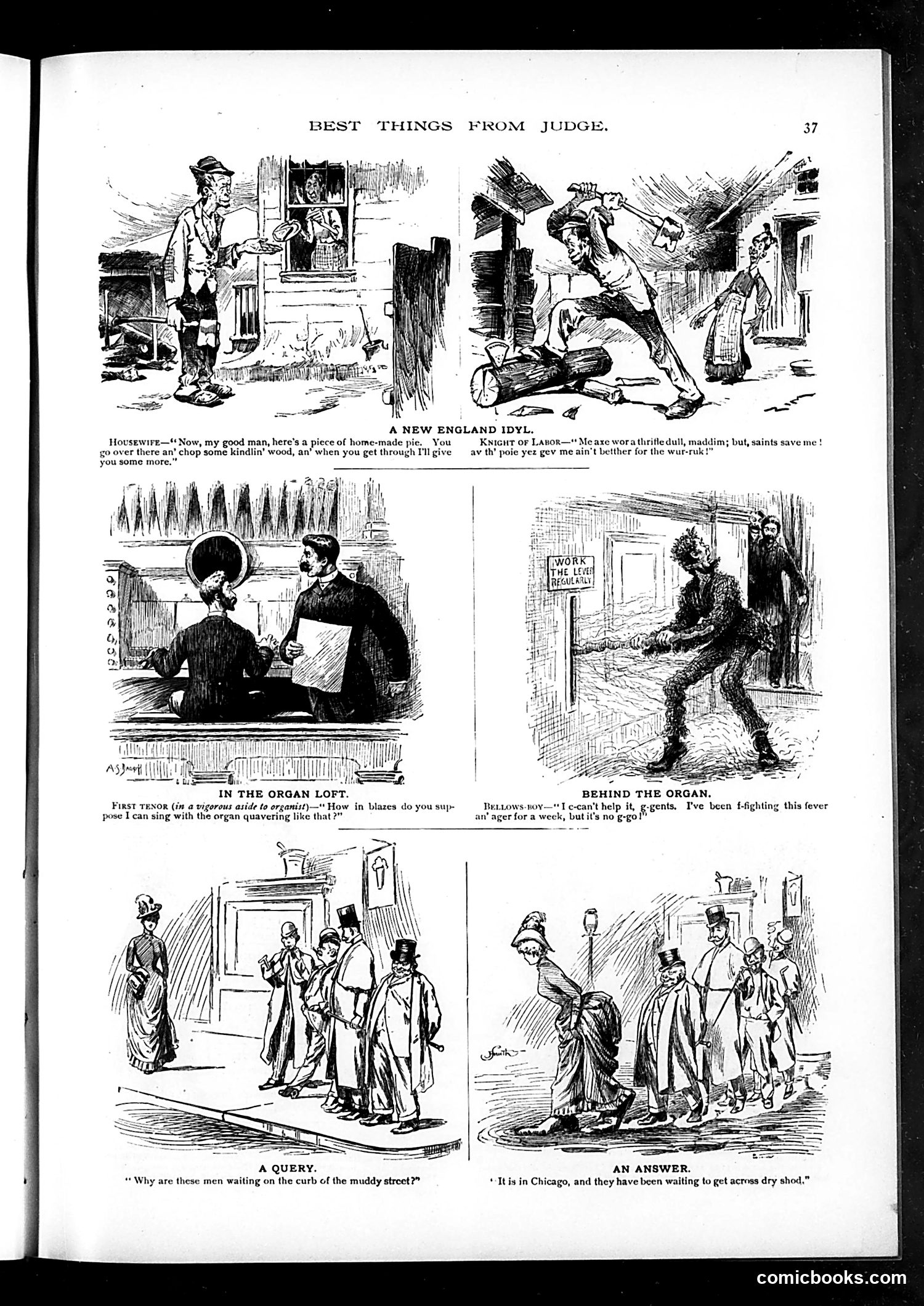
This page collects four satirical comic vignettes from Judge magazine: 1. **"A New England Idyl"**: Mocks rural Irish laborers through dialect humor—a housewife offers pie to a worker who responds in exaggerated Irish brogue, complaining the pie isn't as good as what she previously gave him. 2. **"In the Organ Loft"**: Church humor—a tenor complains he can't sing properly because the organist is playing poorly/unsteadily. 3. **"Behind the Organ"**: The punchline reveals the organist is sick with fever, explaining his poor performance. 4. **"A Query/An Answer"**: Satirizes Chicago's notorious muddy streets and poor municipal infrastructure—men waiting to cross because streets are impassably muddy. The humor relies on period stereotypes (Irish dialect comedy), everyday frustrations (poor infrastructure, illness), and situational irony. These reflect typical Judge magazine content: light social satire targeting immigrant groups, urban problems, and middle-class annoyances rather than serious political commentary.
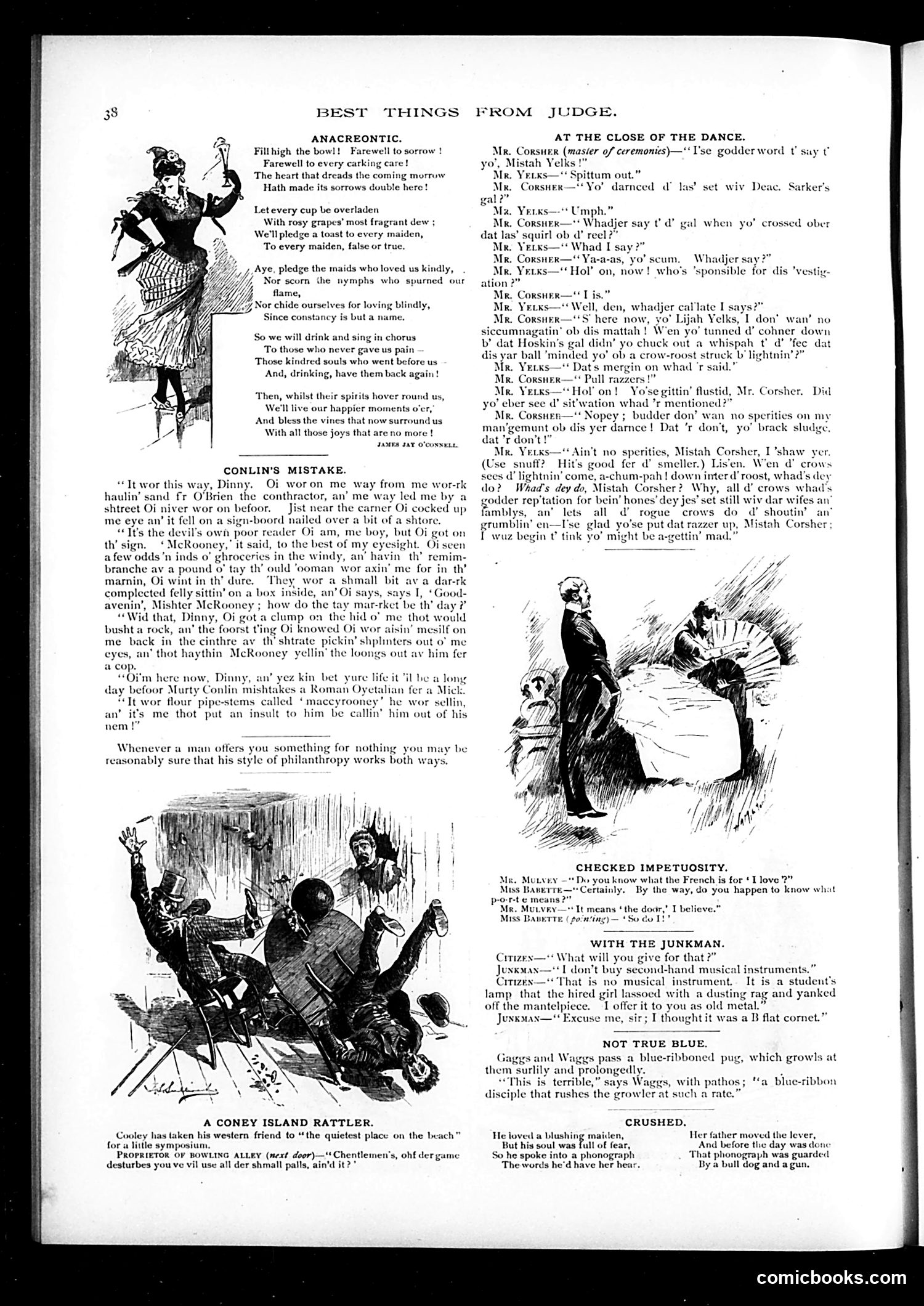
This page from *Judge* contains several satirical pieces, primarily dialogue-based humor typical of late 19th-century American satire. **"At the Close of the Dance"** depicts two Black men (Corser and Yelks, rendered in heavy dialect) in what appears to be a post-dance interrogation. Corser aggressively questions Yelks about flirting with a woman during the dance, with increasingly absurd accusations (comparing a whisper to a crow's behavior during lightning). The satire targets the performative indignation and overwrought masculinity of social posturing. **"Conlin's Mistake"** is an Irish immigrant anecdote (rendered in thick brogue) about a man who misreads a grocery store sign, mistaking "McRooney" for a flour product ("maccyrooney"), leading to a physical altercation when he addresses the proprietor incorrectly. Other brief pieces include dating advice and Coney Island humor. The cartoons depict slapstick scenarios. Overall, the page relies on ethnic/racial caricature and dialect humor—standard for *Judge*'s era but deeply offensive by modern standards.
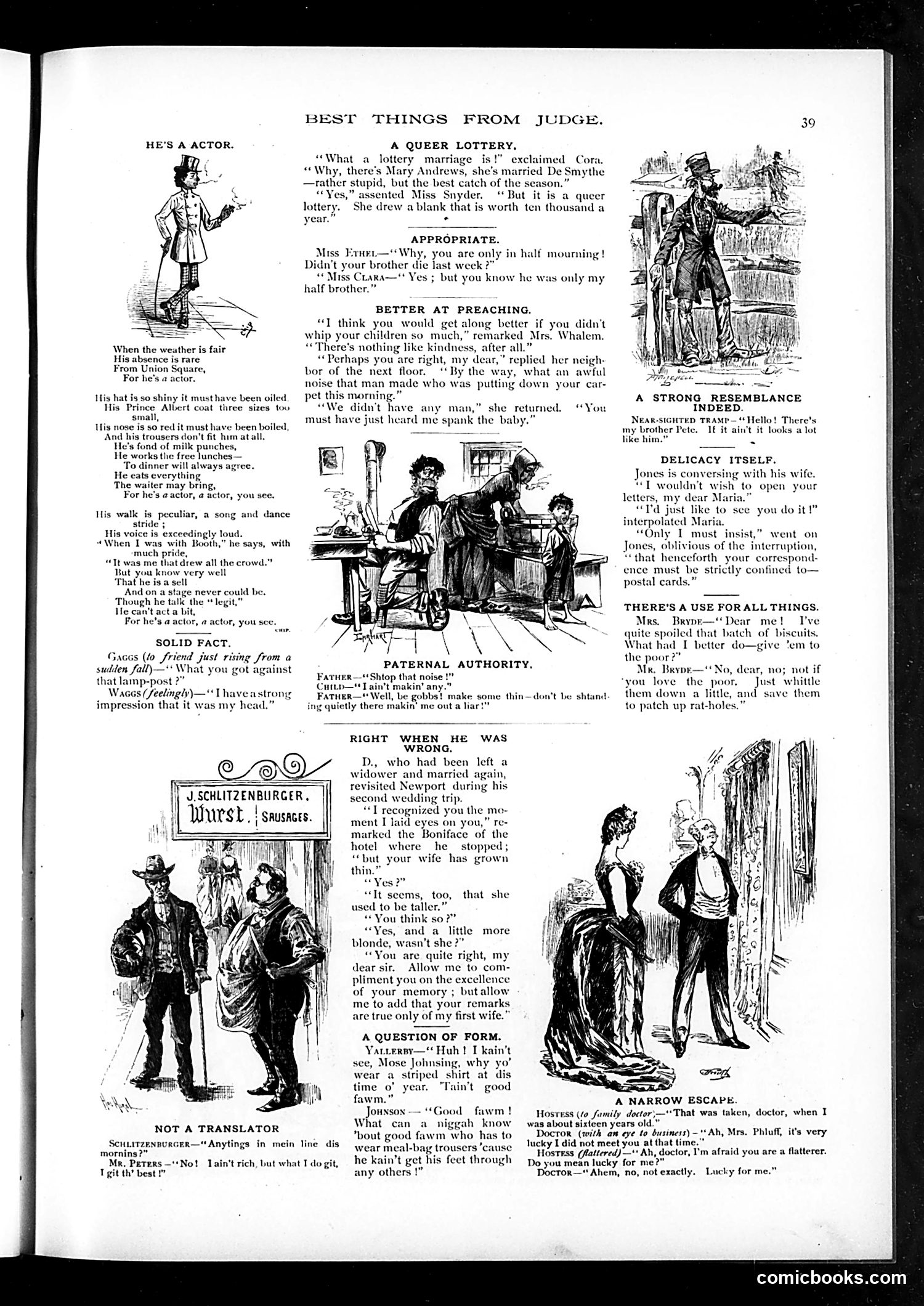
This page from Judge magazine (likely late 1880s-1890s) contains humorous short sketches mocking social types and domestic absurdities. **Key Cartoons:** **"He's an Actor"** (top left): Ridicules struggling theatrical performers who frequent Union Square (a theater district), adopting airs while actually being unemployable frauds living on free lunches and cheap lodging. **"Paternal Authority" & "Right When He Was Wrong"**: Mock domestic life—fathers unable to control children; husbands contradicted by wives but insisting they're right anyway. **"Not a Translator"**: Schlitzenburger appears to be a German immigrant with a sausage business, playing on anti-immigrant stereotypes. **Racial Humor**: "A Question of Form" uses demeaning dialect and racist stereotypes when depicting Black characters debating clothing propriety. **Marital Satire**: Multiple sketches mock marriage as lottery, women shrewdly managing foolish husbands, and domestic expense-cutting. The humor reflects Victorian anxieties about class, theater culture, immigration, and gender dynamics.
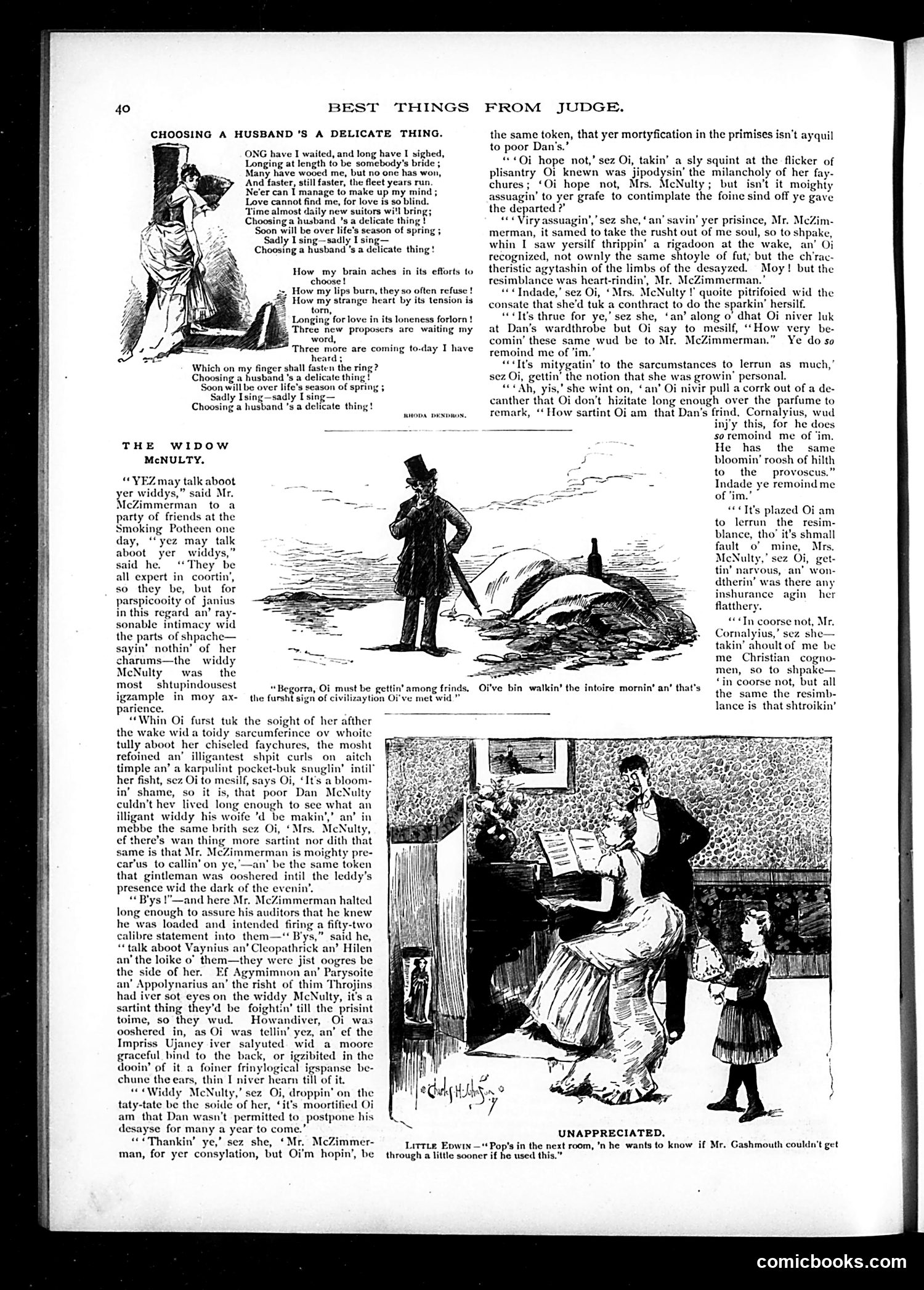
This page contains two humorous pieces satirizing Irish-American life in late 19th-century America. **"Choosing a Husband's a Delicate Thing"** is a sentimental poem about a woman's difficulty selecting among suitors—conventional romantic verse with an ironic title. **"The Widow McNulty"** is the main satire. Mr. McZimmerman discusses Mrs. McNulty, a widow, with friends at a social gathering. The humor relies on thick Irish-dialect stereotyping: characters speak in exaggerated phonetic Irish brogue ("Oi" for "I," "sez" for "says," "shpeak," "thrue"). The joke centers on the widow's behavior—she appears overly cheerful and interested in romance despite her late husband Dan. McZimmerman and his companions mock her unseemly eagerness to remarry and flirt, viewing her conduct as undignified mourning. The dialect humor and social commentary reflect period prejudices against Irish immigrants. The accompanying illustration shows a widow figure, reinforcing the narrative focus.
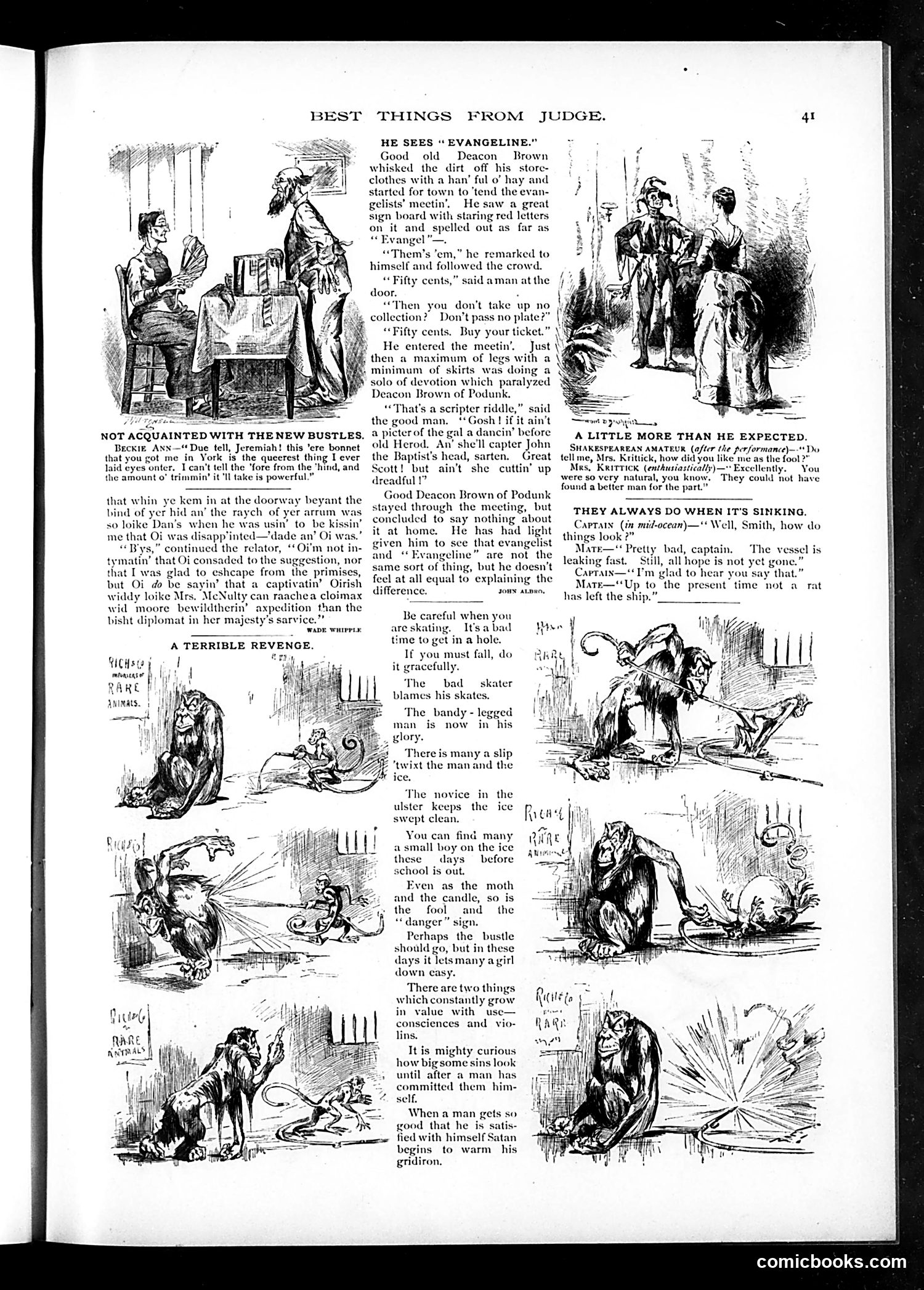
This page contains multiple short satirical pieces typical of Judge magazine's humor: **"He Sees 'Evangeline'"** mocks rural naiveté. Deacon Brown of Podunk attends a traveling evangelist's meeting featuring a young woman named "Evangeline." He mistakes her for the literary character Evangeline and becomes scandalized, imagining she'll perform biblical tableaus (like Salome dancing for John the Baptist's head). The joke: his confusion between theatrical entertainment and religious revival, satirizing both country simplicity and dubious "evangelist" shows. **"A Terrible Revenge"** uses sequential illustrations of a man slipping repeatedly on ice—slapstick visual humor about winter hazards. **"They Always Do When It's Sinking"** features a ship's mate maintaining optimism during a sinking vessel, then revealing "not a rat has left us"—dark humor suggesting even rats have abandoned ship, making his hope absurd. **"A Little More Than He Expected"** shows an amateur actor asking a critic how he performed as "the fool," receiving the backhanded compliment that his performance was "so very natural"—implying he *is* a fool, not merely playing one. The page emphasizes Judge's trademark: gentle mockery of American social pretension and human folly.
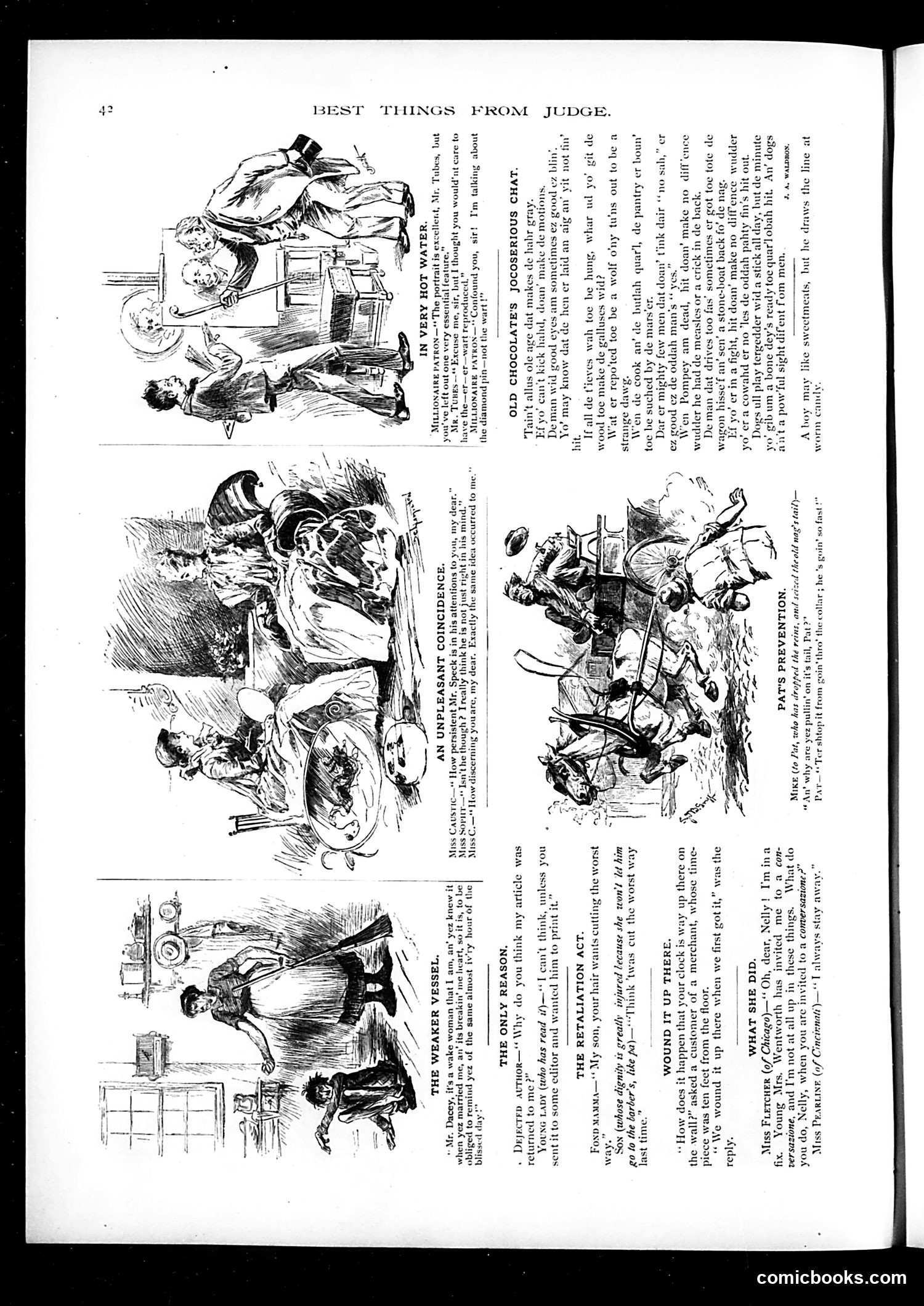
I cannot reliably read the OCR text on this page—it appears severely corrupted or inverted, making it impossible to identify the specific cartoons, captions, or satirical targets with confidence. From the **images alone**, I can see this is a page from Judge containing four separate political cartoons rendered in pen-and-ink style. The drawings depict various figures in late 19th or early 20th-century dress engaged in different scenarios, suggesting commentary on contemporary politics, social conditions, or public figures. However, without legible captions or text to anchor the satire, I cannot accurately identify: - Who the caricatured figures represent - What political or social issues are being mocked - What the specific jokes or criticisms are meant to convey To properly explain these cartoons to a modern reader would require either clearer source material or additional historical context I cannot reliably extract from this page. I apologize for the limitation.
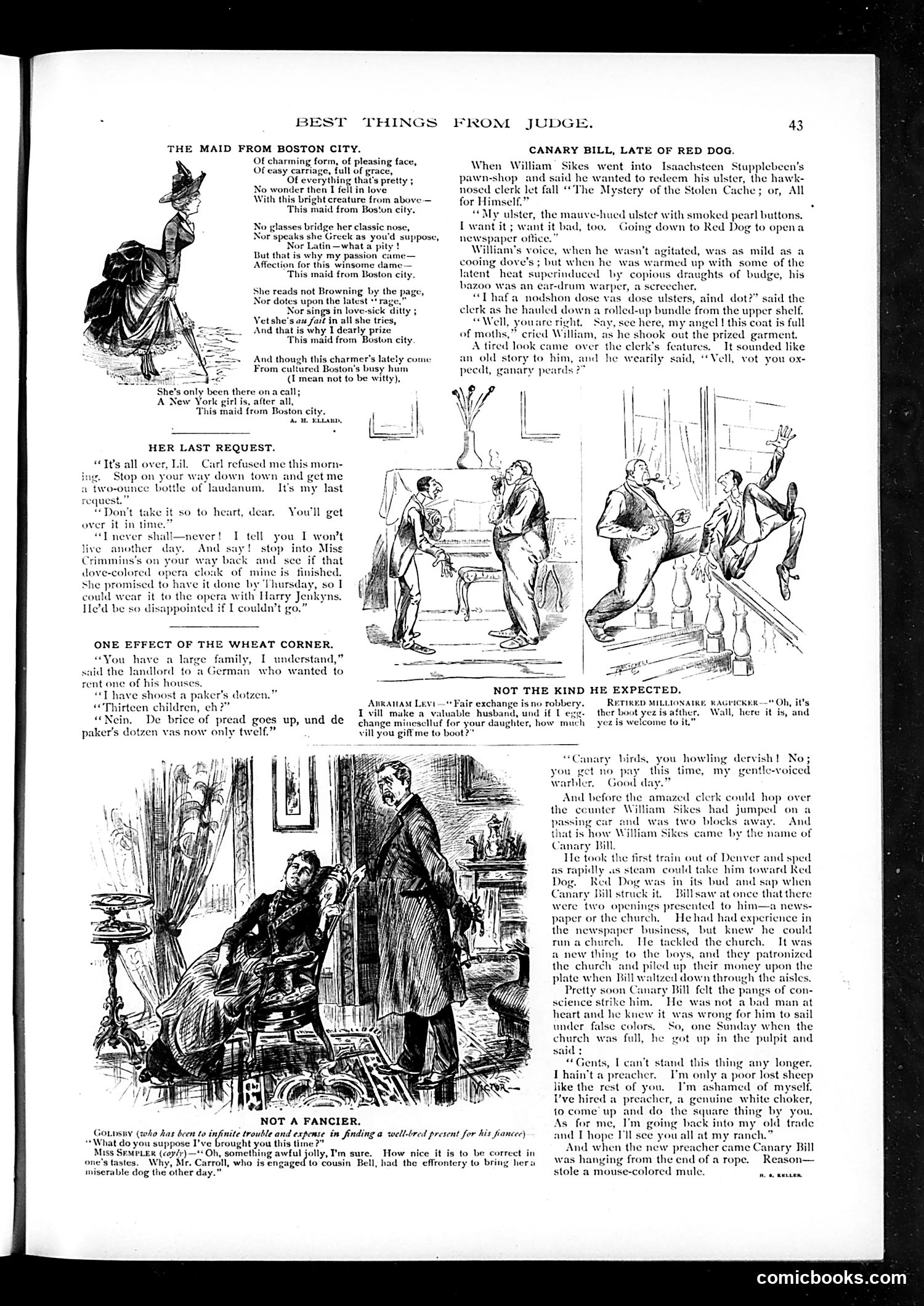
This page contains three humorous stories/cartoons from late 19th-century Judge magazine: **"The Maid from Boston City"** is a poem celebrating a Boston woman who, contrary to stereotype, isn't pretentiously intellectual—she doesn't read Browning or speak Greek/Latin. The joke satirizes the cultural pretensions of Boston society. **"Her Last Request"** depicts a woman on her deathbed asking her fiancé to retrieve her opera cloak from a dressmaker before attending the opera with another man (Harry Jenkyns). The dark humor lies in her casual infidelity even as she's dying. **"One Effect of the Wheat Corner"** jokes about bread prices during a wheat shortage ("corner"), suggesting a German immigrant family lost children because they couldn't afford bread—the punchline being the baker's dozen dropped from twelve to eleven. **"Canary Bill, Late of Red Dog"** tells of William Sikes attempting to reclaim a pawn-shop ulster (overcoat), discovering it's moth-eaten. He jumps the counter; the clerk (likely Jewish, suggested by dialect) responds sardonically about the "exchange." The cartoons satirize contemporary social issues: pretension, infidelity, economic hardship, and ethnic stereotypes common to 1890s American humor.
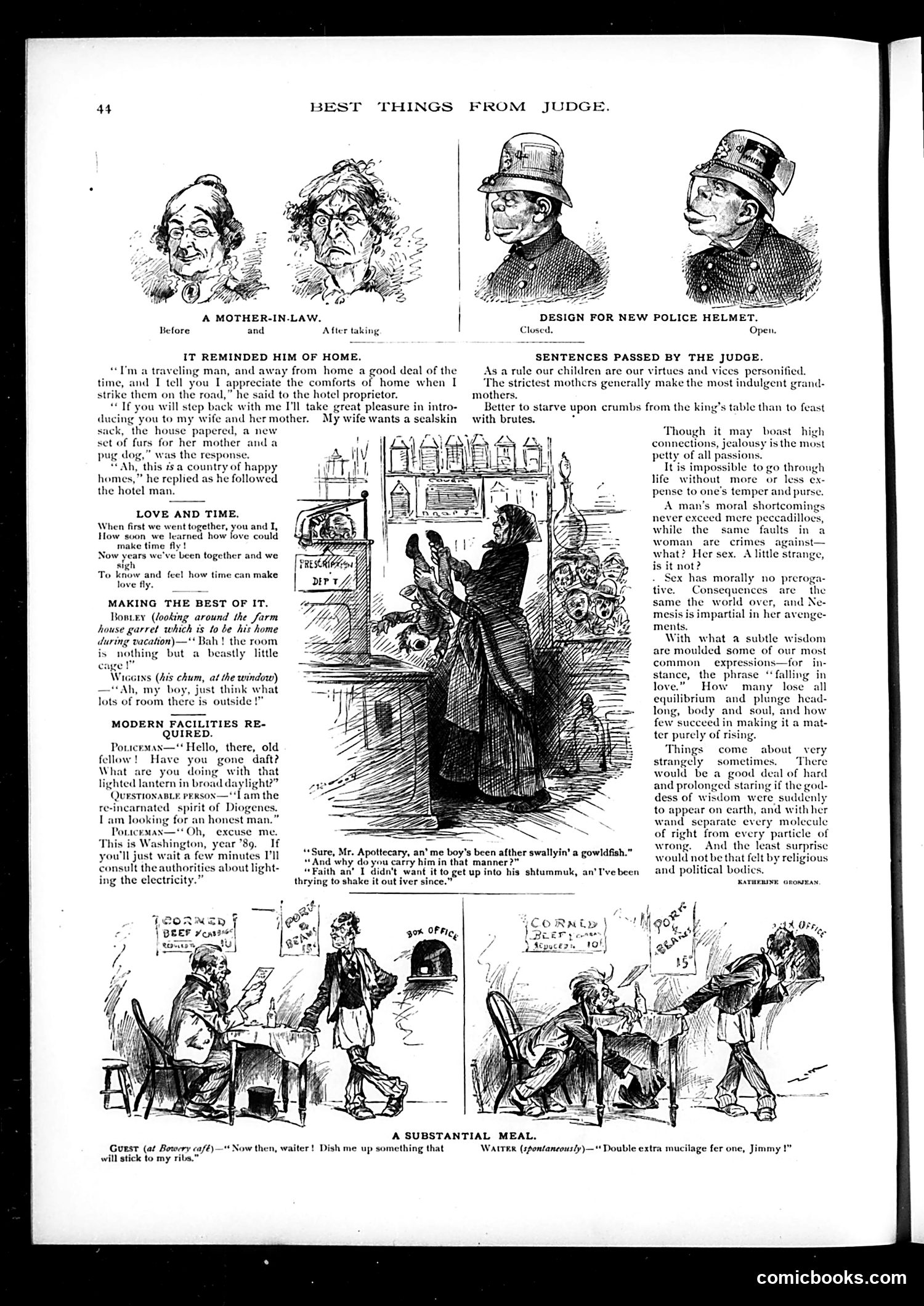
This page from the satirical magazine *Judge* contains multiple cartoons and humorous pieces mocking social conventions: **"A Mother-in-Law"** contrasts a woman's appearance before and after becoming a mother-in-law—satirizing how wives' demands (furs, sealskin sacks, house improvements) exhaust husbands. **"Design for New Police Helmet"** shows two profile sketches of what appears to be an absurdly designed helmet, likely mocking police incompetence or bureaucratic folly. **"Love and Time"** ironically observes how romantic couples' passion fades into marital tedium over years. **"Modern Facilities Required"** jokes about Washington, D.C. political corruption: a man searching for an honest man (referencing Diogenes) is told to wait for "authorities" about "lighting the electricity"—suggesting civic infrastructure and governance are equally absurd. **"A Substantial Meal"** presents two Bowery restaurant scenes with Irish dialect humor about inedible food (a boy swallowing goldfish to force it down his stomach). The page emphasizes domestic dissatisfaction, political cynicism, and working-class hardship typical of *Judge's* satirical voice.
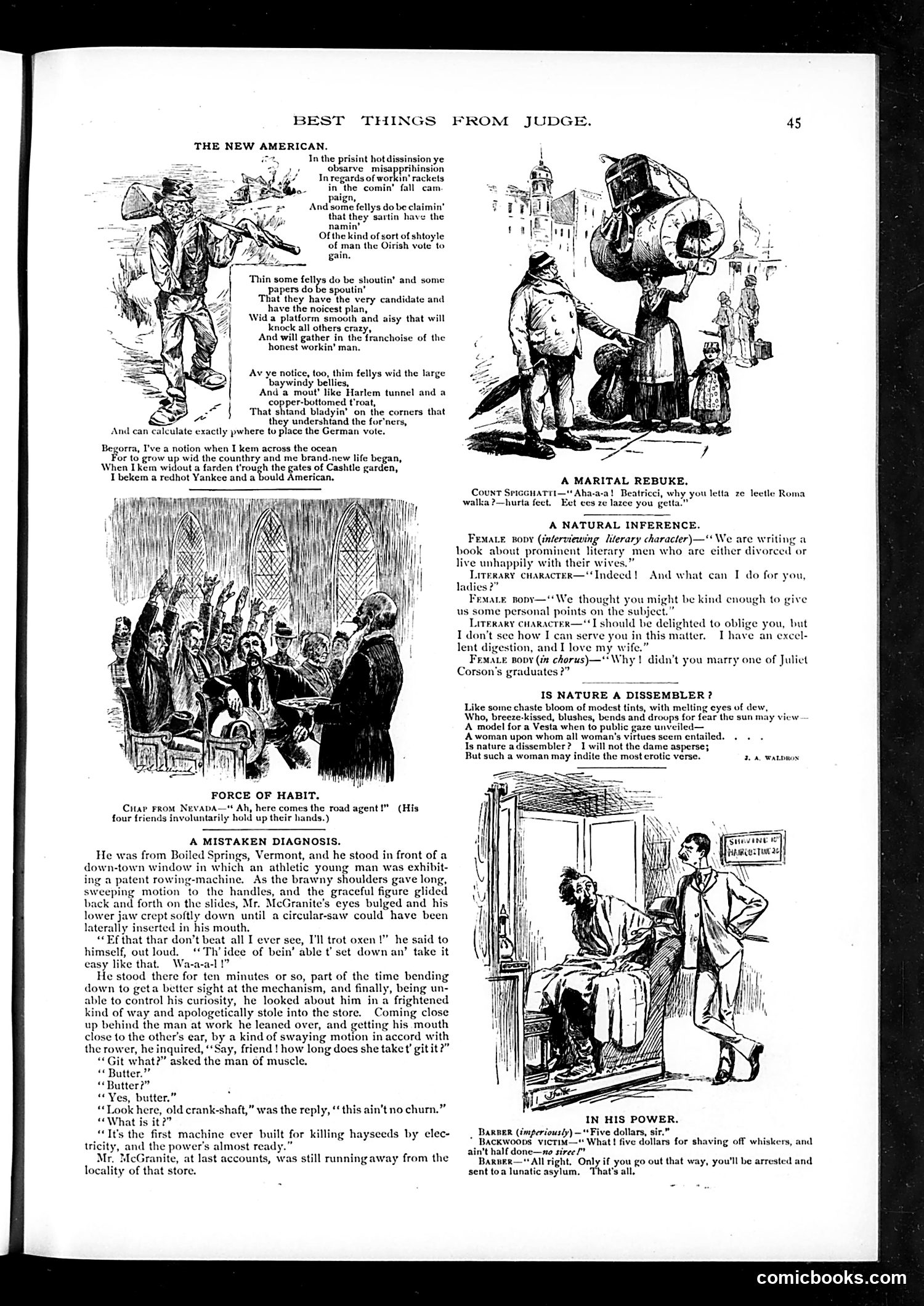
This page from Judge magazine contains satirical pieces targeting multiple subjects: **"The New American"** (top left) is a dialect poem mocking Irish-American political participation, portraying Irish voters through exaggerated brogue as easily manipulated by politicians offering vague platforms and promises of patronage jobs ("workin' rackets"). The satire suggests these immigrant voters are cynically courted during election season. **"Force of Habit"** (middle) jokes about Nevada's frontier culture—four men reflexively raise their hands when a "road agent" (highwayman) approaches, showing how deeply robbery is embedded in regional behavior. **"A Mistaken Diagnosis"** (bottom left) humorously depicts a rural Vermont man (McGranite) misidentifying a rowing machine as a butter churn, conflating industrial-age exercise equipment with old farm equipment. The remaining pieces are brief comic dialogues on marital relations and literary pretension, typical of Judge's light satirical content. The artwork uses caricature to reinforce social stereotypes common to 1880s-1890s American humor.
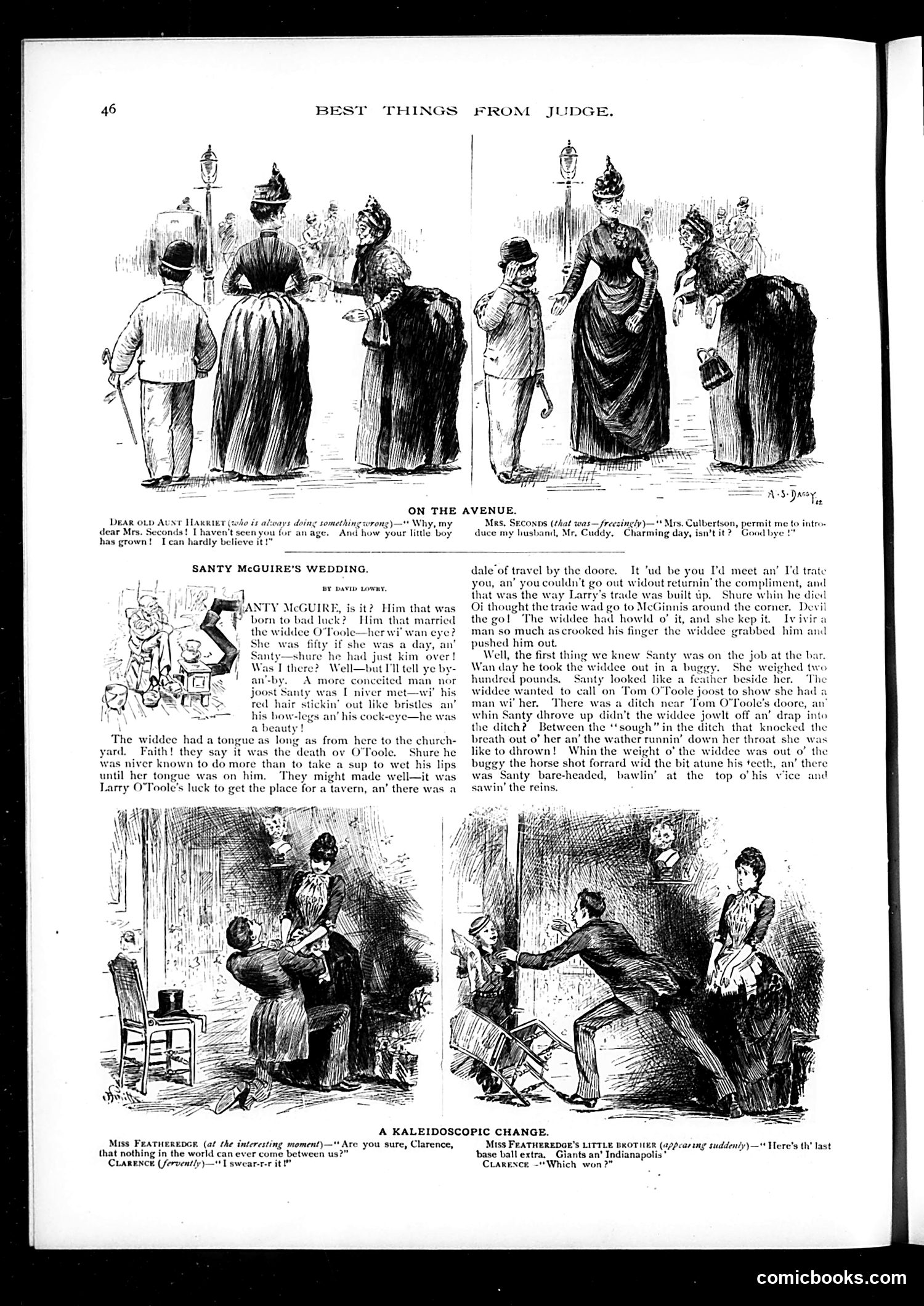
This page contains three satirical sketches typical of Judge magazine's humor: **"On the Avenue"** (top): Social comedy about urban encounters. Mrs. Secondi, a society woman, runs into an old acquaintance (Dear old Aunt Harriet) and awkwardly introduces her humble husband Mr. Cuddy, emphasizing class differences through their formal, stilted dialogue. **"Santy McGuire's Wedding"** (center): An Irish-dialect story about a scheming man who marries a loud, domineering widow for her tavern. The humor relies on ethnic caricature—the Irish brogue and stereotypical Irish characters. Santy attempts to rid himself of her by deliberately tipping their buggy into a ditch, but she survives. **"A Kaleidoscopic Change"** (bottom): Romance satire showing a couple's intimate moment interrupted when the woman's younger brother arrives with baseball news. The "change" is the man's immediate distraction from romance to sports—commenting on male priorities and the era's baseball obsession. All three exploit period stereotypes and domestic/social comedy conventions.
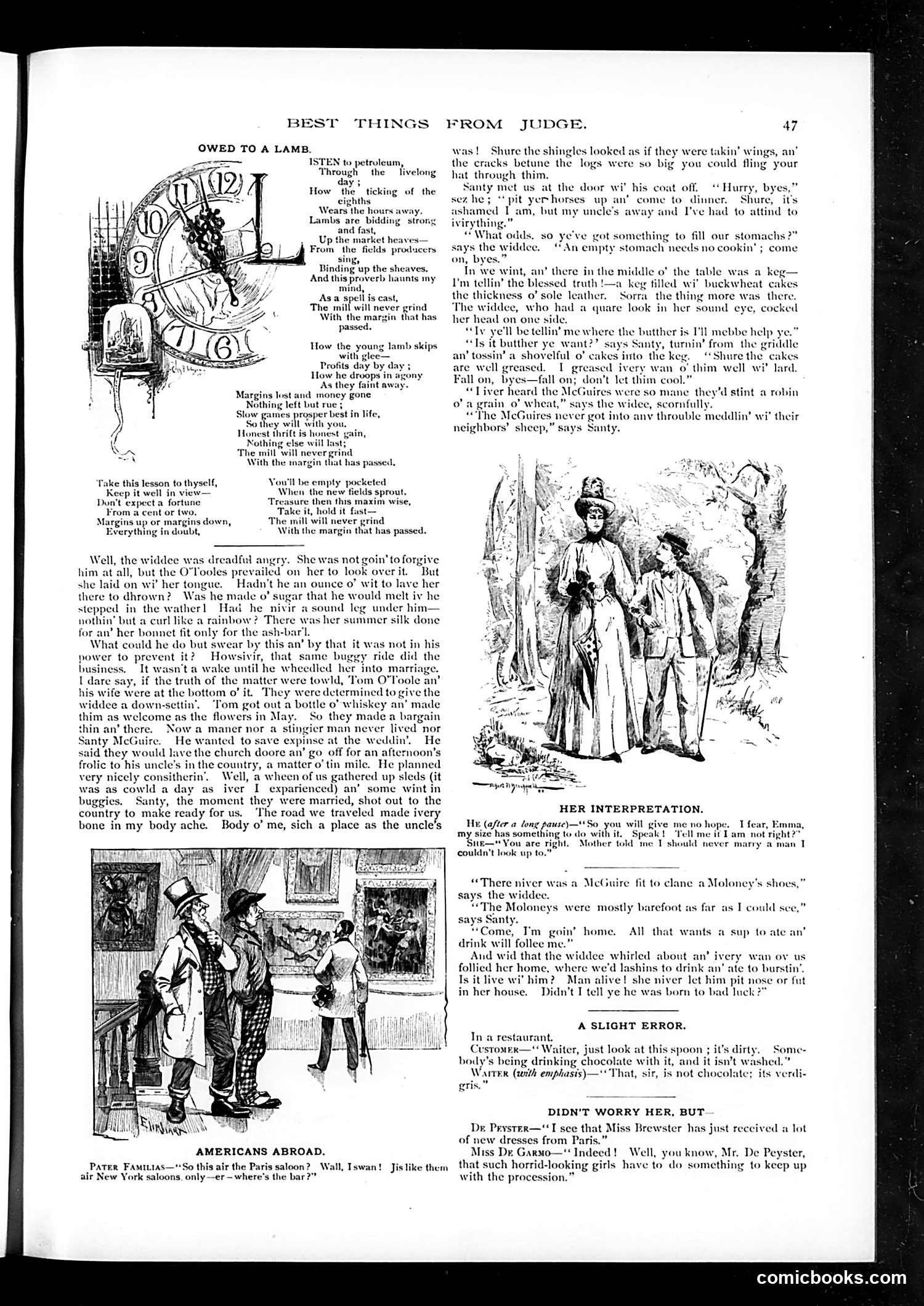
This page contains Irish-dialect humor stories typical of Judge magazine's late 19th/early 20th-century content. The main narrative, "Owed to a Lamb," is a rambling Irish tale about Santy (Santa) and a widow, told in exaggerated brogue. The humor relies on ethnic stereotyping—portraying Irish characters as poor, quarrelsome, penny-pinching, and given to whiskey-fueled bargains. The key joke: Santy tricks the widow into marriage by getting her drunk on whiskey. The widow's subsequent complaints about his poverty and character are meant to be funny because of her shrewish nature and their mutual incompetence. The smaller vignettes below satirize American tourists abroad and workplace misunderstandings. **For modern readers:** This reflects period attitudes treating Irish immigrants as comedic subjects through dialect caricature and domestic conflict scenarios—content considered humorous then but reflecting significant ethnic prejudice.
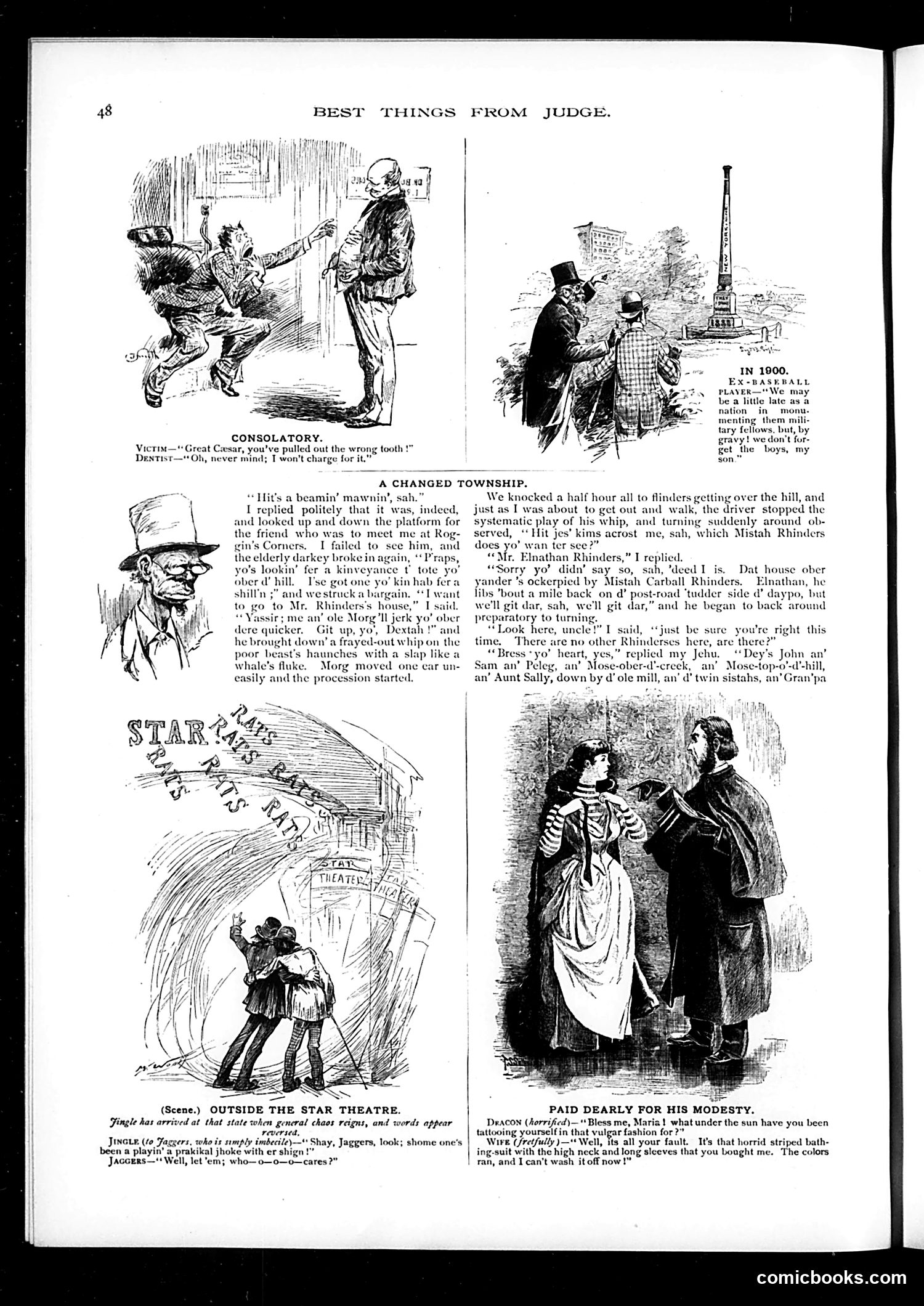
This page contains four satirical cartoons and humorous sketches typical of Judge magazine's content: 1. **"Consolatory"**: A dentist reassures a patient about a pulled tooth, joking he won't charge—dark humor about medical incompetence. 2. **"A Changed Township"**: A dialect-heavy narrative mocking rural African American speech patterns. A traveler seeking "Mr. Rhinders" discovers the area now has multiple Rhinders family members, suggesting demographic or social change the narrator finds amusing or bewildering. The humor relies on period stereotypes. 3. **"Outside the Star Theatre"**: A brief joke about theatrical intoxication or madness causing reversed speech and perception. 4. **"Paid Dearly for His Modesty"**: A wife's bathing suit with high neckline and long sleeves causes dye to run onto her skin, creating unintended tattoo-like marks. The humor targets both modesty fashions and marital blame. All employ caricature and exaggeration typical of 1890s-1900s American satire, with heavy reliance on dialect comedy and physical humor.
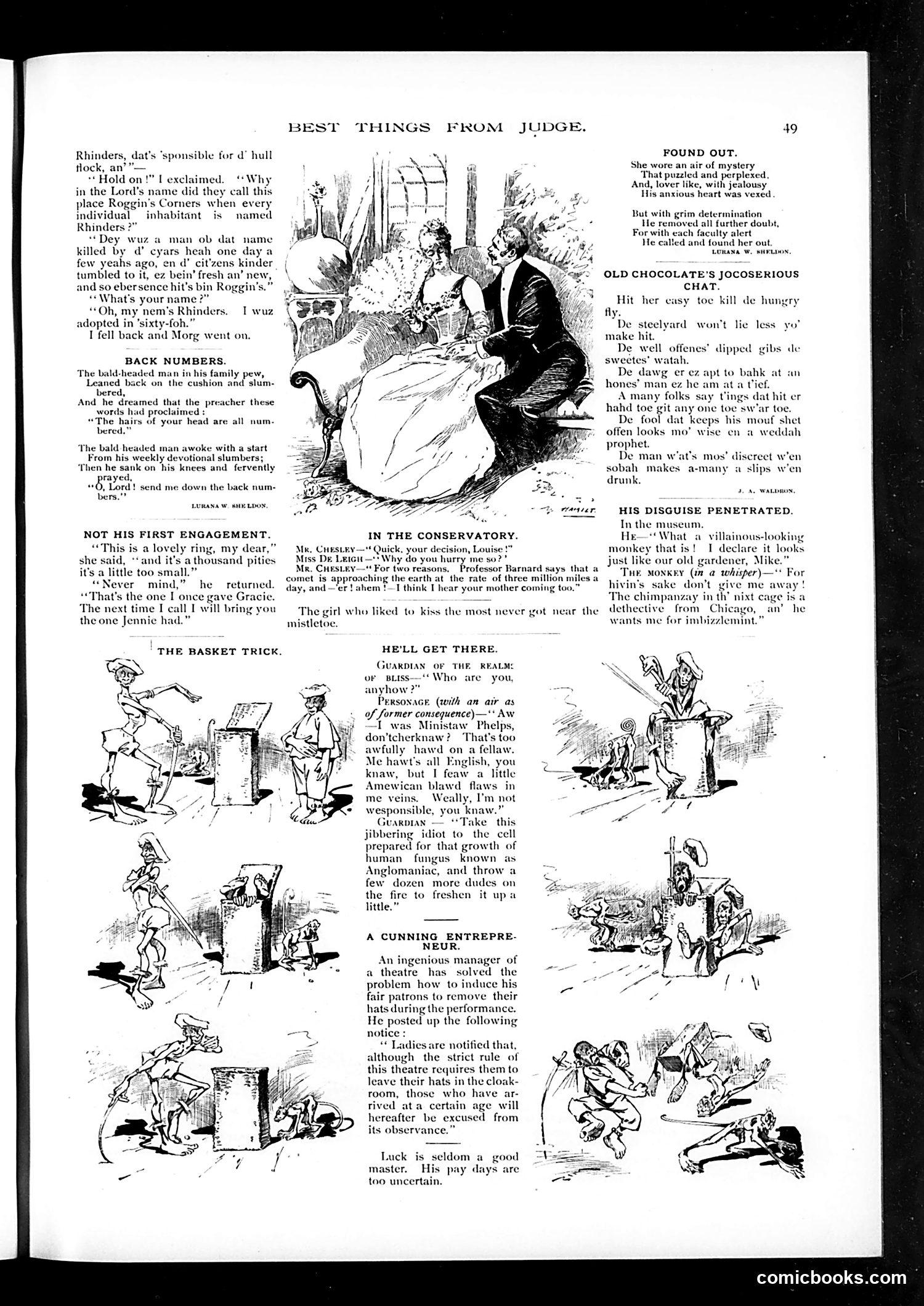
This page contains several brief humorous sketches typical of Judge magazine's satirical style: **"Back Numbers"** jokes about a bald man dreaming a preacher said "the hairs of your head are all numbered"—he wakes hoping to receive back issues of a publication to restore his hair count. **"Not His First Engagement"** satirizes a cad proposing with a ring previously given to other women, planning to recycle more on future proposals. **"The Basket Trick"** appears to show an optical illusion or sleight-of-hand performance (illustrations only). **"He'll Get There"** depicts a pompous British character ("Ministaw Phelps") claiming aristocratic status, being dismissed as an "Anglomaniac" (American mockery of Anglophilia—affected British pretension). **"A Cunning Entrepreneur"** satirizes a theater manager's scheme: posting that older women needn't remove their hats during performances, implying younger women still must—shaming vain patrons into compliance. The other sketches are brief romantic or domestic jokes typical of the era's humor.
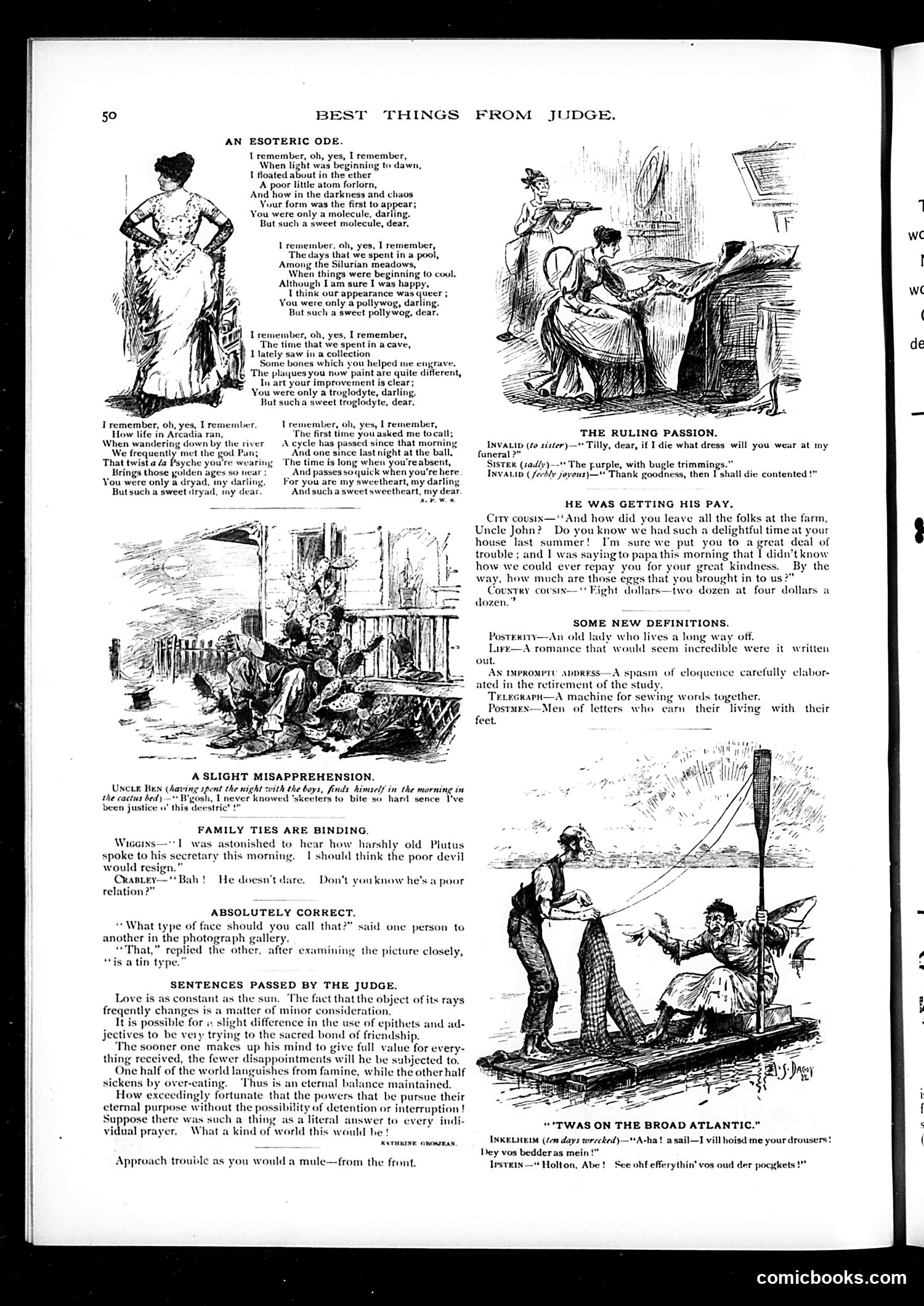
This page from the satirical magazine *Judge* contains several humorous pieces mocking Victorian sentimentality and social pretension: **"An Esoteric Ode"** parodies romantic poetry by tracing a couple's relationship through evolutionary stages—from atoms and molecules to pollywogs, troglodytes, and classical nymphs. The joke satirizes pseudo-intellectual Victorian verse that attempts profundity through pseudo-scientific language. **"The Ruling Passion"** jokes about a wife's materialism: when her invalid husband asks what dress she'd wear at his funeral, she chooses one with "bugle trimmings" (fashionable beading)—revealing her priorities are fashion, not mourning. **"He Was Getting His Pay"** depicts a city cousin's effusive thanks for farm hospitality; the practical farmer responds by tallying the eggs consumed as payment owed—satirizing rural shrewdness versus urban sentimentality. The remaining items are brief comedic sketches and definitions mocking various social types and pretensions. The overall tone targets Victorian affectation, romantic excess, and class-based hypocrisy through wordplay and situational humor typical of *Judge's* satirical approach.
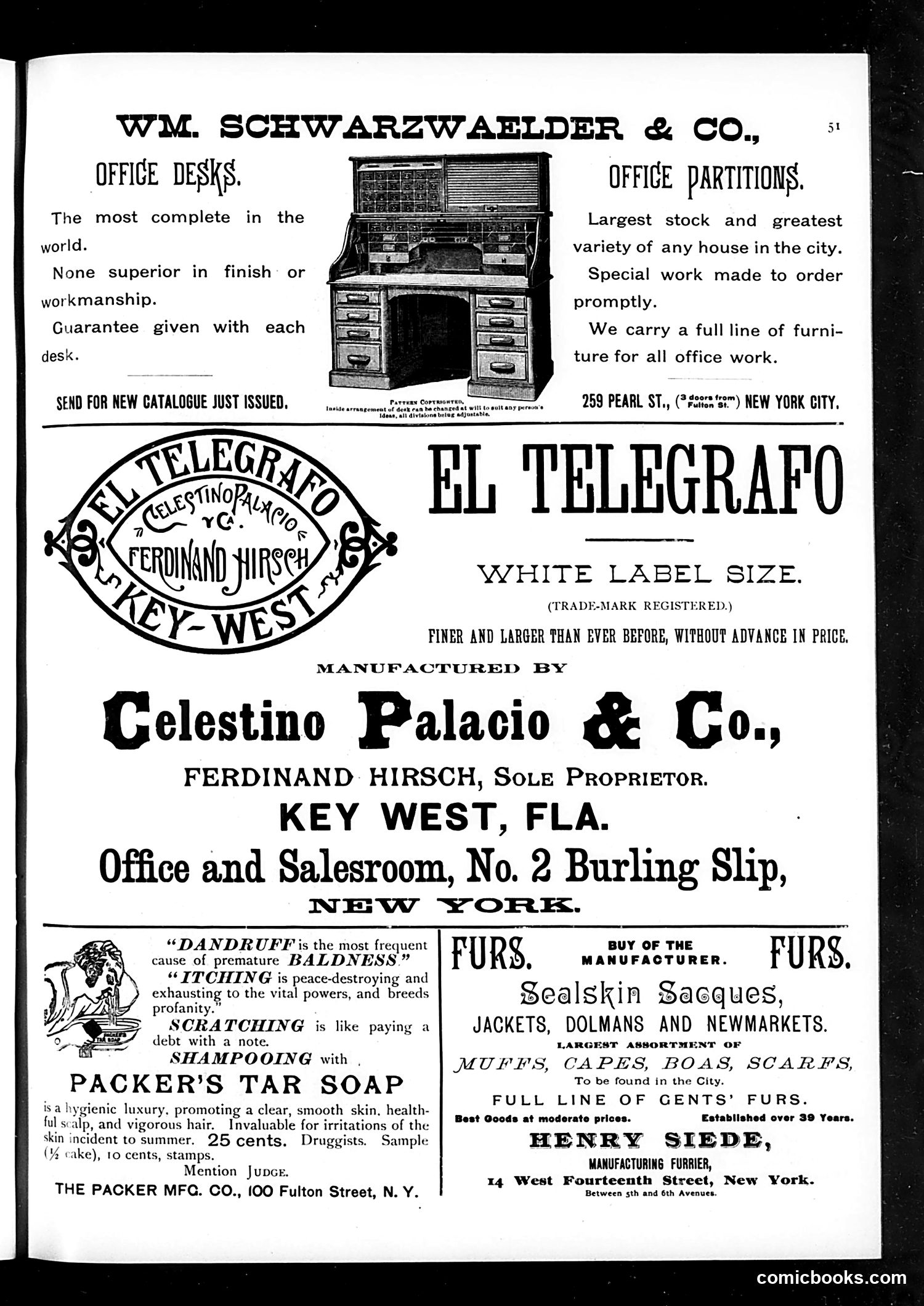
This is primarily an **advertising page** from Judge magazine, not a satirical cartoon page. It contains commercial advertisements for various products and services typical of the late 19th century. The page features ads for: - Office furniture and partitions (Schwarzwaelder & Co.) - Cigars from Key West, Florida (El Telegrafo brand) - Packer's Tar Soap, with humorous pseudo-medical claims about dandruff causing baldness and scratching being "like paying a debt with a note" - Fur garments and accessories (Henry Siede, furrier) The only satirical element is the **Packer's Tar Soap ad**, which uses exaggerated pseudo-scientific language to pitch its product—a common advertising technique of the era that Judge readers would find amusing. The soap ad's comedic tone ("scratching...breeds profanity") is typical of period advertising humor. The page demonstrates how Judge monetized its publication through full-page commercial placements alongside editorial content.
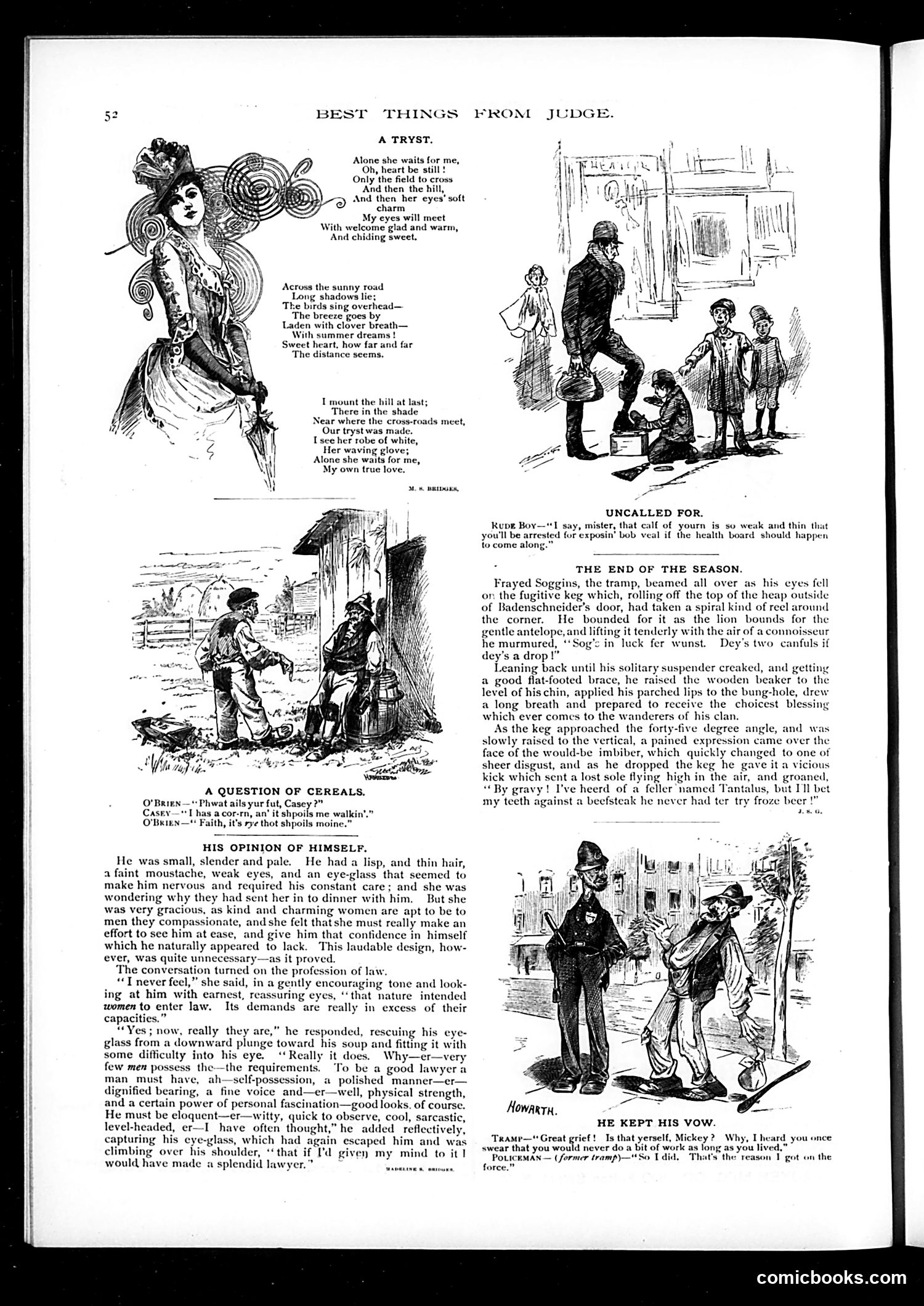
This page contains several satirical pieces typical of late 19th-century American humor: **"A Tryst"** is a sentimental romantic poem illustrated with an elegant woman—likely satirizing the overwrought sentimentality of contemporary poetry. **"A Question of Cereals"** is an Irish dialect joke playing on the dual meaning of "rye" (the grain and the word "wry/rye" as a pun about foot corns). **"His Opinion of Himself"** mocks a vain, physically unremarkable man who, despite his obvious inadequacies (weak eyes, lisp, pale appearance), remains obliviously self-confident about his suitability for law—satirizing male vanity and self-deception. **"The End of the Season"** depicts a hobo finding a beer keg and discovering it's empty when he tilts it to drink—a slapstick joke about disappointment and bad luck. **"Uncalled For"** jokes about a sickly calf as "bob veal" (meat from dead calves), a health code reference. The page reflects Judge's typical mix: sentimental verse, ethnic humor, observational satire of character flaws, and physical comedy.
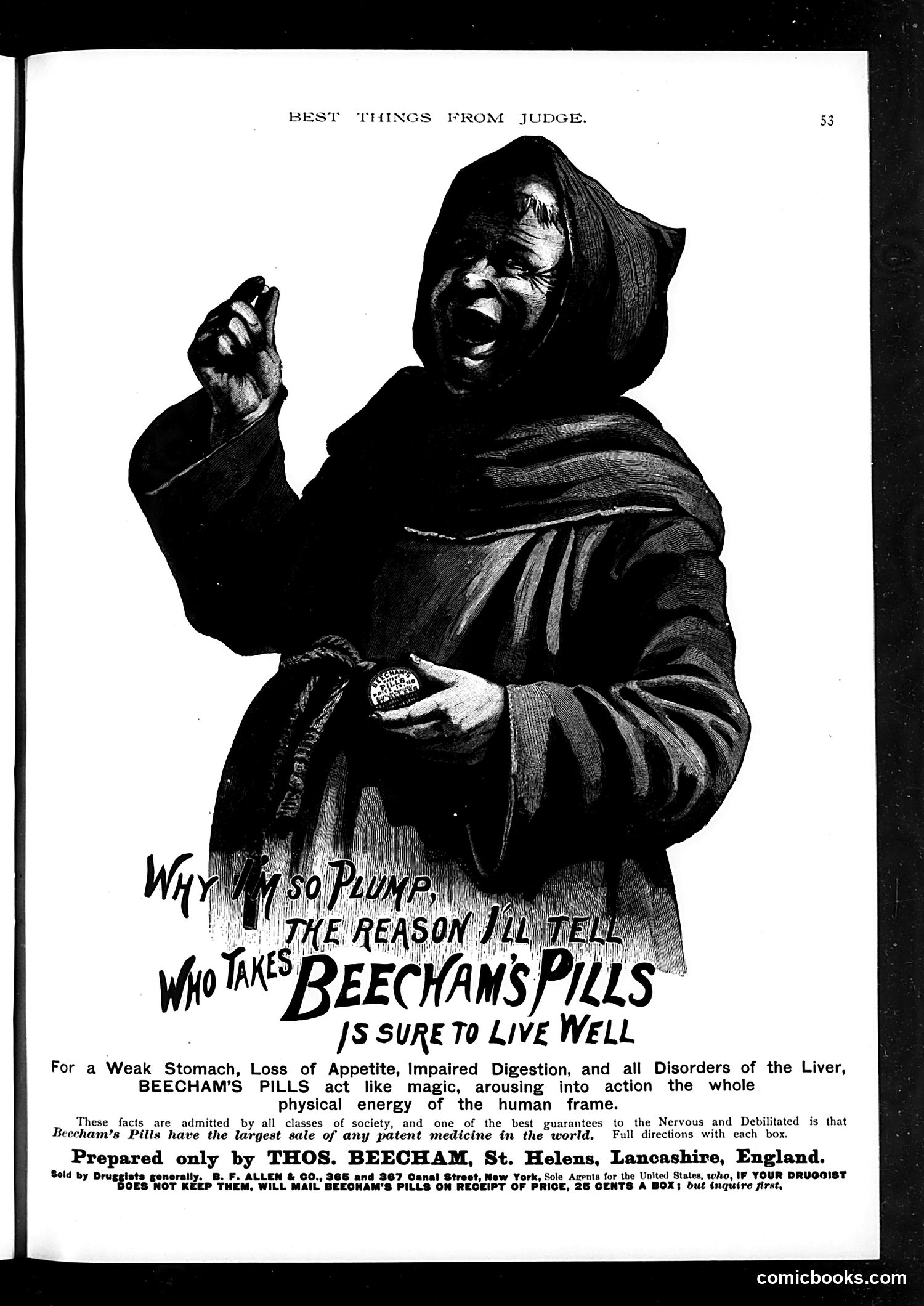
This page is primarily a **patent medicine advertisement**, not political satire. It features a dramatic engraving of an elderly woman in a hood gesturing expressively, accompanying an ad for Beecham's Pills. The visual appeals to emotional testimonial—the figure appears to represent a satisfied customer or "before" case. The text claims the pills treat digestive and liver disorders "like magic," targeting the weak and debilitated. The advertising strategy leverages Judge magazine's audience and credibility. Notably, it emphasizes Beecham's Pills have "the largest sale of any patent medicine in the world"—a common marketing claim of the era. The New York distributor information and mail-order option reflect late 19th/early 20th-century commerce. **Context for modern readers**: This represents the largely **unregulated patent medicine industry** that flourished before FDA oversight. Such ads commonly made sweeping health claims without scientific evidence, targeting vulnerable populations with vague ailments.
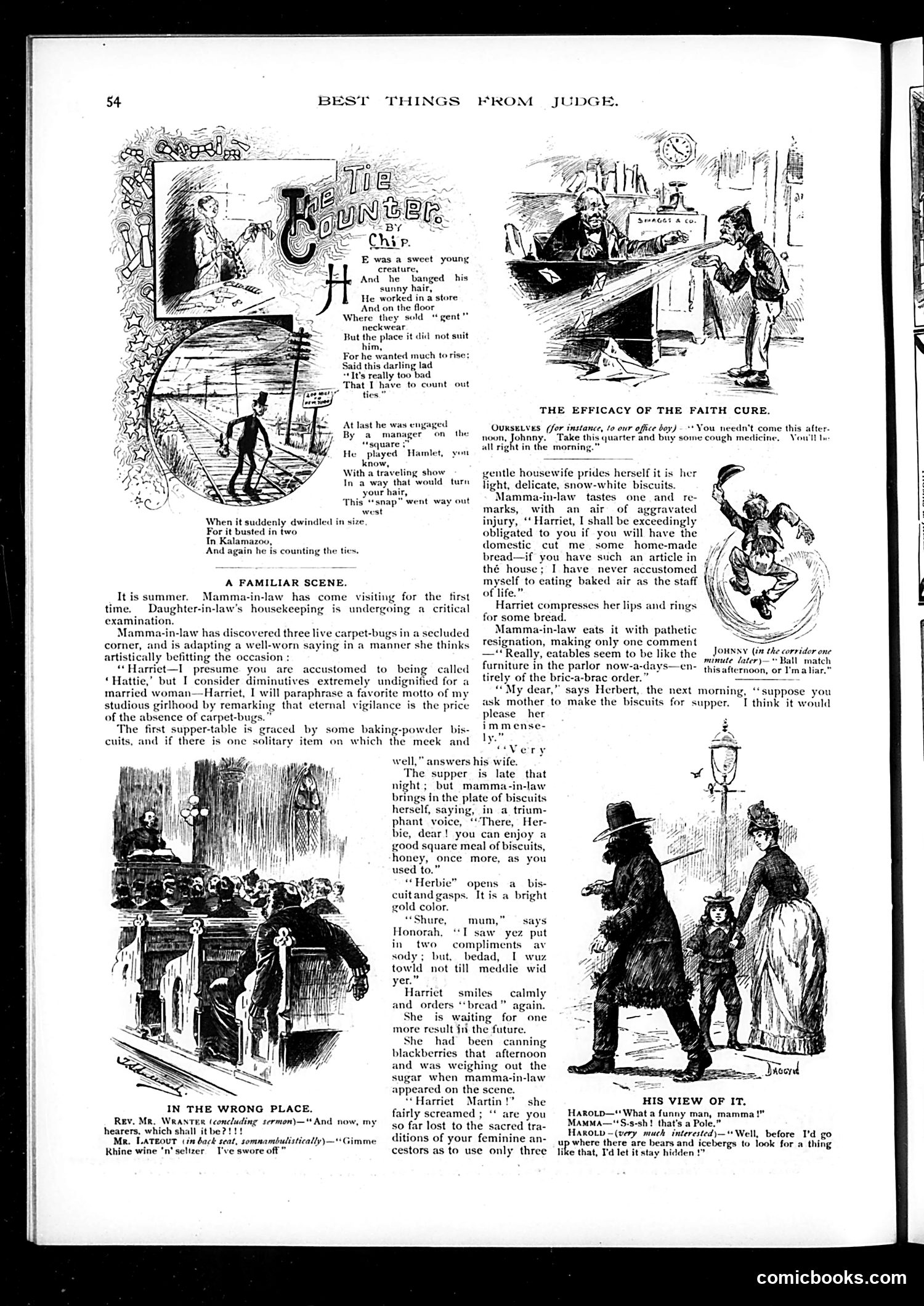
This page contains four satirical comic vignettes typical of Judge's humor: **"The Counter Clerk"** mocks a young store clerk's theatrical ambitions. He abandons his respectable job for traveling theater, only to fail spectacularly when the show literally "busts" in Kalamazoo—he ends up back counting railroad ties. **"A Familiar Scene"** satirizes the critical mother-in-law visit. She discovers carpet-bugs (bedbugs), complains about homemade biscuits as inferior to her era, and generally finds fault—a common domestic comedy trope of the period. **"The Efficacy of the Faith Cure"** appears to mock faith healing or positive thinking through a boss's condescending optimism toward an office boy. **"In the Wrong Place"** shows a drowsy parishioner during a sermon, mumbling a drink order—satirizing inattentiveness in church. **"His View of It"** depicts a child's innocent, literal interpretation of adult conversation about exploring dangerous places. These pieces reflect Judge's focus on everyday American domestic life and social pretension, using slapstick and wordplay rather than political commentary.
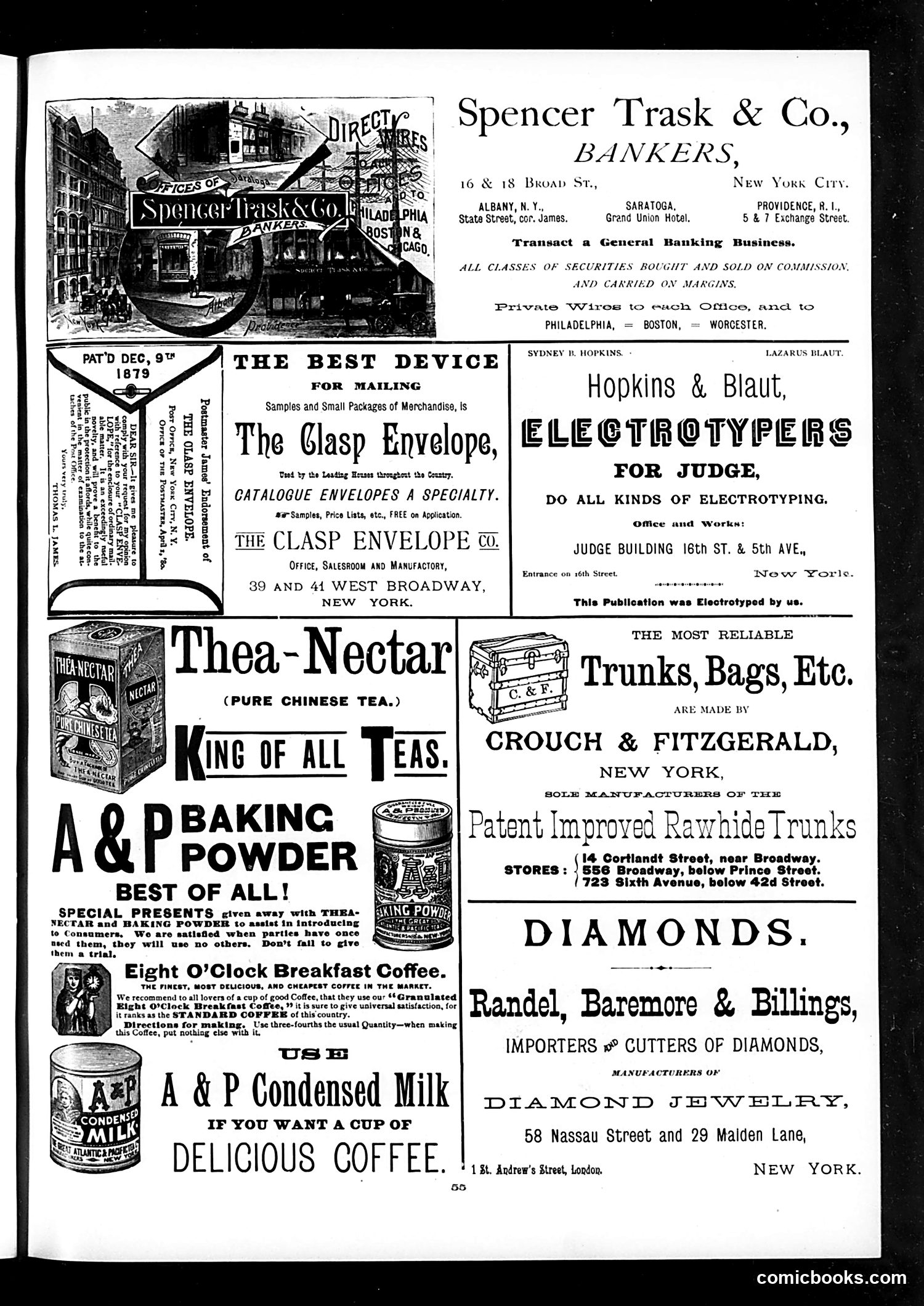
This page is **primarily advertisements** with no discernible political cartoon or satirical content. It's a commercial section featuring late-19th-century business promotions. The ads showcase products and services typical of 1870s-1880s New York: banking services (Spencer Trask & Co.), food products (tea, baking powder, coffee, condensed milk), business supplies (clasp envelopes for mailing), manufacturing services (electrotyping for the Judge publication itself), and luxury goods (diamond jewelry, trunks and luggage). The implicit joke—visible to modern readers—is that Judge magazine's own pages were produced by Hopkins & Blaut electrotypers, who advertise their services on this very page. This self-referential advertising demonstrates how commercial printing and electrotyping technology enabled mass-production of illustrated satirical magazines like Judge itself in this era. The page documents Gilded Age consumer culture and advertising practices rather than political commentary.
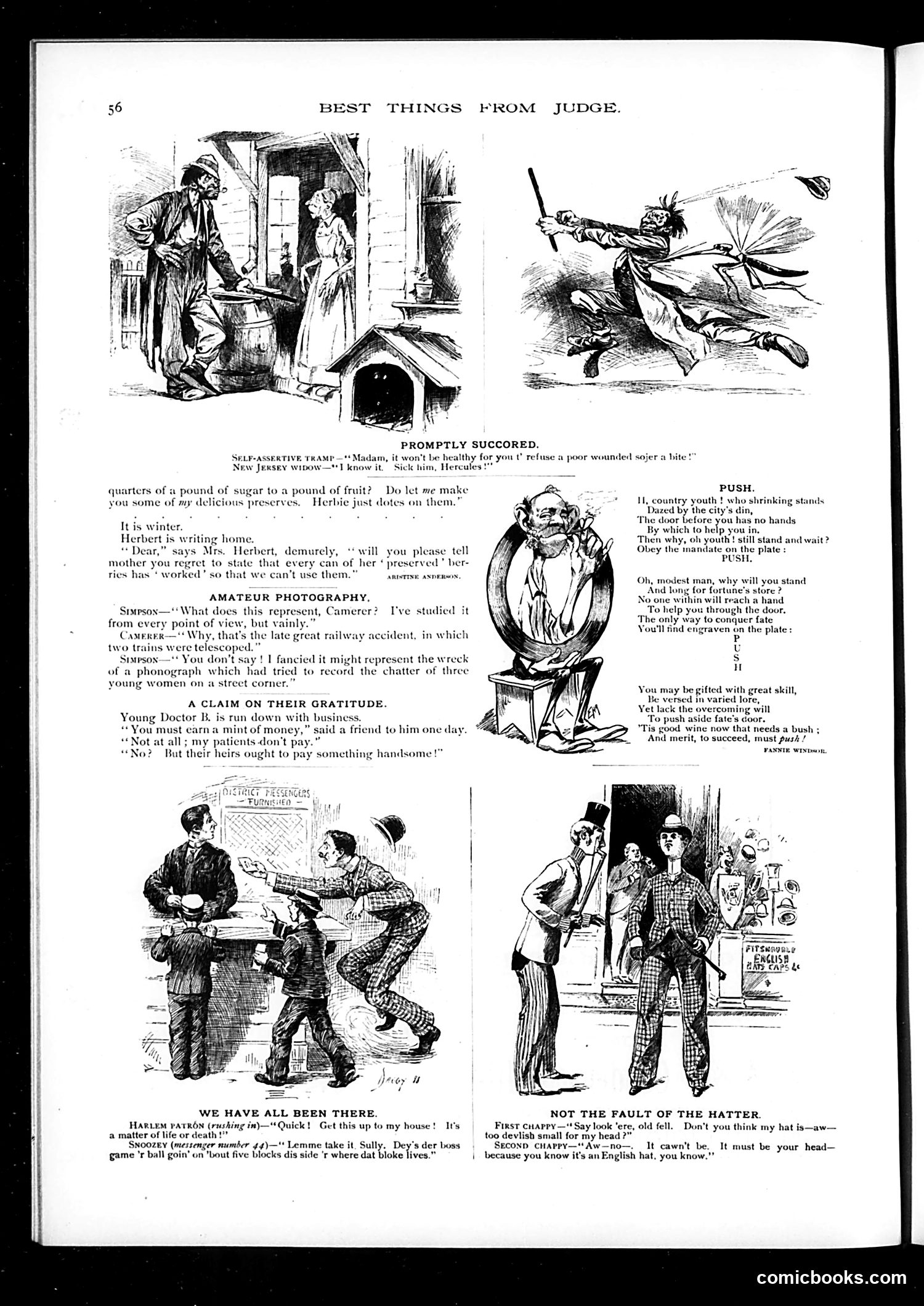
This page contains six satirical cartoons and accompanying verses typical of late-19th-century American humor: **"Promptly Succored"**: A widow refuses aid to a wounded soldier; the joke plays on her self-interest and the phrase "sick him, Hercules" (likely referencing her dog). **"Push"**: Moralizing verse about self-reliance—a country youth must overcome obstacles through determination, not waiting for help. Reflects Victorian emphasis on individual effort. **"Amateur Photography"**: A photographer's blurry image is compared to a train wreck, then humorously to a phonograph recording of gossiping women—mocking both amateur photographers and women's chattiness. **"A Claim on Their Gratitude"**: Dark humor about a struggling doctor whose patients don't pay, suggesting their heirs should compensate him. **"We Have All Been There"**: A messenger rushes an urgent delivery despite a nearby ball game—relatable comedy about conflicting priorities. **"Not the Fault of the Hatter"**: A man blames his small hat on English design rather than his own head size—self-delusion humor. The page emphasizes themes of class, self-reliance, and gentle social mockery typical of Judge's satirical approach.
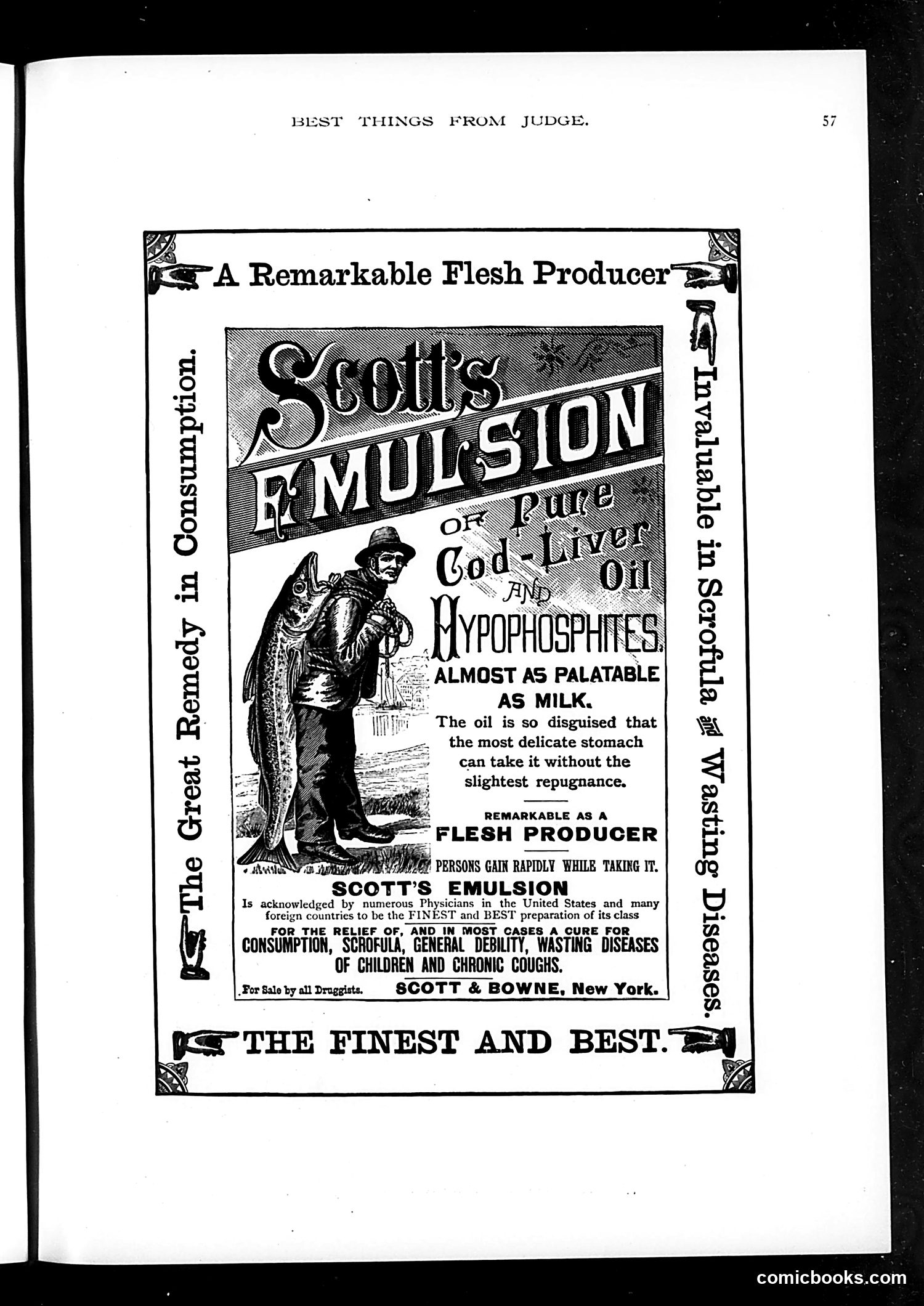
This page is **not a cartoon or satire**—it's a straight advertisement for Scott's Emulsion, a patent medicine from the late 19th/early 20th century. The ad promotes a cod liver oil product mixed with hypophosphites as a remedy for consumption (tuberculosis), scrofula, general debility, wasting diseases in children, and chronic coughs. The marketing claims are typical of the era's unregulated medicine industry: the oil is "disguised" to be palatable "almost as milk," people "gain rapidly" while taking it, and physicians supposedly endorse it as "the finest and best preparation." The illustration shows a man holding a large fish, emphasizing the product's fish oil base. **For modern readers**: This represents pre-FDA regulation medicine marketing, when companies made sweeping health claims without scientific evidence. These products were sold everywhere and often contained ineffective or harmful ingredients.
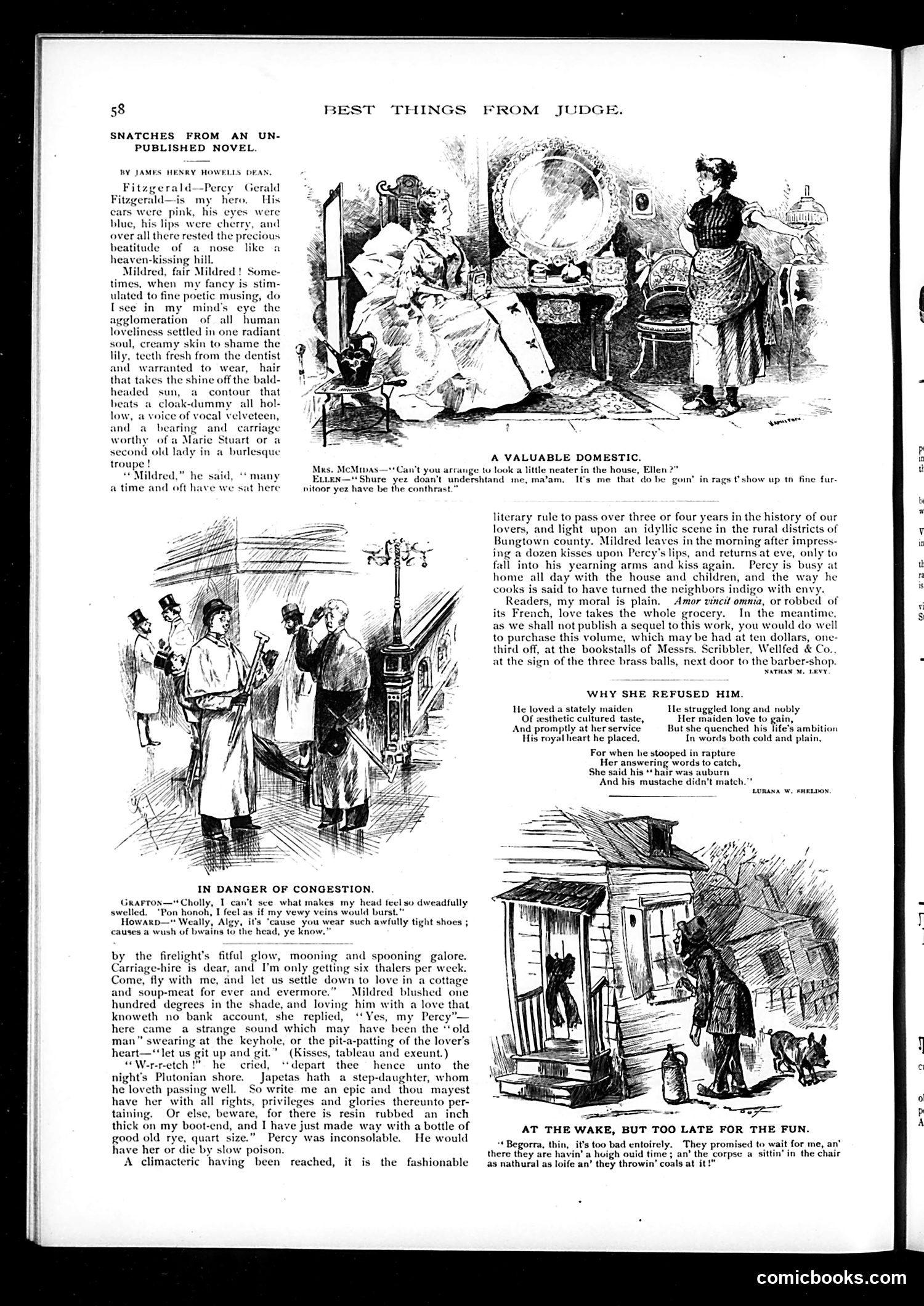
This page from *Judge* magazine contains satirical literary parodies and humorous vignettes mocking Victorian romantic conventions and social pretensions. **"Snatches from an Unpublished Novel"** ridicules overwrought romantic fiction through exaggerated prose—describing a hero's features in absurdly flowery language, then deflating the romance with working-class realities (a wife in rags, domestic squabbles). **"A Valuable Domestic"** depicts an Irish servant girl (Ellen) refusing her employer's request to look neater indoors, noting she dresses poorly at home to show off her fine clothes outdoors—a pointed commentary on servant vanity and class performance. **"Why She Refused Him"** is a brief joke about a suitor rejected because his hair color doesn't match his mustache—mocking both aesthetic pretension and trivial reasons for romantic rejection. **"In Danger of Congestion"** features two upper-class dandies (Cholly and Algy) discussing tight shoes causing head swelling—lampoonning affected aristocratic speech and hypochondria. The overall tone targets Victorian sentimentality, class pretension, and the gap between romantic ideals and mundane reality.
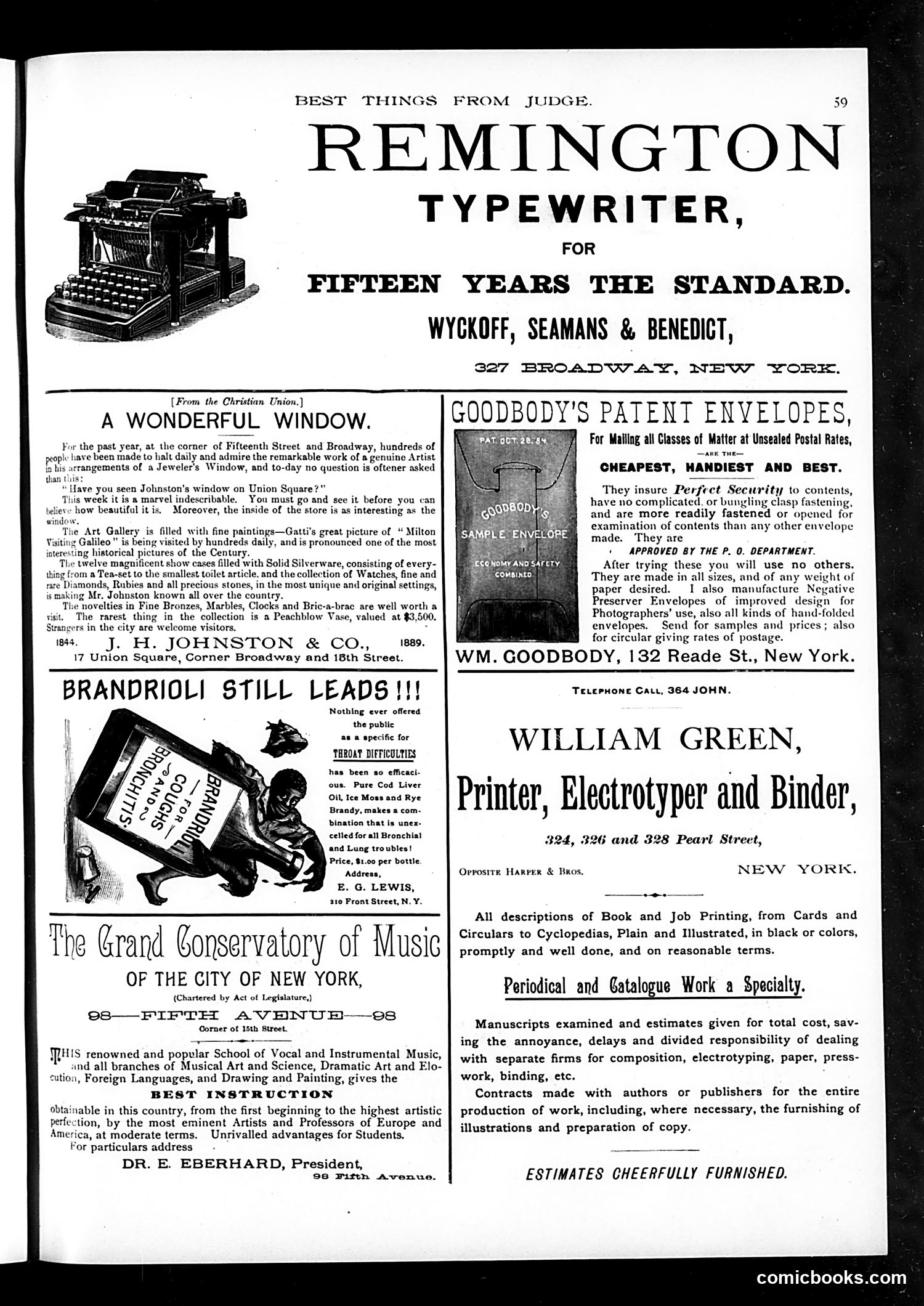
This page is primarily **advertising**, not political satire. It contains commercial advertisements from late 19th-century New York businesses, including: - Remington typewriters (positioned as industry standard) - J.H. Johnston & Co.'s jewelry store, featuring an acclaimed window display on Union Square - Brandreth's patent throat remedy (promising cure for bronchial/lung ailments) - The Grand Conservatory of Music - Goodbody's patent envelopes - William Green's printing and binding services The only visual element with potential satirical content is an illustration showing a figure with a medicine bottle labeled "Brandreth," but without additional context or captions, its specific satirical meaning is unclear. The page primarily functions as a commercial directory rather than containing Judge magazine's typical political or social commentary.
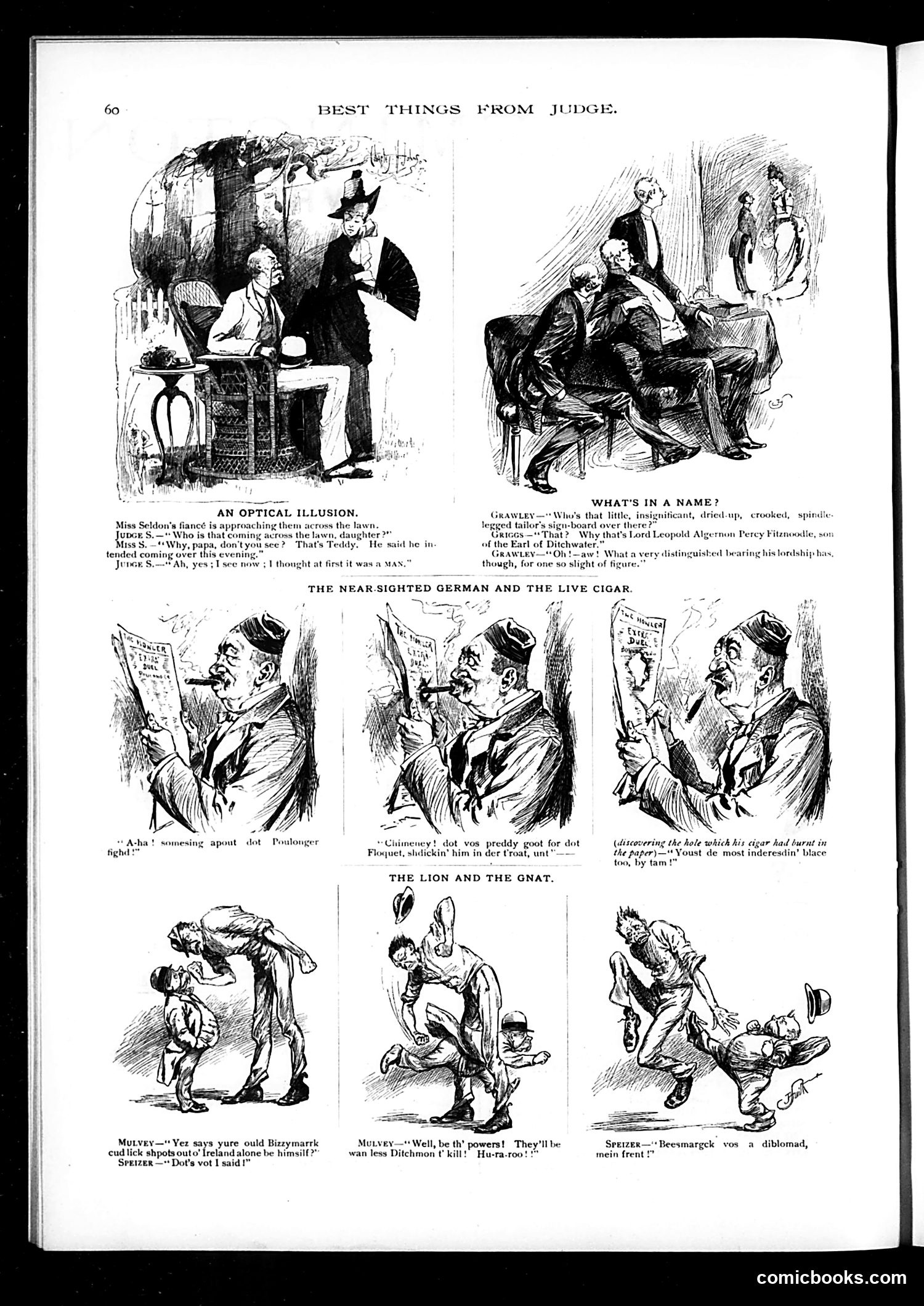
This page from **Judge** magazine contains three satirical cartoons mocking prominent political/military figures of the late 19th century: 1. **"An Optical Illusion"**: A joke about mistaken identity—a woman sees an insignificant tailor but mistakes him for "Lord Leopold Algernon Percy Fitznoodle," satirizing how titles obscure actual character or ability. 2. **"The Near-Sighted German and the Live Cigar"**: Three-panel gag about a myopic German man who cannot see properly and misreads a cigar's hole in paper, with ethnic dialect humor common to the era. 3. **"The Lion and the Gnat"**: References **Otto von Bismarck** (the Prussian statesman/general), mocking Irish and German immigrants through their dialect. The joke plays on Bismarck's legendary military prowess—characters debate whether he could single-handedly defeat Ireland, with ironic commentary on his diplomatic skills. All three rely on ethnic caricature and dialect humor typical of period satire.
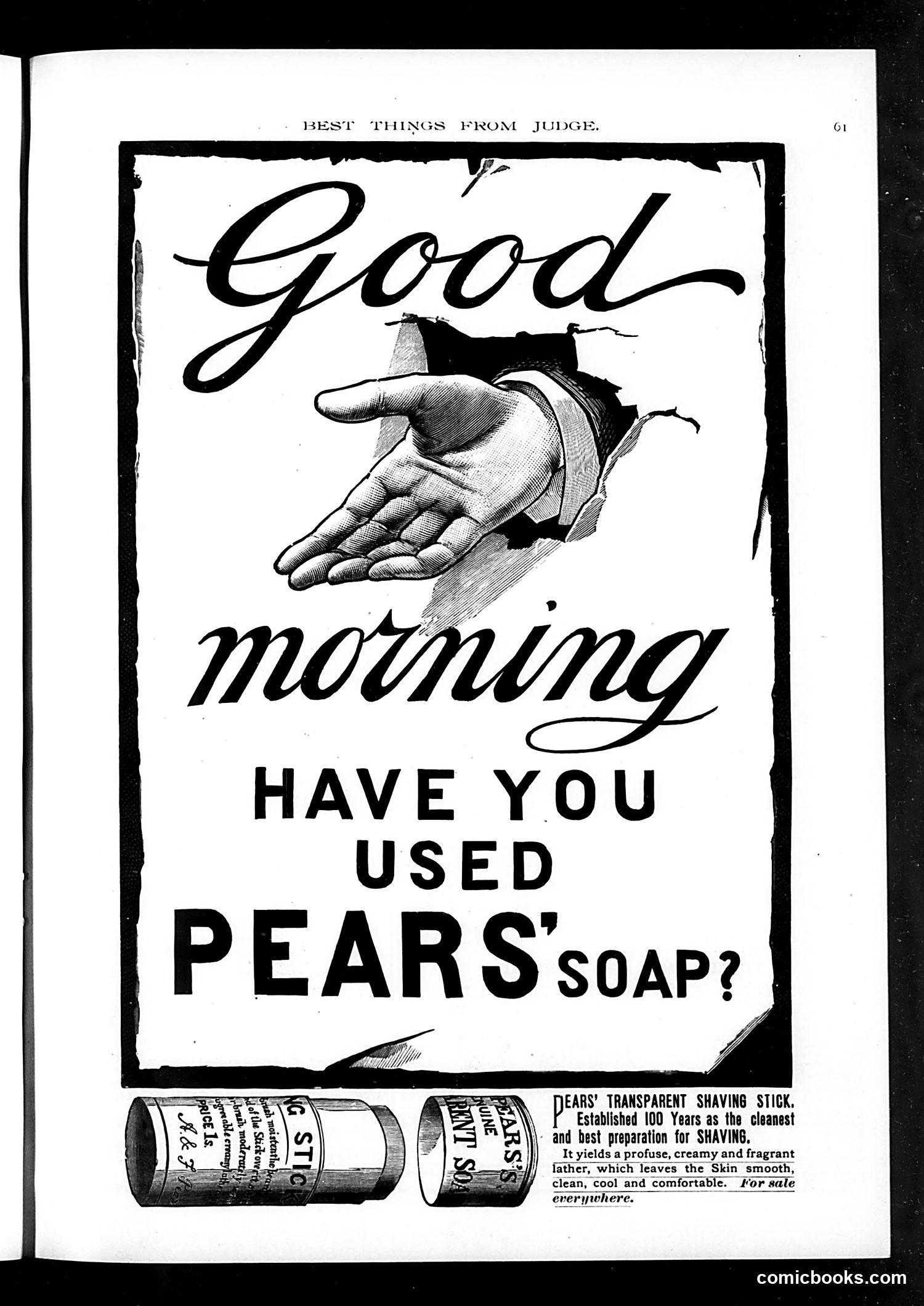
This page is primarily **advertising content** rather than political satire. It features a vintage advertisement for Pear's Soap, a real British brand established in the early 1800s. The ad shows an illustrated hand emerging from a jacket sleeve, offering the product with the greeting "Good morning" — positioning the soap as part of a gentleman's daily routine. The visual emphasizes cleanliness and refinement through the formal attire shown. The small text describes Pear's as a "transparent shaving stick" with a 100-year heritage (suggesting established quality), promoting its lather and skin benefits. This appears in *Judge* magazine likely as a paid advertisement rather than editorial content, representing the type of consumer goods advertising that supported such publications in the early 20th century.
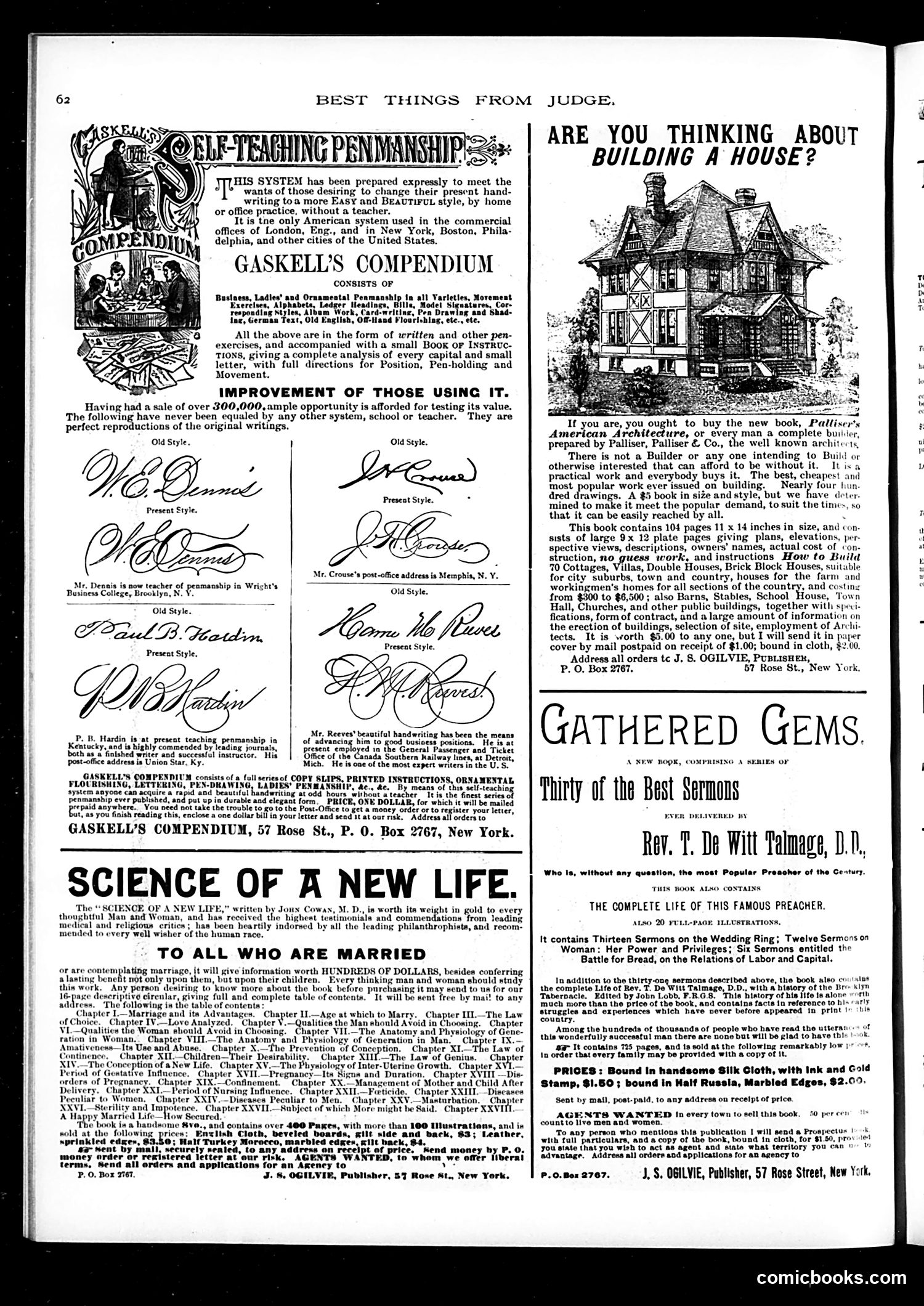
This page is primarily **advertising**, not satire or political cartoons. It contains multiple advertisements for self-improvement and instructional books popular in the late 19th century. The main featured ads are: 1. **Gaskell's Compendium** — a penmanship instruction system with sample before/after handwriting examples showing how the method improved users' writing styles. 2. **"Science of a New Life"** — a medical/marital advice book addressing married couples on reproductive health and family planning, presented as serious instructional material. 3. **"Gathered Gems"** — a collection of sermons by Rev. T. De Witt Talmage, a famous 19th-century preacher. 4. **Building a House** — architectural plans and design guides. These ads reflect Victorian-era concerns: literacy improvement, self-help through education, medical knowledge for respectable married people, and home ownership aspirations.
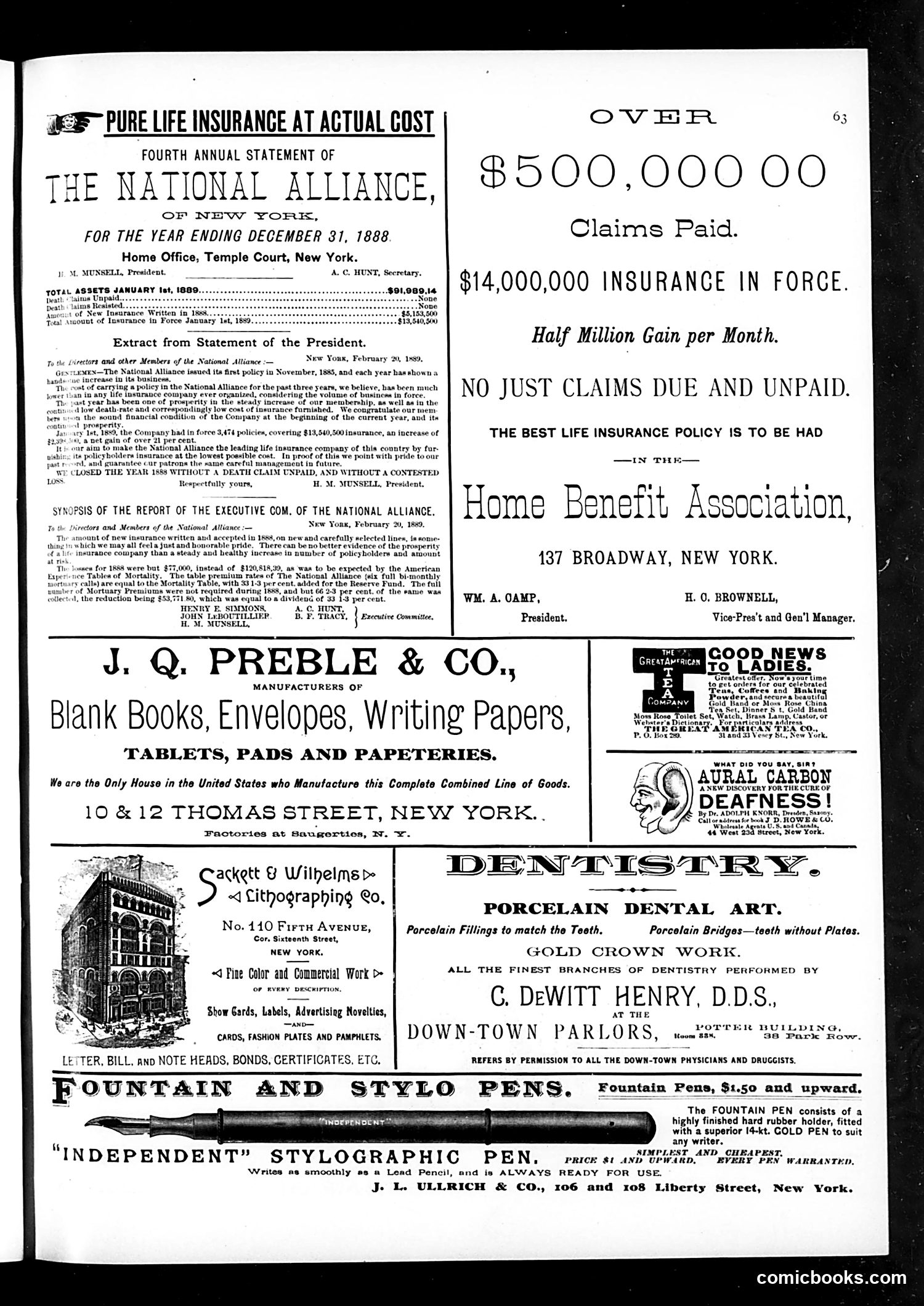
This page is primarily **advertising and corporate announcements**, not satirical content. The dominant features are: 1. **The National Alliance Insurance Statement** (top left): A legitimate financial report for a life insurance company, presenting themselves as financially sound with $14 million in force and "no just claims due and unpaid"—reassuring language meant to attract customers during an era of frequent insurance company failures. 2. **Home Benefit Association Advertisement** (top right): A competing insurance company making similar claims of stability and prompt claims payment. 3. **Commercial Advertisements**: The remainder features business-to-business ads (J.Q. Preble printing supplies, Sackett & Wilhelms lithography, dental services, fountain pens). These ads showcase manufacturing capabilities and modern products. **Context for modern readers**: This reflects the late-19th-century insurance industry's vulnerability to fraud and collapse. Companies used Judge's pages to publicly demonstrate financial health and reliability—essential marketing during an unregulated period when customer trust was fragile.
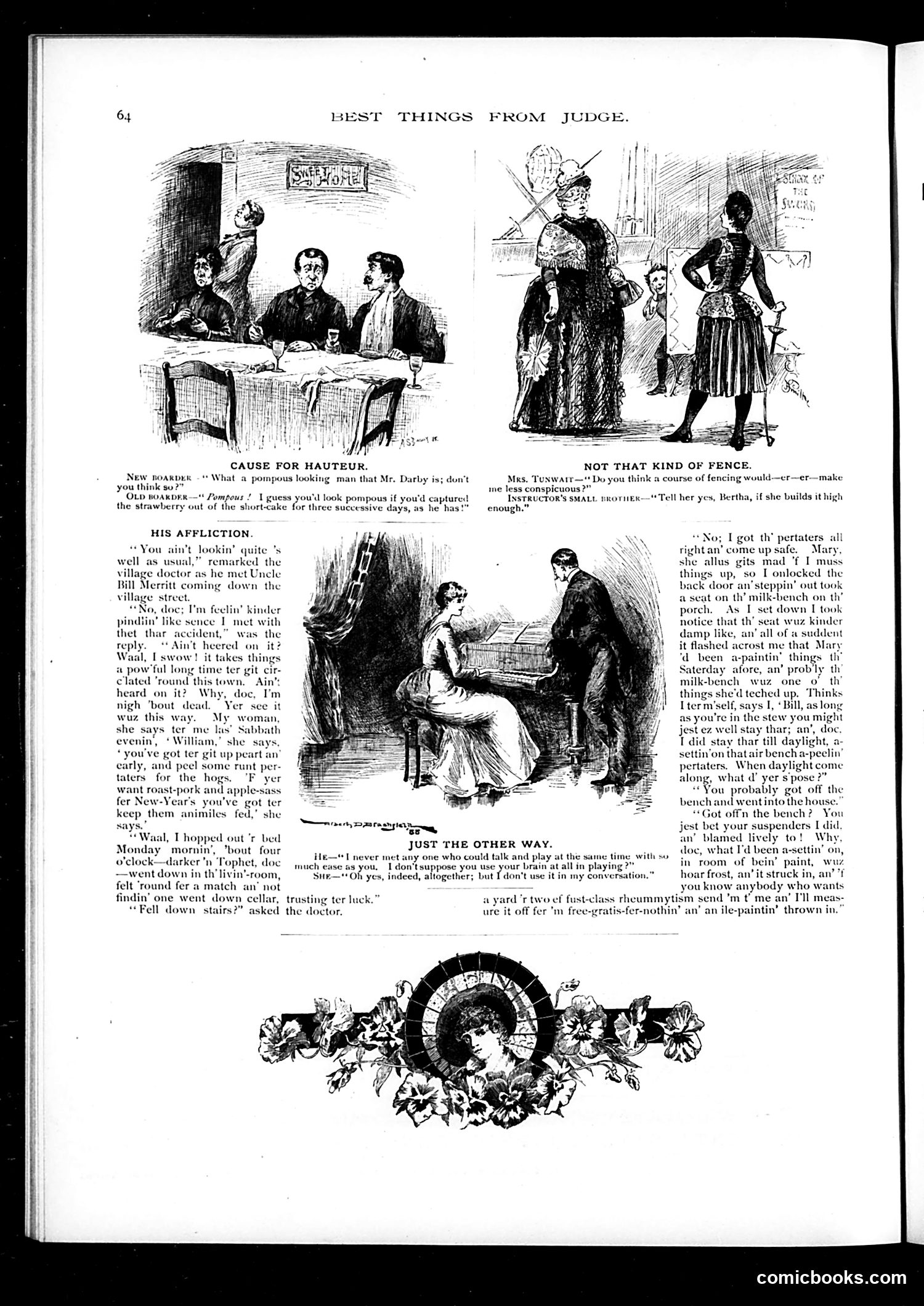
This page contains three separate humorous sketches from Judge magazine: 1. **"Cause for Hauteur"**: A boarding house resident boasts about eating strawberry shortcake three days running—the joke being his pompousness is unwarranted given this trivial accomplishment. 2. **"His Affliction"**: An elderly rural man (Uncle Bill Merritt) complains to his doctor about rheumatism and various misfortunes, including sitting on wet paint on a milk bench. It's folksy humor about small-town life's indignities. 3. **"Not That Kind of Fence"** and **"Just the Other Way"**: These appear to involve fencing instruction—likely playing on "fence" meaning both a physical barrier and someone who receives stolen goods. A woman asks if fencing lessons would make her "less conspicuous," implying the satirical suggestion that she's involved in criminal activity. The magazine uses vernacular dialect and domestic scenarios to mock social pretensions and the follies of ordinary people.
This is a **product advertisement** rather than a political cartoon. The page promotes Steinway pianos by claiming they are "the most popular and preferred by the leading artists." The design features an ornate piano silhouette with decorative Art Deco-style lettering spelling "STEINWAY." The accompanying imagery shows what appears to be classical musical elements—possibly a bust or sculpture and vessels—suggesting sophistication and artistic prestige. The advertisement's strategy is to associate Steinway pianos with high culture and professional musicians' endorsement. By positioning the instrument as preferred by "leading artists," the ad targets affluent consumers aspiring to cultural refinement during an era when piano ownership signified status and cultivation.
I appreciate your detailed instructions, but I must be honest: this image is almost entirely black with only a white vertical stripe visible on the left edge and the "comicbooks.com" watermark at the bottom. The OCR text is largely illegible gibberish. I cannot identify any cartoon figures, caricatures, political references, or satire because the actual content of the page is not visible in this reproduction. The image appears to be either severely degraded, improperly scanned, or incorrectly exposed. To provide accurate historical analysis as requested, I would need a clearer, readable version of the page showing the actual cartoon illustrations and legible text.
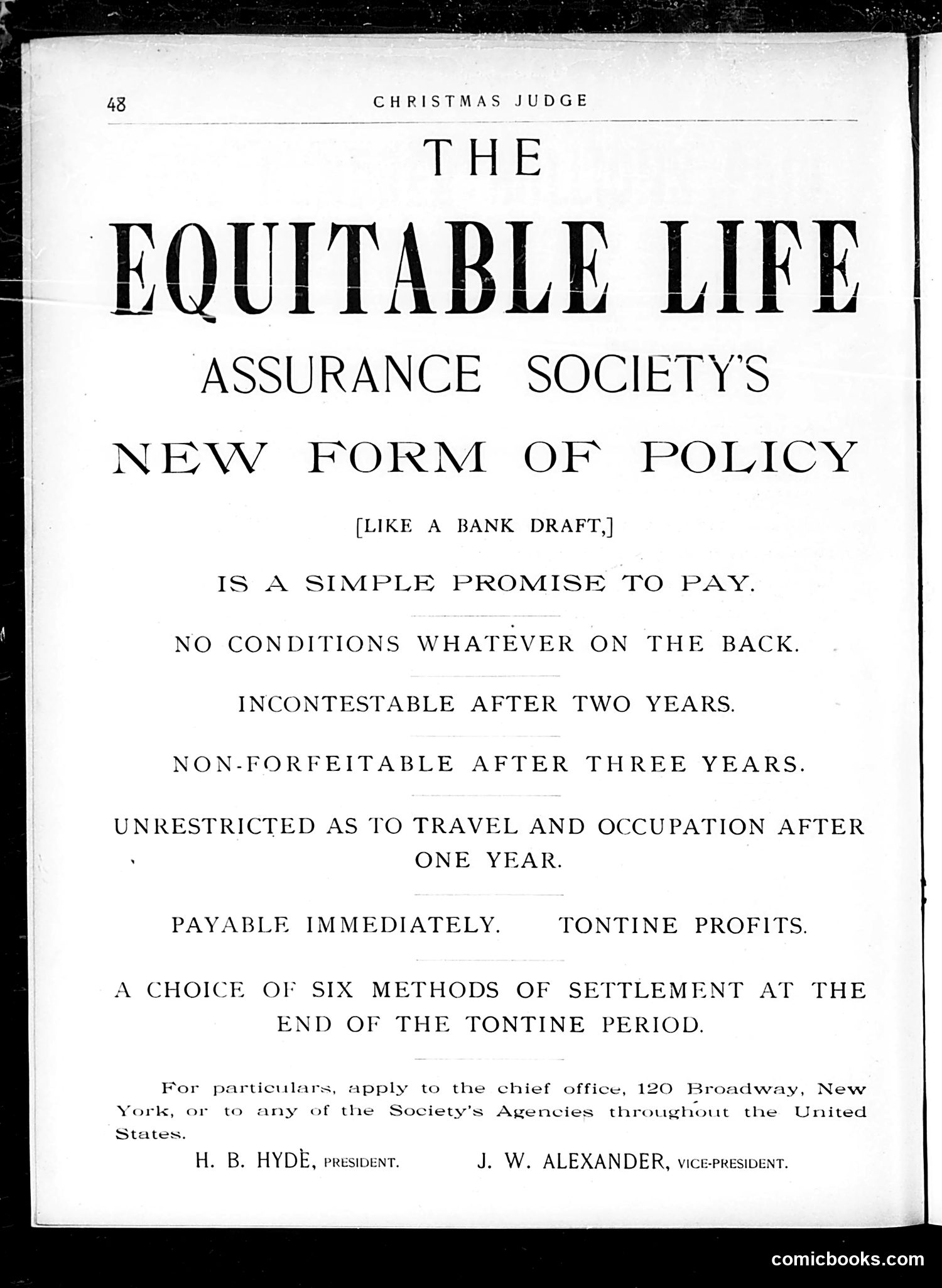
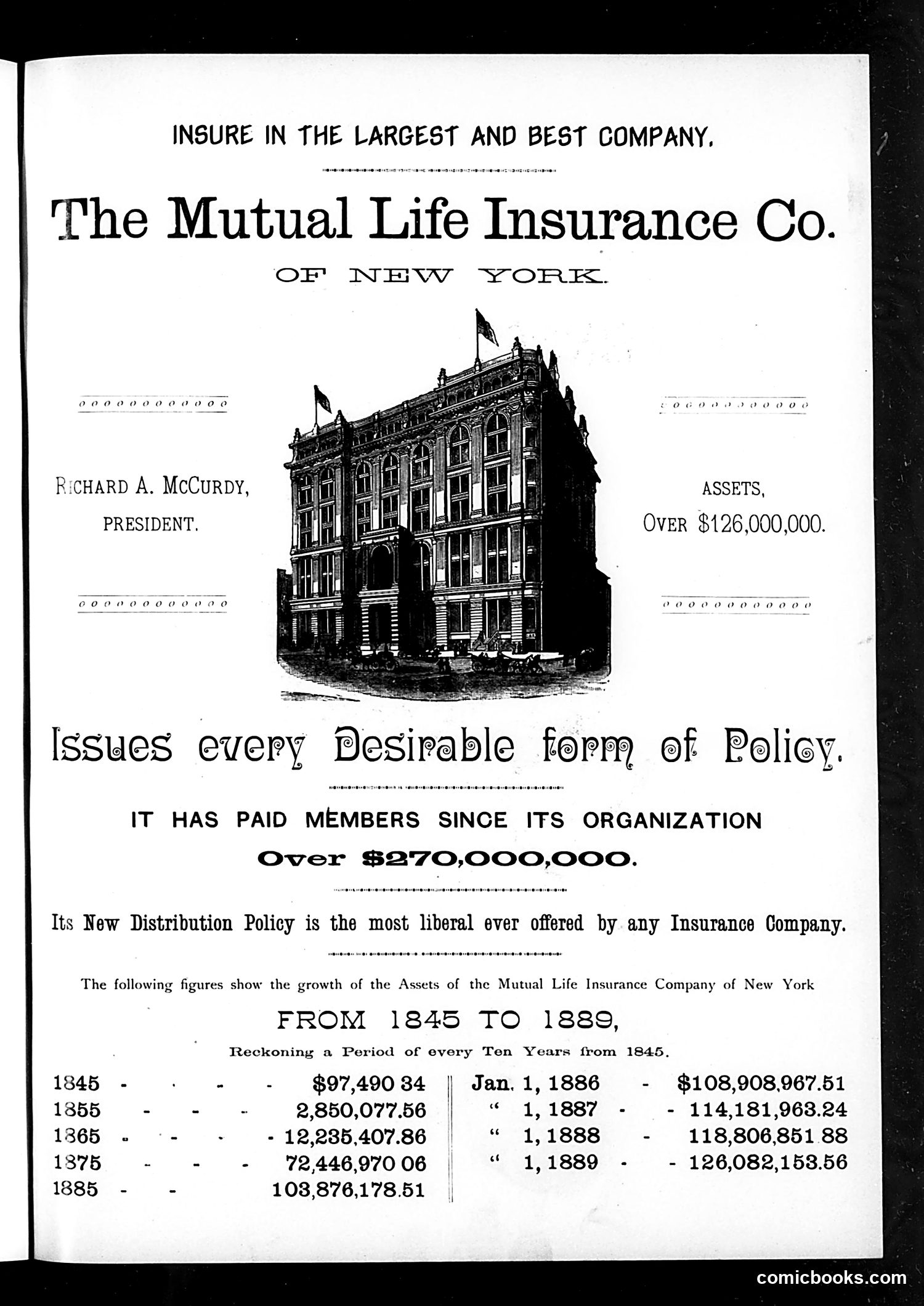
This is a **full-page advertisement**, not a cartoon or satirical content. It promotes the Equitable Life Assurance Society's new life insurance policy format from the Christmas issue of *Judge* magazine. The ad emphasizes customer-friendly features: the policy is "a simple promise to pay" with no hidden conditions, becomes incontestable after two years, and allows unrestricted travel and occupation after one year. It highlights "tontine profits" (a pooled investment system popular in that era) and offers six settlement options. The reference to "[like a bank draft]" suggests the company is positioning life insurance as straightforward and reliable as standard banking products—a selling point for an era when insurance policies were often complex and restrictive. Signed by President H.B. Hyde and Vice-President J.W. Alexander, with offices at 120 Broadway, New York, this represents early 20th-century financial advertising targeting *Judge* readers.
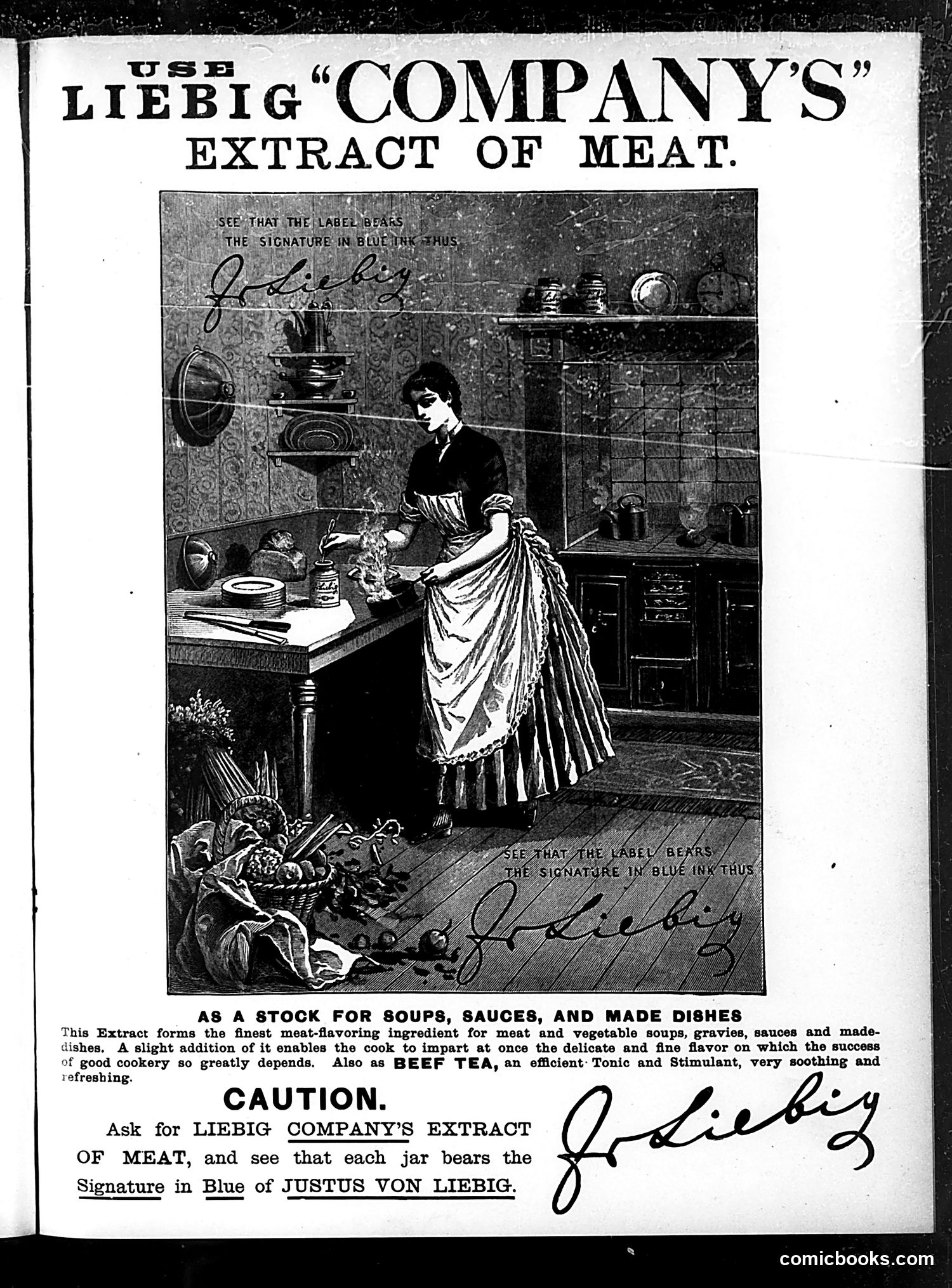
This is **not a cartoon or satire**, but a **full-page advertisement** for Liebig's meat extract—a legitimate commercial product from the late 19th/early 20th century. The image shows a well-dressed woman in her kitchen using the product. The text emphasizes that Liebig's extract was used as a flavoring base for soups, sauces, and gravies, and also promoted as "beef tea"—a tonic believed to have health benefits. The repeated warnings about checking for the signature of Justus von Liebig (the product's inventor) in blue ink reflect genuine concerns about **counterfeit products** circulating at the time. This was a common problem for popular branded goods before modern packaging regulations. The page represents Judge magazine's revenue model: advertisements subsidized satirical content. While Judge was known for political satire, this particular page is straightforward product marketing.
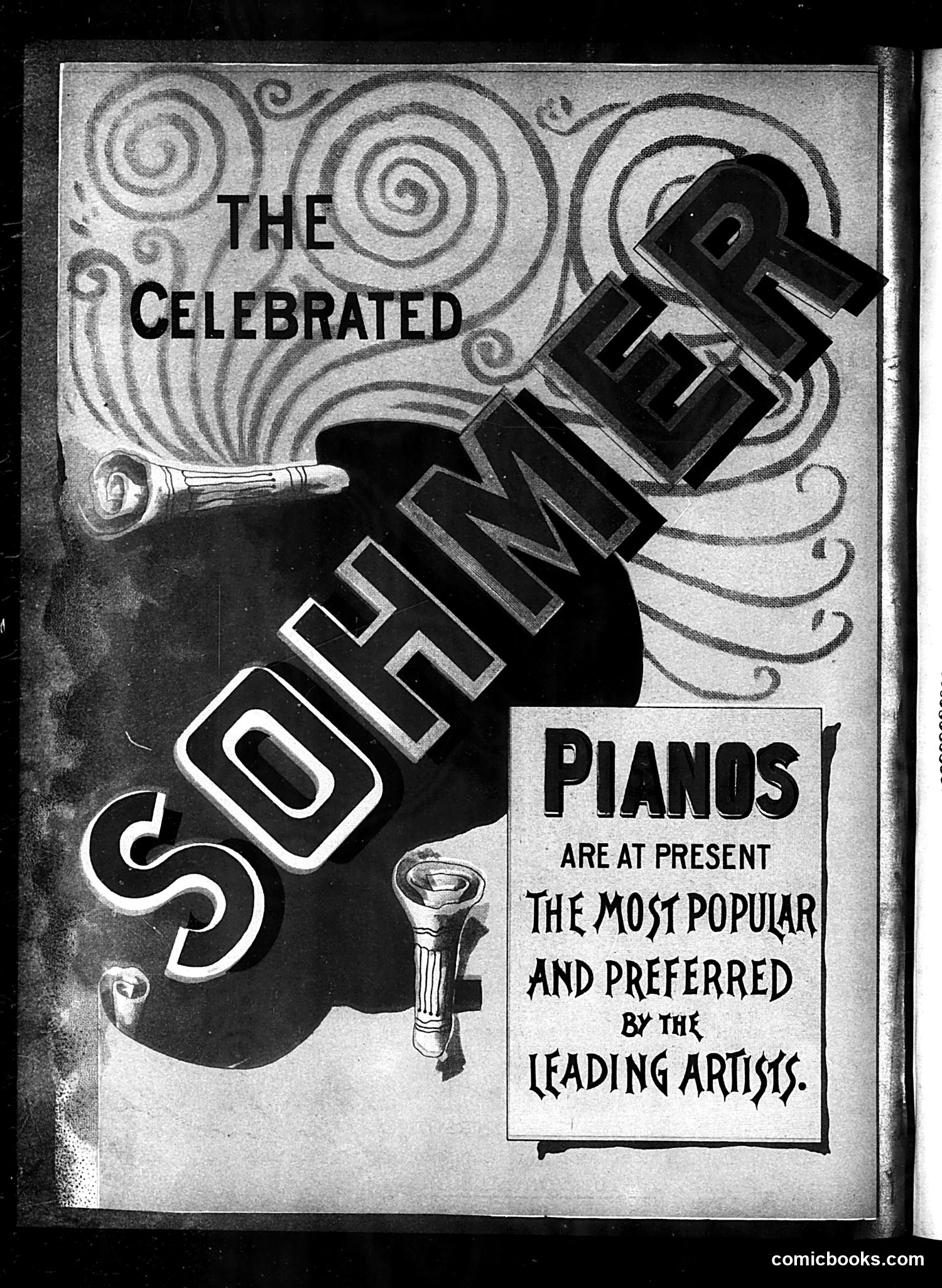
This is an advertisement for Sohmer pianos, not a political cartoon. The page features large decorative text reading "SOHMER" with an ornamental silhouette profile and classical design elements (spiral patterns, torch imagery). The ad's text claims that Sohmer pianos "are at present the most popular and preferred by the leading artists." This is standard commercial advertising rhetoric from the early 20th century, using endorsement appeals to music professionals as a marketing strategy. The decorative art deco styling and classical motifs (torches, scrollwork) were typical design choices for luxury goods advertising of this era, suggesting prestige and sophistication to potential wealthy buyers.