
Judge, 1889 · page 47 of 72
Judge — 1889 — page 47: what you’re looking at
What you’re looking at
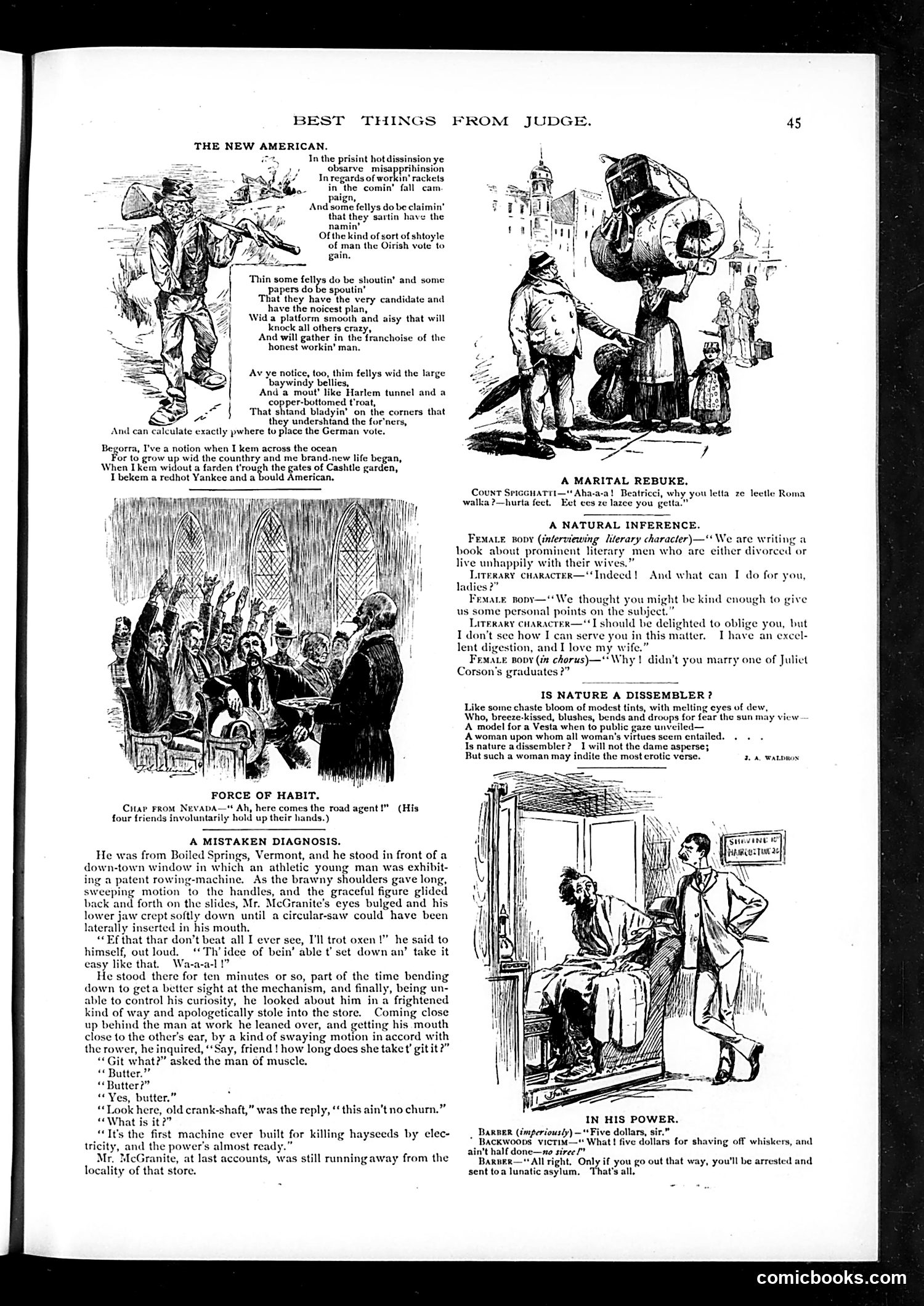
This page from Judge magazine contains satirical pieces targeting multiple subjects: **"The New American"** (top left) is a dialect poem mocking Irish-American political participation, portraying Irish voters through exaggerated brogue as easily manipulated by politicians offering vague platforms and promises of patronage jobs ("workin' rackets"). The satire suggests these immigrant voters are cynically courted during election season. **"Force of Habit"** (middle) jokes about Nevada's frontier culture—four men reflexively raise their hands when a "road agent" (highwayman) approaches, showing how deeply robbery is embedded in regional behavior. **"A Mistaken Diagnosis"** (bottom left) humorously depicts a rural Vermont man (McGranite) misidentifying a rowing machine as a butter churn, conflating industrial-age exercise equipment with old farm equipment. The remaining pieces are brief comic dialogues on marital relations and literary pretension, typical of Judge's light satirical content. The artwork uses caricature to reinforce social stereotypes common to 1880s-1890s American humor.
📄 Transcribed text from this page (OCR, searchable)
Machine-transcribed from the original scan — historical spelling and the odd misread are preserved.
BEST THINGS THE NEW AMERICAN, In the prisint hot dissinsion ye obsarve ‘misapprihinsion In regards of workin’ rackets in ‘the comin’ fall cam: paign, And some fellys do be claimin’ that they sartin have the namin’ Ofthe kind of sort of shtoyle of man the Oirish vote to gain. Thin some fellys do be shoutin’ and some papers do be spoutin’ That they have the very candidate and have the noicest plan, Wid a platform smooth and aisy that will knock all others crazy, And will gather in the franchoise of the honest workin’ man, baywindy bellies, Anda mout like Harlem tunnel and a - copper-bottomed t'roat, =“ | That shtand bladyin’ on the corners that Cal they undershtand the for'ners, And can calculate exactly pwhere to place the German vote. | Av ye notice, too, thim fellys wid the large Begorra, I've a notion when I kem across the ocean For to grow up wid the counthry and me brand-new life began, When I kem widout a farden t'rough the gates of Cashtle garden, I bekem a redhot Yankee and a bould American, Ai MyReT RTA | iat FORCE OF HABIT. Citar Rom NevapA—" Ah, here comes the road agent!" (His four friends involuntarily hold up their hands.) A MISTAKEN DIAGNOSIS. He was from Boiled Springs, Vermont, and he stood in front of a down-town window in which an athletic young man was exhibit- ing a patent rowing-machine. As the brawny shoulders gave long, sweeping motion to the handles, and the graceful figure glided ba nd forth on the slides, Mr. McGranite’s eyes bulged and his lower jaw crept softly down until a circ aw could have been laterally inserted in his mouth, ‘Ef that thar don’t beat all I ever see, I'll trot oxen !" he said to himself, out loud. ‘Th’ idee of bein’ able t’ set down an’ take it easy like that. W: 11” He stood there for ten minutes or so, part of the time bending down to geta better sight at the mechanism, and finally, being un- able to control his curiosity, he looked about him in a frightened kind of way and apologetically stole into the store. Coming close up behind the man at work he leaned over, and getting his mouth close to the other's ear, by a kind of swaying motion in accord with the rower, he inquired, ‘‘Say, friend ! how long does she take t’ git it?” “«Git what?” asked the man of muscle. “Butter.” “Butter?” “Yes, butter.” “Look here, old crank-shaft,” was the reply, “ this ain’t no churn.” “What is it?” “Tt's the first machine ever built for killing hayseeds by elec- tricity, and the power's almost ready.” cGranite, at last accounts, was still running away from the 'y of that store. FROM JUDGE. A MARITAL REBUKE, Count Sriccuatri—"* Aha-a-a! Beatricci, why you letta ze leetle Roma walka ?—hurta feet. Eet ces ze lazce you getta.” A NATURAL INFERENCE. FeMae nopy (inlerviewing lilerary character) —‘ We are writing a book about prominent literary men who are either divorced or live unhappily with their wives.” Literary ciiaracter—‘‘Indecd | ladies ? Femare nopy—“We thought you might be kind cnough to give us some personal points on the subject.” Literary cuaracter—“T should be delighted to oblige you, but I don't see how I can serve you in this matter. I have an excel- lent digestion, and I love my. wife.” Femate poot (in chorus)—“ Why | didn't you marry one of Juliet Corson’s graduates ?” And what can I do for you, IS NATURE A DISSEMBLER? Like some chaste bloom of modest tints, with melting eyes of dew, Who, breeze-kissed, blushes, bends and droops for fear the sun may view A model for a Vesta when to public gaze unveiled— ‘A woman upon whom all woman's virtues scem entailed. . Is nature adissembler? I will not the dame asperse; But such a woman may indite the most erotic verse. 2. A. WALDRON Sinviwe Hansa e2 Tt 27 IN HIS POWER. BARBER (imperiously) —**Five dollars, sir.” * Backwoops victim—* What! five dollars for shaving off whiskers, and ain’t half done—no siree!” Bane I right. Only if you go out that way, you'll be arrested and sent toa lunatic asylum, ‘That's all, comicbooks.com