
Judge, 1889 · page 28 of 72
Judge — 1889 — page 28: what you’re looking at
What you’re looking at
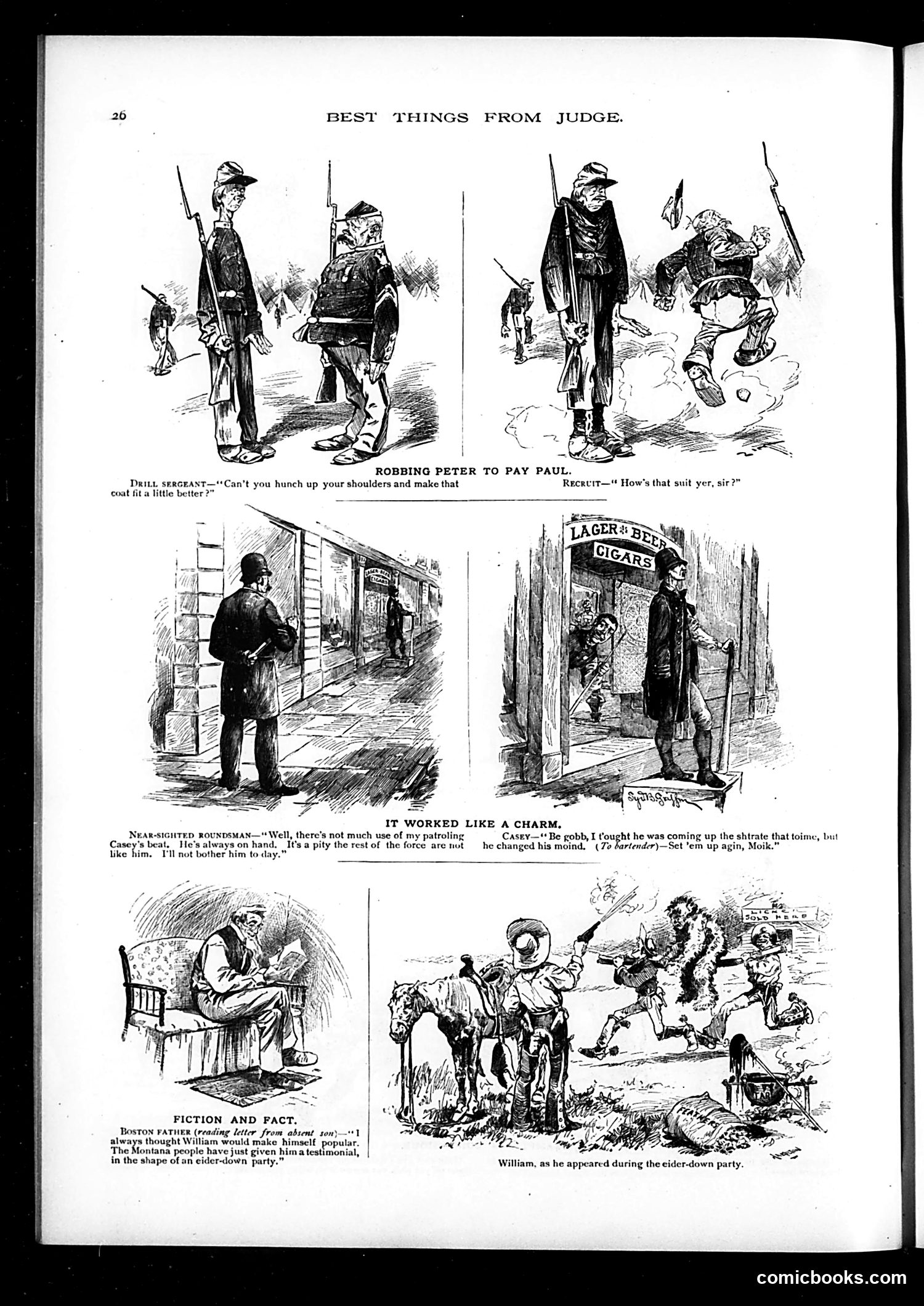
This page collects several satirical cartoons mocking military recruitment and police inefficiency circa early 1900s. **"Robbing Peter to Pay Paul"** shows drill sergeants trying to make ill-fitting uniforms work on recruits by having them hunch their shoulders—satirizing military incompetence and poor supply management. **"It Worked Like a Charm"** depicts a nearsighted policeman ("roundsman") who relies on Casey, a fellow officer, to actually patrol the beat while he loafs. A bartender mentions Casey changed his routine, yet the lazy officer won't notice the difference—mocking corrupt police departments where some officers do no real work. **"Fiction and Fact"** shows a Boston father reading that his son William received a testimonial in Montana—but it's actually an "eider-down party" (a tarring and feathering), a violent frontier form of mob justice. The joke contrasts civilized Eastern expectations with brutal Western vigilantism. The cartoons reflect Progressive-era skepticism toward institutions (military, police) and frontier justice.
📄 Transcribed text from this page (OCR, searchable)
Machine-transcribed from the original scan — historical spelling and the odd misread are preserved.
BEST THINGS FROM JUDGE. ROBBING PETER TO PAY PAUL. “Can't you hunch up your shoulders and make that Recrtit—" How's that suit yer, sir?” coat fit a little IT WORKED LIKE A CHARM. NEAR-SIGHTED ROUNDSMAN—"* Well, there's not much use of my patroling Casev—* Be gobb, I tought he was coming up the shtrate that toime, but Casey's beat, He's always on hand, _ It's. pity the rest of the force are nut he changed his meind.” (7 bartender) Set "em up agin, Moik.” like him. T'll not bother him to day.” FICTION AND FACT. Boston PATHER (reading letter from absent son)—*1 always thought William would make himself popular. The Montana people have just given himatestimonial, | in the shape of an eider-down party.” comicbooks.com