
Judge, 1889 · page 49 of 72
Judge — 1889 — page 49: what you’re looking at
What you’re looking at
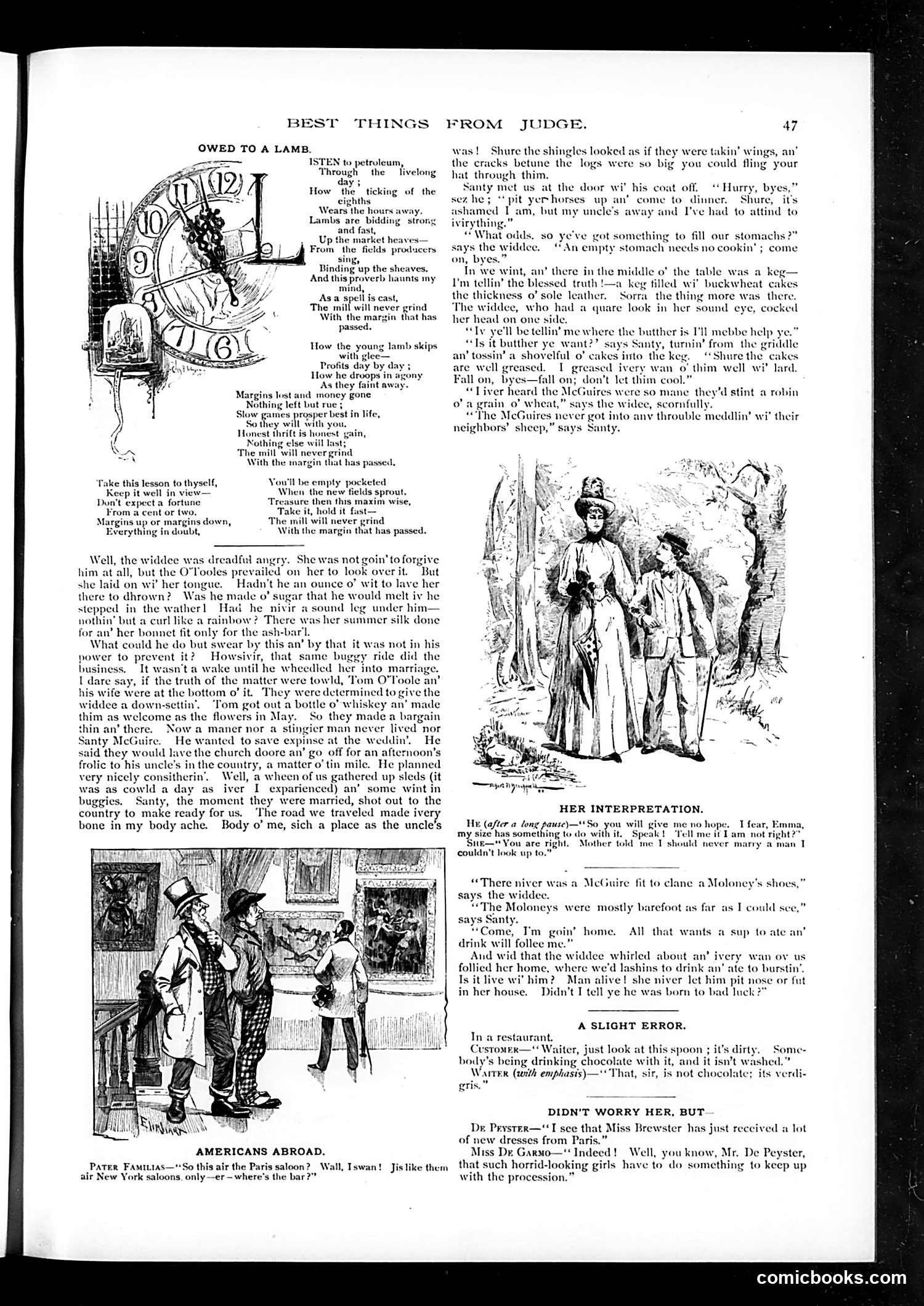
This page contains Irish-dialect humor stories typical of Judge magazine's late 19th/early 20th-century content. The main narrative, "Owed to a Lamb," is a rambling Irish tale about Santy (Santa) and a widow, told in exaggerated brogue. The humor relies on ethnic stereotyping—portraying Irish characters as poor, quarrelsome, penny-pinching, and given to whiskey-fueled bargains. The key joke: Santy tricks the widow into marriage by getting her drunk on whiskey. The widow's subsequent complaints about his poverty and character are meant to be funny because of her shrewish nature and their mutual incompetence. The smaller vignettes below satirize American tourists abroad and workplace misunderstandings. **For modern readers:** This reflects period attitudes treating Irish immigrants as comedic subjects through dialect caricature and domestic conflict scenarios—content considered humorous then but reflecting significant ethnic prejudice.
📄 Transcribed text from this page (OCR, searchable)
Machine-transcribed from the original scan — historical spelling and the odd misread are preserved.
BEST THINGS FROM JUDGE. 47 OWED TO A LAMB. ISTEN to petroleum, Through the — livelong was! Shure the shingles looked as if they were takin’ wings, an’ the cracks betune the logs were so big you could fling your ay hat through thim, iow ae , ; anty met us at the door wi’ his coat off. “Hurry, byes,” sez he} “pit yerhorses up an’ come to dinner, Shure, it’s hamed Tam, but my uncle's away and I’ve had to attind to Lambs ae ivirything.” Up the iarhel heaves: “What odds. so ye've got something to fill our stomachs? From’ the Acids’ prodacens says the widdee. An empty stomach needs no cookin’ ; come on, by! wint, an’ there in the middle 0° I'm tellin’ the Dlessed truth !—a keg filled w Asa spell is cast, the thickness o’ sole leather. Sorra_ the thing more was_ the The milf will never grind The widdee, who had a quare look in her sound eye, coc With the margin thathas her head on on Passed. “Ty ye'll be tellin’ me where the butther is I'll mebbe help ye.” How the young lamb skips ‘Is it butther ye want?’ says Santy, turnin’ from the griddle a into the keg. Shure the cak are well greased. I greased ivery wan o' thim well wi’ lard. ‘As they faint away. Fall on, byes—fall on; don’t let thim cool.” . . Maigtiiteat aia weoney pone “Liver heard the McGuires were so mane they'd stint a robin Nothing left but ru oa grain o’ wheat,” says the widee, scornfully. Slow Skis in life, «The McGuire: ver got into any throuble ‘Meddlin’ wi’ their So they will with neighbors’ sheep,” says Santy. The mill will never With the margin that has passed, You'll be empty pocketed hen the new fields sprout, irgins up or margins down, erything in doubt, With the margin that has pa Well, the widdee dreadful angry. She was not goin’ to forgive him at all, but the O"looles prevailed on her to look over it. But she laid on wi’ her tongue. Hadn't he an ounce o’ wit to lave her there to dhrown? Was he made o' ur that he would melt iv he stepped in the wather] Had he nivir a sound leg under him— nothin’ but a curl like a rainbow ? There was her summer silk done for an’ her bonnet fit only for the ash pari, What could he do but swear by this an’ by that it was not in his power to prevent it? Howsivir, that same buggy ride did the business. It wasn't a wake until he wheedled her into marriage. I dare ay, if the truth of the matter were towld, ‘Tom O'Toole an’ s wife were at the bottom o’ it. They were determined to give the widdee a down-settin’. Tom got out a bottle o’ whiskey an’ made thim as welcome as the flowers in May. So they made a bargain thin an’ there. Nowa maner nor a stingier man never lived nor Si He wanted to save expinse at the weddin’.. He ave the church doore an’ go off for an afternoon's frolic to his uncle's in the country, a matter o’ tin mile. He planned very nicely consitherin’. Well, ‘a wheen of us gathered up sleds (it te was as cowld a day as iver I exparienced) an’ some wint in nna — buggies. Santy, the moment they were married, shot out to the country to make ready for us. ‘The road we traveled made ivery HER INTERPRETATION. bone in my body ache. Body o' me, sich a place as the uncle's Me (efter Zone pause) —So, you will ‘ou are Tigh. Mother told me 1 should nover marry aan T couldn't look up to.” “There niver was a McGuire fit to clane a Moloncy’s shoes,” says the widd “The Moloneys were mostly barefoot as far as I could sce,” says Santy. “Come, Tm goin’ home. All that wants a sup to ate an’ drink will follee me. And wid that the widdee whirled about an’ iv follied her home, where we'd lashins to drink an Is it live wi’ him? Man alive! she niver let him pit nose or fut in her house. Didn't I tell ye he was born to bad luck ? A SLIGHT ERROR. In a restaurant. a titer, just look at thi it’s dirty. Some- being drinking chocolate with it, and i yashed.” ITER (wrth emphasisy—‘* That, sir, is not chocolate; its verdi- DIDN'T WORRY HER, BUT Dr Pryster—‘‘I sce that Miss Brewster has just received a lot of new dresses from Paris.” AMERICANS ABROAD. Miss De Garmo—‘‘ Indeed! Well, you know, Mr. De Peyster, Pater Famtttas—'*So this air the Paris saloon? Wall, Iswan! Jislike them that such horrid-looking girls have to do something to keep up air New York saloons, only —er — where's the bar?” with the procession.” comicbooks.com