
Judge, 1889 · page 37 of 72
Judge — 1889 — page 37: what you’re looking at
What you’re looking at
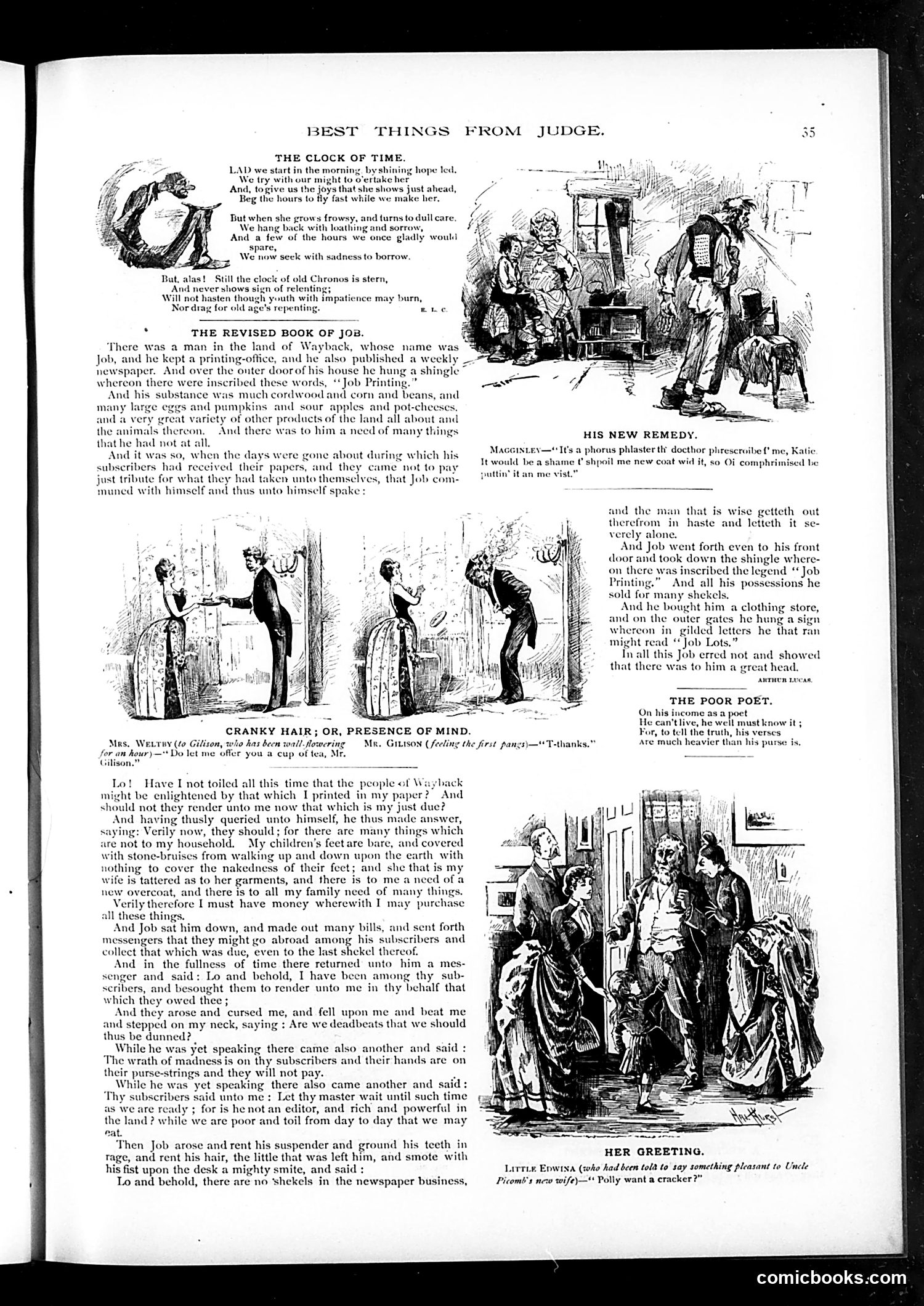
This page contains three satirical pieces poking fun at Victorian-era frustrations: **"The Clock of Time"** is a poem lamenting how time seems to drag in old age after racing by in youth—a universal complaint about mortality rendered as social commentary. **"The Revised Book of Job"** is the main satirical piece, a biblical parody mocking struggling newspaper publishers. It depicts a printer named Job who starts a printing business but can't collect payment from subscribers. Despite sending messengers to demand money, subscribers refuse to pay, offering excuses that they're poor workers while Job is wealthy and powerful. The satire critiques deadbeat subscribers and the precarious economics of 19th-century newspaper publishing. **"Cranky Hair; or, Presence of Mind"** appears to be a brief humorous dialogue (with accompanying illustrations) about social awkwardness—a man offering tea to someone after they've been ignored. The page illustrates Judge magazine's specialty: satirizing middle-class economic anxieties and social pretensions through exaggerated characters and biblical/classical parodies.
📄 Transcribed text from this page (OCR, searchable)
Machine-transcribed from the original scan — historical spelling and the odd misread are preserved.
BEST THINGS THE CLOCK OF TIME. LAD we start in the morning. by shin, We try with our might to o'ertake her And, togive us the joys that she shows just ahead, Beg the hours to Hly fast while we make her. But when she grows frowsy, and turns to dull care. We hang back with loathing and sorrow, And a few of the hours we! ance gla adly would Wo now seek with sadnien to borrow. tll the clock of ald Chronos is stern, n of rele Will not hasten tho zh youth with impatience may burn, ¢ for old age’s repenting. ‘ THE REVISED BOOK OF Jop. ‘There was a man in the land of V ack, Job, and he kept a printing-office, and he newspaper. And over the onter door of his house he hung whercon there were inscribed these words, ‘Job Printing And his substance was much cordwood and corn and beans, and eggs and pumpkins and sour apples and pot-chceses and a very great variety of other products of the land all about and the animals thereon, And there was to him a need of many things that he had not at all. And it was so, wh whose name was on the days were gone about during which his ibers had’ receiv apers, and they came not to pay just tribute for wh had taken unto themselves, that Job com- ‘muned with himself and thus unto himself sps subs CRANKY HAIR; OR, PRESENCE OF MIND. 5. WELTHY (lo Gilison, who has been wall-flowering for an hour)—"* Do let me offer you a cup of tea, Mr. Gilison.” Lo! Have I not toiled all this time that the people of W might be enlightened by that which I printed in my paper should not they render unto me now that which is my just due? And having thusly queried unto himself, he thus made answer, saying: Verily now, they should; for there are many things which are not to my household. My children’s feet are bare, and covered with stone-bruises from walking up and down upon the earth with nothing to cover the nakedness of their feet; and she that is my wife is tattered as to her garments, and there is to me a need of a new overcoat, and there is to all my family need of many things ily therefore | must have money wherewith I may purchase all these things. And Job sat him down, and made out many bills, and sent forth messengers that they might go abroad among his subscribers and collect that which w: en to the last shekel thereof. And in the fullness of time there returned unto him a mes- senger and said: Lo and behold, I have been among thy sub- 's, and besought them to render unto me in thy behalf that which they owed thee ; And they arose and cursed me, and fell upon me and stepped on my neck, ng : Are we deadbeats that we thus be dunned?, While he was yet aking there came als The wrath of madn s on thy subscribers their purse-strings and they will not pay. _While he was yet speaking there also came another and said: ibscribers said unto me : Let thy master wait until such time care ready ; for is he not an editor, and rich and powerful in the land? while we are poor and toil from day to day that we may rat. Then Job arose and rent his suspender and ground his teeth in tage, and rent his hair, the little that was left him, and smote with his fist upon the desk a mighty smite, and said : Lo and behold, there are no shekels in the newspaper business, > another and nd their hands are on Mr. Ginison (feeling the first pangs)—"T-thanks.” FROM JUDGE. iso published a weekly — HIS NEW REMEDY. phorus phlaster th’ docthor phrescroibe {’ me, Katie shpoil me new coat wid it, so Oi comphrimised he Maccistey—1 It would be a shame and the man that is wise getteth out therefrom in haste and letteth it se- verely alone. And Job went forth even to his front door aid took down the shingle where- on there w; Printing.” sold for many : And he bought him a clothing store, and on the outer gates he hung a sign whereon in gilded letters he that ran ead “Job Lots.” Inall this Job erred not and showed that there was to him a great head. scribed the legend “Job THE POOR POET. income as a poet ‘e, he well must know it ; For, to tell the truth, his HER GREETING. Lirte, Epwisa (soho had been tol to say something pleasant to Uncle Picoms's new wife)—" Polly want a cracker?” comicbooks:com