comicbooks.com Join Free

A complete, restored issue of Pulp Fiction from 1883 — all 142 pages of painted-cover fiction magazines that launched science fiction, horror, and hardboiled crime, free to page through at comicbooks.com.

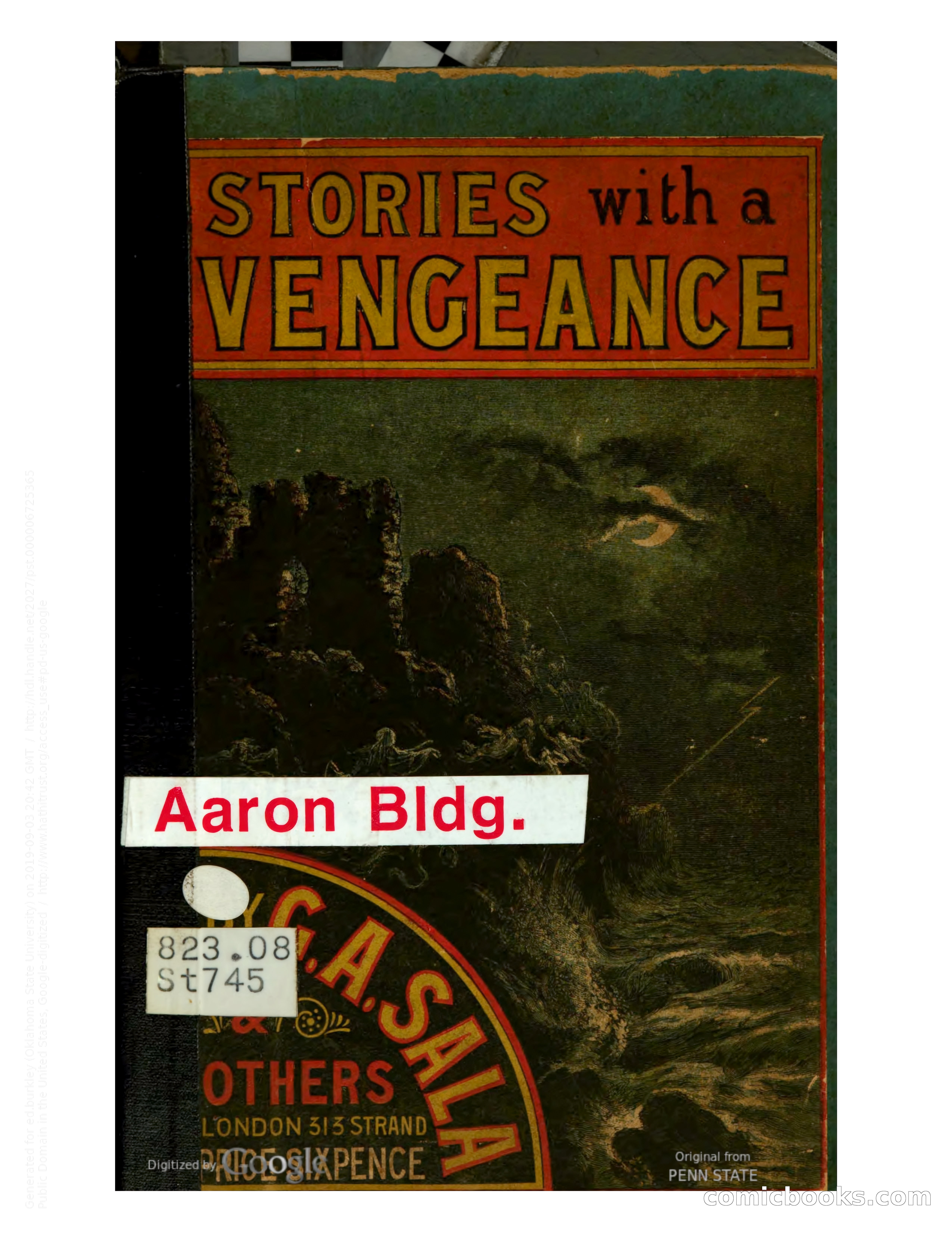
On the cover: This is a book cover for *Stories with a Vengeance*, published by Cassell & Company in London. The cover features a dramatic, shadowy illustration depicting what appears to be a ghostly or supernatural figure hovering over ruins or rocky terrain, rendered in dark greens and browns. The title is prominently displayed in gold lettering on a red banner at the top. A library stamp reading "Aaron Bldg." appears on the cover, and a cataloging label (823.08 St745) is visible in the lower left corner. The book originates from Penn State's collection, as noted in the image.

🖼️ Every page has a plain-English note on what you’re looking at — the figures, the references, the point of the satire.

← Back to Pulp Fiction All exhibitions

HomeExhibitionPulp FictionRead

A complete issue · 142 pages · 1883

Stories with a Vengeance
1883 · Free to read

Stories with a Vengeance — page 1 of 142
1 / 142
What you’re looking at · open this page on its own ↗

This is a book cover for *Stories with a Vengeance*, published by Cassell & Company in London. The cover features a dramatic, shadowy illustration depicting what appears to be a ghostly or supernatural figure hovering over ruins or rocky terrain, rendered in dark greens and browns. The title is prominently displayed in gold lettering on a red banner at the top. A library stamp reading "Aaron Bldg." appears on the cover, and a cataloging label (823.08 St745) is visible in the lower left corner. The book originates from Penn State's collection, as noted in the image.

Stories with a Vengeance — page 2 of 142
2 / 142
What you’re looking at · open this page on its own ↗

This is a title page or cover from The Pennsylvania State University Libraries collection (as indicated by the seal and header text visible on the cover). The page shows catalog/archival information rather than story content: it displays a call number (2776) and what appears to be an accession or reference number (1675) written in handwriting. The OCR'd text is largely garbled and unhelpful. This appears to be a library documentation page photographed during digitization by Google, showing the front matter of a bound volume rather than actual pulp magazine story content or illustration.

Stories with a Vengeance — page 3 of 142
3 / 142
What you’re looking at · open this page on its own ↗

This page is mostly blank with minimal visible content. The OCR text appears to be metadata and administrative information—likely a digitization note or library cataloging data—rather than readable story prose or advertising. The page shows what appears to be the back of a title page or a largely empty page from a pulp magazine, with only scattered dots or marks visible in the image itself. No coherent story text, illustration, or advertisement is discernible on this particular page.

Stories with a Vengeance — page 4 of 142
4 / 142
What you’re looking at · open this page on its own ↗

# Page Description This appears to be a mostly blank page from a pulp magazine, likely a title page, section divider, or advertising page. The visible text is minimal and fragmented—only "3," "ElOOO," and "CO" are discernible, which appear to be OCR errors or partial page elements rather than coherent content. The page shows significant white space with a vertical black element or bar on the right side. Given the sparse and unclear text, this page likely serves a structural rather than content function within the publication, possibly indicating a section break or page number. Without clearer text, the specific subject matter cannot be reliably determined.

Stories with a Vengeance — page 5 of 142
5 / 142
What you’re looking at · open this page on its own ↗

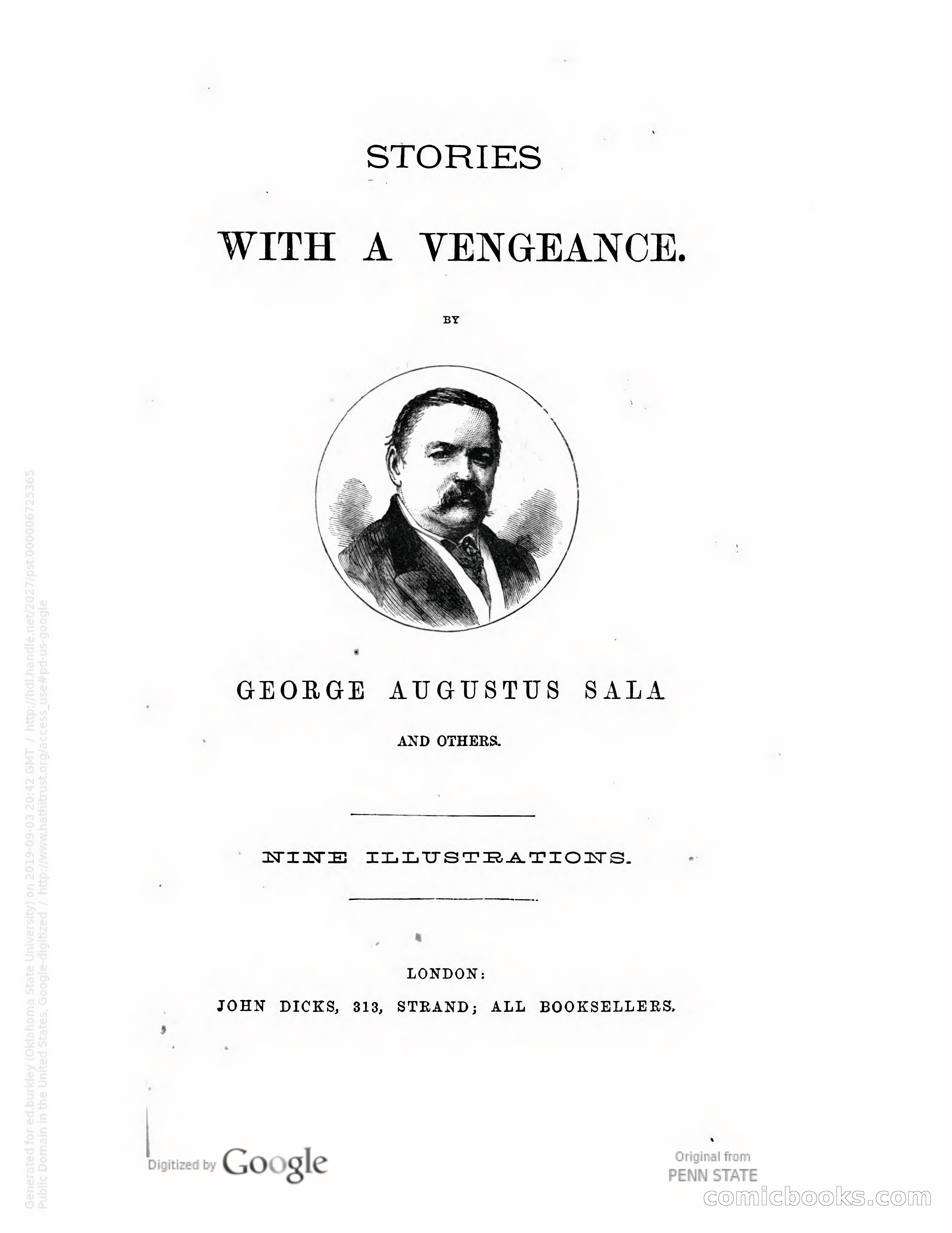
This is a title page from a Victorian-era book published by John Dicks in London. The page announces *Stories with a Vengeance*, a collection by George Augustus Sala and other authors, featuring nine illustrations. A circular engraved portrait of a bearded man (likely Sala) appears at the center. The publication details indicate it was distributed through London booksellers at 313 Strand. The page's formal typography and wood-engraved portrait are characteristic of mid-to-late 19th-century British publishing rather than pulp magazines.

Stories with a Vengeance — page 6 of 142
6 / 142
What you’re looking at · open this page on its own ↗

# Analysis This page appears to be a **title or copyright page** from a digitized book or periodical. The visible text shows "THE PENNSYLVANIA STATE UNIVERSITY LIBRARY" centered on the page, with "Digitized by Google" at the bottom left and "Original from PENN STATE" at the bottom right. The page contains no readable story content, illustrations, or advertisements—only library and digitization metadata. This is a standard introductory page found in Google's digitization of public-domain materials held by Penn State University.

Stories with a Vengeance — page 7 of 142
7 / 142
What you’re looking at · open this page on its own ↗

This appears to be a blank or nearly blank page from a pulp magazine, with only scattered small marks or specks visible against a white background. The OCR text at the bottom is heavily corrupted and largely illegible, making it impossible to determine the actual content. The page bears Google's digitization mark and indicates the original is from Penn State University. Without legible text or clear illustrations, the page's purpose—whether cover, story content, or advertising—cannot be reliably determined from what is visible.

Stories with a Vengeance — page 8 of 142
8 / 142
What you’re looking at · open this page on its own ↗

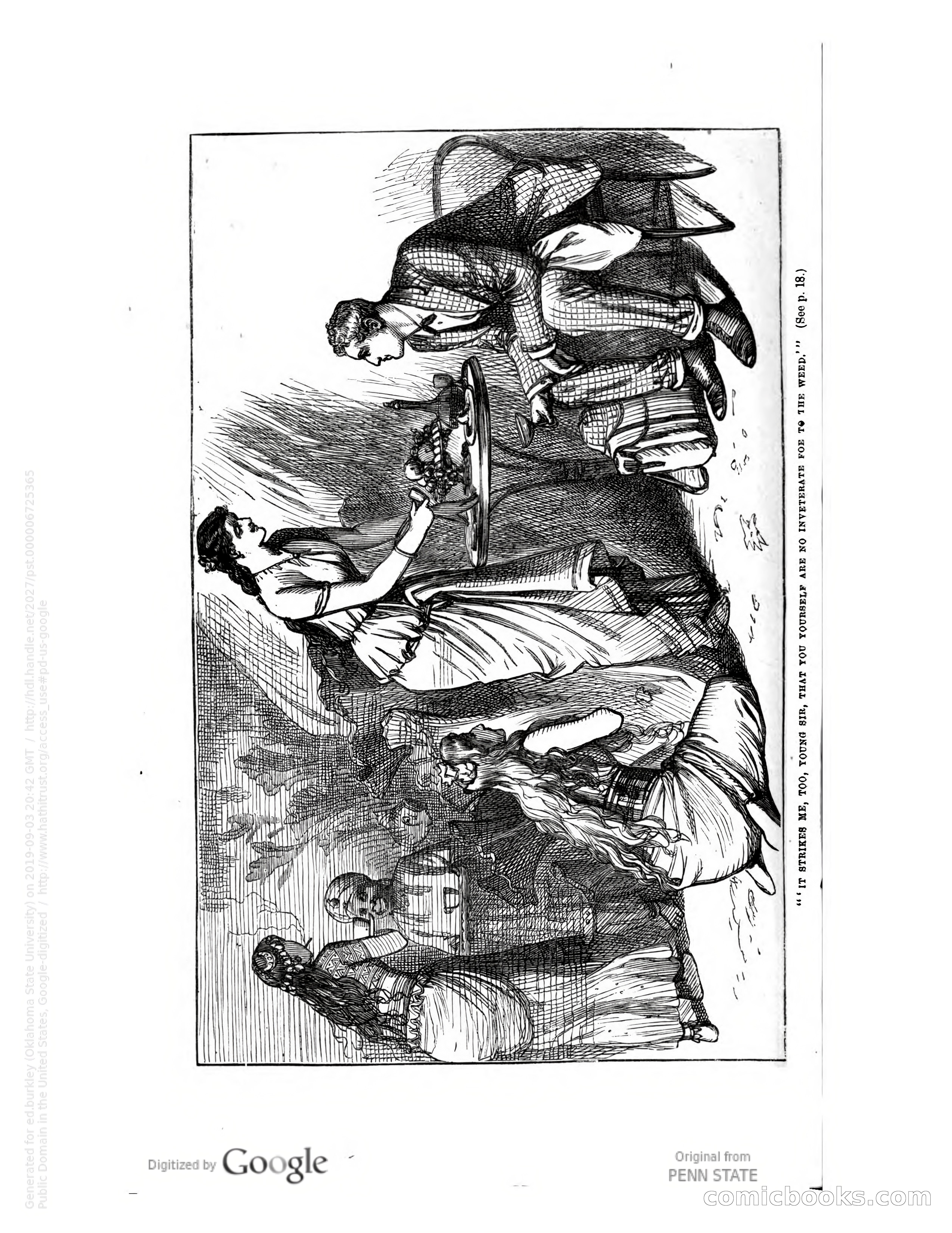
This is an interior illustration from a pulp magazine, rendered in black-and-white line art. The image appears to depict a dramatic scene with multiple figures in period clothing, though the composition is somewhat difficult to parse when rotated. The visible caption reads: "It strikes me, too, young sir, that you yourself are no inveterate foe to the weed," suggesting dialogue about tobacco use. The illustration corresponds to content on page 18 of the publication. The artistic style and subject matter are consistent with early-20th-century pulp fiction illustration.

Stories with a Vengeance — page 9 of 142
9 / 142
What you’re looking at · open this page on its own ↗

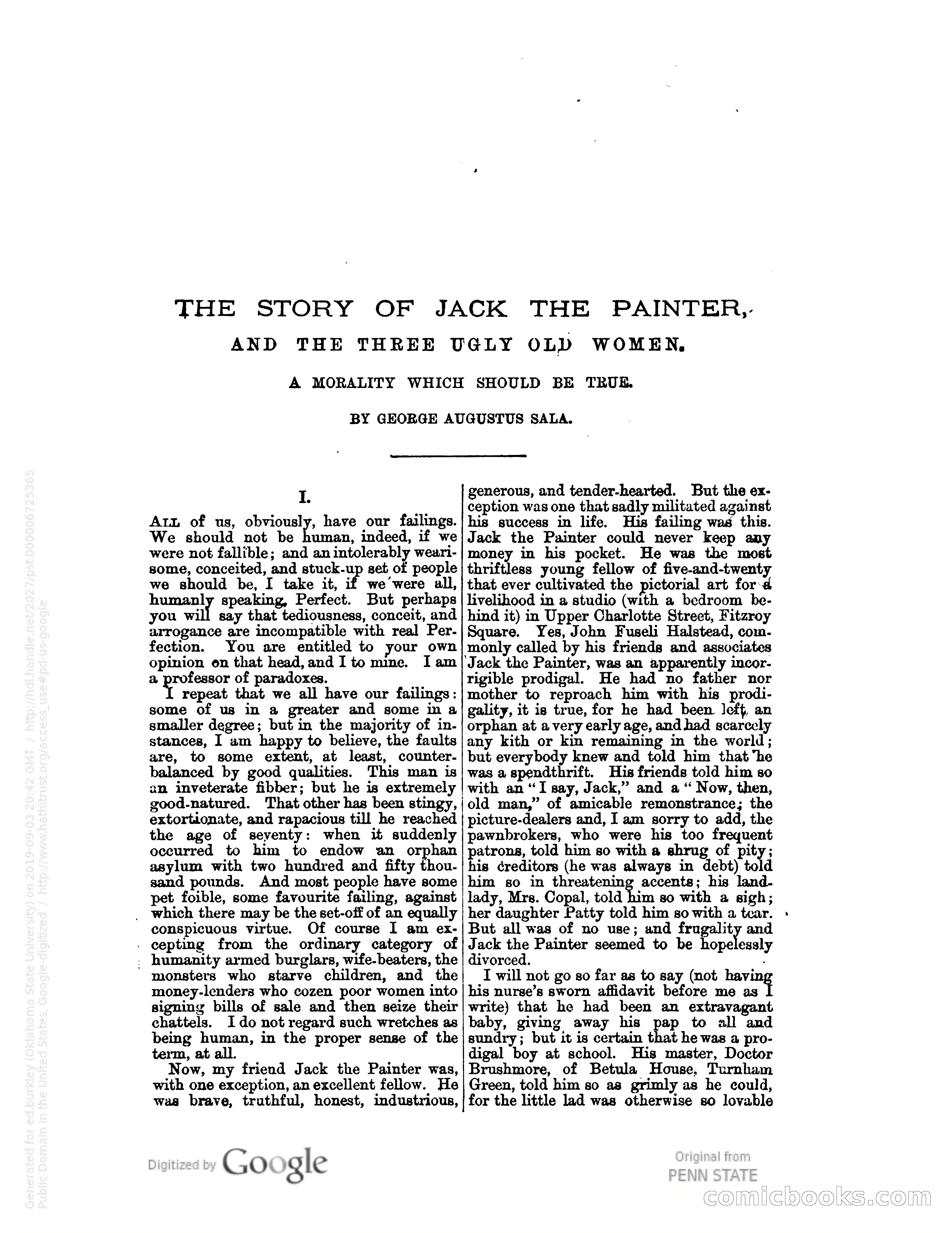
# Page Analysis This is a **story text page** from a pulp fiction magazine, presenting the opening of "The Story of Jack the Painter and the Three Ugly Old Women," a moral tale by George Augustus Sala. The visible text introduces Jack the Painter, a young artist in his mid-twenties living in Fitzroy Square, London, who possesses excellent qualities—he is brave, truthful, honest, and industrious—but suffers from one fatal flaw: he cannot keep money and is hopelessly extravagant. The narrator explains that despite friends', creditors', and his landlady's warnings, Jack remains an irresponsible spendthrift, apparently incapable of financial restraint.

Stories with a Vengeance — page 10 of 142
10 / 142
What you’re looking at · open this page on its own ↗

This page contains story prose from "The Story of Jack the Painter," a serialized narrative appearing in what appears to be a pulp fiction magazine. The text describes Jack Halstead, a schoolboy with a substantial inheritance who recklessly spends his pocket money on frivolous items and generous gifts to fellow students and local vendors, accumulating significant debts in the process. The narrative details his financial irresponsibility, his borrowing habits, and the eventual consequences when his debts are discovered by school authorities.

Stories with a Vengeance — page 11 of 142
11 / 142
What you’re looking at · open this page on its own ↗

# Page Analysis This page contains prose fiction narrative from a story titled "The Story of Jack the Painter." The text describes Jack Halstead's financial misadventures in Paris—how he squandered his inherited fortune through wasteful spending, failed business schemes (including an indigo manufacturing venture), loans to unreliable friends, and stock speculation. The passage follows his return to England with only 150 pounds remaining, and notes that upon his arrival, he surprisingly commits "an act of prudence" for the first time, suggesting a potential turning point in his character or circumstances.

Stories with a Vengeance — page 12 of 142
12 / 142
What you’re looking at · open this page on its own ↗

# Page Analysis This is story prose from a pulp fiction magazine. The visible text is the continuation of "The Story of Jack the Painter," which describes Jack Halstead, a struggling artist living in Upper Charlotte Street, Fitzroy Square. The narrative details his financial difficulties, his reliance on picture dealers and pawnbrokers, and mentions that after he sprains his ankle and is confined indoors for three months, he becomes productive, producing good work while confined to the house. The story explores the contrasting reactions of his various creditors and patrons to his enforced period of recovery and artistic output.

Stories with a Vengeance — page 13 of 142
13 / 142
What you’re looking at · open this page on its own ↗

This page contains story prose from "The Story of Jack the Painter," continuing a narrative about financial negotiations. The text depicts dialogue between Jack the Painter and Mr. Maddix regarding a fifty-pound note and a painting called "Maso Fineguerra" that Jack hopes to sell to the Carlton Gallery. Mr. Halstead, a dealer, offers practical advice about the transaction and suggests Jack needs ready cash. The conversation touches on art dealing, banking, and Jack's financial circumstances. The page is entirely text with no illustrations or advertisements visible—it appears to be the middle of a serialized story in a pulp magazine.

Stories with a Vengeance — page 14 of 142
14 / 142
What you’re looking at · open this page on its own ↗

This is a page of story prose from "The Story of Jack the Painter" (visible in the header). The text describes Jack the Painter's financial situation and his landlady Mrs. Copal's concerns about unpaid rent. It includes dialogue between Mrs. Copal and Jack, in which she references his past employment troubles and warns him about potential dangers. The passage also introduces a mysterious visitor—apparently a piano-tuner—who arrives at Jack's lodgings. The prose is dense and written in a Victorian-influenced style typical of early pulp fiction, focusing on character interaction and plot development rather than illustration.

Stories with a Vengeance — page 15 of 142
15 / 142
What you’re looking at · open this page on its own ↗

# Page Analysis This page contains story prose from "The Story of Jack the Painter" (as shown in the header). The text is formatted in two columns and continues a narrative involving characters named Patty, Mr. Halstead (a pianoforte-tuner), and Jack the Painter. The visible passage depicts Patty in emotional distress, confessing to Jack that she has accepted money from Mr. Halstead under false pretenses. Jack responds with apparent concern for her welfare and moral character. The prose is melodramatic in tone, typical of early pulp fiction, dealing with themes of deception, financial desperation, and romantic entanglement among working-class characters.

Stories with a Vengeance — page 16 of 142

16 / 142
What you’re looking at · open this page on its own ↗

# Page Analysis This page contains story prose from "The Story of Jack the Painter" (as indicated by the page header). The text describes Jack the Painter's fourteen-day break from labor and his travels through the English countryside, including stops at various inns and villages. The narrative details his sketching activities, his wanderings through Surrey and Hampshire, and an encounter with a landlady named Mrs. Cubbley at the "Lamb and Tarbrush" inn, where Jack seeks lodging. The prose is dense Victorian-era narrative fiction focused on character development and rural English settings.

Stories with a Vengeance — page 17 of 142
17 / 142
What you’re looking at · open this page on its own ↗

This page shows story prose from "The Story of Jack the Painter." The text follows Jack's departure from a village after a stay at the "Lamb and Tarbrush" inn. A landlady named Mrs. Cubbley had suspected Jack of involvement in a highway robbery by someone named Jerry Abershaw. Jack leaves the village with thirty-five sovereigns in his possession, heading toward London and Queen's Corklcggatt. The narrative describes Jack becoming lost in woodland near East Jowling, wandering through ferns and gorse before discovering what appears to be a road or track. The page contains no illustrations—only double-column printed text on a white background.

Stories with a Vengeance — page 18 of 142
18 / 142
What you’re looking at · open this page on its own ↗

This is a page of story prose from "The Story of Jack the Painter," as indicated by the header. The text depicts Jack encountering an elderly, impoverished woman on a country road. She appears to be a beggar or vagrant, described as having a dirty canvas bag and looking like "a raw potato." Jack gives her a golden sovereign coin, which she receives with gratitude and superstition (spitting on it for luck). The narrative then shifts to Jack continuing his journey and discovering a burned-out cottage, where he learns from local rustics that an elderly widow named Widow Armlet owned it and has been sent to the workhouse. The page contains primarily dialogue and character interaction within what appears to be a serialized adventure or social commentary tale.

Stories with a Vengeance — page 19 of 142
19 / 142
What you’re looking at · open this page on its own ↗

# Page Analysis This is a story prose page from "The Story of Jack the Painter" (visible at the top). The page contains two columns of text describing Jack's encounter with various characters, including a woman described as "the Second Witch in 'Macbeth,'" a butcher who offers to help, and an elderly woman blocking his path whom he addresses tersely. The narrative involves Jack's charitable impulses conflicting with his limited resources as he travels, and includes dialogue between Jack and these characters about helping a poor burnt-out widow in Devonshire. The tone is satirical and descriptive of Victorian-era social conditions and character interactions.

Stories with a Vengeance — page 20 of 142
20 / 142
What you’re looking at · open this page on its own ↗

This page contains story prose from "The Story of Jack the Painter." The text appears to be a dialogue-heavy narrative segment in which Jack, having lost his purse to a thief, discusses his financial troubles with what seems to be a landlady or older woman at a counter. Jack insists on paying only half a crown and mentions needing to travel to Guildford. The conversation then shifts to Jack's harrowing experience of nearly falling down a steep, wooded declivity while pursuing someone, during which he nearly loses his pipe and tobacco-pouch. The passage employs Victorian-era colloquialisms and focuses on Jack's misadventures and financial predicaments.

Stories with a Vengeance — page 21 of 142
21 / 142
What you’re looking at · open this page on its own ↗

This page contains story prose from "The Story of Jack the Painter," a science fiction narrative. The text describes Jack's surreal descent through an otherworldly realm—apparently the bottom of the sea or a fantastical underwater cave filled with luminescent shells and marine plants. Jack encounters invisible inhabitants who debate the location's identity, and he meets three beautiful ladies, including one named Philocoma. The passage shifts to dialogue featuring Jack's interaction with these mysterious figures, including discussion of his profession as a painter and remarks about propriety regarding married women. The prose is densely printed in two columns across the full page.

Stories with a Vengeance — page 22 of 142
22 / 142
What you’re looking at · open this page on its own ↗

This page contains story prose from "The Story of Jack the Painter," presented in two columns of text. The narrative depicts a conversation between Jack, a painter, and several society ladies including Sister Nicotina and the Lady Philocoma, who are discussing Jack's artistic credentials and social standing. The women appear dismissive of Jack's profession, while he defends himself as "an artist" devoted to "historic genre." The text also introduces a character named Jumbo, described as a Black servant wearing Oriental dress with elaborate jewelry. The dialogue reveals social tensions regarding class, artistic merit, and racial attitudes typical of early pulp fiction.

Stories with a Vengeance — page 23 of 142
23 / 142
What you’re looking at · open this page on its own ↗

# Page Analysis This is a page of story prose from "The Story of Jack the Painter," appearing as page 19 in the publication. The text describes Jack's encounter with railway staff and porters after he boards a train, including an embarrassing moment where a porter calls out "Guildford!" Jack then disembarks and meets with a woman named Mrs. Copal and her daughter Patty in London, where he discovers he's returned with significantly more money than expected. The page concludes with Patty scolding Jack about his past financial irresponsibility and his deceptive behavior toward her mother. The narrative appears to be a character-driven drama rather than science fiction or horror.
Stories with a Vengeance — page 24 of 142
24 / 142
What you’re looking at · open this page on its own ↗

# Page 20: Story Prose from "The Story of Jack the Painter" This is a text-only page of story prose describing Jack's social advancement. The narrative reveals that Jack has received three letters at his lodging, including one from the Countess of Bellarmine inviting him to her home. After attending her salon, Jack is presented to her sister, Lady Florence Perceforest, and eventually becomes the protégé of Lord Belfarmine himself, securing art commissions and achieving financial success. The passage also mentions Jack's friendship with Patty Opal and notes his eldest daughter is named Philocoma. The prose focuses on Jack's rise from poverty to respectability through artistic talent and aristocratic patronage.

Stories with a Vengeance — page 25 of 142
25 / 142
What you’re looking at · open this page on its own ↗

This page contains story prose from "The Story of Jack the Painter" (page 21). The text is divided into two columns and presents dialogue and narrative. A character named Jack is being advised by a friend about marriage to a sensible woman and warned against wasting money. The passage includes philosophical commentary about not squandering earnings, particularly for those who have labored hard. There is also discussion of marrying a woman who will manage finances wisely, with a warning against being foolish regarding "Ugly Old Women." The text emphasizes virtues like kindness and mercy, suggesting that beauty may exist within even physically unattractive people.

Stories with a Vengeance — page 26 of 142
26 / 142
What you’re looking at · open this page on its own ↗

This is a prose fiction page from "At the Tunnel's Mouth" by Richard Dowling. Chapter I, titled "The Rivals," describes the Wander River flowing through a secluded English valley and introduces Gregory Menton, a lock-man on the Bannermouth Canal. The text establishes that Menton is an intelligent, educated man of medium height with distinctive features (red hair, blue eyes), who works as a lock-keeper despite being overqualified for the position. The passage also introduces his eighteen-year-old daughter Mary, described as tall, lithe, and fair-faced. The narrative appears to be setting up character relationships and the rural canal-side setting for the story.

Stories with a Vengeance — page 27 of 142
27 / 142
What you’re looking at · open this page on its own ↗

This page contains story prose from a work titled "At the Tunnel's Mouth" (visible in the header). The narrative describes a young man named Will Ryland and his relationship with Mary Menton, who live near a mill-house and canal in a rural English setting. The text details Will's hopes to marry Mary and improve his family's circumstances by enlarging the mill, as well as the daily meetings between the young couple on a hand-bridge over the canal. The passage emphasizes the peaceful pastoral landscape surrounding them and suggests romantic tension between the characters. There are no illustrations visible on this page.

Stories with a Vengeance — page 28 of 142
28 / 142
What you’re looking at · open this page on its own ↗

# Page Content Description This page contains story prose from what appears to be a pulp fiction narrative titled "At the Tunnel's Mouth" (visible in the header). The text depicts a dramatic scene where a young woman named Mary confronts a man named Ryland near a canal tunnel. Mary is emotionally distressed and pleading with Ryland to leave with her, fearing danger, while Ryland insists on staying to "take care of" himself against someone (possibly Tom Brindley). The dialogue reveals tension and conflict involving multiple characters and suggests themes of danger near the tunnel location. The page contains no illustrations, only two columns of printed text typical of early pulp magazine formatting.

Stories with a Vengeance — page 29 of 142
29 / 142
What you’re looking at · open this page on its own ↗

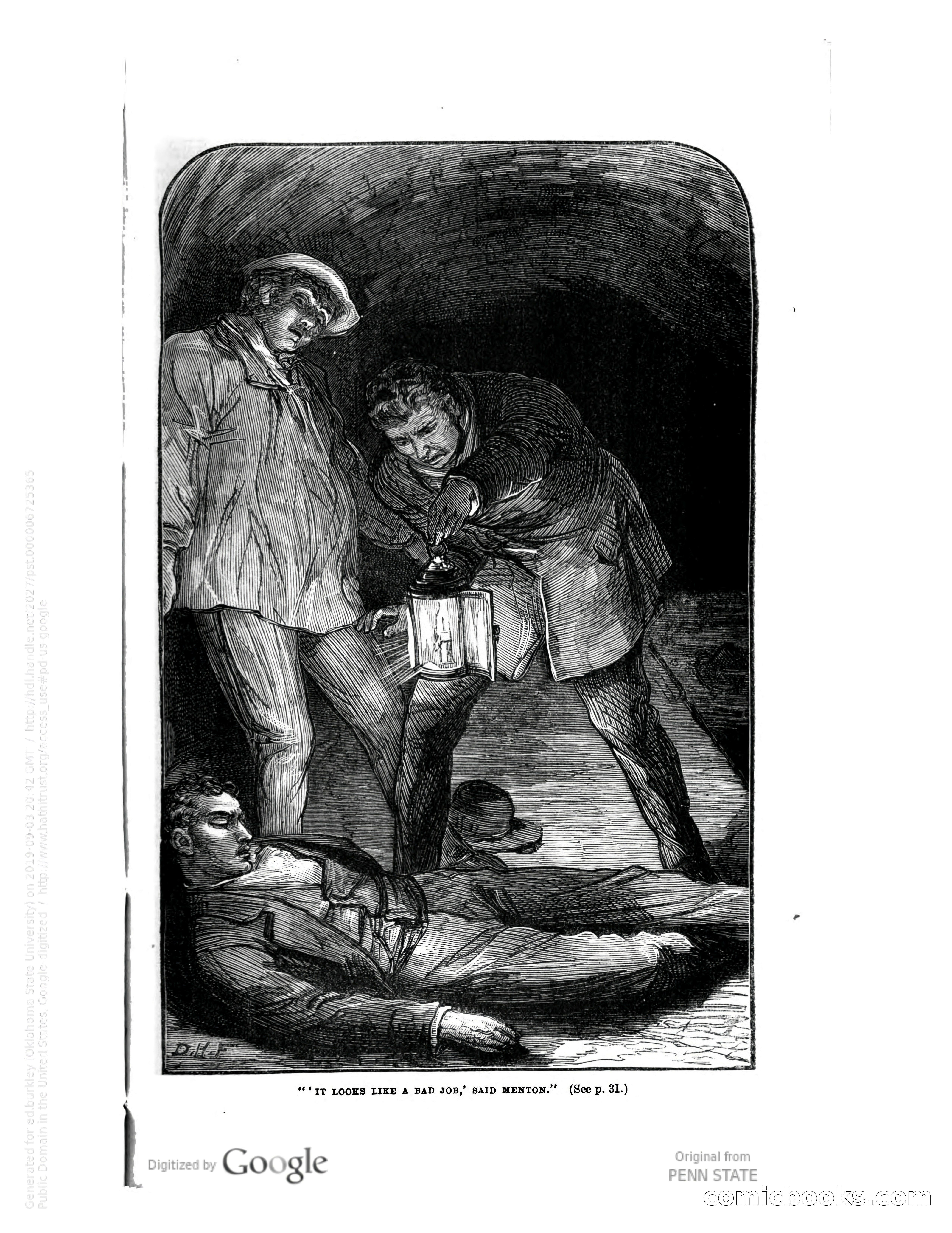
This is a black-and-white illustration from a pulp magazine, depicting what appears to be a crime or mystery scene. Two men stand over a third man who lies on the ground. One standing figure holds what looks like a lantern or light source, while examining the prone figure. The caption reads: "'IT LOOKS LIKE A BAD JOB,' SAID MENTON." (See p. 31.) The illustration uses cross-hatching and engraving techniques typical of early pulp magazine artwork. Based on the dialogue and scene composition, this appears to be an interior illustration accompanying a hardboiled crime or mystery story, with the caption suggesting someone named Menton is observing what may be a body or scene of violence.

Stories with a Vengeance — page 30 of 142
30 / 142
What you’re looking at · open this page on its own ↗

This appears to be a nearly blank or heavily degraded page from a pulp magazine, with only scattered dots and marks visible against a white background. The page shows minimal legible content—no clear text, illustrations, or narrative prose can be discerned. The visible elements consist of sparse punctuation marks and small dots distributed across the page, making it impossible to determine whether this is intended to be story text, advertising, or illustrative material. The degradation or poor image quality renders this page essentially unreadable in terms of its original content or purpose within the magazine.

Stories with a Vengeance — page 31 of 142
31 / 142
What you’re looking at · open this page on its own ↗

# Page Analysis This is a text-only page of story prose from a pulp magazine, numbered 27. The page contains Chapter II, titled "A Stranger at the 'Green Man,'" continuing a narrative about characters named Ryland and Brindley. The visible text describes Ryland's confrontation with Brindley at a harbor, where Ryland pushes Brindley into the water. The passage then shifts to describe Brindley's character—a man from Bancroft known for violent temperament and cruelty—before depicting his emergence from the water and an arranged meeting at the Green Man tavern for the following evening. The prose is typical hardboiled or adventure fiction style common to early pulp magazines.

Stories with a Vengeance — page 32 of 142
32 / 142
What you’re looking at · open this page on its own ↗

# Page Analysis This page contains **story prose** only—no illustrations or advertisements visible. The text is from a story titled "At the Tunnel's Mouth" (visible in the page header). The passage describes a man named Brindley who has arrived at a village called Bancroft and entered the "Green Man" public house. The narrative focuses on an upcoming fight between Brindley and someone named Ryland over a woman named Mary. A stranger then enters the tavern and begins conversing with Brindley about his background, learning he recently returned from Australia working in the wool business and is uncertain about his future prospects. The story appears to be exploring the stranger's interest in manipulating or influencing the young man for unknown purposes.

Stories with a Vengeance — page 33 of 142
33 / 142
What you’re looking at · open this page on its own ↗

# Page Analysis This page contains story prose from a pulp fiction narrative titled "At the Tunnel's Mouth" (visible in the header). The text is arranged in two columns and appears to be from Chapter III, titled "Two Men Missing." The visible story concerns a conversation between characters named Mayfair, Brindley, and others regarding Tom Brindley, who appears to be involved in some sort of clandestine meeting. The dialogue discusses keeping a matter quiet, mentions an encounter in a tunnel, and references arrangements for the next evening. A character named Mary and her father also appear in the narrative. The passage deals with what seems to be a mystery or conflict involving hidden meetings and secretive arrangements among the characters.

Stories with a Vengeance — page 34 of 142
34 / 142
What you’re looking at · open this page on its own ↗

This page contains story prose from a pulp fiction narrative titled "At the Tunnel's Mouth" (visible in the header). The text describes events following a confrontation between young men named Ryland and Brindley over a woman named Mary Mention. Mr. Mayfair, described as a stranger, witnesses a physical altercation and later offers to accompany one of the men through a tunnel. The passage ends with "Chapter IV: Who Did It?" and mentions that Ryland has gone missing. The page appears to be from the middle of a serialized story, likely a mystery or adventure tale set in a rural English village with a distinctive tunnel landmark.

Stories with a Vengeance — page 35 of 142
35 / 142
What you’re looking at · open this page on its own ↗

# Page 31: "At the Tunnel's Mouth" This is a text page of story prose from a pulp fiction magazine. The narrative describes a dramatic scene in which workers discover an injured man lying unconscious in a canal tunnel. After finding what appears to be blood near an arch, they carefully carry him to safety. A doctor is summoned and examines the young, healthy man, who remains unconscious from an apparent head injury. Meanwhile, a landlord awaits anxious news and learns the injured man may be "Mr. Mayfair," whose hat was found at the scene—suggesting possible foul play. Two men are dispatched to investigate further along the canal.

Stories with a Vengeance — page 36 of 142

36 / 142
What you’re looking at · open this page on its own ↗

This page contains story prose from a mystery or crime narrative titled "At the Tunnel's Mouth." The text describes Edwards and Menton investigating the death of a gentleman found in a tunnel, apparently after a fight with someone named Tom Brindley. The passage includes dialogue about the victim's injuries, a missing watch and money, and speculation about whether young Ryland (who appears to be injured) was responsible. The page ends with "Chapter V. Mary's Expedition," beginning a new section that discusses village suspicion of Will Ryland for the stranger's murder. The page is numbered 89 and appears to be from the middle of a serialized pulp fiction story.

Stories with a Vengeance — page 37 of 142
37 / 142
What you’re looking at · open this page on its own ↗

# Page Analysis This page contains story prose from what appears to be a serialized narrative titled "At the Tunnel's Mouth" (visible in the header). The text describes Mary learning about a serious incident: Will Ryland has apparently been murdered during a tunnel fight involving strangers and a man named Matt Hopkins. The passage details Mary's shock at this news, her initial confusion and emotional response, and Hopkins's account of events—including claims that Ryland was knocked unconscious and that he and his mate will testify to the stranger's guilt. The narrative focuses on character reactions and dialogue rather than action, advancing the plot through revelation and emotional consequence.

Stories with a Vengeance — page 38 of 142
38 / 142
What you’re looking at · open this page on its own ↗

This page contains story prose from what appears to be a serialized novel titled "At the Tunnel's Mouth." The text is divided into two columns and concludes Chapter V before beginning Chapter VI, titled "The End." The narrative describes events following a confrontation involving characters named Mary, Tom Brindley, Mr. Ryland, and a magistrate. The plot concerns a injured man, a constable investigation, and the discovery of stolen money and a pocket-book belonging to a murdered man. The text indicates this chapter resolves the story's central conflict.

Stories with a Vengeance — page 39 of 142
39 / 142
What you’re looking at · open this page on its own ↗

This page contains story prose from a narrative titled "AT THE TUNNEL'S MOUTH" (visible in the header). The text describes the trial and execution of a man named Tom Brindley, apparently for murder. The passage details how Brindley harbored a grudge against someone named Ryland, and allegedly drowned him in a canal after a confrontation. The narrative explains that the murder occurred at an eastern tunnel of the Banneymouth Canal, where Ryland's body was discovered years later. The prose concludes by noting Brindley's execution and mentions how the crime has haunted Will and Mary's eldest son with lasting psychological terror. There are no illustrations on this page—only double-columned text.

Stories with a Vengeance — page 40 of 142
40 / 142
What you’re looking at · open this page on its own ↗

# Page Analysis This is a text page from a pulp magazine story titled "The Haunted Hansom" by Howell Davies. It shows Chapter I, containing the opening prose of what appears to be a supernatural or mystery narrative. The narrator, a bachelor living alone in bachelor quarters, introduces himself and begins recounting a strange story that occurred about four years prior in December. The text establishes the narrator's character—a solitary, philosophical man who smokes a pipe—and hints at an unusual occurrence that will form the basis of the tale. No illustrations are visible on this page; it is purely text.

Stories with a Vengeance — page 41 of 142
41 / 142
What you’re looking at · open this page on its own ↗

# Page Analysis: "The Haunted Mansom" This is a prose story page (page 37) from what appears to be an early pulp magazine. The text is a continuation of a narrative about the narrator receiving a telegram from an old school friend named Tom Lawrence, inviting him to visit at Christmas. The narrator reflects nostalgically on their school days together and Tom's impulsive, warm-hearted nature. He then describes his initial hesitation about accepting the invitation, worried about spending Christmas alone, before ultimately deciding to go. The passage combines sentimental reminiscence with hints of mysterious circumstances surrounding Tom's invitation.

Stories with a Vengeance — page 42 of 142
42 / 142
What you’re looking at · open this page on its own ↗

# Page 88: "The Haunted Hansom" — Story Prose This page contains two columns of story prose from Chapter II of what appears to be a serialized horror or mystery narrative titled "The Haunted Hansom." The narrator describes arriving in London by train and being transported in a hansom cab (horse-drawn carriage), where they encounter a mysterious young man passenger. The text focuses on the stranger's unsettling appearance—particularly his deep blue eyes that convey "fountains of laughter and love"—and a horrifying discovery: a bloodstain on the man's white shirt cuff that suggests recent violence. The narrator becomes convinced they've witnessed evidence of a crime.

Stories with a Vengeance — page 43 of 142
43 / 142
What you’re looking at · open this page on its own ↗

# Page Analysis: "The Haunted Ransom" This is **story prose** from a pulp fiction magazine, specifically Chapter III of what appears to be a supernatural or mystery tale titled "The Haunted Ransom." The text describes a narrator's journey by carriage to Southfield, a town three miles away from The Priory. The narrator reflects on experiencing fear and inexplicable dread during travel, attempting to rationalize a supernatural encounter as mere bad dreams and weakness. The passage deals with psychological terror and the narrator's skepticism about having genuinely witnessed a ghost, establishing an atmosphere of creeping unease typical of early-20th-century pulp horror fiction.

Stories with a Vengeance — page 44 of 142
44 / 142
What you’re looking at · open this page on its own ↗

# Page Analysis This is a **story prose page** from "The Haunted Hansom" (visible in the header). The text consists of two columns of narrative describing the narrator's arrival at an English country house called The Priory. The passage details his impressions of the mansion's architecture, his introduction to Lawrence's sister Beatrice, and the pleasant day spent at the estate. The narrator reflects on the house's charm and comfort, and mentions that evening brings an announcement regarding dinner, though Beatrice appears unusually gloomy and distrait. The page contains no illustrations or advertisements—only continuous narrative text.

Stories with a Vengeance — page 45 of 142
45 / 142
What you’re looking at · open this page on its own ↗

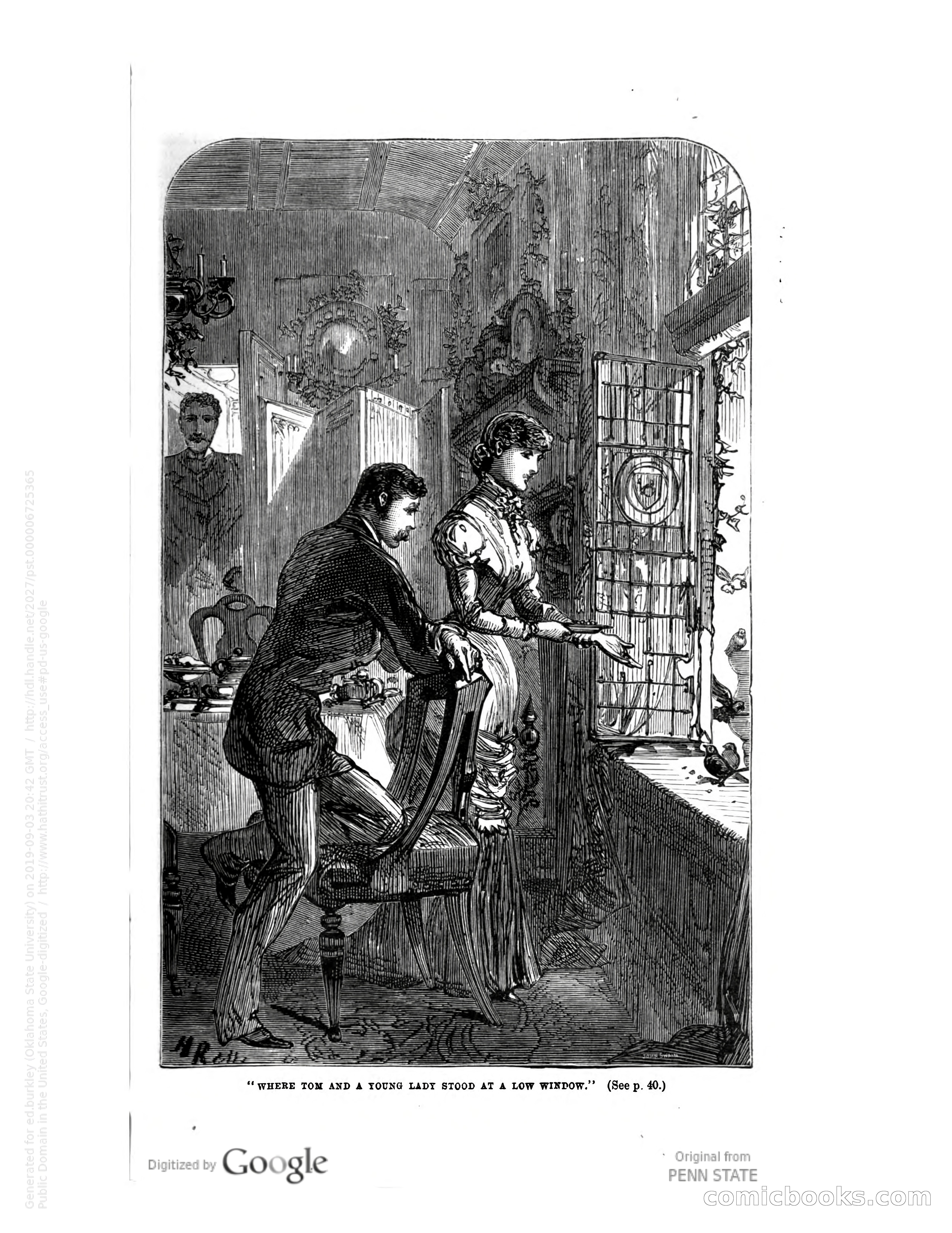
# Page Analysis This is an **illustration** from a book or magazine, showing a Victorian-era domestic scene. The engraving depicts a man and woman at a low window in an ornately decorated interior; a third figure appears in the background. The caption reads "WHERE TOM AND A YOUNG LADY STOOD AT A LOW WINDOW" with a page reference "(See p. 40)." The artwork uses cross-hatching and fine line work typical of 19th-century wood engraving or steel engraving. The detailed interior—with decorative moldings, bookshelves, and furnishings—suggests this illustrates a narrative work, likely Victorian-era fiction. The page was digitized by Google from Penn State's collection.

Stories with a Vengeance — page 46 of 142
46 / 142
What you’re looking at · open this page on its own ↗

This appears to be a page of story prose from a pulp magazine, heavily degraded and difficult to read clearly due to the image quality. The text is printed in a single column and appears to contain narrative fiction, though the OCR rendering is too fragmented and error-filled to reliably convey specific plot details or character names. The page shows typical pulp magazine formatting with dense text blocks. Given the poor legibility of both the image and OCR text, I cannot confidently identify the specific story content, characters, or plot points that would allow me to accurately describe what this page discusses.

Stories with a Vengeance — page 47 of 142
47 / 142
What you’re looking at · open this page on its own ↗

# Page Analysis This is a **text-only story page** (page 43) from *The Haunted Ransom*, a pulp fiction narrative. The page contains two chapters: the conclusion of an earlier chapter where a character named Beatrice Lawrence departs after Christmas Eve dinner, followed by **Chapter IV**, which opens with Tom inviting Martin into a billiard room to discuss an unspecified, potentially troubling matter. The narrator then describes smoking cigars with Martin while observing his emotional struggle, eventually leading Martin to share a story about his mother's premature aging and emotional hardship, apparently caused by his father's death and the resulting family responsibilities.
Stories with a Vengeance — page 48 of 142
48 / 142
What you’re looking at · open this page on its own ↗

This is a page of story prose from a pulp magazine titled "The Haunted Hansom." The text, presented in two columns, continues a narrative about a character named Charlie who disappeared from London on December 23rd. The narrator (apparently named Martin or Tom) describes his frantic search for Charlie, including visiting the train station and discovering Charlie's luggage in the cloak-room. The passage details Tom's visit to Lady Southfield's residence on Christmas morning to inquire about Charlie's whereabouts, revealing tension and concern about Charlie's mysterious disappearance and possible illness. The story appears to be a mystery or suspense narrative involving family relationships and unexplained circumstances.

Stories with a Vengeance — page 49 of 142
49 / 142
What you’re looking at · open this page on its own ↗

# Analysis of Page 45 This is a page of story prose from *The Haunted Ransom*, appearing as Chapter V. The narrative describes a dramatic emotional moment where the protagonist receives distressing news about his brother Charlie's fate. The speaker recounts how Lawrence, upon hearing this information, becomes intensely affected—his hands grip the narrator's shoulders while he demands details about Charlie's whereabouts and what happened "last night." The narrator then reveals that Charlie has been murdered, prompting Lawrence's anguished vow to seek vengeance. The passage concludes with the narrator and Lawrence preparing to travel to town by train, after which the narrator must speak with a woman named Beatrice about the matter.

Stories with a Vengeance — page 50 of 142
50 / 142
What you’re looking at · open this page on its own ↗

This page contains story prose from what appears to be a detective or crime fiction narrative. The text describes the narrator's discovery that their friend Charlie has been murdered and their subsequent involvement with Scotland Yard detectives investigating the crime. The story reveals that a cab driver connected to the case has disappeared, and a detective eventually tracks down a vagrant in Whitechapel whom they suspect of the murder. The text indicates this vagrant confessed to causing the death of "Mr. Charles Lawrence" through actions that occurred on Christmas morning. The narrative concludes with the vagrant apparently dying in police custody from mental breakdown, apparently disturbed by guilt over the crime.

Stories with a Vengeance — page 51 of 142
51 / 142
What you’re looking at · open this page on its own ↗

# Page Content Analysis This is a text-only page of story prose from "The Haunted Hansom" (page 47). The narrative describes a detective's account of a murder investigation involving a cab driver named Charles Lawrence who killed Jim Bullen during a robbery four years prior. The text details Lawrence's crime, his escape, and his eventual descent into madness and suicide. The passage then transitions to Chapter VI, where the narrator explains how police searched the murder scene and how he subsequently returned to London, only to be summoned again a month later to his friend's house, which has become a place of mourning following an apparent death in the family.

Stories with a Vengeance — page 52 of 142
52 / 142
What you’re looking at · open this page on its own ↗

# Page Analysis This is a prose fiction page from "The Haunted Hansom" (visible in the header). The text consists of narrative passages describing the narrator's emotional reflections on leaving a cherished English home called The Priory. The narrator recalls being moved by one of the building's inhabitants, then notes that a final visit occurred in early summer. The passage transitions to mention waiting to take out someone named Beatrice, described as "an awful little tyrant" in an affectionate way. The writing style and content suggest this is Gothic or sentimental fiction from the early 20th century. No illustrations or advertisements appear on this page.

Stories with a Vengeance — page 53 of 142
53 / 142
What you’re looking at · open this page on its own ↗

# Page Analysis This is a text page from a naval adventure story titled "The Captain of the Fortune" by Percy B. St. John. It shows Chapter I, which introduces Captain Henry Arundel, a young naval officer being reassigned to command the H.M. Fortune. The text describes Arundel's background—his family connections, his naval service in the China seas fighting pirates, and his delicate health—and depicts a private dinner conversation between the Port Admiral and Captain Arundel, where the Admiral begins to share confidential information. The page contains no illustrations or advertisements, only printed narrative prose.

Stories with a Vengeance — page 54 of 142
54 / 142
What you’re looking at · open this page on its own ↗

# Page Analysis This is a prose story page (page 60) titled "THE CAPTAIN OF THE FORTUNE" at the top. The text consists entirely of dialogue and narrative describing preparations for a voyage. A young captain named Arundel discusses with an Admiral the assignment of a well-appointed vessel called the Fortune for a special naval service mission. The passage also introduces passengers boarding the ship, including Captain Harcourt (commanding the vessel), his daughter Lucy (an eighteen-year-old English girl), and a retired judge returning to England. The narrative establishes the voyage's mysterious destination and introduces various characters who will apparently feature in the story.

Stories with a Vengeance — page 55 of 142
55 / 142
What you’re looking at · open this page on its own ↗

# Page Analysis This page contains story prose from a work titled "The Captain of the Fortune" (visible in the header). The text describes social dynamics aboard a ship, focusing on a young woman named Lucy Morton who is the daughter of a judge. The passage details the attention she receives from various officers and gentlemen aboard the vessel, including Captain Bennett Spencer and others. It then shifts to describe Captain Harcourt's growing concern about dangerous weather conditions—a severe gale approaching from an unexpected direction—prompting him to order heightened vigilance and preparations for the storm. The narrative appears to be a maritime adventure or romance story typical of early pulp fiction.

Stories with a Vengeance — page 56 of 142
56 / 142
What you’re looking at · open this page on its own ↗

# Page 52: Story Prose from "The Captain of the Fortune" This page contains printed story prose in two columns, appearing to be from Chapter II titled "Opening Orders." The narrative describes a ship called the Fortune and its crew responding to a storm. Captain Arundel consults with his officers about mysterious ship disappearances in the area, including the Dublin Castle, City of Glasgow, and Red Chief. The text discusses the possibility that pirates or criminal activity may be responsible for these losses at sea. The passage includes dialogue between the captain and his lieutenant, Travers, regarding their mission to investigate these disappearances along a particular sea route.

Stories with a Vengeance — page 57 of 142
57 / 142
What you’re looking at · open this page on its own ↗

# Analysis of Page 63 This is a **story prose page** from "The Captain of the Fortune," a pulp adventure narrative. The text depicts a dramatic conversation between Bill Hatton, an elderly sailor, and Lieutenant Travers aboard a ship. Hatton cryptically warns of pirates operating near some islands, claiming to have knowledge of villainous activity in the area for fifty years. When pressed for details, he becomes evasive and reticent, refusing to elaborate further. Travers notes Hatton appears thoroughly convinced of the danger he's describing. The passage captures the tension of the revelation, with Travers and Captain Arundel concerned about the implications of these mysterious threats to their vessel and crew.

Stories with a Vengeance — page 58 of 142
58 / 142
What you’re looking at · open this page on its own ↗

# Page Analysis This page contains **story prose** from "The Captain of the Fortune," a naval adventure narrative. The text depicts a dramatic encounter at sea where the British frigate *Fortune* discovers an approaching vessel through the mist. Lieutenant Travers orders the crew to prepare for possible combat with what appears to be pirates. Captain Arundel is awakened and takes command. The approaching ship is identified as the *City of Glasgow*, an Indiaman (merchant vessel), and Captain Carstairs boards the *Fortune* to explain that they encountered pirates attempting to attack his ship. The page is numbered 54 and shows no illustrations—only dense columns of printed text.

Stories with a Vengeance — page 59 of 142
59 / 142
What you’re looking at · open this page on its own ↗

This is a text page from a pulp fiction story titled "The Captain of the Fortune." The page contains two chapters: the end of Chapter II and the beginning of Chapter III. The narrative describes the crew's search for the Dublin Castle after a storm, with dialogue between characters named Arundel, Henry Arundel, Travers, and Hatton. Chapter III begins with the Dublin Castle encountering dangers at sea, including a sharp lookout for shoals and rocks. The page is entirely prose with no illustrations, focusing on nautical adventure and the crew's efforts to survive and locate the missing vessel.

Stories with a Vengeance — page 60 of 142
60 / 142
What you’re looking at · open this page on its own ↗

This page contains story prose from "The Captain of the Fortune," shown as page 56. The text describes a ship in severe distress during a storm, with six feet of water in the hold. The captain addresses his crew and passengers with calm authority, ordering them to prepare lifeboats and rations while maintaining discipline. He addresses the situation pragmatically, noting the ship may be lost but asserting their duty to survive. The passage emphasizes the captain's composed demeanor as he directs evacuation procedures, including the famous maritime protocol of "children first, women next" before crew and passengers. The narrative focuses on the crisis management and crew response to the apparent sinking.

Stories with a Vengeance — page 61 of 142
61 / 142
What you’re looking at · open this page on its own ↗

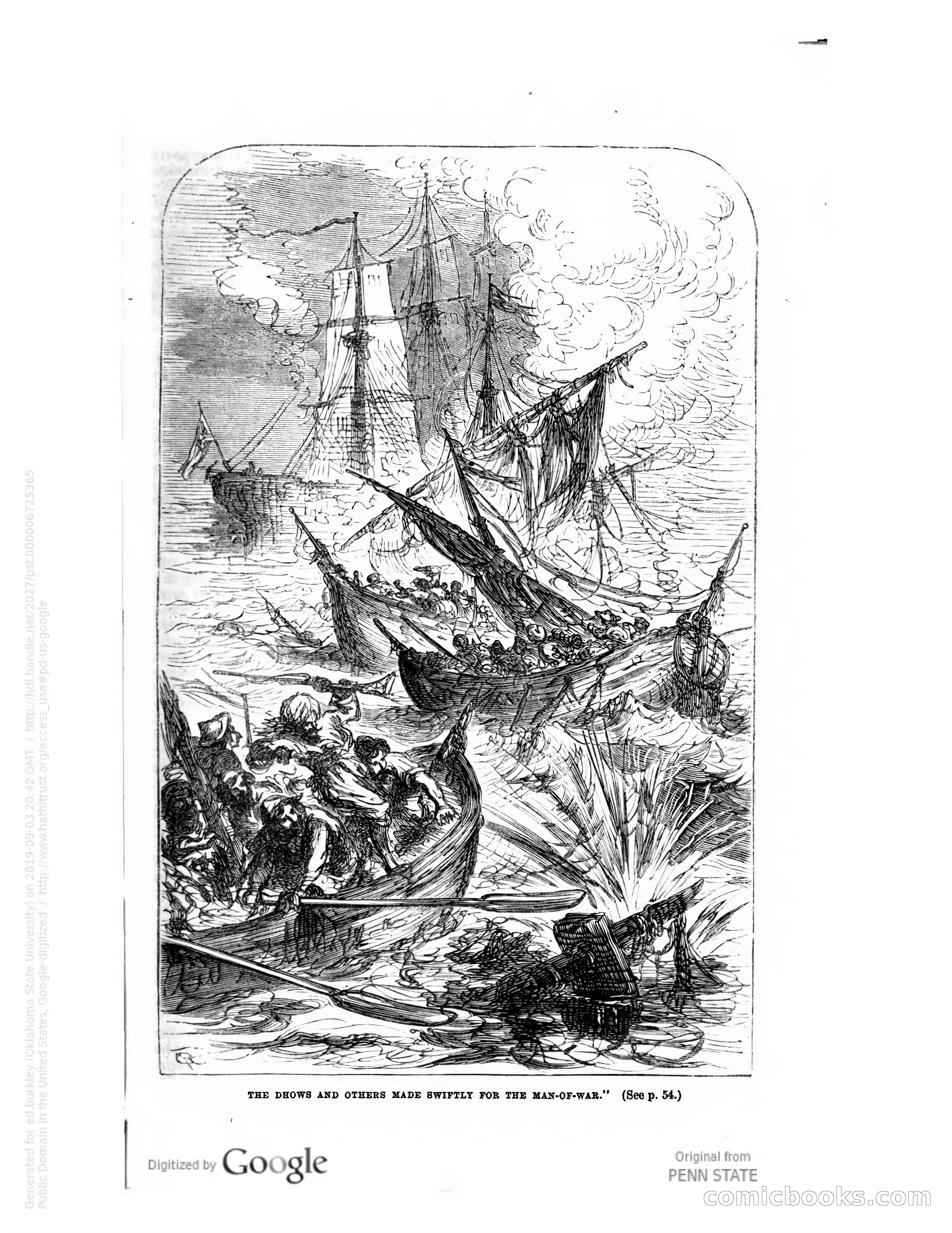
This page is a full-page illustration rendered in black-and-white engraving style. The caption reads "THE DROWS AND OTHERS MADE SWIFTLY FOR THE MAN-OF-WAR." (See p. 54.) The image depicts a dramatic maritime scene showing multiple small boats and their occupants rushing toward or away from a large sailing vessel in the background. The composition features dynamic action with figures in the foreground boats and detailed rigging on the tall-masted ship. Heavy clouds of smoke or steam rise from the right side of the composition, suggesting combat or disaster. The style is typical of early pulp fiction illustration, with intricate crosshatching and line work characteristic of wood engraving or similar period techniques.

Stories with a Vengeance — page 62 of 142
62 / 142
What you’re looking at · open this page on its own ↗

This appears to be a mostly blank page from a digitized pulp magazine, with scattered small text fragments visible throughout but largely illegible in the image. The page shows the Google digitization footer at the bottom and indicates the original source as "PENN STATE." The sparse, dispersed text elements suggest this may be a transition page, advertisement page, or section break within the magazine rather than a story page with continuous narrative. Without being able to read the specific text clearly, I cannot determine the exact content or subject matter of what this page discusses.

Stories with a Vengeance — page 63 of 142
63 / 142
What you’re looking at · open this page on its own ↗

This page contains story prose from "The Captain of the Fortune," appearing in a pulp magazine. The text describes a group of passengers and crew members who have abandoned their ship and are traveling by raft toward land. After landing on shore, they establish a camp and post sentries. That night, a broadside is fired at no great distance, alarming Captain Harcourt and his crew. The captain speculates whether the shot might be from pirates, orders the men to arm themselves, and prepares the group for potential conflict. The passage emphasizes maintaining discipline and readiness while the group remains uncertain about the source of the attack.

Stories with a Vengeance — page 64 of 142
64 / 142
What you’re looking at · open this page on its own ↗

This page contains story prose from "The Captain of the Fortune," appearing as pages 60-61 of the text. The narrative describes Captain Harcourt and his crew encountering pirates on an island. After initial confrontation, Harcourt rallies his men to defend themselves, declaring they are "a hundred well-armed Englishmen." The pirates, led by a physically commanding man in Arab costume, eventually retreat after the crew fires upon them. Chapter IV then begins, describing how the Captain of the Fortune's ship is carefully positioned near shore, with half the crew transferred to a smaller craft to scout landing locations. The text emphasizes the group's cautious approach to an unfamiliar island landscape.

Stories with a Vengeance — page 65 of 142
65 / 142
What you’re looking at · open this page on its own ↗

# Page Analysis This is a text-only page of story prose from what appears to be "The Captain of the Fortune," showing page 61. The narrative describes the rescue of survivors from a shipwreck by Captain Arundel and crew. The visible text details how the Dublin Castle men discover wrecked passengers and crew on an island, with Captain Harcourt boarding the Fortune to hear about a pirate den. The passage covers the reunion of separated brothers, medical care for the wounded, and arrangements for accommodating survivors. The prose is typical Victorian-era adventure fiction emphasizing heroism, duty, and nautical drama.

Stories with a Vengeance — page 66 of 142
66 / 142
What you’re looking at · open this page on its own ↗

This page contains story prose from "The Captain of the Fortune," presented in two columns of text. The narrative describes the resolution of Captain Arundel's shipwreck and his return to England. The visible text covers several plot developments: Arundel's brother Henry learning of the wreck's destruction, Henry's visit to Morton House to claim his inheritance, and a romantic subplot involving Henry proposing to a woman named Lucy. The passage concludes with Henry accepting a naval commission and agreeing to marry Lucy, with a note that he remains ready for military service if needed. The page number 62 appears at the top.

Stories with a Vengeance — page 67 of 142
67 / 142
What you’re looking at · open this page on its own ↗

# "A Ghost in the Witness-Box" by Charles H. Ross This page contains the opening of Part I ("The Marrying Man"), presenting story prose rather than illustration or cover material. The text begins with a newspaper advertisement from about a century ago, in which a gentleman seeks a female companion for domestic comfort and marriage. The narrative then describes how responses arrived at a shop, with one reply requesting that a person named "A. Z." attend a particular church in specific attire to meet a stranger. The passage suggests confusion about whether "A. Z." actually appeared at the church, setting up what appears to be a mystery involving mistaken identity or deception.

Stories with a Vengeance — page 68 of 142
68 / 142
What you’re looking at · open this page on its own ↗

# Page Analysis This is a text page from a pulp fiction story titled "A Ghost in the Witness-Box." The page contains two sections of prose narrative. The first section concludes a scene involving a newly married couple and mysterious "top boots" that have alarmed household staff, with the husband departing in a hackney coach. The second section, titled "PART II. THE MAN WHO WOULD NOT MARRY," begins a new narrative set in 1828 in Suffolk county, introducing a young woman named Maria whose face and figure have reportedly been ruined, leading to her disgrace and death. The text appears to be mystery or gothic fiction typical of early pulp magazines.

Stories with a Vengeance — page 69 of 142
69 / 142
What you’re looking at · open this page on its own ↗

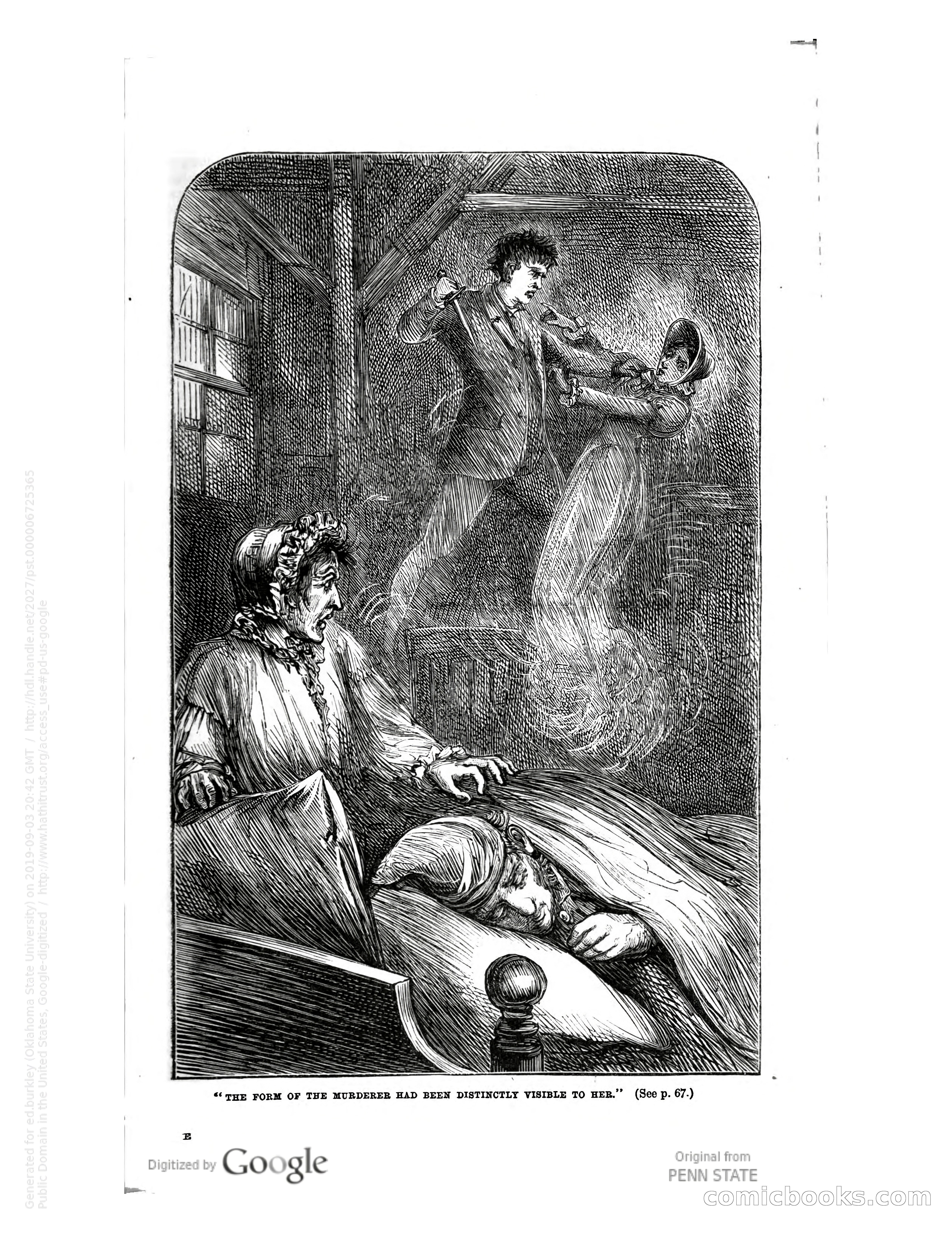
This page contains a black-and-white engraved illustration accompanying a story. The caption reads: "THE FORM OF THE MURDERER HAD BEEN DISTINCTLY VISIBLE TO HER." (See p. 67.) The dramatic scene depicts what appears to be a supernatural or ghostly encounter in an interior setting. A seated woman in period dress observes two figures—one appears to be a materialized spirit or apparition in flowing robes—while another figure moves in the background. The style and subject matter suggest this is from a horror or mystery story, likely from an early-20th-century pulp publication. The engraving technique and Gothic atmosphere are characteristic of period pulp illustration.

Stories with a Vengeance — page 70 of 142
70 / 142
What you’re looking at · open this page on its own ↗

This appears to be a nearly blank page from a pulp magazine, likely serving as a section divider or end-of-story page. The page contains only scattered punctuation marks and dots scattered across white space, with no readable body text visible. At the bottom, standard publication information appears: "Digitized by Google" on the left and "Original from PENN STATE" on the right. The page's content is too minimal to determine specific story details or subject matter. It functions primarily as filler between sections rather than containing substantive narrative or illustrative material.

Stories with a Vengeance — page 71 of 142
71 / 142
What you’re looking at · open this page on its own ↗

# Page 67: Story Prose from "A Ghost in the Witness-Box" This page contains two columns of prose fiction text from a story titled "A Ghost in the Witness-Box." The narrative describes a mysterious case involving a young woman and an alleged murder. The visible text recounts details about a man's disappearance with his wife, subsequent correspondence bearing a London postmark, and a horrifying discovery in a barn where a murdered girl's remains are found. The passage emphasizes the mother's supernatural vision revealing the crime's location and the murderer's identity. The text appears to be mid-story, presenting testimony or narration of these strange and criminal events in the style typical of early horror-mystery pulp fiction.

Stories with a Vengeance — page 72 of 142
72 / 142
What you’re looking at · open this page on its own ↗

This page contains story prose from "Part III: The Hanged Man," a section of a narrative titled "A Ghost in the Witness-Box." The text discusses a legal case involving a man's execution for murder. It describes how the defense attempted to introduce the ghost as evidence, the difficulty in keeping the dream-ghost in the background during trial proceedings, and details of the execution itself, including the large crowd that gathered and the display of the murdered man's possessions afterward. The passage also mentions the condemned man's apparent innocence and his confession the following day, though the specific crimes referenced remain unclear from this excerpt alone.

Stories with a Vengeance — page 73 of 142
73 / 142
What you’re looking at · open this page on its own ↗

This is a story text page titled "LORD SEVERNOAK'S DAUGHTER" by M.H.H. The visible prose describes Lord Severnoak's financial ruin and his subsequent reduced circumstances, explaining how his faithful governess Mary Shadwell helped preserve some of the family's possessions from being sold. The narrative then introduces Cecil, Lord Severnoak's daughter, and describes her godmother's unexpected departure. The text goes on to detail the sale of the Castle's contents and Lord Severnoak's eventual isolated situation in a small house. The page contains two columns of dense narrative prose typical of early pulp fiction magazines.

Stories with a Vengeance — page 74 of 142
74 / 142
What you’re looking at · open this page on its own ↗

# Page 70: Story Prose from "Lord Severnoak's Daughter" This page contains story prose from a work titled "Lord Severnoak's Daughter." The narrative depicts a conversation between Cecil (apparently a young woman) and her father, an elderly nobleman. Cecil reads aloud from a letter she has received from someone named Mr. Webster regarding the purchase of estates. The elderly father becomes distressed upon learning that an ironmonger (a person dealing in iron goods) named Webster is involved in acquiring property connected to Severnoak Castle, which he finds socially degrading. The dialogue explores themes of class distinction, family honor, and financial circumstances affecting the aristocratic household.

Stories with a Vengeance — page 75 of 142
75 / 142
What you’re looking at · open this page on its own ↗

# Analysis of Page 71 This page contains **story prose** from a work titled "Lord Severnoak's Daughter" (visible in the header). The text depicts a conversation between characters named Cecil, Mary Shadwell, and Lord Severnoak regarding romantic and financial matters. Cecil discusses his engagement to his cousin and his prospects as a painter, while Lord Severnoak expresses concerns about the relationship and mentions Wilfred's arrival by train. The dialogue suggests domestic drama involving inheritance, family obligations, and romantic entanglements among upper-class characters. No illustrations are present—this is entirely typeset fiction text presented in two columns.

Stories with a Vengeance — page 76 of 142
76 / 142
What you’re looking at · open this page on its own ↗

This is a page of story prose from a pulp magazine titled "Lord Severnoak's Daughter" (visible at the top). The page contains two columns of text depicting a dramatic domestic conversation between family members. Cecil and her cousin Wilfrid discuss her father's circumstances and her future prospects, including questions about marriage and her family's financial situation. The dialogue suggests tension around Cecil's romantic prospects and her obligation to her aging father. No illustrations are present—this is purely text content continuing the narrative of what appears to be a romance or family drama story.

Stories with a Vengeance — page 77 of 142
77 / 142
What you’re looking at · open this page on its own ↗

This page contains story prose from "Lord Severnoak's Daughter." The narrative describes a conversation between Mary Shadwell and Mr. Webster regarding Lord Severnoak's estate, followed by an encounter between Mr. Webster and Cecil (apparently Lord Severnoak's daughter). The text depicts Mr. Webster's sudden infatuation with Cecil, describing her beauty and his emotional reaction. The passage concludes with Lord Severnoak's approval of the developing relationship between Webster and his daughter, suggesting the elder man views Webster as a suitable match despite social differences. The page is entirely text with no illustrations.

Stories with a Vengeance — page 78 of 142
78 / 142
What you’re looking at · open this page on its own ↗

This page contains story prose from "Lord Severnoak's Daughter," a serialized narrative. The text depicts dialogue and scenes involving Cecil (apparently Lord Severnoak's daughter), Mr. Webster (a well-educated man of wealth), and John Webster, who appears to be Mr. Webster's son. The passage describes Cecil's emotional reaction to viewing ancestral portraits at a castle, subsequent conversation about Mr. Webster's character and eligibility, and John Webster's tour of Severnoak Castle—a grand estate with an impressive picture gallery that he has purchased. The narrative focuses on romantic tension and the characters' observations of each other and their surroundings.

Stories with a Vengeance — page 79 of 142
79 / 142
What you’re looking at · open this page on its own ↗

# Page Analysis This is a page of story prose from "Lord Severnoak's Daughter," appearing on page 75 of the magazine. The text describes a dramatic romantic scene in which John Webster declares his love to Cecil, a young woman whose portrait hangs in the cottage where they've met. The passage conveys Webster's emotional desperation and Cecil's conflicted response as he urges her to become his wife, promising devotion to her service. The scene culminates with Webster pressing her hands to his lips before she asks him to leave, saying "Pray excuse me now." The narrative focuses on dialogue and internal emotion rather than action.

Stories with a Vengeance — page 80 of 142
80 / 142
What you’re looking at · open this page on its own ↗

# Page Analysis This is a page of story prose from a pulp fiction magazine, numbered page 76, titled "LORD SEVERNOAK'S DAUGHTER" at the top. The text depicts a conversation between Mary Shadwell and Cecil regarding her romantic feelings. Mary discusses her conflicted emotions about two suitors—her cousin Wilfred and John Webster—and seeks Cecil's advice about whom to marry. The passage shows Mary ultimately deciding to marry John Webster, despite his modest circumstances, because she values his character and genuine affection. The dialogue explores themes of love, family duty, and social position in what appears to be a romantic or domestic drama storyline.

Stories with a Vengeance — page 81 of 142
81 / 142
What you’re looking at · open this page on its own ↗

This is a page of story prose from a pulp magazine, specifically page 77 of "Lord Severnoak's Daughter." The text describes the romantic relationship between John Webster and Lord Severnoak's daughter Mary Shadwell following their marriage. It depicts their emotional connection, including a tender scene where Mary expresses her deep love for John, who initially struggles to believe she loves him as much as he loves her. The passage explores their growing affection over two years of marriage and the birth of their grandson, with particular emphasis on Mary's declaration that she loves John more than anyone else in the world.

Stories with a Vengeance — page 82 of 142
82 / 142
What you’re looking at · open this page on its own ↗

# Page Analysis This page shows the opening of a story titled "YEARS AGO" by George Manville Penn. It is pure prose text with no illustrations or advertisements visible. The narrative begins with dialogue between characters named Phil and Humphrey aboard what appears to be a naval vessel. The speaker recalls events from years earlier during a cruise near New Orleans, describing shipboard life, the sailors' anticipation of visiting the city, and their observations of the crew's behavior and dynamics. The text mentions concerns about the crew's conduct and references to "the massacre of their white masters," suggesting the story may involve historical conflicts or racial tensions of the period.

Stories with a Vengeance — page 83 of 142
83 / 142
What you’re looking at · open this page on its own ↗

# Page 79: Story Prose This page contains prose fiction text in two columns. The narrator describes attending social events and dinners in what appears to be a colonial or Caribbean setting, mentioning cotton brokers and local grandees. The text focuses on the narrator's encounter with a handsome man named Phil at a ball, describing Phil's appearance and charm, and recounting how the narrator lost sight of him during the evening's festivities. The passage includes observations about the social scene, the women present, and the narrator's conflicted feelings about Phil—admiring his good looks while noting what the narrator perceives as his lack of intelligence or substance.

Stories with a Vengeance — page 84 of 142
84 / 142
What you’re looking at · open this page on its own ↗

# Page Analysis This is a text-only page (page 80) from a pulp fiction story titled "Years Ago." The narrative appears to be a first-person account of a dramatic evening at what seems to be a social gathering or dance. The visible text describes the narrator's interaction with a woman named Mademoiselle Levine, a subsequent confrontation with someone named Harding over the woman's affections, and an escalating altercation involving a knife that causes chaos in a saloon. The passage emphasizes tension, jealousy, and violence, with the narrator describing feeling shocked and confused as events spiral out of control. The prose style and content are consistent with early 20th-century pulp fiction conventions.

Stories with a Vengeance — page 85 of 142
85 / 142
What you’re looking at · open this page on its own ↗

This is an illustration accompanying a story in a pulp magazine. The image shows a dramatic scene rendered in black-and-white ink, depicting multiple figures in what appears to be an interior setting. The composition is oriented sideways on the page, requiring rotation to view properly. The OCR text is largely illegible in this reproduction, making it difficult to determine the specific story title or plot details with certainty. Based on the artistic style and composition, this appears to be a typical early-20th-century pulp illustration meant to capture a pivotal, action-oriented moment from the accompanying narrative. The exact subject matter of the scene remains unclear from the visible image alone.

Stories with a Vengeance — page 86 of 142
86 / 142
What you’re looking at · open this page on its own ↗

# Page Description This is a mostly blank page with scattered dots and small marks distributed across a white background. The page appears to be either the back of a cover, an endpaper, or a transitional page between sections in the magazine. The visible text at the bottom indicates this is from a publication digitized by Google and originally from Penn State University's collection. No readable story text, illustrations, or advertisements are discernible on this page. The marks and dots visible may be artifacts from the scanning or aging process rather than intentional content.

Stories with a Vengeance — page 87 of 142
87 / 142
What you’re looking at · open this page on its own ↗

This page contains story prose from what appears to be a serialized adventure narrative. The text describes a dramatic scene involving a wounded woman named Manette Levine, a surgeon treating injuries from an apparent altercation, and the narrator's observations of tensions between characters—particularly involving a man named Harding and a rival named Louis Canville. The passage includes dialogue and internal monologue exploring romantic jealousy and the aftermath of violence. The narrator mentions fainting from blood loss and being cared for at a house. The dense prose suggests this is mid-story, continuing an ongoing plot involving personal conflict and possible danger.

Stories with a Vengeance — page 88 of 142
88 / 142
What you’re looking at · open this page on its own ↗

# Page Analysis This page contains **story prose** from a pulp fiction narrative, presented in two columns of dense text. The visible content depicts a conversation between characters—including someone named Harding, Phil, and references to a wounded girl being cared for by an old black servant named Manette. The narrator describes physical weakness and pain while recovering, discusses a challenge or duel that has been issued, and deliberates about matters of honor and whether to engage in a confrontation. The passage suggests a maritime or nautical setting, with mentions of a ship's skipper and wind conditions. The tone is dramatic and introspective, typical of early pulp adventure fiction.

Stories with a Vengeance — page 89 of 142
89 / 142
What you’re looking at · open this page on its own ↗

This page contains story prose from a pulp fiction narrative. The text describes a narrator's preparations for a duel and subsequent journey to a plantation meeting place with Captain Merret. The passage details the narrator's physical condition following a wound, his feverish night, and a pre-dawn departure across dewy grounds toward "an opening by a plantation, with not a house for certainly half a mile." The narrative includes dialogue between characters discussing the duel and its potential outcomes, including references to someone named Manette and expressions of resignation about the dangerous affair. The prose style and subject matter are typical of early adventure or romantic fiction from the pulp era.

Stories with a Vengeance — page 90 of 142
90 / 142
What you’re looking at · open this page on its own ↗

# Page Analysis This is a page of story prose (page 86) from a pulp magazine titled "YEARS AGO." The text continues a narrative involving several characters including Waiting, Merret, Phil, Canville, Harding, and a wounded girl. The narrator describes returning from a ship and subsequent events in what appears to be New Orleans, including encounters with various characters and references to illness (cholera mentioned). The prose discusses romantic entanglements, jealousy, and mysterious circumstances surrounding a woman's death. Section IV begins at the bottom, focusing on Harding's possible involvement in poisoning. The writing style and content are consistent with early adventure or mystery pulp fiction.

Stories with a Vengeance — page 91 of 142
91 / 142
What you’re looking at · open this page on its own ↗

# Page Analysis This is a text page from a pulp magazine containing the beginning of a story titled "The Doctor's Story," part of a larger work called "Some Authenticated Ghost Stories" by H. L. Cowen. The visible prose describes a doctor's specialty in treating soldiers, set in an Eastern colony. The narrator explains he will recount a supernatural experience involving a location called Seelie House (or Pearl Island) in the Indian Ocean. The text establishes the story's setting and introduces a colonial mansion with a peculiar history, including mention of a former high colonial official who wore a distinctive beard and was known by nicknames in the local community. The story appears to be building toward a ghost narrative.

Stories with a Vengeance — page 92 of 142
92 / 142
What you’re looking at · open this page on its own ↗

# Page Analysis This is a **story prose page** from a pulp magazine, numbered 88 and titled "SOME AUTHENTICATED GHOST STORIES" at the header. The text describes a narrative set in colonial India, focused on a young woman named Effie Somerville who arrives at Cocoburg (appears to be a fictional Anglo-Indian settlement). The narrator recounts details of her appearance and character, then describes a Christmas Eve incident where Miss Somerville mysteriously becomes ill—discovered nearly unconscious in her room with physical symptoms including blood on her face and neck. The passage suggests supernatural or mysterious circumstances, though the exact cause remains unclear from this excerpt alone. The page contains no illustrations, only dense double-column text typical of early pulp magazine formatting.

Stories with a Vengeance — page 93 of 142
93 / 142
What you’re looking at · open this page on its own ↗

This page contains prose text from a ghost story, printed in two columns. The narrative concerns a character named Miss Somerville who experienced a mysterious illness or supernatural encounter on New Year's Eve. The narrator describes investigating her condition with Mr. and Mrs. Champneys, discovering locked doors and unexplained phenomena. Later, a portrait of what appears to be an elderly man named Sir Angus Strengtharm surfaces, which Miss Somerville claims to recognize as someone she saw in her room—though he is supposedly dead. The text explores whether these events represent genuine supernatural occurrence or psychological delusion, with characters debating rational versus supernatural explanations for the incidents.

Stories with a Vengeance — page 94 of 142
94 / 142
What you’re looking at · open this page on its own ↗

This page contains story prose from a section titled "The Cantarrice's Story." The text describes a theatrical ghost story supposedly originating from the Teatro Reale in Palermo, Italy. The narrator, an opera singer, explains how he was asked to perform the role of Romeo at this haunted theater, where the ghost of a woman named Giulietta allegedly appeared during performances of Mercutio. The passage details the supernatural legend and the narrator's reluctance to take the role, fearing a confrontation with the apparition. The text appears to be part of a larger collection titled "Some Authenticated Ghost Stories," as indicated by the page header.

Stories with a Vengeance — page 95 of 142
95 / 142
What you’re looking at · open this page on its own ↗

# Page Analysis This is a text-only page (page 91) from a ghost story collection titled "Some Authenticated Ghost Stories." The visible prose describes a narrator's experience performing in an opera production, apparently dealing with supernatural or mysterious stage occurrences. The text references an opera called "I Puritani" and mentions various theatrical elements—costumes, stage effects, and backstage incidents. A poster advertising the upcoming Monday opera performance is quoted. The narrative appears to concern itself with unexplained phenomena during theatrical rehearsals and performances, fitting the ghost-story anthology format. No illustrations are visible on this page.

Stories with a Vengeance — page 96 of 142
96 / 142
What you’re looking at · open this page on its own ↗

This page contains story prose from a pulp fiction magazine, numbered page 92. It presents "The Quadroon Nurse's Story," section III of a larger narrative. The text consists of dialogue and first-person narration, with a character named Araminta responding indignantly to criticism about her manner of dress, asserting her respectability. The narrator then transitions to recounting a story from "the good old West Indian time," apparently a ghost or supernatural tale that Araminta will relate. The page is entirely text with no illustrations visible.

Stories with a Vengeance — page 97 of 142
97 / 142
What you’re looking at · open this page on its own ↗

# Page Analysis This is a **story prose page** (page 93) from a pulp magazine titled "Some Authenticated Ghost Stories." The text recounts nostalgic memories of life on a sugar estate, apparently in the West Indies, during slavery or its aftermath. The narrator describes the plantation owner Mr. Bordmann, his family, and the various enslaved workers and domestic staff who lived there. The account details the material conditions, social hierarchies, and relationships on the estate, including descriptions of Miss Bella (the owner's daughter) and commentary on a Captain Clarkson and his relationship to Miss Bella. The narrative includes period-typical racial language and attitudes reflecting the historical era being described.

Stories with a Vengeance — page 98 of 142
98 / 142
What you’re looking at · open this page on its own ↗

# Page Description This page contains story prose from a ghost story titled "Some Authenticated Ghost Stories." The narrative describes a young woman named Bella whose fiancé, Captain Clarson, has gone missing. After days without communication, Bella hears mysterious sounds in the night—footsteps on the stairs and a clanking sword. She encounters what appears to be a white soldier's ghost ascending the staircase. The narrator witnesses this apparition and later learns that Captain Clarson had died of yellow fever in Falmouth around the time of the haunting. The page presents the supernatural encounter as a supposedly authenticated ghost story.

Stories with a Vengeance — page 99 of 142
99 / 142
What you’re looking at · open this page on its own ↗

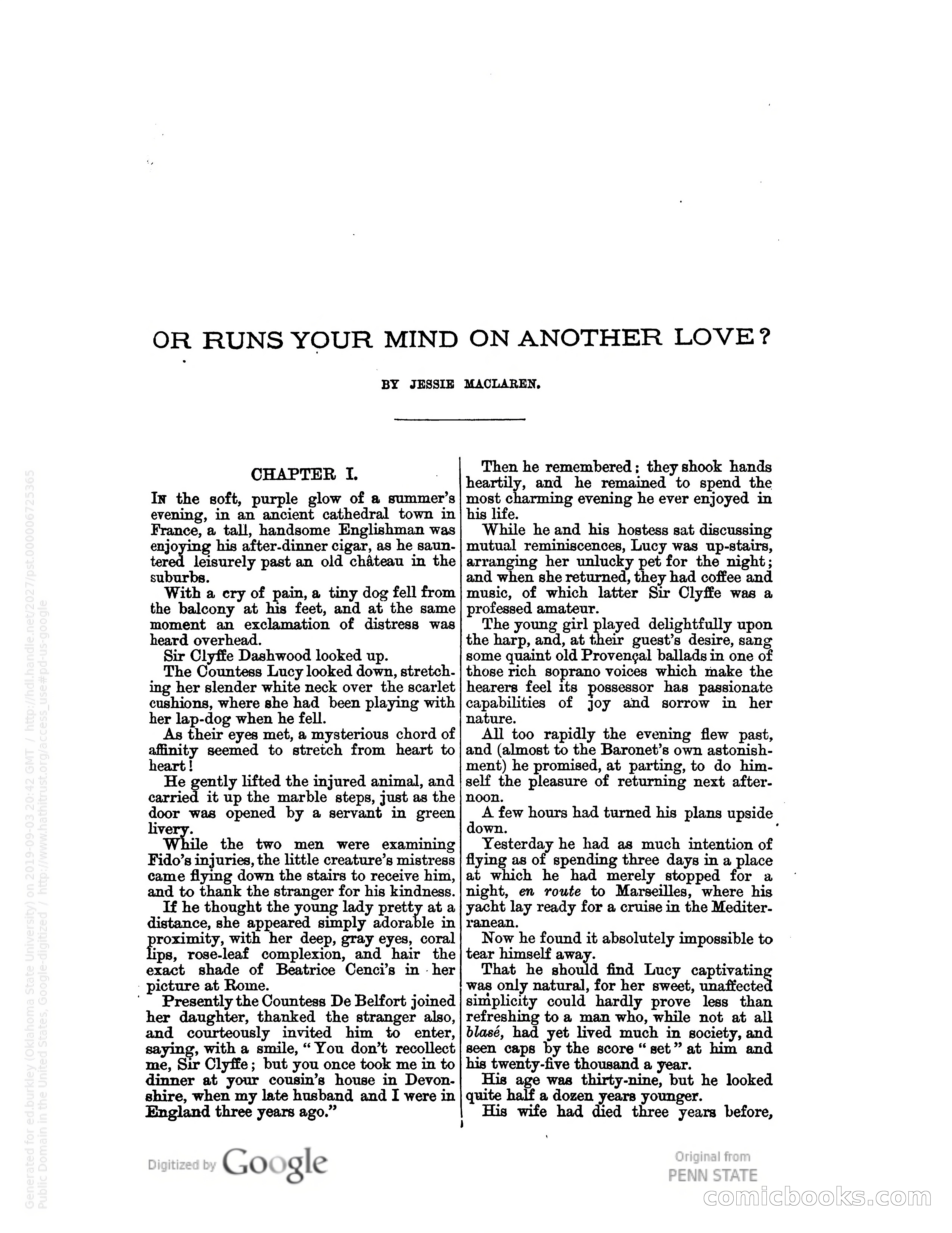
# Analysis of Page This is a **story text page** (not a cover or illustration) from a pulp fiction magazine. It shows Chapter I of a story titled "Or Runs Your Mind on Another Love?" by Jessie MacLaren. The visible text depicts a romantic scene in a French cathedral town where a tall English gentleman named Sir Clyffe Dashwood meets the Countess Lucy and her daughter. After an injured dog is brought in, the characters discuss mutual acquaintances and share music. The narrative suggests Sir Clyffe has altered his travel plans to spend time with Lucy, implying romantic interest, though his wife died three years prior.

Stories with a Vengeance — page 100 of 142
100 / 142
What you’re looking at · open this page on its own ↗

# Page Content Description This page contains **story prose** from what appears to be a serialized narrative. The text describes a dramatic domestic crisis in which Lady Dashwood strikes her sister Gertrude in a violent outburst of jealousy, causing Gertrude to have what seems to be an epileptic fit. The passage details the aftermath: Gertrude's subsequent mental illness, the family's distress, and Sir Clyffe's concern about his wife's sanity. The narrative indicates that Gertrude eventually recovers through medical treatment over several months, though she remains altered. The page focuses on interpersonal conflict, jealousy, and mental health consequences within what appears to be an aristocratic English household.

Stories with a Vengeance — page 101 of 142
101 / 142
Stories with a Vengeance — page 102 of 142
102 / 142
What you’re looking at · open this page on its own ↗

This page appears to be mostly blank or heavily degraded, with only scattered dots and marks visible across a white background. The image quality is poor, making it impossible to discern whether this is a cover, illustration, or text page from the pulp magazine. The OCR text provided is empty or unreadable. At the bottom, there is a Google Books digitization credit and a "Penn State" attribution as the original source. Without legible content, I cannot determine what story or advertisement this page contains or what subject matter it addresses.

Stories with a Vengeance — page 103 of 142
103 / 142
What you’re looking at · open this page on its own ↗

# Page 99: Story Prose This page contains two columns of story prose from what appears to be a serialized novel or novella. The narrative follows Sir Clyffe Dashwood's emotional turmoil regarding his cousin Lucy and various family matters at Clyffe Castle, a five-hundred-year-old structure by the sea. The text discusses romantic entanglements, a widowed relation, and a character named Gertrude. Chapter II begins partway down the page, shifting to describe a yacht journey and further developments in the romantic plot. The writing style and subject matter suggest this is likely Victorian-era melodrama or romantic fiction rather than science fiction or crime fiction.

Stories with a Vengeance — page 104 of 142
104 / 142
What you’re looking at · open this page on its own ↗

# Page Analysis This page contains story prose from a serialized novel titled "Or Ruin Your Mind on Another Love?" (visible in the header). The text shows Chapters III and IV of what appears to be a romantic fiction story. Chapter III depicts Sir Clyffe's farewell to Lucy, a betrothed couple parting at dawn with emotional dialogue about their upcoming separation and wedding plans. Chapter IV shifts focus to introducing Lady Clare Eliot's interest in Sir Clyffe's impending marriage, establishing potential romantic complications. The narrative style and subject matter—aristocratic characters, betrothal arrangements, emotional farewells—suggest this is conventional romantic or society fiction typical of early pulp magazine serialization. No illustrations are present on this page.

Stories with a Vengeance — page 105 of 142
105 / 142
What you’re looking at · open this page on its own ↗

This page contains story prose from what appears to be a romantic novel. It describes a striking woman who is younger-looking than her forty years, and recounts her relationship with Lord Marston and her life as Lady Dashwood. The narrative details her dressing-room, her past romance with a military officer, and preparations for an upcoming wedding. Chapter V begins partway down the page, addressing wedding-day arrangements and discussing with Sir Olyffe when the ceremony should occur, with reference to an old rhyme about lucky days for weddings. The text is primarily dialogue and narrative exposition with no illustrations visible.

Stories with a Vengeance — page 106 of 142
106 / 142
What you’re looking at · open this page on its own ↗

# Page 102: Story Prose This page contains printed story prose in two columns from what appears to be a romantic novel. The text describes a wedding scene and its aftermath, focusing on a character named Lucy and her marriage to Lord Marston. The narrative details the wedding ceremony at an old cathedral, the bride's appearance and grace, the guests in attendance (described as French nobility), and the couple's subsequent departure for a honeymoon tour in Italy and Switzerland before arriving at Clyffe Castle. The page ends with "CHAPTER VI," indicating a chapter break. There are no illustrations visible—only dense text formatting typical of early-20th-century pulp magazine layouts.

Stories with a Vengeance — page 107 of 142
107 / 142
What you’re looking at · open this page on its own ↗

This page contains story prose from what appears to be a romance or literary fiction narrative. The text is printed in two columns and comprises Chapter VII, which opens with Lord Marston's unusual decision to stay at his mansion at Dane Rook during winter rather than after Christmas. The chapter describes the deepening intimacy between two families, a pleasant autumn walk along cliffs near the Castle, and Lord Marston and Lucy's Indian file walk alongside Lady Clare and Sir Clyffe. The narrative focuses on romantic relationships, family dynamics, and countryside scenery rather than science fiction, horror, or crime elements typical of pulp magazines.

Stories with a Vengeance — page 108 of 142
108 / 142
What you’re looking at · open this page on its own ↗

This page contains story prose from what appears to be a serialized narrative. The text shows dialogue and narrative passages discussing the romantic and social entanglements of several characters, including Lord Marston, Lady Clare, Sir Clyffe, and others. The conversation centers on concerns about a young woman named Gertrude and her attachment to a much older man, with characters debating whether to intervene. Chapter VIII begins partway down the page. The prose style and subject matter suggest this is domestic fiction rather than science fiction or horror, though the exact publication and story title are not visible in this excerpt.

Stories with a Vengeance — page 109 of 142
109 / 142
What you’re looking at · open this page on its own ↗

# Page Analysis This page contains story prose from what appears to be a serialized romance or society novel. The visible text spans two chapters: the end of one chapter describing a woman named Lucy's unhappiness in her marriage to Lord Marsdon, and the beginning of Chapter IX, which describes preparations for a New Year's Eve ball at a castle. The narrative details costume dances planned for entertainment, including descriptions of Lady Clare's elaborate "Summer" costume in turquoise velvet with crimson roses. The page focuses on domestic drama and social events among the English upper classes, with no illustrations visible—purely text-based storytelling typical of early pulp magazine serials.

Stories with a Vengeance — page 110 of 142
110 / 142
What you’re looking at · open this page on its own ↗

This is a page of story prose from a pulp fiction magazine, specifically from a romantic novel titled "Or Ruin Your Mind on Another Love?" The text describes a dramatic scene at a formal ball where Lady Clare attends with Lord Marston, while Sir Clyffe observes them with yearning and regret. Lucy, apparently Sir Clyffe's neglected wife, watches from a window and reflects bitterly on her situation, wondering why her husband chose Lady Clare over their marriage. The passage conveys emotional tension and unrequited feelings among the characters at this social event. Chapter X begins at the page's bottom.

Stories with a Vengeance — page 111 of 142
111 / 142
What you’re looking at · open this page on its own ↗

This is a page of story prose from a pulp magazine, numbered 107. The text depicts a dramatic scene in which Lady Dashwood, apparently dead or unconscious on the floor, has been discovered by her husband Sir Clyffe and her maid Gertrude. The narrative describes Lucy's emotional distress, her trembling and inability to speak coherently, and Sir Clyffe's frantic response upon finding his wife. The scene involves dialogue between characters and appears to be the climax of a domestic drama or mystery plot. No illustrations are visible on this text-heavy page.

Stories with a Vengeance — page 112 of 142
112 / 142
What you’re looking at · open this page on its own ↗

# Page Analysis This page contains story prose from what appears to be a romantic drama or melodrama. The text shows a domestic crisis unfolding: Sir Clyffe confronts his wife Lucy about her affection for another man, while Lady Dashwood and servants deal with the aftermath of poor Miss Gertrude's apparent mental breakdown. The narrative involves emotional confrontations about love, jealousy, and marital duty, with references to a ball-room event and the castle clock striking midnight. The prose style and concerns with aristocratic propriety and social scandal are typical of early 20th-century pulp fiction, though the specific story title and author are not visible on this page.

Stories with a Vengeance — page 113 of 142
113 / 142
What you’re looking at · open this page on its own ↗

# Page 109: Story Prose from "Or Runs Your Mind on Another Love?" This is a text-only page of prose fiction, likely from the middle of a serialized story. The narrative focuses on Lady Clare, a widow at Dane Rock Hall, experiencing distress after a ball. The visible text describes her emotional turmoil following a reconciliation with a man, her subsequent isolation, and her descent into anxiety and superstition as she sits alone through the night, troubled by omens like an owl's cry. The page concludes with what appears to be a newspaper extract announcing "Sudden Death of Lady Clare Eliot" at Dane Rock Hall, suggesting the story's tragic trajectory.

Stories with a Vengeance — page 114 of 142
114 / 142
What you’re looking at · open this page on its own ↗

# Analysis of Page 1110 This is a page of story prose from a pulp magazine. The text describes the death of a woman—the widowed sister of a lord—found dead in bed. The passage explains that she had attended a ball at Clyfle Castle the previous evening in good health, but felt ill afterward. A bottle of chloral (a sedative drug) was discovered in her hand with the stopper removed. The text suggests the death may have resulted from a cold contracted at the event, though the chloral's presence raises questions. The passage concludes with information about the woman's earlier marriage in 1186 to Colonel Eliot of the Dragoon Guards. The narrative appears part of a mystery or gothic story exploring the circumstances of her death.

Stories with a Vengeance — page 115 of 142
115 / 142
What you’re looking at · open this page on its own ↗

This page contains the prologue to a short story titled "The Spectre of the Strand: A Tale of the Day" by J. Greville Burns. The text is entirely prose, with no illustrations visible. The prologue establishes a dark, atmospheric scene set on a rainy October night in London, describing the miserable weather and the hardship it creates for poor pedestrians. It then focuses on the area around Blackfriars Bridge, depicting the Thames and the desolate urban landscape. The narrator describes searching for corpses in the river and references a Times reporter's involvement, building an ominous, Gothic mood typical of period horror or mystery fiction.

Stories with a Vengeance — page 116 of 142
116 / 142
Stories with a Vengeance — page 117 of 142
117 / 142
What you’re looking at · open this page on its own ↗

This page is a black and white illustration from a pulp fiction magazine. The image depicts a nighttime scene at what appears to be a riverside dock or wharf, with a figure in period clothing standing on a railed platform near a street lamp. Below, a boat with several passengers is visible on the water. The caption reads "THAT'S THE SPECTRE OF THE STRAND!" with a reference to page 115. The engraving style and atmospheric rendering—with rain suggested by diagonal lines and shadowed architecture in the background—suggests this illustrates a dramatic moment from a mystery or supernatural story, though the exact plot details remain unclear from this page alone.

Stories with a Vengeance — page 118 of 142
118 / 142
What you’re looking at · open this page on its own ↗

# Page Analysis This is a page of story prose from a pulp fiction magazine titled "The Spectre of the Strand" (visible in the header). The text appears to be from a dramatic narrative involving military characters, specifically Colonel De Mourrier and a young woman named Adèle. The passage describes a tense scene where De Mourrier interrogates soldiers about a riot in Arras, Normandy, and a young woman rushes into the room. The narrative involves themes of military discipline, romance, and apparent civil unrest. The prose style and subject matter suggest this is likely an adventure or romantic fiction story, typical of early-20th-century pulp magazines.

Stories with a Vengeance — page 119 of 142
119 / 142
What you’re looking at · open this page on its own ↗

# Page 117: Story Prose from "The Specter of the Strand" This page contains story prose (no illustrations or advertisements visible). The narrative follows Colonel De Mourrier, a retired military officer who has married Adèle, a baker's daughter. The text describes how De Mourrier becomes mysteriously ill shortly after their wedding and gradually declines in health. Adèle attempts to help him, consulting a Doctor Blanche about his condition. The passage culminates in a dramatic scene where De Mourrier is shot while sitting on a park bench during what appears to be a moment of respite, collapsing fatally. His final words—"Tell André Marquier!"—suggest a mystery connected to his death.

Stories with a Vengeance — page 120 of 142
120 / 142
What you’re looking at · open this page on its own ↗

# Page Analysis This is a **story prose page** from a pulp magazine titled "The Spectre of the Strand" (visible in the header). The page shows **Chapter II** of what appears to be a Gothic or mystery story. The narrative describes events eight years after Colonel De Mowbray's death, focusing on his widow Adèle, now married to André Marquer. The text details Adèle's unhappy marriage to a gambling drunkard and introduces her young son Evremond, who fears ghosts and appears emotionally troubled. The passage explores themes of inheritance, family dysfunction, and the child's psychological disturbance, with dialogue between family members discussing the boy's behavioral problems and fears.

Stories with a Vengeance — page 121 of 142
121 / 142
What you’re looking at · open this page on its own ↗

This page contains story prose from Chapter III of "The Specter of the Strand," as indicated by the header. The text describes a domestic conflict between characters named Adèle, Marquer, and a child named André, apparently following Evremond De Mourrier's recovery from illness. The narrative focuses on tension within the household, including Adèle's attempts to protect the child from Marquer's cruelty, Jeanette's intervention on the child's behalf, and Marquer's subsequent anger and threats of punishment. The passage concludes with a scene of the child being led away from the house by a servant. The text is presented in two columns on the page with no illustrations visible.

Stories with a Vengeance — page 122 of 142
122 / 142
What you’re looking at · open this page on its own ↗

# Analysis of Page 120 from "The Spectre of the Steand" This page contains **story prose** — two columns of text from what appears to be a serialized narrative. The visible text depicts a emotional scene where a woman named Madame Massilon encounters a young boy (Evremond) and invites him into her carriage, offering him shelter and comfort. The passage emphasizes the boy's distress and vulnerability, describing his reaction to kindness and his memories of his deceased father. The narrative includes dialogue and emotional reflection, characteristic of early pulp fiction's sentimental storytelling style. No illustrations or advertisements appear on this page.

Stories with a Vengeance — page 123 of 142
123 / 142
What you’re looking at · open this page on its own ↗

# Page Description This is a text page (page 121) from a serialized story titled "The Spectre of the Strand." The visible prose describes a domestic scene where Madame Massilon and her daughter Marie meet with a young boy named Evremond, apparently their relative. The narrative focuses on Marie's emotional attachment to the delicate child and Madame Massilon's plan to arrange his education with a local schoolmaster. The passage explores themes of family affection, education, and parting, concluding with a bittersweet farewell scene in the garden. The text appears to be romantic or sentimental fiction typical of early pulp magazine serialization.

Stories with a Vengeance — page 124 of 142
124 / 142
What you’re looking at · open this page on its own ↗

# Page Content Analysis This is a text page from "The Spectre of the Strand," displaying prose fiction in two columns. The page contains Chapter IV, which focuses on a schoolmaster named M. Marat and a student named Evremond De Mourrier. The narrative describes M. Marat confronting Evremond about bringing a pupil to his school, with dialogue revealing tension between the characters. The text also discusses Evremond's growing affection for a girl named Marie Massilon and his physical development into adolescence. The passage appears part of a mystery or crime narrative involving accusations and emotional conflict among the characters.

Stories with a Vengeance — page 125 of 142
125 / 142
Stories with a Vengeance — page 126 of 142
126 / 142
What you’re looking at · open this page on its own ↗

# Page Description This is a prose story page from a pulp magazine titled "The Spectre of the Strand" (visible in the header). The page contains two columns of dense narrative text with no illustrations. The story concerns a young man named Evremond De Mouvrier who has learned that his beloved Marie has abandoned him and married another man named Mr. Ronpell, a city broker. The text describes Evremond's desperation and his confrontation with Marie, who refuses to see him. The passage ends with newsboys shouting about a forgery crime at a city merchant, introducing what appears to be a separate plot development.

Stories with a Vengeance — page 127 of 142
127 / 142
What you’re looking at · open this page on its own ↗

# Page Analysis: "The Spectre of the Strand" This is a text-only story page (page 125) containing prose fiction with no illustrations. The narrative concerns a man named Ervemond who, two years after a traumatic New Year's Eve incident, struggles with his inability to forgive a woman named Marie. The text reveals that Marie's husband died in prison as a convicted felon, and their child was placed in a common lodging-house. Ervemond torments himself over his past rejection of Marie and her subsequent disappearance into London's streets and poverty. The page depicts his emotional turmoil and desperate search for her through the city.

Stories with a Vengeance — page 128 of 142
128 / 142
What you’re looking at · open this page on its own ↗

This page contains the final prose of a story, followed by an "Epilogue" section. The main text describes the tragic discovery of a drowned woman's body in the Thames near Blackfriars Bridge during a storm, with her identity revealed through police investigation. The epilogue section begins with the declaration that "Erremond De Mourrier is dead!" and announces that "The Spectre of the Strand" is finished. It then describes finding a dead man in a cellar in Clare Market, Drury Lane, with the mysterious revelation that "Nature had reunited him to Marie!" The page marks the conclusion of the serialized story.

Stories with a Vengeance — page 129 of 142
129 / 142
What you’re looking at · open this page on its own ↗

# Analysis of Page This is a **story prose page** from a pulp magazine, titled "SAVED" by George Augustus Sala. The narrative appears to be a first-person account from a ladies' maid describing her experiences working for wealthy employers. The visible text discusses the maid's access to backstage theater secrets, her knowledge of her lady's wardrobe and jewelry, and various anecdotes about grand gentlemen, diamonds, and emeralds. The story includes references to the Italian Opera House, Mr. Triballs (a pawnbroker), and other London locations. The tone is gossipy and character-focused, typical of period fiction emphasizing social observation and domestic intrigue among the upper classes.

Stories with a Vengeance — page 130 of 142
130 / 142
What you’re looking at · open this page on its own ↗

# Page 123: Story Prose This page contains dense narrative prose from a story titled "SAVED." The narrator recounts a social anecdote about Lady Harriette Dash, whose husband Stephen Dash became a Government clerk and eventually rose to prominence as a Privy Councillor and Under Secretary of State. The passage humorously describes Stephen's grueling work ethic—staying at his office from morning through evening, enduring poor working conditions, wearing uncomfortable clothing, and drinking strong tea—while suggesting his wife had grand social ambitions that he could not fulfill. The text appears to be from an early 20th-century fiction magazine, though the specific publication is unclear from this page alone.

Stories with a Vengeance — page 131 of 142
131 / 142
What you’re looking at · open this page on its own ↗

# Page Analysis This page is a **black-and-white illustration** (not prose text) from what appears to be a Victorian-era literary work. The image depicts a scene at what looks like a railway station or public building, with a well-dressed woman in the foreground holding a parasol, while behind her a bearded man in a cap appears to be having a conversation with another figure. The caption reads: "'THIS WAY, LADIES,' SAID A VERY CIVIL PORTER" (See p. 134), indicating this illustration accompanies story text on page 134. The engraving style and fashion suggest late 19th-century publication. The page notation indicates it was digitized by Google from Penn State's collection.

Stories with a Vengeance — page 132 of 142
132 / 142
What you’re looking at · open this page on its own ↗

This page is almost entirely blank, with only scattered small marks or dots visible across a white background. There is no discernible text content, illustration, or story prose that can be meaningfully read or analyzed. At the bottom of the page appear the Google Books digitization credit line and an indication that the original is from Penn State University. The page appears to be either a blank page from the original magazine, a separator page, or a digitization artifact. No substantive content about the magazine's story or advertisements is visible on this particular page.

Stories with a Vengeance — page 133 of 142
133 / 142
What you’re looking at · open this page on its own ↗

# Page Analysis This is a page of story prose (page 131, titled "SAVED") from what appears to be an early pulp magazine. The text is a first-person narrative in which a character describes Lady Harriette Brambledean, the youngest daughter of an Irish Earl, and her marriage to Lord Stephen Dash. The narrator discusses Lady Harriette's character, beauty, and unfortunate circumstances—including her unhappy marriage and her husband's indifference. The passage also introduces Count Zabidi, a foreign nobleman employed as a clerk in the narrator's household, whom the narrator describes as despicable, mysterious, and disliked. The narrative tone is gossipy and Victorian in style.

Stories with a Vengeance — page 134 of 142
134 / 142
What you’re looking at · open this page on its own ↗

This page contains story prose from a pulp fiction magazine. The text describes the social circumstances of a disreputable foreign nobleman—Count Zabidi—whom Lady Harriette has taken into her household, apparently against her husband's wishes. The narrative details the Count's scandalous reputation, his mysterious background (possibly Polish or Russian), his employment in a minor government position, and his involvement in a romantic entanglement with Lady Harriette. The passage focuses on society gossip and the narrator's observations about the Count's character and his inappropriate relationship with the lady of the house, suggesting a plot involving social impropriety and potential scandal in what appears to be a London social setting.

Stories with a Vengeance — page 135 of 142
135 / 142
What you’re looking at · open this page on its own ↗

# Page 133 of a Pulp Fiction Story This page contains story prose from a narrative titled "BAYED" (visible at top). The text describes a dramatic elopement scheme involving a woman, a man named Captain Towerlock, and a servant narrator. The narrator recounts helping the woman escape London by train to Edgemouth under cover of darkness, smuggling her jewels in a cab. The passage details the journey's logistics, including railway gauge changes at Rowchester, and concludes with their arrival at Rowchester station amid typical Victorian-era rail travel confusion. The narrator later reveals a mysterious encounter with Count Zabidi in a locked room. No illustrations appear on this page.

Stories with a Vengeance — page 136 of 142
136 / 142
What you’re looking at · open this page on its own ↗

# Page Analysis This page contains story prose from a pulp fiction magazine. The narrative describes a woman's desperate railway journey and her rescue from scandal. After boarding the wrong train to Edgemouth instead of Paddington, the protagonist is discovered by Count Zabidi, who arranges her safe passage to her husband's house in Ealton Place. The story concludes with the woman, Lady Harriette, being "saved" from social ruin. The page includes a section header "PAINFUL AFFAIR IN HIGH LIFE" discussing rumors of scandal involving aristocratic circles. The text is presented in two columns of dense Victorian-era narrative prose.

Stories with a Vengeance — page 137 of 142
137 / 142
What you’re looking at · open this page on its own ↗

# Analysis This is a **contents page** from *Bow Bells Annual*, listing the stories and illustrations featured in this publication. The page displays a table of contents organized by story title, author, and page number. Featured works include "The Story of Jack the Painter, and the Three Ugly Old Women" by George Augustus Sala, "At the Tunnel's Mouth" by Richard Dowling, "The Haunted Hansom" by Howell Davies, and several others, including ghost stories and what appears to be a mix of fiction genres. Each entry notes the illustrator's name and the story's starting page number. The selections suggest this annual compilation contains Victorian-era short fiction with supernatural and dramatic themes.

Stories with a Vengeance — page 138 of 142
138 / 142
What you’re looking at · open this page on its own ↗

# Advertisement Page This is an advertisements page from a vintage publication, featuring a Victorian-era engraving of a woman on the left side. The primary advertisement promotes "Seigel's Curative Syrup," claiming it treats digestive ailments and general malaise by restoring stomach function. The text elaborates on various symptoms of poor digestion—fatigue, headaches, loss of appetite, and general weakness—arguing that improved stomach health would benefit overall bodily functions. Below the main advertisement appear testimonial letters from chemists and merchants across Britain dated from January 1, 1883 onward, praising the syrup's effectiveness and sales success. A brief note about "Seigel's Operating Pills" appears at the bottom, describing their mild but thorough action on the bowels.

Stories with a Vengeance — page 139 of 142
139 / 142
What you’re looking at · open this page on its own ↗

This appears to be a table of contents or index page from a pulp magazine, printed vertically along the left margin. The page is mostly blank white space with minimal visible text. The OCR'd content shows what appears to be a numbered list of stories or articles, though the specific titles are difficult to read clearly in this image. The page displays the Google Books digitization watermark at bottom left and indicates the original source as Penn State University. Without clearer legibility of the actual text entries, I cannot reliably describe the specific story titles or authors listed on this page.

Stories with a Vengeance — page 140 of 142
140 / 142
What you’re looking at · open this page on its own ↗

This appears to be a library cataloging/transit page rather than actual magazine content. The visible text shows an ID number (0000067253565), a call number (823.0B$T745), and identifies the item as "Stories with a vengea Sala, George Augustus" with routing information to "CATO-PARK" and "UP-ANNEX," dated 11/13/2006. A barcode label reading "0067253b5" is visible in the upper right. The page shows "3ldg." (likely "3ldg." meaning "3rd building"). This is a book's internal library processing document, not pulp magazine content itself.

Stories with a Vengeance — page 141 of 142
141 / 142
What you’re looking at · open this page on its own ↗

# Circulation Record and Reader List This appears to be an administrative page rather than story content—specifically a circulation or mailing record from a pulp magazine. The page lists several names and addresses, likely subscribers or recipients, including entries for locations in Pennsylvania and other states. The handwritten notations appear to document distribution information, with reference numbers visible at the top (823.0, 56794). The black redacted sections obscure some details. This type of record-keeping page would typically appear in publisher archives rather than in the published magazine itself, suggesting this is internal documentation from a pulp magazine's production records.

Stories with a Vengeance — page 142 of 142
142 / 142
What you’re looking at · open this page on its own ↗

This appears to be a back cover or endpaper of a pulp magazine. The page is divided into two sections: a larger left portion showing a textured teal or blue-green surface with visible wear and discoloration, and a narrower right section in solid black. A barcode label with the identifier "A000006L7253L5" is affixed to the lower portion. The "Digitized by Google" and "Original from PENN STATE" attributions appear at the bottom, indicating this is a digitized archive item. No readable text content or illustration is visible on the page itself.

Browse this issue page by page

Each page has its own page — the cartoon, who’s in it, and what the satire means.

  1. Page 1 This is a book cover for *Stories with a Vengeance*, published by Cassell & Company in London. The cover features a dramatic, shadowy illustration depicting wha…
  2. Page 2 This is a title page or cover from The Pennsylvania State University Libraries collection (as indicated by the seal and header text visible on the cover). The p…
  3. Page 3 This page is mostly blank with minimal visible content. The OCR text appears to be metadata and administrative information—likely a digitization note or library…
  4. Page 4 # Page Description This appears to be a mostly blank page from a pulp magazine, likely a title page, section divider, or advertising page. The visible text is m…
  5. Page 5 This is a title page from a Victorian-era book published by John Dicks in London. The page announces *Stories with a Vengeance*, a collection by George Augustus…
  6. Page 6 # Analysis This page appears to be a **title or copyright page** from a digitized book or periodical. The visible text shows "THE PENNSYLVANIA STATE UNIVERSITY …
  7. Page 7 This appears to be a blank or nearly blank page from a pulp magazine, with only scattered small marks or specks visible against a white background. The OCR text…
  8. Page 8 This is an interior illustration from a pulp magazine, rendered in black-and-white line art. The image appears to depict a dramatic scene with multiple figures …
  9. Page 9 # Page Analysis This is a **story text page** from a pulp fiction magazine, presenting the opening of "The Story of Jack the Painter and the Three Ugly Old Wome…
  10. Page 10 This page contains story prose from "The Story of Jack the Painter," a serialized narrative appearing in what appears to be a pulp fiction magazine. The text de…
  11. Page 11 # Page Analysis This page contains prose fiction narrative from a story titled "The Story of Jack the Painter." The text describes Jack Halstead's financial mis…
  12. Page 12 # Page Analysis This is story prose from a pulp fiction magazine. The visible text is the continuation of "The Story of Jack the Painter," which describes Jack …
  13. Page 13 This page contains story prose from "The Story of Jack the Painter," continuing a narrative about financial negotiations. The text depicts dialogue between Jack…
  14. Page 14 This is a page of story prose from "The Story of Jack the Painter" (visible in the header). The text describes Jack the Painter's financial situation and his la…
  15. Page 15 # Page Analysis This page contains story prose from "The Story of Jack the Painter" (as shown in the header). The text is formatted in two columns and continues…
  16. Page 16 # Page Analysis This page contains story prose from "The Story of Jack the Painter" (as indicated by the page header). The text describes Jack the Painter's fou…
  17. Page 17 This page shows story prose from "The Story of Jack the Painter." The text follows Jack's departure from a village after a stay at the "Lamb and Tarbrush" inn. …
  18. Page 18 This is a page of story prose from "The Story of Jack the Painter," as indicated by the header. The text depicts Jack encountering an elderly, impoverished woma…
  19. Page 19 # Page Analysis This is a story prose page from "The Story of Jack the Painter" (visible at the top). The page contains two columns of text describing Jack's en…
  20. Page 20 This page contains story prose from "The Story of Jack the Painter." The text appears to be a dialogue-heavy narrative segment in which Jack, having lost his pu…
  21. Page 21 This page contains story prose from "The Story of Jack the Painter," a science fiction narrative. The text describes Jack's surreal descent through an otherworl…
  22. Page 22 This page contains story prose from "The Story of Jack the Painter," presented in two columns of text. The narrative depicts a conversation between Jack, a pain…
  23. Page 23 # Page Analysis This is a page of story prose from "The Story of Jack the Painter," appearing as page 19 in the publication. The text describes Jack's encounter…
  24. Page 24 # Page 20: Story Prose from "The Story of Jack the Painter" This is a text-only page of story prose describing Jack's social advancement. The narrative reveals …
  25. Page 25 This page contains story prose from "The Story of Jack the Painter" (page 21). The text is divided into two columns and presents dialogue and narrative. A chara…
  26. Page 26 This is a prose fiction page from "At the Tunnel's Mouth" by Richard Dowling. Chapter I, titled "The Rivals," describes the Wander River flowing through a seclu…
  27. Page 27 This page contains story prose from a work titled "At the Tunnel's Mouth" (visible in the header). The narrative describes a young man named Will Ryland and his…
  28. Page 28 # Page Content Description This page contains story prose from what appears to be a pulp fiction narrative titled "At the Tunnel's Mouth" (visible in the header…
  29. Page 29 This is a black-and-white illustration from a pulp magazine, depicting what appears to be a crime or mystery scene. Two men stand over a third man who lies on t…
  30. Page 30 This appears to be a nearly blank or heavily degraded page from a pulp magazine, with only scattered dots and marks visible against a white background. The page…
  31. Page 31 # Page Analysis This is a text-only page of story prose from a pulp magazine, numbered 27. The page contains Chapter II, titled "A Stranger at the 'Green Man,'"…
  32. Page 32 # Page Analysis This page contains **story prose** only—no illustrations or advertisements visible. The text is from a story titled "At the Tunnel's Mouth" (vis…
  33. Page 33 # Page Analysis This page contains story prose from a pulp fiction narrative titled "At the Tunnel's Mouth" (visible in the header). The text is arranged in two…
  34. Page 34 This page contains story prose from a pulp fiction narrative titled "At the Tunnel's Mouth" (visible in the header). The text describes events following a confr…
  35. Page 35 # Page 31: "At the Tunnel's Mouth" This is a text page of story prose from a pulp fiction magazine. The narrative describes a dramatic scene in which workers di…
  36. Page 36 This page contains story prose from a mystery or crime narrative titled "At the Tunnel's Mouth." The text describes Edwards and Menton investigating the death o…
  37. Page 37 # Page Analysis This page contains story prose from what appears to be a serialized narrative titled "At the Tunnel's Mouth" (visible in the header). The text d…
  38. Page 38 This page contains story prose from what appears to be a serialized novel titled "At the Tunnel's Mouth." The text is divided into two columns and concludes Cha…
  39. Page 39 This page contains story prose from a narrative titled "AT THE TUNNEL'S MOUTH" (visible in the header). The text describes the trial and execution of a man name…
  40. Page 40 # Page Analysis This is a text page from a pulp magazine story titled "The Haunted Hansom" by Howell Davies. It shows Chapter I, containing the opening prose of…
  41. Page 41 # Page Analysis: "The Haunted Mansom" This is a prose story page (page 37) from what appears to be an early pulp magazine. The text is a continuation of a narra…
  42. Page 42 # Page 88: "The Haunted Hansom" — Story Prose This page contains two columns of story prose from Chapter II of what appears to be a serialized horror or mystery…
  43. Page 43 # Page Analysis: "The Haunted Ransom" This is **story prose** from a pulp fiction magazine, specifically Chapter III of what appears to be a supernatural or mys…
  44. Page 44 # Page Analysis This is a **story prose page** from "The Haunted Hansom" (visible in the header). The text consists of two columns of narrative describing the n…
  45. Page 45 # Page Analysis This is an **illustration** from a book or magazine, showing a Victorian-era domestic scene. The engraving depicts a man and woman at a low wind…
  46. Page 46 This appears to be a page of story prose from a pulp magazine, heavily degraded and difficult to read clearly due to the image quality. The text is printed in a…
  47. Page 47 # Page Analysis This is a **text-only story page** (page 43) from *The Haunted Ransom*, a pulp fiction narrative. The page contains two chapters: the conclusion…
  48. Page 48 This is a page of story prose from a pulp magazine titled "The Haunted Hansom." The text, presented in two columns, continues a narrative about a character name…
  49. Page 49 # Analysis of Page 45 This is a page of story prose from *The Haunted Ransom*, appearing as Chapter V. The narrative describes a dramatic emotional moment where…
  50. Page 50 This page contains story prose from what appears to be a detective or crime fiction narrative. The text describes the narrator's discovery that their friend Cha…
  51. Page 51 # Page Content Analysis This is a text-only page of story prose from "The Haunted Hansom" (page 47). The narrative describes a detective's account of a murder i…
  52. Page 52 # Page Analysis This is a prose fiction page from "The Haunted Hansom" (visible in the header). The text consists of narrative passages describing the narrator'…
  53. Page 53 # Page Analysis This is a text page from a naval adventure story titled "The Captain of the Fortune" by Percy B. St. John. It shows Chapter I, which introduces …
  54. Page 54 # Page Analysis This is a prose story page (page 60) titled "THE CAPTAIN OF THE FORTUNE" at the top. The text consists entirely of dialogue and narrative descri…
  55. Page 55 # Page Analysis This page contains story prose from a work titled "The Captain of the Fortune" (visible in the header). The text describes social dynamics aboar…
  56. Page 56 # Page 52: Story Prose from "The Captain of the Fortune" This page contains printed story prose in two columns, appearing to be from Chapter II titled "Opening …
  57. Page 57 # Analysis of Page 63 This is a **story prose page** from "The Captain of the Fortune," a pulp adventure narrative. The text depicts a dramatic conversation bet…
  58. Page 58 # Page Analysis This page contains **story prose** from "The Captain of the Fortune," a naval adventure narrative. The text depicts a dramatic encounter at sea …
  59. Page 59 This is a text page from a pulp fiction story titled "The Captain of the Fortune." The page contains two chapters: the end of Chapter II and the beginning of Ch…
  60. Page 60 This page contains story prose from "The Captain of the Fortune," shown as page 56. The text describes a ship in severe distress during a storm, with six feet o…
  61. Page 61 This page is a full-page illustration rendered in black-and-white engraving style. The caption reads "THE DROWS AND OTHERS MADE SWIFTLY FOR THE MAN-OF-WAR." (Se…
  62. Page 62 This appears to be a mostly blank page from a digitized pulp magazine, with scattered small text fragments visible throughout but largely illegible in the image…
  63. Page 63 This page contains story prose from "The Captain of the Fortune," appearing in a pulp magazine. The text describes a group of passengers and crew members who ha…
  64. Page 64 This page contains story prose from "The Captain of the Fortune," appearing as pages 60-61 of the text. The narrative describes Captain Harcourt and his crew en…
  65. Page 65 # Page Analysis This is a text-only page of story prose from what appears to be "The Captain of the Fortune," showing page 61. The narrative describes the rescu…
  66. Page 66 This page contains story prose from "The Captain of the Fortune," presented in two columns of text. The narrative describes the resolution of Captain Arundel's …
  67. Page 67 # "A Ghost in the Witness-Box" by Charles H. Ross This page contains the opening of Part I ("The Marrying Man"), presenting story prose rather than illustration…
  68. Page 68 # Page Analysis This is a text page from a pulp fiction story titled "A Ghost in the Witness-Box." The page contains two sections of prose narrative. The first …
  69. Page 69 This page contains a black-and-white engraved illustration accompanying a story. The caption reads: "THE FORM OF THE MURDERER HAD BEEN DISTINCTLY VISIBLE TO HER…
  70. Page 70 This appears to be a nearly blank page from a pulp magazine, likely serving as a section divider or end-of-story page. The page contains only scattered punctuat…
  71. Page 71 # Page 67: Story Prose from "A Ghost in the Witness-Box" This page contains two columns of prose fiction text from a story titled "A Ghost in the Witness-Box." …
  72. Page 72 This page contains story prose from "Part III: The Hanged Man," a section of a narrative titled "A Ghost in the Witness-Box." The text discusses a legal case in…
  73. Page 73 This is a story text page titled "LORD SEVERNOAK'S DAUGHTER" by M.H.H. The visible prose describes Lord Severnoak's financial ruin and his subsequent reduced ci…
  74. Page 74 # Page 70: Story Prose from "Lord Severnoak's Daughter" This page contains story prose from a work titled "Lord Severnoak's Daughter." The narrative depicts a c…
  75. Page 75 # Analysis of Page 71 This page contains **story prose** from a work titled "Lord Severnoak's Daughter" (visible in the header). The text depicts a conversation…
  76. Page 76 This is a page of story prose from a pulp magazine titled "Lord Severnoak's Daughter" (visible at the top). The page contains two columns of text depicting a dr…
  77. Page 77 This page contains story prose from "Lord Severnoak's Daughter." The narrative describes a conversation between Mary Shadwell and Mr. Webster regarding Lord Sev…
  78. Page 78 This page contains story prose from "Lord Severnoak's Daughter," a serialized narrative. The text depicts dialogue and scenes involving Cecil (apparently Lord S…
  79. Page 79 # Page Analysis This is a page of story prose from "Lord Severnoak's Daughter," appearing on page 75 of the magazine. The text describes a dramatic romantic sce…
  80. Page 80 # Page Analysis This is a page of story prose from a pulp fiction magazine, numbered page 76, titled "LORD SEVERNOAK'S DAUGHTER" at the top. The text depicts a …
  81. Page 81 This is a page of story prose from a pulp magazine, specifically page 77 of "Lord Severnoak's Daughter." The text describes the romantic relationship between Jo…
  82. Page 82 # Page Analysis This page shows the opening of a story titled "YEARS AGO" by George Manville Penn. It is pure prose text with no illustrations or advertisements…
  83. Page 83 # Page 79: Story Prose This page contains prose fiction text in two columns. The narrator describes attending social events and dinners in what appears to be a …
  84. Page 84 # Page Analysis This is a text-only page (page 80) from a pulp fiction story titled "Years Ago." The narrative appears to be a first-person account of a dramati…
  85. Page 85 This is an illustration accompanying a story in a pulp magazine. The image shows a dramatic scene rendered in black-and-white ink, depicting multiple figures in…
  86. Page 86 # Page Description This is a mostly blank page with scattered dots and small marks distributed across a white background. The page appears to be either the back…
  87. Page 87 This page contains story prose from what appears to be a serialized adventure narrative. The text describes a dramatic scene involving a wounded woman named Man…
  88. Page 88 # Page Analysis This page contains **story prose** from a pulp fiction narrative, presented in two columns of dense text. The visible content depicts a conversa…
  89. Page 89 This page contains story prose from a pulp fiction narrative. The text describes a narrator's preparations for a duel and subsequent journey to a plantation mee…
  90. Page 90 # Page Analysis This is a page of story prose (page 86) from a pulp magazine titled "YEARS AGO." The text continues a narrative involving several characters inc…
  91. Page 91 # Page Analysis This is a text page from a pulp magazine containing the beginning of a story titled "The Doctor's Story," part of a larger work called "Some Aut…
  92. Page 92 # Page Analysis This is a **story prose page** from a pulp magazine, numbered 88 and titled "SOME AUTHENTICATED GHOST STORIES" at the header. The text describes…
  93. Page 93 This page contains prose text from a ghost story, printed in two columns. The narrative concerns a character named Miss Somerville who experienced a mysterious …
  94. Page 94 This page contains story prose from a section titled "The Cantarrice's Story." The text describes a theatrical ghost story supposedly originating from the Teatr…
  95. Page 95 # Page Analysis This is a text-only page (page 91) from a ghost story collection titled "Some Authenticated Ghost Stories." The visible prose describes a narrat…
  96. Page 96 This page contains story prose from a pulp fiction magazine, numbered page 92. It presents "The Quadroon Nurse's Story," section III of a larger narrative. The …
  97. Page 97 # Page Analysis This is a **story prose page** (page 93) from a pulp magazine titled "Some Authenticated Ghost Stories." The text recounts nostalgic memories of…
  98. Page 98 # Page Description This page contains story prose from a ghost story titled "Some Authenticated Ghost Stories." The narrative describes a young woman named Bell…
  99. Page 99 # Analysis of Page This is a **story text page** (not a cover or illustration) from a pulp fiction magazine. It shows Chapter I of a story titled "Or Runs Your …
  100. Page 100 # Page Content Description This page contains **story prose** from what appears to be a serialized narrative. The text describes a dramatic domestic crisis in w…
  101. Page 101 View this page →
  102. Page 102 This page appears to be mostly blank or heavily degraded, with only scattered dots and marks visible across a white background. The image quality is poor, makin…
  103. Page 103 # Page 99: Story Prose This page contains two columns of story prose from what appears to be a serialized novel or novella. The narrative follows Sir Clyffe Das…
  104. Page 104 # Page Analysis This page contains story prose from a serialized novel titled "Or Ruin Your Mind on Another Love?" (visible in the header). The text shows Chapt…
  105. Page 105 This page contains story prose from what appears to be a romantic novel. It describes a striking woman who is younger-looking than her forty years, and recounts…
  106. Page 106 # Page 102: Story Prose This page contains printed story prose in two columns from what appears to be a romantic novel. The text describes a wedding scene and i…
  107. Page 107 This page contains story prose from what appears to be a romance or literary fiction narrative. The text is printed in two columns and comprises Chapter VII, wh…
  108. Page 108 This page contains story prose from what appears to be a serialized narrative. The text shows dialogue and narrative passages discussing the romantic and social…
  109. Page 109 # Page Analysis This page contains story prose from what appears to be a serialized romance or society novel. The visible text spans two chapters: the end of on…
  110. Page 110 This is a page of story prose from a pulp fiction magazine, specifically from a romantic novel titled "Or Ruin Your Mind on Another Love?" The text describes a …
  111. Page 111 This is a page of story prose from a pulp magazine, numbered 107. The text depicts a dramatic scene in which Lady Dashwood, apparently dead or unconscious on th…
  112. Page 112 # Page Analysis This page contains story prose from what appears to be a romantic drama or melodrama. The text shows a domestic crisis unfolding: Sir Clyffe con…
  113. Page 113 # Page 109: Story Prose from "Or Runs Your Mind on Another Love?" This is a text-only page of prose fiction, likely from the middle of a serialized story. The n…
  114. Page 114 # Analysis of Page 1110 This is a page of story prose from a pulp magazine. The text describes the death of a woman—the widowed sister of a lord—found dead in b…
  115. Page 115 This page contains the prologue to a short story titled "The Spectre of the Strand: A Tale of the Day" by J. Greville Burns. The text is entirely prose, with no…
  116. Page 116 View this page →
  117. Page 117 This page is a black and white illustration from a pulp fiction magazine. The image depicts a nighttime scene at what appears to be a riverside dock or wharf, w…
  118. Page 118 # Page Analysis This is a page of story prose from a pulp fiction magazine titled "The Spectre of the Strand" (visible in the header). The text appears to be fr…
  119. Page 119 # Page 117: Story Prose from "The Specter of the Strand" This page contains story prose (no illustrations or advertisements visible). The narrative follows Colo…
  120. Page 120 # Page Analysis This is a **story prose page** from a pulp magazine titled "The Spectre of the Strand" (visible in the header). The page shows **Chapter II** of…
  121. Page 121 This page contains story prose from Chapter III of "The Specter of the Strand," as indicated by the header. The text describes a domestic conflict between chara…
  122. Page 122 # Analysis of Page 120 from "The Spectre of the Steand" This page contains **story prose** — two columns of text from what appears to be a serialized narrative.…
  123. Page 123 # Page Description This is a text page (page 121) from a serialized story titled "The Spectre of the Strand." The visible prose describes a domestic scene where…
  124. Page 124 # Page Content Analysis This is a text page from "The Spectre of the Strand," displaying prose fiction in two columns. The page contains Chapter IV, which focus…
  125. Page 125 View this page →
  126. Page 126 # Page Description This is a prose story page from a pulp magazine titled "The Spectre of the Strand" (visible in the header). The page contains two columns of …
  127. Page 127 # Page Analysis: "The Spectre of the Strand" This is a text-only story page (page 125) containing prose fiction with no illustrations. The narrative concerns a …
  128. Page 128 This page contains the final prose of a story, followed by an "Epilogue" section. The main text describes the tragic discovery of a drowned woman's body in the …
  129. Page 129 # Analysis of Page This is a **story prose page** from a pulp magazine, titled "SAVED" by George Augustus Sala. The narrative appears to be a first-person accou…
  130. Page 130 # Page 123: Story Prose This page contains dense narrative prose from a story titled "SAVED." The narrator recounts a social anecdote about Lady Harriette Dash,…
  131. Page 131 # Page Analysis This page is a **black-and-white illustration** (not prose text) from what appears to be a Victorian-era literary work. The image depicts a scen…
  132. Page 132 This page is almost entirely blank, with only scattered small marks or dots visible across a white background. There is no discernible text content, illustratio…
  133. Page 133 # Page Analysis This is a page of story prose (page 131, titled "SAVED") from what appears to be an early pulp magazine. The text is a first-person narrative in…
  134. Page 134 This page contains story prose from a pulp fiction magazine. The text describes the social circumstances of a disreputable foreign nobleman—Count Zabidi—whom La…
  135. Page 135 # Page 133 of a Pulp Fiction Story This page contains story prose from a narrative titled "BAYED" (visible at top). The text describes a dramatic elopement sche…
  136. Page 136 # Page Analysis This page contains story prose from a pulp fiction magazine. The narrative describes a woman's desperate railway journey and her rescue from sca…
  137. Page 137 # Analysis This is a **contents page** from *Bow Bells Annual*, listing the stories and illustrations featured in this publication. The page displays a table of…
  138. Page 138 # Advertisement Page This is an advertisements page from a vintage publication, featuring a Victorian-era engraving of a woman on the left side. The primary adv…
  139. Page 139 This appears to be a table of contents or index page from a pulp magazine, printed vertically along the left margin. The page is mostly blank white space with m…
  140. Page 140 This appears to be a library cataloging/transit page rather than actual magazine content. The visible text shows an ID number (0000067253565), a call number (82…
  141. Page 141 # Circulation Record and Reader List This appears to be an administrative page rather than story content—specifically a circulation or mailing record from a pul…
  142. Page 142 This appears to be a back cover or endpaper of a pulp magazine. The page is divided into two sections: a larger left portion showing a textured teal or blue-gre…