
Pulp Fiction, 1883 · page 120 of 142
Stories with a Vengeance — page 120: what you’re looking at
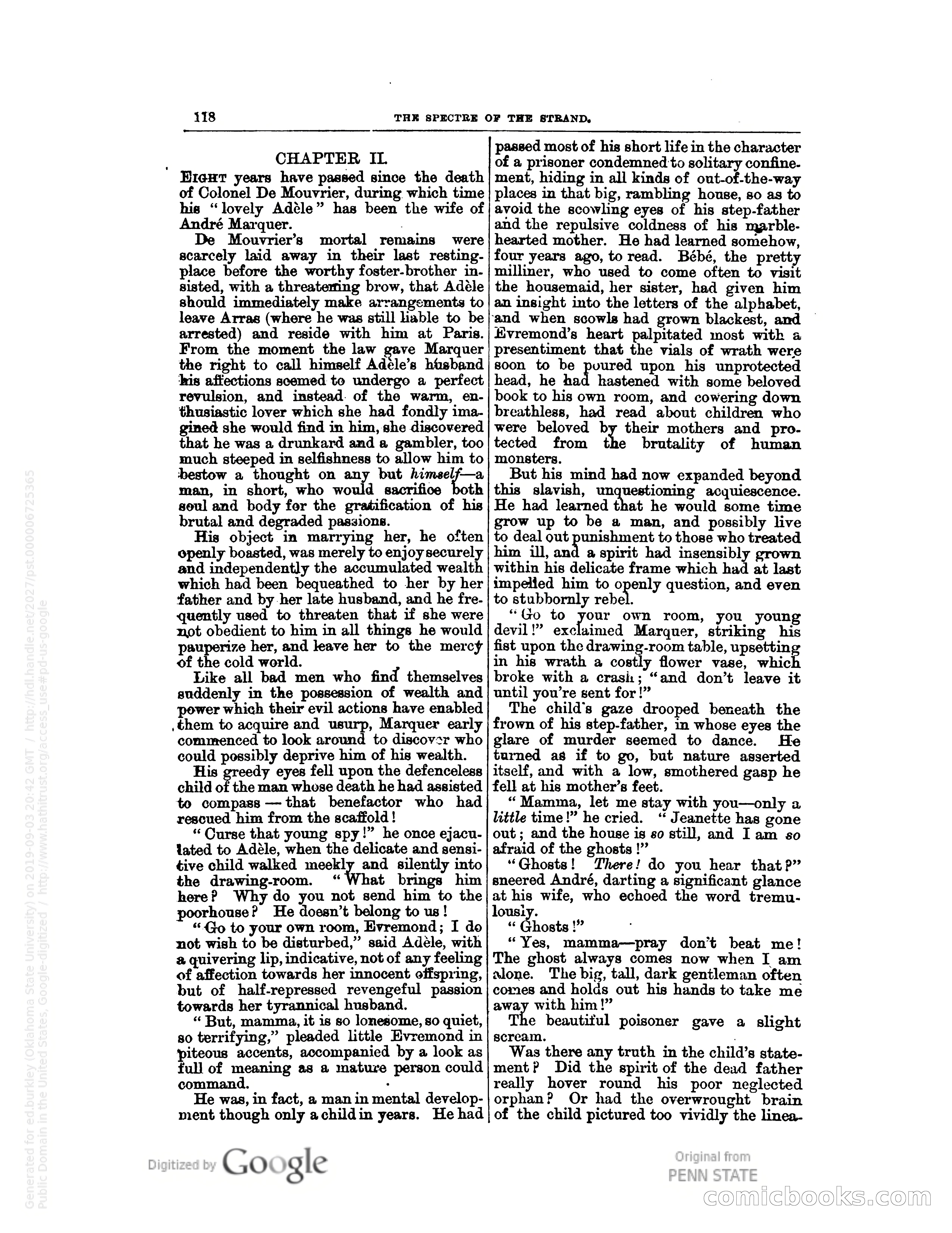
A restored page from Pulp Fiction, 1883. Page through the whole issue in the reader above.
📄 Transcribed text from this page (OCR, searchable)
Machine-transcribed from the original scan — historical spelling and the odd misread are preserved.
118 THE SPECTRE OF THE STRAND, CHAPTER IL ' Ereut years have passed since the death of Colonel De Mouvrier, during which time his “lovely Adéle” has been the wife of André Marquer. De Mouvrier’s mortal remains were scarcely laid away in their last resting- place before the worthy foster-brother in- sisted, with a threaterfing brow, that Adéle should immediately make arrangements to leave Arras (where he was still lable to be arrested) and reside with him at Paris. From the moment the law gave Marquer the right to call himself Adele’s husband his affections seemed to undergo a perfect revulsion, and instead. of the warm, en- thusiastic lover which she had fondly ima- gined she would find in him, she discovered that he was a drunkard and a gambler, too much steeped im selfishness to allow him to bestow a thought on any but himself—a man, in short, who would sacrifice both seul and body for the grasification of his brutal and degraded passions. His object in marrying her, he often openly boasted, was merely to enjoy securely and independently the accumulated wealth which had been bequeathed to her by her father and by her late husband, and he fre- quently used to threaten that if she were not obedient to him in all things he would pauperize her, and leave her to the mercy of the cold world. Like all bad men who find themselves suddenly in the possession of wealth and power which their evil actions have enabled ,¢them to acquire and usurp, Marquer early commenced to look around to discover who could possibly deprive him of his wealth. His greedy eyes fell upon the defenceless child of the man whose death he had assisted to compass — that benefactor who had rescued him from the scaffold! “ Curse that young spy!” he once ejacu- lated to Adéle, when the delicate and sensi- tive child walked meekly and silently into the drawing-room. “ What brings him here? Why do you not send him to the poorhouse? He doesn’t belong to us! “Go to your own room, Evremond; I do not wish to be disturbed,” said Adele, with @ quivering lip, indicative, not of any feeling of affection towards her innocent offspring, but of half-repressed revengeful passion towards her tyrannical husband. “ But, mamma, it 1s so lonesome, so quiet, so terrifying,” pleaded little Evremond in piteous accents, accompanied by a look as full of meaning as a mature person could command. ; He was, in fact, 2 man in mental develop- nent though only achildin years. He had Google passed most of his short life in the character of a prisoner condemned to solitary confine. ment, hiding in all kinds of out-of-the-way places in that big, rambling house, so as to avoid the scowling eyes of his step-father and the repulsive coldness of his marble- hearted mother. He had learned somehow, four years ago, to read. Bébé, the pretty milliner, who used to come often to visit the housemaid, her sister, had given him an insight into the letters of the alphabet, ‘and when scowls had grown blackest, and Hivremond’s heart palpitated most with a presentiment that the vials of wrath were soon to be poured upon his unprotected head, he had hastened with some beloved book to his own room, and cowering down breathless, had read about children who were beloved by their mothers and pro- tected from the brutality of human monsters. But his mind had now expanded beyond this slavish, unquestioning acquiescence. He had learned that he would some time grow up to be a man, and possibly live to deal out punishment to those who treated him ill, and a spirit had insensibly grown within his delicate frame which had at last impelied him to openly question, and even to stubbornly gebel. “Go to your own room, you young devil!” exclaimed Marquer, striking his fist upon the drawing-room table, upsettin in his wrath a costly flower vase, which broke with a crasi; “and don’t leave it until you’re sent for !” The child's gaze drooped beneath the frown of his step-father, in whose eyes the glare of murder seemed to dance. He turned as if to go, but nature asserted itself, and with a low, smothered gasp he fell at his mother’s feet. “Mamma, let me stay with you—only a little time!” he cried. ‘“‘ Jeanette has gone out; and the house is so still, and Iam so afraid of the ghosts !” “Ghosts! There! do you hear that?” sneered André, darting a significant glance at his wife, who echoed the word tremu- lousiy. “ Ghosts !” “Yes, mamma—pray don’t beat me! The ghost always comes now when I am lone. The big, tall, dark gentleman often comes and holds out his hands to take me away with him!” The beautiful poisoner gave a slight scream. | Was there any truth in the child’s state- ment? Did the spirit of the dead father really hover round his poor neglected orphan? Or had the overwrought brain of the child pictured too vividly the linea- JOO a Ss > a S CO)