
Pulp Fiction, 1883 · page 119 of 142
Stories with a Vengeance — page 119: what you’re looking at
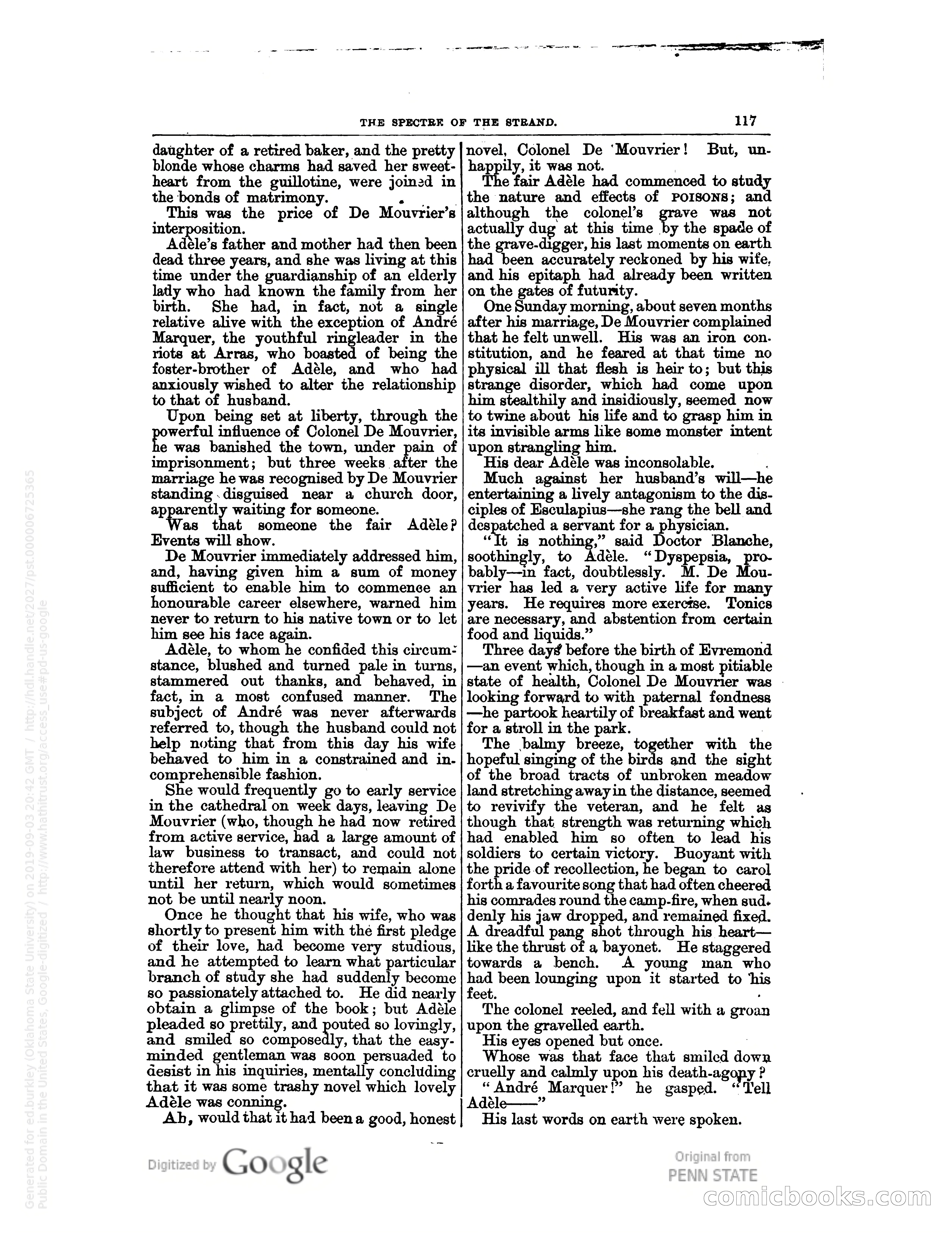
A restored page from Pulp Fiction, 1883. Page through the whole issue in the reader above.
📄 Transcribed text from this page (OCR, searchable)
Machine-transcribed from the original scan — historical spelling and the odd misread are preserved.
ee ee THE SPECTRE OF THE STRAND. daughter of a retired baker, and the pretty blonde whose charms had saved her sweet- heart from the guillotine, were joimed in the bonds of matrimony. +... This was the price of De Mouvrier’s interposition. Adéle’s father and mother had then been dead three years, and she was living at this time under the guardianship of an elderly lady who had known the family from her birth. She had, in fact, not a single relative alive with the exception of André Marquer, the youthful ringleader in the riots at Arras, who boasted of being the foster-brother of Adéle, and who had anxiously wished to alter the relationship to that of husband. Upon being set at liberty, through the powers influence of Colonel De Mouvrier, e was banished the town, under pain of imprisonment; but three weeks after the marriage he was recognised by De Mouvrier standing .disguised near a church door, apparently waiting for someone. as that someone the fair Adele? Events will show. De Mouvrier immediately addressed him, and, having given him a sum of money sufficient to enable him to commence an honourable career elsewhere, warned him never to return to his native town or to let him see his face again. Adele, to whom he confided this circum: stance, blushed and turned pale in turns, stammered out thanks, and behaved, in fact, in a most confused manner. The subject of André was never afterwards referred to, though the husband could not help noting that from this day his wife behaved to him in a constrained and in- comprehensible fashion. | She would frequently go to early service in the cathedral on week days, leaving De Mouvrier (who, though he had now retired from active service, had a large amount of law business to transact, and could not therefore attend with her) to remain alone until her return, which would sometimes not be until nearly noon. Once he thought that his wife, who was shortly to present him with the first pledge of their love, had become very studious, and he attempted to learn what particular branch of study she had suddenly become so passionately attached to. He did nearly obtain a glimpse of the book; but Adéle pleaded so prettily, and pouted so lovingly, and smiled so sompoacdly: that the easy- minded gentleman was soon persuaded to desist in his inquiries, mentally concluding that 1t was some trashy novel which lovely Adéle was conning. -_-— ae ee Toe es A ee —_— 117 novel, Colonel De ‘Mouvnier! But, un- happily, it was not. | The fair Adéle had commenced to study the nature and effects of POISONS; and although the colonel’s grave was not actually dug at this time by the spade of the grave-digger, his last moments on earth had been accurately reckoned by his wite, and his epitaph had already been written on the gates of futunity. One Sunday morning, about seven months after his marriage, De Mouvrier complained that he felt unwell. His was an iron con. stitution, and he feared at that time no physical ill that flesh is heir to; but this strange disorder, which had come upon him stealthily and insidiously, seemed now to twine about his life and to grasp him in its invisible arms like some monster intent upon strangling him. | His dear Adele was inconsolable. ; Much against her husband’s will—he entertaining a lively antagonism to the dis- ciples of Esculapius—she rang the bell and despatched a servant for a physician. “It is nothing,” said Doctor Blanche, soothingly, to Adele. “Dyspepsia, pro- bably—in fact, doubtlessly. M. De Mou- vrier has led a very active life for many years. He requires more exerctse. Tonics are necessary, and abstention from certain food and liquids.” Three day# before the birth of Evremond —an event which, though in a most pitiable state of health, Colonel De Mouvrier was . looking forward to with paternal fondness —he partook heartily of breakfast and went for a stroll in the park. , The balmy breeze, together with th hopeful singing of the birds and the sight of the broad tracts of unbroken meadow land stretching away in the distance, seemed to revivify the veteran, and he felt ag though that strength was returning which had enabled him so often to lead his soldiers to certain victory. Buoyant with the pride of recollection, he began to carol forth a favourite song that had often cheered his comrades round the camp-fire, when sud. denly his jaw dropped, and remained fixed. A dreadful pang shat through his heart— like the thrust of a, bayonet. He staggered towards a bench. A young man who os been lounging upon it started to his eet. The colonel reeled, and fell with a groan upon the gravelled earth. His eyes opened but once. : Whose was that face that smiled down cruelly and calmly upon his death-agopy ? “André Marquer!” he gasped. “Tell Adele——” Ah, would that it had beena good, honest | His last words on earth were spoken. Google mn CY, (SO) JOO S CO)