
Pulp Fiction, 1883 · page 68 of 142
Stories with a Vengeance — page 68: what you’re looking at
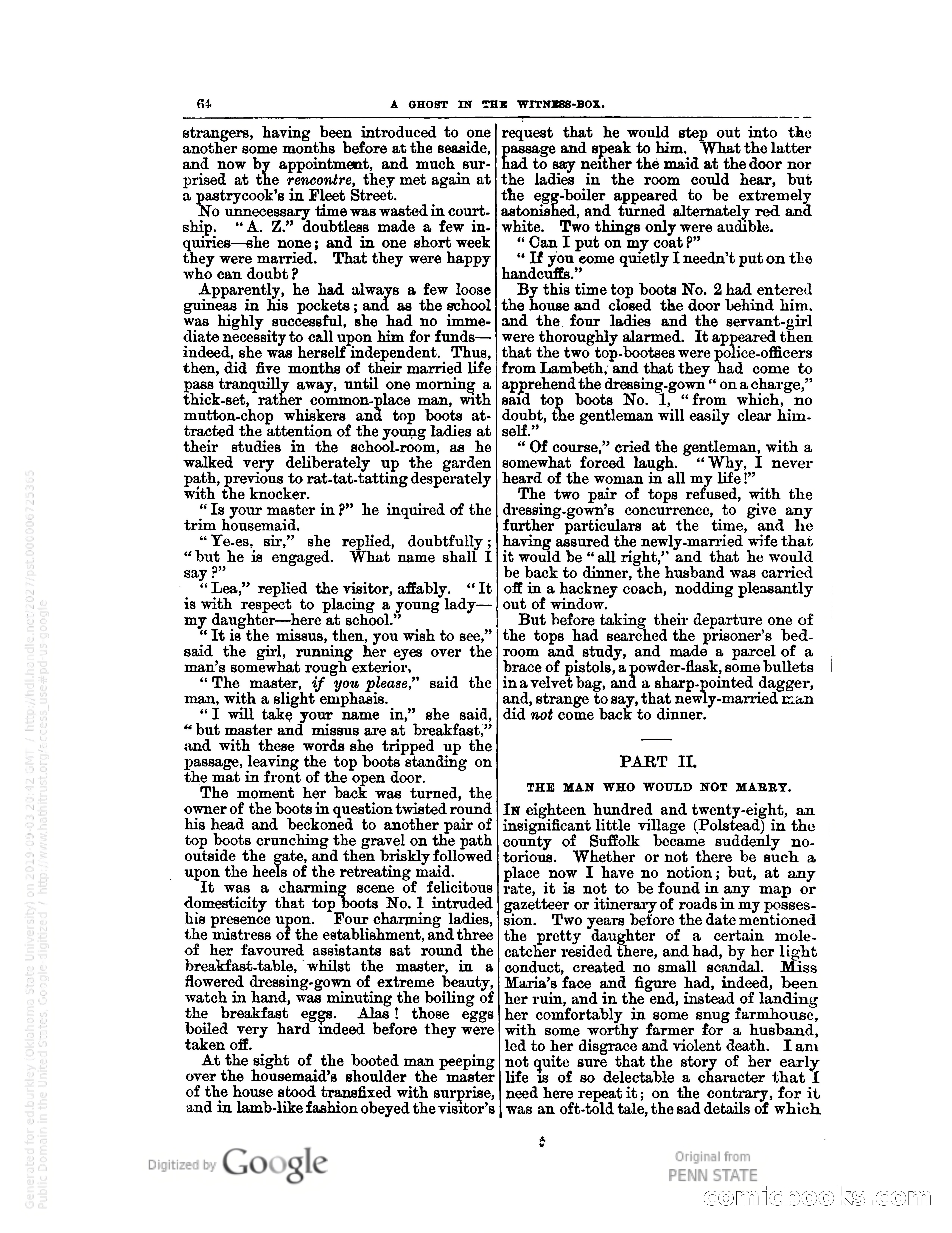
A restored page from Pulp Fiction, 1883. Page through the whole issue in the reader above.
📄 Transcribed text from this page (OCR, searchable)
Machine-transcribed from the original scan — historical spelling and the odd misread are preserved.
64 strangers, having been introduced to one another some months before at the seaside, and now by appointment, and much sur- prised at the rencontre, they met again at a pastrycook’s in Fleet Street. oO unnecessary time was wasted in court- ship. “A. Z.” doubtless made a few in- quiries—she none; and in one short week they were married. That they were happy who can doubt ? Apparently, he had always a few loose guineas in his pockets; and as the school was highly successful, she had no imme- diate necessity to call upon him for funds— indeed, she was herself independent. Thus, then, did five months of their married life pass tranquilly away, until one morning a thick-set, rather common-place man, with mutton-chop whiskers and top boots at- tracted the attention of the young ladies at their studies in the school-room, as he walked very deliberately up the garden path, previous to rat-tat-tatting desperately with the knocker. “Is your master in P” he inquired of the trim housemaid. ““Ye-es, sir,” she replied, doubtfully ; = one he is engaged. What name shall I say 93 “Lea,” rephed the visitor, affably. ‘It is with respect to placing a young lady—, my daughter—here at school.” “It is the missus, then, you wish to see,” said the girl, running her eyes over the man’s somewhat rough exterior, “The master, if you please,” said the man, with a slight emphasis. “1 will take your name in,” she said, “but master and missus are at breakfast,” and with these words she tripped up the passage, leaving the top boots standing on the mat in front of the open door. The moment her back was turned, the owner of the boots in question twisted round his head and beckoned to another pair of top boots crunching the gravel on the path outside the gate, and then briskly followed _ upon the heels of the retreating maid. It was a charming scene of felicitous domesticity that top boots No.1 intruded his presence upon. Four charming ladies, the mistress of the establishment, and three of her favoured assistants sat round the breakfast-table, whilst the master, in a flowered dressing-gown of extreme beauty, watch in hand, was minuting the boiling of the breakfast eggs. Alas! those eggs boiled very hard indeed before they were taken off. At the sight of the booted man peeping over the housemaid’s shoulder the master of the house stood transfixed with surprise, and in lamb-like fashion obeyed the visitor’s Google A GHOST IN THE WITNESS-BOX. owe ee request that he would step out into the pase and speak to him. What the latter ad to say neither the maid at the door nor the ladies in the room could hear, but the egg boiler appeared to be extremely astonished, and turned alternately red and white. ‘Two things only were audible. “Can I put on my coat P” ** If you eome quietly I needn’t put on the handcuffs.” By this time top boots No. 2 had entered the house and closed the door behind him. and the four ladies and the servant-girl were thoroughly alarmed. It appeared then that the two top-bootses were police-officers from Lambeth, and that they had come to apprehend the dressing-gown “ on a charge,” said top boots No. 1, “from which, no doubt, the gentleman will easily clear him- self.” “ Of course,” cried the gentleman, with a somewhat forced laugh. ‘ Why, I never heard of the woman in all my hfe!” The two pair of tops refused, with the dressing-gown’s concurrence, to give any further particulars at the time, and he having assured the newly-married wife that it would be “all right,” and that he would be back to dinner, the husband was carried off in a hackney coach, nodding pleasantly out of window. But before taking their departure one of the tops had searched the prisoner’s bed- room and study, and made a parcel of a brace of pistols, a powder-flask, some bullets ina velvet bag, and a sharp-pointed dagger, and, strange to say, that newly-married man did not come back to dinner. PART IT. THE MAN WHO WOULD NOT MARRY. In eighteen hundred and twenty-eight, an insignificant little village (Polstead) in the county of Suffolk became suddenly no- torious. Whether or not there be such a place now I have no notion; but, at any rate, it is not to be found in any map or gazetteer or itinerary of roads in my posses- sion. ‘Two years before the date mentioned the pretty daughter of a certain mole- catcher resided there, and had, by her light conduct, created no small scandal. Miss Maria’s face and figure had, indeed, been her ruin, and in the end, instead of landing her comfortably in some snug farmhouse, with some worthy farmer for a husband, led to her disgrace and violent death. Tam not quite sure that the story of her early life 1s of so delectable a character that I need here repeat it; on the contrary, for it was an oft-told tale, the sad details of which a te > a JOO S CO)