
Pulp Fiction, 1883 · page 12 of 142
Stories with a Vengeance — page 12: what you’re looking at
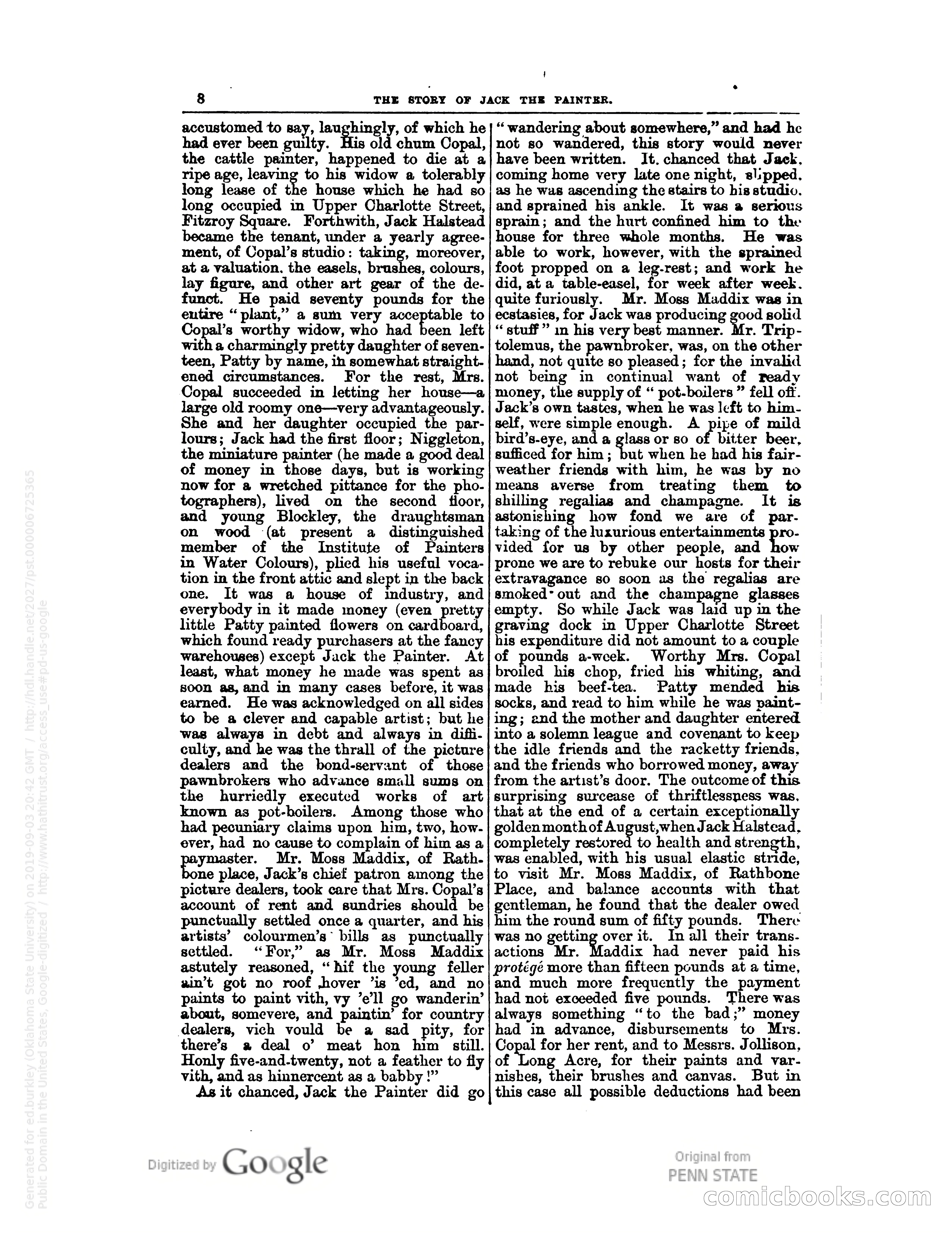
A restored page from Pulp Fiction, 1883. Page through the whole issue in the reader above.
📄 Transcribed text from this page (OCR, searchable)
Machine-transcribed from the original scan — historical spelling and the odd misread are preserved.
8 THE STORY OF JACK THE PAINTER. { e ee or ee accustomed to say, laughingly, of which he | “ wandering about somewhere,” and had he had ever been guilty. His old chum Copal, the cattle painter, happened to die at a ripe age, leaving to his widow a tolerably long lease of the house which he had so long occupied in Upper Charlotte Street, Fitzroy Square. Forthwith, Jack Halstead e the tenant, under a yearly agree- ment, of Copal’s studio: taking, moreover, at a valuation. the easels, brushes, colours, lay figure, and other art gear of the de- funct. He paid seventy pounds for the entire “plant,” a sum very acceptable to Copal’s worthy widow, who had been left with a charmingly pretty daughter of seven- teen, Patty by name, in somewhat straight- ened circumstances. For the rest, Mrs. Copal succeeded in letting her house—a large old roomy one—very advantageously. She and her daughter occupied the par- lours; Jack had the first floor; Niggleton, the miniature painter (he made a good deal of money in those days, but is working now for a wretched pittance for the pho- tographers), lived on the second floor, and young Blockley, the draughtsman on wood (at present a distinguished member of the Institute of Painters in Water Colours), plied his useful voca- tion in the front attic and slept in the back one. It was a house of industry, and everybody in it made money (even pretty little Patty painted flowers on cardboard, which found ready purchasers at the fancy warehouses) except Jack the Painter. At least, what money he made was spent as soon as,and in many cases before, it was earned. He was acknowledged on all sides to be a clever and capable artist; but he was always in debt and always in difii- culty, and he was the thrall of the picture dealers and the bond-servant of those pawnbrokers who advance small sums on the hurriedly executed works of art known as pot-boilers. Among those who had pecuniary claims upon him, two, how. ever, had no cause to complain of him as a paymaster. Mr. Moss Maddix, of Rath. ne place, Jack’s chief patron among the pictare dealers, took care that Mrs. Copal’s account of rent and sundries should be punctually settled once a quarter, and his artists’ colourmen’s* bills as punctually settled. “For,” as Mr. Moss Maddix astutely reasoned, ‘“hif the young feller ain't got no roof ,hover ‘is ’ed, and no paints to paint vith, vy ’e’ll go wanderin’ about, somevere, and paintin’ for country dealers, vich vould be a sad pity, for there’s a deal o’ meat hon him siill. Honly five-and-twenty, not a feather to fly vith, and as hinnercent as a babby !” As it chanced, Jack the Painter did go Google not so wandered, this story would never have been written. It. chanced that Jack. coming home very late one night, slipped, as he was ascending the atairs to his studio. and sprained his ankle. It was a serious sprain; and the hurt confined him to the house for three whole months. He was able to work, however, with the spramed foot propped on a leg-rest; and work he did, at a table-easel, for week after week. quite furiously. Mr. Moss Maddix was in ecstasies, for Jack was producing good solid “ stuff” in his very best manner. Mr. Trip- tolemus, the pawnbroker, was, on the other hand, not quite so pleased; for the invalid not being in continual want of ready money, the supply of ‘“‘ pot-boilers ” fell off. Jack’s own tastes, when he was left to him- self, were sumple enough. A pipe of mild bird’s-eye, and a glass or so of bitter beer, sufficed for him; but when he had his fair- weather friends with him, he was by no means averse from treating them to shilling regalias and champagne. It is astonishing how fond we are of par- taking of the luxurious entertainments pro- vided for us by other people, and how prone we are to rebuke our hosts for their extravagance so soon as the regalias are smoked’ out and the champagne glasses empty. So while Jack was laid up in the graving dock in Upper Charlotte Street his expenditure did not amount to a couple of pounds a-week. Worthy Mrs. Copal broiled his chop, fried his whiting, and made his beef-tea. Patty mended his socks, and read to him while he was paint- ing; end the mother and daughter entered into a solemn league and covenant to keep the idle friends and the racketty friends, and the friends who borrowed money, away from the artist’s door. The outcome of this surprising surcease of thriftlessness was. that at the end of a certain exceptionally golden monthof August,when Jack Halstead, completely restored to health and strength, was enabled, with his usual elastic stride, to visit Mr. Moss Maddix, of Rathbone Place, and balance accounts with that gentleman, he found that the dealer owed him the round sum of fifty pounds. There was no getting over it. In all their trans- actions Mr. Maddix had never paid his protégé more than fifteen pounds at a time, and much more frequently the payment had not exceeded five pounds. There was always something “to the bad;” money had in advance, disbursements to Mrs. Copal for her rent, and to Messrs. Jollison, of ‘Long Acre, for their paints and var- nishes, their brushes and canvas. But in this case all possible deductions had been JOO @ © = a S CO)