
Pulp Fiction, 1883 · page 9 of 142
Stories with a Vengeance — page 9: what you’re looking at
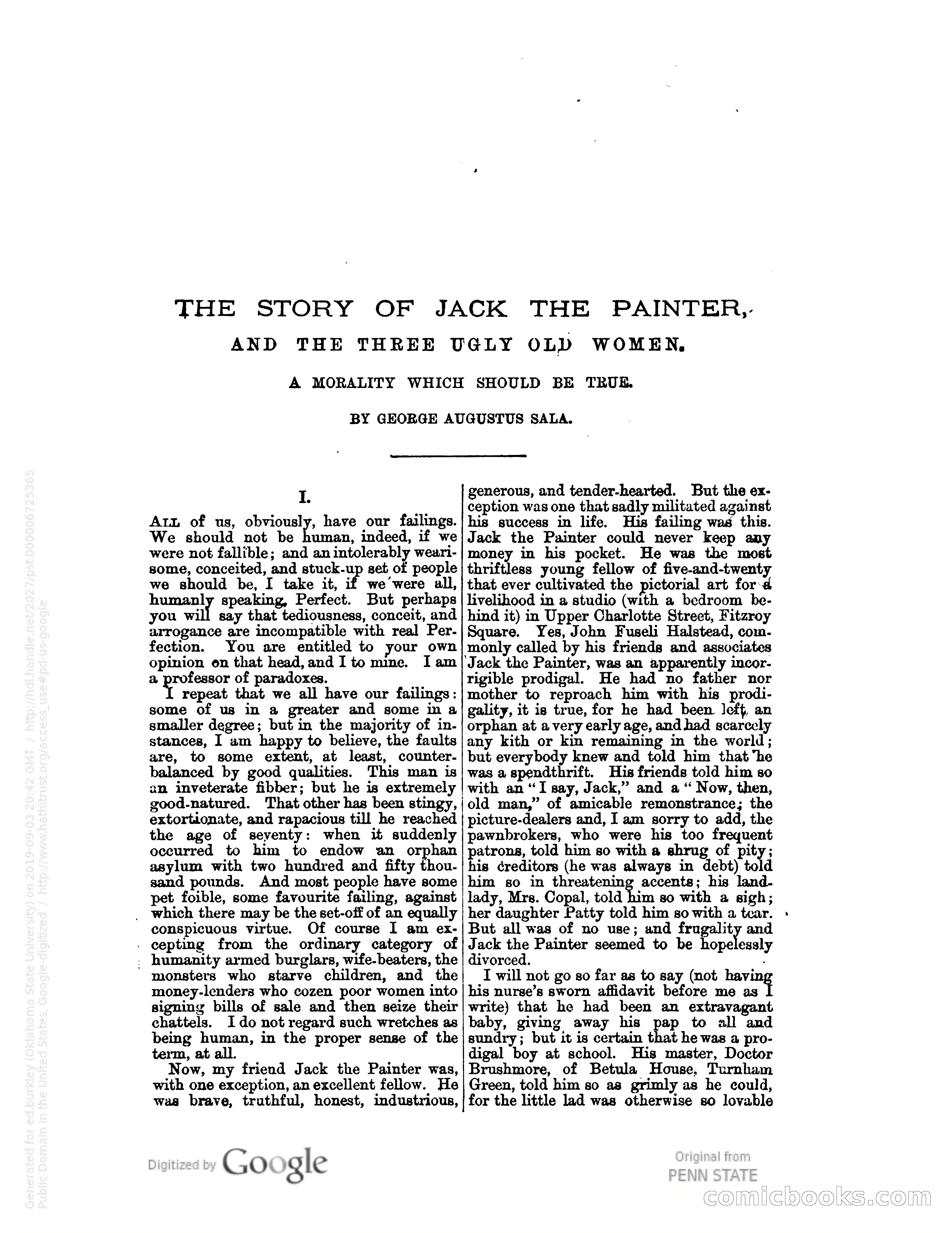
A restored page from Pulp Fiction, 1883. Page through the whole issue in the reader above.
📄 Transcribed text from this page (OCR, searchable)
Machine-transcribed from the original scan — historical spelling and the odd misread are preserved.
THE STORY OF JACK THE PAINTER, AND THE THREE UGLY OLD WOMEN. A MORALITY WHICH SHOULD BE TRUE. BY GEORGE AUGUSTUS SALA. I. Ath of us, obviously, have our failings. We should not be human, indeed, if we were not fallible; and an intolerably weari- some, conceited, and stuck-up set of people we should be, I take it, if we were all, humanly speaking, Perfect. But perhaps you will say that tediousness, conceit, and arrogance are incompatible with real Per- fection. You are entitled to your own opinion on that head, and I to mine. a professor of paradoxes. repeat that we all have our failings: some of us in a greater and some im a smaller degree; but in the majority of in- stances, I am happy to believe, the faults are, to some extent, at least, counter- balanced by good qualities. This man is an inveterate fibber; but he is extremely Iam good-natured. That other has been stingy, | extortionate, and rapacious till he reached the age of seventy: when it suddenly occurred to him to endow an orphan asylum with two hundred and fifty thou- sand pounds. And most people have some pet foible, some favourite failing, against _ which there may be the set-off of an equally conspicuous virtue. Of course I am ex- . cepting from the ordinary category of . humanity armed burglars, wife-beaters, the monsters who starve children, and the money-lenders who cozen poor women into signing bills of sale and then seize their chattels. Ido not regard such wretches as being human, in the proper sense of the term, at all. Now, my friend Jack the Painter was, with one exception, an excellent fellow. He was brave, truthful, honest, industrious, Google generous, and tender-hearted. But the ex- ception was one that sadly militated against his success in life. His failing was this. Jack the Painter could never keep any money in his pocket. He was most thriftless young fellow of five-and-twenty that ever cultivated the pictorial art ford livelihood in a studio (with a bedroom be- hind it) in Upper Charlotte Street, Fitzroy Square. Yes, John Fuseli Halstead, com- monly called by his friends and assvciates ‘Jack the Painter, was an apparently incor- rigible prodigal. He had no father nor mother to reproach him with his prodi- gality, it is true, for he had been left, an orphan at avery early age, and had scarecly any kith or kin remaining in the world ; but everybody knew and told him that ‘he was a spendthrift. Huis friends told him so with an “I say, Jack,” and a “ Now, then, old man,” of amicable remonstrance; the picture-dealers and, I am sorry to add, the pawnbrokers, who were his too frequent patrons, told him so with a shrug of pity; his creditors (he was always in debt) told him so in threatening accents; his land- lady, Mrs. Copal, told him so with a sigh; her daughter Patty told him so with a tear. But all was of no use; and frugality and Jack the Painter seemed to be hopelessly divorced. I will not go so far as to say (not havin his nurse’s sworn affidavit before me as f write) that. he had been an extravagant baby, giving away his pap to all and sundry; but it is certain that he was a pro- digal boy at school. His master, Doctor Brushmore, of Betula House, Turnham Green, told him so as grimly as he could, for the little lad was otherwise so lovable > a JOO S CO)