
Pulp Fiction, 1883 · page 94 of 142
Stories with a Vengeance — page 94: what you’re looking at
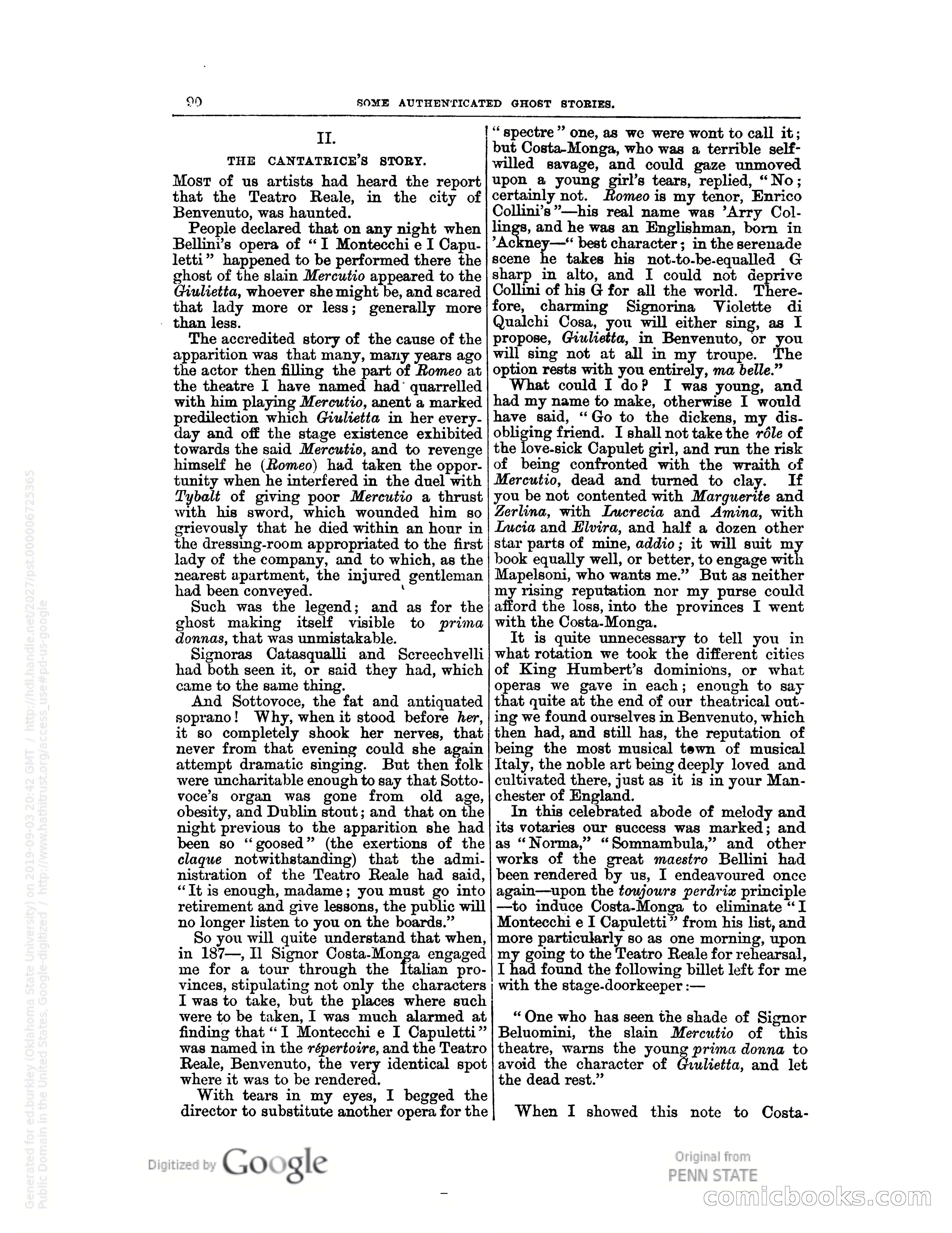
A restored page from Pulp Fiction, 1883. Page through the whole issue in the reader above.
📄 Transcribed text from this page (OCR, searchable)
Machine-transcribed from the original scan — historical spelling and the odd misread are preserved.
20 SOME AUTHENTICATED GHOST STORIES. II. THE CANTATRICE’S STORY. Most of us artists had heard the report that the Teatro Reale, in the city of Benvenuto, was haunted. People declared that on any night when Bellini’s opera of “I Montecchi e I Capu- letti” happened to be performed there the ghost of the slain Mercutio appeared to the Giulietta, whoever she might be, and scared that lady more or less; generally more - than less. The accredited story of the cause of the apparition was that many, many years ago the actor then filling the part of Romeo at the theatre I have named had’ quarrelled with him playing Mercutio, anent a marked predilection which Giulietta in her every- day and off the stage existence exhibited towards the said Mercutio, and to revenge himself he (Romeo) had taken the oppor- tunity when he interfered in the duel with Tybalt of giving poor Mercutio a thrust with his sword, which wounded him so grievously that he died within an hour in the dressing-room appropriated to the first lady of the company, and to which, as the nearest apartment, the injured gentleman had been conveyed. ‘ Such was the legend; and as for the ghost making itself visible to prima donnas, that was unmistakable. Signoras Catasqualli and Screechvelli had both seen it, or said they had, which came to the same thing. And Sottovoce, the fat and antiquated soprano! Why, when it stood before her, it so completely shook her nerves, that never from that evening could she again attempt dramatic singing. But then folk were uncharitable enough to say that Sotto- voce’s organ was gone from old age, obesity, and Dublin stout; and that on the night previous to the apparition she had been so ‘‘goosed” (the exertions of the claque notwithstanding) that the admi- nistration of the Teatro Reale had said, “Tt is enough, madame; you must go into retirement and give lessons, the public will no longer listen to you on the boards.” So you will quite understand that when, in 187—, Il Signor Costa-Monga engaged me for a tour through the fialian pro- vinces, stipulating not only the characters I was to take, but the places where such were to be taken, I was much alarmed at finding that “I Montecchi e I Capuletti” was named in the répertoire, and the Teatro Reale, Benvenuto, the very identical spot where it was to be rendered. With tears in my eyes, I begged the director to substitute another opera for the Google |“ spectre” one, as we were wont to call it; but Costa-Monga, who was a terrible self- willed savage, and could gaze unmoved upon a young girl’s tears, replied, “No; certainly not. Romeo is my tenor, Enrico Collini’s””—his real name was ’Arry Col- ye and he was an Englishman, born in "Ac oa best character; in the serenade scene he takes his not-to-be-equalled G sharp in alto, and I could not deprive Collini of his G for all the world. There- fore, charming Signorina Violette di Qualchi Cosa, you will either sing, as I propose, Giulietta, in Benvenuto, or you will sg not at all in my troupe. The option rests with you entirely, ma belle.” What could I doP I was young, and had my name to make, otherwise I would have said, “Go to the dickens, my dis- obliging friend. I shall not take the réle of the love-sick Capulet girl, and run the risk of being confronted with the wraith of Mercutio, dead and turned to clay. If you be not contented with Marguerite and Zerlina, with LIncrecia and Amina, with Incia and Elvira, and half a dozen other star parts of mine, addio; it will suit my book equally well, or better, to engage with Mapelsoni, who wants me.” But as neither my rising reputation nor my purse could afford the loss, into the provinces I went with the Costa-Monga. It is quite unnecessary to tell you in what rotation we took the different cities of King Humbert’s dominions, or what operas we gave in each; enough to say that quite at the end of our theatrical out- ing we found ourselves in Benvenuto, which then had, and still has, the reputation of being the most musical tewn of musical Italy, the noble art being deeply loved and cultivated there, just as it is in your Man- chester of England. In this celebrated abode of melody and its votaries our success was marked; and as “Norma,” “Somnambula,” and other works of the great maestro Bellini had been rendered by us, I endeavoured once again—upon the toujours perdrixz principle —to induce Costa-Monga to eliminate “I Montecchi e I Capuletti” from his list, and more particularly so as one morning, upon my going to the Teatro Reale for rehearsal, I had found the following billet left for me with the stage-doorkeeper :— “One who has seen the shade of Signor Beluomini, the slain Mercutio of this theatre, warns the young prima donna to avoid the character of Guulietta, and let the dead rest.” When I showed this note to Costa- > a JOO S CO)