
Pulp Fiction, 1883 · page 123 of 142
Stories with a Vengeance — page 123: what you’re looking at
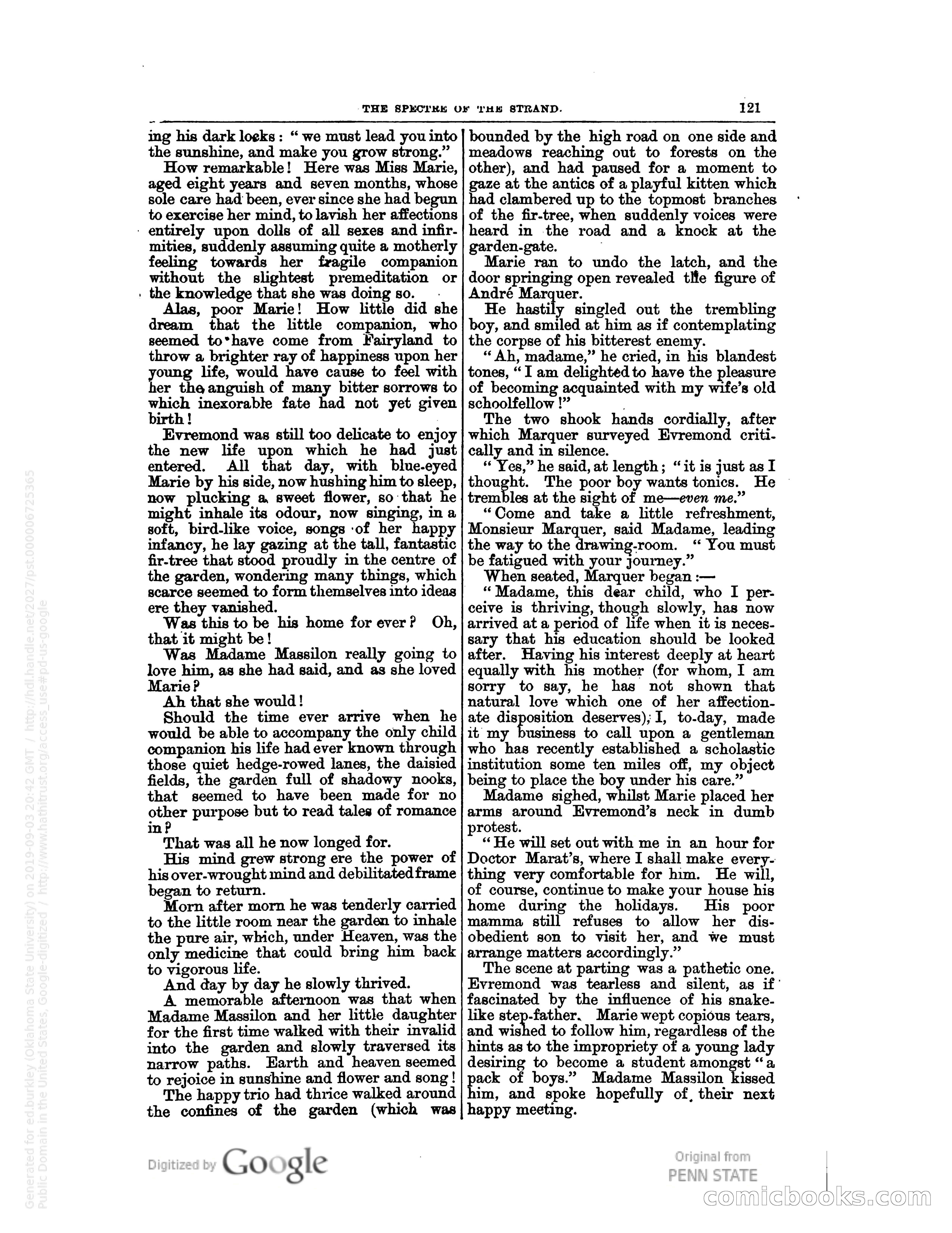
A restored page from Pulp Fiction, 1883. Page through the whole issue in the reader above.
📄 Transcribed text from this page (OCR, searchable)
Machine-transcribed from the original scan — historical spelling and the odd misread are preserved.
“THE SPECTRE OY 'THE STRAND. ing his dark logks: “ we must lead you into the sunshine, and make you grow strong.” How remarkable! Here was Miss Marie, aged eight years and seven months, whose sole care had been, ever since she had be to exercise her mind, to lavish her affections - entirely upon dolls of all sexes and infir- mities, suddenly assuming quite a motherly feeling towards her fragile companion without the slightest premeditation or | the knowledge that she was doing so._ Alas, poor Marie! How little did she dream that the little companion, who seemed to*have come from Fairyland to throw a brighter ray of happiness upon her young life, would have cause to feel with er the anguish of many bitter sorrows to which inexorable fate had not yet given birth ! . Evremond was still too delicate to enjoy the new life upon which he had just entered. All that day, with blue-eyed Marie by his side, now hushing him to sleep, now plucking a sweet flower, so that he might inhale its odour, now singing, in a soft, bird-like voice, songs ‘of her happy infancy, he lay gazing at the tall, fantastic fir-tree that stood proudly in the centre of the garden, wondering many things, which scarce seemed to form themselves into ideas | ere they vanished. Was this to be his home for ever? Oh, that it might be! Was Madame Massilon really going to love him, as she had said, and as she loved Marie? Ah that she would! Should the time ever arrive when he would be able to accompany the only child companion his life had ever known through those quiet hedge-rowed lanes, the daisied fields, the garden full of shadowy nooks, that seemed to have been made for no other purpose but to read tales of romance in That was all he now longed for. His mind grew strong ere the power of his over-wrought mind and debilitated frame began to return. Morn after morn he was tenderly carried to the little room near the garden to inhale the pure air, which, under Heaven, was the only medicine that could bring him back to vigorous life And day by day he slowly thrived. A memorable afternoon was that when Madame Massilon and her little daughter for the first time walked with their invalid into the garden and slowly traversed its narrow paths. Harth and heaven seemed to rejoice in sunshine and flower and song ! The happy trio had thrice walked around the confines of the garden (which was Google 121 bounded by the high road on one side and meadows reaching out to forests on the other), and had paused for a moment to gaze at the antics of a playful kitten which had clambered up to the topmost branches of the fir-tree, when suddenly voices were heard m the road and a knock at the garden-gate. Marie ran to undo the latch, and the door springing open revealed tle figure of André Marquer. He hastily singled out the trembling boy, and smiled at him as if contemplating the corpse of his bitterest enemy. “Ah, madame,” he cried, in his blandest tones, “I am delighted to have the pleasure of becoming acquainted with my wife’s old schoolfellow !” . The two shook hands cordially, after which Marquer surveyed Evremond criti- cally and in silence. “Yes,” he said, at length; “it is Just as I thought. The poor boy wants tonics. He © trembles at the sight of me—even me.” “Come and take a little refreshment, Monsieur Marquer, said Madame, leading the way to the drawing-room. “ You must be fatigued with your journey.” When seated, Marquer began :— “Madame, this dear child, who I per- ceive is thriving, though slowly, has now arrived at a period of life when it is neces- sary that his education should be looked after. Having his interest deeply at heart equally with his mother (for whom, I am sorry to say, he has not shown that natural love which one of her affection- ate disposition deserves); 1, to-day, made it my business to call upon a gentleman who has recently established a scholastic institution some ten miles off, my object being to place the boy under his care.” Madame sighed, whilst Marie placed her arms around Evremond’s neck in dumb protest. “He will set out with me in an hour for Doctor Marat’s, where I shall make every- thing very comfortable for him. He will, of course, continue to make your house his home during the holidays. His poor mamma still refuses to allow her dis- obedient son to visit her, and we must arrange matters accordingly.” The scene at parting was a pathetic one. Evremond was tearless and silent, as if’ fascinated by the influence of his snake- like step-father. Marie wept copious tears, and wished to follow him, regardless of the hints as to the impropriety of a young lady desiring to become a student amongst “a pack of boys.” Madame Massilon kissed him, and spoke hopefully of, their next happy meeting. S CO) sok