
Pulp Fiction, 1883 · page 31 of 142
Stories with a Vengeance — page 31: what you’re looking at
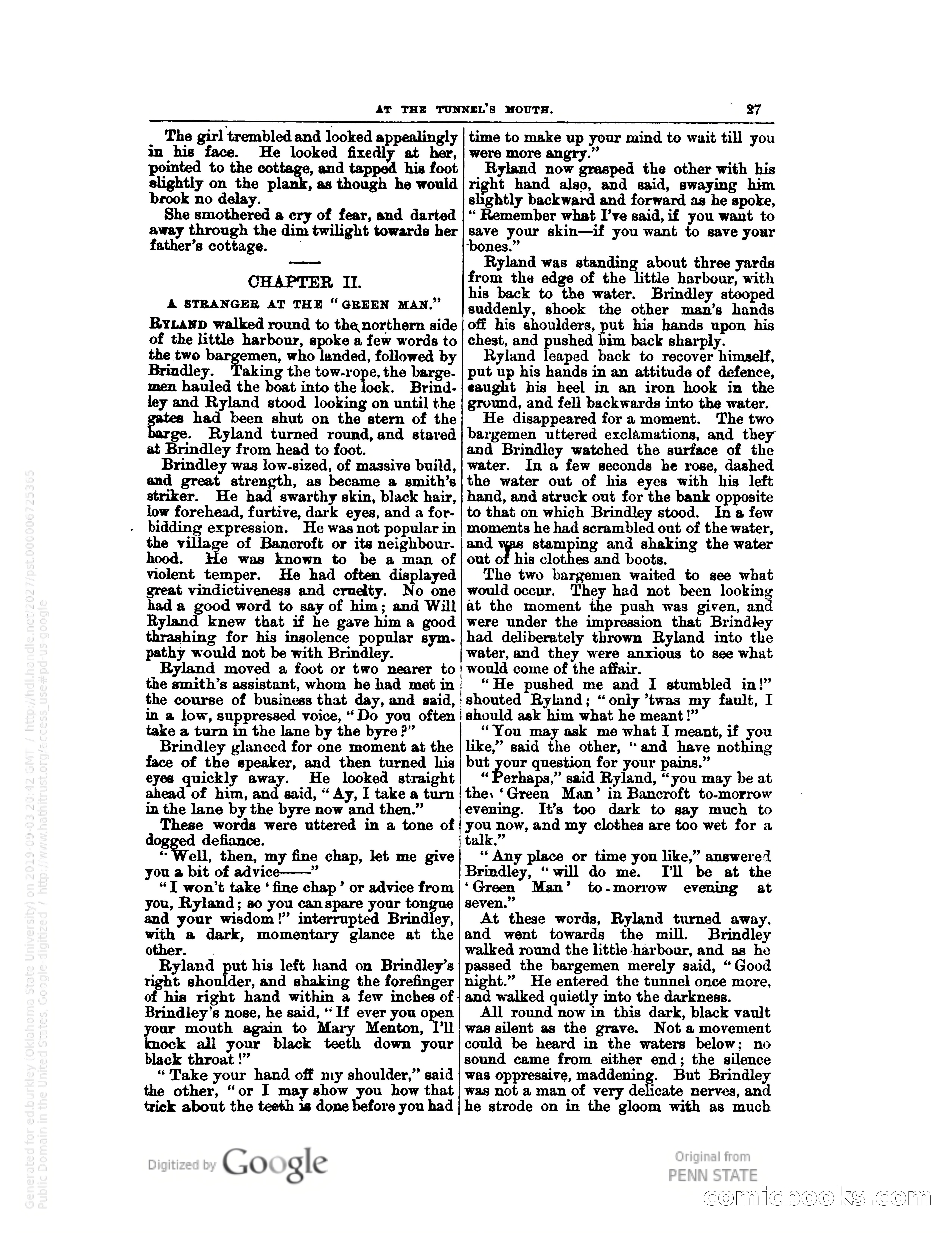
A restored page from Pulp Fiction, 1883. Page through the whole issue in the reader above.
📄 Transcribed text from this page (OCR, searchable)
Machine-transcribed from the original scan — historical spelling and the odd misread are preserved.
AT THE TUNNEL’S MOUTH. 27 The girl trembled and looked appealingly in his face. He looked fixedly at her, pointed to the cottage, and tapped his foot slightly on the plank. as though he would brook no delay. She smothered a cry of fear, and darted away through the dim twilight towards her father’s cottage. | CHAPTER II. A STRANGER AT THE “GREEN MAN.” Ry.anp walked round to the northern side of the little harbour, spoke a few words to the two bargemen, who landed, followed by Brindley. Taking the tow-rope, the barge- men hauled the boat into the Took, Brind- ley and Ryland stood looking on until the had been shut on the stern of the ge. Ryland turned round, and stared at Brindley from head to foot. Brindley was low-sized, of massive build, and great strength, as became a smith’s striker. He had swarthy skin, black hair, low forehead, furtive, dark eyes, and a for- . bidding expression. He was not popular in the village of Bancroft or its neighbour. hood. e was known to be a man of violent temper. He had often displayed great vindictiveness and cruelty. No one had a good word to say of him; and Will Ryland knew that if he gave hima good thrashing for his insolence popular sym- pathy would not be with Brindley. Ryland moved a foot or two nearer to the smith’s assistant, whom he had met in the course of business that day, and said, in a low, suppressed voice, “Do you often take a turn in the lane by the byre ?” Brindley glanced for one moment at the face of the speaker, and then turned his eyes quickly away. He looked straight ahead of him, and said, “ Ay, I take a turn in the lane by the byre now and then.” These words were uttered in a tone of dogged defiance. * Well, then, my fine chap, let me give you a bit of advice——” “T won’t take ‘fine chap’ or advice from you, Ryland ; so you canspare your tongue and your wisdom!” interrupted Brindley, with a dark, momentary glance at the other. Ryland put his left hand on Brindley’s right shoulder, and shaking the forefinger of his right hand within a few inches of Brindley’s nose, he said, ‘If ever you one your mouth again to Mary Menton, I'll knock all your black teeth down your black throat !” “Take your hand off my shoulder,” said the other, “or I may show you how that trick about the teeth 1s done before you had Google were more angry.” Ryland now grasped the other with his right hand also, and said, swaying him shghtly backward and forward as he spoke, ‘‘ Remember what I’ve said, if you want to save your skin—if you want to save your ‘bones.” Ryland was standing about three yards from the edge of the little harbour, with his back to the water. Brindley stooped suddenly, shook the other man’s hands off his shoulders, put his hands upon his chest, and pushed him back sharply. Ryland leaped back to recover himself, put up his hands in an attitude of defence, eaught his heel in an iron hook in the ground, and fell backwards into the water. He disappeared fora moment. The two bargemen uttered exclamations, and they and Brindley watched the surface of the water. In a few seconds he rose, dashed the water out of his eyes with his left hand, and struck out for the bank opposite to that on which Brindley stood. In a few moments he had scrambled out of the water, and stamping and shaking the water out of his clothes and boots. The two bargemen waited to see what would occur. They had not been looking at the moment the push was given, and were under the impression that Brindley had deliberately thrown Ryland into the water, and they were anxious to see what would come of the affair. “He pushed me and I stumbled in!” shouted Ryland; “only twas my fault, I | should ask him what he meant!” “You may ask me what I meant, if you like,” said the other, “and have nothing but your question for your pains.” “Perhaps,” said Ryland, “you may be at the, ‘Green Man’ in Bancroft to-morrow evening. It’s too dark to say much to you now, and my clothes are too wet for a talk.” “‘ Any place or time you like,” answered Brindley, “will do me. Til be at the ‘Green Man’ to-morrow evening at seven.” At these words, Ryland turned away, and went towards the mill. Brindley walked round the little harbour, and as he passed the bargemen merely said, “ Good night.” He entered the tunnel once more, and walked quietly into the darkness. All round now in this dark, black vault was silent as the grave. Not a movement could be heard in the waters below; no sound came from either end; the silence was oppressive, maddening. But Brindley was not a man of very delicate nerves, and he strode on in the gloom with as much time to make up your mind to wait till you | CY, JOO S CO)