
Pulp Fiction, 1883 · page 66 of 142
Stories with a Vengeance — page 66: what you’re looking at
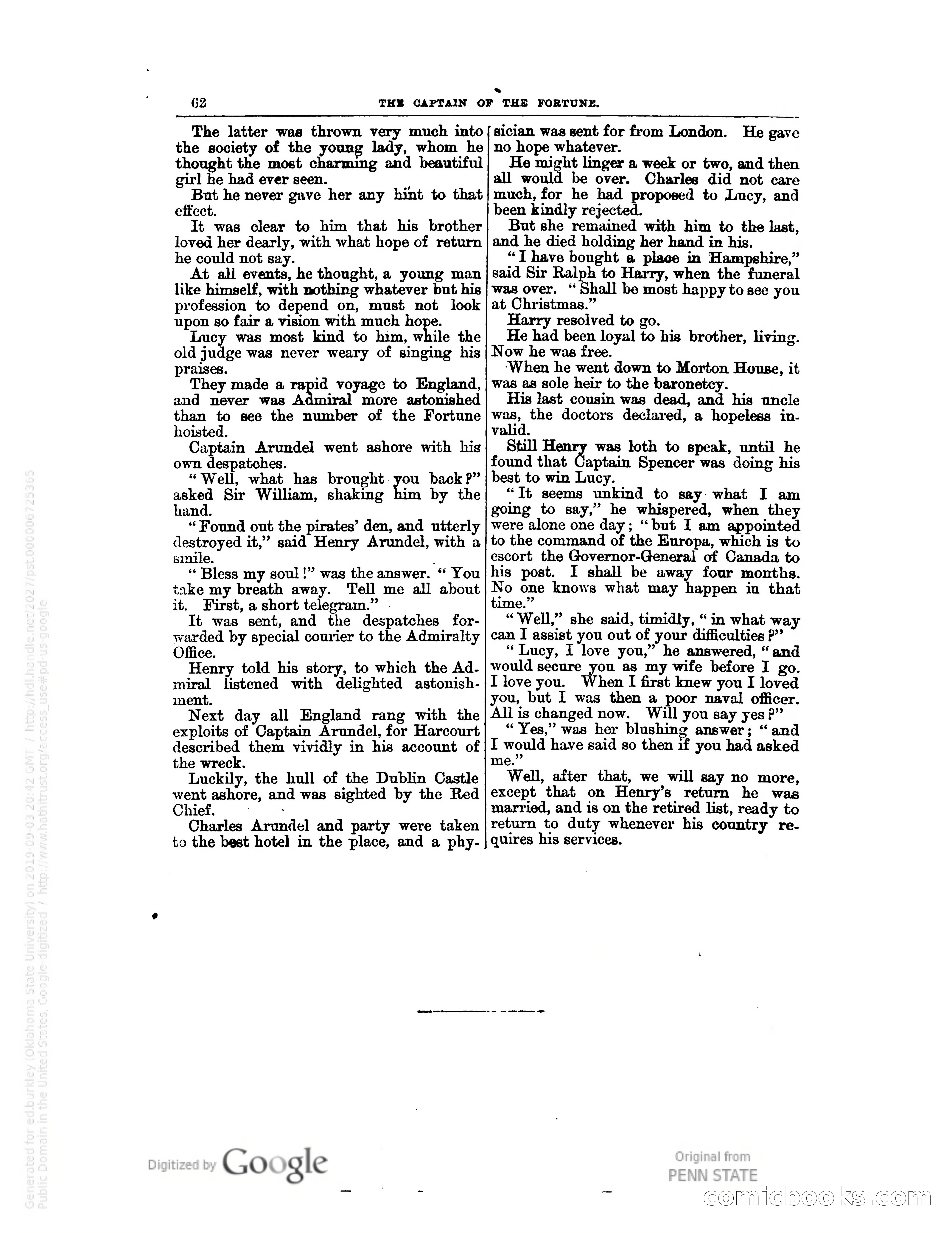
A restored page from Pulp Fiction, 1883. Page through the whole issue in the reader above.
📄 Transcribed text from this page (OCR, searchable)
Machine-transcribed from the original scan — historical spelling and the odd misread are preserved.
es 62 THE CAPTAIN OF THE FORTUNE. The latter was thrown very much into the society of the young lady, whom he thought the most charming and beautiful girl he had ever seen. But he never gave her any hint to that elfect. It was clear to him that his brother loved her dearly, with what hope of return he could not say. At all events, he thought, a young man like himself, with nothing whatever but his profession to depend on, must not look upon so fair a vision with much nope Lucy was most kind to him, while the old judge was never weary of singing his praises. They made a rapid voyage to England, and never was Admiral more astonished than to see the number of the Fortune hoisted. Captain Arundel went ashore with his own despatches. “Well, what has brought. you back?” asked Sir William, shaking hits by the hand. “Found out the pirates’ den, and utterly destroyed it,” said Henry Arundel, with a simile. ‘“‘ Bless my soul!” was the answer. “ You take my breath away. Tell me all about it. Furst, a short telegram.” . It was sent, and the despatches for- warded by special courier to the Admiralty Office. Henry told his story, to which the Ad- miral listened with delighted astonish- ment. Next day all England rang with the exploits of Captain Arundel, for Harcourt described them vividly in his account of the wreck. Luckily, the hull of the Dublin Castle went ashore, and was sighted by the Red Chief. : Charles Arunde] and party were taken to the best hotel in the place, and a phy- sician was sent for from London. He gave no hope whatever. He might linger a week or two, and then all would be over. Charles did not care much, for he had proposed to Lucy, and been kindly rejected. But she remained with him to the last, and he died holding her hand in his. “] have bought a place in Hampshire,” said Sir Ralph to Harry, when the funeral was over. “Shall be most happy to see you at Christmas.” Harry resolved to go. He had been loyal to his brother, living. Now he was free. ‘When he went down to Morton House, it was as sole heir to the baronetcy. His last cousin was dead, and his uncle was, the doctors declared, a hopeless in- valid. Still Henry was loth to speak, until he found that Captain Spencer was doing his best to win Lucy. “Tt seems unkind to say: what I am going to say,” he whispered, when they were alone one day; “but I am appointed to the command of the Europa, which is to escort the Governor-General of Canada to his post. I shall be away four months. No one knows what may happen in that time.” “Well,” she said, timidly, “in what way can I assist you out of your difficulties P”’ “Lucy, 1 love you,” he answered, “and would secure you as my wife before I go. I love you. When I first knew you I loved you, but I was then a poor naval officer. All is changed now. Will you say yes ?” “Yes,” was her blushing answer; “and I would have said so then if you had asked me.” Well, after that, we will say no more, except that on Henry’s return he was married, and 1s on the retired list, ready to return to duty whenever his country re- quires his services. Ene eer 0 ce ren ee es ere ee 0) O gle JOO | a Ss > a S CO)