
Pulp Fiction, 1883 · page 76 of 142
Stories with a Vengeance — page 76: what you’re looking at
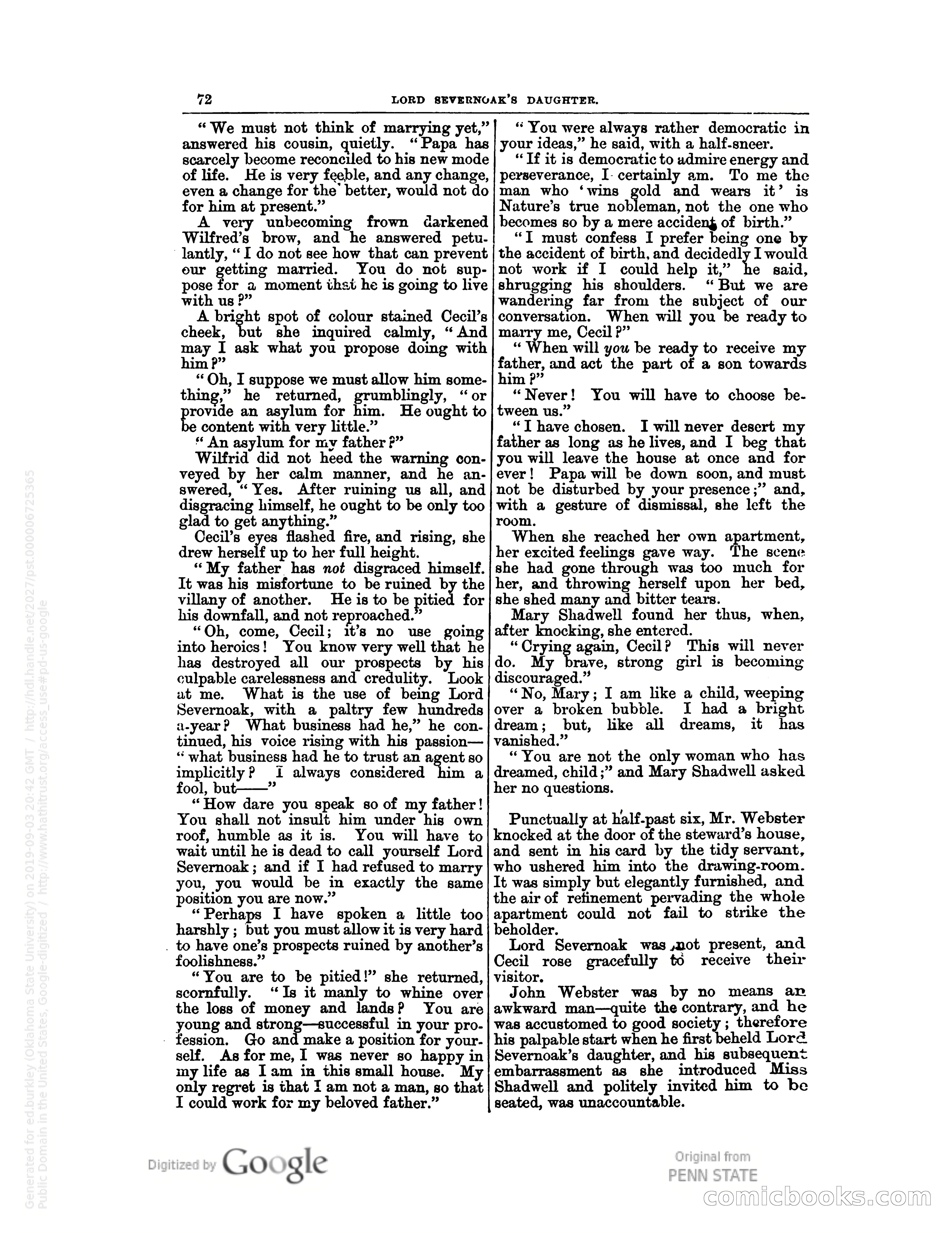
A restored page from Pulp Fiction, 1883. Page through the whole issue in the reader above.
📄 Transcribed text from this page (OCR, searchable)
Machine-transcribed from the original scan — historical spelling and the odd misread are preserved.
72 LORD S8EVERNUAK’S DAUGHTER. “We must not think of marrying yet,” answered his cousin, quietly. ‘“ Papa has scarcely become reconciled to his new mode of life. He is very feeble, and any change, even a change for the better, would not do for him at present.” A very unbecoming frown darkened Wilfred’s brow, and he answered petu- lantly, “I do not see how that can prevent eur getting married. You do not sup- pose for 2 moment thsi he is going to live with us ?” A bright spot of colour stained Cecil’s cheek, but she inquired calmly, “ And may I ask what you propose doing with him P” “Oh, I suppose we must allow him some- thing,” he returned, grumblingly, “or pou an asylum for him. He ought to content with very little.” * An asylum for mv father Wilfrid did not heed the warning con- veyed by her calm manner, and he an- swered, “Yes. After ruining us all, and disgracing himself, he ought to be only too glad to get anything.” Cecil’s eyes flashed fire, and rising, she drew herself up to her full height. “My father has not disgraced himself. It was his misfortune to be ruined by the villany of another. He is to be pitied for his downfall, and not reproached.” “Oh, come, Cecil; it’s no use going into heroics! You know very well that he has destroyed all our prospects by his culpable carelessness and credulity. Look at me. What is the use of bemg Lord Severnoak, with a paltry few hundreds a-year? What business had he,” he con- tinued, his voice rising with his passion— “ what business had he to trust an ae SO a 999 iy implicitly P 1 always cons:dered fool, but——” ‘“‘How dare you speak so of my father! You shall not insult him under his own roof, humble as it is. You will have to wait until he is dead to call yourself Lord Severnoak ; and if I had refused to marry you, you would be in exactly the same position you are now.” “Perhaps I have spoken a little too harshly ; but you must allow it is very hard . to have one’s prospects ruined by another’s foolishness.” “You are to be pitied!” she returned, scornfully. ‘Is it manly to whine over the loss of money and landsP You are young and strong—successful in your pro- _ fession. Go and make a position for your- self. As for me, 1 was never so happy in my life as Iam in this small house. My only regret is that I am not a man, so that I could work for my beloved father.” Google “ You were always rather democratic in your ideas,” he said, with a half-sneer. “If it is democratic to udmire energy and perseverance, I- certainly am. To me the man who ‘wins gold and wears it’ is Nature’s true nobleman, not the one who becomes so by a mere accideng of birth.” “I must confess I prefer being one by the accident of birth, and decidedly I would not work if I could help it,” he said, shrugging his shoulders. ‘“ But we are wandering far from the subject of our conversation. When will you be ready to marry me, Cecil P” ‘When will you be ready to receive my father, and act the part of a son towards him ?” “Never! You will have to choose be- tween us.” “IT have chosen. I will never desert my father as long as he lives, and I beg that you will leave the house at once and for ever! Papa will be down soon, and must not be disturbed by your presence ;” and, with a gesture of dismissal, she left the room. When she reached her own apartment, her excited feelings gave way. The scene she had gone through was too much for her, and throwing herself upon her bed, she shed many and bitter tears. Mary Shadwell found her thus, when, after knocking, she entered. “Crying again, Cecil? This will never do. My brave, strong girl is becoming discouraged.” “No, Mary; I am like a child, weeping over a broken bubble. I had a bright dream; but, like all dreams, it has vanished.” “You are not the only woman who has dreamed, child ;” and Mary Shadwell asked her no questions. Punctually at half-past six, Mr. Webster knocked at the door of the steward’s house, and sent in his card by the tidy servant, who ushered him into the drawing-room. It was simply but elegantly furnished, and the air of refinement pervading the whole apartment could not fail to strike the beholder. Lord Severnoak was ,not present, and Cecil rose gracefully to receive their visitor. John Webster was by no means an awkward man—quite the contrary, and he was accustomed to good Bevin 3 therefore his palpable start when he first beheld Lord Severnoak’s daughter, and his subsequent embarrassment as she introduced Miss Shadwell and politely invited him to be seated, was unaccountable. JOO @ © = a S CO)